
- Home
- »
- Semiconductors
- »
-
Chiplet Market Size, Share & Trends Report, 2026-2033GVR Report cover

Chiplet Market (2026 - 2033)
Size, Share & Trends Analysis Report By Processor (CPU Chiplets, GPU Chiplets, AI/ML Accelerators, FPGA Chiplets, APU Chiplets), By Packaging Technology (2.5D/3D Packaging, Multi-Chip Module, SiP, Fan-Out Packaging, FCBGA), By End-user Industry, By Region
Market Size, 2025
$12.3BMarket Estimate, 2026
$17.0BMarket Forecast, 2033
$223.6BCAGR, 2026–2033
44.5%Chiplet Market Summary
The global chiplet market size was valued at USD 12.3 billion in 2025 and is projected to grow from USD 17.0 billion in 2026 to USD 223.6 billion by 2033, at a CAGR of 44.5% from 2026 to 2033. Asia Pacific dominated the market, accounting for a revenue share of 40.0% in 2025. The market is driven by increasing demand for AI, high-performance computing (HPC), advanced data center processors, and heterogeneous semiconductor architectures, all of which require scalable, high-performance computing platforms.
Key Market Trends & Insights
- By processor: CPU chiplets segment accounted for the largest market revenue share of 41.0% in 2025.
- By packaging technology: 2.5D/3D packaging segment held the largest revenue share of 30.0% in 2025.
- By end-user industry: Data center & HPC segment held the largest revenue share of 35.0% in 2025.
Regional Highlights
- Largest regional market: Asia Pacific (40.0% revenue share, 2025)
- By country: China dominated the Asia Pacific region in 2025.
Market Size & Forecast
- Market size in 2025: USD 12.3 Billion
- Estimated market size in 2026: USD 17.0 Billion
- Projected market size by 2033: USD 223.6 Billion
- CAGR (2026-2033): 44.5%
Three ways to get this report
Buy it, customize it, or ask a question.Ask an Analyst
Analyst response in 1 business day
- AccessReport author, directly
- Reply timeWithin 1 working day
- No sales callDirect answer only
- FormatEmail reply
- CostFree, no cost
Get the Full Report
What the study covers
- FormatsPDF · Excel · Dashboard
- Timeline2026–2033 annual, 2025 base
- Coverage20+ countries, 5 regions
- Companies10+ key players profiled
Customize the Report
20% free customization
- IncludeCountries, segments, points
- TailorTo your product definition
- ExtendDeeper competitor detail
- OrA fully bespoke study
- Turnaround5–10 working days
The rising cost and complexity of monolithic system-on-chips (SoCs) are encouraging a shift toward disaggregated chiplet-based designs that improve yield and reduce time-to-market. In addition, rapid advancements in 2.5D/3D integration and advanced packaging technologies are making heterogeneous integration more feasible and cost-effective. The market also holds significant potential in edge AI and IoT applications, where power efficiency and customization are critical. However, high design and validation costs further act as a restraint, particularly for smaller players with limited R&D budgets. Source: Grand View Research, IR Documents, Primary Interviews, Paid DatabasesTo learn more about this report,
 Download Free Sample Report
 The surging demand for AI and HPC workloads is driving significant advancements in chiplet technology to meet the need for scalable, efficient computing solutions. Industries across sectors such as healthcare, automotive, and finance increasingly rely on AI for data processing, while HPC applications require enhanced computational power for tasks such as simulations and analytics. Traditional monolithic chips struggle to meet these demands efficiently, making modular chiplet architectures more attractive for their flexibility and cost-effectiveness. For instance, in March 2025, Axelera AI unveiled Titania, a scalable AI inference chiplet based on its Digital In-Memory Computing (D-IMC) architecture. Supported by up to USD 66.2 million (EUR 61.6 million) in EU funding through the DARE Project, Titania targets edge-to-cloud AI and HPC applications, aligning with Europe’s strategy for processor independence and extreme-scale computing.
As semiconductor nodes advance, the cost of designing, manufacturing, and validating large monolithic SoCs has escalated dramatically, with costs often ranging from hundreds of millions to over a billion dollars per chip, especially at cutting-edge process nodes such as 3nm or 5nm. This increase is driven by the need for greater transistor counts, advanced packaging, and rigorous testing to ensure high yields. Chiplets, by contrast, offer a modular approach that divides functionality across smaller, easier-to-manufacture dies, reducing risk and cost. This modularity also accelerates development cycles and enhances yield by isolating defects to individual chiplets rather than the entire SoC, presenting a more cost-effective and scalable solution for complex semiconductor designs.
The expansion into Edge AI and IoT devices is being propelled by the increasing need for scalable, low-latency, and energy-efficient processing solutions that can operate closer to data sources. This trend is driven by the rapid adoption of smart devices, connected sensors, and real-time analytics in automotive and industrial automation applications. To address these demands, chiplet architectures that offer modular, customizable integration have become essential, enabling improved performance and faster time-to-market for edge deployments. For instance, in January 2025, DreamBig announced advancements in its MARS Chiplet Platform, integrating 3D HBM-stacked Chiplet Hub and Networking IO Chiplets. Partnering Samsung Foundry and Silicon Box, DreamBig aims to deliver high-performance AI, data center, and automotive solutions with reduced latency and enhanced energy efficiency. This indicates that chiplet-based platforms are critical enablers of next-generation edge AI and IoT innovations.
High design and validation costs significantly restrain the market, frequently totaling several million USD per project. The complexity of integrating multiple dies into a cohesive system demands extensive engineering resources, comprehensive testing, and thorough validation to ensure compatibility and reliability across diverse components. These substantial upfront expenses increase financial risk, particularly for smaller companies and startups, limiting broader adoption. Also, the high-cost barrier slows innovation and market expansion despite the clear technological advantages of chiplet architecture.
Analyst Perspective
The chiplet market is driven by rising demand for high-performance computing, artificial intelligence, data centers, and advanced processors that require greater computing capacity and improved energy efficiency. Market opportunities emerge from heterogeneous chiplet architectures, advanced packaging, and the integration of specialized processing, memory, and connectivity functions within a single package. By processor, the CPU chiplets segment dominated, as CPUs serve as core computing components across servers, personal computers, data centers, and high-performance systems, while chiplet-based CPU designs allow manufacturers to scale processing performance and improve manufacturing flexibility. Asia Pacific leads the market through its strong semiconductor manufacturing ecosystem, expanding data center capacity, advanced packaging investments, and growing demand for AI and high-performance computing hardware across China, Taiwan, South Korea, and Japan.
Processor Insights
By processor, the CPU chiplet segment accounted for the largest share in 2025, at around 41.0%. Chiplet-based CPU designs enable modular development, offering flexibility, reduced time-to-market, and cost advantages over traditional monolithic SoCs. These benefits are especially crucial in the era of AI and cloud computing, where rapid iteration and customization are key. Factors such as the increasing demand for high-performance computing, rising adoption of heterogeneous integration, improved scalability in data center architectures, and growing investments in advanced packaging technologies is supporting the segment growth.
The AI/ML accelerators segment is expected to grow at the fastest CAGR from 2026 to 2033, driven by surging demand for generative AI workloads, increasing deployment of energy-efficient inference hardware, advancements in chiplet-based heterogeneous integration, and rising investments in data center AI infrastructure. This growth is fueled by the industry shift toward specialized processors that can deliver high throughput with lower latency and power consumption, especially for transformer-based and large language models. For instance, in March 2025, Ayar Labs launched the world’s first UCIe-compliant optical interconnect chiplet for AI systems. Delivering 8 Tbps bandwidth via its TeraPHY chiplet and SuperNova light source, the solution enhances AI scale-up efficiency, lowers power consumption, and enables cross-vendor interoperability using optical links. This highlights the critical role of chiplet-based AI/ML accelerators in meeting escalating demands for performance and efficiency, particularly as enterprises and hyperscalers seek to scale computing resources without compromising power budgets or interoperability.
Packaging Technology Insights
In terms of packaging technology, the 2.5D/3D packaging segment accounted for the largest share, around 30.0%, in 2025, driven by increasing demand for high-bandwidth interconnects, rising adoption of heterogeneous integration, growing AI and HPC workloads, and rapid advancements in packaging technologies. These packaging approaches allow dense chiplet integration with improved signal integrity, thermal management, and modular scalability, making them essential for next-generation systems. For instance, in March 2025, Global Unichip Corp. (GUC) announced the successful launch of the industry’s first 32G UCIe 2.0 PHY silicon on TSMC’s 3nm process using CoWoS packaging. Targeting AI and HPC, the solution delivers 10 Tbps/mm bandwidth density and includes advanced reliability features for high-speed, chiplet-based architectures. Such developments demonstrate how 2.5D and 3D packaging are becoming critical enablers of performance and efficiency gains in modern chiplet-based systems, especially across compute-intensive domains.
The system-in-package (SiP) segment is expected to grow at a significant CAGR during the forecast period, driven by increasing miniaturization of electronics, rising demand for heterogeneous integration, growing adoption of wearables and edge devices, and the need for improved power efficiency. SiP technology allows multiple integrated circuits and passive components to be packaged into a single module, reducing board space and enabling compact system designs ideal for consumer, medical, and IoT applications.
End-user Industry Insights
By end user, the data center & HPC segment accounted for the largest share, at around 35.0% in 2025, driven by the rising complexity of AI workloads, the growing need for modular compute scaling, the increasing adoption of chiplet-based processors for thermal and yield efficiency, and surging demand for low-latency, high-bandwidth interconnects. As compute-intensive applications proliferate, traditional monolithic SoCs are becoming less viable, making chiplet architectures increasingly attractive in high-density data center environments.
The telecom & IT segment is expected to register a notable CAGR from 2026 to 2033. As telecom networks evolve, latency-sensitive applications such as cloud-native RAN, real-time video processing, and AI-driven traffic management require agile compute and memory resources distributed across the network. Segment growth is mainly driven by the growing need for high-throughput, low-latency interconnects, the increasing adoption of disaggregated architectures, the rising deployment of edge computing infrastructure, and the ongoing migration to 5G and 6G networks. These trends are accelerating demand for chiplet-based solutions that can optimize bandwidth, power efficiency, and modular scalability.
Regional Insights
The North America chiplet market accounted for a significant share of revenue in 2025. The North America market is being driven by increasing defense-sector investments in secure semiconductors, strong participation in open chiplet ecosystems, rising demand for customizable compute solutions, and early access to advanced packaging nodes. The region benefits from the presence of major semiconductor design houses and foundry alliances that are accelerating the adoption of modular architectures through collaborative development models. For instance, in June 2025, QuickLogic joined the Intel Foundry Chiplet Alliance to accelerate the development of secure, eFPGA-based chiplets for commercial and defense markets. The collaboration offers early access to Intel’s 18A process and advanced packaging roadmap, and supports standards-based, multi-chip solutions using UCIe interconnect to enable flexibility and security.
U.S. Chiplet Market Trends
The chiplet industry in the U.S. held a dominant position in 2025. The market in the U.S. is undergoing a significant transformation, driven by sustained federal investments in semiconductor innovation, growing AI and HPC workloads, strategic ecosystem partnerships, and a rising shift toward modular system design. The U.S. continues to lead in high-performance computing infrastructure and silicon R&D, making it a fertile ground for chiplet adoption across defense, hyperscale, and commercial sectors. For instance, in October 2024, Lawrence Berkeley National Laboratory and the Open Compute Project partnered to explore chiplet-based architectures for high-performance computing (HPC). The initiative targets performance stagnation in supercomputing by advancing modular chiplet integration to enhance energy efficiency and processing capabilities in future systems. Such developments highlight the U.S.'s strategic focus on chiplet-driven innovation to maintain its global leadership in HPC, AI infrastructure, and semiconductor technology.
Europe Chiplet Market Trends
The chiplet industry in Europe was identified as a lucrative region in 2025. The European market is witnessing significant transformation, driven by rising AI infrastructure investments, strategic public funding initiatives, a growing focus on chiplet-based interconnect innovations, and a strong emphasis on open, standards-based semiconductor ecosystems. As European nations seek to reduce dependency on foreign chip supply chains, regional support for advanced packaging and modular architecture is accelerating.
To support these goals, governments are directly investing in next-generation chiplet technologies. For instance, in November 2024, Alphawave Semi received a research grant from the UK's Advanced Research + Invention Agency (ARIA) as part of a USD 63 million (GBP 50 million) initiative to eliminate networking bottlenecks in AI systems. The funding is focused on advancing chiplet-based connectivity to enhance interconnect efficiency across AI accelerator clusters. This underscores Europe’s strategic direction to lead in AI-era semiconductor design by fostering scalable, power-efficient chiplet infrastructure through coordinated public-private R&D efforts.
Germany’s chiplet industry is being shaped by increasing investment in domestic semiconductor capabilities, strong government backing for advanced packaging R&D, rising demand for localized AI compute infrastructure, and participation in Pan-European processor initiatives. Germany's industrial leadership in automotive, automation, and edge AI also creates demand for chiplet-based solutions that offer modularity, efficiency, and faster time-to-market.
The chiplet industry in the UK is advancing steadily, supported by a growing focus on AI infrastructure development, increasing R&D investments in chiplet interconnect technologies, and strong collaboration with global foundries for next-generation semiconductor packaging. As chiplet adoption accelerates across AI and HPC applications, domestic firms are leading innovations that improve data transfer speeds, reduce power consumption, and enable modular system scaling. For instance, in July 2024, Alphawave Semi introduced the industry’s first 3nm UCIe Die-to-Die IP using TSMC’s CoWoS packaging. Designed for AI, HPC, and hyperscaler applications, the IP delivers 8 Tbps/mm bandwidth density and 24 Gbps D2D speeds, supports multiple protocols, and offers enhanced reliability via live per-lane health monitoring.
Asia Pacific Chiplet Market Trends
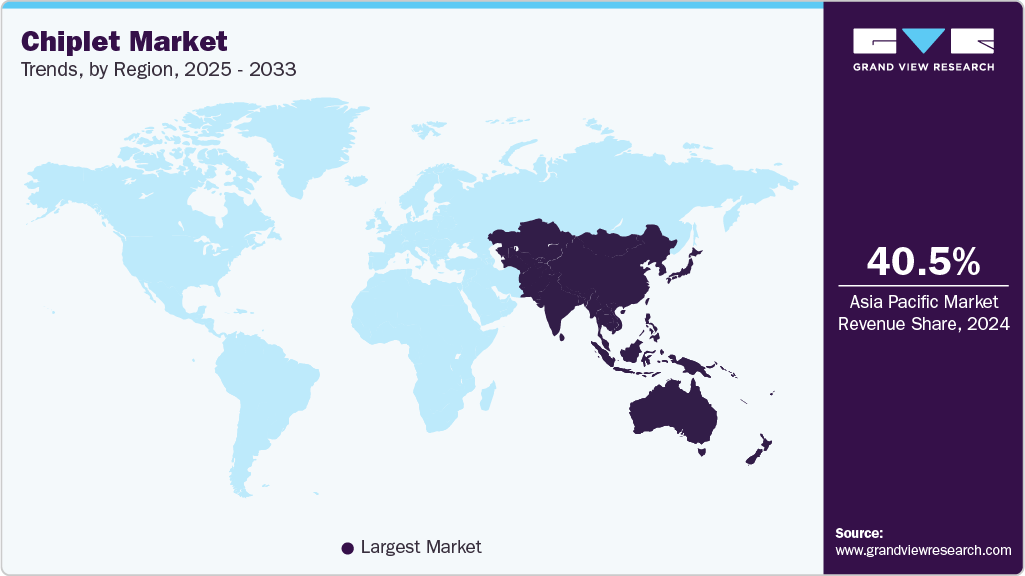
The chiplet industry in Asia Pacific dominated the global market, with the largest revenue share of approximately 40.0% in 2025, driven by robust regional semiconductor investment programs, rising demand for AI and HPC systems, growing participation in chiplet standardization efforts, and the expansion of advanced packaging infrastructure. Governments across the region are aggressively supporting local manufacturing ecosystems to meet the computational needs of emerging sectors such as AI, electric vehicles, and cloud computing. These trends are accelerating the shift toward chiplet-based architectures that offer better scalability, yield, and energy efficiency compared to traditional monolithic SoCs. For instance, in August 2024, OPENEDGES Technology launched its UCIe-compliant OPENEDGES UCIe Controller (OUC) IP, enabling reliable die-to-die connectivity for chiplet systems and supporting heterogeneous integration across vendors. Such developments reflect Asia Pacific’s rapid advances in chiplet packaging capabilities and UCIe-compliant IP innovation, reinforcing its position as a global hub for next-generation semiconductor design and integration.
 To learn more about this report, Download Free Sample Report
 The China chiplet industry held a substantial market share in 2025. The market is experiencing rapid growth, driven by strong government-led semiconductor self-sufficiency goals, rising investment in chiplet R&D, the push to localize advanced packaging capabilities, and increasing demand for AI and data center processors. As the country faces ongoing export restrictions and supply chain disruptions, the chiplet approach is gaining traction as a means of enabling scalable, cost-efficient domestic semiconductor innovation.
The chiplet industry in Japan held a significant share in 2025. The market is influenced by the steady advancement of domestic semiconductor initiatives, strong public-private R&D partnerships, growing emphasis on advanced packaging, and the strategic push to develop next-generation 2nm-class technologies. Japan’s government and industry leaders are intensifying efforts to reclaim global competitiveness in chip manufacturing by investing in future-ready chiplet-based platforms.
As part of this national strategy, Japan is actively collaborating with global technology leaders to accelerate innovation in chiplet packaging. For instance, in June 2024, Rapidus and IBM expanded their collaboration to jointly develop chiplet packaging technology for 2nm-generation semiconductors. Supported by Japan’s NEDO, the initiative will leverage IBM’s advanced packaging capabilities to scale mass production and strengthen Japan’s footprint in the global chiplet and semiconductor packaging ecosystem.
Key Chiplet Company Insights
Leading companies are expanding chiplet portfolios through advanced packaging technologies, heterogeneous integration platforms, strategic foundry partnerships, UCIe-compliant interconnect solutions, and investments in AI, HPC, and data center processor development. Companies are also collaborating across the semiconductor ecosystem to accelerate the commercialization of modular chiplet architecture.
Key Chiplet Companies
The following key companies have been profiled for this study on the chiplet market:
-
Advanced Micro Devices, Inc. (AMD)
-
Intel Corporation
-
NVIDIA Corporation
-
Marvell Technology, Inc.
-
Broadcom Inc.
-
Samsung Electronics Co., Ltd.
-
Tenstorrent Inc.
-
Amazon Web Services, Inc. (AWS)
-
Alibaba Group Holding Ltd. (T-Head)
-
Microsoft Corporation
Recent Developments
-
In January 2025, YorChip and ChipCraft introduced a low-cost, low-power 8-bit 200Ms/s ADC chiplet. This solution addresses a gap in the market, offering designers a high-speed ADC without the high costs or power requirements of standard ASSPs or complex IP licensing for custom SoCs.
-
In July 2024, DreamBig Semiconductor announced a USD 75 million funding round co-led by Samsung Catalyst Fund to accelerate the commercialization of its MARS Chiplet Platform and Chiplet Hub. The platform enables scalable AI, data center, and automotive solutions, incorporating advanced 3D HBM stacking for bandwidth-intensive applications such as generative AI.
-
In June 2024, Achronix and Primemas partnered to integrate Achronix’s Speedcore eFPGA IP into Primemas’ SoC Hublet platform. This chiplet-based solution enables programmable, scalable, and cost-effective performance for AI, data centers, and cloud applications, enhancing flexibility and accelerating time-to-market through advanced embedded FPGA capabilities.
-
In June 2024, SEMIFIVE signed an MoU with OPENEDGES Technology to jointly develop a chiplet platform integrating OPENEDGES’ LPDDR6 memory subsystem. Targeting high-performance computing (HPC), the partnership leverages SEMIFIVE’s SoC design expertise and 4nm process optimization to enhance memory performance, reduce design costs, and accelerate time-to-market.
Chiplet Market Report Scope
Report Attribute
Details
Market size in 2025
USD 12.3 billion
Estimated Market size in 2026
USD 17.0 billion
Projected Market size by 2033
USD 223.6 billion
Growth rate
CAGR of 44.5% from 2026 to 2033
Base year for estimation
2025
Actual data
2021 - 2025
Forecast period
2026 - 2033
Quantitative units
Revenue in USD billion, and CAGR from 2026 to 2033
Report coverage
Revenue forecast, company ranking, competitive landscape, growth factors, and trends
Segments covered
Processor, packaging technology, end-user industry, region
Regional Scope
North America; Europe; Asia Pacific; Latin America; Middle East & Africa
Country scope
U.S.; Canada; Mexico; Germany; UK; France; Italy; China; India; Japan; South Korea; Australia; Brazil; UAE; Saudi Arabia; South Africa.
Key companies profiled
Advanced Micro Devices, Inc. (AMD); Intel Corporation; NVIDIA Corporation; Marvell Technology Inc.; Broadcom Inc.; Samsung Electronics Co., Ltd.; Tenstorrent Inc.; Amazon Web Services, Inc. (AWS); Alibaba Group Holding Ltd. (T-Head); Microsoft Corporation
Customization scope
Free report customization (equivalent up to 8 analysts working days) with purchase. Addition or alteration to country, regional & segment scope.
Pricing and purchase options
Avail of customized purchase options to meet your exact research needs. Explore purchase options
Global Chiplet Market Report Segmentation
This report forecasts revenue growth at the regional and country levels and provides an analysis of the latest industry trends and opportunities in each sub segment from 2021 to 2033. For this study, Grand View Research has segmented the global chiplet market report by processor, packaging technology, end-user industry, and region.
- Processor Outlook (Revenue, USD Billion, 2021 - 2033)
- CPU Chiplets
- GPU Chiplets
- AI/ML Accelerators
- FPGA Chiplets
- APU Chiplets
- Packaging Technology Outlook (Revenue, USD Billion, 2021 - 2033)
- 2.5D/3D Packaging
- System-in-Package (SiP)
- Fan-Out Packaging
- Multi-Chip Module (MCM)
- Flip-Chip Ball Grid Array (FCBGA)
- End-user Industry Outlook (Revenue, USD Billion, 2021 - 2033)
- Data Center & HPC
- Telecom & IT
- Automotive
- Consumer & Enterprise
- Industrial Automation
- Aerospace & Defense
- Healthcare & Medical
- Regional Outlook (Revenue, USD Billion, 2021 - 2033)
- North America
- U.S.
- Canada
- Mexico
- Europe
- UK
- Germany
- France
- Asia Pacific
- China
- India
- Japan
- South Korea
- Australia
- Latin America
- Brazil
- Middle East & Africa (MEA)
- UAE
- Saudi Arabia
- South Africa
- North America
Frequently Asked Questions About This Report
The CPU chiplets segment accounted for the largest revenue share of around 41.0% in 2025.
The global chiplet market size was valued at USD 12.3 billion in 2025 and is estimated at USD 17.0 billion for 2026.
The global chiplet market is expected to grow at a CAGR of 44.5% from 2026 to 2033, reaching USD 223.6 billion.
Key players in the market include Advanced Micro Devices, Inc. (AMD); Intel Corporation; NVIDIA Corporation; Marvell Technology Inc.; Broadcom Inc.; Samsung Electronics Co., Ltd.; Tenstorrent Inc.; Amazon Web Services, Inc. (AWS); Alibaba Group Holding Ltd. (T-Head); Microsoft Corporation and others.
Asia Pacific dominated with approximately 40.0% revenue share in 2025.
About the Author(s)
Semiconductors Research Team
Semiconductors & Electronics · SemiconductorsThis report was authored by the semiconductors research team at Grand View Research - comprising two research analysts, one senior research analyst, and one industry expert - with specialized expertise in the semiconductors segment of the semiconductors & electronics industry. All findings are based on proprietary semiconductors & electronics databases, executive interviews, and regulatory analysis, subject to internal peer review prior to publication.
Last Updated:
Speak to Analyst

Customize this report to your needs - add regions, segments, or data points, with 20% free customization.
Or view our licence options:


ISO 9001:2015 & 27001:2022 Certified
We are GDPR and CCPA compliant! Your transaction & personal information is safe and secure. For more details, please read our privacy policy.


