
- Home
- »
- Plastics, Polymers & Resins
- »
-
Chocolate Bar Packaging Market Size Report, 2026-2033GVR Report cover

Chocolate Bar Packaging Market (2026 - 2033)
Size, Share & Trends Analysis Report By Material (Plastic, Paper, Metal), By Product (Stick Packs, Wrappers, Pouches, Bags), By Distribution Channel, By Region, And Segment Forecasts
Market Size, 2025
$13.9BMarket Estimate, 2026
$14.7BMarket Forecast, 2033
$22.0BCAGR, 2026–2033
5.9%Chocolate Bar Packaging Market Summary
The global chocolate bar packaging market size was valued at USD 13.9 billion in 2025 and is projected to grow from USD 14.7 billion in 2026 to USD 22.0 billion by 2033, at a CAGR of 5.9% from 2026 to 2033. The Asia Pacific held the largest share of 40.9% of the global market in 2025. One of the primary drivers is the steady growth in chocolate consumption worldwide.
 Source: Grand View Research, IR Documents, Primary Interviews, Paid DatabasesTo learn more about this report,
 Download Free Sample Report
 Key Market Trends & Insights
- By product: Wrappers segment held the largest market share in 2025.
- By material: Plastic segment held the largest market share in 2025.
- By distribution channel: Retail industry segment held the largest market share in 2025.
Regional Highlights
- Largest regional market: Asia Pacific (40.9% revenue share, 2025)
- By country: China held the largest share in 2025
Market Size & Forecast
- Market size in 2025: USD 13.9 Billion
- Estimated market size in 2026: USD 14.7 Billion
- Projected market size by 2033: USD 22.0 Billion
- CAGR (2026-2033): 5.9%
Three ways to get this report
Buy it, customize it, or ask a question.Ask an Analyst
Analyst response in 1 business day
- AccessReport author, directly
- Reply timeWithin 1 working day
- No sales callDirect answer only
- FormatEmail reply
- CostFree, no cost
Get the Full Report
What the study covers
- FormatsPDF · Excel · Dashboard
- Timeline2026–2033 annual, 2025 base
- Coverage20+ countries, 5 regions
- Companies10+ key players profiled
Customize the Report
20% free customization
- IncludeCountries, segments, points
- TailorTo your product definition
- ExtendDeeper competitor detail
- OrA fully bespoke study
- Turnaround5–10 working days
Emerging markets in Asia-Pacific, Latin America, and the Middle East are witnessing rising disposable incomes and increasing westernization of diets, which is boosting demand for chocolates as an everyday indulgence rather than an occasional treat. At the same time, mature markets in Europe and North America continue to show strong demand for premium and artisanal chocolates. This expansion in chocolate consumption directly translates into higher demand for packaging, as every unit, whether mass-market or premium, requires protective, functional, and attractive packaging. To learn more about this report, Download Free Sample Report
 Moreover, the shift toward premiumization and a gifting culture. Consumers are increasingly willing to pay more for high-quality, aesthetically appealing chocolate products, especially during festivals, holidays, and special occasions. This has led manufacturers to invest heavily in innovative and visually appealing packaging formats, including high-quality paper wraps, embossed foils, and customized designs. Packaging is no longer just a protective layer-it has become a critical part of the product experience, influencing purchasing decisions and brand perception. As a result, demand is rising not just in volume but also in value.
The rapid growth of e-commerce and D2C channels is also significantly contributing to packaging demand. Unlike traditional retail, e-commerce requires packaging that is more durable, tamper-proof, and capable of protecting products during shipping and handling. Chocolate, being temperature-sensitive and fragile, needs specialized packaging solutions such as insulated wraps, multi-layer films, and secure secondary packaging. In addition, brands are focusing on “unboxing experiences,” which further drives demand for premium and customized packaging formats.
Sustainability is another major growth driver reshaping the market. With increasing environmental awareness and stricter regulations on plastic usage across regions like the EU and parts of North America, there is a strong push toward eco-friendly packaging solutions. This includes recyclable paper-based wrappers, compostable films, and reduced-plastic designs. Many leading chocolate brands are committing to sustainable packaging goals, which is accelerating innovation and increasing demand for alternative materials. This transition is not only replacing traditional packaging but also expanding the overall market through new product development and material technologies.
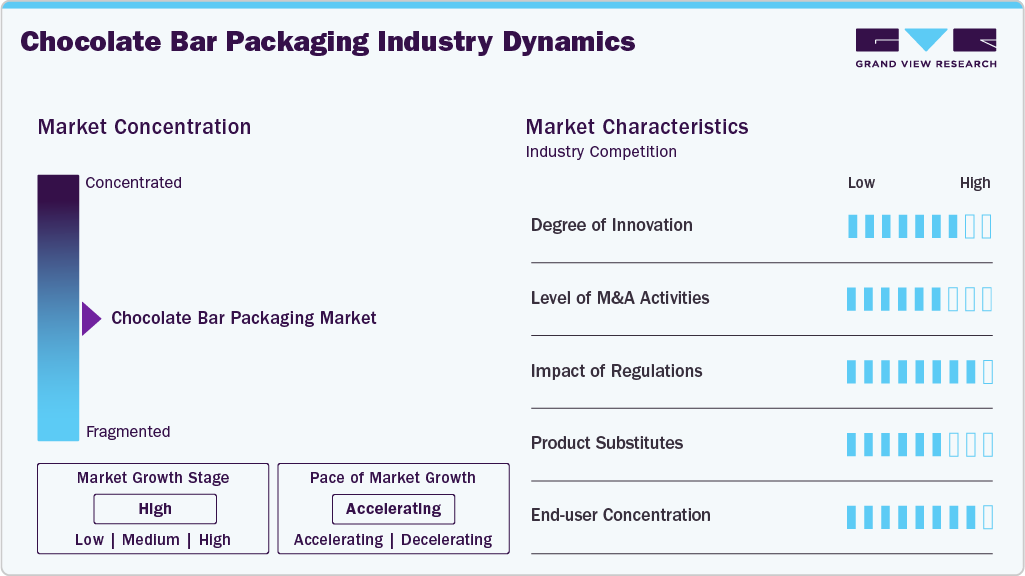
Market Concentration & Characteristics
The chocolate bar packaging industry shows a strong and evolving level of innovation, mainly because packaging today is expected to do much more than just protect the product. Companies are constantly working on improving both functionality and visual appeal. On the functional side, there is a clear focus on developing materials that can better protect chocolate from heat, moisture, and oxygen, since chocolate is highly sensitive to environmental conditions. This has led to the use of advanced barrier films and layered materials.
Regulations have a significant influence on the chocolate bar packaging industry. Governments across various regions are introducing stricter rules around plastic usage, recyclability, and waste management, which directly impact the type of materials companies can use. This is especially noticeable in developed markets where environmental policies are more stringent.
 To learn more about this report, Download Free Sample Report
 In addition to sustainability regulations, there are also strict food safety and labeling requirements that packaging must comply with. These include standards for materials that come in direct contact with food and clear labeling for ingredients and nutritional information. As a result, companies must invest more in compliance and testing, which increases costs but also improves product safety and quality. Overall, regulations are acting as both a challenge and a driver of innovation in the market.
The presence of substitutes in this market is growing but still limited in impact. Traditional materials like plastic films and aluminum foil continue to dominate because they offer excellent protection and are cost-effective. However, there is increasing pressure to replace these with more sustainable alternatives, such as paper-based packaging and bio-based materials.
The market has a moderately concentrated customer base, with large global chocolate manufacturers accounting for a significant share of demand. These companies operate at high volumes and require packaging that is consistent, cost-efficient, and scalable. Due to their size, they often have strong bargaining power and can influence pricing and material choices.
Product Insights
Wrappers dominate the market as they are the most widely used and cost-efficient packaging format for chocolate bars. The majority of chocolate products, especially single-serve bars, are sold using flexible wrappers made from plastic films, paper, or foil laminates. Their simplicity, ease of production, and compatibility with high-speed packaging lines make them the preferred choice for mass manufacturers. Since global chocolate consumption is heavily driven by everyday, impulse purchases, wrappers naturally capture the largest share of packaging demand.
Moreover, their dominance is their strong functional performance. Wrappers provide effective protection against external factors such as moisture, oxygen, and light, all of which can impact the taste, texture, and shelf life of chocolate. Multi-layer wrapper structures, often combining plastic and aluminum, offer high barrier properties while remaining lightweight and flexible. This makes them ideal not only for preserving product quality but also for optimizing transportation and storage efficiency across long supply chains.
Stick packs are witnessing the highest growth because they perfectly align with the shift toward convenience and on-the-go consumption. Modern consumers, especially in urban areas, prefer smaller, easy-to-carry formats that can be consumed quickly without mess or waste. Stick packs cater to this need by offering single-portion, lightweight, and portable packaging, making them ideal for busy lifestyles, travel, and snacking between meals.
Material Insights
The plastic segment dominates the market in 2025. This is attributed to its superior versatility and performance characteristics. It offers excellent barrier properties against moisture, oxygen, and contaminants, which is critical for maintaining the freshness and quality of chocolate. Unlike many alternative materials, plastic can be easily engineered into different forms-films, laminates, and coatings-making it suitable for a wide range of packaging formats, particularly wrappers and pouches.
Another major advantage of plastic is its cost-effectiveness and scalability. It is relatively inexpensive compared to materials like metal or specialty paper, and it supports high-speed manufacturing processes, which is essential for large-scale chocolate production. For global chocolate brands that operate on thin margins and high volumes, plastic provides the ideal balance between performance and cost. In addition, its lightweight nature reduces transportation costs and improves overall supply chain efficiency.
Paper-based packaging is growing at the fastest CAGR due to the global shift toward sustainability and eco-conscious consumption. Consumers today are more aware of environmental issues, particularly plastic waste, and are actively choosing brands that offer recyclable, biodegradable, or compostable packaging. Paper fits well into this narrative, making it a preferred alternative for environmentally responsible packaging solutions.
Distribution Channel Insights
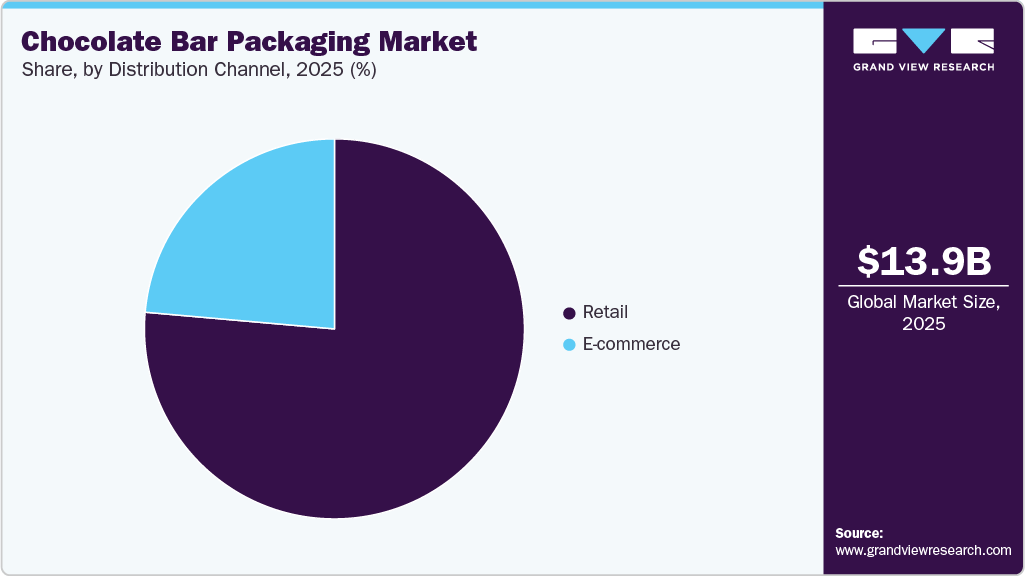
The retail industry represents the largest segment in the market as it is deeply integrated into consumer purchasing behavior. Chocolate bars are largely impulse-driven purchases, commonly bought at supermarkets, convenience stores, and kiosks. The widespread availability of chocolates across retail outlets ensures consistent demand for packaging, particularly for single-serve and small-format products that are designed for quick consumption. Another important factor is the visibility and shelf presence offered by retail environments. Packaging plays a critical role in attracting consumers in-store, where purchasing decisions are often made within seconds. As a result, chocolate brands invest heavily in eye-catching designs, compact formats, and easy-to-handle packaging that perform well in retail displays. This strong reliance on physical shelf appeal reinforces the importance of retail as the primary distribution channel.
 To learn more about this report, Download Free Sample Report
 E-commerce is the fastest-growing distribution channel due to the rapid digitalization of consumer purchasing behavior. More consumers are buying chocolates online, whether for personal consumption, gifting, or bulk purchases. This shift has been accelerated by changing lifestyles, increased internet penetration, and the convenience of home delivery, making online platforms a key growth driver for the chocolate industry.
Regional Insights
The Asia Pacific region dominates the chocolate bar packaging market and is forecasted to grow at the highest CAGR of 6.3% over the coming years. Asia Pacific leads the market primarily because of its sheer scale and rapid expansion of consumer markets. Countries across the region are witnessing a surge in middle-class populations, which is increasing discretionary spending on packaged and branded foods like chocolate. At the same time, the region has become a global manufacturing hub for both chocolates and packaging materials, supported by lower production costs and strong industrial infrastructure. This dual advantage-high consumption and high production-allows the Asia Pacific to dominate not just in demand but also in supply, making it the largest regional market.
 To learn more about this report, Download Free Sample Report
 China Chocolate Bar Packaging Market Trends
The chocolate bar packaging market in China stands out due to its fast-evolving consumer preferences and strong domestic production ecosystem. Chocolate consumption, once relatively low, is growing as consumers adopt more global food habits and show increasing interest in premium and imported products. What makes China unique is the integration of advanced manufacturing and packaging technologies, enabling large-scale, efficient production of innovative packaging formats. In addition, the country’s highly developed retail and digital commerce landscape is pushing brands to invest in differentiated and visually appealing packaging, further driving demand.
Europe Chocolate Bar Packaging Market Trends
The chocolate bar packaging market in Europe is rising because of the region’s strong focus on sustainability and regulatory compliance. European consumers are highly conscious about environmental impact, which is pushing brands to redesign packaging using recyclable and low-impact materials. This has created a continuous need for innovation and replacement of existing packaging formats. Furthermore, Europe has a long-standing culture of chocolate consumption, particularly in premium segments, where packaging quality and aesthetics play a major role, leading to consistent and evolving demand.
Germany chocolate bar packaging market is driven by its highly advanced packaging industry and engineering expertise. The country is home to some of the world’s leading packaging technology providers, which allows for rapid adoption of new materials and efficient production processes. In addition, German consumers place strong emphasis on quality, precision, and environmental responsibility, encouraging brands to adopt high-performance and sustainable packaging solutions. This combination of technological capability and consumer expectation supports steady growth in demand.
North America Chocolate Bar Packaging Market Trends
The chocolate bar packaging market in North America is increasing due to the strong presence of established chocolate brands and continuous product innovation. The market is highly competitive, which encourages companies to frequently update packaging designs and formats to maintain consumer interest. There is also a growing emphasis on branding and storytelling through packaging, especially in premium and seasonal products. This constant cycle of product launches and rebranding efforts drives sustained demand for packaging solutions across the region.
The U.S. chocolate bar packaging marketis seeing rising demand because of its high consumption frequency and evolving retail dynamics. Chocolate is widely consumed across different age groups and occasions, creating a steady need for diverse packaging formats. What sets the U.S. apart is the increasing influence of direct-to-consumer brands and subscription-based models, which require customized and durable packaging solutions. In addition, the growing popularity of seasonal gifting and themed products further boosts the need for innovative and visually distinctive packaging.
Key Chocolate Bar Packaging Company Insights
The competitive environment in the market is moderately consolidated, with a mix of global packaging giants and regional converters competing across cost, innovation, and sustainability. Large multinational players dominate high-volume contracts by leveraging their scale, advanced manufacturing capabilities, and long-standing relationships with major chocolate brands. These companies focus on delivering consistent quality, cost efficiency, and global supply reliability, which are critical for large confectionery manufacturers operating across multiple regions. At the same time, mid-sized and regional players remain competitive by offering flexibility, faster turnaround times, and customized solutions, especially for local and niche chocolate brands.
Competition is increasingly shifting toward differentiation through sustainable materials, design innovation, and value-added services. Companies are investing heavily in developing recyclable and eco-friendly packaging solutions to meet both regulatory requirements and brand commitments. In addition, packaging providers are expanding their capabilities in printing, digital integration, and premium finishing to help brands stand out in crowded retail environments and enhance the consumer experience. Strategic partnerships, product innovation, and selective acquisitions are becoming key tools to strengthen market position, making the competitive landscape dynamic and innovation-driven rather than purely price-based.
Key Chocolate Bar Packaging Companies:
The following key companies have been profiled for this study on the chocolate bar packaging market.
- Amcor Plc
- Swiss Pack
- Packman Packaging
- Swiftpak Limited
- Sonoco Products Company
- Mondi Plc
- Huhtamaki Oyj
- Charpak Ltd
- Marber S.r.l.
- Stora Enso Oyj
- JBM Packaging
- Packle Packaging Industries
- The Sherwood Group
Recent Developments
-
In April 2023, the innovative paper packaging from Mars Wrigley may be recycled using conventional curbside recycling bins and will be available in Australian supermarkets and convenience stores.
-
In January 2024, Global pioneer in creating and manufacturing environmentally friendly packaging solutions, Cadbury's efforts to decrease its reliance on virgin plastic have been expedited with the recent agreement Amcor and Mondelēz International reached to source 1,000 tonnes of post-consumer recycled plastic to wrap its core chocolate assortment.
Chocolate Bar Packaging Market Report Scope
Report Attribute
Details
Market size in 2025
USD 13.9 billion
Estimated market size in 2026
USD 14.7 billion
Projected market size by 2033
USD 22.0 billion
Growth rate
CAGR of 5.9% from 2026 to 2033
Historical data
2021 - 2025
Forecast period
2026 - 2033
Quantitative units
Revenue in USD million/billion, and CAGR from 2026 to 2033
Report coverage
Revenue forecast, company ranking, competitive landscape, growth factors, and trends
Segments covered
Product, material, distribution channel, region
Regional scope
North America; Europe; Asia Pacific; Latin America; MEA
Country scope
U.S.; Canada; Mexico; Germany; UK; France; Spain; Italy; China; India; Japan; Australia; South Korea, Brazil; South Africa; UAE; Argentina; Saudi Arabia
Key companies profiled
Amcor Plc; Swiss Pack; Packman Packaging; Swiftpak Limited; Sonoco Products Company; Mondi Plc; Huhtamaki Oyj; Charpak Ltd.; Marber S.r.l.; Stora Enso Oyj; JBM Packaging; Packle Packaging Industries; The Sherwood Group
Customization scope
Free report customization (equivalent up to 8 analysts’ working days) with purchase. Addition or alteration to country, regional, and segment scope.
Pricing and purchase options
Avail customized purchase options to meet your exact research needs. Explore purchase options
Global Chocolate Bar Packaging Market Report Segmentation
This report forecasts revenue growth at the global, regional, and country levels and provides an analysis of the latest industry trends in each of the sub-segments from 2021 to 2033. For this study, Grand View Research has segmented the global chocolate bar packaging market report based on product, material, distribution channel, and region:
 To learn more about this report, Download Free Sample Report
 -
Material Outlook (Revenue, USD Million, 2021 - 2033)
-
Plastic
-
Metal
-
Paper
-
Others
-
-
Product Outlook (Revenue, USD Million, 2021 - 2033)
-
Stick Packs
-
Wrappers
-
Pouches
-
Bags
-
Others
-
-
Distribution Channel Outlook (Revenue, USD Million, 2021 - 2033)
-
Retail
-
E-commerce
-
-
Regional Outlook (Revenue, USD Million, 2021 - 2033)
-
North America
-
U.S.
-
Canada
-
Mexico
-
-
Europe
-
Germany
-
UK
-
France
-
Italy
-
Spain
-
-
Asia Pacific
-
China
-
India
-
Japan
-
Australia
-
South Korea
-
-
Latin America
-
Brazil
-
Argentina
-
-
Middle East & Africa
-
South Africa
-
Saudi Arabia
-
UAE
-
-
Frequently Asked Questions About This Report
The wrappers segment held the largest revenue share in 2025, while the stick packs segment is the fastest-growing.
The plastic segment held the largest revenue share in 2025, while the paper-based packaging segment is the fastest-growing.
Asia Pacific dominated with a 40.9% revenue share in 2025.
The global chocolate bar packaging market size was valued at USD 13.9 billion in 2025 and is expected to reach USD 14.7 billion by 2026
The global chocolate bar packaging market is forecasted to grow at a CAGR of 5.9% to reach USD 22.0 billion by 2033
The retail industry represents the largest segment in the chocolate bar packaging with the revenue share of 76.4% in 2025. This is attributed to visibility and shelf presence offered by retail environments.
Some of the key players operating in the global chocolate packaging market include key companies profiled Amcor Plc, Swiss Pack, Packman Packaging, Swiftpak Limited, Sonoco Products Company, Mondi Plc, Huhtamaki Oyj, Charpak Ltd, Marber S.r.l., Stora Enso Oyj, JBM Packaging, Packle Packaging Industries, The Sherwood Group
One of the primary drivers is the steady growth in chocolate consumption worldwide. Emerging markets in Asia-Pacific, Latin America, and the Middle East are witnessing rising disposable incomes and increasing westernization of diets, which is boosting demand for chocolates as an everyday indulgence rather than an occasional treat.
About the Author(s)
Plastics, Polymers & Resins Research Team
Bulk Chemicals · Plastics, Polymers & ResinsThis report was authored by the plastics, polymers & resins research team at Grand View Research - comprising two research analysts, one senior research analyst, and one industry expert - with specialized expertise in the plastics, polymers & resins segment of the bulk chemicals industry. All findings are based on proprietary bulk chemicals databases, executive interviews, and regulatory analysis, subject to internal peer review prior to publication.
Last Updated:
Speak to Analyst

Customize this report to your needs - add regions, segments, or data points, with 20% free customization.
Or view our licence options:


ISO 9001:2015 & 27001:2022 Certified
We are GDPR and CCPA compliant! Your transaction & personal information is safe and secure. For more details, please read our privacy policy.


