
- Home
- »
- Next Generation Technologies
- »
-
Cloud Manufacturing Market Size, Share, Share Report, 2033GVR Report cover

Cloud Manufacturing Market (2026 - 2033)
Size, Share, & Trend Analysis By Component (Solution, Services), By Deployment, By Enterprise Size, By Application (Enterprise Resource Planning, Product Lifecycle Management & Engineering), By End-use, By Region, And Segment Forecasts
Market Size, 2025
$98.4BMarket Estimate, 2026
$128.3BMarket Forecast, 2033
$449.2BCAGR, 2026–2033
19.6%Cloud Manufacturing Market Summary
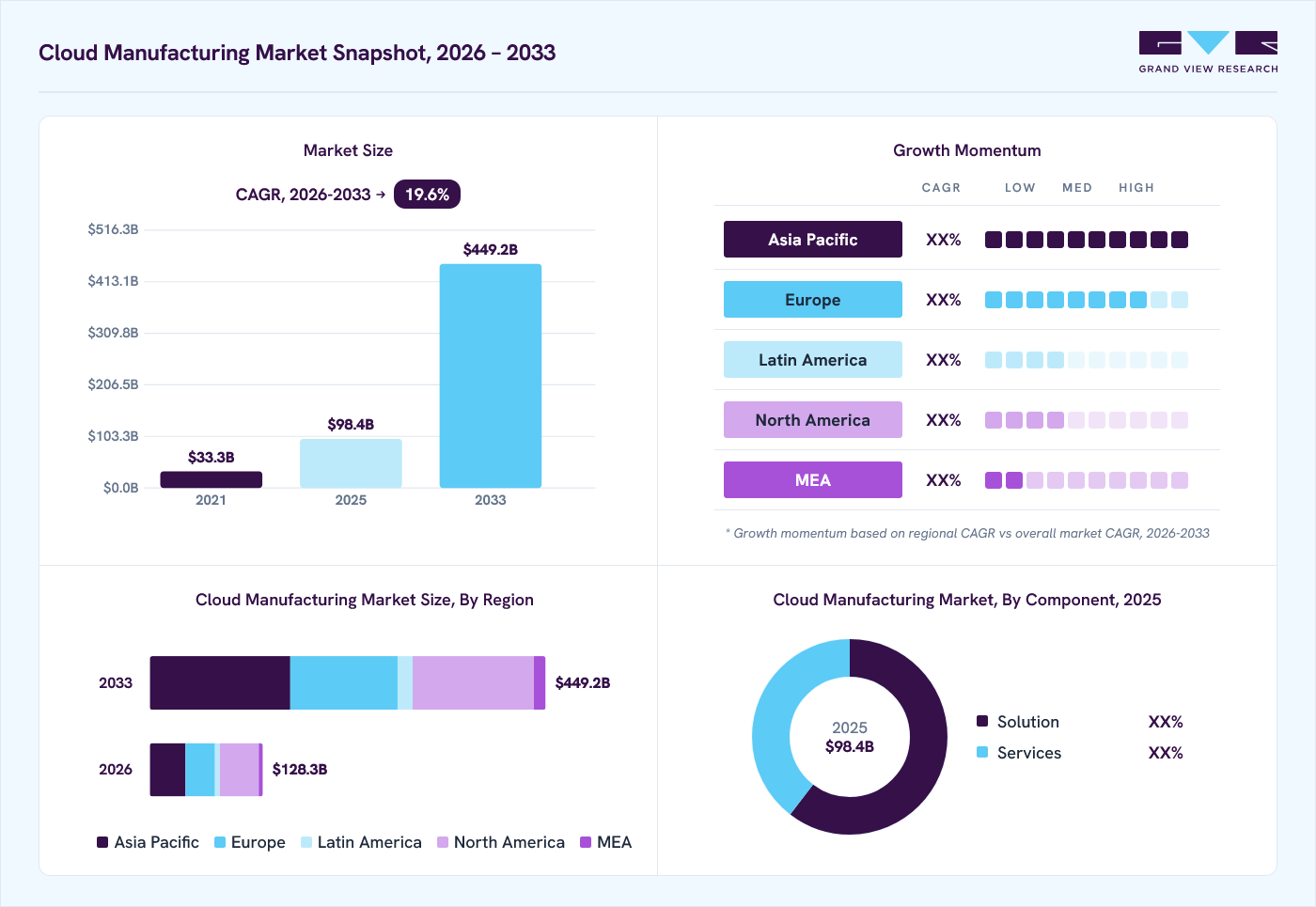
The global cloud manufacturing market size was valued at USD 98.4 billion in 2025 and is projected to grow from USD 128.3 billion in 2026 to USD 449.2 billion by 2033, at a CAGR of 19.6% from 2026 to 2033. North America dominated the market, accounting for the largest revenue share of 34.9% in 2025. The growing adoption of Industry 4.0 and smart manufacturing initiatives is driving demand for cloud manufacturing by enabling real-time production monitoring, scalable automation, data analytics, and connected factory operations.
 Source: Grand View Research, IR Documents, Primary Interviews, Paid DatabasesTo learn more about this report,
 Download Free Sample Report
 Key Market Trends & Insights
- By component: The solution segment held the largest market share of 60.4% in 2025.
- By deployment: The hybrid cloud segment led the market with the largest revenue share of 43.5% in 2025.
- By enterprise size: The large enterprises segment dominated the market with the largest revenue share of 63.7% in 2025.
- By application: The production planning & manufacturing execution segment held the largest market share of 25.1% in 2025.
- By end-use: The automotive & transportation segment held the largest revenue share of 27.8% in 2025.
Regional Highlights
- Largest regional market: North America (34.9% revenue share, 2025)
- Fastest-growing regional market: Asia Pacific (highest CAGR, 2026-2033)
- By country: The U.S. dominated North America with the largest revenue share in 2025.
Market Size & Forecast
- Market size in 2025: USD 98.4 Billion
- Estimated market size in 2026: USD 128.3 Billion
- Projected market size by 2033: USD 449.2 Billion
- CAGR (2026-2033): 19.6%
Three ways to get this report
Buy it, customize it, or ask a question.Ask an Analyst
A direct answer, usually in 1 working day
- AccessReport author, directly
- Reply timeWithin 1 working day
- No sales callDirect answer only
- FormatEmail reply
- CostFree, no cost
Get the Full Report
What the study covers
- FormatsPDF · Excel · Dashboard
- Timeline2026–2033 annual, 2025 base
- Coverage20+ countries, 5 regions
- Companies10+ key players profiled
Customize the Report
20% free customization
- IncludeCountries, segments, points
- TailorTo your product definition
- ExtendDeeper competitor detail
- OrA fully bespoke study
- Turnaround5–10 working days
Manufacturers are increasingly seeking infrastructure that can scale rapidly with changes in production volumes, product variants, and facility requirements. Cloud-based manufacturing platforms allow organizations to provision computing resources, applications, storage, and processing capacity without extensive investments in dedicated on-premises infrastructure. This flexibility is particularly valuable for manufacturers expanding production capacity or operating multiple facilities, as cloud environments can support standardized applications and data access across locations while reducing the need for extensive local IT infrastructure.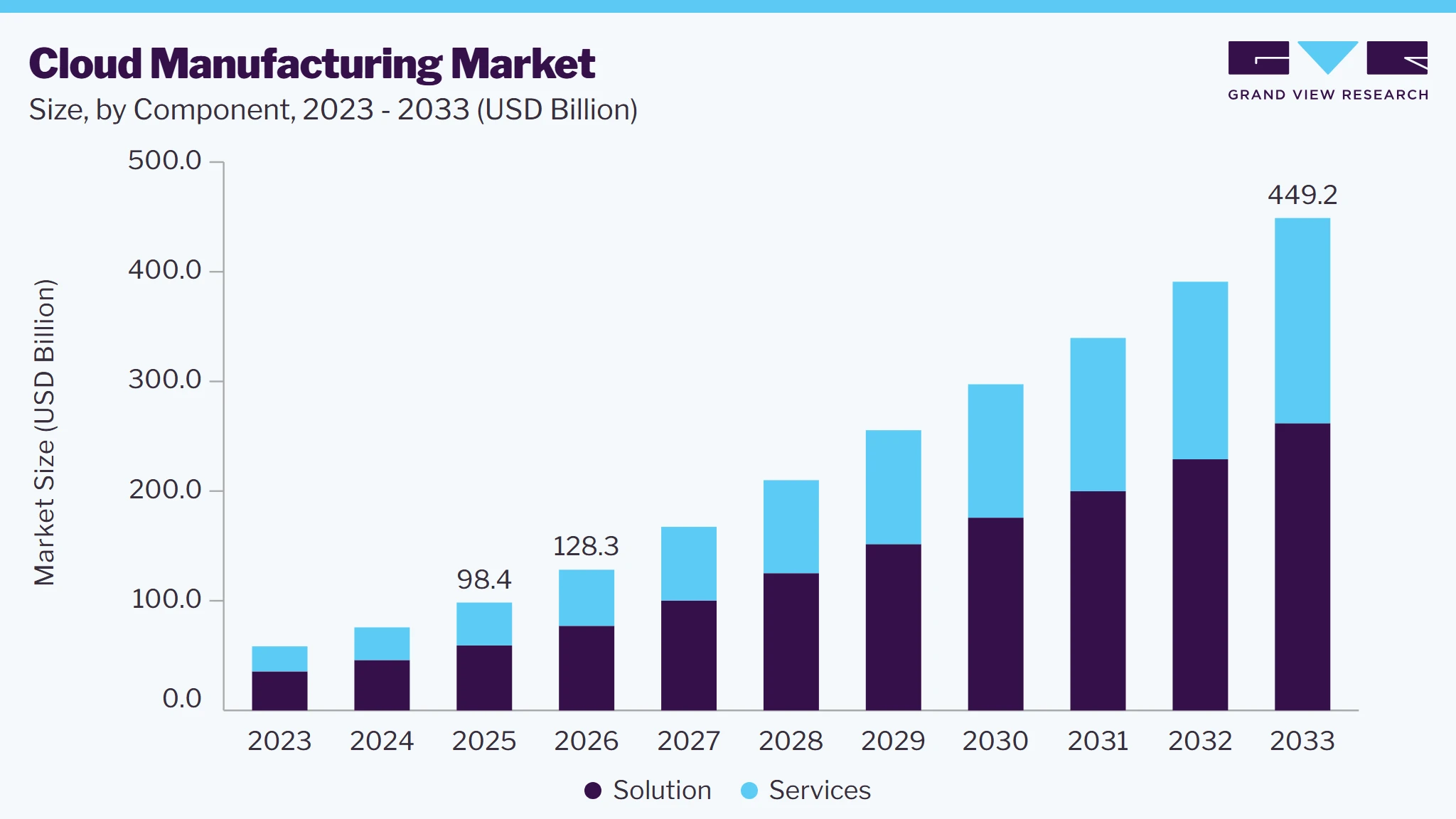 To learn more about this report, Download Free Sample Report
 Growing supply chain complexity and exposure to disruptions are encouraging manufacturers to adopt cloud-based platforms that provide centralized visibility across suppliers, inventory, production facilities, and distribution networks. Cloud manufacturing solutions enable organizations to consolidate information from geographically dispersed operations and provide stakeholders with timely access to inventory levels, procurement status, production schedules, and logistics information. This improved visibility enables faster responses to material shortages, demand fluctuations, supplier delays, and other supply chain disruptions. For instance, in June 2026, Oracle announced new AI-driven capabilities within Oracle Fusion Cloud Supply Chain & Manufacturing (SCM) designed to strengthen supply-chain visibility, improve inventory management, and enhance manufacturing efficiency. The company introduced four Fusion Agentic Applications covering inventory planning, supplier qualification, production readiness, and Kanban management, enabling organizations to identify operational issues earlier, prioritize corrective actions, reduce production disruptions, and improve material availability.
Market Dynamics
The cloud manufacturing industry is expanding as manufacturers increasingly adopt cloud-based platforms to make production more flexible, streamline operations, support business growth, strengthen collaboration, and enable faster operational decisions. The growing integration of smart manufacturing technologies, including the Industrial Internet of Things, artificial intelligence, automation, advanced analytics, digital twins, and cloud-native applications, is creating connected production environments in which equipment, enterprise systems, workforce operations, and supply chain activities can work together through a unified digital infrastructure. Cloud manufacturing is increasingly moving beyond basic infrastructure hosting to encompass integrated ERP, PLM, MES, supply chain management, quality management, asset management, and manufacturing analytics, supporting real-time visibility and data-driven production optimization.
The rapid adoption of Industry 4.0 as well as smart manufacturing is driving the market growth as manufacturers seek scalable platforms to integrate machines, operational technologies, enterprise applications, and production data. Cloud-based manufacturing solutions enable real-time monitoring, predictive analytics, production optimization, remote collaboration, and centralized management across geographically distributed facilities. As manufacturers modernize legacy production environments and increase automation, demand for cloud-based MES, ERP, PLM, IIoT, analytics, and digital manufacturing platforms is increasing. For instance, in March 2026, Siemens announced the expansion of its partnership with Alibaba to bring advanced industrial simulation software to the cloud, alongside new edge, automation, and control technologies for AI-driven industrial decision-making. Siemens stated that industrial AI is moving from experimentation toward large-scale deployment across factories and industrial supply chains.
Data security, cybersecurity risks, and integration challenges can restrain market growth. Manufacturers often operate heterogeneous environments comprising legacy machinery, industrial control systems, SCADA, MES, EAM, ERP, PLM, and IIoT devices that use different protocols and data architectures. Migrating these systems to cloud environments can require significant investments in IT/OT integration, APIs, data migration, cybersecurity, connectivity, and system modernization. Concerns regarding intellectual property, production data, operational continuity, regulatory compliance, and unauthorized access can also slow cloud adoption, particularly among manufacturers operating in safety-critical or highly sensitive production environments.
The increasing adoption of autonomous manufacturing, predictive analysis, and artificial intelligence creates significant opportunities for cloud manufacturing providers. Cloud platforms can aggregate production, equipment, supply-chain, quality, and workforce data at scale, enabling AI-driven production optimization, predictive maintenance, demand forecasting, quality prediction, and real-time operational decision-making. The opportunity is particularly significant across sectors, as manufacturers increasingly seek integrated platforms to optimize distributed production networks and accelerate digital transformation.
Market Concentration & Characteristics
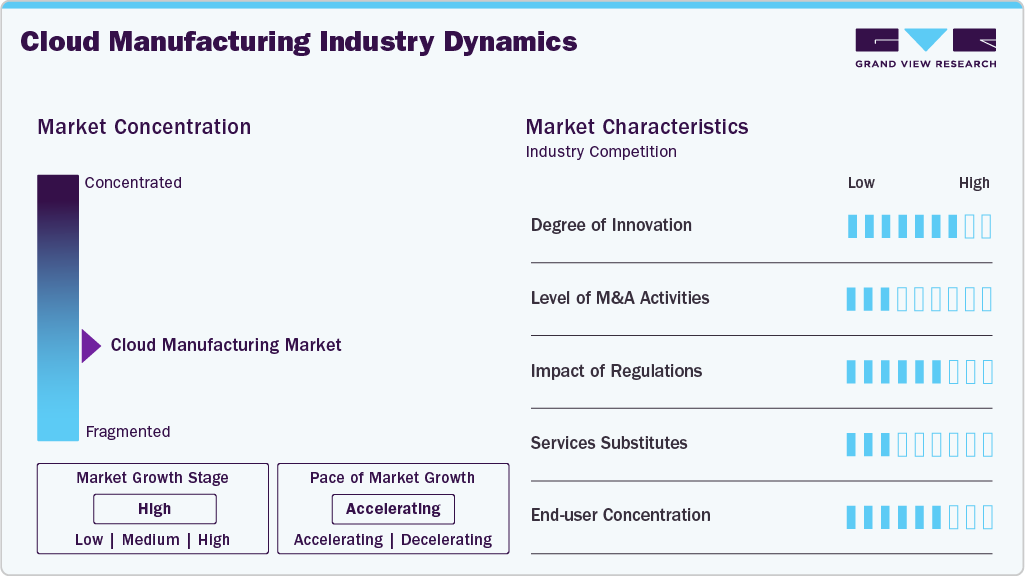
The cloud manufacturing industry is moderately fragmented, with competition among large cloud service providers, enterprise software companies, industrial automation vendors, engineering software providers, and specialized manufacturing platform companies. Major participants include Microsoft, SAP, Oracle, Siemens, Amazon Web Services, Google, IBM, PTC, Dassault Systèmes, Rockwell Automation, Autodesk, and ABB, as well as numerous regional and specialized providers. Entry barriers are moderate to high because competitive offerings require cloud infrastructure, manufacturing-specific software capabilities, cybersecurity, industrial connectivity, integration expertise, and established relationships with manufacturers.
 To learn more about this report, Download Free Sample Report
 The market is in a rapid expansion phase, driven by manufacturers' migration from legacy on-premises systems to cloud-based applications and platforms. Adoption is moving from individual cloud applications toward integrated environments that connect production, engineering, supply chain, quality, asset management, and enterprise operations. Competitive differentiation is increasingly shifting from basic cloud hosting toward AI-enabled analytics, industry-specific functionality, interoperability, real-time processing, cybersecurity, digital twins, and end-to-end manufacturing orchestration.
Analyst Perspective
The convergence of cloud computing, industrial Internet of Things, digital twins, AI, edge computing, advanced analytics, and automation is expected to increasingly shape the cloud manufacturing market. Manufacturers are moving from isolated cloud applications to integrated cloud manufacturing environments that connect production equipment, enterprise systems, supply chains, engineering teams, and operational data across multiple facilities. AI is expected to transform cloud manufacturing platforms from primarily data-management and application-hosting environments into proactive manufacturing intelligence platforms that can predict equipment failures, optimize production schedules, identify quality issues, forecast demand, and recommend operational actions.
Component Insights
The solution segment led the market with the largest revenue share of 60.4% in 2025, driven by the increasing complexity of cloud migration and the need for specialized implementation, integration, customization, consulting, training, and managed services. Manufacturers often require external expertise to migrate legacy manufacturing applications, configure cloud environments, integrate production systems with enterprise platforms, and maintain cloud-based workloads.
The service segment is anticipated to grow at the fastest CAGR during the forecast period, driven by manufacturers' growing need to replace fragmented, legacy manufacturing applications with integrated cloud-based software environments. Cloud manufacturing solutions can consolidate production, engineering, supply-chain, quality, and operational information into centralized platforms, enabling standardized workflows and easier access to manufacturing data across facilities.
Deployment Insights
The hybrid cloud segment led the market with the largest revenue share of 43.5% in 2025, due to manufacturers' preference for reducing upfront infrastructure investments and accessing computing resources on a scalable, pay-as-you-use basis. Public cloud platforms allow manufacturers to deploy applications and scale storage and processing capacity without purchasing and maintaining dedicated hardware.
The public cloud segment is anticipated to grow at the fastest CAGR during the forecast period, supported by manufacturers' need to balance cloud scalability with continued control over sensitive production workloads and legacy systems. Manufacturers can retain applications or operational data that require low latency, strict security, or uninterrupted local access within private environments while transferring less-sensitive workloads, such as analytics, collaboration, and selected enterprise applications, to Public Clouds.
Enterprise Size Insights
The large enterprises segment led the market with the largest revenue share of 63.7% in 2025, due to the increasing complexity of managing geographically dispersed manufacturing operations and the need to standardize technology across multiple plants. Large manufacturers can use cloud platforms to establish common applications, data structures, workflows, and reporting standards across production facilities, subsidiaries, and supply-chain networks.
The small & medium enterprises (SMEs) segment is expected to grow at the fastest CAGR during the forecast period, driven by the growing availability of affordable cloud-based manufacturing applications that lower the technological and financial barriers to adopting advanced digital tools. Subscription-based cloud models enable smaller manufacturers to access ERP, production management, analytics, quality, and other capabilities without substantial investments in servers, software infrastructure, or specialized IT personnel.
Application Insights
The production planning & manufacturing execution segment led the market with the largest revenue share of 25.1% in 2025, driven by manufacturers' need to improve production scheduling, resource utilization, work-order management, and shop-floor coordination amid increasingly complex product portfolios. Cloud-based platforms provide centralized access to production schedules, machine status, work orders, material requirements, and operational performance, allowing planners and plant managers to coordinate production activities more effectively.
The manufacturing analytics & optimization segment is expected to grow at the fastest CAGR during the forecast period, driven by the increasing volume of data generated by connected machinery, production systems, sensors, and enterprise applications. Cloud platforms provide the computing capacity and centralized data environments required to process large datasets and generate insights into production efficiency, resource utilization, quality performance, and operational bottlenecks.
End-use Insights
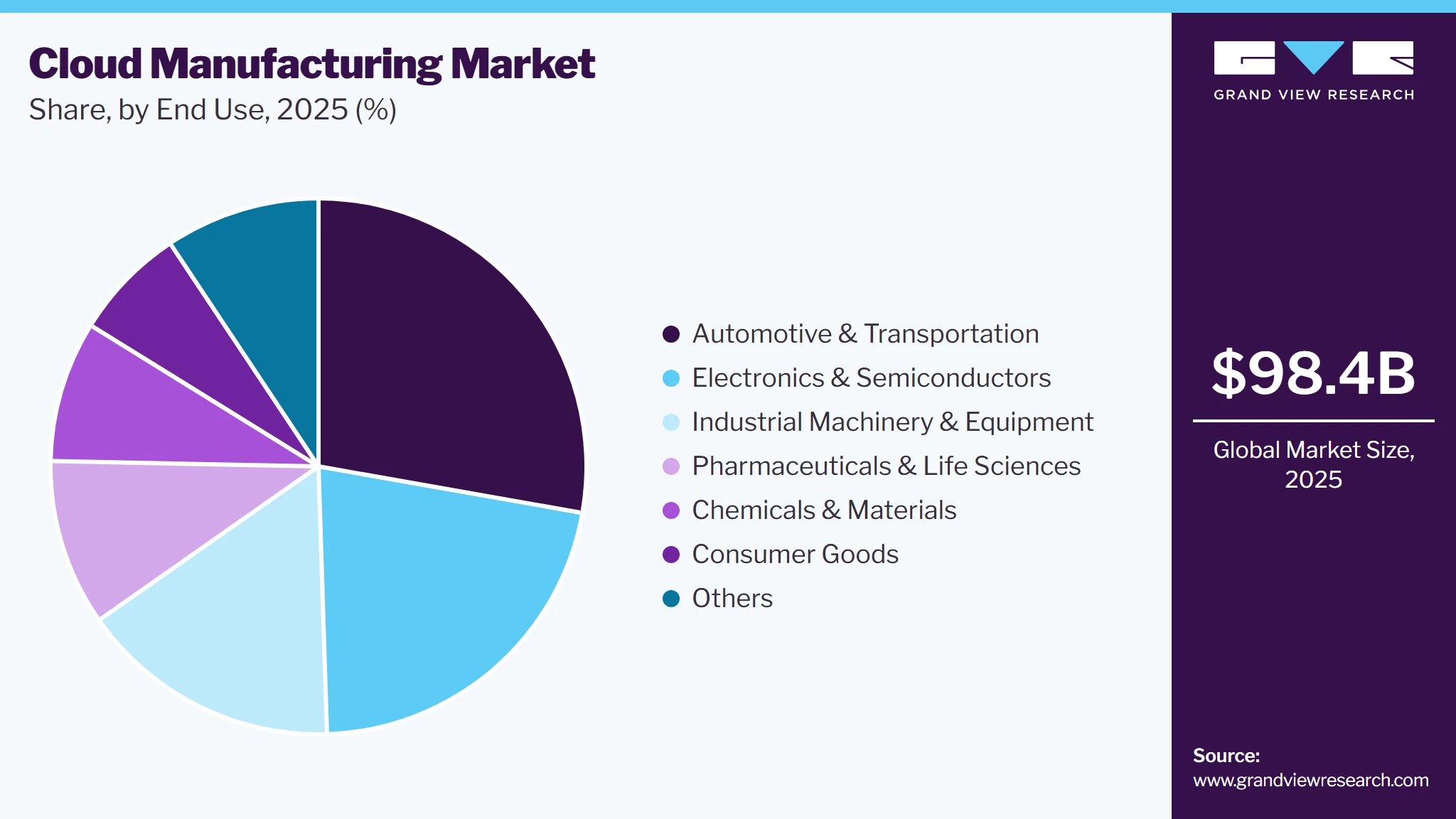
The automotive & transportation segment led the market with the largest revenue share of 27.8% in 2025, supported by the industry's transition toward software-defined vehicles, electric vehicles, increasingly complex component ecosystems, and highly distributed manufacturing networks. Automotive manufacturers and suppliers require connected digital environments to coordinate engineering, production, and supplier activities, as well as vehicle-program data, across plants and global supply chains.
 To learn more about this report, Download Free Sample Report
 The electronics & semiconductors segment is expected to grow at the fastest CAGR over the forecast period, driven by rapid product lifecycles, high production complexity, and the need for precise control over increasingly sophisticated manufacturing processes. Semiconductor and electronics manufacturers generate large volumes of production, equipment, testing, and quality data, creating demand for cloud platforms capable of consolidating and analyzing information across msanufacturing operations.
Regional Insights
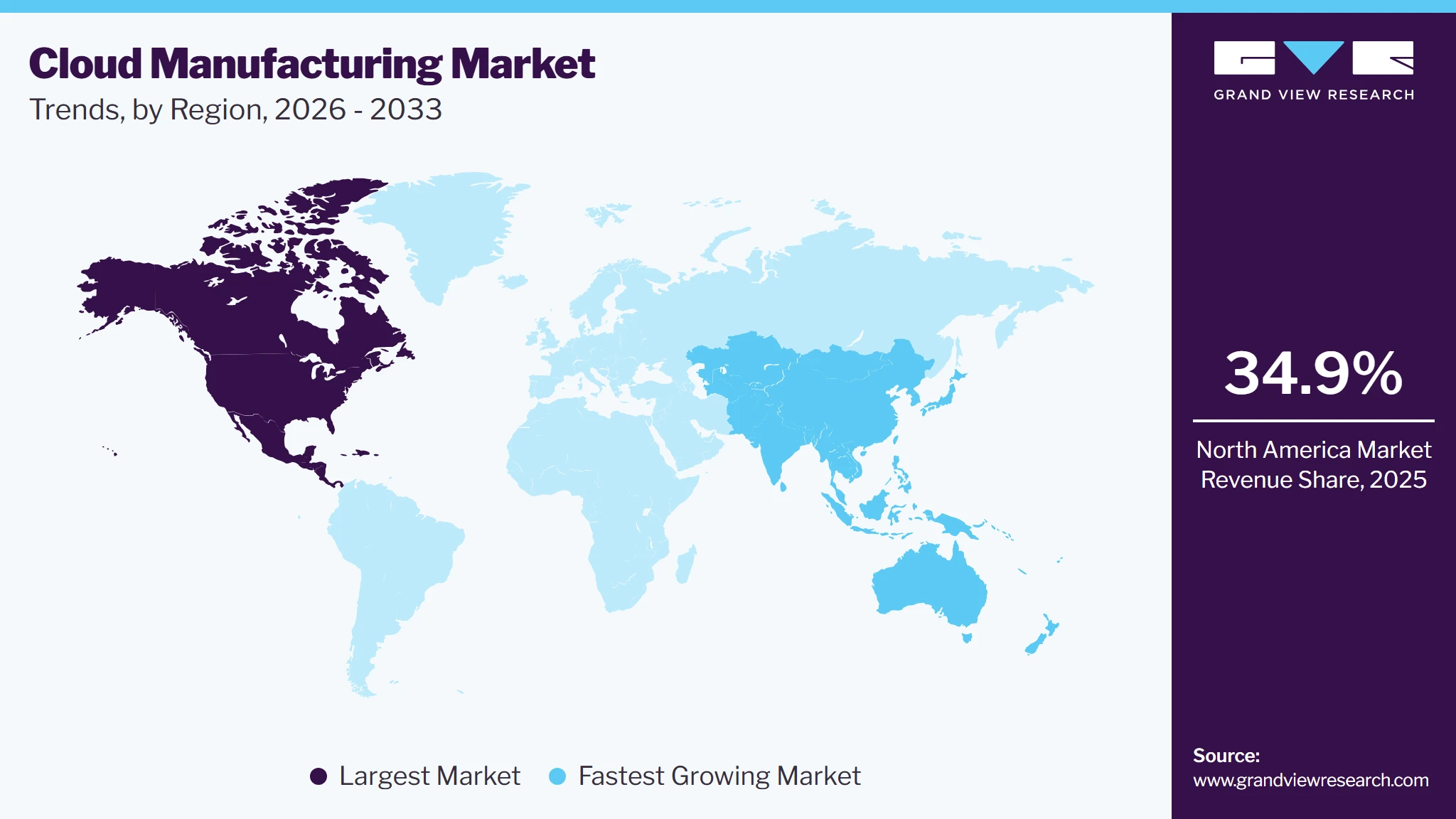
The North America cloud manufacturing market held the largest revenue share of 34.9% in 2025, driven by the strong presence of advanced manufacturing industries and mature digital infrastructure, which facilitates the deployment of cloud-based production and enterprise applications. Manufacturers across the region are increasingly modernizing legacy industrial environments and adopting connected manufacturing architectures to improve operational agility, while the presence of major cloud providers and industrial technology companies supports the availability of scalable cloud platforms and specialized manufacturing solutions.
 To learn more about this report, Download Free Sample Report
 U.S. Cloud Manufacturing Market Trends
The cloud manufacturing market in the U.S. accounted for the largest revenue share in North America in 2025, driven by substantial investments in AI-enabled manufacturing and advanced automation, as manufacturers seek to integrate AI, robotics, machine learning, and intelligent software into production environments.
Europe Cloud Manufacturing Market Trends
The cloud manufacturing market in Europe is anticipated to grow at a considerable CAGR from 2026 to 2033, driven by increasing emphasis on industrial sustainability and energy efficiency, which is encouraging manufacturers to adopt cloud-based platforms to monitor resource consumption, optimize production processes, and improve environmental performance.
The UK cloud manufacturing market is expected to grow rapidly in the coming years, owing to the expansion of digital manufacturing initiatives and government-backed industrial technology programs aimed at increasing productivity and technology adoption among manufacturers. Support for digital transformation, advanced manufacturing, and technology-intensive production is encouraging companies to adopt cloud-based software and data platforms that can improve collaboration, operational visibility, and access to advanced digital capabilities.
The cloud manufacturing market in Germany held a substantial share of the European market in 2025, due to the country's extensive industrial automation and engineering ecosystem, particularly in automotive, machinery, electrical equipment, and industrial manufacturing. Manufacturers are increasingly connecting automated production environments with cloud-based platforms to coordinate engineering and operational data, standardize processes across plants, and improve the management of highly automated production systems.
Asia Pacific Cloud Manufacturing Market Trends
The cloud manufacturing market in the Asia Pacific is anticipated to grow at the fastest CAGR during the forecast period, due to the rapid expansion of manufacturing capacity and industrial digitalization across China, India, Japan, South Korea, and Southeast Asia. New manufacturing investments are increasingly incorporating connected production systems and digital infrastructure from the outset, while established facilities are being modernized to improve productivity and competitiveness.
The Japan cloud manufacturing market is expected to grow rapidly in the coming years, driven by the country's aging industrial workforce and increasing need to preserve manufacturing expertise and productivity. Manufacturers are adopting digital platforms to capture operational knowledge, standardize processes, automate routine activities, and support workers in managing increasingly sophisticated production environments.
The cloud manufacturing market in China held a significant share of the Asia Pacific market in 2025, due to the country's large-scale smart factory development and industrial digitalization programs. Manufacturers are increasingly deploying digital platforms across production facilities to improve factory intelligence, automate operations, and integrate manufacturing data at scale.
Key Cloud Manufacturing Company Insight
Key players operating in the cloud manufacturing industry are Microsoft, SAP SE, Oracle, Siemens, Amazon.com, Inc., Google LLC, IBM Corporation, and PTC Inc. The companies are focusing on various strategic initiatives, including new product development, partnerships & collaborations, and agreements to gain a competitive advantage over their rivals.
Key Cloud Manufacturing Companies
The following key companies have been profiled for this study on the cloud manufacturing market:
-
ABB Ltd
-
Amazon.com, Inc.
-
Autodesk, Inc.
-
Cisco Systems, Inc.
-
Dassault Systemes SE
-
Google LLC
-
Hewlett Packard Enterprise Company
-
IBM Corporation
-
Infor Inc.
-
Microsoft
-
Oracle
-
PTC Inc.
-
Rockwell Automation, Inc.
-
SAP SE
-
Siemens
Competitive Benchmarking
Category
Operating Strategies
Competitive Edge
Weakness
Established Players (Microsoft, SAP SE, Oracle, Siemens, Amazon.com, Inc., Google LLC, IBM Corporation, and PTC Inc.)
- Invest in cloud-native manufacturing platforms, artificial intelligence, digital twin, industrial Internet of Things, analytics, enterprise resource planning, product lifecycle management, manufacturing execution system, supply-chain management, and manufacturing automation to expand cloud-based manufacturing capabilities.
- Expand manufacturing portfolios through strategic partnerships, technology integrations, acquisitions, and broader cloud ecosystems.
- Strong global brands, extensive enterprise customer bases, and established relationships with large manufacturers across automotive, electronics, industrial machinery, pharmaceuticals, chemicals, and other industries.
- Broad portfolios spanning cloud infrastructure, MES, IIoT, PLM, AI, analytics, ERP, cybersecurity, and enterprise applications provide strong cross-selling opportunities.
- Higher software, cloud infrastructure, implementation, integration, and customization costs can constrain adoption among smaller manufacturers.
- Integration with legacy manufacturing equipment and heterogeneous IT/OT environments can require substantial technical expertise and implementation resources.
Emerging Players (Infor Inc., Rockwell Automation, Inc., ABB Ltd, Autodesk, Inc. )
- Focus on specialized cloud manufacturing applications, industrial automation, CAD/CAM, IIoT, MES, PLM, enterprise resource planning, digital twins, asset management, production optimization, and connected factory solutions.
- Expand capabilities through partnerships with hyperscalers, industrial technology providers, automation companies, and enterprise software vendors.
- Strong domain expertise in specialized manufacturing functions, including industrial automation, engineering design, production management, MES, PLM, robotics, and asset operations.
- More focused portfolios can enable deeper functionality for specific manufacturing use cases and provide greater flexibility for manufacturers seeking targeted cloud transformation without replacing their entire technology stack.
- Smaller global footprints in cloud infrastructure and enterprise software than the largest hyperscalers and enterprise technology providers.
- Greater dependence on technology partners for certain cloud infrastructure, enterprise applications, or complementary capabilities can limit end-to-end control.
Recent Developments
-
In June 2026, Siemens and IFS announced a strategic partnership to help manufacturers connect engineering, production, and asset-management data through Industrial AI across the product lifecycle. The collaboration combines Siemens’ expertise in industrial AI, engineering, automation, manufacturing execution, and digital twins with IFS’s capabilities in enterprise asset management, field service, and operational lifecycle data. The companies aim to establish a connected digital environment that links product design and simulation to factory execution, maintenance, and real-world asset performance, enabling manufacturers to improve productivity, reduce unplanned downtime, optimize production assets, and respond more effectively to operational changes.
-
In February 2026, PTC Inc. introduced cloud-native Model-Based Definition (MBD) capabilities for Onshape, enabling manufacturers to embed manufacturing specifications directly within 3D models rather than maintaining them across separate drawings and files. The new functionality integrates manufacturing information with Onshape’s CAD and product data management environment, providing a continuously updated product definition and supporting browser-based collaboration across engineering, manufacturing, and quality teams. The capabilities are designed to improve design-to-production workflows, reduce information handoffs and errors, and strengthen change management throughout the product lifecycle.
Cloud Manufacturing Report Scope
Report Attribute
Details
Market size in 2025
USD 98.4 billion
Estimated market size in 2026
USD 128.3 billion
Projected market size by 2033
USD 449.0 billion
Growth rate
CAGR of 19.6% from 2026 to 2033
Base year for estimation
2025
Historical data
2021 - 2024
Forecast period
2025 - 2033
Quantitative units
Revenue in USD billion, and CAGR from 2026 to 2033
Report coverage
Revenue forecast, company share, competitive landscape, growth factors, and trends
Segments covered
Component, deployment, enterprise size, application, end-use, region
Regional scope
North America; Europe; Asia Pacific; Latin America; MEA
Country scope
U.S.; Canada; Mexico; UK; Germany; France; China; India; Japan; Australia; South Korea; Brazil; UAE; Kingdom of Saudi Arabia; South Africa
Key companies profiled
ABB Ltd; Amazon.com, Inc.; Autodesk, Inc.; Cisco Systems, Inc.; Dassault Systemes SE; Google LLC; Hewlett Packard Enterprise Company; IBM Corporation; Infor Inc.; Microsoft; Oracle, PTC Inc.; Rockwell Automation, Inc.; SAP SE; Siemens
Customization scope
Free report customization (equivalent to 8 analysts working days) with purchase. Addition or alteration to country, regional & segment scope.
Pricing and purchase options
Avail customized purchase options to meet your exact research needs. Explore purchase options
Global Cloud Manufacturing Market Report Segmentation
This report forecasts revenue growth at the global, regional, and country levels and provides an analysis of the latest industry trends in each of the sub-segments from 2021 to 2033. For this study, Grand View Research has segmented the global cloud manufacturing market report based on component, deployment, enterprise size, application, end-use, and region.
-
Component Outlook (Revenue, USD Billion, 2021 - 2033)
-
Solutions
-
Services
-
-
Deployment Outlook (Revenue, USD Billion, 2021 - 2033)
-
Public Cloud
-
Private Cloud
-
Hybrid Cloud
-
-
Enterprise Size Outlook (Revenue, USD Billion, 2021 - 2033)
-
Large Enterprises
-
Small & Medium Enterprises (SMEs)
-
-
Application Outlook (Revenue, USD Billion, 2021 - 2033)
-
Enterprise Resource Planning (ERP)
-
Product Lifecycle Management (PLM) & Engineering
-
Production Planning & Manufacturing Execution
-
Supply Chain & Inventory Management
-
Quality Management
-
Asset & Maintenance Management
-
Manufacturing Analytics & Optimization
-
Others
-
-
End-use Outlook (Revenue, USD Billion, 2021 - 2033)
-
Automotive & Transportation
-
Electronics & Semiconductors
-
Industrial Machinery & Equipment
-
Pharmaceuticals & Life Sciences
-
Chemicals & Materials
-
Consumer Goods
-
Others
-
-
Regional Outlook (Revenue, USD Billion, 2021 - 2033)
-
North America
-
U.S.
-
Canada
-
Mexico
-
-
Europe
-
UK
-
Germany
-
France
-
-
Asia Pacific
-
China
-
India
-
Japan
-
South Korea
-
Australia
-
-
Latin America
-
Brazil
-
-
Middle East & Africa
-
UAE
-
Saudi Arabia
-
South Africa
-
-
Research Methodology
The cloud manufacturing marketfigures in this report are based on a proven research process that combines executive interviews with secondary research from proprietary databases, company filings, and recognized regulatory and institutional sources. Market size is built through value-chain sizing-reconciling supply-side and demand-side estimates-and triangulated with bottom-up and top-down approaches. Every estimate passes multiple levels of expert validation before publication, with each cloud manufacturing segment quantified using the revenue-capture definitions in the table below.
Segment Definition
Segment - Component
Revenue capture definition
Solution
Market value is captured through cloud-based manufacturing software platforms and applications used to manage manufacturing processes and operations. This includes cloud enterprise resource planning, product lifecycle management, manufacturing execution systems, supply chain management, quality management, asset management, manufacturing analytics, engineering applications, and other manufacturing-specific software. Revenue includes software licenses, subscriptions, SaaS fees, and usage-based charges attributable to cloud manufacturing solutions.
Services
Market value is captured through professional and managed services directly associated with the implementation, operation, integration, customization, and support of cloud manufacturing solutions. This includes consulting, implementation, system integration, migration, customization, training, maintenance, technical support, and managed cloud services. Revenue from general-purpose IT services not directly attributable to cloud manufacturing deployments is excluded.
Segment - Deployment
Revenue capture definition
Public Cloud
Market value is captured from cloud manufacturing applications and workloads hosted on shared, third-party cloud infrastructure and delivered to multiple customers over the internet. Revenue includes subscriptions, usage-based fees, and other charges attributable to the public cloud deployment of manufacturing applications and services.
Private Cloud
Market value is captured from cloud manufacturing applications deployed on dedicated cloud infrastructure operated exclusively for a single manufacturing organization. This includes privately hosted cloud environments managed internally or by a third-party provider.
Hybrid Cloud
Market value is captured in cloud manufacturing environments that integrate private or on-premises infrastructure with public cloud resources, enabling manufacturing applications and data to operate across interconnected environments. Revenue includes charges attributable to hybrid deployment and associated cloud manufacturing capabilities.
Segment - Enterprise Size
Revenue capture definition
Large Enterprises
The large enterprises segment, with respect to the number of employees, typically comprises organizations employing more than 1,000 employees for multinational corporations.
Small & Medium Enterprises (SMEs)
The SMEs segment, with respect to the number of employees, generally includes organizations employing between 10 and 999 employees.
Segment - Application
Revenue capture definition
Enterprise Resource Planning (ERP)
Market value is captured through cloud-based ERP applications that manage core manufacturing enterprise processes, including financial management, procurement, sales, order management, production-related processes, and resource planning. Only manufacturing-related cloud ERP revenue is included.
Product Lifecycle Management (PLM) & Engineering
Market value is captured through cloud-based applications used to manage product design, engineering data, product configurations, bills of materials, product development, simulation, design collaboration, and product lifecycle processes from development through production.
Production Planning & Manufacturing Execution
Market value is captured through cloud-based applications used for production planning, scheduling, work-order management, shop-floor execution, production monitoring, manufacturing workflows, and manufacturing execution system (MES) functions.
Supply Chain & Inventory Management
Market value is captured through cloud-based applications that manage procurement, supplier coordination, material planning, inventory, warehouse operations, demand planning, logistics, and supply chain visibility for manufacturing operations.
Quality Management
Market value is captured through cloud-based applications used for quality planning, inspection, nonconformance management, corrective and preventive actions, quality control, audits, compliance, and quality reporting across manufacturing operations.
Asset & Maintenance Management
Market value is captured through cloud-based applications that manage industrial assets, equipment maintenance, work orders, asset performance, preventive and predictive maintenance, spare parts, and equipment lifecycle management.
Manufacturing Analytics & Optimization
Market value is captured through cloud-based applications used to analyze manufacturing and operational data and optimize production performance, including production analytics, operational intelligence, performance monitoring, process optimization, predictive analytics, and manufacturing dashboards.
Others
Market value is captured through other manufacturing-specific cloud applications that do not fall within the seven primary application categories. This includes specialized manufacturing applications such as manufacturing compliance, production costing, shop-floor collaboration, manufacturing workforce management, and other niche manufacturing workflows.
Segment - End Use
Revenue capture definition
Automotive & Transportation
Market value is captured from cloud manufacturing solutions purchased and deployed by manufacturers of automobiles, commercial vehicles, automotive components, aerospace and transportation equipment, including their manufacturing and production operations.
Electronics & Semiconductors
Market value is captured from cloud manufacturing solutions used by manufacturers of semiconductors, electronic components, consumer electronics, electrical equipment, and related products for production, engineering, quality, supply-chain, and operational management.
Industrial Machinery & Equipment
Market value is captured from cloud manufacturing solutions used by manufacturers of industrial machinery, equipment, machine tools, automation equipment, and other capital goods across engineering, production, asset management, quality, and supply chain operations.
Pharmaceuticals & Life Sciences
Market value is captured from cloud manufacturing solutions used by manufacturers of pharmaceuticals, biotechnology products, medical devices, diagnostics, and other life-science products, across production, quality, compliance, and supply chain activities.
Chemicals & Materials
Market value is captured from cloud manufacturing solutions used by manufacturers and processors of chemicals, specialty chemicals, plastics, polymers, metals, minerals, and other industrial materials for production, quality, inventory, and asset management.
Consumer Goods
Market value is captured from cloud manufacturing solutions used by manufacturers of consumer products, including household, personal care, and packaged goods, as well as appliances and other consumer-oriented manufactured goods.
Other
Market value is captured from cloud manufacturing solutions deployed by other manufacturing industries not covered above, including Food & Beverages, Textiles & Apparel, Paper & Pulp, Printing & Packaging, Glass & Ceramics, Building & Construction Materials, Furniture & Wood Products, Tobacco Products, and miscellaneous manufacturing.
Estimation Model
Layer No.
Layer
Question
Analysis
01
Manufacturing Operations & Production Environment Layer
Where are cloud manufacturing solutions required?
Identify manufacturing environments where organizations require scalable digital platforms to manage production, engineering, supply chains, assets, quality, and enterprise operations. This layer evaluates automotive plants, electronics and semiconductor facilities, industrial machinery factories, pharmaceutical manufacturing sites, chemical plants, consumer-goods facilities, and other manufacturing environments. The analysis considers the scale of manufacturing operations, the number of production facilities, the degree of digitalization, the complexity of production processes, and the need to coordinate data and workflows across plants.
02
Cloud Manufacturing Technology & Infrastructure Layer
What enables cloud manufacturing implementation?
Assess the technologies and infrastructure supporting cloud manufacturing, including cloud computing platforms, SaaS applications, industrial IoT, edge computing, AI/ML, digital twins, data analytics, APIs, connectivity, cybersecurity, enterprise resource planning, product lifecycle management, manufacturing execution system, SCADA, automation systems, and IT/OT integration. Effective implementation depends on the ability to connect production equipment and operational systems with cloud environments while maintaining interoperability, data security, availability, scalability, and low-latency access for critical manufacturing processes.
03
Cloud Manufacturing Application & Deployment Layer
How are cloud manufacturing capabilities delivered and used?
Analyze the deployment models and applications through which cloud manufacturing capabilities are delivered, including public, private, and Hybrid Cloud environments supporting ERP, PLM and engineering, production planning and manufacturing execution, supply-chain and inventory management, quality management, asset and maintenance management, and manufacturing analytics and optimization. Providers deliver these capabilities through SaaS platforms, cloud-native applications, APIs, data platforms, digital twins, analytics tools, and integrated manufacturing ecosystems, supported by implementation, integration, consulting, and managed services.
04
Cloud Manufacturing Solutions & Enterprise Economics Layer
How is value generated within the cloud manufacturing ecosystem?
Evaluate revenue generated through cloud manufacturing software subscriptions, SaaS fees, usage-based charges, licenses, cloud infrastructure consumption, implementation and systems integration, consulting, customization, migration, managed services, maintenance, training, and technical support. Additional enterprise value is generated through improved production efficiency, reduced IT infrastructure expenditure, faster product development, higher asset utilization, improved inventory management, reduced downtime, enhanced quality, greater supply-chain visibility, accelerated deployment of manufacturing applications, and standardized operations across geographically distributed facilities.
Delivered Customization
This report has been delivered with the following In-depth customizations:
Client Request
Customization Delivered
Value Adds
Cloud Manufacturing Technology Integration & Smart Factory Trends
- Analyzed cloud manufacturing technologies, including cloud-native ERP, MES, PLM, IIoT, digital twins, AI/ML, edge computing, industrial analytics, APIs, and IT/OT integration.
- Evaluated the integration of cloud platforms with connected machinery, production systems, engineering applications, and enterprise infrastructure
- Helps identify cloud technology adoption and integration opportunities across manufacturing operations.
- Provides insights into smart-factory transformation, interoperability, scalable infrastructure, and connected production environments.
Cloud Manufacturing, AI-Powered Operations & Digital Transformation Trends
- Evaluated adoption of cloud-based production management, manufacturing analytics, AI-enabled optimization, digital twins, predictive analytics, and intelligent automation.
- Assessed the convergence of cloud computing, industrial IoT, AI, analytics, and automation across manufacturing workflows.
- Highlights emerging technologies shaping cloud-enabled manufacturing transformation.
- Enables understanding of how AI, IIoT, analytics, and cloud platforms are improving production efficiency, asset utilization, quality, and operational decision-making.
Cloud Manufacturing Application & Enterprise Opportunity Assessment
- Assessed key applications across automotive & transportation, electronics & semiconductors, industrial machinery & equipment, pharmaceuticals & life sciences, chemicals & materials, consumer goods, and other manufacturing industries.
- Evaluated public, private, and Hybrid Cloud adoption across large enterprises and SMEs, as well as solutions versus services demand.
- Supports identification of high-growth applications, industries, enterprise sizes, and deployment models.
- Helps prioritize opportunities for cloud providers, manufacturing software vendors, industrial technology companies, system integrators, and managed-service providers.
Frequently Asked Questions About This Report
The global cloud manufacturing market size was estimated at USD 98.4 billion in 2025 and is expected to reach USD 128.3 billion in 2026.
The global cloud manufacturing market is expected to grow at a compound annual growth rate of 19.6% from 2026 to 2033 to reach USD 449.2 billion by 2033.
Key factors include the growing adoption of Industry 4.0 and smart manufacturing initiatives, which are driving demand for cloud manufacturing by enabling real-time production monitoring, scalable automation, data analytics, and connected factory operations.
North America dominated with 34.9% revenue share in 2025.
Asia Pacific is the fastest-growing region over the forecast period.
The solution segment led with a 60.4% revenue share in 2025, while the services segment is the fastest-growing segment.
The hybrid cloud segment led with a 43.5% revenue share in 2025 and is the fastest-growing segment.
The production planning & manufacturing execution segment held the largest share (over 25.1%) in 2025, while the manufacturing analytics & optimization segment is the fastest-growing segment.
Key players operating in the cloud manufacturing market include ABB Ltd, Amazon.com, Inc., Autodesk, Inc., Cisco Systems, Inc., Dassault Systèmes SE, Google LLC, Hewlett Packard Enterprise Company, IBM Corporation, Infor Inc., Microsoft, Oracle, PTC Inc., Rockwell Automation, Inc., SAP SE, Siemens
About the Author(s)
Next Generation Technologies Research Team
Technology · Next Generation TechnologiesThis report was authored by the next generation technologies research team at Grand View Research - comprising two research analysts, one senior research analyst, and one industry expert - with specialized expertise in the next generation technologies segment of the technology industry. All findings are based on proprietary technology databases, executive interviews, and regulatory analysis, subject to internal peer review prior to publication.
Last Updated:
Speak to Analyst

Customize this report to your needs - add regions, segments, or data points, with 20% free customization.
Or view our licence options:


ISO 9001:2015 & 27001:2022 Certified
We are GDPR and CCPA compliant! Your transaction & personal information is safe and secure. For more details, please read our privacy policy.


