
- Home
- »
- Network Security
- »
-
Cloud Security Posture Management Market Report, 2033GVR Report cover

Cloud Security Posture Management Market (2026 - 2033)
Size, Share & Trends Analysis Report By Component (Solution, Services), By Cloud Service (SaaS, IaaS), By Enterprise Size, By Cloud, By Vertical, By Region, And Segment Forecasts
Market Size, 2025
$7.4BMarket Estimate, 2026
$8.3BMarket Forecast, 2033
$21.1BCAGR, 2026–2033
14.2%Cloud Security Posture Management Market Summary
The global cloud security posture management market size was valued at USD 7.4 billion in 2025 and is projected to grow from USD 8.3 billion in 2026 to USD 21.1 billion by 2033, at a CAGR of 14.2% from 2026 to 2033. The North America market dominated, with a revenue share of 40.5% in 2025. The regulatory standards are playing a pivotal role in driving the cloud security posture management market's growth.
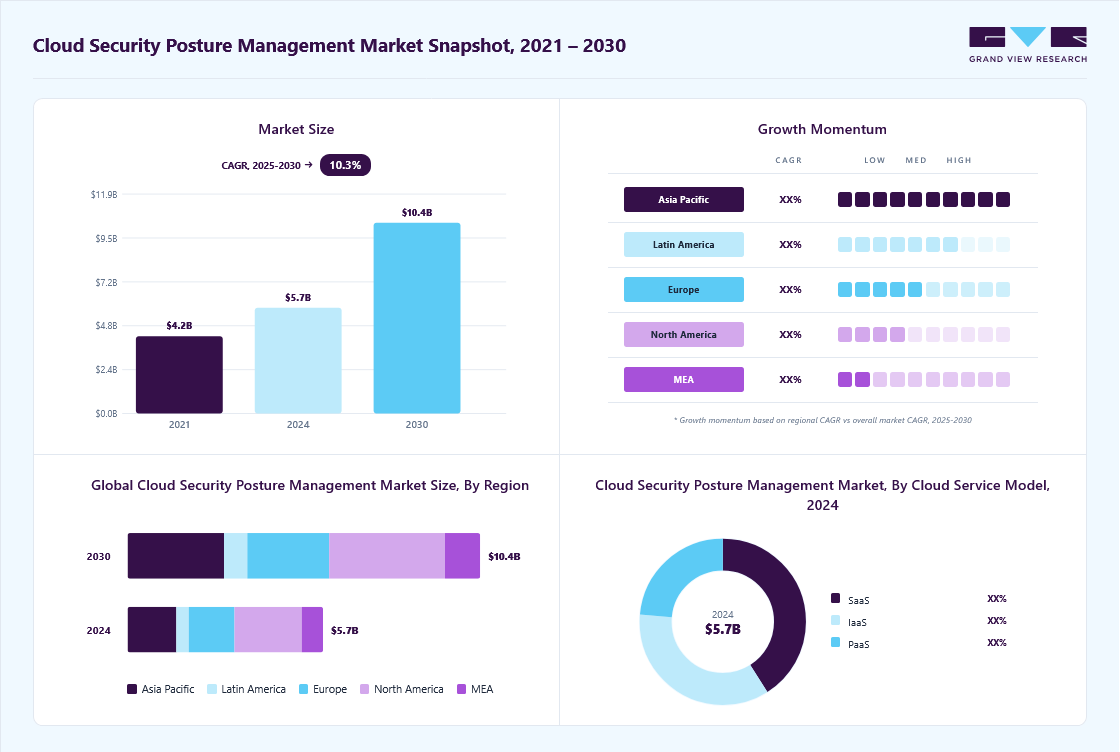 Source: Grand View Research, IR Documents, Primary Interviews, Paid DatabasesTo learn more about this report,
 Download Free Sample Report
 Key Market Trends & Insights
- By component: Solution segment dominated the market, with a revenue share of 68.3% in 2025.
- By cloud service model: SaaS segment held the largest market share of 40.5% in 2025.
- By cloud type: Public segment held the largest market share of 52.0% in 2025.
- By enterprise size: Large enterprises segment held the largest market share of 66.7% in 2025.
- By vertical: Defense/government segment held the largest market share of 28.5% in 2025.
Regional Highlights
- Largest regional market: North America (40.5% revenue share, 2025)
- Fastest-growing regional market: Asia Pacific (highest CAGR, 2026-2033)
- By country: The U.S. held the largest market share in 2025
Market Size & Forecast
- Market size in 2025: USD 7.4 Billion
- Estimated market size in 2026: USD 8.3 Billion
- Projected market size by 2033: USD 21.1 Billion
- CAGR (2026-2033): 14.2%
Three ways to get this report
Buy it, customize it, or ask a question.Ask an Analyst
Analyst response in 1 business day
- AccessReport author, directly
- Reply timeWithin 1 working day
- No sales callDirect answer only
- FormatEmail reply
- CostFree, no cost
Get the Full Report
What the study covers
- FormatsPDF · Excel · Dashboard
- Timeline2026–2033 annual, 2025 base
- Coverage20+ countries, 5 regions
- Companies10+ key players profiled
Customize the Report
20% free customization
- IncludeCountries, segments, points
- TailorTo your product definition
- ExtendDeeper competitor detail
- OrA fully bespoke study
- Turnaround5–10 working days
Regulatory bodies are putting more stringent data protection and privacy requirements, resulting in businesses opting for robust security measures in their cloud environments. The increasing cloud security concerns are driving the market growth. For instance, according to ISC Inc. (an international nonprofit membership association for information security leaders), 67% of the survey respondents saw misconfiguration of cloud platforms/wrong setups as the biggest security threat in the public cloud.The benefits offered by cloud security posture management (CSPM) include loading misconfigured network connectivity, detecting exceedingly liberal account permissions, continuous monitoring of the cloud environment, assessing data risks, automatically remedying the misconfigurations in certain cases, and compliance with common standards for the best practices such as SOC2 (Service Organization Control Type 2), HIPAA (Health Insurance Portability and Accountability Act), and PIC (Programmable Interface Controller), which have been able to counter the cloud security threats.
 To learn more about this report, Download Free Sample Report
 CSPM has risen as a crucial aspect of contemporary cybersecurity as organizations increasingly migrate their operations into the cloud. CSPM tools allow businesses to monitor and enforce security best practices within their cloud environments, ensuring compliance and mitigating risks. The increasing demand for improved cloud security solutions will fuel its demand in the coming years. Many companies are working toward safeguarding sensitive business data, improving customer trust, and enhancing compliance with strict regulations, paving the way for the rising adoption of CSPM solutions. Cyber threats require real-time monitoring and automating of cybersecurity measures in the cloud, fueling the adoption of CSPM.
The regulatory standards are also pivotal in driving the CSPM market's growth. Regulatory bodies are putting more stringent data protection and privacy requirements, resulting in businesses opting for robust security measures in their cloud environments. Compliance frameworks, including HIPAA, General Data Protection Regulation (GDPR), and Payment Card Industry Data Security Standard (PCI DSS), necessitate constant monitoring and enforcement of security controls. Likewise, industries with stringent security needs, including healthcare, government, and finance, increasingly opt for CSPM providers to ensure their cloud infrastructures adhere to the essential security standards. As compliance and data protection requirements grow, the CSPM market is poised to experience sustained expansion, attracting investment and innovation from vendors eager to capitalize on this flourishing demand.
The market growth is slowed down by various issues concerning the CSPM solution, which include a lack of adequate skills for deployment and maintenance of the CSPM solution, complicated deployment and response without vulnerability scanning features, issues with automatic remediation, which might require manual intervention, CSPM does not proactively stop ransomware, among others. All the aspects mentioned above concerned with CSPM have been slowing the growth of the development of the market over the forecast period.
The increasing awareness among businesses about the importance of proactive security measures has led to a shift from reactive to preventive security approaches. CSPM empowers organizations to detect and address security issues before they escalate into major incidents, making it a vital component of a comprehensive cloud security strategy. High-profile data breaches, cyberattacks on major corporations, and ransomware incidents have garnered significant media attention, putting cybersecurity at the forefront of public consciousness. This heightened awareness has also extended to business leaders, executives, and IT professionals who recognize that a security breach could severely affect their organization's reputation, financial stability, and customer trust.
Market Dynamics
The Cloud Security Posture Management (CSPM) market is witnessing strong expansion as enterprises accelerate cloud adoption across public, private, and hybrid environments, leading to increased complexity in securing misconfigurations, identity risks, and compliance gaps. Organizations are increasingly deploying multi-cloud architectures across AWS, Microsoft Azure, and Google Cloud, which has significantly heightened the need for continuous visibility, automated compliance monitoring, and real-time risk assessment. As cloud environments become more dynamic and distributed, CSPM solutions are evolving from basic configuration monitoring tools into integrated cloud-native application protection platforms (CNAPP), combining workload protection, identity governance, and cloud security analytics. Additionally, regulatory pressures such as GDPR, HIPAA, PCI DSS, and emerging data sovereignty laws are compelling enterprises to adopt proactive cloud posture management strategies.
The market is also being shaped by increasing enterprise focus on DevSecOps practices, where security is embedded early in the application development lifecycle. CSPM solutions are becoming essential in identifying vulnerabilities, enforcing security policies, and ensuring compliance in CI/CD pipelines. Furthermore, integration of artificial intelligence (AI) and machine learning (ML) is enhancing threat detection, anomaly detection, and automated remediation capabilities, enabling organizations to reduce cloud security risks at scale while minimizing manual intervention.
The CSPM market is primarily driven by the rapid adoption of multi-cloud and hybrid cloud environments across enterprises seeking scalability, flexibility, and cost optimization. As organizations increasingly distribute workloads across multiple cloud providers, the complexity of managing security configurations, access controls, and compliance requirements has grown significantly. This complexity has led to a rise in cloud misconfiguration incidents, which remain one of the leading causes of cloud security breaches. CSPM solutions address this challenge by providing continuous monitoring, automated compliance checks, and real-time visibility into security posture across cloud environments.
Additionally, the growing shift toward cloud-native application development and DevSecOps practices is accelerating CSPM adoption. Enterprises are embedding security earlier in the development lifecycle to reduce vulnerabilities and ensure compliance before deployment. For instance, modern CSPM platforms are increasingly integrated into CI/CD pipelines to automatically detect misconfigurations and enforce security policies during application development and deployment. This proactive security approach is becoming a key requirement for organizations operating in highly regulated industries such as BFSI, healthcare, and government.
One of the major restraints in the CSPM market is the complexity associated with managing multiple cloud security tools and platforms across diverse environments. Enterprises often struggle with fragmented security architectures, where CSPM tools must integrate with cloud workload protection platforms (CWPP), identity and access management (IAM) systems, and broader security operations tools. This integration complexity can lead to operational inefficiencies and increase the burden on security teams.
Additionally, the shortage of skilled cloud security professionals remains a significant challenge. Many organizations lack the expertise required to configure CSPM tools effectively, interpret security findings, and implement remediation actions. This skills gap is particularly pronounced in small and medium-sized enterprises, where limited cybersecurity resources restrict the effective deployment and utilization of advanced CSPM solutions. As a result, some organizations may underutilize CSPM capabilities or delay adoption despite increasing cloud security risks.
The CSPM market presents significant opportunities through the evolution of Cloud-Native Application Protection Platforms (CNAPP), which unify CSPM, CWPP, Cloud Infrastructure Entitlement Management (CIEM), and workload protection into a single integrated framework. Enterprises are increasingly seeking consolidated cloud security solutions that provide end-to-end visibility, reduce tool sprawl, and improve operational efficiency. This convergence is creating strong demand for next-generation CSPM platforms that offer unified risk management across cloud environments.
Furthermore, the integration of AI and automation into CSPM solutions is unlocking new growth potential. AI-driven CSPM platforms enable predictive risk analysis, automated remediation, and continuous compliance monitoring at scale. As enterprises increasingly adopt zero-trust architectures and expand cloud-native workloads, CSPM solutions embedded with intelligent automation are expected to become critical components of enterprise cybersecurity strategies. Additionally, growing regulatory requirements and increasing cloud adoption in emerging markets are expected to further expand the addressable market for CSPM solutions globally.
Analyst Perspective
The CSPM market is becoming a foundational pillar of enterprise cloud security as organizations adopt multi-cloud and hybrid environments. CSPM is increasingly integrated into broader CNAPP platforms, combining workload protection, identity governance, and runtime security. Rising cloud complexity, misconfiguration-related breaches, regulatory scrutiny, DevSecOps adoption, and AI-driven automation are fueling demand for continuous risk visibility and automated remediation. Despite challenges such as tool sprawl, skills shortages, and multi-cloud complexity, the market outlook remains positive, with AI-powered analytics, zero-trust architectures, and cloud-native security expected to drive future growth.
Component Insights
Based on component, the solution segment led the market with the largest revenue share of 68.3% in 2025. With businesses' rapid adoption of cloud services across industries, the need to ensure robust security and compliance in cloud environments has become paramount. CSPM solutions offer organizations real-time visibility into their cloud infrastructure, enabling them to detect vulnerabilities, misconfigurations, and potential threats. The continuous monitoring and automated remediation capabilities of CSPM tools have proven instrumental in safeguarding sensitive data and maintaining regulatory compliance, thereby driving the remarkable growth of CSPM solutions in the ever-expanding cloud security market.
The services segment is projected to grow at a CAGR of 13.4% from 2026 to 2033. CSPM service providers offer specialized expertise and consultancy, assisting organizations in designing, implementing, and optimizing their cloud security strategies. These services encompass comprehensive risk assessments, custom security policy development, continuous security monitoring, and actionable insights to enhance cloud security posture. The surge in demand for CSPM services underscores the importance of tailored approaches to cloud security, ensuring businesses can maximize the benefits of cloud technologies while minimizing potential risks and vulnerabilities.
Cloud Service Insights
Based on the cloud service model, the SaaS segment led the market with the largest revenue share of 40.5% in 2025. With the proliferation of SaaS solutions, ensuring the security and compliance of data and applications hosted in these environments has become a top priority. CSPM solutions tailored for SaaS offer specialized features to assess the security posture of SaaS applications, identify misconfigurations, and enforce best security practices. They provide a centralized view of security across multiple SaaS platforms, allowing businesses to gain real-time insights into potential risks and vulnerabilities. As the SaaS landscape expands and cybersecurity threats evolve, the adoption of CSPM in SaaS environments is expected to continue its upward trajectory, safeguarding sensitive data and bolstering trust in cloud-based software solutions.
The IaaS segment is projected to grow at a CAGR of 14.0% from 2026 to 2033. IaaS allows businesses to build and manage virtualized resources, but it also brings security challenges due to the shared responsibility model. CSPM solutions for IaaS platforms offer comprehensive monitoring and analysis capabilities, enabling businesses to proactively identify and rectify security gaps, misconfigurations, and compliance issues in their cloud infrastructure. The need for robust security in IaaS environments has become paramount. CSPM solutions are vital in helping businesses maintain a strong security posture, bolstering confidence in their cloud deployments. As the adoption of IaaS continues to soar, the demand for CSPM in these environments is expected to grow, fostering a more secure and resilient cloud computing landscape.
Enterprise Size Insights
Based on enterprise size, the large enterprises segment led the market with the largest revenue share of 66.7% in 2025. Large enterprises are adopting CSPM owing to its benefits, including automated remediation, content monitoring and compliance, comprehensive cloud security, cost optimization, visibility and control, scalability, third-party risk management, and improved regulatory compliance. Furthermore, the shift toward a remote and distributed workforce has accelerated the reliance on cloud-based collaboration tools and services. As large enterprises embrace this digital transformation, the need for robust cloud security becomes even more critical. CSPM provides visibility and control to ensure that remote access and collaboration tools do not compromise the organization's security posture.
The small and medium-sized enterprises segment is projected to be the fastest-growing segment from 2026 to 2033. SMEs often have limited IT resources and budget constraints, making them attractive targets for cyber threats. CSPM solutions offer a cost-effective and easy-to-implement way for SMEs to bolster their cloud security measures without requiring extensive in-house expertise. With the rapid migration of SMEs to cloud-based services for enhanced agility and scalability, CSPM provides a comprehensive set of tools to monitor and manage their cloud environments effectively. By automating security assessments, identifying misconfigurations, and ensuring compliance, CSPM empowers SMEs to address security challenges proactively and protect their data, applications, and customer information from potential breaches, instilling greater confidence in their cloud operations.
Cloud Insights
Based on cloud type, the public segment led the market with the largest revenue share of 52.0% in 2025. With the vast array of services public cloud providers offer, managing security and compliance across these dynamic environments has become complex. CSPM solutions address this challenge by continuously monitoring cloud resources, assessing configurations, and flagging potential security risks. As data breaches and cyber threats escalate, businesses prioritize robust security measures to safeguard their sensitive information. CSPM tools are crucial in ensuring a proactive and vigilant approach to cloud security, enabling organizations to stay ahead of evolving threats and maintain a strong security posture in the public cloud. The increasing adoption of CSPM in the public cloud underscores its indispensable role in bolstering the confidence of businesses as they leverage the scalability and agility of cloud computing.
The hybrid segment is projected to be the fastest-growing segment from 2026 to 2033. Organizations embracing the hybrid cloud model to optimize workloads face the challenge of managing security across a blend of on-premises data centers and multiple cloud platforms. CSPM solutions tailored for hybrid cloud offer a unified and holistic approach to security, providing continuous monitoring and analysis of resources across all environments. This enables businesses to seamlessly detect and remediate security vulnerabilities, misconfigurations, and compliance issues. As hybrid cloud deployments become more prevalent, CSPM plays a crucial role in ensuring consistent security policies, mitigating risks, and facilitating regulatory compliance, making it a crucial component in the journey toward a secure and seamlessly integrated hybrid cloud ecosystem.
Vertical Insights
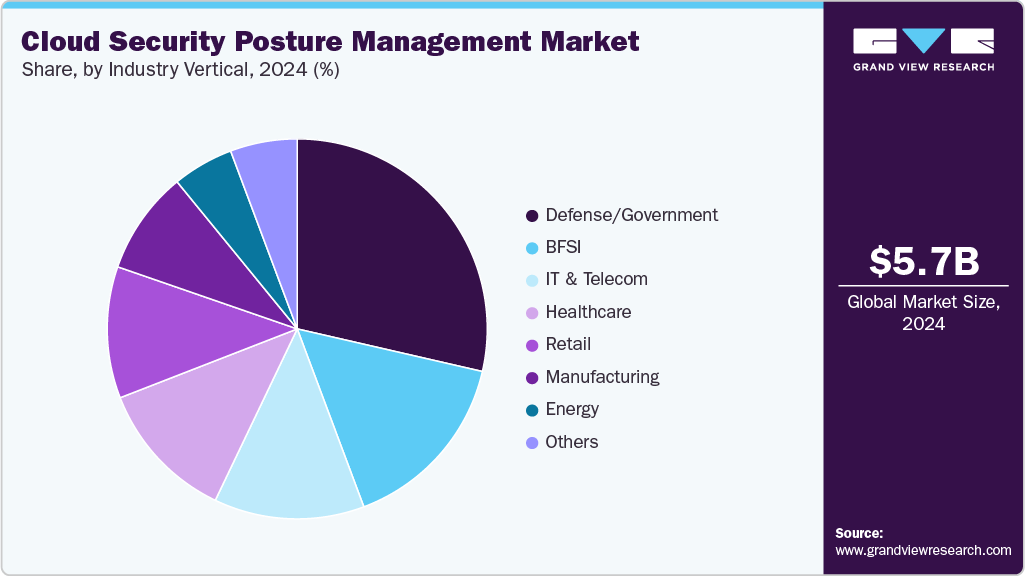
Based on vertical, the defense/government segment led the market with the largest revenue share of 28.5% in 2025. As defense/government organizations increasingly transition to cloud-based infrastructures to improve agility and efficiency, protecting classified and sensitive information becomes paramount. CSPM solutions offer specialized security capabilities, continuous monitoring, and automated risk assessments, empowering these organizations to comply with stringent security protocols and regulations. CSPM solutions play a vital role in safeguarding national security, sensitive data, and critical assets for defense/government entities by providing real-time visibility into their cloud environments and proactively identifying and mitigating security risks.
 To learn more about this report, Download Free Sample Report
 The healthcare segment is expected to register the fastest CAGR from 2026 to 2033. Healthcare organizations migrate to the cloud to enhance collaboration and scalability, ensuring that the security and privacy of patient information are of utmost importance. CSPM solutions offer specialized tools for continuous monitoring and analysis, allowing healthcare providers to proactively detect and address security vulnerabilities, misconfigurations, and compliance gaps in their cloud environments. By meeting stringent data protection regulations and safeguarding patient confidentiality, CSPM plays a vital role in fortifying the healthcare industry's cybersecurity and maintaining the trust and confidence of patients and stakeholders.
Regional Insights
North America dominated the global cloud security posture management market with the largest revenue share of 40.5% in 2025. North America is a global hub for technological innovation and digital transformation, with many businesses and enterprises leveraging cloud services. As more organizations migrate their workloads to the cloud, the demand for robust cloud security measures, such as CSPM solutions, has grown exponentially. Additionally, the region faces a higher frequency of cyber threats and data breaches, which has heightened the urgency for comprehensive cloud security. High-profile security incidents have made businesses and consumers more aware of the risks associated with cloud computing, leading to an increased focus on strengthening cybersecurity measures, including CSPM.
 To learn more about this report, Download Free Sample Report
 U.S. Cloud Security Posture Management Market Trends
The cloud security posture management market in the U.S. held the largest share in the North America region in 2025. The U.S. market is also witnessing a significant increase in cybersecurity threats, specifically targeting cloud assets. Threat actors are evolving their tactics to exploit cloud-specific vulnerabilities, such as over-permissioned identities, insecure APIs, and exposed storage buckets. These threats are often difficult to detect using traditional security tools designed for on-premises infrastructure. CSPM platforms address this challenge by offering cloud-native capabilities that are tailored to the unique risks of public, private, and hybrid cloud environments. They use automation and advanced analytics to detect anomalies, enforce least-privilege access policies, and respond quickly to threats. This advanced functionality appeals to U.S. organizations that require proactive, scalable defense mechanisms to protect their expanding cloud footprints.
Europe Cloud Security Posture Management Market Trends
The cloud security posture management industry in Europe is expected to grow during the forecast period. The growth of remote work and decentralized workforces across Europe has highlighted the need for scalable, cloud-native security solutions that are not dependent on traditional perimeter-based architectures. CSPM tools, by design, operate natively in cloud environments and support security postures that extend across geographies and user devices. They allow IT and security teams to maintain governance and compliance regardless of where employees or cloud workloads are located. This is particularly crucial for organizations with operations spanning multiple European countries. The remote work paradigm has permanently shifted how businesses approach security, and CSPM has emerged as a vital component in maintaining control and reducing risk in this new landscape.
The cloud security posture management industry in Germany is expected to grow during the forecast period. Germany’s advanced manufacturing sector, a cornerstone of its economy, is undergoing a digital transformation through initiatives such as Industrie 4.0. As manufacturers integrate Internet of Things (IoT) devices, cloud analytics, and AI-driven automation into their production environments, the underlying IT infrastructure becomes more exposed to potential cyber risks. CSPM solutions provide the necessary oversight to manage this expanded threat surface, particularly by securing cloud-based operational data and ensuring role-based access to sensitive systems. The ability of CSPM tools to integrate with DevOps workflows and enforce secure configurations as code is also particularly valued in this technologically sophisticated and innovation-driven industrial context.
Asia Pacific Cloud Security Posture Management Market Trends
The Asia Pacific cloud security posture management industry is expected to be the fastest-growing segment, with a CAGR of 15.8% over the forecast period. The region is experiencing rapid digital transformation and cloud adoption across various industries, including finance, healthcare, manufacturing, and e-commerce. As businesses in Asia Pacific leverage cloud services for enhanced agility and scalability, securing their cloud environments becomes paramount, driving the demand for CSPM solutions. Moreover, the region has become a hotspot for cyber threats and attacks. With the growing number of cyber adversaries targeting organizations in the region, there is a heightened awareness of the importance of robust cloud security measures. CSPM tools offer continuous monitoring and real-time threat detection, enabling businesses to proactively identify and mitigate security risks, protecting their critical data and applications from potential breaches.
The cloud security posture management industry in China is projected to grow during the forecast period. China’s booming e-commerce, fintech, and internet service sectors further amplify the demand for robust cloud security management. These industries operate at a massive scale, with dynamic infrastructures that process vast amounts of user data and financial transactions. CSPM platforms support such environments by enabling real-time inventory and configuration tracking, maintaining governance over access controls, and securing APIs and microservices. As these businesses expand both domestically and internationally, maintaining a consistent security posture becomes increasingly complex, and CSPM serves as a core enabler of that stability.
Key Cloud Security Posture Management Company Insights
Some of the key companies operating in the market are Microsoft Corporation and Palo Alto Networks, Inc., among others are some of the leading participants in the cloud security posture management industry.
-
Microsoft Corporation is a global technology company specializing in personal computer software and office productivity suites. One major area of focus is Cloud Security Posture Management (CSPM), which involves the continuous assessment and improvement of cloud infrastructure to identify misconfigurations and minimize security risks. Microsoft addresses CSPM through its Azure Security Center and Microsoft Defender for Cloud, which offers automated security recommendations, compliance monitoring, and real-time threat detection across multi-cloud environments.
-
Palo Alto Networks, Inc. is a cybersecurity company providing advanced security solutions to enterprises, governments, and service providers worldwide. A core component of Palo Alto Networks' modern offerings is Cloud Security Posture Management (CSPM), which plays a vital role in securing cloud-native environments. Through its Prisma Cloud platform, the company delivers industry-leading CSPM capabilities that help organizations continuously monitor their cloud configurations and enforce security best practices.
Aqua Security Software Ltd. and Lacework are some of the emerging market participants in the cloud security posture management market.
-
Aqua Security Software Ltd. is a cybersecurity company specializing in protecting cloud-native applications and infrastructure. Aqua Security's Real-Time Cloud Security Posture Management (CSPM) solution is designed to provide continuous visibility and assessment of cloud security risks. It supports major cloud platforms such as AWS, Azure, Google Cloud, and Oracle Cloud. The CSPM tool identifies misconfigurations, compliance violations, and potential vulnerabilities in real-time, enabling organizations to prioritize and remediate critical issues promptly.
-
Palo Alto Networks, Inc. is a cybersecurity company providing advanced security solutions to enterprises, governments, and service providers worldwide. A core component of Palo Alto Networks' modern offerings is Cloud Security Posture Management (CSPM), which plays a vital role in securing cloud-native environments. Through its Prisma Cloud platform, the company delivers industry-leading CSPM capabilities that help organizations continuously monitor their cloud configurations and enforce security best practices.
Key Cloud Security Posture Management Companies:
The following key companies have been profiled for this study on the cloud security posture management market.
-
Aqua Security Software Ltd.
-
Armor Defense Inc.
-
Check Point Software Technologies Ltd
-
Cloudflare, Inc.
-
CrowdStrike
-
Lacework
-
McAfee, LLC
-
Microsoft Corporation
-
NetApp, Inc.
-
Palo Alto Networks, Inc.
-
Qualys, Inc.
-
SentinelOne
-
Sophos Ltd.
-
Trend Micro Incorporated
Competitive Benchmarking
Category
Operating Strategies
Competitive Edge
Weakness
Mature Players (Microsoft, Palo Alto Networks, Check Point Software Technologies, Cloudflare, CrowdStrike, McAfee, Qualys, Trend Micro, Sophos, and NetApp)
- Expand unified security platforms combining CSPM, CNAPP, endpoint protection, network security, and SIEM/XDR capabilities into integrated enterprise security ecosystems.
- Strengthen cloud-native security offerings through hyperscaler partnerships (AWS, Azure, GCP) and AI-driven threat detection capabilities across multi-cloud environments.
- Strong global enterprise customer base with deep penetration in regulated industries such as BFSI, government, and healthcare.
- Broad cybersecurity portfolios enabling end-to-end visibility across cloud, endpoint, network, and application security layers.
- High product complexity and overlapping security toolsets can create integration challenges for customers.
- Premium pricing and enterprise-focused models reduce penetration in cost-sensitive SME segments.
Emerging Players (Aqua Security, Armor Defense, Lacework, and SentinelOne)
- Focus on cloud-native security, CSPM-to-CNAPP evolution, workload protection, and DevSecOps-integrated security models.
- Emphasize automation, AI-driven vulnerability detection, and lightweight deployment models tailored for modern cloud environments.
- High innovation speed in cloud-native security architecture and rapid adoption of DevSecOps-first approaches.
- Strong specialization in niche areas such as container security, workload protection, and cloud misconfiguration detection.
- Limited global sales reach and smaller enterprise footprint compared to established cybersecurity leaders.
- Dependence on hyperscaler ecosystems and partnerships for large-scale enterprise adoption.
Recent Developments
-
In February 2025, Check Point Software Technologies Ltd. partnered with Wiz to tackle the growing challenges enterprises face in securing hybrid cloud environments. This collaboration aims to close the persistent gap between cloud network security and Cloud Native Application Protection Platforms (CNAPP) through deep technological integration and a strategic business alliance. The result is a unified, industry-leading security solution that offers a comprehensive and holistic approach.
-
In October 2024, Cognizant partnered with Palo Alto Networks to provide cybersecurity solutions and services to enterprises across various industries. Through this collaboration, Cognizant will strengthen its capabilities and expand its offerings across Palo Alto Networks' AI-powered platforms, including the Precision AI-driven Network Security Platform, Code-to-Cloud Platform, and Security Operations Platform. The joint effort is focused on helping clients streamline their cybersecurity infrastructure by consolidating tools across different functions, thereby reducing complexity and enhancing overall security through a platform-based approach.
-
In August 2024, SentinelOne and Google Cloud are deepening their collaboration to deliver enhanced enterprise cyber defense. By combining SentinelOne’s advanced AI-powered autonomous endpoint protection with Google Cloud’s robust threat intelligence, the partnership enables organizations to improve their security posture significantly.
-
In April 2023, Qualys, Inc., partnered with Cowbell to integrate real-time attack surface intelligence from Qualys’ External Attack Surface Management into Cowbell’s cyber risk assessment for insurance purposes. This collaboration allows Cowbell to enhance its existing suite of risk assessment tools by incorporating data from Qualys EASM. As a result, customers seeking standalone cyber insurance coverage from Cowbell will gain access to an External Attack Surface assessment that identifies risks, vulnerabilities, and security misconfigurations and provides a comprehensive view of their cyber risk posture.
Cloud Security Posture Management Market Report Scope
Report Attribute
Details
Market size in 2025
USD 7.4 billion
Estimated market size in 2026
USD 8.3 billion
Projected market size by 2033
USD 21.1 billion
Growth rate
CAGR of 14.2% from 2026 to 2033
Base year for estimation
2025
Historical data
2021 - 2024
Forecasts period
2026 - 2033
Quantitative units
Revenue in USD million/billion and CAGR from 2026 to 2033
Report coverage
Revenue forecasts, company market share analysis, competitive landscape, growth factors, and trends
Segments covered
Component, Cloud Service Model, Cloud Type, Enterprise Size, Vertical, and Region
Regional scope
North America; Europe; Asia Pacific; Latin America; MEA
Country scope
U.S.; Canada; Mexico; Germany; UK; France; Italy; Spain; China; Japan; India; South Korea; Australia; Brazil; Saudi Arabia; South Africa; UAE
Key companies profiled
Aqua Security Software Ltd.; Armor Defense Inc.; Check Point Software Technologies Ltd; Cloudflare, Inc.; CrowdStrike; Lacework; McAfee, LLC; Microsoft Corporation; NetApp, Inc.; Palo Alto Networks, Inc.; Qualys, Inc.; SentinelOne; Sophos Ltd.; Trend Micro Incorporated
Customization scope
Free report customization (equivalent to up to 8 analysts' working days) with purchase. Addition or alteration to country, regional & segment scope.
Pricing and purchase options
Avail customized purchase options to meet your exact research needs. Explore purchase options
Global Cloud Security Posture Management Market Report Segmentation
This report forecasts revenue growth at global, regional, and country levels and provides an analysis of the latest industry trends in each of the sub-segments from 2021 to 2033. For this study, Grand View Research has segmented the global cloud security posture management market report based on component, cloud service, enterprise size, cloud, vertical, and region.
-
Component Outlook (Revenue, USD Billion, 2021 - 2033)
-
Solution
-
Services
-
-
Cloud Service Outlook (Revenue, USD Billion, 2021 - 2033)
-
SaaS
-
IaaS
-
PaaS
-
-
Enterprise Size Outlook (Revenue, USD Billion, 2021 - 2033)
-
Large Enterprises
-
Small and Medium Enterprises (SMEs)
-
-
Cloud Outlook (Revenue, USD Billion, 2021 - 2033)
-
Public
-
Private
-
Hybrid
-
-
Vertical Outlook (Revenue, USD Billion, 2021 - 2033)
-
Retail
-
Healthcare
-
IT & Telecom
-
BFSI
-
Defense/Government
-
Manufacturing
-
Energy
-
Others
-
-
Regional Outlook (Revenue, USD Billion, 2021 - 2033)
-
North America
-
U.S.
-
Canada
-
Mexico
-
-
Europe
-
Germany
-
UK
-
France
-
-
Asia Pacific
-
China
-
India
-
Japan
-
South Korea
-
Australia
-
-
Latin America
-
Brazil
-
-
Middle East & Africa
-
UAE
-
Saudi Arabia
-
South Africa
-
-
Research Methodology
The cloud security posture management market figures in this report are based on a proven research process that combines executive interviews with secondary research from proprietary databases, company filings, and recognized regulatory and institutional sources. Market size is built through value-chain sizing - reconciling supply-side and demand-side estimates - and triangulated with bottom-up and top-down approaches. Every estimate passes multiple levels of expert validation before publication, with each cloud security posture management segment quantified using the revenue-capture definitions in the table below.
Segment Definition
Segment - Component
Revenue Capture Definition
Solution
Revenue is generated through CSPM software platforms that provide continuous cloud security monitoring, configuration management, compliance tracking, risk assessment, and automated remediation across cloud environments.
Services
Revenue is earned through consulting, implementation, integration, managed cloud security services, compliance advisory, and ongoing optimization of CSPM platforms.
Segment - Cloud Service Model
Revenue Capture Definition
SaaS
Revenue is captured through subscription-based CSPM platforms delivered via SaaS, offering continuous monitoring, policy enforcement, and automated compliance management.
IaaS
Revenue is generated through securing infrastructure layers in cloud environments, including virtual machines, storage, and network configurations within CSPM frameworks.
PaaS
Revenue is earned through securing application development platforms, APIs, and cloud-native services by monitoring misconfigurations and enforcing security policies in development environments.
Segment - Cloud Type
Revenue Capture Definition
Public
Revenue is generated through CSPM solutions securing workloads deployed on public cloud platforms like AWS, Azure, and Google Cloud, focusing on compliance and configuration management.
Private
Revenue is earned through CSPM tools securing private cloud environments, ensuring internal infrastructure compliance, data protection, and governance controls.
Hybrid
Revenue is captured through unified CSPM platforms managing security posture across both public and private cloud infrastructures, enabling centralized visibility and governance.
Segment - Enterprise Size
Revenue Capture Definition
Large Enterprises
Revenue is earned through enterprise-grade CSPM platforms with advanced analytics, multi-cloud governance, automation, integration with SOC tools, and large-scale compliance management.
Small and Medium-sized Enterprises (SMEs)
Revenue is generated through simplified, subscription-based CSPM solutions offering automated compliance checks, basic security monitoring, and cost-effective cloud risk management.
Segment - Vertical
Revenue Capture Definition
IT & Telecom
Revenue is generated through securing cloud-native applications, telecom infrastructure, network workloads, and multi-cloud environments with continuous posture management.
Retail
Revenue is captured through securing e-commerce platforms, customer data, payment systems, and cloud-based retail applications.
BFSI
Revenue is earned through ensuring compliance, data protection, and risk management across cloud-based banking, insurance, and financial platforms.
Healthcare
Revenue is generated through securing electronic health records, telehealth systems, and healthcare cloud applications while ensuring regulatory compliance.
Defense/Government
Revenue is captured through securing sensitive government workloads, defense systems, and sovereign cloud environments with strict compliance and governance requirements.
Manufacturing
Revenue is earned through securing cloud-connected industrial systems, IoT platforms, and supply chain applications.
Energy
Revenue is generated through protecting cloud-based energy management systems, smart grids, and critical infrastructure platforms.
Others
Revenue is captured from industries such as education, logistics, transportation, and media, where CSPM solutions secure cloud workloads and ensure compliance.
Estimation Model
Layer
Question
Analysis
Cloud Adoption Layer (Total Addressable Market)
Who can potentially need CSPM solutions?
Estimate all organizations using or transitioning to cloud (public, private, hybrid), including enterprises, SMEs, and public sector entities exposed to cloud security risks.
Cloud Complexity & Readiness Layer (Serviceable Market)
Who can technically adopt CSPM?
Narrow to organizations with multi-cloud/hybrid environments, regulated data workloads, and sufficient cloud maturity requiring continuous security posture monitoring.
Security Adoption Layer (Active Market)
Who actively uses CSPM?
Includes enterprises implementing CSPM tools for misconfiguration detection, compliance monitoring, risk assessment, and integration with DevSecOps and cloud security stacks.
Monetization Layer (Revenue Realization)
How is revenue generated?
Revenue from CSPM SaaS subscriptions, cloud security platforms, compliance automation, managed services, and enterprise-wide multi-cloud governance solutions.
Delivered Customizations
This report has been delivered with the following In-depth customizations
CLIENT REQUEST
CUSTOMIZATION DELIVERED
VALUE ADDS
Cloud Security Posture & Risk Visibility Analysis
Conducted detailed assessment of CSPM adoption across multi-cloud environments, misconfiguration risks, compliance automation trends, and DevSecOps integration patterns across enterprises.
Help stakeholders identify cloud security maturity levels, risk exposure patterns, and evolving enterprise security priorities.
Industry-Specific Cloud Security Demand Assessment
Analyzed CSPM demand across BFSI, healthcare, government, retail, manufacturing, IT & telecom, and energy sectors, focusing on compliance requirements, data sensitivity, and threat exposure levels.
Enables targeted go-to-market strategies by identifying high-risk industries and compliance-driven adoption opportunities.
Regional Cloud Security & CNAPP Transition Analysis
Delivered insights on CSPM-to-CNAPP evolution, cloud-native security adoption, and regional cloud security investments across North America, Europe, and Asia Pacific.
Supports strategic planning by highlighting high-growth regions, security modernization trends, and cloud-native security adoption trajectories.
Frequently Asked Questions About This Report
The global cloud security posture management market size was valued at USD 7.4 billion in 2025 and is estimated at USD 8.3 billion for 2026.
Some key players operating in the market include Aqua Security Software Ltd., Armor Defense Inc., Check Point Software Technologies Ltd, Cloudflare, Inc., CrowdStrike, Lacework, McAfee, LLC, Microsoft Corporation, NetApp, Inc., Palo Alto Networks, Inc., Qualys, Inc., SentinelOne, Sophos Ltd., Trend Micro Incorporated.
Factors such the increasing cloud security concerns and the regulatory standards are also pivotal in driving the cloud security posture management market's growth.
Large enterprises segment held the largest share (over 66.0%) in 2025, while the small and medium-sized enterprises is the fastest-growing segment.
The global cloud security posture management market is expected to grow at a CAGR of 14.2% from 2026 to 2033, reaching USD 21.1 billion by 2033.
North America dominated with a 40.5% revenue share in 2025.
Asia Pacific is the fastest-growing region over the forecast period.
The solution segment led with a 68.3% revenue share in 2025.
The SaaS segment led with a 40.5% revenue share in 2025.
The public segment led with a 52.0% revenue share in 2025, while the hybrid segment is the fastest-growing type.
About the Author(s)
Network Security Research Team
Technology · Network SecurityThis report was authored by the network security research team at Grand View Research - comprising two research analysts, one senior research analyst, and one industry expert - with specialized expertise in the network security segment of the technology industry. All findings are based on proprietary technology databases, executive interviews, and regulatory analysis, subject to internal peer review prior to publication.
Last Updated:
Speak to Analyst

Customize this report to your needs - add regions, segments, or data points, with 20% free customization.
Or view our licence options:


ISO 9001:2015 & 27001:2022 Certified
We are GDPR and CCPA compliant! Your transaction & personal information is safe and secure. For more details, please read our privacy policy.


