
- Home
- »
- Network Security
- »
-
Zero Trust Architecture Market Size Report, 2026-2033GVR Report cover

Zero Trust Architecture Market (2026 - 2033)
Size, Share & Trends Analysis Report By Component (Solution, Services), By Security Type (Network Security, Data Security, Endpoint Security), By Authentication Type, By End Use, By Region, And Segment Forecasts
Market Size, 2025
$39.1BMarket Estimate, 2026
$44.8BMarket Forecast, 2033
$136.6BCAGR, 2026–2033
17.3%Zero Trust Architecture Market Summary
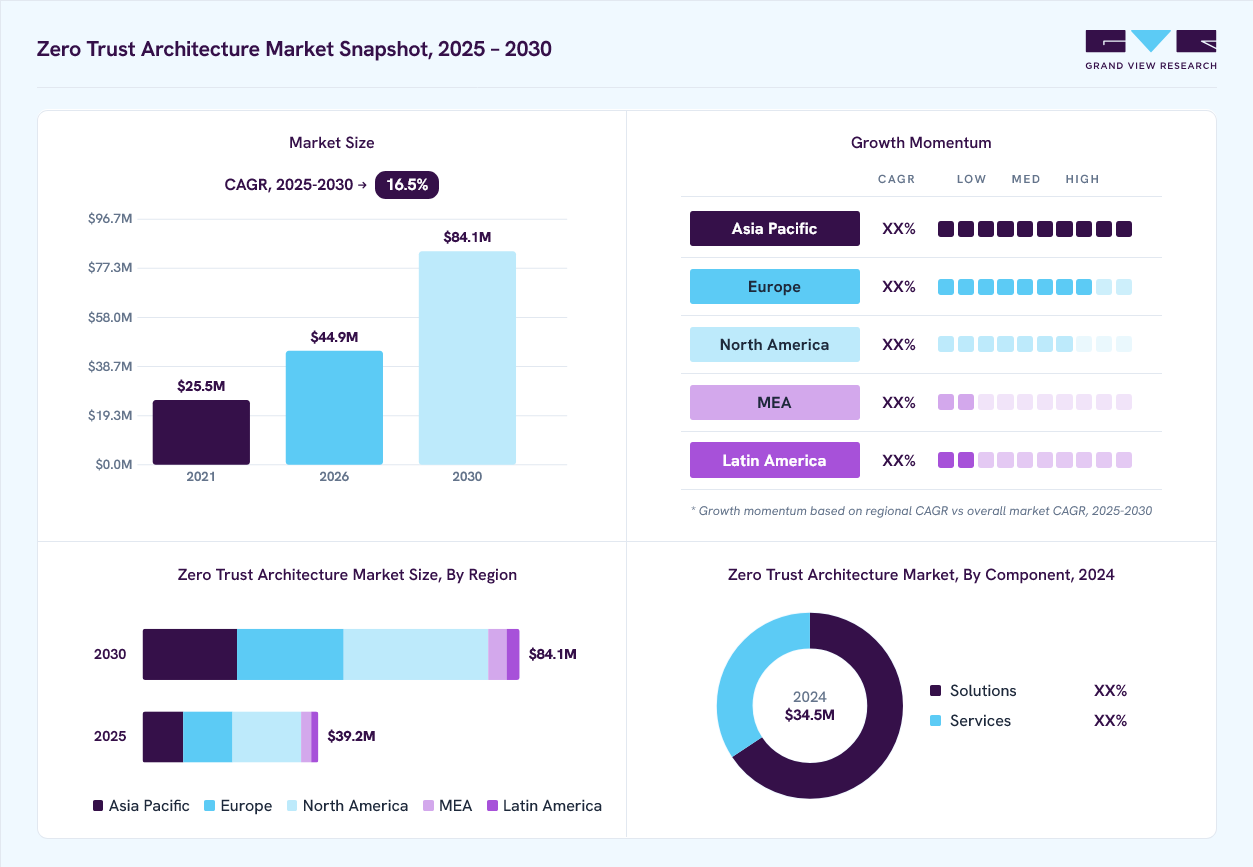
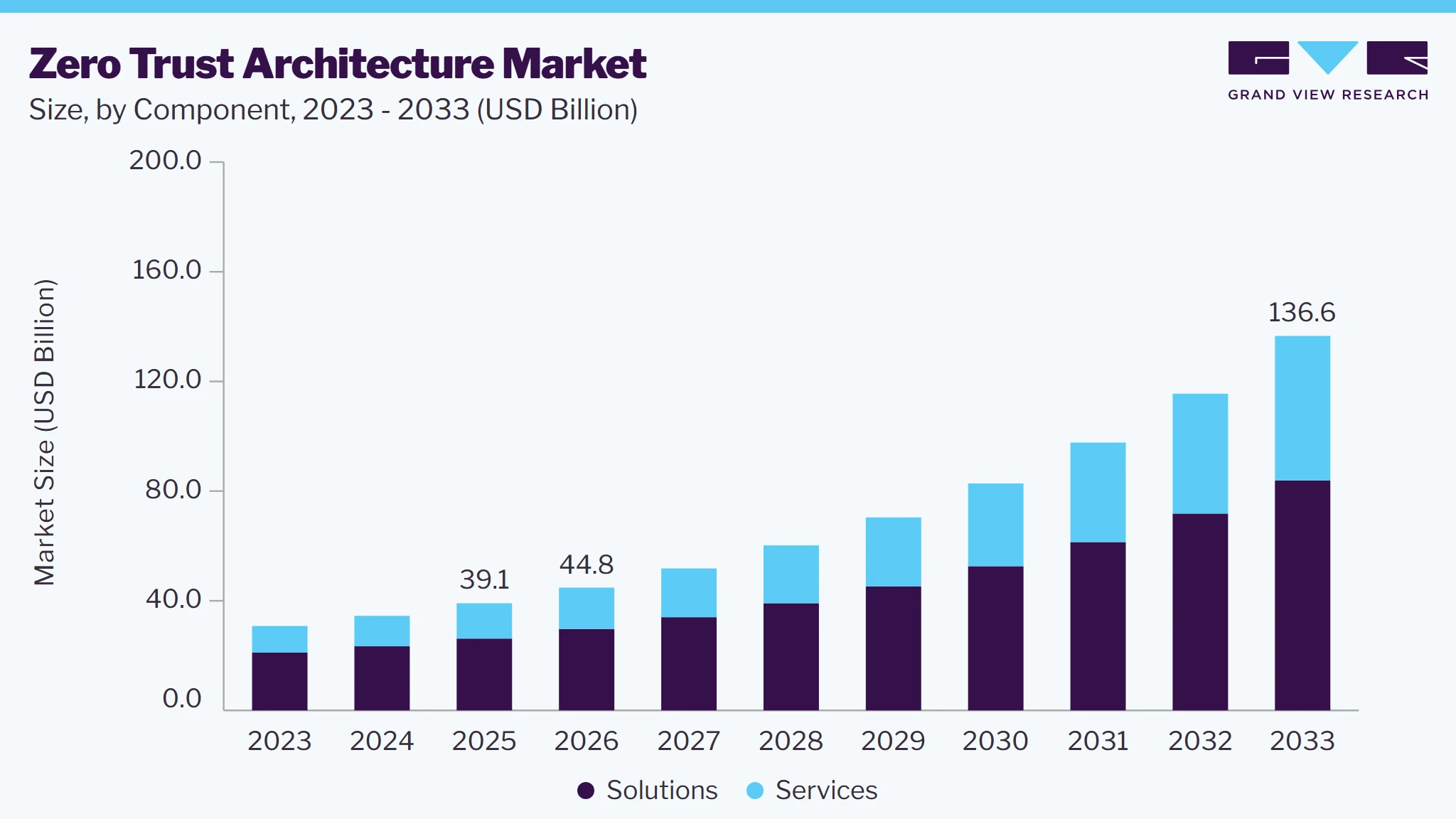
The global zero trust architecture market size was valued at USD 39.1 billion in 2025 and is projected to grow from USD 44.8 billion in 2026 to USD 136.6 billion by 2033, at a CAGR of 17.3% from 2026 to 2033. The North America dominated the market, accounting for a revenue share of 40.1% in 2025. The rising frequency and sophistication of cyberattacks, including ransomware, phishing, and insider threats, are accelerating the adoption of Zero Trust Architecture (ZTA).
 Source: Grand View Research, IR Documents, Primary Interviews, Paid DatabasesTo learn more about this report,
 Download Free Sample Report
 Key Market Trends & Insights
- By component: The solutions segment dominated the market, with a revenue share of 67.0% in 2025.
- By security Type: The network security segment dominated the market, with a revenue share of 32.2% in 2025.
- By authentication Type: The multi-factor authentication segment dominated the market in 2025.
- By organization Size: The large enterprises segment dominated the market in 2025.
- By end use: The BFSI segment held the largest market share in 2025.
Regional Highlights
- Largest regional market: North America (40.1% revenue share, 2025)
- Fastest-growing regional market: Asia Pacific (highest CAGR, 2026-2033)
- By country: The U.S. held the largest market share in 2025.
Market Size & Forecast
- Market size in 2025: USD 39.1 Billion
- Estimated market size in 2026: USD 44.8 Billion
- Projected market size by 2033: USD 136.6 Billion
- CAGR (2026-2033): 17.3%
Three ways to get this report
Buy it, customize it, or ask a question.Ask an Analyst
A direct answer, usually in 1 working day
- AccessReport author, directly
- Reply timeWithin 1 working day
- No sales callDirect answer only
- FormatEmail reply
- CostFree, no cost
Get the Full Report
What the study covers
- FormatsPDF · Excel · Dashboard
- Timeline2026–2033 annual, 2025 base
- Coverage20+ countries, 5 regions
- Companies10+ key players profiled
Customize the Report
20% free customization
- IncludeCountries, segments, points
- TailorTo your product definition
- ExtendDeeper competitor detail
- OrA fully bespoke study
- Turnaround5–10 working days
As traditional perimeter-based security becomes less effective in increasingly distributed IT environments, organizations are implementing identity-centric, continuous verification models to minimize unauthorized access and reduce cyber risk. This trend is particularly strong across sectors such as finance, healthcare, and government, where protecting sensitive data is a top priority.
As attackers become more advanced and networks more dispersed, enterprises can no longer rely on static perimeter defenses. Zero trust provides a dynamic, identity-centric approach that restricts access based on user roles, context, and real-time behavior, significantly reducing the attack surface. Organizations in sectors such as finance, healthcare, and government, which are often targeted due to the sensitivity of their data, are especially turning to ZTA to mitigate these evolving threats.
 To learn more about this report, Download Free Sample Report
 The accelerated adoption of remote and hybrid work models has also made traditional security frameworks obsolete. With users accessing enterprise resources from personal devices and remote locations, IT teams face increased challenges in maintaining secure access and visibility. Zero trust architecture addresses this by authenticating users and devices continuously and enforcing granular access policies regardless of network location. This has become essential for businesses seeking to ensure productivity and collaboration while maintaining security in a decentralized workforce.
In addition, the rise of identity and access management (IAM), endpoint detection and response (EDR), and security information and event management (SIEM) tools is complementing the zero trust ecosystem. These solutions integrate seamlessly with zero trust models to provide real-time risk assessment, behavioral analytics, and policy enforcement. As more organizations adopt a layered security approach, ZTA is increasingly seen not as a product but as a strategy built on integrated tools and processes that support continuous verification and adaptive trust.
Furthermore, the increasing focus on digital transformation and secure modernization of IT infrastructure is encouraging businesses to shift to zero trust models. With initiatives like smart cities, IoT-enabled manufacturing, and cloud-native development gaining momentum, securing access to distributed, real-time systems is crucial. Zero trust enables this by allowing context-aware access control, segmentation, and visibility across digital assets. As a result, enterprises view ZTA as a long-term investment in resilience, scalability, and trust in an era of digital complexity.
Market Dynamics
The Zero Trust Architecture (ZTA) market is experiencing strong growth as organizations accelerate cloud adoption, hybrid work models, and digital transformation initiatives. Enterprises are shifting from traditional perimeter-based security to identity-first security frameworks that continuously authenticate users, devices, and workloads before granting access. The increasing adoption of multi-cloud environments, software-as-a-service (SaaS) applications, and remote access solutions is further driving demand for zero trust platforms that provide unified identity management, continuous monitoring, and automated policy enforcement. In addition, governments and regulatory bodies are promoting zero trust strategies to strengthen national cybersecurity and protect critical infrastructure, encouraging wider adoption across both public and private sectors.
Artificial intelligence (AI) and automation are emerging as key trends reshaping the zero-trust architecture market. Vendors are integrating AI-driven threat detection, behavioral analytics, and adaptive access controls to identify anomalous activities in real time and automate security responses. The convergence of zero trust with extended detection and response (XDR), security service edge (SSE), secure access service edge (SASE), and identity threat detection and response (ITDR) is enabling organizations to build more comprehensive and resilient cybersecurity ecosystems. As cyber threats continue to evolve and compliance requirements become more stringent, enterprises are increasingly investing in integrated, cloud-native zero trust solutions that improve security visibility, operational efficiency, and regulatory compliance.
The increasing frequency and sophistication of cyberattacks, including ransomware, phishing, insider threats, business email compromise (BEC), and supply chain attacks, have made cybersecurity a strategic priority for organizations worldwide. As enterprises expand their digital footprint through cloud computing, hybrid work, Internet of Things (IoT), and interconnected applications, traditional perimeter-based security models are becoming increasingly ineffective. This has accelerated the shift toward Zero Trust Architecture (ZTA), which continuously verifies every user, device, and application before granting access, significantly reducing the risk of unauthorized access and lateral movement within networks.
In addition, growing regulatory requirements related to data privacy and cybersecurity are encouraging organizations to adopt identity-centric security frameworks. Industries such as banking, healthcare, government, manufacturing, and critical infrastructure are investing heavily in zero trust solutions to protect sensitive information, secure remote access, and strengthen cyber resilience. Continuous authentication, least-privilege access, micro-segmentation, and real-time monitoring have become essential capabilities, making zero trust one of the fastest-growing cybersecurity approaches across enterprise environments.
Despite its growing adoption, implementing Zero Trust Architecture remains a complex and resource-intensive process for many organizations. Transitioning from traditional security models requires extensive modernization of identity and access management (IAM), network infrastructure, endpoint security, and application architectures. Organizations operating legacy systems often encounter compatibility issues, making integration with modern zero trust platforms challenging and increasing deployment timelines.
Furthermore, the implementation of zero trust demands skilled cybersecurity professionals capable of designing, deploying, and managing identity-centric security policies. The shortage of experienced cyberse/curity talent, combined with high upfront investment costs for software, integration, training, and continuous monitoring, creates significant barriers, particularly for small and medium-sized enterprises (SMEs). These challenges may delay adoption despite the long-term security and operational benefits offered by zero trust frameworks.
The rapid adoption of artificial intelligence (AI), machine learning (ML), and cloud-native security technologies is creating significant growth opportunities for the Zero Trust Architecture market. Modern zero trust platforms increasingly leverage AI-powered behavioral analytics, continuous risk assessment, and automated threat detection to identify suspicious activities and dynamically adjust access policies in real time. These capabilities enable organizations to improve security effectiveness while reducing manual intervention and operational complexity.
At the same time, the continued migration toward multi-cloud environments, Software-as-a-Service (SaaS) applications, and hybrid work models is driving demand for scalable, cloud-native zero trust solutions. The growing convergence of zero trust with Secure Access Service Edge (SASE), Security Service Edge (SSE), Extended Detection and Response (XDR), and Identity Threat Detection and Response (ITDR) is enabling organizations to build unified cybersecurity ecosystems. As enterprises prioritize digital transformation and cyber resilience, vendors offering integrated, AI-enabled zero trust platforms are well positioned to capitalize on expanding market opportunities across both developed and emerging economies.
Analyst Perspective
The Zero Trust Architecture (ZTA) market is gaining strong momentum as organizations adopt identity-centric and continuously verified security frameworks. Growth is driven by cloud adoption, hybrid work environments, and increasingly sophisticated cyber threats. Enterprises are moving beyond traditional perimeter-based security toward least-privilege access, continuous authentication, and real-time monitoring. Looking ahead, AI, behavioral analytics, automation, and cloud-native security solutions are expected to strengthen the market. However, implementation complexity and high deployment costs remain key challenges, while demand for scalable and proactive cybersecurity frameworks is expected to support long-term growth.
Component Insights
Based on component, the solutions segment led the market with the largest revenue share of 67.0% in 2025. The rising need for network micro-segmentation and lateral movement prevention is also propelling the solutions segment. Traditional flat networks allow attackers to move easily once inside a perimeter. Zero trust solutions with micro-segmentation capabilities divide networks into isolated zones, restricting access between them and containing potential breaches. This approach is increasingly favored in data-sensitive environments such as financial services, healthcare, and government, where the containment of threats is critical to minimizing operational and reputational damage.
The services segment is anticipated to grow at the highest CAGR during the forecast period. The rise in demand for managed security services drives the services segment growth. As cyber threats become more advanced and constant monitoring becomes essential, many organizations, especially small and medium-sized enterprises (SMEs), are outsourcing their zero trust operations to third-party providers. These managed services include real-time threat detection, incident response, access policy enforcement, and performance optimization. Outsourcing zero trust management helps organizations maintain robust security postures without the need for extensive in-house resources, while gaining access to the latest security technologies and threat intelligence.
Security Type Insights
Based on the security type, the network security segment led the market with the largest revenue share of 32.2% in 2025. The surge in remote work and cloud adoption has further accelerated the demand for zero trust network security solutions. Employees now access corporate resources from various devices and locations, often bypassing traditional VPNs and perimeter firewalls. In response, organizations are implementing software-defined perimeters (SDPs) and secure access service edge (SASE) technologies, which provide dynamic, identity-based network access control. These tools enforce zero trust principles by verifying user identity, device posture, and access context before permitting connections to authentication types or data.
The cloud security segment is expected to register the highest CAGR from 2026 to 2033. The rising frequency of cloud-related cyberattacks and data breaches is also propelling the cloud security segment of the ZTA market. High-profile incidents involving unauthorized access, credential theft, and misconfigured cloud storage have heightened awareness of cloud vulnerabilities. Zero trust principles reduce the blast radius of such attacks by limiting access on a per-session, per-resource basis and by continuously verifying trust before granting permissions. This approach is especially valuable for sectors like finance, healthcare, and retail, where cloud-hosted customer data and transaction information must be tightly secured.
Authentication Type Insights
Based on the authentication type, the multi-factor authentication segment led the market with the largest revenue share of 86.7% in 2025. A major driver of MFA adoption within the zero trust framework is the widespread inadequacy of password-based security. Passwords remain a weak link in cybersecurity, often reused, easily guessed, or compromised through phishing attacks. Zero trust models require users to prove their identities through multiple authentication methods, something they know (password), something they have (token or smartphone), or something they are (biometrics). By incorporating MFA, organizations significantly reduce the risk of unauthorized access, even if credentials are stolen, making it a first line of defense in any zero trust deployment.
The single-factor authentication segment is expected to register a CAGR of 12.0% from 2026 to 2033. The prevalence of legacy systems and budget constraints, particularly in small to mid-sized organizations or in specific operational environments like manufacturing or education, is driving market growth. These entities may have older authentication types that do not support multi-factor protocols or lack the financial and technical resources to upgrade their identity and access management systems immediately. In the context of zero trust, SFA may still be utilized as an initial step, often combined with additional verification layers elsewhere in the architecture, such as device posture assessments or network behavior analytics, to create a more comprehensive security posture.
Enterprise Size Insights
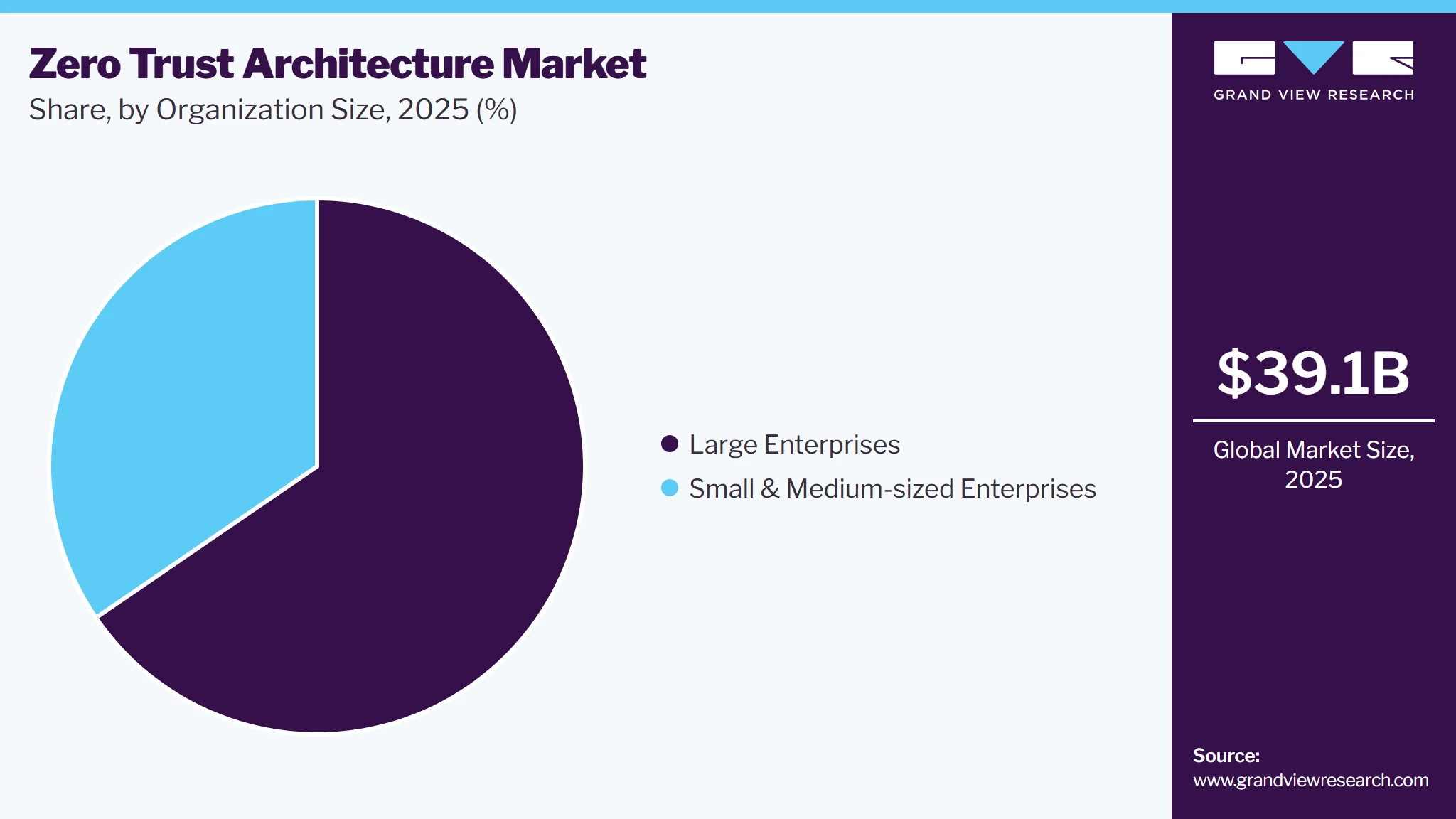
Based on the organization size, the large enterprises segment led the market with the largest revenue share of 65.5% in 2025. The growing emphasis on identity, modernization, and unified identity management is contributing to market growth. Large enterprises typically have thousands of users and identities spanning employees, partners, contractors, and systems. Traditional identity solutions often lead to fragmented visibility and inconsistent policy enforcement. Zero trust architectures emphasize centralized identity management and identity federation across platforms, allowing organizations to maintain tighter control over access permissions and identity verification across the enterprise. This is particularly valuable in achieving both operational efficiency and security compliance.
The small and medium-sized enterprises (SMEs) segment is expected to register the highest CAGR from 2026 to 2033. The need for proactive threat mitigation and business continuity is a crucial driver. Many SMEs cannot afford the financial or reputational damage caused by data breaches or downtime. Zero trust architecture reduces risk by assuming a breach and restricting lateral movement within the network, which can contain incidents more effectively and minimize their impact. As awareness of these benefits grows, SMEs are increasingly recognizing that zero trust is achievable and essential for long-term resilience and growth.
End Use Insights
Based on the end use, the BFSI segment led the market with the largest revenue share of 28.3% in 2025. The shift toward digital banking and the increasing use of cloud technologies in the BFSI sector is another key driver for zero trust adoption. Financial institutions are rapidly adopting cloud-based platforms for operations, customer-facing authentication types, and data storage. While cloud environments offer greater flexibility and scalability, they also introduce new security challenges, such as managing multi-cloud environments and securing remote access to financial systems. Zero trust is particularly effective in these contexts, as it ensures that access to cloud-based services is tightly controlled and continuously monitored. It also supports secure collaboration between internal teams and external partners by enforcing access policies that are based on identity, device health, location, and real-time risk assessment.
 To learn more about this report, Download Free Sample Report
 The healthcare segment is anticipated to register the highest CAGR of 18.3% during the forecast period. The growing adoption of Internet of Medical Things (IoMT) devices is another key driver for the zero trust architecture market in healthcare. IoMT devices, such as connected medical equipment, wearable health monitors, and remote patient monitoring devices, are becoming increasingly prevalent in hospitals, clinics, and patient homes. While these devices offer tremendous benefits in terms of patient care and operational efficiency, they also expand the attack surface for cyber threats. Zero trust architecture is essential to secure these devices, as it requires continuous authentication and validation of each device before it is allowed to access healthcare networks or transmit sensitive data. This approach helps prevent potential vulnerabilities in medical devices from being exploited by attackers.
Regional Insights
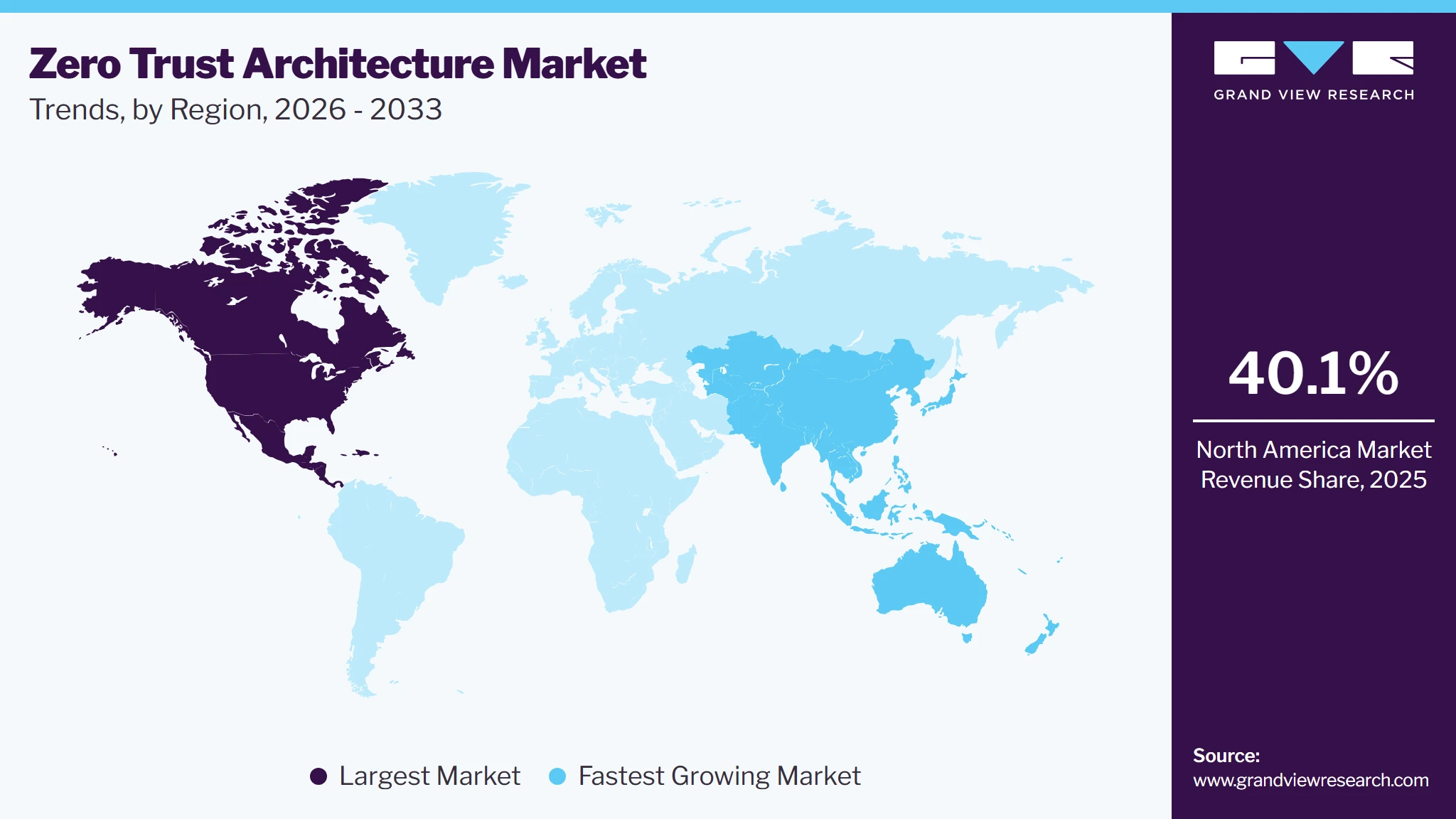
North America dominated the global zero trust architecture market, with the largest revenue share of 40.1% in 2025. The rapid adoption of cloud computing and hybrid IT environments is another significant driver for ZTA in North America. As organizations increasingly rely on cloud services for scalability and flexibility, they face new challenges in securing their distributed environments. Cloud platforms, while offering many advantages, require a shift in security strategy, as traditional perimeter defenses are less effective in these decentralized systems. Zero trust is designed to secure cloud infrastructures by continuously validating access requests based on identity, device health, and user behavior, making it an ideal solution for cloud-first organizations. As more companies migrate to multi-cloud or hybrid cloud environments, zero trust helps provide consistent, granular security across these diverse platforms.
 To learn more about this report, Download Free Sample Report
 U.S. Zero Trust Architecture Market Trends
The Zero Trust Architecture market in the U.S. held the largest share of the North American market in 2025. The increasing focus on insider threats is driving the adoption of the zero trust architecture market. In contrast, external cybercriminals are a major concern; insider threats, whether from employees, contractors, or third-party vendors, also pose significant risks to U.S. organizations. According to various reports, insider threats account for a significant proportion of data breaches, often stemming from human error, negligence, or malicious intent. Zero trust helps mitigate this risk by enforcing strict access controls and ensuring that users are only granted the minimum level of access necessary for their roles. Continuous monitoring and the ability to detect abnormal behavior further enhance the ability to identify and respond to potential insider threats in real time.
Europe Zero Trust Architecture Market Trends
The zero trust architecture market in Europe is expected to grow at a CAGR of 16.7% from 2026 to 2033. The growing adoption of remote work and digital collaboration tools in Europe, accelerated by the COVID-19 pandemic, has further fueled the demand for zero trust architecture. As companies shift to hybrid or fully remote work models, securing remote access to corporate networks and systems has become a top priority. The reliance on personal devices, home networks, and public Wi-Fi for remote work creates a broader attack surface, making traditional network perimeter defenses insufficient. Zero trust architecture ensures that every access request, whether from a remote worker, a contractor, or a third-party service, is verified based on identity, device health, and the specific access needs of the user. By continuously verifying access, zero trust minimizes the risk of unauthorized access, which is particularly critical as European companies increasingly rely on remote work and digital tools.
The zero trust architecture market in Germany is grow during the forecast period. The increasing adoption of IoT (Internet of Things) devices in Germany is also a driving factor for zero trust architecture. IoT devices are becoming more prevalent across industries like manufacturing, healthcare, and smart cities, where they are used to collect and transmit data. However, many IoT devices have inherent security vulnerabilities, which can expose networks to attacks. Zero trust helps address these vulnerabilities by ensuring that every device connecting to the network is continuously authenticated and monitored for security posture. In sectors like manufacturing, where the Industrial Internet of Things (IIoT) is being increasingly deployed, securing IoT devices with a zero trust model is critical to protecting both operational technology (OT) and information technology (IT) systems.
Asia Pacific Zero Trust Architecture Market Trends
The demand for zero trust architecture in the Asia Pacific is expected to register the highest CAGR of 18.0% from 2026 to 2033. Support from managed security service providers (MSSPs) is aiding the adoption of zero trust in the APAC region. Many organizations in APAC, especially small and medium-sized enterprises (SMEs), lack the internal resources or expertise to implement and manage complex security frameworks like zero trust. MSSPs are offering managed zero trust services, providing organizations with the necessary tools, expertise, and support to deploy and maintain these advanced security solutions. This is making zero trust more accessible to businesses of all sizes across the region, enabling them to strengthen their security posture without the need for significant investments in infrastructure or specialized personnel.
India zero trust architecture market is projected to grow during the forecast period. Regulatory compliance is another important factor driving the adoption of zero trust in India. The Indian government has introduced several data protection and privacy laws, such as the Personal Data Protection Bill (PDPB), which is expected to impose stringent requirements on organizations regarding data protection and security. Zero trust architecture is well-suited to help Indian businesses comply with these regulations, as it enforces the principle of least privilege access, continuous monitoring, and detailed auditing. By restricting access to sensitive data and ensuring that only authorized users can interact with critical systems, zero trust aligns with regulatory mandates to protect personal data and mitigate the risk of data breaches. The PDPB and other emerging regulations are pushing Indian businesses to adopt more secure and compliant security measures, driving the growth of zero trust solutions.
Key Zero Trust Architecture Company Insights
Some of the key companies operating in the market Datadog, and Oracle Corporation, among others are some of the leading participants in the zero trust architecture market.
-
Datadog is an American technology company specializing in cloud-scale monitoring and security solutions. In terms of zero trust architecture, Datadog integrates security features into its observability platform to support organizations in implementing zero trust principles. While specific details about Datadog's zero trust architecture are not explicitly outlined in the provided sources, the company's focus on comprehensive monitoring and security solutions suggests that its platform can facilitate the enforcement of least-privilege access controls, continuous authentication, and real-time monitoring of user and device behaviors all key components of a zero trust security model.
-
Oracle Corporation, a global company in enterprise software and cloud computing, has been at the forefront of integrating zero trust architecture (ZTA) into its security offerings. One notable advancement is the Oracle Cloud Infrastructure (OCI) Zero Trust Packet Routing. This service enables organizations to define specific access pathways for data using an intuitive, intent-based policy language. By ensuring that only explicitly permitted traffic can traverse the network, OCI Zero Trust Packet Routing helps prevent unauthorized access and reduces the potential attack surface. This approach decouples security policies from the underlying network architecture, addressing common vulnerabilities associated with network misconfigurations.
Lakeside Software, LLC, and SmartBear Software are some of the emerging market participants in the zero trust architecture market.
-
Lakeside Software is a provider of digital experience monitoring (DEM) and IT operations analytics. Lakeside's flagship product, SysTrack, collects and analyzes data from various endpoints to offer real-time visibility into system performance, user behavior, and authentication type usage. This enables IT teams to proactively address issues, improve resource allocation, and ensure a seamless digital experience for users.
-
SmartBear Software is a prominent provider of software development and quality tools. Through the consolidation of SmartBear, AutomatedQA, and Pragmatic Software, the company has grown to support over 16 million developers, testers, and engineers across more than 32,000 organizations worldwide, including industry leaders like Adobe, JetBlue, FedEx, and Microsoft. SmartBear's product suite encompasses API testing, automated testing, performance monitoring, and code review tools, such as SwaggerHub, TestComplete, Bugsnag, ReadyAPI, Zephyr, and Pactflow. The company's mission is to empower software development teams with tools that ensure end-to-end quality and accelerate the delivery of authentication types.
Key Zero Trust Architecture Companies:
The following key companies have been profiled for this study on the zero trust architecture market.
-
Dynatrace LLC
-
New Relic, Inc.
-
Cisco Systems, Inc.
-
Datadog
-
IBM Corporation
-
SAP SE
-
Oracle Corporation
-
Catchpoint Systems, Inc.
-
Riverbed Technology
-
Lumen Technologies
-
Nexthink
-
Lakeside Software, LLC
-
SmartBear Software
-
Splunk LLC
-
Zscaler, Inc.
Competitive Benchmarking
Category
Operating Strategies
Competitive Edge
Weakness
Mature Players (Cisco Systems, IBM, Oracle, SAP, Splunk, Zscaler, Dynatrace, Datadog)
Focus on end-to-end digital experience and observability platforms integrating APM, cloud monitoring, AI-driven analytics, and IT operations through unified SaaS ecosystems and strategic acquisitions.
Strong global footprint, deep enterprise adoption, scalable cloud-native platforms, and advanced AI/ML-driven insights with strong integration across IT environments.
High cost, complex deployment, and potential vendor lock-in; less suitable for smaller or cost-sensitive organizations.
Emerging Players (New Relic, Catchpoint, Riverbed, Lumen, Nexthink, Lakeside, SmartBear)
Focus on cloud-native, API-first, and lightweight observability tools emphasizing real-time monitoring, user experience analytics, and fast deployment.
High flexibility, faster onboarding, cost-effective solutions, and strong innovation in niche observability and digital experience monitoring.
Limited enterprise-scale presence, narrower product ecosystems, and dependence on third-party integrations for full-stack observability.
Recent Developments
-
In January 2025, Zscaler, Inc., launched its Zero Trust Network Access service. Zscaler Private Access for SAP, powered by the Zscaler Zero Trust Exchange platform, assists SAP customers with on-premise ERP workloads in streamlining and mitigating the risks of cloud migration, while avoiding the complexities and vulnerabilities of traditional VPNs. This integration also offers Zscaler Data Protection for compliance and Digital Experience Monitoring through Zscaler Digital Experience, ensuring an enhanced user experience.
-
In May 2024, Zscaler, Inc. partnered with Google to create a joint zero trust architecture featuring Chrome Enterprise. This robust collaboration combines Zscaler Private Access (ZPA) to deliver secure, zero trust access to private authentication types across various locations and devices, alongside the enhanced threat and data protection capabilities of Chrome Enterprise Premium. Together, they provide customers with a seamless, highly secure private app access solution, leveraging Zscaler’s security expertise and Chrome Enterprise’s advanced security features, all without added complexity.
-
In October 2024, Airtel Business partnered with Zscaler Inc. to launch Airtel Secure Digital Internet, the first fully managed solution built on Zero Trust Architecture. This cutting-edge offering aims to safeguard enterprises from a wide range of cyber threats. Additionally, Airtel has optimized its network performance and reduced latency by incorporating Zscaler's advanced security stack into its Internet Points of Presence.
Zero Trust Architecture Market Report Scope
Report Attribute
Details
Market size in 2025
USD 39.1 billion
Estimated Market size in 2026
USD 44.8 billion
Projected Market size by 2033
USD 136.6 billion
Growth rate
CAGR of 17.3% from 2026 to 2033
Base year for estimation
2025
Historical data
2021 - 2024
Forecasts period
2026 - 2033
Quantitative units
Revenue in USD billion/billion and CAGR from 2026 to 2033
Report coverage
Revenue forecasts, company market share analysis, competitive landscape, growth factors, and trends
Segments covered
Component, Security Type, Authentication Type, Organization Size, End Use, and Region
Regional scope
North America; Europe; Asia Pacific; Latin America; MEA
Country scope
U.S.; Canada; Mexico; Germany; UK; France; Italy; Spain; China; Japan; India; South Korea; Australia; Brazil; Saudi Arabia; South Africa; UAE
Key companies profiled
Dynatrace LLC; New Relic, Inc.; Cisco Systems, Inc.; Datadog; IBM Corporation; SAP SE; Oracle Corporation; Catchpoint Systems, Inc.; Riverbed Technology; Lumen Technologies; Nexthink; Lakeside Software, LLC; SmartBear Software; Splunk LLC; Zscaler, Inc.
Customization scope
Free report customization (equivalent to up to 8 analysts' working days) with purchase. Addition or alteration to country, regional & segment scope.
Pricing and purchase options
Avail customized purchase options to meet your exact research needs. Explore purchase options
Global Zero Trust Architecture Market Segmentation
This report forecasts revenue growth at global, regional, and country levels and provides an analysis of the latest industry trends in each of the sub-segments from 2021 to 2033. For this study, Grand View Research has segmented the zero trust architecture market report based on component, security type, authentication type, enterprise size, end use, and region.
-
Component Outlook (Revenue, USD Billion, 2021 - 2033)
-
Solution
-
Identity and Access Management (IAM)
-
Security Information and Event Management (SIEM)
-
User and Entity Behavior Analytics (UEBA)
-
Zero Trust Data Access (ZTDA)
-
Zero Trust Network Access (ZTNA)
-
Others
-
-
Services
-
Professional Services
-
Managed Services
-
-
-
Security Type Outlook (Revenue, USD Billion, 2021 - 2033)
-
Network Security
-
Data Security
-
Endpoint Security
-
Cloud Security
-
Application Security
-
-
Authentication Type Outlook (Revenue, USD Billion, 2021 - 2033)
-
Single-Factor Authentication
-
Multi-Factor Authentication
-
-
Enterprise Size Outlook (Revenue, USD Billion, 2021 - 2033)
-
Small and Medium-sized Enterprises (SMEs)
-
Large Enterprises
-
-
End Use Outlook (Revenue, USD Billion, 2021 - 2033)
-
Retail and E-commerce
-
Healthcare
-
IT & Telecom
-
BFSI
-
Government and Defense
-
Others
-
-
Regional Outlook (Revenue, USD Billion, 2021 - 2033)
-
North America
-
U.S.
-
Canada
-
Mexico
-
-
Europe
-
Germany
-
UK
-
France
-
-
Asia Pacific
-
China
-
India
-
Japan
-
South Korea
-
Australia
-
-
Latin America
-
Brazil
-
-
Middle East & Africa
-
UAE
-
Saudi Arabia
-
South Africa
-
-
Research Methodology
The zero trust architecture market figures in this report are based on a proven research process that combines executive interviews with secondary research from proprietary databases, company filings, and recognized regulatory and institutional sources. Market size is built through value-chain sizing - reconciling supply-side and demand-side estimates - and triangulated with bottom-up and top-down approaches. Every estimate passes multiple levels of expert validation before publication, with each zero trust architecture segment quantified using the revenue-capture definitions in the table below.
Segment Definition
Segment - Component
Revenue Capture Definition
Solutions
Revenue generated from Zero Trust software platforms and tools including Identity and Access Management (IAM), Zero Trust Network Access (ZTNA), micro-segmentation, endpoint security, identity governance, continuous authentication, and policy enforcement engines that enable least-privilege access and real-time access verification across enterprise environments.
Services
Revenue from consulting, implementation, integration, and managed services supporting Zero Trust deployment. This includes architecture design, identity framework setup, cloud migration support, policy configuration, training, and ongoing managed security services delivered by vendors, system integrators, and MSSPs.
Segment - Security Type
Revenue Capture Definition
Network Security
Revenue from Zero Trust-based network segmentation, secure access controls, ZTNA solutions, and traffic inspection systems that restrict lateral movement and secure internal and external network communication.
Data Security
Revenue generated from encryption, data access governance, identity-based data protection, data loss prevention (DLP), and continuous data monitoring solutions within Zero Trust environments.
Endpoint Security
Revenue from endpoint identity verification, device posture checks, EDR integration, and endpoint compliance enforcement enabling secure access from laptops, mobile devices, and IoT endpoints.
Cloud Security
Revenue generated from cloud-native Zero Trust solutions securing multi-cloud and hybrid environments, including workload protection, cloud identity management, and SaaS application access control.
Application Security
Revenue from Zero Trust application access controls, API security, authentication enforcement, and identity-based application segmentation across enterprise applications and microservices.
Segment - Authentication Type
Revenue Capture Definition
Single-Factor Authentication
Revenue from basic identity verification solutions using passwords or single credentials, typically used in legacy or low-security environments transitioning toward Zero Trust frameworks.
Multi-Factor Authentication (MFA)
Revenue generated from advanced authentication solutions requiring multiple identity verification factors such as biometrics, OTPs, tokens, and behavioral authentication, forming a core pillar of Zero Trust security models.
Segment - Organization Size
Revenue Capture Definition
Large Enterprises
Revenue generated from enterprise-grade Zero Trust platforms with advanced identity governance, micro-segmentation, AI-driven policy enforcement, large-scale integration, and complex multi-cloud security architectures.
Small and Medium-sized Enterprises (SMEs)
Revenue from standardized and cost-effective Zero Trust solutions offering simplified deployment, pre-configured security policies, and cloud-based access controls tailored for organizations with limited cybersecurity maturity.
Segment - End Use
Revenue Capture Definition
BFSI
Revenue from Zero Trust adoption in banking, financial services, and insurance for securing transactions, preventing fraud, enabling secure digital banking, and ensuring regulatory compliance.
Healthcare
Revenue generated from securing electronic health records (EHR), patient data, connected medical devices, and ensuring compliance with healthcare data protection regulations.
IT and ITES
Revenue from Zero Trust deployment in IT services, software firms, and outsourcing companies for securing distributed workforces, cloud environments, and client data access.
Government and Defense
Revenue generated from securing critical infrastructure, classified data, and national cybersecurity systems through strict identity-based access controls and continuous monitoring.
Retail & E-commerce
Revenue from protecting digital payment systems, customer data, online platforms, and preventing identity fraud in high-volume transactional ecosystems.
Others
Revenue from industries such as manufacturing, energy & utilities, education, and logistics adopting Zero Trust to secure operational technology (OT), IoT environments, and enterprise IT systems.
Estimation Model
Layer
Question
Analysis
Security Demand Layer (TAM)
Who can potentially require zero trust architecture?
All organizations with digital infrastructure requiring secure access, including enterprises, government agencies, BFSI, healthcare, IT & telecom, manufacturing, retail, education, and critical infrastructure operators.
Digital Readiness Layer (SAM)
Who can technically adopt zero trust solutions?
Organizations with cloud, hybrid, or multi-cloud environments, remote workforces, identity management systems, and modern IT infrastructure capable of implementing identity-centric security controls.
Active Adoption Layer (SOM)
Who actively deploys zero trust today?
Large enterprises, government organizations, BFSI, healthcare providers, technology companies, and regulated industries implementing Zero Trust for continuous authentication, least-privilege access, and regulatory compliance.
Revenue Realization Layer
How is revenue generated?
Revenue is generated through Zero Trust software subscriptions, cloud security platforms, identity and access management (IAM), network access solutions (ZTNA), professional and managed security services, implementation, integration, consulting, and ongoing support.
Delivered Customizations
This report has been delivered with the following In-depth customizations
Client Request
Customization Delivered
Value Adds
Zero Trust readiness & security maturity assessment
Evaluated enterprise cybersecurity maturity, including IAM deployment, multi-factor authentication (MFA) adoption, endpoint security (EDR/XDR), cloud security posture, network segmentation, and identity governance frameworks. Assessed readiness for Zero Trust Architecture (ZTA) implementation across cloud, hybrid, and on-premises environments.
Help organizations identify security gaps, improve identity-centric controls, and define phased Zero Trust adoption roadmaps aligned with digital transformation maturity.
Zero Trust architecture & ecosystem integration review
Assessed integration of Zero Trust solutions with existing enterprise security stack, including IAM, SASE, SSE, SIEM, XDR, endpoint security, cloud security platforms, and network access control (ZTNA). Reviewed the suitability of full-stack vs. modular Zero Trust deployment models.
Enables improved security posture through unified identity verification, reduced attack surface, seamless cross-platform integration, and enhanced visibility across users, devices, and applications.
Competitive benchmarking & vendor positioning
Benchmarked leading Zero Trust providers including Cisco Systems, IBM Corporation, Microsoft Corporation, Zscaler, Palo Alto Networks, Oracle Corporation, SAP SE, Splunk LLC, Dynatrace LLC, Datadog, New Relic, Catchpoint Systems, Riverbed Technology, Lumen Technologies, Nexthink, Lakeside Software, SmartBear Software, and others across parameters such as identity security strength, AI-driven threat detection, scalability, cloud-native capabilities, and ecosystem integration depth.
Supports vendor evaluation, procurement strategy, and cybersecurity modernization planning by differentiating enterprise-grade platforms from specialized and emerging Zero Trust and observability solutions.
Frequently Asked Questions About This Report
The global zero trust architecture market size was valued at USD 39.1 billion in 2025 and is estimated at USD 44.8 billion in 2026 .
Some key players operating in the zero trust architecture market include Dynatrace LLC, New Relic, Inc., Cisco Systems, Inc., Datadog, IBM Corporation, SAP SE, Oracle Corporation, Catchpoint Systems, Inc., Riverbed Technology, Lumen Technologies, Nexthink, Lakeside Software, LLC, SmartBear Software, Splunk LLC, Zscaler, Inc.
Key factors that are driving the market growth include the growing frequency and severity of cyberattacks, including ransomware, phishing, and insider threats and the increasing focus on digital transformation and secure modernization of IT infrastructure
Asia Pacific is the fastest-growing region over the forecast period.
The solutions segment led with a 67.0% revenue share in 2025, while the services segment is the fastest-growing segment.
The network security segment led with a 32.2% revenue share in 2025, while the cloud security segment is the fastest-growing.
The multi-factor authentication segment led with a 86.7% revenue share in 2025 and is also the fastest-growing segment.
The global zero trust architecture market is expected to grow at a CAGR of 17.3% from 2026 to 2033, reaching USD 136.6 billion by 2033.
North America dominated with a 40.1% revenue share in 2025.
About the Author(s)
Network Security Research Team
Technology · Network SecurityThis report was authored by the network security research team at Grand View Research - comprising two research analysts, one senior research analyst, and one industry expert - with specialized expertise in the network security segment of the technology industry. All findings are based on proprietary technology databases, executive interviews, and regulatory analysis, subject to internal peer review prior to publication.
Last Updated:
Speak to Analyst

Customize this report to your needs - add regions, segments, or data points, with 20% free customization.
Or view our licence options:


ISO 9001:2015 & 27001:2022 Certified
We are GDPR and CCPA compliant! Your transaction & personal information is safe and secure. For more details, please read our privacy policy.


