
- Home
- »
- Power Generation & Storage
- »
-
Compressed Air Energy Storage Market Size Report, 2033GVR Report cover

Compressed Air Energy Storage Market (2026 - 2033)
Size, Share & Trends Analysis Report By Technology (Diabatic CAES, Adiabatic CAES, Isothermal CAES, Hybrid/Advanced CAES), By Application (Grid-Scale Bulk Storage, Ancillary Services), By Region, And Segment Forecasts
Market Size, 2025
$650.0MMarket Estimate, 2026
$812.5MMarket Forecast, 2033
$4,522.3MCAGR, 2026–2033
27.8%Compressed Air Energy Storage Market Summary
The global compressed air energy storage market size was valued at USD 650 million in 2025 and is projected to grow from USD 812.5 million in 2026 to USD 4,522.3 million by 2033, at a CAGR of 27.8% from 2026 to 2033. Asia Pacific dominated the market, accounting for a revenue share of 57.8% in 2025. The expansion is driven by increasing demand for large-scale energy storage solutions, rising adoption of renewable energy sources, and the need for grid stability and energy efficiency across industries.
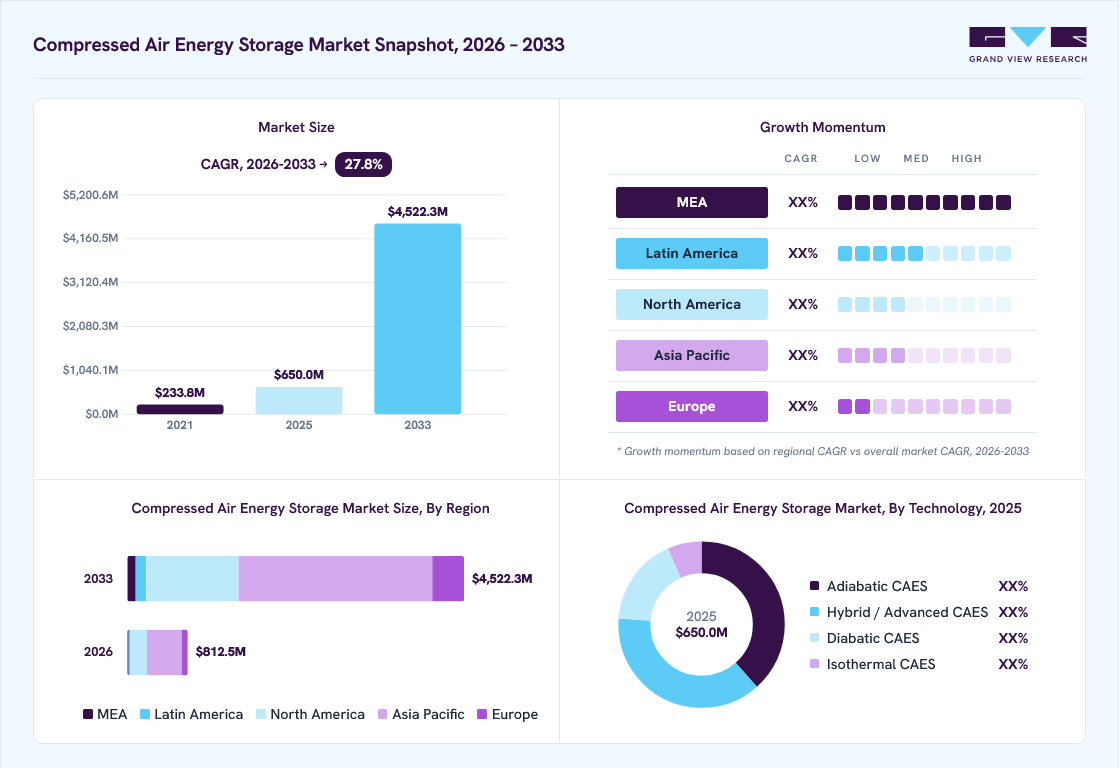 Source: Grand View Research, IR Documents, Primary Interviews, Paid DatabasesTo learn more about this report,
 Download Free Sample Report
Key Market Trends & Insights
- By technology: Adiabatic CAES segment led the market with the largest revenue share of 38.4% in 2025.
- By application: Grid-scale bulk storage segment led the market with the largest revenue share of 48.0% in 2025.
Regional Highlights
- Largest regional market: Asia Pacific (57.8% revenue share, 2025)
- By country: China held the largest market share in 2025.
Market Size & Forecast
- Market size in 2025: USD 650 Million
- Estimated market size in 2026: USD 812.5 Million
- Projected market size by 2033: USD 4,522.3 Million
- CAGR (2026-2033): 27.8%
Prism AI by Grand View Research Free to tryAsk a question about the compressed air energy storage marketTry asking✓Every figure cited from GVR research Prefer the report? Download free sample →
Moreover, government initiatives promoting clean energy, technological advancements in storage systems, and growing investment in sustainable infrastructure are expected to accelerate market growth further. The compressed air energy storage industry in North America is growing steadily, driven by strong federal and state-level clean energy mandates, increasing renewable energy penetration, and the need for long-duration grid balancing solutions. The U.S. leads regional deployment through Department of Energy (DOE) funding programs, investment tax credits (ITC), and utility-supported grid modernization strategies that integrate CAES to enhance system resilience and peak-load management. Rising adoption of large-scale and behind-the-meter storage by commercial and industrial consumers, combined with corporate decarbonization goals, virtual power plant (VPP) initiatives, and growing investment in long-duration storage for microgrids, is further accelerating market momentum. To learn more about this report, Download Free Sample Report
Asia Pacific dominates the global compressed air energy storage market, fueled by rapid industrialization, ambitious national renewable energy capacity targets, and strong capital investment in flexible power infrastructure. China, India, Japan, and Australia are at the forefront of commercialization, supported by long-duration energy storage procurement policies, subsidies for utility-scale storage projects, and integration of CAES into smart grid development.
Market Dynamics
The Compressed Air Energy Storage (CAES) market is witnessing increasing adoption as utilities and grid operators seek long-duration energy storage solutions to support the growing integration of renewable energy. Rising investments in grid modernization, decarbonization initiatives, and energy security are driving the deployment of CAES projects, particularly in regions with suitable geological storage formations. Technological advancements, including adiabatic CAES systems, are improving efficiency while reducing reliance on fossil fuels during discharge. However, high upfront capital requirements, lengthy project development cycles, and limited availability of suitable storage sites continue to restrain widespread market expansion.
The rapid expansion of wind and solar power is increasing the need for reliable long-duration energy storage solutions that can balance intermittent electricity generation and maintain grid stability. CAES enables utilities to store surplus renewable electricity during periods of low demand and dispatch it during peak demand or when renewable output declines. As countries accelerate grid decarbonization and modernize electricity infrastructure, CAES is emerging as a viable solution for enhancing energy reliability, reducing renewable energy curtailment, and supporting a more resilient power system.
In June 2026, the UK's energy regulator Ofgem provisionally approved 16 long-duration electricity storage projects, including compressed air energy storage systems, to strengthen grid reliability and support higher renewable energy penetration, highlighting the growing role of CAES in future low-carbon power systems.
CAES projects require substantial upfront investment in compressors, turbines, thermal management systems, and underground storage infrastructure such as salt caverns or depleted gas reservoirs. The need for extensive site development, geological assessments, and grid interconnection further increases project costs and extends development timelines. In September 2025, Hydrostor secured USD 55 million in financing from Export Development Canada to advance the development of its 200 MW Silver City Advanced CAES project in Australia, underscoring the substantial funding required even before construction of utility-scale CAES facilities can proceed.
Adiabatic CAES presents a significant business opportunity by eliminating the need for natural gas during electricity generation. Unlike conventional CAES, A-CAES captures and stores the heat produced during air compression and reuses it during expansion, enabling a fully electric, low-emission storage process with higher round-trip efficiency. As governments and utilities prioritize long-duration energy storage to support renewable energy integration and decarbonization targets, demand for advanced adiabatic CAES technologies is expected to create new opportunities for equipment manufacturers, engineering firms, and energy storage developers.
Analyst Perspective
The compressed air energy storage (CAES) market is transitioning from pilot-scale deployments toward larger commercial projects as the need for long-duration energy storage continues to grow. Market growth is being supported by increasing renewable energy capacity, grid modernization investments, and the need for greater power system flexibility. A notable trend is the growing focus on adiabatic and advanced CAES technologies, which improve system efficiency while reducing dependence on fossil fuels. Although high upfront costs and site availability remain key challenges, continued technology advancements and supportive energy policies are expected to strengthen the market's long-term outlook.
Drivers, Opportunities & Restraints
The global CAES industry is primarily driven by the increasing demand for reliable and large-scale energy storage solutions to support the growing integration of renewable energy sources such as wind and solar. The need for grid stability, peak load management, and improved energy efficiency, coupled with rising investments in smart grid infrastructure, is further propelling market growth. Technological advancements in storage systems and cost reductions in energy storage projects are also strengthening market adoption.
Emerging opportunities in the CAES market include the expansion of decentralized and off-grid energy storage solutions, particularly in regions with high renewable energy penetration. Innovations in hybrid energy storage systems, government incentives for clean energy, and the rising adoption of electric mobility infrastructure offer significant growth potential. In addition, collaborations between energy companies and technology providers for large-scale CAES projects are creating new avenues for market expansion.
High initial capital investment and complex site selection requirements for large-scale storage facilities restrain the growth of the CAES market. Technical challenges such as energy losses during compression and expansion, long project lead times, and limited public awareness of CAES technology also hinder widespread adoption. Moreover, competition from alternative energy storage solutions like lithium-ion batteries and pumped hydro storage adds pressure on market growth.
Technology Insights
Based on technology, the adiabatic CAES segment led the market with the largest revenue share of 38.4% in 2025, owing to its relatively lower upfront capital costs, technical maturity, and proven deployment at utility scale compared with adiabatic and isothermal systems. Diabatic CAES plants leverage conventional gas-fired heating during the air expansion phase, enabling higher round-trip efficiency without requiring complex thermal storage infrastructure, which makes them cost-competitive for large-capacity installations.
The Hybrid CAES segment is expected to witness significant growth, registering a robust CAGR of 32.28% from 2025 to 2033, driven by its ability to combine the advantages of multiple storage and generation technologies to deliver higher round-trip efficiency, lower carbon emissions, and enhanced operational flexibility. Additionally, growing investment in decarbonized power systems, demand for flexible backup capacity, and advancements in turbine-thermal integration technologies are supporting commercialization, positioning Hybrid CAES as a preferred solution for next-generation grid stability and energy transition initiatives.
Application Insights
Based on application, the grid-scale bulk storage segment led the market with the largest revenue share of 48.0% in 2025, driven by the surge in renewable energy integration and the increasing need for long-duration storage to manage daily and seasonal fluctuations in power generation. Utilities and grid operators are prioritizing large-capacity compressed air energy storage systems to address peak-load balancing, minimize curtailment of wind and solar power, and enhance frequency and voltage stability across transmission networks.
 To learn more about this report, Download Free Sample Report
The commercial backup segment is anticipated to experience significant growth, with a CAGR of 23.86% from 2025 to 2033, driven by increasing demand among commercial facilities for reliable, long-duration backup power to protect critical operations from grid disruptions and rising electricity price volatility. Businesses across sectors such as data centers, manufacturing, logistics, and healthcare are adopting compressed air energy storage systems to ensure an uninterrupted power supply, reduce dependence on diesel generators, and optimize energy costs through peak shaving and load management.
Regional Insights
North America accounted for the largest share, approximately 32% of the global compressed air energy storage market in 2024, driven by strong policy support for long-duration energy storage, rapid expansion of renewable power generation, and increasing investments in grid resilience. Additionally, growing adoption of microgrids, virtual power plant (VPP) frameworks, and behind-the-meter storage by commercial and industrial users further strengthened regional demand, supported by low natural gas prices and availability of suitable geological formations for underground storage development.
 To learn more about this report, Download Free Sample Report
U.S. Compressed Air Energy Storage Market Trends
The compressed air energy storage market in the U.S. is expanding rapidly, supported by strong federal clean energy initiatives, widespread renewable deployment, and rising demand for long-duration storage to enhance grid stability. Growing investments under Department of Energy (DOE) funding programs, long-duration storage demonstration grants, and tax incentives are advancing the commercialization of both diabatic and next-generation hybrid CAES technologies.
Europe Compressed Air Energy Storage Market Trends
The compressed air energy storage market in Europe is witnessing strong growth driven by ambitious renewable energy targets, the rapid expansion of wind and solar capacity, and increasing emphasis on long-duration energy storage to support grid reliability. The EU’s decarbonization roadmap, Net Zero Industry Act, and national-level storage procurement policies are incentivizing utility-scale CAES deployments to address intermittency and seasonal power imbalances. Countries such as Germany, the U.K., Italy, and the Netherlands are leading adoption through large-scale demonstration programs, energy transition funding, and the repurposing of salt caverns and depleted hydrocarbon reservoirs for underground storage.
Asia Pacific Compressed Air Energy Storage Market Trends
Asia Pacific dominated the compressed air energy storage market with the largest revenue share of 57.8% in 2025. The compressed air energy storage market in Asia Pacific dominates globally, driven by rapid industrialization, large-scale renewable energy expansion, and increasing investment in long-duration storage to stabilize high-voltage transmission networks. Governments across China, India, Japan, and Australia are prioritizing CAES as part of national energy transition strategies, with supportive policies including renewable-plus-storage mandates, capital subsidies, and funding for long-duration storage demonstrations. The compressed air energy storage market in China held the largest share in the Asia Pacific region in 2025.
Latin America Compressed Air Energy Storage Market Trends
The compressed air energy storage market in Latin America is emerging steadily, supported by the accelerating deployment of wind and solar power, growing focus on grid reliability, and increasing demand for long-duration energy storage in remote and industrial regions. Countries such as Brazil, Chile, and Mexico are leading adoption as governments introduce renewable integration policies, transmission modernization plans, and incentives for utility-scale and hybrid storage projects.
Middle East & Africa Compressed Air Energy Storage Market Trends
The Middle East & Africa compressed air energy storage (CAES) market is gaining momentum as countries accelerate renewable energy deployment and invest in long-duration storage to enhance grid flexibility and energy security. National diversification agendas such as Saudi Arabia’s Vision 2030, the UAE’s Energy Strategy 2050, and South Africa’s Integrated Resource Plan are supporting the integration of CAES as a solution for managing intermittent solar and wind generation across large geographic areas. Growing demand for reliable and cost-efficient backup power in industrial sectors, including mining, oil & gas, and desalination, is further driving adoption.
Key Compressed Air Energy Storage Companies Insights
Key players operating in the compressed air energy storage market are undertaking various initiatives to strengthen their presence and increase the reach of their products and services. Strategies such as expansion activities and partnerships are key in propelling the market growth. Some of the key players operating in the global compressed air energy storage market include Hydrostor Inc., Siemens Energy AG, General Compression Ltd., Storelectric Ltd.
-
Siemens Energy AG is a leading global provider of power generation, transmission, and storage technologies, and holds a strong position in the compressed air energy storage (CAES) market through its portfolio of large-scale, turnkey storage solutions. Leveraging expertise in turbomachinery, compressors, turbines, and grid-integration systems, the company delivers utility-grade CAES systems designed to support peak-load management, renewable firming, and long-duration energy storage for grids with high wind and solar penetration.
-
Hydrostor Inc. is a leading developer of long-duration energy storage solutions and a pioneer in Advanced Compressed Air Energy Storage (A-CAES) technology, offering utility-scale systems designed to deliver emission-free, dispatchable power for 8 hours or longer. Headquartered in Toronto, the company has built a strong global presence with major projects across North America, Australia, and Europe, targeting applications such as renewable energy firming, peak-load management, and grid-stability services. By eliminating reliance on fossil fuels during discharge and enabling storage in purpose-built underground caverns, Hydrostor provides a cost-competitive and environmentally sustainable alternative to traditional diabatic CAES and large-scale battery systems, positioning the company as a key innovator in the transition toward resilient, renewable-dominated power grids.
Key Compressed Air Energy Storage Companies
The following key companies have been profiled for this study on the compressed air energy storage market.
-
ALACAES SA
-
Apex CAES LLC
-
Corre Energy BV
-
General Compression Ltd.
-
Hydrostor Inc.
-
LightSail Energy
-
Mitsubishi Power Americas
-
Ridge Energy Storage & Grid Services LP
-
Siemens Energy AG
-
Storelectric Ltd.
Competitive Benchmarking
Category
Operating Strategies
Competitive Edge
Weakness
Established Players (Siemens Energy, Mitsubishi Power, Hydrostor, Storelectric Ltd, Corre Energy)
- Develop large-scale CAES projects through long-term partnerships with utilities, grid operators, and renewable energy developers.
- Invest in advanced CAES technologies and integrated energy storage solutions to improve efficiency and project performance.
- Expand global engineering, EPC, and service capabilities to execute complex long-duration energy storage projects.
- Strong engineering expertise and proven experience in delivering large-scale energy infrastructure projects.
- Established customer relationships and global presence across power generation and grid modernization markets.
- Strong financial resources to support R&D, project financing, and international expansion.
- High capital investment requirements and lengthy project development timelines can slow deployment.
- Large organizational structures may reduce flexibility in adopting emerging storage technologies quickly.
- Greater dependence on regulatory approvals and utility procurement cycles for project execution.
Emerging Players (TES CAES Technology Ltd., BaroMar, ALACAES, General Compression Limited, Haddington Ventures, L.L.C.)
- Focus on innovative CAES technologies such as underwater, modular, and advanced thermal storage solutions for niche applications.
- Collaborate with utilities, technology partners, and investors to commercialize pilot and demonstration projects.
- Prioritize technology validation and strategic partnerships before expanding into large-scale commercial deployments.
- Innovative technologies designed to improve storage efficiency and reduce system complexity.
- Greater flexibility to customize solutions for renewable integration and long-duration storage applications.
- Faster product development cycles and ability to address emerging market opportunities.
- Limited commercial installations and shorter operational track records compared to established competitors.
- Dependence on external funding and government support to scale commercialization activities.
- Smaller manufacturing capabilities and lower brand recognition in the global energy storage market.
Recent Developments
-
In February 2025, Hydrostor secured USD 200 million in Canada to accelerate the development of its A-CAES long-duration energy storage projects, including the 500 MW/4,000 MWh Quinte Energy Storage Centre.
Compressed Air Energy Storage Market Report Scope
Report Attribute
Details
Market Definition
The compressed air energy storage (CAES) market represents the revenue generated from the sale of compressed air energy storage systems.
Market size in 2025
USD 650.0 million
Estimated market size in 2026
USD 812.5 million
Projected market size by 2033
USD 4,522.3 million
Growth rate
CAGR of 27.8% from 2026 to 2033
Base year for estimation
2025
Historical data
2021 - 2024
Forecast period
2026 - 2033
Quantitative units
Revenue in USD Million/Billion and CAGR from 2026 to 2033
Report coverage
Revenue forecast, company ranking, competitive landscape, growth factors, and trends
Segments covered
Technology, application, region
Regional scope
North America, Europe, Asia Pacific, Latin America, Middle East & Africa
Country scope
U.S.; Canada; Mexico; Germany; UK; France; China; India; Japan; South Korea; Brazil; Saudi Arabia; UAE
Key companies profiled
Hydrostor, Siemens Energy, TES CAES Technology Ltd., Storelectric LTD, Haddington Ventures, L.L.C., GENERAL COMPRESSION LIMITED, ALACAES, Mitsubishi Power, Corre Energ, BaroMar
Customization scope
Free report customization (equivalent up to 8 analysts' working days) with purchase. Addition or alteration to country, regional & segment scope.
Pricing and purchase options
Avail customized purchase options to meet your exact research needs. Explore purchase options
Global Compressed Air Energy Storage Market Report Segmentation
This report forecasts revenue growth at the global, regional, and country levels and provides an analysis of the latest industry trends in each of the sub-segments from 2021 to 2033. For this study, Grand View Research has segmented the global compressed air energy storage market report on the basis of technology, application and region.
 To learn more about this report, Download Free Sample Report
-
Technology Outlook (Revenue, USD Million, 2021 - 2033)
-
Diabatic CAES
-
Adiabatic CAES
-
Isothermal CAES
-
Hybrid / Advanced CAES
-
-
Application Outlook (Revenue, USD Million, 2021 - 2033)
-
Grid-Scale Bulk Storage
-
Renewable Integration (Wind/Solar + CAES)
-
Ancillary Services
-
Commercial Backup
-
Microgrid & Off-Grid Storage
-
-
Regional Outlook (Revenue, USD Million, 2021 - 2033)
-
North America
-
U.S.
-
Canada
-
Mexico
-
-
Europe
-
Germany
-
UK
-
France
-
-
Asia Pacific
-
China
-
India
-
Japan
-
South Korea
-
-
Latin America
-
Brazil
-
-
Middle East & Africa
-
Saudi Arabia
-
UAE
-
-
Research Methodology
The compressed air energy storage market figures in this report are based on a proven research process that combines executive interviews with secondary research from proprietary databases, company filings, and recognized regulatory and institutional sources. Market size is built through value-chain sizing-reconciling supply-side and demand-side estimates-and triangulated with bottom-up and top-down approaches. Every estimate passes multiple levels of expert validation before publication, with each compressed air energy storage segment quantified using the revenue-capture definitions in the table below.
Segment Definition
Segment – Technology
Revenue capture definition
Diabatic CAES
Diabatic CAES systems compress air and store it underground while using external fuel, typically natural gas, to reheat the air during electricity generation. Revenue is generated through the sale and deployment of diabatic compressed air energy storage systems.
Adiabatic CAES
Adiabatic CAES systems capture and store the heat generated during air compression, eliminating the need for fossil fuel combustion during expansion. Revenue is generated through the sale and deployment of adiabatic compressed air energy storage systems.
Isothermal CAES
Isothermal CAES systems maintain near-constant air temperature during compression and expansion to improve energy efficiency and reduce thermal losses. Revenue is generated through the sale and deployment of isothermal compressed air energy storage systems.
Hybrid / Advanced CAES
This segment includes advanced CAES technologies incorporating thermal energy storage, renewable integration, pressure compensation, or other next-generation system designs to improve efficiency and operational flexibility. Revenue is generated through the sale and deployment of hybrid and advanced compressed air energy storage systems.
Segment – Application
Revenue capture definition
Grid-Scale Bulk Storage
Grid-scale bulk storage systems store excess electricity and discharge it during periods of high demand to improve grid reliability and balance electricity supply. Revenue is generated through the deployment of compressed air energy storage systems for utility-scale bulk energy storage applications.
Renewable Integration
These systems store surplus electricity generated from wind and solar power and release it when renewable generation is low, improving renewable energy utilization. Revenue is generated through the deployment of compressed air energy storage systems integrated with renewable energy projects.
Ancillary Services
Compressed air energy storage systems support grid stability by providing services such as frequency regulation, voltage support, spinning reserve, and load balancing. Revenue is generated through the deployment of CAES systems for ancillary grid service applications.
Commercial Backup
Commercial facilities use CAES systems to ensure uninterrupted power supply during grid outages while improving energy resilience. Revenue is generated through the deployment of compressed air energy storage systems for commercial backup power applications.
Microgrid & Off-Grid Storage
This segment includes CAES systems deployed in microgrids and remote off-grid locations to provide reliable energy storage and support localized power generation. Revenue is generated through the deployment of compressed air energy storage systems for microgrid and off-grid energy storage applications.
Estimation Model
Layer No.
Layer Name
Key Question
Description
01
Energy Storage Deployment Layer
What forms the demand base for CAES systems?
Assess utility-scale energy storage deployments, renewable energy capacity additions, grid modernization initiatives, and long-duration energy storage requirements. Evaluate renewable curtailment levels, grid balancing needs, electricity demand growth, and investments in energy storage infrastructure to determine the underlying demand for compressed air energy storage systems.
02
Technology Adoption Layer
Which CAES technologies are being deployed?
Analyze the adoption of diabatic, adiabatic, isothermal, and hybrid/advanced CAES technologies across utility-scale and industrial projects. Assess system efficiency, thermal management approach, storage duration, commercial maturity, operating costs, and integration capabilities to determine technology-wise market adoption.
03
Application Layer
Where are CAES systems being deployed?
Evaluate deployment across grid-scale bulk storage, renewable energy integration, ancillary services, commercial backup power, and microgrid/off-grid applications. Analyze use cases such as renewable energy balancing, peak load management, frequency regulation, reserve capacity, and backup power to estimate application-wise market contribution.
04
Revenue Layer
How is market revenue generated?
Market revenue is quantified through the sale and deployment of diabatic, adiabatic, isothermal, and hybrid/advanced CAES systems. The overall market value is determined by technology adoption, project capacity, and deployment across grid-scale bulk storage, renewable integration, ancillary services, commercial backup, and microgrid & off-grid storage applications.
Delivered Customization
This report has been delivered with the following In-depth customizations
Client Request
Customization Delivered
Value Adds
CAES Technology Benchmarking
Compared diabatic, adiabatic, isothermal, and hybrid CAES technologies based on round-trip efficiency, storage duration, capital cost, commercial maturity, thermal management approach, and scalability. Assessed their suitability across utility-scale, renewable integration, and long-duration energy storage applications.
Helped identify the most suitable CAES technologies for different applications and long-term investment strategies.
Application Opportunity Assessment
Evaluated the adoption potential of CAES across grid-scale bulk storage, renewable integration, ancillary services, commercial backup, and microgrid applications. Assessed deployment trends, revenue potential, operational requirements, and end-user demand to identify the most attractive growth opportunities.
Helped prioritize high-growth application segments and optimize market expansion strategies.
Regional Deployment & Policy Assessment
Assessed regional CAES project pipelines, renewable energy expansion, geological suitability, long-duration energy storage demand, and government policy support. Evaluated funding programs, regulatory frameworks, and infrastructure readiness influencing commercial deployment across key markets.
Helped identify attractive investment regions and understand policy-driven growth opportunities.
Frequently Asked Questions About This Report
The compressed air energy storage market is primarily driven by the growing need for long-duration energy storage to support renewable energy integration, enhance grid stability, and improve power system reliability.
The compressed air energy storage market is expected to grow at a CAGR of 27.8% from 2026 to 2033 to reach USD 4,522.3 million by 2033.
The Asia Pacific region dominated the compressed air energy storage market with a revenue share of 57.8% in 2025.
China dominated the Asia Pacific region market with a revenue share in 2025.
Based on application, the grid-scale bulk storage segment accounted for the largest revenue share of 48.0% in 2025.
The global compressed air energy storage market size was estimated at USD 650 million in 2025 and is expected to reach USD 812.5 million in 2026.
Based on technology, the adiabatic CAES segment accounted for the largest revenue share of 38.4% in 2025.
Some of the key players operating in the compressed air energy storage market are Hydrostor, Siemens Energy, TES CAES Technology Ltd., Storelectric LTD, Haddington Ventures, L.L.C., GENERAL COMPRESSION LIMITED, ALACAES, Mitsubishi Power, Corre Energ, BaroMar, and others.
About the Author(s)
Power Generation & Storage Research Team
Energy & Power · Power Generation & StorageThis report was authored by the power generation & storage research team at Grand View Research - comprising two research analysts, one senior research analyst, and one industry expert - with specialized expertise in the power generation & storage segment of the energy & power industry. All findings are based on proprietary energy & power databases, executive interviews, and regulatory analysis, subject to internal peer review prior to publication.
Last Updated:
Speak to Analyst

Customize this report to your needs - add regions, segments, or data points, with 20% free customization.
Or view our licence options:


ISO 9001:2015 & 27001:2022 Certified
We are GDPR and CCPA compliant! Your transaction & personal information is safe and secure. For more details, please read our privacy policy.


