
- Home
- »
- Next Generation Technologies
- »
-
Computational Photography Market Size, Growth Report, 2026-2033GVR Report cover

Computational Photography Market (2026 - 2033)
Size, Share & Trends Analysis Report By Offering (Camera Modules, Software), By Product (Smartphone, Standalone, Machine Vision, AR/VR Devices), By Application (3D Imaging, AR/VR/MR), By End-use, By Region, And Segment Forecasts
Market Size, 2025
$17.3BMarket Estimate, 2026
$20.1BMarket Forecast, 2033
$53.1BCAGR, 2026–2033
14.9%Computational Photography Market Summary
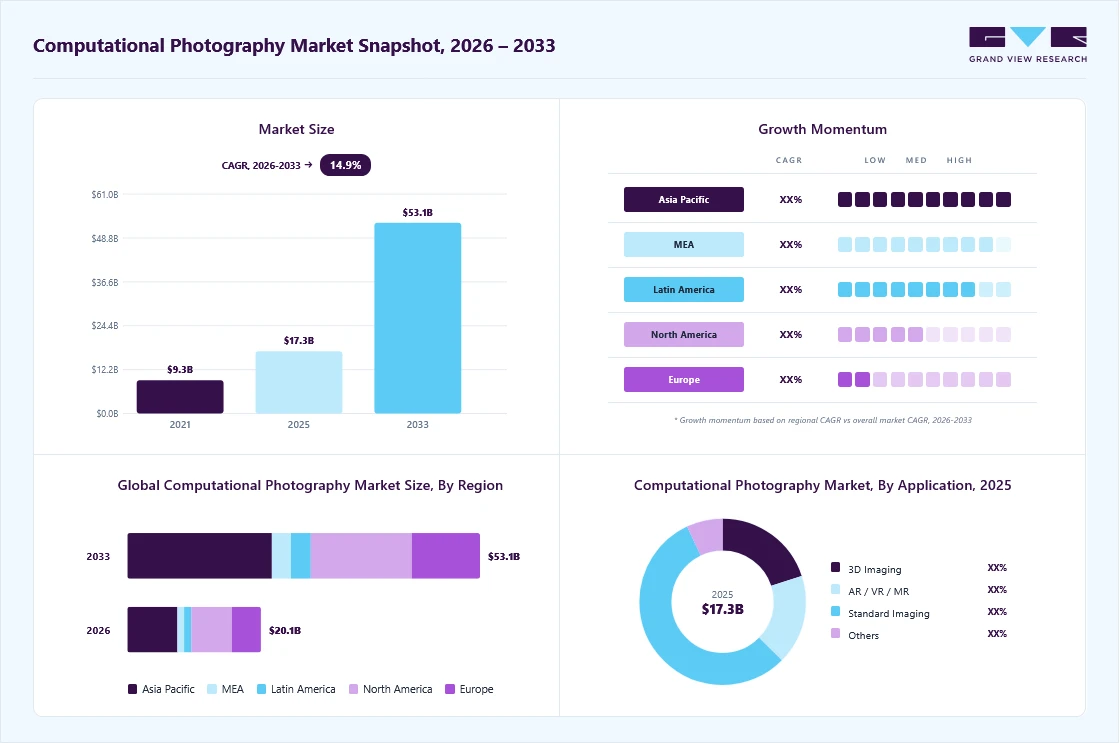
The global computational photography market size was valued at USD 17.3 billion in 2025 and is projected to grow from USD 20.1 billion in 2026 to USD 53.1 billion by 2033, at a CAGR of 14.9% from 2026 to 2033. Asia Pacific dominated the global market, accounting for the largest revenue share of 37% in 2025.. The market is witnessing strong momentum, driven by rising adoption of AI-powered image processing and machine learning algorithms, increasing demand for high-quality smartphone photography and mobile-first imaging, growing integration of multi-camera systems and advanced image signal processors (ISP), expanding use of AR/VR and 3D imaging technologies across industries, surge in social media content creation and digital visual communication needs, continuous advancements in semiconductor and sensor technologies enabling real-time computational imaging.
 Source: Grand View Research, IR Documents, Primary Interviews, Paid DatabasesTo learn more about this report,
 Download Free Sample Report
 Key Market Trends & Insights
- By offering: Camera modules segment led the market with the largest revenue share of 50% in 2025.
- By product: Smartphone cameras segment led the market with the largest revenue share of 49.5% in 2025.
- By end use: Industrial segment is expected to grow at the fastest CAGR of 18% from 2026 to 2033.
Regional Highlights
- Largest regional market: Asia Pacific (37% revenue share, 2025)
- By country: The China computational photography industry is a major contributor to the global market.
Market Size & Forecast
- Market size in 2025: USD 17.3 Billion
- Estimated market size in 2026: USD 20.1 Billion
- Projected market size by 2033: USD 53.1 Billion
- CAGR (2026-2033): 14.9%
Three ways to get this report
Buy it, customize it, or ask a question.Ask an Analyst
A direct answer, usually in 1 working day
- AccessReport author, directly
- Reply timeWithin 1 working day
- No sales callDirect answer only
- FormatEmail reply
- CostFree, no cost
Get the Full Report
What the study covers
- FormatsPDF · Excel · Dashboard
- Timeline2026–2033 annual, 2025 base
- Coverage20+ countries, 5 regions
- Companies10+ key players profiled
Customize the Report
20% free customization
- IncludeCountries, segments, points
- TailorTo your product definition
- ExtendDeeper competitor detail
- OrA fully bespoke study
- Turnaround5–10 working days
The adoption of augmented reality (AR), virtual reality (VR), and 3D imaging is driving demand for advanced computational photography. These technologies require precise depth sensing, real-time image reconstruction, and high-performance rendering to create immersive experiences. Their use in gaming, media, real estate, and e-commerce is increasing user engagement and enabling interactive digital environments. Integrating spatial computing, LiDAR, and depth-mapping technologies is expanding applications and improving imaging accuracy. As a result, computational photography is shifting from traditional imaging to dynamic, immersive, and experience-driven visual ecosystems.
 To learn more about this report, Download Free Sample Report
 The computational photography industry is rapidly evolving as artificial intelligence and machine learning are integrated into imaging workflows. Advanced AI algorithms now deliver real-time image enhancement, such as multi-frame processing, noise reduction, and dynamic range optimization. Rising demand for automated, high-quality imaging on smartphones and digital platforms is accelerating the adoption of intelligent image processing systems. Companies are investing in AI-based imaging pipelines to improve performance and reduce dependence on hardware upgrades. This shift is transforming imaging capabilities by enabling software-defined photography and scalable innovation.
Rising demand for personalized and creative visual content is driving the adoption of AI-enabled image editing in computational photography. Advanced tools now offer automated enhancements, object recognition, background modification, and real-time customization. The expansion of social media, digital marketing, and content creation platforms is increasing the need for intelligent imaging solutions. Users want seamless integration of capture and editing in a unified workflow. As a result, computational photography is emerging as a key enabler of next-generation, creative, user-focused imaging experiences.
Offering Insights
The camera modules segment led the market with the largest revenue share of 50% in 2025. Growth was driven by the rapid adoption of multi-camera smartphone designs and advances in sensor technology. Rising demand for high-resolution imaging, better low-light performance, and optical image stabilization is accelerating the integration of advanced camera modules into consumer devices. The expansion of mid-range and premium smartphones with multi-lens configurations is further increasing market volume and penetration. Adoption of imaging modules in automotive vision, security surveillance, and industrial automation is also expanding the market beyond consumer electronics. Continued innovation in miniaturization, power efficiency, and cost optimization is reinforcing the segment’s leadership.
The software segment is expected to grow at the fastest CAGR during the forecast period, driven by the shift toward AI-based imaging algorithms and software-defined photography. The move from hardware-centric to computation-led imaging is accelerating software adoption in smartphones and intelligent imaging systems. Demand for real-time image enhancement, improved image quality, and features such as scene recognition, semantic segmentation, and depth mapping is fueling this growth. The integration of cloud computing, edge AI, and generative imaging technologies is enabling scalable, adaptive image processing. As a result, software is becoming the primary value driver in the computational photography industry.
Product Insights
The smartphone cameras segment accounted for the largest market revenue share in 2025, supported by widespread adoption of advanced mobile devices and rising demand for high-quality imaging. Integration of multi-camera systems, AI-powered image processing, and features such as HDR, night mode, and portrait enhancement is accelerating growth. Ongoing advancements in sensor technology, image signal processors, and computational photography are further improving image quality. Increased use of social media and mobile-first content creation continues to drive demand for advanced smartphone imaging. Continued innovation in camera hardware and software integration is maintaining the segment’s market leadership.
The machine vision cameras segment is projected to grow at the fastest CAGR during the forecast period, driven by rising demand for high-precision imaging and quality assurance in advanced manufacturing. The move toward zero-defect production and stricter regulatory standards is increasing the adoption of automated visual inspection systems. Expanded use of machine vision in electronics, semiconductor fabrication, and pharmaceutical manufacturing is accelerating segment growth. Integration of computational photography with high-speed imaging and advanced optics is improving accuracy and detection. Increased investment in smart factories and digital production ecosystems is supporting the segment’s long-term growth.
Application Insights
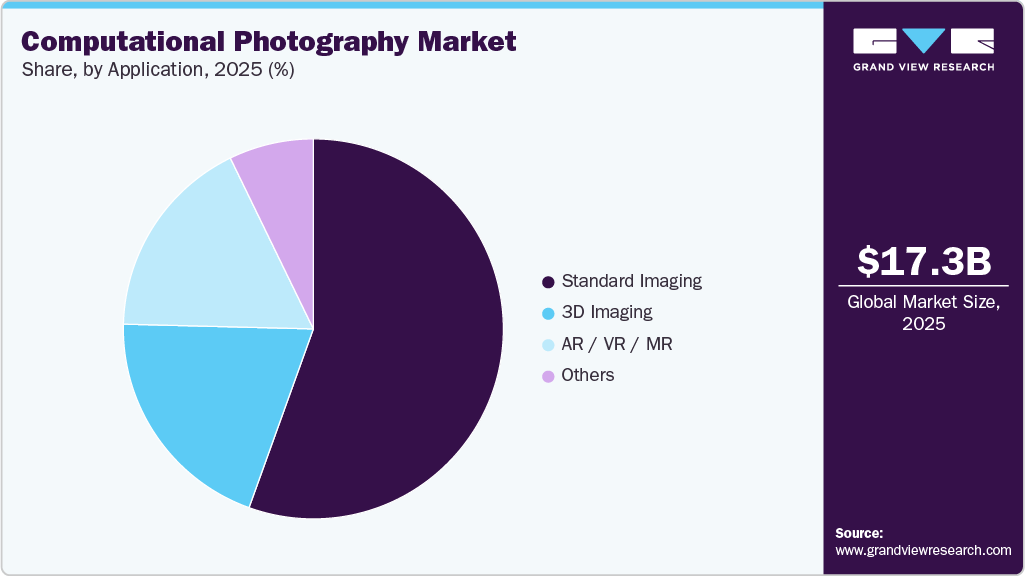
The standard imaging segment accounted for the largest market revenue share in 2025, driven by the widespread integration of computational photography features in smartphones and consumer electronics. High adoption of HDR, night mode, portrait enhancement, and real-time image optimization is sustaining strong demand. Increased mobile photography, fueled by social media and digital content creation, is expanding usage across user groups. Advances in AI-based image processing and image signal processors are improving output quality while reducing dependence on high-end hardware. Making these features standard across mid-range and premium devices is key to maintaining the segment’s market leadership.
 To learn more about this report, Download Free Sample Report
 The 3D imaging segment is projected to grow at the fastest CAGR during the forecast period, driven by the broader adoption of depth-sensing technologies and advanced spatial imaging across industries. Rising demand for facial recognition, biometric authentication, and gesture tracking is accelerating 3D imaging adoption. Growth in AR, VR, and MR platforms is increasing the need for accurate depth mapping and real-time spatial rendering. Expanding use in healthcare diagnostics, automotive vision systems, and industrial inspection is broadening the segment’s applications. Ongoing innovation in LiDAR, advanced sensors, and AI-based image reconstruction is further driving the segment’s growth.
End-use Insights
The consumer electronics segment accounted for the largest market revenue share in 2025, driven by the accelerated integration of AI-enabled imaging technologies into smart devices. The growing demand for real-time image optimization, intelligent scene recognition, and advanced camera features is accelerating the adoption of computational photography. The expansion of premium and mid-range devices with multi-camera systems and AI-driven imaging is increasing market penetration. Ongoing product differentiation through software-defined imaging, ecosystem integration, and user-friendly interfaces is sustaining global demand. The combination of advanced hardware and computational imaging algorithms continues to strengthen the segment’s leading position and long-term growth.
The industrial segment is projected to grow at the fastest CAGR during the forecast period, driven by the rapid adoption of high-speed imaging systems and real-time analytics in modern production environments. The growing demand for operational visibility, precision control, and data-driven decision-making is accelerating the adoption of computational photography in industrial workflows. Expanding applications such as automated inspection, precision measurement, defect detection, and intelligent sorting are further supporting segment growth. Advances in edge computing, high-resolution sensors, and AI-powered image processing are enabling faster analysis, lower latency, and greater accuracy. The shift toward smart factories and digitally integrated manufacturing is sustaining demand for advanced computational imaging technologies in the industrial sector.
Regional Insights
The North America computational photography market held a significant share in 2025, driven by strong adoption of AI-powered imaging, high smartphone penetration, and ongoing camera technology innovation. The presence of leading technology companies and chipset manufacturers investing in image signal processing and machine learning-based photography further strengthens the region’s position. Rising demand for high-quality mobile imaging, augmented reality, and real-time image enhancement continues to drive growth. Advancements in computational imaging software, cloud-based processing, and 5G-enabled devices are also supporting sustained market expansion.
U.S. Computational Photography Market Trends
The computational photography market in the U.S. is growing steadily, driven by rapid advancements in artificial intelligence, deep learning, and smartphone camera innovation. Major players are investing in R&D to advance multi-frame processing, low-light imaging, and real-time image optimization. Increased content creation, social media use, and demand for professional-grade mobile photography are boosting the need for advanced imaging solutions. Integration with AR/VR, autonomous systems, and edge AI technologies is also contributing to market growth.
Europe Computational Photography Market Trends
The computational photography market in Europe is projected to grow at a significant CAGR over the forecast period, driven by the increased adoption of smart imaging technologies across automotive, industrial, and consumer electronics. Rising demand for machine vision, advanced driver-assistance systems, and high-resolution imaging is expanding the scope of computational photography. Growth in AI-driven image processing, 3D imaging, and depth-sensing technologies is also evident. Regulatory emphasis on innovation and digital transformation is encouraging investment in next-generation imaging solutions.
Asia Pacific Computational Photography Market Trends
Asia Pacific dominated the global computational photography market with the largest revenue share of 37% in 2025 and is projected to grow at the fastest CAGR during the forecast period, driven by robust smartphone manufacturing and strong consumer demand for advanced mobile imaging. The presence of major OEMs and semiconductor companies investing in AI-based image processing, multi-camera systems, and sensor technologies further supports growth. Rapid increases in social media use, mobile content creation, and affordable high-performance smartphones are fueling demand. Expanding applications in AR/VR, smart devices, and industrial imaging are also contributing to the region’s continued market leadership.
 To learn more about this report, Download Free Sample Report
 The computational photography market in China accounted for the largest market revenue share in the Asia Pacific in 2025, driven by strong domestic smartphone manufacturing and rapid adoption of AI-powered imaging technologies. The increasing demand for high-quality mobile photography, driven by social media engagement and digital content creation, is accelerating market expansion. Continuous advancements in multi-camera systems, image sensors, and AI-based image processing are further enhancing device capabilities. In addition, the presence of leading OEMs and ongoing investments in semiconductor and imaging innovation are reinforcing the country’s growth trajectory in computational photography.
Key Computational Photography Company Insights
Some key players in the computational photography industry include Apple Inc., Samsung Electronics, Google (Alphabet), Huawei, and Qualcomm.
-
Apple Inc. advances computational photography by integrating imaging software with proprietary chipsets in its iPhones. Key features include HDR processing, low-light enhancement, and multi-frame image fusion powered by the Neural Engine. Apple optimizes image quality through close coordination of hardware and software, shaping broader trends in smartphone computational imaging.
-
Samsung Electronics engages in computational photography through its smartphone and image sensor divisions. The company emphasizes multi-camera systems, high-resolution imaging, and AI-driven image processing. ISOCELL sensors and integrated image signal processing enhance image quality and optimize scene rendering. Samsung’s involvement in both components and devices positions across several stages of the computational photography value chain.
Key Computational Photography Companies:
The following key companies have been profiled for this study on the computational photography market.
- Apple Inc.
- Samsung Electronics
- Google (Alphabet)
- Huawei
- Xiaomi
- Honor
- Sony Corporation
- Qualcomm
- MediaTek
- NVIDIA
- Nikon Corporation
Recent Developments
-
In April 2026, Huawei introduced Mate 80 Pro with advanced real-time computational photography capabilities. The device integrates AI-driven image processing to enhance low-light performance and optimize image quality in real time. It also reflects Huawei’s continued investment in proprietary imaging technologies and in-house chip development. This launch strengthens the company’s position in delivering high-performance, software-driven smartphone imaging solutions.
-
In April 2026, vivo launched the X300 Ultra globally, highlighting its focus on professional-grade smartphone imaging. The device features ZEISS Master Lenses and advanced multi-camera capabilities to enhance image quality. It combines high-end optics with computational photography and AI-driven processing for improved performance. This launch reflects vivo’s strategy to strengthen its position in the premium smartphone imaging segment.
-
In March 2026, Honor partnered with ARRI to bring cinema-grade image science to its smartphones. The collaboration focuses on improving color accuracy, dynamic range, and overall visual quality through advanced imaging technologies. It aims to deliver professional, film-like output despite hardware limitations by leveraging AI-driven computational imaging. This development underscores the growing role of computational photography in enhancing smartphone imaging capabilities.
Computational Photography Market Report Scope
Report Attribute
Details
Market size in 2025
USD 17.3 billion
Estimated Market size in 2026
USD 20.1 billion
Projected Market size by 2033
USD 53.1 billion
Growth rate
CAGR of 14.9% from 2026 to 2033
Base year for estimation
2025
Historical data
2021 - 2024
Forecast period
2026 - 2033
Quantitative units
Revenue in USD million/billion, and CAGR from 2026 to 2033
Report coverage
Revenue forecast, company ranking, competitive landscape, growth factors, and trends
Segments covered
Offering, product, application, end-use, region
Regional scope
North America; Europe; Asia Pacific; Latin America; MEA
Country scope
U.S.; Canada; Mexico; Germany; UK; France; China; India; Japan; Australia; South Korea; Brazil; UAE; South Africa; KSA
Key companies profiled
Apple Inc.; Samsung Electronics; Google (Alphabet); Huawei; Xiaomi; Honor; Sony Corporation; Qualcomm; MediaTek; NVIDIA; Nikon Corporation.
Customization scope
Free report customization (equivalent up to 8 analysts working days) with purchase. Addition or alteration to country, regional & segment scope.
Pricing and purchase options
Avail customized purchase options to meet your exact research needs. Explore purchase options
Global Computational Photography Market Report Segmentation
This report forecasts revenue growth at global, regional, and country levels and provides an analysis of the latest industry trends in each of the sub-segments from 2021 to 2033. For this study, Grand View Research has segmented the global computational photography market report based on offering, product, application, end-use, and region:
-
Offering Outlook (Revenue, USD Billion, 2021 - 2033)
-
Camera Modules
-
Software
-
-
Product Outlook (Revenue, USD Billion, 2021 - 2033)
-
Smartphone Cameras
-
Standalone Cameras
-
Machine Vision Cameras
-
AR/VR Devices
-
Others
-
-
Application Outlook (Revenue, USD Billion, 2021 - 2033)
-
3D Imaging
-
AR / VR / MR
-
Standard Imaging
-
Others
-
-
End Use Outlook (Revenue, USD Billion, 2021 - 2033)
-
Consumer Electronics
-
Automotive
-
Security & Surveillance
-
Industrial
-
Healthcare
-
Media & Entertainment
-
Others
-
-
Regional Outlook (Revenue, USD Billion, 2021 - 2033)
-
North America
-
U.S.
-
Canada
-
Mexico
-
-
Europe
-
UK
-
Germany
-
France
-
-
Asia Pacific
-
China
-
India
-
Japan
-
Australia
-
South Korea
-
-
Latin America
-
Brazil
-
-
MEA
-
UAE
-
South Africa
-
KSA
-
-
Frequently Asked Questions About This Report
The camera modules segment led with a 50.0% revenue share in 2025, while software is the fastest-growing offering.
The smartphone cameras segment led with a 49.5% revenue share in 2025, while machine vision cameras is the fastest-growing product.
The consumer electronics segment held the largest revenue share in 2025, while industrial is the fastest-growing segment.
Standard imaging segment held the largest share in 2025, while 3D imaging is the fastest-growing application.
The global computational photography market size was valued at USD 17.3 billion in 2025 and is estimated at USD 20.1 billion for 2026.
The global computational photography market is expected to grow at a CAGR of 14.9% from 2026 to 2033, reaching USD 53.1 billion by 2033.
Asia Pacific dominated the computational photography market, accounting for over 37.0% in 2025, driven by the growing production and consumption of smartphones equipped with AI-driven camera systems and advanced image processing capabilities. The regional market expansion is being fueled by increasing investments in semiconductor technologies, rising adoption of 5G-enabled mobile devices, and the strong presence of consumer electronics manufacturers continuously integrating computational imaging features to enhance photography performance and user experience.
Key players include Apple Inc.; Samsung Electronics; Google (Alphabet); Huawei; Xiaomi; Honor; Sony Corporation; Qualcomm; MediaTek; NVIDIA; Nikon Corporation.
Key factors that are driving the market growth include the increasing adoption of AI-powered smartphone cameras, rising demand for enhanced image quality and real-time image processing, and continuous advancements in machine learning and computer vision technologies.
About the Author(s)
Next Generation Technologies Research Team
Technology · Next Generation TechnologiesThis report was authored by the next generation technologies research team at Grand View Research - comprising two research analysts, one senior research analyst, and one industry expert - with specialized expertise in the next generation technologies segment of the technology industry. All findings are based on proprietary technology databases, executive interviews, and regulatory analysis, subject to internal peer review prior to publication.
Last Updated:
Speak to Analyst

Customize this report to your needs - add regions, segments, or data points, with 20% free customization.
Or view our licence options:


ISO 9001:2015 & 27001:2022 Certified
We are GDPR and CCPA compliant! Your transaction & personal information is safe and secure. For more details, please read our privacy policy.


