
- Home
- »
- Specialty & Chemicals
- »
-
Concrete Release Agents Market Size Report, 2025-2033GVR Report cover
![Concrete Release Agents Market (2025 - 2033)Report]()
Concrete Release Agents Market (2025 - 2033)
Size, Share & Trends Analysis Report By Product (Plant-based Agents, Mineral Oil-based Agents), By Application (Precast, Other Concrete Types), By Region, And Segment Forecasts
Market Size, 2024
$4.9BMarket Estimate, 2026
$5.4BMarket Forecast, 2033
$8.2BCAGR, 2025–2033
6.1%Concrete Release Agents Market Summary
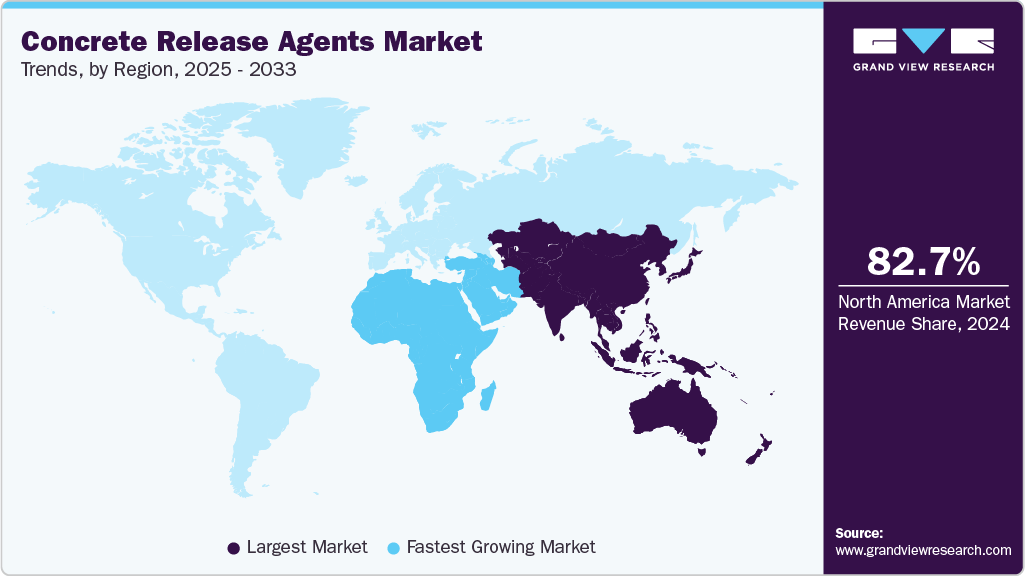
The global concrete release agents market size was valued at USD 4.9 billion in 2024 and is projected to grow from USD 5.4 billion in 2026 to USD 8.2 billion by 2033, at a CAGR of 6.1% from 2025 to 2033. Asia Pacific dominated the market, accounting for a revenue share of 82.7% in 2024. The market is primarily driven by accelerating demand for high-quality precast and architectural concrete products. This demand is supported by a global surge in infrastructure modernization and the adoption of sustainable construction practices.

Key Market Trends & Insights
- The market in China is expected to grow at the fastest CAGR of 5.8% from 2025 to 2033.
- By product, the mineral oil-based agents segment is expected to grow at the fastest CAGR of 6.4% from 2025 to 2033 in terms of revenue.
- By application, the precast segment held the largest revenue share of 73.7% in 2024 in terms of value.
Market Size & Forecast
- 2024 Market Size: USD 4,856.0 Million
- 2033 Projected Market Size: USD 8192.1 Million
- CAGR (2025-2033): 6.1%
- Asia Pacific: Largest market in 2024
- Middle East & Africa: Fastest growing market from 2025 to 2033
There is a growing focus on surface finish quality, mold reusability, and production efficiency. Therefore, there is an increased need for advanced release formulations that reduce adhesion, minimize surface defects, and extend the life of formwork. The market is shifting toward bio-based and low-VOC plant-derived agents. This reflects tighter environmental regulations and end user preference for eco-friendly alternatives.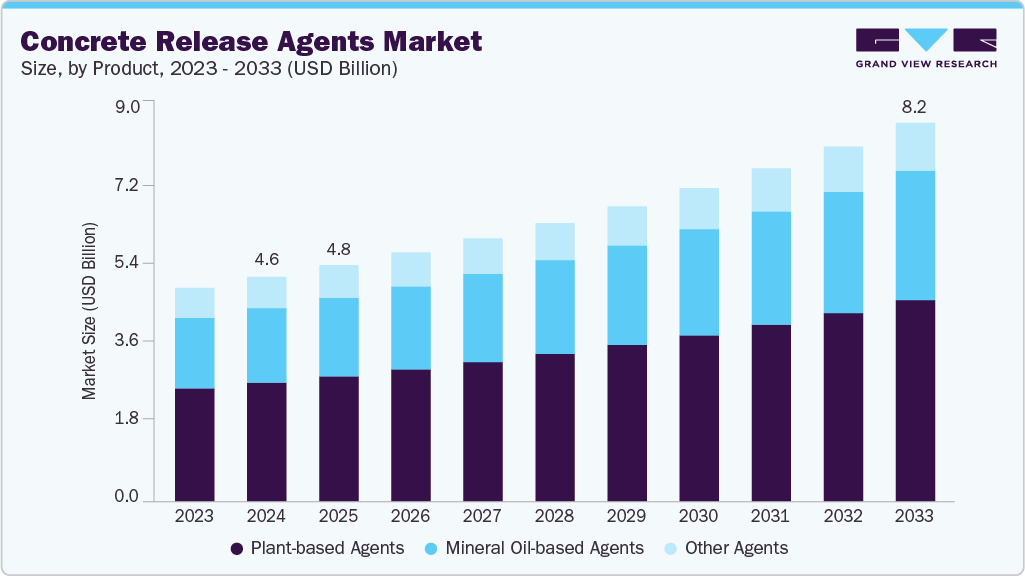
The market for concrete release agents is poised for growth as construction companies seek cleaner, safer, and more efficient solutions. There is a clear opportunity for suppliers to expand their plant-based product offerings, as builders increasingly prefer eco-friendly options that enhance surface quality and reduce post-processing work. Growing investment in precast production, especially in Asia Pacific and the Middle East, creates space for specialized release agents tailored to wet cast, dry cast, and AAC applications. At the same time, tightening environmental regulations are prompting users to switch to low-VOC and biodegradable formulations, providing manufacturers with the opportunity to introduce innovative, value-added products and enhance their presence in rapidly developing markets.
The market faces several restraints that limit its growth potential. Volatility in raw material prices, especially for plant-based oils and specialty additives, increases manufacturers’ costs. Strict environmental regulations on VOC emissions, chemical residues, and sustainability certifications increase compliance expenses. This is particularly challenging for mineral-oil-based formulations. Limited awareness and the slow transition from traditional mineral oil-based agents to higher-value plant-based alternatives remain barriers. This is especially true in emerging economies, where cost is a primary factor in decision-making.
Market Concentration & Characteristics
The concrete release agents industry is moderately consolidated, with leading manufacturers such as BASF, Sika AG, W.R. Meadows, and FUCHS holding strong positions through their broad portfolios. Along with major global companies, many regional suppliers offer release agents tailored to local construction practices. The leading players rely on strong R&D, wide distribution networks, and practical customer support to deliver reliable results across different concrete applications. Their product range now includes plant-based oils, basic and advanced emulsions, and low VOC options, reflecting the market’s shift toward safer and more environmentally friendly solutions.
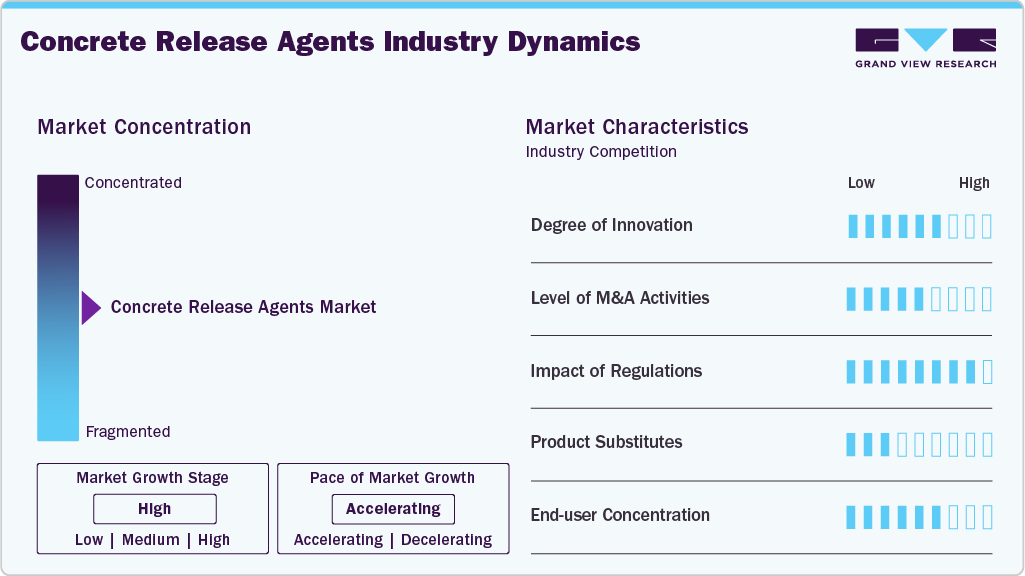
Competition in the concrete release agents industry centers on formulation performance, environmental compliance, and cost-effectiveness. Suppliers are increasingly focusing on low-VOC, plant-based formulations, high-efficiency emulsions, and ready-to-use blends that support consistent release and superior surface quality. However, smaller manufacturers face pressure from volatile raw material prices, limited standardization in application practices, and rising regulatory requirements related to chemical safety and sustainability. To strengthen competitiveness, leading players are investing in bio-based chemistry, expanding their regional footprint through distributor partnerships, and promoting digitalized application and monitoring systems that improve process accuracy, reduce waste, and enhance long-term customer loyalty.
Product Insights
The plant-based agents dominated the market with the largest revenue share of 52.9%, in 2024. They offer cleaner, safer, and more consistent release performance than traditional mineral-oil products. Construction companies and precast manufacturers are increasingly choosing these formulations due to their low VOC profile, biodegradability, and compliance with stringent environmental regulations across major regions. Plant-based agents also deliver superior surface quality and reduce staining risks. They minimize post-treatment work, making them cost-efficient over time. Large infrastructure and precast operations in the Asia Pacific and the Middle East are moving toward sustainable, high-performance materials. As a result, demand for plant-based oils and emulsions has grown rapidly. This trend has solidified the segment’s position as the dominant choice in 2024.
The mineral oil-based agents segment is projected to witness the fastest CAGR of 6.4% during the forecast period, due to its cost-effectiveness and reliability for large-scale concrete production. Many contractors and precast manufacturers prefer these formulations because of their ease of application, and wide mold compatibility. Demand is rising in developing markets, where price sensitivity is high and plant-based alternatives are seen as premium products. Improved emulsion technologies and cleaner, lower-VOC variants enable mineral oil agents to remain competitive. These changes meet new regulatory requirements without raising costs.
Application Insights
The precast segment dominated the global market with the largest revenue share of 73.7%, in 2024. These agents ensure smooth demolding, protect molds, and maintain consistent product quality. The rapid expansion of infrastructure, housing, and industrial construction, particularly in the Asia Pacific and the Middle East continues to strengthen demand for precast elements. These include panels, beams, slabs, and AAC blocks. Within this segment, wet cast holds the leading share. Its fluid concrete mixes, longer curing cycles, and intricate mold designs require dependable release performance to achieve defect-free surfaces.
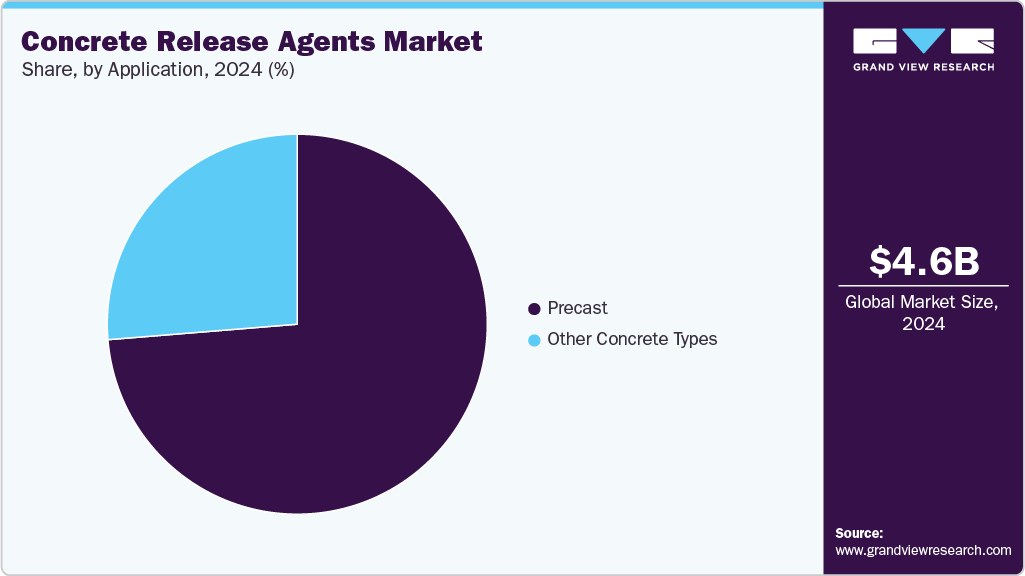
While dry cast and Autoclaved Aerated Concrete (AAC) applications also rely on release agents, their faster processing and lower-slump mixes reduce the volume required. This keeps wet cast as the dominant sub-segment within precast.
Regional Insights
Asia Pacific concrete release agents industry dominated the global market with an 82.7% revenue share in 2024, driven by its rapid urbanization, large-scale infrastructure investments, and the continuous expansion of residential and industrial construction. Countries such as China, India, Indonesia, and Vietnam are experiencing robust growth in precast production, driven by government-backed housing programs and smart city initiatives. This high-volume construction environment increases the demand for reliable release agents that ensure efficiency and consistent quality in precast and other concrete applications. In addition, the region’s shift toward modern construction methods, including greater adoption of mechanized precast plants and AAC manufacturing, further accelerates consumption.
China concrete release agents industry accounted for a dominant 72.1% share in the Asia Pacific region in 2024, driven by its massive construction ecosystem, precast manufacturing capacity, and ongoing government investment. Large-scale housing programs and industrial park development which consume high-volume concrete production. In this environment, efficient release agents are essential for maintaining productivity and quality. The rapid adoption of precast and modular construction, driven by efficiency and stricter standards, increases the use of release agents across wet-cast, dry-cast, and AAC applications. Strong domestic manufacturing, competitive pricing, and a growing preference for eco-friendly, plant-based formulations reinforce China’s leading position within Asia Pacific and globally.
North America Concrete Release Agents Market Trends
The concrete release agents industry in North America is primarily driven by the strong and steady demand for high-quality precast and ready-mix concrete used in infrastructure rehabilitation and commercial construction. Aging transportation networks, bridges, and public utilities require continuous upgrades, creating a consistent need for durable and precision-made precast components. This encourages manufacturers to utilize reliable release agents that ensure smooth demolding, minimize surface defects, and maintain production efficiency. Additionally, the region’s strict environmental and safety regulations are accelerating the shift toward low-VOC, plant-based, and advanced emulsion products and high-performance solutions tailored to North American standards.
U.S. Concrete Release Agents Market Trends
The U.S.concrete release agents industry dominated the North American market in revenue with an 84.5% share in 2024. The primary driver in the U.S. market is the strong demand for high-performance precast and structural concrete products, which are required for large-scale infrastructure renewal. With substantial federal investment directed toward highway upgrades, bridge reconstruction, and modernization of public facilities, precast producers are prioritizing release agents that support efficient production and deliver consistent, high-quality finishes. The market is also influenced by strict construction standards and growing expectations for cleaner, safer job-site practices, which are encouraging the use of improved emulsions and plant-based alternatives. This combination of sustained infrastructure spending and the shift toward higher-quality, productivity-focused materials continues to support steady market growth in the U.S.
Europe Concrete Release Agents Market Trends
The concrete release agents industry in Europe is driven by the region's strong emphasis on quality, safety, and sustainable construction practices. Ongoing investments in infrastructure modernization, particularly in transportation, energy-efficient buildings, and urban redevelopment are driving the increased use of precast and specialty concrete components, for which reliable release agents are crucial to achieving precise finishes and minimizing defects. Regulatory and industry standards are pushing manufacturers toward cleaner, more advanced formulations, fueling a shift toward plant-based and high-performance emulsions. This focus on durability, compliance, and efficiency continues to elevate demand for premium release agents across Europe.
Germany concrete release agents industry represents one of the most mature markets in Europe primarily driven by the country’s focus on high-performance precast production and its adoption of technically advanced construction practices. The market benefits from Germany’s ongoing investments in transport networks, public infrastructure, and energy-efficient buildings, all of which require concrete components with precise dimensions and clean surface finishes. To meet these expectations, manufacturers rely on release agents that deliver consistent results and support automated production processes widely used across German precast facilities.
Middle East & Africa Concrete Release Agents Market Trends
The Middle East concrete release agents industry is being driven by construction boom underpinned by mega-projects and aggressive infrastructure spending it is the fastest growing market for (CRA) in the forecast with a CAGR of 7.5%. Saudi Arabia’s Vision 2030 initiatives including NEOM, The Red Sea development, and the Jeddah Central project are driving large-scale precast demand, especially for high-quality release agents that ensure precision, surface finish, and mold longevity. In this context, release agent suppliers benefit from the rapid growth of infrastructure and road networks.
Latin America Concrete Release Agents Market Trends
The concrete release agents industry in Latin America is driven by sustained investment in infrastructure modernization, urban housing development, and industrial construction across key countries, including Brazil, Colombia, and Chile. Major projects, including Brazil’s ongoing transportation and sanitation upgrades, Colombia’s 5G infrastructure program, and Chile’s port and logistics expansion, are increasing the use of precast and structural concrete components, which rely on efficient release agents to ensure clean demolding and consistent production quality.
Key Concrete Release Agents Company Insights
Key players, such as FUCHS, BASF, Sika AG, W.R Meadows, Evonik and Nox-crete are dominating the market.
-
FUCHS is one of the leading global manufacturers of specialty lubricants and industrial chemical solutions, holding a strong position in the concrete release agents industry through its well-established SOK and RENOCAST product lines. The company offers an extensive portfolio of mineral-oil-based, water-emulsion, and bio-based formulations, including flagship products such as SOK 128, SOK 912, RENOCAST DES 6/8/20/40/42, and biodegradable variants like RENOCAST DES 50 BI and DES 58 AL, all engineered to ensure clean, residue-free separation of concrete from steel, wood, and plasticf formwork while enhancing surface quality and operational productivity in both precast plants and on-site construction. FUCHS differentiates itself through its continuous focus on sustainability and regulatory compliance, developing rapidly biodegradable and low-emission formulations that meet strict EU REACH and global environmental standards.
Key Concrete Release Agents Companies:
The following are the leading companies in the concrete release agents market. These companies collectively hold the largest market share and dictate industry trends.
- FUCHS
- Sika AG
- W. R. Meadows
- BASF
- MC-Bauchemie Müller GmbH & Co
- Evonik
- Nox-crete
- MAPEI S.p.A.
- Fosroc
- Henkel AG & Co
Global Concrete Release Agents Market Report Scope
Report Attribute
Details
Market size in 2024
USD 4.9 billion
Estimated market size in 2026
USD 5.4 billion
Projected market size by 2033
USD 8.2 billion
Growth rate
CAGR of 6.1% from 2025 to 2033
Base year for estimation
2024
Historical data
2018 - 2023
Forecast period
2025 - 2033
Quantitative units
Revenue in USD million/billion, Volume in Kilotons, and CAGR from 2025 to 2033
Report coverage
Revenue forecast, company ranking, competitive landscape, growth factors, and trends
Segments covered
Product, application, region
Regional scope
North America; Europe; Asia Pacific; Middle East & Africa; Latin America
Country scope
U.S.; Canada; Mexico; Germany; UK; France; Italy; Spain; China; India; Japan; South Korea; Brazil; Argentina; South Africa; Saudi Arabia
Key companies profiled
FUCHS; Sika AG; W. R. Meadows; BASF;
MC-Bauchemie Müller GmbH & Co; Evonik; Nox-crete; MAPEI S.p.A.; Fosroc; Henkel AG & Co
Customization scope
Free report customization (equivalent up to 8 analysts’ working days) with purchase. Addition or alteration to country, regional & segment scope.
Pricing and purchase options
Avail customized purchase options to meet your exact research needs. Explore purchase options
Global Concrete Release Agents Market Report Segmentation
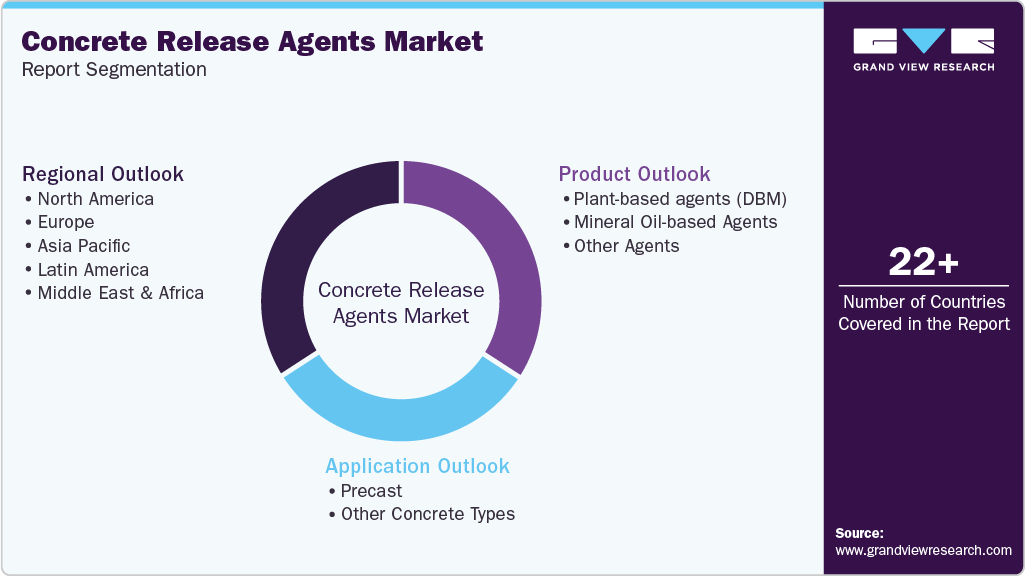
This report forecasts revenue growth at global, regional, and country levels and provides an analysis of the latest industry trends in each of the sub-segments from 2018 to 2033. For this study, Grand View Research has segmented the global concrete release agents market report based on product, application, and region:
-
Product Outlook (Volume, Kilotons; Revenue, USD Million, 2018 - 2033)
-
Plant-based agents (DBM)
-
Pure Oils
-
Plant Emulsions
-
-
Mineral Oil-based Agents
-
Pure Oils
-
Emulsions
-
-
Other Agents
-
-
Application Outlook (Volume, Kilotons; Revenue, USD Million, 2018 - 2033)
-
Precast
-
Wet cast
-
Dry cast
-
Autoclaved Aerated Concrete (AAC)
-
-
Other Concrete Types
-
-
Regional Outlook (Volume, Kilotons; Revenue, USD Million, 2018 - 2033)
-
North America
-
U.S.
-
Canada
-
Mexico
-
-
Europe
-
Germany
-
UK
-
France
-
Italy
-
Spain
-
-
Asia Pacific
-
China
-
India
-
Japan
-
South Korea
-
-
Latin America
-
Brazil
-
Argentina
-
-
Middle East & Africa
-
Saudi Arabia
-
South Africa
-
-
Frequently Asked Questions About This Report
The precast segment dominated the concrete release agents market with a 73.7% revenue share in 2024, because it uses release agents in every production cycle, resulting in significantly higher consumption than on-site concrete work. Its controlled, repetitive manufacturing process also requires consistent release performance, making release agents essential for all types of products, including wet cast, dry cast, and AAC.
Some of the key players operating in the concrete release agents market include FUCHS, Sika AG, W. R. Meadows, BASF, MC-Bauchemie Müller GmbH & Co, Evonik, Nox-crete, MAPEI S.p.A., Fosroc and Henkel AG & Co
The concrete release agents market is driven by growing use of precast concrete, rising construction activity across emerging markets, and the need for cleaner, more efficient demolding solutions. Increasing adoption of plant-based and advanced emulsion formulations to meet quality and sustainability requirements also supports market growth.
The global concrete release agents market size was valued at USD 4.9 billion in 2024 and is estimated at USD 5.4 billion for 2026.
The global concrete release agents market is expected to grow at a CAGR of 6.1% from 2025 to 2033, reaching USD 8.2 billion by 2033.
About the Author(s)
Specialty & Chemicals Research Team
Research · Specialty & ChemicalsThis report was authored by the specialty & chemicals research team at Grand View Research - comprising two research analysts, one senior research analyst, and one industry expert - with specialized expertise in the specialty & chemicals segment of the research industry. All findings are based on proprietary research databases, executive interviews, and regulatory analysis, subject to internal peer review prior to publication.
Last Updated:
Speak to Analyst

Need a Tailored Report?
Customize this report to your needs — add regions, segments, or data points, with 20% free customization.
Or view our licence options:


ISO 9001:2015 & 27001:2022 Certified
We are GDPR and CCPA compliant! Your transaction & personal information is safe and secure. For more details, please read our privacy policy.












