
- Home
- »
- Next Generation Technologies
- »
-
Consent Management Market Size, Share Report, 2026-2033GVR Report cover

Consent Management Market (2026 - 2033)
Size, Share & Trends Analysis Report By Component (Software, Services), By Deployment (Cloud, On-premise), By Touchpoint (Web App), By Organization Size, By End-use (BFSI, IT & Telecom), By Region, And Segment Forecasts
Market Size, 2025
$1.0BMarket Estimate, 2026
$1.2BMarket Forecast, 2033
$2.8BCAGR, 2026–2033
13.1%Consent Management Market Summary
The global consent management market size was valued at USD 1.0 billion in 2025 and is projected to grow from USD 1.2 billion in 2026 to USD 2.8 billion by 2033, at a CAGR of 13.1% from 2026 to 2033. The North America dominated the global market with the largest revenue share of 36.1% in 2025. This market has gained significant importance with the rise of global data protection regulations, increasing digital interactions, and growing concerns around consumer data privacy.
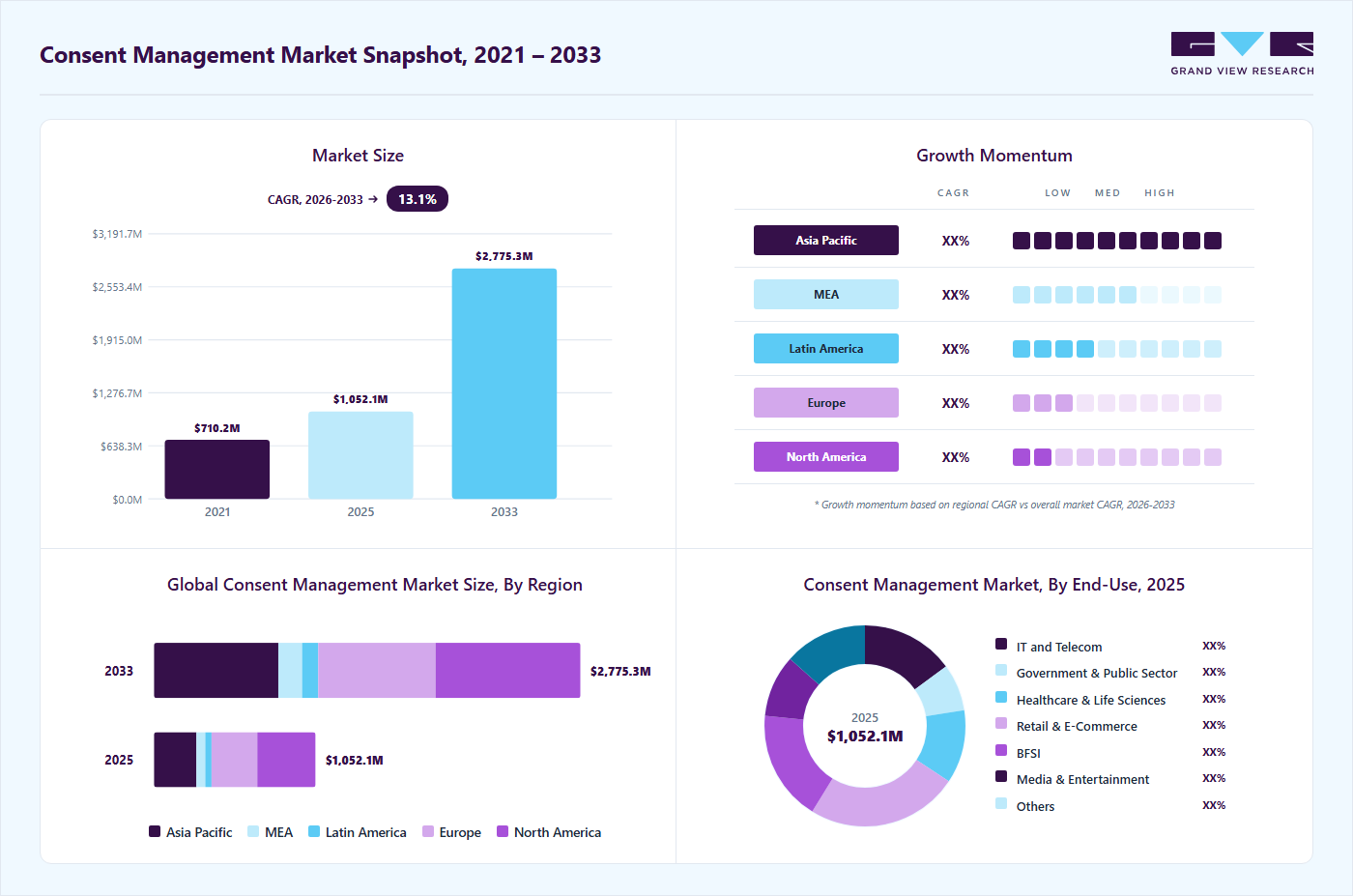 Source: Grand View Research, IR Documents, Primary Interviews, Paid DatabasesTo learn more about this report,
 Download Free Sample Report
 Key Market Trends & Insights
- By component: Software segment held the largest revenue share of 68.3% in 2025.
- By deployment: Cloud segment held the largest revenue share in 2025.
- By touchpoint: Web app segment dominated the market, accounting for the largest share in 2025.
Regional Highlights
- Largest regional market: Asia Pacific (36.1% revenue share, 2025)
- By country: The U.S. consent management market is growing at a CAGR of 11.9% from 2026 to 2033.
Market Size & Forecast
- Market size in 2025: USD 1.0 Billion
- Estimated market size in 2026: USD 1.2 Billion
- Projected market size by 2033: USD 2.8 Billion
- CAGR (2026-2033): 13.1%
Three ways to get this report
Buy it, customize it, or ask a question.Ask an Analyst
Analyst response in 1 business day
- AccessReport author, directly
- Reply timeWithin 1 working day
- No sales callDirect answer only
- FormatEmail reply
- CostFree, no cost
Get the Full Report
What the study covers
- FormatsPDF · Excel · Dashboard
- Timeline2026–2033 annual, 2025 base
- Coverage20+ countries, 5 regions
- Companies10+ key players profiled
Customize the Report
20% free customization
- IncludeCountries, segments, points
- TailorTo your product definition
- ExtendDeeper competitor detail
- OrA fully bespoke study
- Turnaround5–10 working days
As businesses expand across websites, mobile applications, cloud platforms, and connected devices, the volume of personal data being generated and processed has grown exponentially. This multi-channel engagement means companies are constantly collecting user information through various touchpoints, often across different geographies and regulatory environments. Managing consent manually in such a complex ecosystem becomes impractical and risky. As a result, organizations require scalable, automated solutions to capture, store, and enforce user consent in real time. Consent Management Platforms (CMPs) enable businesses to standardize consent processes, ensure compliance, and maintain audit trails across all digital interfaces. This makes CMPs essential for enabling seamless customer experiences while complying with evolving data privacy regulations.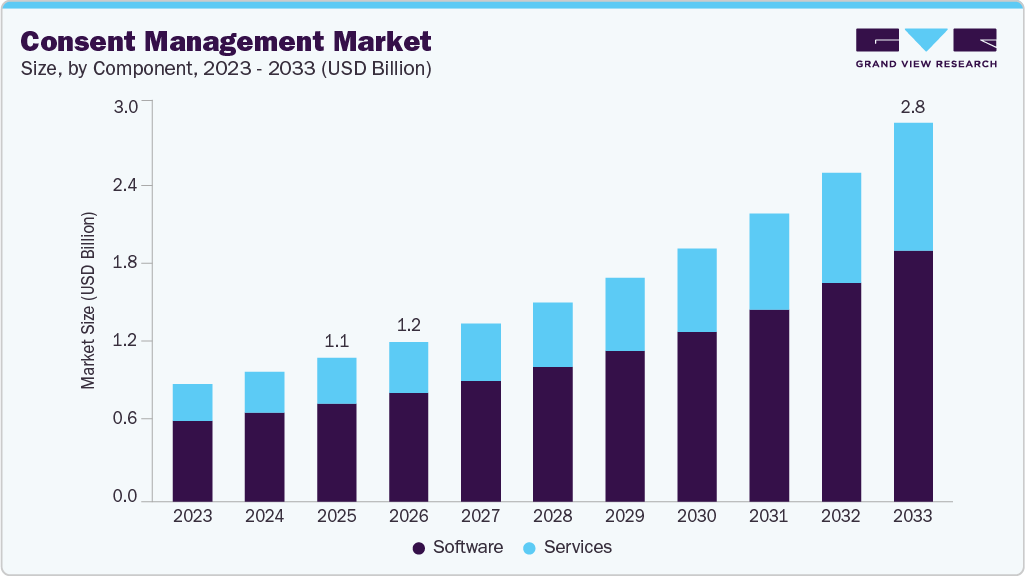 To learn more about this report, Download Free Sample Report
 Rising consumer awareness around data privacy is significantly influencing the adoption of consent management solutions. Users today are better informed about how their personal data is collected, stored, and shared, leading to greater demand for transparency from organizations. They expect clear communication on data usage, along with the ability to control what information is collected and how it is used. Additionally, consumers increasingly prefer customizable consent options rather than blanket approvals. At the same time, a growing trust gap exists, with many users doubting whether companies handle their data responsibly. This lack of trust is pushing organizations to implement robust consent management systems to enhance transparency, build credibility, and ensure compliance.
The lack of standardization and interoperability remains a key challenge in consent management. There is no universal framework governing consent data formats or the sharing of consent information across platforms. As a result, organizations struggle to integrate consent data seamlessly across systems, especially when working with multiple vendors and third-party partners. This fragmentation increases complexity, limits data consistency, and makes compliance management more difficult in interconnected digital ecosystems.
Component Insights
The software segment dominated the market and accounted for the revenue share of 68.3% in 2025. The growing volume of user data across websites, mobile apps, and digital platforms has made manual consent tracking inefficient and error-prone. Organizations today operate in highly dynamic environments where user interactions happen continuously across multiple touchpoints. In such scenarios, relying on manual processes increases the risk of non-compliance and data inconsistencies. Consent Management Platform (CMP) software addresses this challenge by automating the entire consent lifecycle, including data capture, storage, and enforcement. These solutions ensure that user preferences are consistently applied across systems in real time. As a result, businesses can efficiently manage consent at scale, reduce operational complexity, and maintain compliance while supporting seamless digital experiences.
The services segment is anticipated to grow at the fastest CAGR during the forecast period. The frequent evolution of data privacy regulations has made compliance an ongoing process rather than a one-time effort. Organizations must continuously monitor changes in laws, update consent mechanisms, and conduct regular audits to remain compliant. Managing this internally can be resource-intensive and complex. As a result, there is a growing demand for service providers who offer continuous compliance monitoring and support. These providers help businesses stay updated with regulatory changes, implement necessary updates, and ensure that consent management systems remain aligned with current legal requirements, reducing the risk of non-compliance and associated penalties.
Deployment Insights
The cloud segment dominated the market and accounted for the largest revenue share in 2025. Cloud-based consent management solutions provide high scalability and flexibility, making them well-suited for dynamic digital environments. As organizations experience fluctuations in user traffic and data volumes, cloud platforms allow them to seamlessly scale resources up or down without requiring additional infrastructure. This eliminates capacity constraints and ensures consistent performance during peak demand periods. Businesses can quickly adapt to growth, seasonal spikes, or expansion into new markets. Additionally, this flexibility supports faster deployment of new features and updates, enabling organizations to efficiently manage consent across evolving digital ecosystems while maintaining compliance and operational efficiency.
The on-premise segment is expected to grow at a significant CAGR during the forecast period. Organizations handling sensitive data, such as in the BFSI, healthcare, and government sectors, prioritize robust data security and controls. On-premise consent management solutions allow them to store and process data within their own infrastructure, ensuring complete ownership and oversight. This reduces reliance on third-party environments and minimizes exposure to external threats. As a result, organizations can better safeguard sensitive consent data while meeting strict security and compliance requirements.
Touchpoint Insights
The web app segment dominated the market, accounting for the largest revenue share in 2025. Websites remain the primary digital touchpoint for customer interactions across industries such as e-commerce, banking, media, and SaaS. Every visit to a website typically involves the collection of user data through cookies, analytics tools, and tracking technologies. This widespread and continuous data collection creates a strong need for effective consent management at the web level. Organizations must ensure that user permissions are obtained before any data is captured. As a result, consent management solutions have become essential for websites to maintain compliance, manage user preferences, and ensure transparent data practices.
The mobile app segment is expected to grow at a significant CAGR during the forecast period. The rapid adoption of smartphones and mobile internet has significantly increased the use of mobile applications across industries like e-commerce, banking, gaming, and healthcare. As users engage more frequently with apps, a large volume of personal and behavioral data is continuously collected. This surge in data generation creates a strong need for effective consent management, ensuring that user permissions are obtained and managed properly in compliance with data privacy regulations.
Organization Size Insights
The large enterprises segment dominated the market, accounting for the largest revenue share in 2025. Large enterprises operate across multiple countries, each with its own data privacy regulations such as GDPR, CCPA, and DPDP. Managing compliance separately in each region can be complex, time-consuming, and error-prone. This creates a strong need for centralized consent management systems that can standardize processes and enforce consistent compliance across all geographies. Such systems enable organizations to manage diverse regulatory requirements from a single platform, ensuring that user consent is collected, stored, and applied in accordance with local laws while maintaining operational efficiency and reducing compliance risks.
The small & medium enterprises (SMEs) segment is expected to grow at a significant CAGR over the forecast period.SMEs are rapidly adopting digital business models such as e-commerce, online services, and digital marketing to expand their reach and competitiveness. As a result, they are collecting increasing amounts of customer data through websites, apps, and online platforms. This growing data volume creates a need for structured consent management to ensure compliance with privacy regulations and maintain customer trust, driving the adoption of consent management solutions among SMEs.
End-use Insights
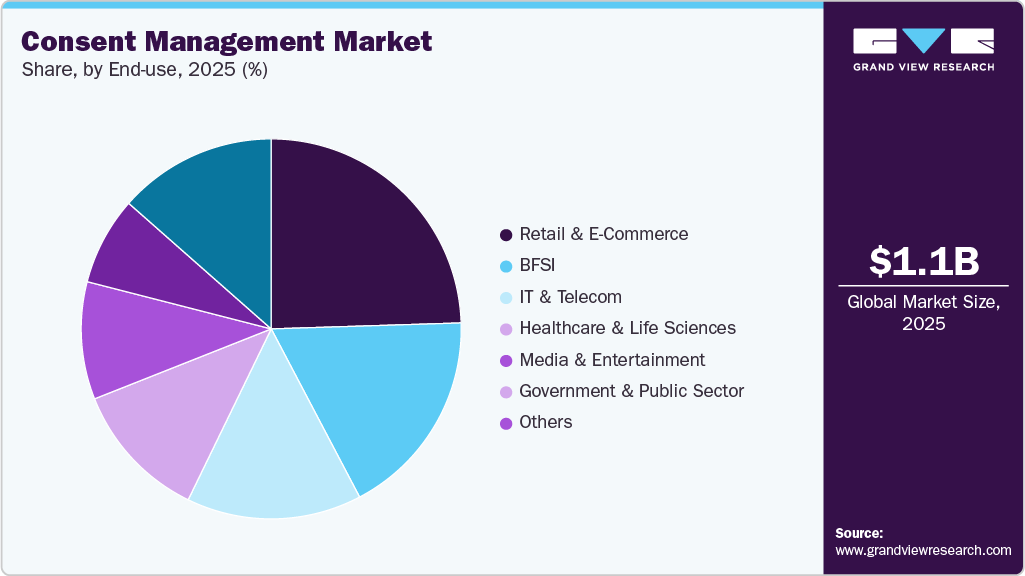
The retail & e-commerce segment dominated the market and accounted for the largest revenue share in 2025. The rapid growth of digital commerce and omnichannel retail has significantly increased the number of customer interactions across multiple platforms, including websites, mobile apps, social media, and in-store digital systems. Consumers now engage with brands seamlessly across these channels, creating a complex ecosystem for data collection and usage. Managing user consent consistently across all these touchpoints becomes challenging without a centralized system. Consent management platforms address this need by enabling businesses to capture, store, and synchronize user preferences across channels. This ensures that customer consent is respected everywhere, helping organizations maintain regulatory compliance, deliver consistent user experiences, and build trust while supporting integrated, data-driven marketing strategies.
 To learn more about this report, Download Free Sample Report
 The healthcare & life sciences segment is expected to grow at a significant CAGR over the forecast period. Healthcare data, including medical records and personal information, is highly sensitive and a prime target for cyberattacks. As data breaches in the healthcare sector continue to rise, organizations are placing greater emphasis on securing patient information. Consent management solutions help ensure that data is collected, accessed, and shared only with proper authorization. By enforcing strict consent controls and maintaining audit trails, these systems enhance data security and regulatory compliance. This reduces the risk of unauthorized access, minimizes potential breaches, and strengthens patient trust in how their data is handled.
Regional Insights
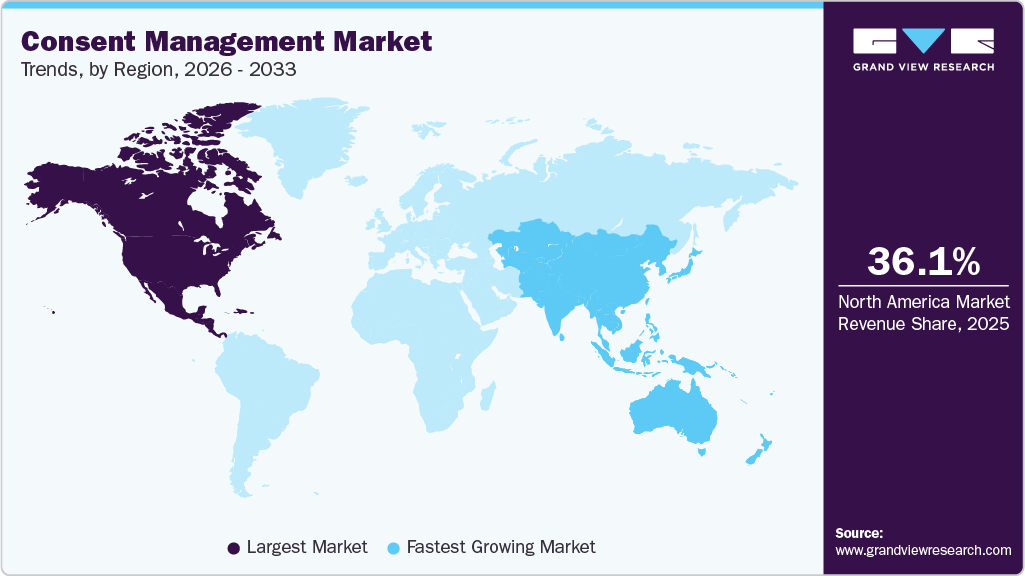
The North America consent management market dominated the global market with the largest revenue share of 36.1% in 2025. North America is home to many data-driven enterprises and technology companies that operate in complex digital environments. These organizations actively invest in advanced consent management solutions to handle large-scale data operations, ensure regulatory compliance, and maintain transparency. This strong enterprise adoption significantly drives the growth of the market in the region.
 To learn more about this report, Download Free Sample Report
 U.S. Consent Management Market Trends
The consent management market in the U.S. is expected to grow significantly at a CAGR of 11.9% from 2026 to 2033. U.S. consumers are highly aware of data privacy issues, with a large proportion expressing concerns about how companies use their personal data. This rising awareness creates pressure on organizations to implement transparent consent mechanisms and build trust.
Europe Consent Management Market Trends
The consent management market in Europe is anticipated to register considerable growth from 2026 to 2033. European regulators strictly enforce data privacy laws, imposing significant fines and penalties for non-compliance. This creates significant pressure on organizations to comply with regulations such as GDPR. To mitigate legal and financial risks, businesses invest in robust consent management systems that ensure proper data handling, compliance, and audit readiness across operations.
The UK consent management market is expected to grow rapidly in the coming years. The UK has a highly developed digital ecosystem with widespread use of web platforms, mobile apps, and e-commerce. This increases data collection across touchpoints, driving demand for centralized consent management solutions.
The consent management market in Germany held a substantial market share in 2025. Organizations in Germany are adopting advanced consent management platforms with features like granular consent controls, automated tracking, and real-time updates to meet strict regulatory requirements. These capabilities enable precise data handling, improve compliance efficiency, and enhance user transparency. As a result, technological adoption is significantly driving growth in the industry.
Asia Pacific Consent Management Market Trends
The consent management market in the Asia Pacific held a significant share in the global market in 2025. APAC is witnessing massive growth in internet users, smartphones, and digital services, particularly in countries such as India, China, and Southeast Asia. This has significantly increased the volume of personal data being generated, driving demand for consent management solutions.
The Japan consent management market is expected to grow rapidly in the coming years. The rapid expansion of e-commerce, fintech, and digital platforms in the region has increased customer interactions and data collection across channels, necessitating robust consent management systems.
The consent management market in China held a substantial market share in 2025. China’s Personal Information Protection Law (PIPL) is the most significant driver. It mandates explicit, informed, and voluntary consent for the collection and processing of personal data, similar to the GDPR. Organizations must also allow users to withdraw consent and obtain separate consent for sensitive data and cross-border transfers.
Key Consent Management Company Insights
Key players operating in the consent management industry are BigID, Cookiebot, CookieYes, Crownpeak, Didomi, iubenda., Ketch, OneTrust, Osano, Piwik PRO, Quantcast, Securiti, Sourcepoint Technologies, TrustArc, and Usercentrics. The companies are focusing on various strategic initiatives, including new product development, partnerships & collaborations, and agreements to gain a competitive advantage over their rivals. The following are some instances of such initiatives.
-
In April 2026, CookieYes announced the launch of a Cookie Policy Generator to help businesses automatically create accurate, up-to-date cookie policies. The tool scans websites, detects cookies, and updates policies in real time, reducing reliance on legal templates. Privacy regulations covering most of the global population address compliance gaps, enhance transparency, and simplify adherence to laws like GDPR and CCPA.
-
In February 2026, Didomi partnered with Backscreen, a Baltic-based OTT technology provider, to enhance consent management for broadcasters and streaming services. The collaboration integrates Didomi’s consent and preference management tools, aligned with IAB Europe’s Transparency & Consent Framework (TCF) 2.2 and 2.3, and Google-certified into Backscreen’s OTT platforms. This enables operators to handle user consent seamlessly across web, mobile apps, and connected TV, ensuring privacy compliance across complex, multi-device streaming environments.
-
In January 2026, Usercentrics acquired MCP Manager, an advanced governance platform for the Model Context Protocol (MCP) developed by AI infrastructure experts. This acquisition positions Usercentrics as the first major global privacy solutions provider to extend consent and data controls into AI-driven workflows. The combined platform will offer a unified Privacy-Led Marketing Suite, enabling organizations to manage consent, preferences, and data governance across websites, applications, internal systems, and AI-powered consumer interfaces.
Key Consent Management Companies:
The following key companies have been profiled for this study on the consent management market.
-
BigID
-
Cookiebot
-
CookieYes
-
Crownpeak
-
Didomi
-
iubenda.
-
Ketch
-
OneTrust
-
Osano
-
Piwik PRO
-
Quantcast
-
Securiti
-
Sourcepoint Technologies
-
TrustArc
-
Usercentrics
Consent Management Market Report Scope
Report Attribute
Details
Market size in 2025
USD 1.0 billion
Estimated Market size in 2026
USD 1.2 billion
Projected Market size by 2033
USD 2.8 billion
Growth rate
CAGR of 13.1% from 2026 to 2033
Actual data
2021 - 2025
Forecast period
2026 - 2033
Quantitative units
Revenue in USD million/billion and CAGR from 2026 to 2033
Report enterprise size
Revenue forecast, company share, competitive landscape, growth factors, and trends
Segments covered
Component, deployment, touchpoint, organization size, end-use, region
Regional scope
North America; Europe; Asia Pacific; Latin America; Middle East and Africa
Country scope
U.S.; Canada; Mexico; UK; Germany; France; China; India; Japan; Australia; South Korea; Brazil; UAE; Kingdom of Saudi Arabia; South Africa
Key companies profiled
BigID, Cookiebot, CookieYes, Crownpeak, Didomi, iubenda, Ketch, OneTrust, Osano, Piwik PRO, Quantcast, Securiti, Sourcepoint Technologies, TrustArc, Usercentrics.
Customization scope
Free report customization (equivalent to 8 analysts working days) with purchase. Addition or alteration to country, regional & segment scope.
Pricing and purchase options
Avail customized purchase options to meet your exact research needs. Explore purchase options
Global Consent Management Market Report Segmentation
This report forecasts revenue growth at the global, regional, and country levels and provides an analysis of the latest industry trends in each of the sub-segments from 2021 to 2033. For this study, Grand View Research has segmented the global consent management market report based on component, deployment, touchpoint, organization size, end-use, and region:
-
Component Outlook (Revenue, USD Billion, 2021 - 2033)
-
Software
-
Services
-
-
Deployment Outlook (Revenue, USD Billion, 2021 - 2033)
-
Cloud
-
On-premise
-
-
Touchpoint Outlook (Revenue, USD Billion, 2021 - 2033)
-
Web App
-
Mobile App
-
-
Organization Size Outlook (Revenue, USD Billion, 2021 - 2033)
-
Large Enterprises
-
Small & Medium Enterprises (SMEs)
-
-
End-use Outlook (Revenue, USD Billion, 2021 - 2033)
-
BFSI
-
IT & Telecom
-
Government & Public Sector
-
Healthcare & Life Sciences
-
Retail & E-Commerce
-
Media & Entertainment
-
Others
-
-
Regional Outlook (Revenue, USD Billion, 2021 - 2033)
-
North America
-
U.S.
-
Canada
-
Mexico
-
-
Europe
-
UK
-
Germany
-
France
-
-
Asia Pacific
-
China
-
India
-
Japan
-
South Korea
-
Australia
-
-
Latin America
-
Brazil
-
-
Middle East & Africa
-
UAE
-
Saudi Arabia
-
South Africa
-
-
Frequently Asked Questions About This Report
North America dominated the global market with the largest revenue share of 36.1% in 2025.
The software segment dominated the market and accounted for the revenue share of 68.3% in 2025.
The cloud segment dominated the market and accounted for the largest revenue share in 2025.
The global consent management market size was valued at USD 1.0 billion in 2025 and is expected to reach USD 1.2 billion in 2026.
The global consent management market is expected to grow at a compound annual growth rate of 13.1% from 2026 to 2033 to reach USD 2.8 billion by 2033.
The software segment dominated the market and accounted for the revenue share of 68.3% in 2025. The growing volume of user data across websites, mobile apps, and digital platforms has made manual consent tracking inefficient and error-prone. Organizations today operate in highly dynamic environments where user interactions happen continuously across multiple touchpoints. In such scenarios, relying on manual processes increases the risk of non-compliance and data inconsistencies.
Key players operating in the consent management industry are BigID, Cookiebot, CookieYes, Crownpeak, Didomi, iubenda, Ketch, OneTrust, Osano, Piwik PRO, Quantcast, Securiti, Sourcepoint Technologies, TrustArc, Usercentrics.
Key factors include the rise of global data protection regulations, increasing digital interactions, and growing concerns around consumer data privacy.
The web app segment dominated the market, accounting for the largest revenue share in 2025.
The retail & e-commerce segment dominated the market, accounting for the largest revenue share in 2025.
About the Author(s)
Next Generation Technologies Research Team
Technology · Next Generation TechnologiesThis report was authored by the next generation technologies research team at Grand View Research - comprising two research analysts, one senior research analyst, and one industry expert - with specialized expertise in the next generation technologies segment of the technology industry. All findings are based on proprietary technology databases, executive interviews, and regulatory analysis, subject to internal peer review prior to publication.
Last Updated:
Speak to Analyst

Customize this report to your needs - add regions, segments, or data points, with 20% free customization.
Or view our licence options:


ISO 9001:2015 & 27001:2022 Certified
We are GDPR and CCPA compliant! Your transaction & personal information is safe and secure. For more details, please read our privacy policy.


