
- Home
- »
- IT Services & Applications
- »
-
Construction Management Software Market Size And Share Report, 2026-2033GVR Report cover

Construction Management Software Market (2026 - 2033)
Size, Share & Trends Analysis Report By Project Type, By Deployment (Cloud, On-premise), By Enterprise Size (Large Enterprises, SMEs), By Application, By End-use, By Region, And Segment Forecasts
Market Size, 2025
$7.7BMarket Estimate, 2026
$8.3BMarket Forecast, 2033
$16.4BCAGR, 2026–2033
10.2%Construction Management Software Market Summary
The global construction management software market size was valued at USD 7.7 billion in 2025 and is projected to grow from USD 8.3 billion in 2026 to USD 16.4 billion by 2033, at a CAGR of 10.2% from 2026 to 2033. The North America market held the largest share of 31.9% of the global market in 2025. The market growth is primarily driven by the increasing digitalization of construction activities, rising complexity of large-scale projects, and the need for improved cost control and project efficiency across the construction industry.
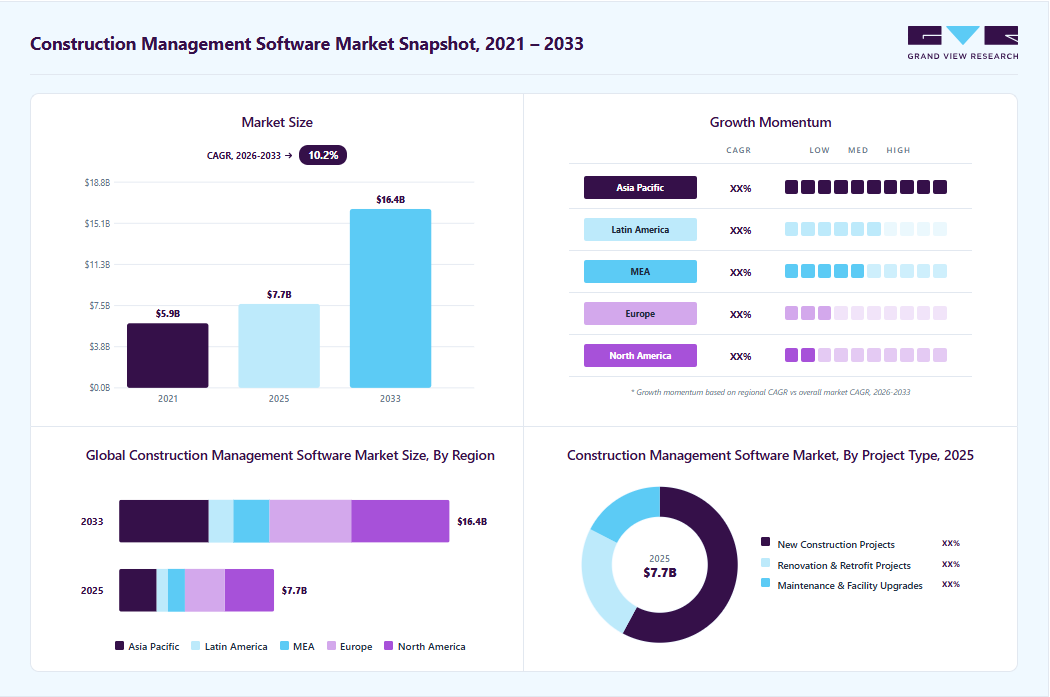 Source: Grand View Research, IR Documents, Primary Interviews, Paid DatabasesTo learn more about this report,
 Download Free Sample Report
 Key Market Trends & Insights
- By project type: The new construction projects segment accounted for the largest revenue share of 57.8% in 2025.
- By deployment: The cloud segment dominated the market in 2025.
- By enterprise size: The large enterprises segment dominated the market in 2025.
- By application: The project management & scheduling segment accounted for the largest revenue share in 2025.
Regional Highlights
- Largest regional market: North America (31.9% revenue share, 2025)
- Fastest-growing regional market: Asia Pacific (highest CAGR, 2026-2033)
- By country: The China held the largest market share in 2025.
Market Size & Forecast
- Market size in 2025: USD 7.7 Billion
- Estimated market size in 2026: USD 8.3 Billion
- Projected market size by 2033: USD 16.4 Billion
- CAGR (2026-2033): 10.2%
Three ways to get this report
Buy it, customize it, or ask a question.Ask an Analyst
Analyst response in 1 business day
- AccessReport author, directly
- Reply timeWithin 1 working day
- No sales callDirect answer only
- FormatEmail reply
- CostFree, no cost
Get the Full Report
What the study covers
- FormatsPDF · Excel · Dashboard
- Timeline2026–2033 annual, 2025 base
- Coverage20+ countries, 5 regions
- Companies10+ key players profiled
Customize the Report
20% free customization
- IncludeCountries, segments, points
- TailorTo your product definition
- ExtendDeeper competitor detail
- OrA fully bespoke study
- Turnaround5–10 working days
The rapid growth in global infrastructure and urban development projects is one of the key market drivers. Governments and private developers are investing heavily in residential, commercial, and infrastructure construction, which requires efficient project planning, scheduling, and coordination. Construction management software helps streamline workflows, reduce delays, and ensure better resource utilization, making it an essential tool for managing large and complex projects.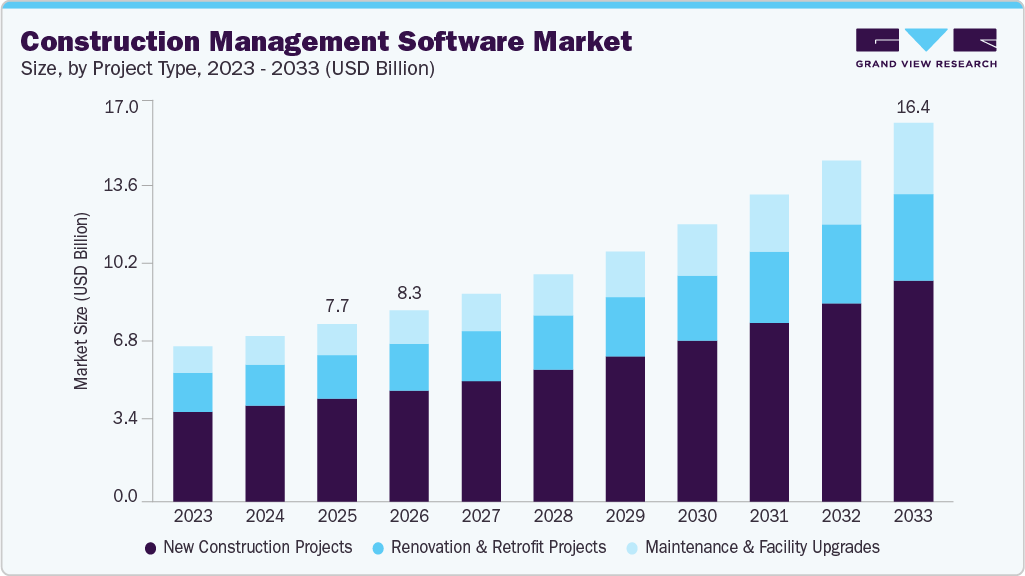 To learn more about this report, Download Free Sample Report
 The increasing need for improved project visibility and centralized data management is a key driver supporting the adoption of construction management software. Construction projects typically involve multiple stakeholders, including contractors, subcontractors, architects, and clients, making coordination complex. These software solutions provide a unified platform that enables real-time data sharing, communication, and decision-making, thereby reducing errors and improving overall project efficiency.
The growing emphasis on cost optimization and risk management is accelerating the adoption of construction management software. With rising material and labor costs, companies are focusing on tools that provide accurate cost estimation, budget tracking, and financial forecasting. These solutions help minimize cost overruns and improve profitability by offering better visibility into project finances and performance.
In addition, increasing regulatory requirements related to safety and compliance are driving demand for software solutions that can track and manage safety protocols, documentation, and reporting. Construction firms are using these platforms to ensure adherence to local regulations, reduce workplace incidents, and maintain proper documentation for audits and inspections.
Furthermore, the integration of advanced technologies such as Building Information Modeling (BIM), artificial intelligence (AI), and data analytics is further enhancing the capabilities of construction management software. These technologies enable predictive insights, improved design coordination, and better decision-making, which are helping companies improve project outcomes and gain a competitive advantage in the market.
Project Type Insights
The new construction projects segment accounted for the largest revenue share of 57.8% in 2025. This dominance is driven by the high volume of residential, commercial, and infrastructure development projects that require comprehensive planning, coordination, and execution tools. Construction management software is widely used in new projects to manage end-to-end workflows, including scheduling, cost estimation, resource allocation, and real-time progress tracking. The increasing scale and complexity of modern construction projects, along with the need to reduce delays and control budgets, are further boosting adoption. In addition, growing investments in urban development and the demand for efficient project delivery are key factors supporting the strong use of construction management software in new construction projects.
The maintenance & facility upgrades segment is expected to register the highest CAGR from 2026 to 2033. This growth is driven by the increasing focus on extending the lifecycle of existing buildings and infrastructure through regular maintenance and modernization activities. Organizations are adopting construction management software to efficiently plan, track, and manage repair, renovation, and upgrade projects while minimizing operational disruptions. The rising demand for better asset performance, energy efficiency improvements, and compliance with evolving building standards is further supporting adoption. In addition, the integration of digital tools for ongoing facility monitoring, work order management, and resource optimization is accelerating the use of construction management software in maintenance and upgrade projects.
Deployment Insights
The cloud segment dominated the market in 2025. The increasing demand for real-time collaboration, scalability, and cost-effective deployment models across construction projects drives this dominance. Cloud-based solutions enable seamless access to project data from any location, allowing stakeholders such as contractors, engineers, and project managers to collaborate efficiently. The reduced need for upfront IT infrastructure, along with subscription-based pricing, makes cloud platforms particularly attractive for both large enterprises and SMEs. In addition, the growing adoption of mobile devices on construction sites and the need for instant updates, data sharing, and remote project monitoring are further accelerating the shift toward cloud-based construction management solutions.
The on-premise segment is expected to register a significant CAGR from 2026 to 2033. This growth is driven by the increasing demand for enhanced data security, control, and customization among large construction enterprises and government projects. Organizations handling sensitive project data, complex infrastructure developments, and regulatory requirements prefer on-premise deployment to maintain full control over their IT environment and ensure compliance with internal policies. In addition, the need for seamless integration with legacy systems and enterprise resource planning (ERP) platforms is supporting adoption. Industries with strict data governance standards and long project lifecycles are further contributing to the steady growth of on-premise construction management solutions.
Enterprise Size Insights
The large enterprises segment dominated the market in 2025. This dominance is driven by the high volume and complexity of projects handled by large construction firms, which require advanced tools for project planning, cost control, and resource management. These organizations have greater financial capacity to invest in integrated software platforms and are early adopters of digital technologies to improve operational efficiency. In addition, large enterprises often manage multiple projects across different locations, increasing the need for centralized systems that enable real-time collaboration, data visibility, and performance tracking. The growing focus on minimizing project delays, optimizing resource utilization, and ensuring compliance further supports the strong adoption of construction management software among large enterprises.
The SMEs segment is expected to register the fastest CAGR from 2026 to 2033. This growth is driven by the increasing availability of affordable, cloud-based construction management solutions that lower the barrier to entry for small and medium-sized enterprises. SMEs are increasingly adopting these tools to improve project efficiency, reduce manual processes, and enhance cost control. The rising need to remain competitive, manage multiple projects with limited resources, and ensure timely project delivery is further encouraging adoption. In addition, user-friendly interfaces, subscription-based pricing models, and mobile accessibility are making it easier for SMEs to integrate construction management software into their operations, thereby accelerating market growth.
Application Insights
The project management & scheduling segment accounted for the largest revenue share in 2025. The essential role these tools play in planning, organizing, and tracking construction activities across the project lifecycle drives this dominance. Construction firms rely on project management and scheduling solutions to allocate resources efficiently, manage timelines, monitor task dependencies, and ensure timely project completion. The increasing complexity of multi-phase construction projects, along with the need to minimize delays and cost overruns, is further boosting demand. In addition, the adoption of cloud-based platforms and real-time tracking capabilities is enhancing collaboration among stakeholders, making these solutions critical for improving productivity and overall project performance.
The field service management segment is anticipated to grow at the fastest CAGR during the forecast period. This growth is driven by the increasing need for efficient on-site operations, real-time data capture, and seamless coordination between field workers and project managers. Construction companies are adopting field service management solutions to enable mobile-based task management, instant reporting, and improved workforce productivity across multiple job sites. The rising use of smartphones, tablets, and cloud-based platforms allows field teams to update progress, report issues, and access project information in real time. In addition, the growing focus on reducing manual paperwork, improving response times, and enhancing overall project execution efficiency is further accelerating the demand for field service management solutions.
End-use Insights
The commercial construction segment accounted for the largest market share in 2025. This dominance is driven by the high volume and value of commercial projects such as office buildings, retail spaces, hotels, and mixed-use developments, which require advanced planning, coordination, and monitoring tools. Construction management software is widely adopted in this segment to manage complex workflows, multiple stakeholders, and strict project timelines. The need to control costs, optimize resource utilization, and ensure timely project delivery is further fueling demand. In addition, increasing investments in urban development and smart commercial infrastructure are encouraging the adoption of digital solutions, thereby strengthening the growth of construction management software in the commercial construction segment.
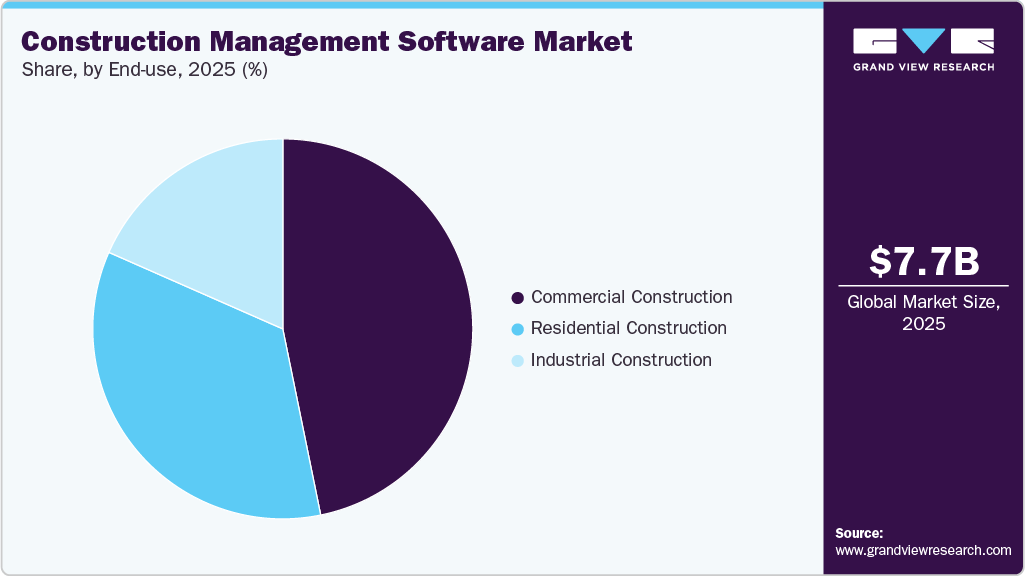 To learn more about this report, Download Free Sample Report
 The residential construction segment is anticipated to register the fastest CAGR during the forecast period. This growth is driven by the rising demand for housing, rapid urbanization, and increasing investments in residential development projects across emerging and developed economies. Construction management software is being widely adopted in this segment to streamline project scheduling, manage costs, and improve coordination across multiple housing units and sites. In addition, the growing need for faster project completion, efficient resource utilization, and improved transparency for buyers is encouraging developers to implement digital solutions. The increasing adoption of cloud-based platforms and mobile applications further supports real-time tracking and communication, thereby accelerating the use of construction management software in residential construction projects.
Regional Insights
The construction management software market in North America accounted for the largest market share of 31.9% in 2025, driven by the early adoption of advanced digital technologies, the strong presence of leading software providers, and high investment in infrastructure and commercial construction projects. The North America region benefits from a mature construction ecosystem and widespread use of cloud-based platforms, enabling real-time collaboration and efficient project execution. In addition, increasing adoption of Building Information Modeling (BIM), integration of AI and mobile-based field solutions, and strict regulatory requirements related to safety and compliance are further accelerating demand for construction management software across North America.
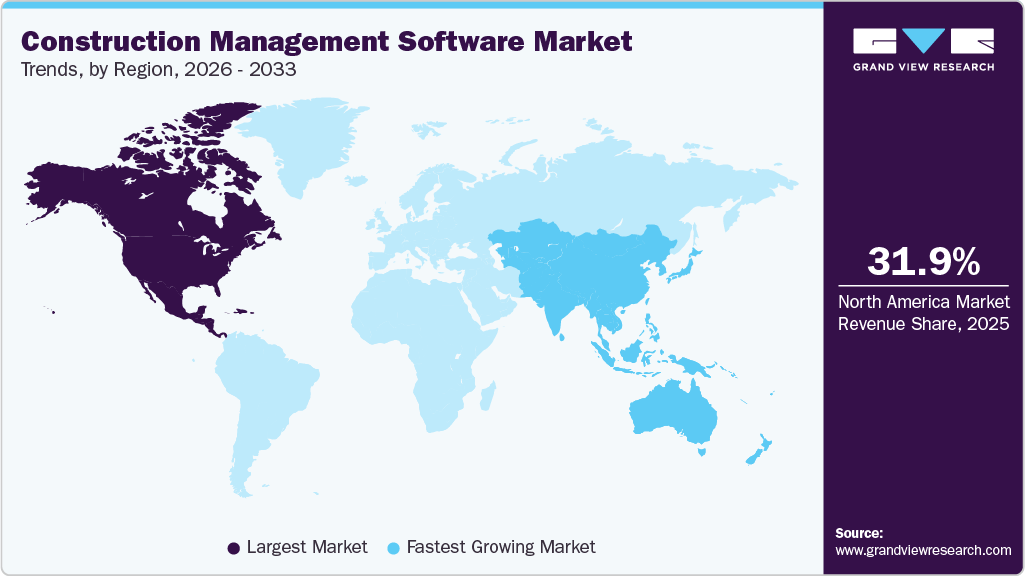 To learn more about this report, Download Free Sample Report
 U.S. Construction Management Software Market Trends
The construction management software market in the U.S. is projected to grow significantly during the forecast period. This growth is driven by large-scale infrastructure investments, including government initiatives for the modernization of transportation and public infrastructure, as well as the increasing need for cost control and operational efficiency in construction projects. Rising labor costs, growing project complexity, and strong demand for real-time project monitoring tools are encouraging companies to adopt advanced software solutions. In addition, the rapid shift toward cloud-based platforms, integration of AI-driven analytics, and the need to improve resource utilization and reduce project delays are key factors supporting market growth in the U.S.
Asia Pacific Construction Management Software Market Trends
The construction management software market in the Asia Pacific is expected to grow at the fastest CAGR from 2026 to 2033. This growth is driven by rapid urbanization, expanding smart city initiatives, and increasing investments in large-scale infrastructure and real estate development across emerging economies such as India, Southeast Asia, and others. The rising adoption of digital construction practices, along with growing awareness among contractors about improving project efficiency and reducing delays, is further supporting market expansion. In addition, the increasing penetration of mobile technologies, government-led digital transformation initiatives, and the need to manage high-volume construction projects are key factors accelerating the adoption of construction management software in the region.
China construction management software market is projected to grow steadily during the forecast period. This growth is driven by the country’s strong focus on large-scale infrastructure development, including transportation networks, urban housing, and industrial projects. The increasing adoption of prefabrication and modular construction techniques is creating demand for advanced project coordination and management tools. In addition, government support for digital construction practices and the growing focus on improving construction quality and efficiency are encouraging the use of software solutions. The presence of a vast construction ecosystem and the need to manage complex, high-density urban projects are further contributing to the steady growth of the market in China.
Europe Construction Management Software Market Trends
The construction management software market in Europe is experiencing steady growth, supported by the increasing focus on sustainable construction practices and strict environmental regulations across the region. The push toward green buildings and energy-efficient infrastructure is encouraging the adoption of digital tools for better planning, monitoring, and reporting of construction activities. In addition, the growing use of digital twins and lifecycle-based project management approaches is driving demand for integrated software solutions. The presence of well-established construction standards and the need for improved project documentation and transparency are further contributing to the steady adoption of construction management software in Europe.
The UK construction management software market is projected to grow significantly during the forecast period. This growth is driven by the increasing adoption of digital construction standards such as BIM mandates for public sector projects, which require advanced software for project coordination and data management. The rising demand for renovation and refurbishment of aging infrastructure, along with a strong focus on improving project delivery timelines, is further supporting market growth. In addition, the growing trend of modular and off-site construction, coupled with the need for efficient stakeholder collaboration and data-driven decision-making, is accelerating the adoption of construction management software in the UK.
Key Construction Management Software Company Insights
Some prominent players in the market include Procore Technologies, Inc., Autodesk, Inc., Trimble Inc., Oracle, Sage Group plc, among others.
-
Procore Technologies is a U.S.-based construction technology company that provides cloud-based construction management software designed to connect all stakeholders involved in construction projects on a single platform. The company offers an end-to-end solution that supports the entire construction lifecycle, including preconstruction, project management, resource management, and financial management. With millions of users across more than 160 countries and support for millions of projects globally, Procore has established a strong presence as one of the leading players in the market, offering an integrated and scalable platform tailored specifically for the construction industry.
-
Autodesk is a global software company that provides advanced solutions for the architecture, engineering, and construction (AEC) industry, with a strong presence in the market through its Autodesk Construction Cloud platform. Its solutions, such as Autodesk Build, BIM Collaborate, and Takeoff, enable real-time collaboration, risk mitigation, and improved decision-making. With adoption across millions of projects globally and strong integration capabilities with enterprise systems, Autodesk has established itself as one of the leading players in the market, delivering end-to-end digital solutions for builders, contractors, and project owners.
Key Construction Management Software Companies:
The following key companies have been profiled for this study on the construction management software market.
- Autodesk, Inc.
- Bluebeam
- CMiC
- CoConstruct (A Buildertrend Company)
- ConstructConnect
- Fieldwire by Hilti
- Jonas Construction Software Inc.
- Nemetschek Group
- Oracle
- PlanRadar
- Procore Technologies, Inc.
- RIB Software GmbH
- Sage Group plc
- STACK Construction Technologies
- Trimble Inc.
Recent Developments
-
In January 2026, Autodesk introduced over 40 new updates to its Autodesk Construction Cloud platform aimed at enhancing connected project delivery and improving workflow efficiency across construction projects. These updates focused on strengthening data management, access control, and change management capabilities, while also introducing AI-powered assistance features to support faster decision-making. The enhancements were rolled out across key solutions such as Autodesk Build, BIM Collaborate, and Takeoff, enabling better collaboration, real-time insights, and streamlined project execution for construction teams.
-
In January 2024, Autodesk announced that it had signed an agreement to acquire Payapps, a company that provides construction payment and compliance management solutions, to strengthen its construction management software offerings. The acquisition builds on the existing integration between Payapps and Autodesk Construction Cloud and is intended to improve payment processes, increase transparency, and ensure better compliance across construction projects.
Construction Management Software Market Report Scope
Report Attribute
Details
Market size in 2025
USD 7.7 Billion
Estimated market size in 2026
USD 8.3 billion
Projected market size by 2033
USD 16.4 billion
Growth rate
CAGR of 10.2% from 2026 to 2033
Actual data
2021 - 2025
Forecast period
2026 - 2033
Quantitative units
Revenue in USD million/billion and CAGR from 2026 to 2033
Report coverage
Revenue forecast, company share, competitive landscape, growth factors, and trends
Segments covered
Project type, deployment, enterprise size, application, end-use, region
Regional scope
North America; Europe; Asia Pacific; Latin America; MEA
Country scope
U.S.; Canada; Mexico; UK; Germany; France; China; India; Japan; Australia; South Korea; Brazil; UAE; Saudi Arabia; South Africa
Key companies profiled
Autodesk, Inc.; Bluebeam; CMiC; CoConstruct (A Buildertrend Company); ConstructConnect; Fieldwire by Hilti; Jonas Construction Software Inc.; Nemetschek Group; Oracle; PlanRadar; Procore Technologies, Inc.; RIB Software GmbH; Sage Group plc; STACK Construction Technologies; Trimble Inc.
Customization scope
Free report customization (equivalent to 8 analysts working days) with purchase. Addition or alteration to country, regional & segment scope.
Pricing and purchase options
Avail customized purchase options to meet your exact research needs. Explore purchase options
Global Construction Management Software Market Report Segmentation
This report forecasts revenue growth at global, regional, and country levels and provides an analysis of the latest industry trends in each of the sub-segments from 2021 to 2033. For this study, Grand View Research has segmented the global construction management software market report based on project type, deployment, enterprise size, application, end-use, and region:
-
Project Type Outlook (Revenue, USD Million, 2021 - 2033)
-
New Construction Projects
-
Renovation & Retrofit Projects
-
Maintenance & Facility Upgrades
-
-
Deployment Outlook (Revenue, USD Million, 2021 - 2033)
-
Cloud
-
On-premise
-
-
Enterprise Size Outlook (Revenue, USD Million, 2021 - 2033)
-
Large Enterprises
-
SMEs
-
-
Application Outlook (Revenue, USD Million, 2021 - 2033)
-
Project Management & Scheduling
-
Cost Estimation & Budgeting
-
Project Planning & Design Coordination
-
Document Management
-
Field Service Management
-
Safety & Compliance Management
-
Resource & Equipment Management
-
-
End-use Outlook (Revenue, USD Million, 2021 - 2033)
-
Residential Construction
-
Commercial Construction
-
Industrial Construction
-
-
Regional Outlook (Revenue, USD Million, 2021 - 2033)
-
North America
-
U.S.
-
Canada
-
Mexico
-
-
Europe
-
Germany
-
UK
-
France
-
-
Asia Pacific
-
China
-
India
-
Japan
-
South Korea
-
Australia
-
-
Latin America
-
Brazil
-
-
Middle East & Africa
-
UAE
-
Saudi Arabia
-
South Africa
-
-
Frequently Asked Questions About This Report
Asia Pacific is the fastest-growing region over the forecast period.
Project management & scheduling segment accounted for the largest revenue share in 2025, while field service management is the fastest-growing segment.
The new construction projects segment held the highest market share of 57.8% in 2025. while maintenance & facility upgrades is the fastest-growing segment.
The cloud segment held the highest market share in 2025, while on-premise is growing significantly.
Large enterprises segment dominated the market in 2025, while SMEs is the fastest-growing segment.
The global construction management software market size was estimated at USD 7.7 billion in 2025 and is expected to reach USD 8.3 billion in 2026.
The global construction management software market is expected to grow at a compound annual growth rate of 10.2% from 2026 to 2033 to reach USD 16.4 billion by 2033.
North America dominated with a 31.9% revenue share in 2025.
Some key players operating in the market include Autodesk, Inc.; Bluebeam; CMiC; CoConstruct (A Buildertrend Company); ConstructConnect; Fieldwire by Hilti; Jonas Construction Software Inc.;Nemetschek Group; Oracle; PlanRadar; Procore Technologies, Inc.; RIB Software GmbH; Sage Group plc; STACK Construction Technologies; Trimble Inc., and Others.
Key factors include rising adoption of digital project management tools to improve efficiency and collaboration, increasing complexity of large-scale construction projects, and growing demand for real-time cost control, scheduling, and resource optimization play a key role in accelerating the construction management software market.
About the Author(s)
IT Services & Applications Research Team
Technology · IT Services & ApplicationsThis report was authored by the it services & applications research team at Grand View Research - comprising two research analysts, one senior research analyst, and one industry expert - with specialized expertise in the it services & applications segment of the technology industry. All findings are based on proprietary technology databases, executive interviews, and regulatory analysis, subject to internal peer review prior to publication.
Last Updated:
Speak to Analyst

Customize this report to your needs - add regions, segments, or data points, with 20% free customization.
Or view our licence options:


ISO 9001:2015 & 27001:2022 Certified
We are GDPR and CCPA compliant! Your transaction & personal information is safe and secure. For more details, please read our privacy policy.


