
- Home
- »
- Next Generation Technologies
- »
-
Container Handling Equipment Market Report, 2026-2033GVR Report cover
![Container Handling Equipment Market (2026 - 2033)Report]()
Container Handling Equipment Market (2026 - 2033)
Size, Share & Trends Analysis Report By Equipment Type (Forklift Truck,Reach Stacker), By Propulsion Type (Diesel), By Lifting Capacity, By Handling Mode, By End Use, By Region, And Segment Forecasts
Market Size, 2025
$8.5BMarket Estimate, 2026
$8.8BMarket Forecast, 2033
$12.7BCAGR, 2026–2033
5.3%Container Handling Equipment Market Summary
The global container handling equipment market size was valued at USD 8.5 billion in 2025 and is projected to grow from USD 8.8 billion in 2026 to USD 12.7 billion by 2033, at a CAGR of 5.3% from 2026 to 2033. The market in Asia Pacific dominated with a revenue share of 35.1% in 2025. Terminal automation, encompassing the full or partial substitution of manned operations with automated equipment and processes, has emerged as a significant trend in the global market.

Key Market Trends & Insights
- By equipment type: Cranes segment held the largest market share of 46.4% in 2025.
- By propulsion type: Diesel segment held the largest market share in 2025.
- By lifting capacity: > 100 tons segment held the largest market share in 2025.
- By handling mode: Manual segment held the largest market share in 2025.
- By end use: Port segment held the largest market share in 2025.
Regional Highlights
- Largest regional market: Asia Pacific (35.1% revenue share, 2025)
- By country: India held the largest market share in 2025
Market Size & Forecast
- Market size in 2025: USD 8.5 Billion
- Estimated market size in 2026: USD 8.8 Billion
- Projected market size by 2033: USD 12.7 Billion
- CAGR (2026-2033): 5.3%
The container handling equipment market is expected to experience substantial growth owing to the rising global containerized trade and increasing cargo movement across international maritime routes. The expansion of global manufacturing activities, cross-border trade, and e-commerce logistics has significantly increased the volume of containers handled at ports and inland terminals. In addition, the growing deployment of mega container vessels with higher TEU capacities is increasing the need for efficient loading, unloading, stacking, and yard management operations at ports. This has encouraged terminal operators to invest in advanced container handling equipment, such as cranes, reach stackers, straddle carriers, forklifts, and automated guided vehicles, to improve operational productivity and reduce vessel turnaround time.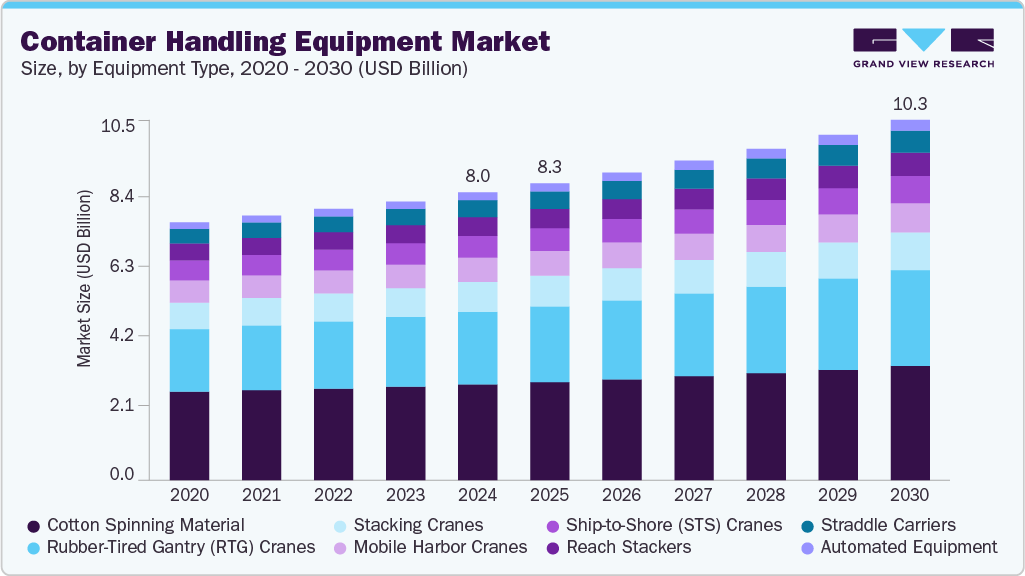
Moreover, governments across developing economies are heavily investing in port modernization and logistics infrastructure development projects to strengthen trade competitiveness and support economic growth. The growing development of inland container depots, dry ports, and intermodal freight corridors is also driving demand for container-handling equipment beyond traditional seaport applications. In addition, rising congestion at ports and terminals has accelerated the adoption of high-capacity, automated handling systems to improve throughput efficiency. The growing focus on faster cargo movement, reduced operational downtime, and optimized yard utilization is further supporting market expansion. These infrastructure and trade-related developments are collectively driving the growth of the container handling equipment market globally.
Furthermore, the market for container-handling equipment is witnessing strong growth, driven by the increasing adoption of automation and smart technologies across port and terminal operations. Port operators are increasingly focusing on improving cargo handling efficiency, minimizing labor dependency, and reducing operational errors through the deployment of automated equipment. In addition, the rising labor costs and workforce shortages at major ports are encouraging the integration of automated guided vehicles, automated stacking cranes, remote-controlled quay cranes, and intelligent terminal management systems. The growing implementation of smart port initiatives integrating IoT, artificial intelligence, predictive maintenance, and real-time fleet monitoring systems is further accelerating the demand for technologically advanced container handling equipment.
Market Dynamics
The container handling equipment market is anticipated to grow significantly due to the ongoing expansion of global seaborne trade, rising container throughput at ports, and increasing investments in port modernization projects. The growth in international trade agreements, industrial manufacturing output, and intermodal transportation networks has accelerated the movement of containerized cargo across major shipping corridors. Furthermore, the increasing adoption of larger container ships with higher cargo-carrying capacities is driving strong demand for efficient, high-capacity container-handling systems across ports, terminals, rail freight depots, and logistics hubs.
The container handling market faces significant challenges due to the high capital investment associated with the procurement, installation, and maintenance of advanced container handling equipment and port infrastructure. Equipment such as automated cranes, straddle carriers, automated guided vehicles, and rail-mounted gantry systems requires substantial upfront expenditure, making adoption difficult for small and medium-sized port operators and logistics companies. In addition, the integration of automation technologies, digital terminal management systems, and smart port infrastructure further increases operational and implementation costs.
The container handling equipment market is expected to create substantial growth opportunities due to the increasing development of smart ports, automated terminals, and sustainable logistics infrastructure across global trade hubs. Governments and port authorities are investing heavily in digital port ecosystems, automated cargo handling operations, and integrated terminal management systems to improve operational efficiency, reduce congestion, and enhance supply chain visibility. This is accelerating the adoption of advanced container handling equipment integrated with artificial intelligence, IoT, remote monitoring, and autonomous operational capabilities.
Market Concentration & Characteristics
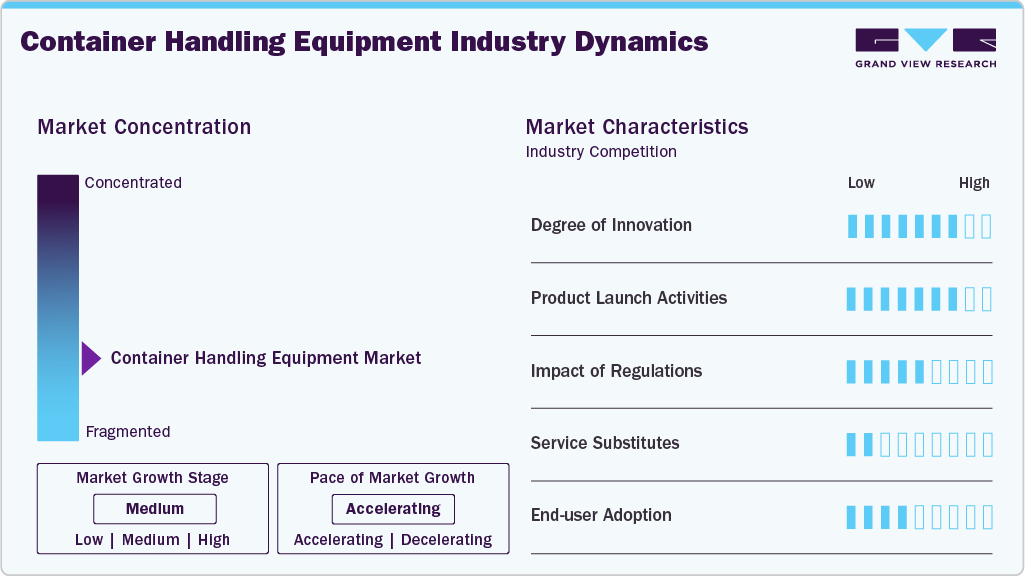
The container handling equipment market is moderately consolidated, with the presence of several global port equipment manufacturers, industrial vehicle suppliers, crane manufacturers, and automation technology providers competing across maritime ports, inland container depots, rail freight terminals, and logistics hubs. Major companies maintain strong market positions through extensive product portfolios, large-scale manufacturing capabilities, global service networks, and long-term contracts with port operators and terminal management companies. At the same time, the market also includes regional equipment manufacturers and specialized automation solution providers offering customized material handling and terminal operation systems.
The market is characterized by increasing port automation, rising containerized cargo volumes, and growing investments in smart port infrastructure across developed and emerging economies. Companies are focusing on integrating automation technologies, electrification systems, artificial intelligence, IoT-enabled fleet management, and remote-controlled operations to improve cargo handling efficiency, reduce labor dependency, and minimize operational downtime. In addition, the increasing deployment of mega container vessels and the expansion of intermodal freight transportation networks are encouraging terminal operators to invest in high-capacity, technologically advanced container-handling equipment.
Furthermore, the growing emphasis on sustainability and emission reduction is accelerating the adoption of electric and hybrid container handling equipment, including electric rubber-tired gantry cranes, automated guided vehicles, and battery-powered forklifts. Market participants are also focusing on strategic partnerships, acquisitions, aftersales service expansion, and digital terminal management solutions to strengthen their competitive positioning and improve long-term customer retention.
Equipment Type Insights
The cranes segment accounted for the largest revenue share of 46.40% in 2025. The crane segment is expected to witness substantial growth owing to the increasing container traffic across seaports, inland terminals, and intermodal freight facilities globally. The growing deployment of mega container vessels with significantly higher cargo capacities has increased the need for efficient ship loading, unloading, and container stacking, thereby driving demand for ship-to-shore (STS) cranes. Moreover, the rising pressure on port operators to minimize vessel turnaround time and improve berth productivity is accelerating investments in high-capacity automated crane systems. Rubber-tired gantry (RTG) cranes are experiencing strong demand due to their operational flexibility and ability to efficiently manage container stacking in terminal yards. In addition, rail-mounted gantry (RMG) cranes are increasingly adopted at rail terminals and automated container yards owing to their superior stacking precision, high throughput efficiency, and suitability for intermodal cargo handling.
The forklift truck segment is expected to grow at the fastest CAGR of 7.7% during the forecast period. The segment is expected to grow due to the rising demand for efficient material handling solutions across ports and logistics hubs. The increasing global containerized trade and growth in port-related cargo handling activities are indirectly supporting forklift demand for supporting operations such as container stuffing, de-stuffing, pallet handling, and short-distance cargo movement.
Propulsion Type Insights
The diesel segment accounted for the largest revenue share in 2025. The segment growth is attributed to its widespread use in heavy-duty and high-capacity material handling applications across ports, terminals, and industrial yards. Diesel-powered equipment continues to be preferred for operations requiring high torque, superior lifting capacity, and uninterrupted performance under harsh operating conditions, particularly in large-scale container terminals and bulk cargo handling environments. In addition, ship-to-shore (STS) cranes, reach stackers, straddle carriers, and heavy forklifts operating in port environments often rely on diesel engines due to their robustness and ability to support long operational cycles with minimal downtime. The expansion of global container trade and increasing port throughput volumes are further sustaining demand for diesel-powered equipment, especially in developing economies where electrification infrastructure is still evolving.
The electric segment is projected to grow at the fastest CAGR over the forecast period. The segment growth is attributed to the accelerating shift toward low-emission and sustainable port operations globally. Increasing environmental regulations targeting carbon emissions and air quality improvement at ports and logistics hubs are compelling terminal operators to replace conventional diesel-powered equipment with electric alternatives. In addition, the growing adoption of electrified container-handling equipment, such as electric forklifts, electric rubber-tired gantry (RTG) cranes, electric reach stackers, and automated guided vehicles, is driven by stricter ESG compliance requirements and net-zero emissions commitments adopted by global port authorities and shipping companies.
Lifting Capacity Insights
The > 100 Tons segment accounted for the largest revenue share in 2025. The segment growth is owing to the increasing deployment of ultra-large container vessels (ULCVs) and the corresponding need for high-capacity cargo handling infrastructure at major ports. The global shipping industry is steadily shifting toward larger vessels to achieve economies of scale, which has significantly increased the need for heavy-duty equipment capable of handling higher container weights and dense stacking.
The > 100 Tons segment is expected to grow at the fastest CAGR over the forecast period. The high growth is attributed to ship-to-shore (STS) cranes, heavy reach stackers, and high-capacity rubber-tired gantry (RTG) cranes; above 100 tons are becoming essential for efficient loading and unloading of mega vessels within limited berth windows. The expansion of deep-water ports and transshipment hubs is also driving demand for ultra-heavy lifting equipment capable of managing high throughput volumes and continuous operations. In addition, growing container weight per shipment, driven by industrial goods, automotive components, and heavy machinery trade, is further reinforcing the need for higher tonnage handling capability.
Handling Mode Insights
The manual segment accounted for the largest revenue share in 2025. The manual segment within the handling mode category is expected to maintain a steady presence in the container handling equipment market owing to its widespread adoption in small and medium-scale ports, warehouses, and industrial facilities. Manual equipment continues to be preferred in cost-sensitive markets where capital investment constraints limit the adoption of automated or semi-automated handling systems. In addition, manual forklifts, hand pallet trucks, and basic lifting tools are widely used in low-volume cargo-handling environments where operational complexity is limited, and throughput requirements are moderate. The growth of small logistics hubs, regional distribution centers, and secondary ports in emerging economies is further supporting demand for manually operated equipment due to its affordability and ease of deployment.
The automatic segment is projected to grow at the fastest CAGR over the forecast period. The segment is expected to witness steady growth in the container handling equipment market, owing to the increasing global production of passenger and commercial vehicles and the growing complexity of automotive supply chains. The automotive industry relies heavily on efficient inbound and outbound logistics systems, which require frequent handling of components, subassemblies, and finished vehicles across ports, warehouses, and manufacturing plants.
End use Insights
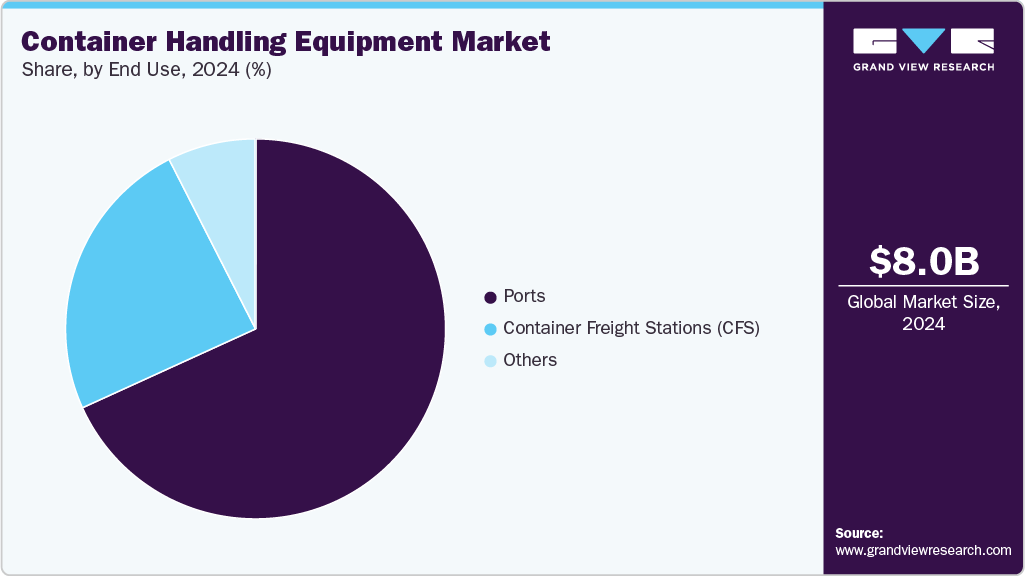
The port segment accounted for the largest revenue share in 2025. The port segment growth is due to the continuous expansion of global maritime trade and increasing container traffic across major seaports and transshipment hubs. Ports remain the primary nodes of international trade, handling a significant share of global containerized cargo, driving sustained investments in advanced material-handling infrastructure.
The port segment is expected to grow at the fastest CAGR over the forecast period. The growth is attributed to the increasing deployment of ultra-large container vessels, which is compelling port operators to enhance berth capacity, upgrade crane systems, and improve yard handling efficiency to manage higher cargo volumes within limited turnaround times. The growing emphasis on port modernization and capacity expansion projects, particularly in Asia-Pacific, the Middle East, and Africa, is further accelerating demand for high-performance container-handling equipment, including ship-to-shore (STS) cranes, rubber-tired gantry (RTG) cranes, rail-mounted gantry (RMG) cranes, and terminal tractors.
Regional Insights
Asia Pacific Container Handling Equipment Industry Trends
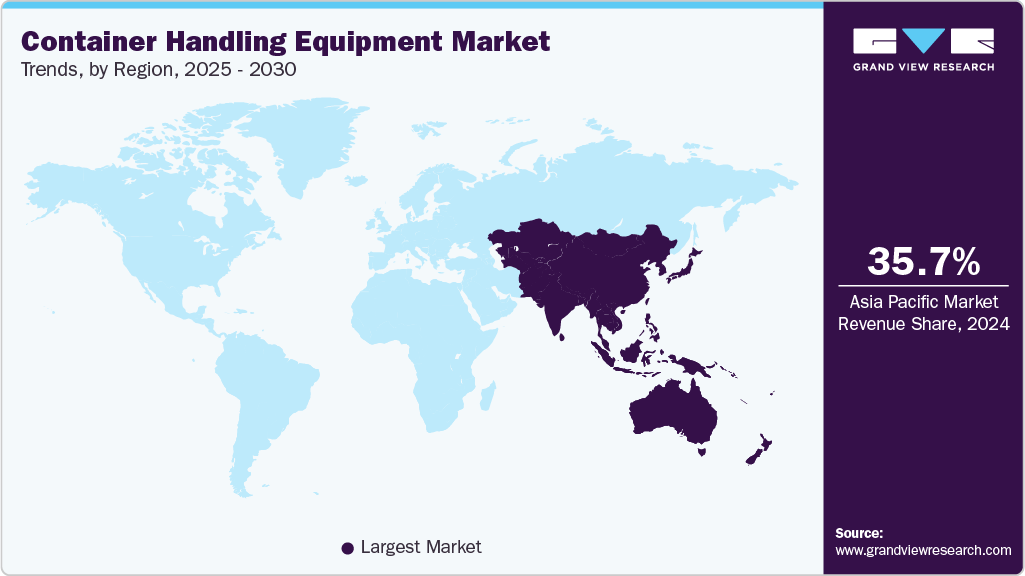
The Asia Pacific container handling equipment market held a 35.12% share in 2025. The container handling equipment market in the Asia-Pacific region is driven by rapid industrialization and expanding international trade activities. Countries like China, India, Japan, and South Korea are making significant investments in port infrastructure development and modernization. The region is witnessing increasing adoption of automated container handling equipment solutions and sustainable equipment, particularly in major maritime hubs.
The India container handling equipment market held a significant share in 2025. The container handling equipment market in India emerges as the fastest-growing market in the Asia-Pacific region. The country's growing economy fuels a thriving port industry, with Mumbai Port serving as India's primary gateway for imports and exports. The Indian government has planned to invest in developing ports around the nation due to the decline in imports and exports. The building of new ports, the creation of Special Economic Zones, and the expansion of manufacturing are all predicted to increase demand for container handling equipment in India.
The China container handling equipment market held a significant share in 2025. China container handling equipment market is supported by its extensive network of 34 container ports and 2,000 minor ports, with Shanghai being the world's largest port. China's market is characterized by significant investments in port automation technologies and indigenous manufacturing capabilities for container handling equipment.
North America Container Handling Equipment Industry Trends
North America container handling equipment market accounted for a significant share of the overall market in 2025, driven by extensive port infrastructure development and modernization initiatives across the U.S. and Canada. The region's market is characterized by the growing adoption of automated container-handling equipment and a strong focus on environmental sustainability in port operations. The presence of major ports along both the Pacific and Atlantic coasts supports steady demand for advanced port cargo-handling equipment, while ongoing investments in port expansion projects continue to shape market dynamics.
U.S. Container Handling Equipment Market Trends
The U.S. container handling equipment market held a dominant position in 2025. The country's leadership position is supported by its extensive network of 20+ container ports, with the Port of Los Angeles as the busiest. The market is driven by significant investments in port automation technologies and the increasing adoption of zero-emission container handling equipment. Major ports across the country are actively transitioning towards more sustainable operations, with several facilities implementing battery-electric and hybrid handling equipment to reduce their environmental impact.
Europe Container Handling Equipment Market Trends
The Europe container handling equipment market is expected to witness moderate growth over the forecast period. The region's market is driven by significant investments in port automation and sustainable handling solutions across Germany, the United Kingdom, and France. European ports are at the forefront of adopting electric and hybrid container handling equipment, reflecting the region's strong commitment to reducing environmental impact in port operations.
The Germany container handling equipment market is growing rapidly in the coming years. Germany container handling equipment market’s dominance is supported by its extensive network of ports, including Hamburg, Bremerhaven, and Wilhelmshaven, which serve as major transshipment and gateway ports. The German market is characterized by high adoption rates of automated container handling equipment solutions and significant investments in port infrastructure development.
The UK container handling equipment industry is growing rapidly in the coming years. The container handling equipment market in the UK is making significant investments in port development schemes to establish itself as a central marine trade hub in the European region. For instance, the development of Scotland's most crucial port facility has been initiated. This project results in a 7.3-hectare expansion in the port's berthage area, potentially increasing the need for port equipment in the nation.
Key Container Handling Equipment Company Insights
Some of the key companies in the container handling equipment market include Cargotec Corporation, Liebherr Group, Sany Group, Konecranes, Hyster-Yale, Inc., and others. Organizations are focusing on increasing the customer base to gain a competitive edge in the industry. Therefore, key players are taking several strategic initiatives, such as mergers and acquisitions, and partnerships with other major companies.
-
Sany Group is one of the leading global manufacturers in the container handling equipment market and plays a significant role across port, logistics, and industrial material handling applications. The company offers a comprehensive portfolio of equipment including ship-to-shore (STS) cranes, rubber-tired gantry (RTG) cranes, reach stackers, empty container handlers, and heavy forklifts, catering to both automated and conventional terminal operations. Sany Group focuses on providing integrated, high-performance lifting and handling solutions designed to support large-scale container throughput and high-intensity port environments.
-
Konecranes is a key global player in the container handling equipment market, specializing in advanced lifting equipment and intelligent port solutions. The company provides a broad range of products including ship-to-shore (STS) cranes, rubber-tired gantry (RTG) cranes, rail-mounted gantry (RMG) cranes, and automated yard cranes, with a strong focus on automation and digitalization in port operations. Konecranes is widely recognized for its leadership in smart port technologies, offering remote operation systems, automated crane solutions, and data-driven fleet management platforms that enhance terminal efficiency and safety. The company’s equipment is extensively deployed in high-capacity container terminals, intermodal logistics hubs, and deep-water ports across Europe, North America, and Asia.
Key Container Handling Equipment Companies:
The following key companies have been profiled for this study on the container handling equipment market.
- Cargotec Corporation
- Liebherr Group
- Sany Group
- Konecranes
- Hyster-Yale, Inc.
- Toyota Industries Corporation
- China Communications Construction Company Limited
- PALFINGER AG
- Mi-Jack
- Daifuku Co., Ltd.
Competitive Benchmarking
Operating Strategies
Competitive Edge
Weaknesses
Mature Players: Caterpillar; Toyota Material Handling; The Raymond Corporation; CLARK
- Mature players focus on large-scale industrial telematics deployments across material handling fleets including forklifts, reach stackers, AGVs, and warehouse automation systems across manufacturing plants, distribution centers, and 3PL facilities.
- Their strategies emphasize integrated digital ecosystems combining equipment manufacturing, embedded sensors, fleet management software, and cloud-based analytics platforms.
- Strong global installed base of material handling equipment enables seamless integration of embedded telematics solutions at the manufacturing stage.
- Ability to deliver end-to-end solutions combining equipment, sensors, connectivity, analytics, and aftermarket services enhances customer lock-in.
- Heavy reliance on legacy industrial systems and hardware-centric business models can slow digital transformation and software-first innovation.
- High solution cost and complex deployment structures limit penetration in small and mid-sized warehouse and logistics operators.
Emerging Players: Trackunit Corporation; ZTR Control Systems LLC; MLE B.V.
- Emerging players target niche, high-growth use cases such as forklift fleet telematics, last-mile warehouse visibility, battery monitoring systems, and AI-based safety analytics.
- Their offerings are typically cloud-native, API-driven, and hardware-agnostic, enabling faster integration with mixed equipment fleets.
- Higher agility and faster innovation cycles enable quicker rollout of advanced analytics, AI-driven insights, and cloud-native platforms.
- Greater flexibility in supporting multi-brand and legacy equipment fleets enhances addressable market reach.
- Limited scale of deployment and lower global service reach constrain ability to support large multinational logistics networks.
- Dependence on project-based or subscription revenues creates challenges in achieving long-term predictable revenue stability.
Recent Developments
-
In May 2026, Terberg Tractors Malaysia Sdn Bhd (TTM) announced the launch of new fully battery-powered electric terminal tractor, the YT201EV, amid growing global demand for electrified port and logistics equipment. The product launch is expected to help company attract new customers and strengthen its position in the market.
-
In February 2026, KALMAR CORPORATION announced the launch of TT7 terminal tractor to the European market. This new product launch is expected to help company increase its customer base and strengthen its position in the Europe market.
-
In December 2025, Konecranes announced the launch of electric reach stacker to meet increasing demand from port customers. The product launch is expected to help company expand its product portfolio and increase the customer base.
Container Handling Equipment Market Report Scope
Report Attribute
Details
Market size in 2025
USD 8.5 billion
Estimated market size in 2026
USD 8.8 billion
Projected market size by 2033
USD 12.7 billion
Growth rate
CAGR of 5.3% from 2026 to 2033
Base year for estimation
2025
Historical data
2021 - 2024
Forecast period
2026 - 2033
Quantitative units
Revenue in USD billion and CAGR from 2026 to 2033
Report coverage
Revenue forecast, company ranking, competitive landscape, growth factors, and trends
Segments covered
Equipment Type, Propulsion Type, Lifting Capacity, Handling Mode, End use and Region
Regional scope
North America, Europe, Asia Pacific, Latin America, MEA
Country scope
U.S., Canada, Mexico, Germany, UK, France, China, Japan, India, South Korea, Australia, Brazil, KSA, UAE, and South Africa
Key companies profiled
Cargotec Corporation, Liebherr Group, Sany Group, Konecranes, Hyster-Yale, Inc., Toyota Industries Corporation, China Communications Construction Company Limited, PALFINGER AG, Mi-Jack
And Daifuku Co., Ltd.,
Customization scope
Free report customization (equivalent up to 8 analysts working days) with purchase. Addition or alteration to country, regional & segment scope.
Pricing and purchase options
Avail customized purchase options to meet your exact research needs. Explore purchase options
Global Container Handling Equipment Market Report Segmentation
This report forecasts revenue growth at global, regional, and country levels and provides an analysis of the latest industry trends in each of the sub-segments from 2021 to 2033. For this study, Grand View Research has segmented the global container handling equipment market report based on equipment type, propulsion type, lifting capacity, handling mode, end use, and region:
-
Equipment Type Outlook (Revenue, USD Billion, 2021 - 2033)
-
Forklift Truck
-
Reach Stacker
-
Straddle Carrier
-
Cranes
-
RTG Cranes
-
RMG Cranes
-
Ship-to-Shore Crane
-
Mobile Harbor Cranes
-
-
Automated Guided Vehicle (AGV)
-
Terminal Tractor/Yard Truck
-
Others
-
-
Propulsion Type Outlook (Revenue, USD Billion, 2021 - 2033)
-
Diesel
-
Electric
-
Hybrid
-
-
Lifting Capacity Outlook (Revenue, USD Billion, 2021 - 2033)
-
> 100 Tons
-
50-100 Tons
-
< 50 Tons
-
-
Handling Mode Outlook (Revenue, USD Billion, 2021 - 2033)
-
Manual
-
Automatic
-
-
End use Outlook (Revenue, USD Billion, 2021 - 2033)
-
Ports
-
Container Freight Stations (CFS)
-
Others
-
-
Regional Outlook (Revenue, USD Billion, 2021 - 2033)
-
North America
-
U.S.
-
Canada
-
Mexico
-
-
Europe
-
Germany
-
UK
-
France
-
-
Asia Pacific
-
China
-
Japan
-
India
-
South Korea
-
Australia
-
-
Latin America
-
Brazil
-
-
Middle East and Africa (MEA)
-
KSA
-
UAE
-
South Africa
-
-
Delivered Customizations
This report has been delivered with the following In-depth customizations
Client Request
Customization Delivered
Value Adds
Port Operator/Container Terminal Operator
Evaluation of automated container handling equipment deployment strategies
Analysis of terminal automation systems, yard management, and cargo flow optimization
Benchmarking of ship-to-shore cranes, RTG cranes, AGVs, and terminal operating technologies
Improved port operational efficiency and cargo throughput
Reduced vessel turnaround time and yard congestion
Enabled higher terminal automation and productivity optimization
Logistics & Intermodal Freight Company
Assessment of container handling requirements across rail terminals and inland depots
Analysis of fleet modernization opportunities for forklifts, reach stackers, and terminal tractors
Evaluation of digital fleet monitoring and predictive maintenance solutions
Strengthened intermodal cargo handling capabilities
Reduced equipment downtime and maintenance costs
Improved fleet utilization and logistics efficiency
Port Authority/Smart Port Infrastructure Developer
Market readiness assessment for smart port and electrified handling infrastructure
Analysis of electric and hybrid container handling equipment adoption trends
ROI evaluation for automated and sustainable cargo handling investments
Supported long-term sustainable port development strategies
Enabled reduction in port emissions and fuel consumption
Improved investment planning for next-generation port infrastructure
Frequently Asked Questions About This Report
Terminal automation, encompassing the full or partial substitution of manned operations with automated equipment and processes, has emerged as a significant trend in the global container handling equipment market.
The cranes segment led with a 46.4% revenue share in 2025, while the forklift truck segment is the fastest-growing.
The diesel segment held the largest revenue share in 2025, while the electric segment is the fastest-growing.
The > 100 tons segment held the largest revenue share in 2025, while the > 100 tons segment is the fastest-growing.
The manual segment held the largest revenue share in 2025, while the automatic segment is the fastest-growing.
The port segment held the largest revenue share in 2025, while the port segment is the fastest-growing.
The global container handling equipment market size was valued at USD 8.5 billion in 2025 and is estimated at USD 8.8 billion for 2026.
The global container handling equipment market is expected to grow at a CAGR of 5.3% from 2026 to 2033, reaching USD 12.7 billion by 2033.
Asia Pacific dominated with a 35.1% revenue share in 2025.
Key players include Cargotec Corporation, Liebherr Group, Sany Group, Konecranes, Hyster-Yale, Inc., Toyota Industries Corporation, China Communications Construction Company Limited, PALFINGER AG, Mi-Jack And Daifuku Co., Ltd.
About the Author(s)
Next Generation Technologies Research Team
Technology · Next Generation TechnologiesThis report was authored by the next generation technologies research team at Grand View Research - comprising two research analysts, one senior research analyst, and one industry expert - with specialized expertise in the next generation technologies segment of the technology industry. All findings are based on proprietary technology databases, executive interviews, and regulatory analysis, subject to internal peer review prior to publication.
Last Updated:
Speak to Analyst


Customize this report to your needs — add regions, segments, or data points, with 20% free customization.
Or view our licence options:


ISO 9001:2015 & 27001:2022 Certified
We are GDPR and CCPA compliant! Your transaction & personal information is safe and secure. For more details, please read our privacy policy.


