
- Home
- »
- Advanced Interior Materials
- »
-
Cordless Power Tools Market Size & Share Report, 2033GVR Report cover

Cordless Power Tools Market (2026 - 2033)
Size, Share & Trends Analysis Report By Product Type (Drilling & Fastening Tools, Sawing & Cutting Tools, Grinding & Surface Prep Tools), By End Use (Industrial, Residential), By Region, And Segment Forecasts
Market Size, 2025
$14.4BMarket Estimate, 2026
$15.7BMarket Forecast, 2033
$31.8BCAGR, 2026–2033
10.6%Cordless Power Tools Market Summary
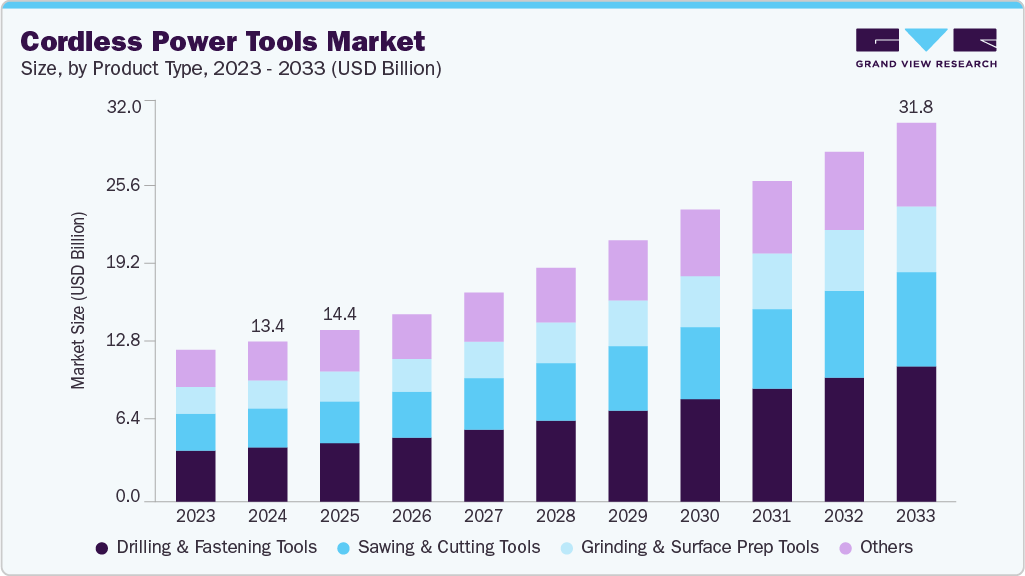
The global cordless power tools market size was valued at USD 14.4 billion in 2025 and is projected to grow from USD 15.7 billion in 2026 to USD 31.8 billion by 2033, at a CAGR of 10.6% from 2026 to 2033. Asia Pacific dominated the cordless power tools market with the largest revenue share of 33.5% in 2025. The demand for cordless power tools is rapidly increasing due to the growing emphasis on operational flexibility, portability, and ease of use across construction, automotive, and manufacturing sectors.
 Source: Grand View Research, IR Documents, Primary Interviews, Paid DatabasesTo learn more about this report,
 Download Free Sample Report
 Key Market Trends & Insights
- By product type: Drilling & fastening tools segment held the largest market share of 34.0% in 2025.
- By end use: Industrial segment held the largest market share of 67.3% in 2025.
Regional Highlights
- Largest regional market: Asia Pacific (33.5% revenue share, 2025)
- By country: China held the largest market share in 2025.
Market Size & Forecast
- Market size in 2025: USD 14.4 Billion
- Estimated market size in 2026: USD 15.7 Billion
- Projected market size by 2033: USD 31.8 Billion
- CAGR (2026-2033): 10.6%
Three ways to get this report
Buy it, customize it, or ask a question.Ask an Analyst
A direct answer, usually in 1 working day
- AccessReport author, directly
- Reply timeWithin 1 working day
- No sales callDirect answer only
- FormatEmail reply
- CostFree, no cost
Get the Full Report
What the study covers
- FormatsPDF · Excel · Dashboard
- Timeline2026–2033 annual, 2025 base
- Coverage20+ countries, 5 regions
- Companies10+ key players profiled
Customize the Report
20% free customization
- IncludeCountries, segments, points
- TailorTo your product definition
- ExtendDeeper competitor detail
- OrA fully bespoke study
- Turnaround5–10 working days
The shift from corded to battery-operated tools is accelerated by advancements in lithium-ion batteries, which provide longer runtimes and faster charging. Additionally, the surge in home improvement and DIY projects, particularly in developed economies, is fueling consumer-level adoption. The professional trades segment is also witnessing higher demand as cordless tools reduce downtime and enhance mobility on-site. The increasing need for efficient maintenance and repair activities across industries further strengthens market growth globally.Technological advancements in battery chemistry, such as lithium-ion and solid-state batteries, are key growth drivers for the cordless power tools industry. Manufacturers are focusing on improving energy density, durability, and power output to match the performance of corded tools. The rise of smart, connected power tools with IoT integration and digital monitoring features is enhancing productivity and precision. Rapid industrialization and urbanization in emerging economies are increasing construction and infrastructure activities, boosting tool consumption. Additionally, labor shortages in the construction sector are driving automation and the adoption of high-efficiency tools that minimize physical strain and time.
 To learn more about this report, Download Free Sample Report
 The market is witnessing continuous innovations, particularly in battery management systems, brushless motor technology, and tool connectivity. Major players are launching smart cordless tools integrated with Bluetooth and app-based performance monitoring. Modular battery systems compatible across multiple tools are emerging as a key trend, improving cost-effectiveness for professionals. Lightweight and ergonomic designs are gaining popularity to reduce user fatigue. Sustainable manufacturing practices and recyclable battery technologies are being prioritized by top brands. Furthermore, the integration of AI and sensors for predictive maintenance is redefining tool reliability and user safety.
Market Dynamics
The cordless power tools market is experiencing steady growth due to increasing demand from construction, manufacturing, automotive, woodworking, and residential renovation activities. Improvements in lithium-ion battery technology, brushless motors, and ergonomic tool designs are enhancing tool performance and user convenience. Rising preference for portable, cable-free equipment and growing adoption by professional contractors and DIY users are supporting market expansion. However, battery cost, charging limitations, and intense competition continue to influence pricing strategies and product development across the industry.
The widespread adoption of lithium-ion battery technology is a major driver of the cordless power tools market. Lithium-ion batteries provide higher energy density, faster charging, longer operating time, and lower maintenance requirements compared to older battery technologies. These advantages improve tool productivity while reducing downtime on construction sites and industrial facilities. Continuous improvements in battery capacity and compatibility across multiple tools are encouraging professionals and consumers to replace corded equipment with cordless alternatives, supporting sustained market growth.
The relatively high purchase cost of cordless power tools remains a significant restraint for market growth. Professional-grade tools often require investment in batteries, chargers, and compatible accessories, increasing the overall ownership cost. Small contractors, occasional users, and price-sensitive consumers may delay replacing corded tools due to budget constraints. Although long-term operating benefits exist, the higher upfront expenditure can limit adoption, particularly in developing markets and among customers with infrequent tool usage requirements.
The growing adoption of smart connected power tools presents significant opportunities for the cordless power tools market. Manufacturers are integrating Bluetooth, IoT, and cloud-based connectivity to enable tool tracking, usage monitoring, maintenance alerts, and inventory management. These capabilities help contractors improve asset utilization, reduce equipment loss, and enhance job-site productivity. Increasing digitalization in construction and industrial operations is expected to accelerate demand for connected cordless tools, creating new opportunities for technology-driven product innovation and premium offerings.
Market Concentration & Characteristics
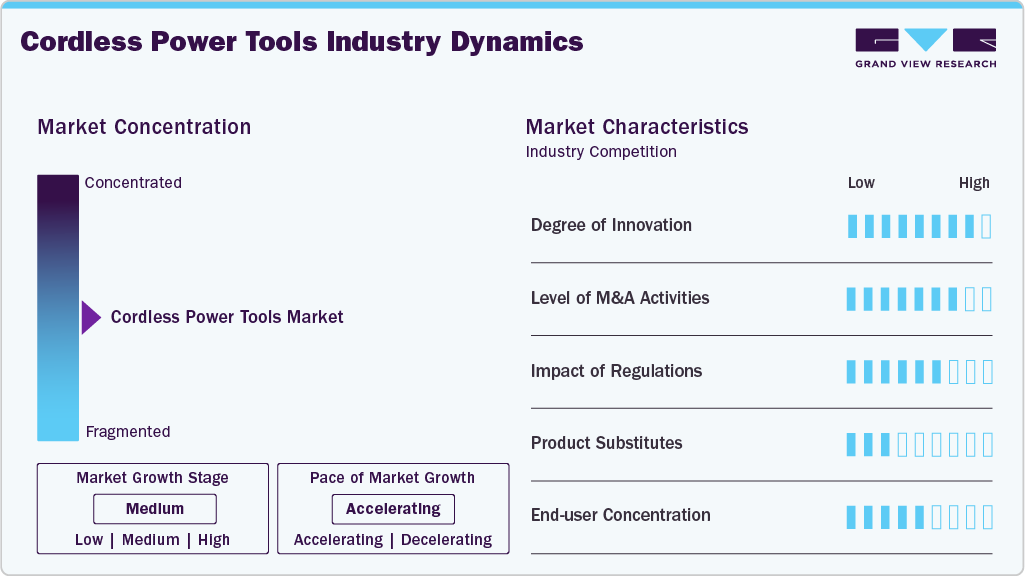
The cordless power tools market is moderately consolidated, with leading players such as Stanley Black & Decker, Bosch, Makita, and Hilti commanding significant global shares. These companies dominate due to extensive product portfolios, strong distribution networks, and continuous R&D investment. However, emerging Asian manufacturers are expanding rapidly by offering affordable and durable alternatives. The market sees moderate entry barriers due to high capital and technological requirements, though niche segments like gardening and DIY tools attract smaller firms. Strategic partnerships, acquisitions, and product innovations are reshaping competition dynamics.
 To learn more about this report, Download Free Sample Report
 The threat of substitutes is relatively low as cordless tools provide unmatched mobility and convenience compared to corded alternatives. Pneumatic and hydraulic tools serve as substitutes in specific industrial applications but are less preferred due to limited flexibility and maintenance challenges. However, the high cost of advanced cordless systems can push budget-conscious consumers toward traditional wired tools. With battery prices declining and performance improving, cordless variants are increasingly replacing older technologies across industries, further minimizing substitute threats.
Analyst Perspective
The cordless power tools market is expected to witness sustained growth, supported by increasing construction activities, industrial automation, and rising home improvement projects worldwide. Advancements in lithium-ion batteries, brushless motors, and connected tool technologies are improving performance, runtime, and operational efficiency, encouraging greater adoption among professional and residential users. Manufacturers are focusing on expanding cordless product portfolios, developing interoperable battery platforms, and enhancing safety features to strengthen their competitive position. Growing investments in infrastructure, manufacturing, and smart job-site solutions are expected to create long-term growth opportunities for market participants.
Product Type Insights
Based on product type, the drilling & fastening tools segment led the market with the largest revenue share of 34.0% in 2025, due to their widespread use across construction, manufacturing, and assembly operations. These tools are essential for applications such as fastening bolts, screws, and rivets, as well as drilling holes in various materials like wood, metal, and concrete. Their versatility, combined with compact design and improved torque control, makes them indispensable for both professionals and DIY users. Continuous advancements in brushless motor technology and ergonomic design have enhanced tool performance, driving sustained demand across industrial and commercial sectors.
The sawing & cutting tools segment is expected to grow at a significant CAGR of 10.6% over the forecast period, fueled by increasing use in woodworking, metal fabrication, and renovation projects. The development of high-efficiency cordless circular saws, reciprocating saws, and jigsaws with extended battery life and advanced safety features is transforming user experience. Rising construction and interior remodeling activities, coupled with growing preference for lightweight and portable equipment, are further accelerating adoption. The integration of smart sensors for precise cutting and reduced material wastage is also a key trend boosting demand in this segment.
End Use Insights
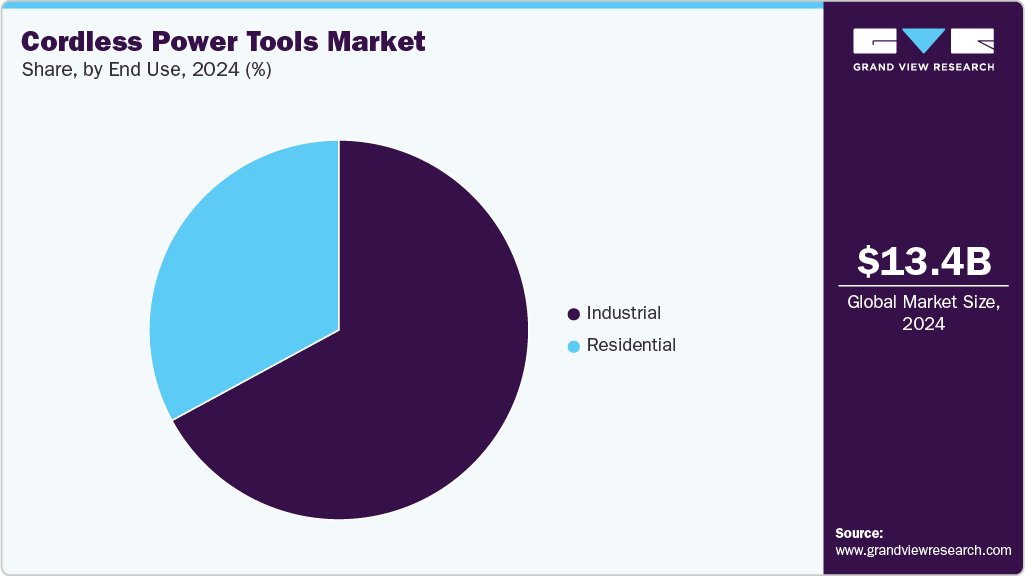
Based on end use, the industrial segment led the market with the largest revenue share of 67.3% in 2025, driven by extensive usage across construction, automotive, aerospace, and manufacturing industries. Industrial professionals rely on these tools for their reliability, durability, and high power output in demanding environments. The shift toward automation and smart manufacturing has further increased the adoption of cordless solutions for faster assembly and maintenance operations. Additionally, the growing focus on worker efficiency and reduced downtime has made cordless tools an integral part of industrial equipment portfolios globally.
 To learn more about this report, Download Free Sample Report
 The residential segment is expected to grow at a significant CAGR of 9.7% over the forecast period, supported by the rising popularity of DIY culture and home improvement activities. Consumers are increasingly investing in cordless drills, screwdrivers, and saws for household repairs, furniture assembly, and renovation tasks. E-commerce platforms and retail chains are making these tools more accessible, while product innovations like quick-charging batteries and lightweight designs enhance convenience. As disposable incomes rise and awareness of tool versatility spreads, residential adoption of cordless power tools is set to expand rapidly, particularly in urban markets.
Regional Insights
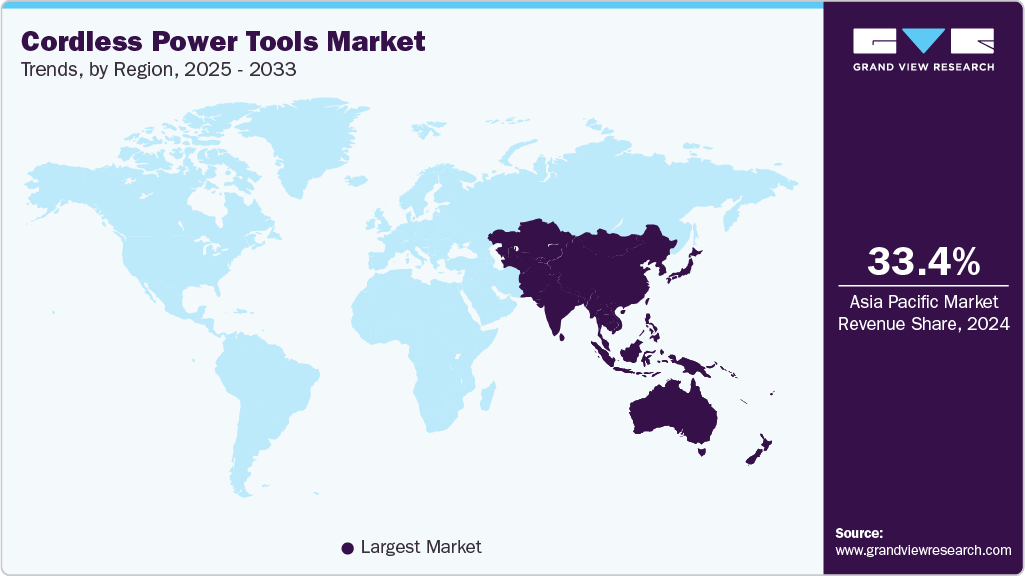
Asia Pacific dominated the cordless power tools market with the largest revenue share of 33.5% in 2025, driven by massive infrastructure development, rapid urbanization, and robust growth in construction and automotive manufacturing. Countries such as China, Japan, India, and South Korea are investing heavily in smart manufacturing and housing projects, which boost tool consumption. The expansion of small and medium enterprises (SMEs) and a growing DIY culture in urban areas further accelerate market growth. Government initiatives promoting industrialization and domestic manufacturing are strengthening local production capacity. Moreover, the availability of low-cost labor and raw materials supports competitive pricing and global export potential. With increasing adoption of advanced lithium-ion tools, Asia Pacific is set to maintain its dominant position through 2032.
 To learn more about this report, Download Free Sample Report
 China Cordless Power Tools Market Trends
The cordless power tools market in the China held the largest share in the Asia Pacific region in 2025, due to its extensive manufacturing ecosystem, cost-efficient production, and export-oriented strategies. The nation’s growing construction and renewable energy projects drive demand for versatile tools used in assembly, maintenance, and installation. Government support for infrastructure expansion, coupled with initiatives such as “Made in China 2025,” is encouraging the production of technologically advanced cordless tools. Major domestic players are innovating with lithium-ion batteries and lightweight, high-performance tools to meet rising industrial standards. The increasing presence of e-commerce platforms also enhances tool accessibility across consumer and professional segments.
North America Cordless Power Tools Market Trends
North America remains a mature yet growing market for cordless power tools, driven by strong demand from the construction, automotive, and residential renovation sectors. The U.S. and Canada are witnessing significant investments in smart manufacturing and advanced repair technologies, promoting cordless tool adoption. The DIY culture and preference for convenient, portable equipment among consumers further contribute to market expansion. Growing usage of brushless motor technology and connected, app-based tool monitoring systems are transforming user efficiency. Manufacturers are also focusing on sustainability, offering recyclable batteries and energy-efficient designs that align with regulatory standards.
The U.S. dominates North America cordless power tools landscape with consistent innovation and high adoption rates across both consumer and industrial applications. A strong focus on home improvement, repair, and remodeling activities drives retail sales, particularly through online platforms like Amazon and Home Depot. Professional contractors are increasingly shifting toward battery-powered solutions to enhance productivity and reduce maintenance costs. Manufacturers like Stanley Black & Decker, Milwaukee Tool, and DeWalt are investing heavily in smart cordless systems that integrate Bluetooth connectivity and real-time diagnostics. Furthermore, the country’s emphasis on green construction and infrastructure modernization continues to stimulate tool demand.
Europe Cordless Power Tools Market Trends
Europe’s cordless power tools industry is supported by stringent safety regulations, sustainability goals, and the adoption of eco-friendly technologies. Countries like Germany, the UK, France, and Italy are leading in innovation, integrating ergonomic designs and smart features into professional-grade tools. The construction and manufacturing industries are the primary users, with a growing share of demand from residential renovation projects. The European Union’s focus on carbon reduction and energy efficiency encourages the use of advanced, low-emission tools. Increased R&D collaboration among European manufacturers enhances competitiveness and performance quality across the market.
The Germany cordless power tools market is expected to grow during the forecast period. Germany serves as a technological hub for cordless power tools, with strong demand from the automotive, engineering, and manufacturing sectors. The country’s precision-driven industries rely heavily on high-performance cordless tools for assembly, maintenance, and repair operations. Innovations in brushless motors and battery systems are particularly prevalent among German brands, ensuring superior reliability and output. The government’s ongoing investment in Industry 4.0 and factory automation is further driving cordless adoption. Local players and international brands alike are focusing on ergonomic, compact, and energy-efficient designs to align with the country’s sustainability goals.
Central & South America Cordless Power Tools Market Trends
The Central & South America cordless power tools industry is witnessing steady growth as construction and infrastructure development gain momentum in countries like Brazil, Mexico, and Chile. Rising urbanization and a recovering industrial sector are boosting demand for versatile cordless tools. Increasing imports from Asia and North America are improving product availability and affordability across regional markets. The proliferation of retail and e-commerce platforms is making premium cordless tools accessible to small contractors and DIY consumers. Additionally, regional governments’ emphasis on energy-efficient and sustainable construction practices supports long-term growth prospects.
Middle East & Africa Cordless Power Tools Market Trends
The Middle East & Africa region is emerging as a key growth frontier for cordless power tools, supported by large-scale infrastructure and industrial projects. The Gulf countries, particularly Saudi Arabia and the UAE, are investing in mega-projects under Vision 2030 and national diversification plans, boosting professional tool demand. Infrastructure modernization, construction of new cities, and expansion in oil & gas and renewable energy sectors drive market penetration. Africa’s growing construction and repair activities are also creating opportunities for cordless tool manufacturers. Increasing partnerships between international and regional distributors are improving market access and brand presence.
Key Cordless Power Tools Company Insights
Some of the key players operating in the market include Ideal Power Tools and Stanley Black & Decker.
-
Ideal Power Tools is an India-based manufacturer known for its cost-effective and durable cordless tools catering to both professional and DIY users. The company focuses on accessible technology and reliable performance across drills, saws, grinders, and impact drivers. With a strong domestic distribution network, Ideal Power Tools has built a reputation for offering value-driven solutions suitable for small contractors and industrial maintenance applications.
-
Stanley Black & Decker is a global leader in the power tools market, known for brands such as DeWalt, Craftsman, and Black+Decker. The company has been at the forefront of cordless innovation, pioneering brushless motors, advanced lithium-ion batteries, and connected smart tool technologies. Its products cater to professional tradespeople, industrial users, and home improvement consumers. With robust R&D and global distribution, Stanley Black & Decker continues to shape the future of cordless tool efficiency, ergonomics, and safety standards across multiple industries.
Ryobi and Hilti are some of the emerging participants in the cordless power tools market.
-
Ryobi, a subsidiary of Techtronic Industries (TTI), is widely recognized for its extensive range of cordless power tools designed for both consumer and professional applications. The brand is particularly strong in the DIY and prosumer segment, offering high-value, feature-rich tools at competitive prices. Its ONE+ battery system, which powers over 200 tools, exemplifies modular innovation and user convenience. Ryobi’s strong presence in North America, Europe, and Asia, backed by TTI’s global R&D capabilities, enhances its reputation for reliability and versatility.
-
Hilti is a Switzerland-based multinational specializing in professional-grade cordless power tools tailored for construction, engineering, and industrial applications. The company is renowned for its precision, durability, and focus on high-performance cordless systems. Hilti invests heavily in R&D, particularly in battery technology, safety features, and digital fleet management solutions. Its strong after-sales service and direct sales model differentiate it from competitors.
Key Cordless Power Tools Companies
The following key companies have been profiled for this study on the cordless power tools market.
-
Ideal Power Tools
-
Festool
-
Ryobi
-
Stanley Black & Decker
-
Bosch
-
Makita
-
Hilti
-
DeWalt
-
Milwaukee
-
Craftsman
Competitive Benchmarking
Category
Operating Strategies
Competitive Edge
Weakness
Established Players (e.g. Stanley Black & Decker; Robert Bosch GmbH; Makita Corporation; Hilti Corporation; DeWalt)
- Focus on expanding cordless product ecosystems with compatible battery platforms across drills, saws, grinders, and heavy-duty tools.
- Invest heavily in R&D for brushless motors, smart connectivity, and high-capacity lithium-ion batteries to improve productivity and runtime.
- Strengthen global distribution through dealer networks, e-commerce channels, and strategic partnerships with construction and industrial firms.
- Strong global brand recognition and extensive customer base across industrial, commercial, and residential sectors.
- Broad product portfolios with technologically advanced cordless tools designed for professional and heavy-duty applications.
- Premium pricing of advanced cordless systems may limit adoption among small contractors and price-sensitive consumers.
- Large operational structures can reduce flexibility and slow response to rapidly changing consumer preferences.
- Large-scale manufacturing capabilities and established after-sales service networks provide operational reliability and customer trust.
Emerging & Regional Players (e.g Milwaukee Tool; Ideal Power Tools; Festool; Ryobi; Craftsman)
- Focus on niche product innovation, lightweight tool designs, and affordable cordless solutions targeting DIY and mid-range users.
- Expand market presence through online retail platforms, regional distributors, and customer-focused promotional strategies.
- Introduce compact battery platforms and specialized cordless tools for woodworking, home improvement, and portable applications.
- Greater flexibility in launching innovative and user-friendly cordless products for specific customer segments.
- Competitive pricing strategies help attract residential users and small businesses seeking cost-effective solutions.
- Ability to quickly adapt to new market trends, ergonomic designs, and evolving consumer preferences.
- Limited global presence and smaller distribution networks compared to established market leaders.
- Lower investment capacity for advanced R&D and large-scale battery technology development.
Recent Developments
-
In August 2025, Festool entered the market with the HLC 82. This tool features an 82mm width with a spiral blade cutter that makes pulling cuts for a cleaner, quieter finish.
Cordless Power Tools Market Report Scope
Report Attribute
Details
Market size in 2025
USD 14.4 billion
Estimated market size in 2026
USD 15.7 billion
Projected market size by 2033
USD 31.8 billion
Growth rate
CAGR of 10.6% from 2026 to 2033
Base year for estimation
2025
Historical data
2021 - 2024
Forecast period
2026 - 2033
Quantitative units
Revenue in USD billion and CAGR from 2026 to 2033
Report coverage
Revenue forecast, company ranking, competitive landscape, growth factors, and trends
Segments covered
Product type, end use, region
Regional scope
North America; Europe; Asia Pacific; Latin America; Middle East & Africa
Country scope
U.S., Canada, Mexico, Germany, France, UK, Italy, Spain, China, India, Japan, South Korea.
Key companies profiled
Ideal Power Tools; Festool; Ryobi; Stanley Black & Decker; Bosch; Makita; Hilti; DeWalt; Milwaukee; Craftsman
Customization scope
Free report customization (equivalent up to 8 analysts' working days) with purchase. Addition or alteration to country, regional & segment scope.
Pricing and purchase options
Avail customized purchase options to meet your exact research needs. Explore purchase options
Global Cordless Power Tools Market Report Segmentation
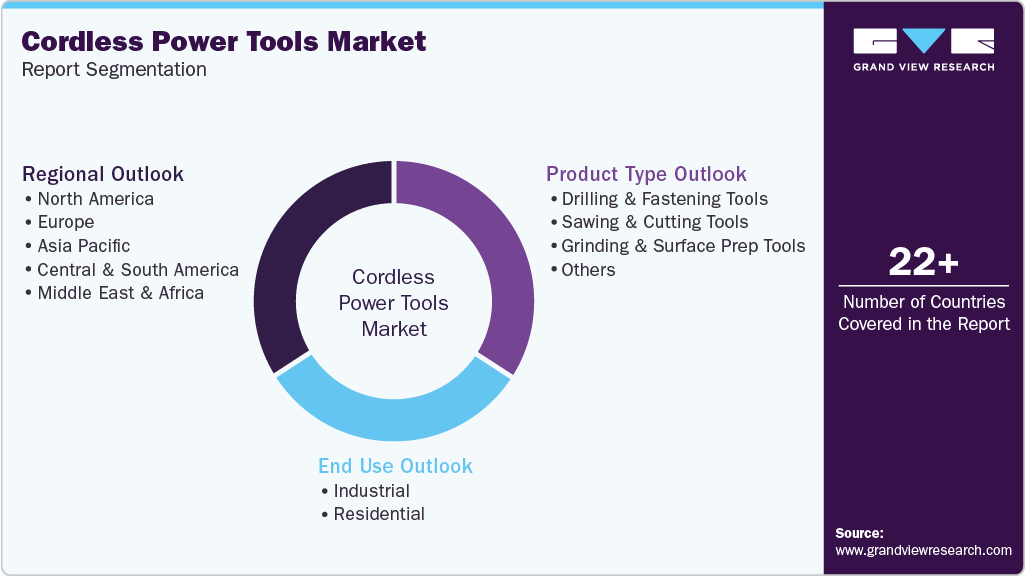
This report forecasts revenue growth at the global, regional & country levels and provides an analysis on the industry trends in each of the sub-segments from 2021 to 2033. For this study, Grand View Research has segmented the cordless power tools market report based on product type, end use, and region:
 To learn more about this report, Download Free Sample Report
 -
Product Type Outlook (Revenue, USD Million, 2021 - 2033)
-
Drilling & Fastening Tools
-
Sawing & Cutting Tools
-
Grinding & Surface Prep Tools
-
Others
-
-
End Use Outlook (Revenue, USD Million, 2021 - 2033)
-
Industrial
-
Residential
-
-
Regional Outlook (Revenue, USD Million, 2021 - 2033)
-
North America
-
U.S.
-
Canada
-
Mexico
-
-
Europe
-
UK
-
Germany
-
France
-
Spain
-
Asia Pacific
-
China
-
Japan
-
India
-
South Korea
-
-
Central & South America
-
Middle East & Africa
-
Saudi Arabia
-
UAE
-
Egypt
-
Qatar
-
Kuwait
-
-
Research Methodology
The cordless power tools market figures in this report are based on a proven research process that combines executive interviews with secondary research from proprietary databases, company filings, and recognized regulatory and institutional sources. Market size is built through value-chain sizing - reconciling supply-side and demand-side estimates - and triangulated with bottom-up and top-down approaches. Every estimate passes multiple levels of expert validation before publication, with each cordless power tools segment quantified using the revenue-capture definitions in the table below.
Segment Definition
Segment - Product Type
Revenue Capture Definition
Drilling & Fastening Tools
Revenue generated through the sale of cordless drills, hammer drills, impact drivers, impact wrenches, screwdrivers, and related battery-powered fastening equipment used across industrial, commercial, and residential applications.
Sawing & Cutting Tools
Revenue generated through the sale of circular saws, reciprocating saws, jigsaws, band saws, oscillating multi-tools, and other battery-powered cutting equipment designed for wood, metal, plastic, and construction materials.
Grinding & Surface Prep Tools
Revenue generated through the sale of angle grinders, polishers, sanders, buffers, and other battery-powered equipment used for grinding, sanding, polishing, finishing, and surface preparation across various industries.
Others
Revenue generated from sales of other cordless power tools, including rotary hammers, heat guns, inflators, grease guns, nailers, staplers, planers, routers, inspection tools, and other battery-powered equipment not included in the above categories.
Segment - End Use
Revenue Capture Definition
Industrial
Revenue generated from the sale of cordless power tools used in industrial users, including manufacturing, construction, automotive, aerospace, energy, shipbuilding, maintenance, repair, warehousing, and other commercial and industrial sectors.
Residential
Revenue generated from the sale of cordless power tools used in residential users for home improvement, DIY projects, repairs, furniture assembly, gardening, remodeling, and routine household maintenance activities.
Estimation Model
Layer Name
Key Question
Description
Construction, Manufacturing, and DIY Demand Layer
Which sectors generate demand for cordless power tools?
The estimation begins by evaluating demand across construction, manufacturing, automotive, woodworking, metal fabrication, maintenance & repair, utilities, landscaping, and residential DIY activities. Market demand is influenced by infrastructure development, industrial production, home renovation trends, increasing mechanization, and the growing preference for portable power tools.
Product Type and Technology Layer
Which product types drive market demand?
This layer refines demand by assessing the adoption of drilling & fastening tools, sawing & cutting tools, grinding & surface preparation tools, and other cordless power tools. Battery advancements, brushless motor technology, ergonomic designs, interchangeable battery platforms, charging efficiency, and smart connectivity features influence product adoption across professional and residential users.
End-user Adoption Layer
What determines cordless power tool demand?
Market demand is estimated by evaluating cordless power tool adoption across industrial and residential end users. Factors including construction activity, manufacturing expansion, maintenance requirements, replacement cycles, workforce productivity needs, DIY participation, and increasing demand for cordless and lightweight equipment determine product sales across end-use segments.
Revenue Layer
How is total market revenue calculated?
Revenue is estimated by aggregating sales of cordless power tools across product types, end-use industries, and regional markets. Equipment pricing, battery system adoption, replacement demand, industrial investments, residential renovation spending, distribution channel performance, manufacturer revenues, and regional sales trends are incorporated to validate the overall market size.
Delivered Customizations
This report has been delivered with the following In-depth customizations
Client Request
Customization Delivered
Value Adds
Regional Segmentation
Detailed regional analysis of the cordless power tools market covering North America, Europe, Asia-Pacific, Latin America, and the Middle East & Africa, along with country-level demand assessment, import-export trends, industrial growth patterns, and construction activity analysis.
Helped clients identify high-growth geographic markets and prioritize expansion strategies based on regional demand potential.
Opportunity Assessment
Comprehensive opportunity analysis focusing on emerging applications, technological advancements, battery innovation trends, infrastructure investments, and rising DIY adoption across residential markets. The customization also assessed growth potential across industrial, automotive, woodworking, and construction sectors, while identifying untapped customer segments and future revenue pockets.
Enabled clients to develop targeted market entry and product development strategies by identifying the most profitable growth areas. Assisted in strategic planning, investment prioritization, and innovation roadmap development while helping businesses align product offerings with evolving customer requirements and industry trends.
Competitive benchmarking
In-depth benchmarking of major cordless power tool manufacturers based on product portfolio strength, battery platform capabilities, geographic presence, distribution channels, R&D investments, and technological innovation. The analysis also compared company positioning across professional, industrial, and residential customer segments.
Assisted clients in understanding competitor strengths, market positioning, and strategic focus areas. Helped identify product differentiation opportunities, partnership potential, and operational improvement areas, enabling businesses to strengthen competitive advantage and long-term market strategies.
Frequently Asked Questions About This Report
The global cordless power tools market size was estimated at USD 14.4 billion in 2025 and USD 15.7 billion in 2026.
The global cordless power tools market is expected to grow at a compound annual growth rate of 10.6% from 2026 to 2033 to reach USD 31.8 billion by 2033.
Some of the key players operating in the cordless power tools market include Ideal Power Tools, Festool, Ryobi, Stanley Black & Decker, Bosch, Makita, Hilti, DeWalt, Craftsman, and Milwaukee.
Rising demand for convenient, portable, and efficient tools in construction, automotive, and DIY applications is driving the cordless power tools market.
Based on end use, the industrial segment led the market with the largest revenue share of 67.3% in 2025.
Sawing & cutting tools segment is expected to grow at significant CAGR during forecast period in cordless power tools market.
Residential segment is expected to grow at significant CAGR during forecast period in cordless power tools market.
Which country held the largest market share in the Asia Pacific cordless power tools market in 2025?The cordless power tools market in the China held the largest share in the Asia Pacific region in 2025.
Based on product type, the drilling & fastening tools segment led the market with the largest market share of 34.0% in 2025.
About the Author(s)
Advanced Interior Materials Research Team
Advanced Materials · Advanced Interior MaterialsThis report was authored by the advanced interior materials research team at Grand View Research - comprising two research analysts, one senior research analyst, and one industry expert - with specialized expertise in the advanced interior materials segment of the advanced materials industry. All findings are based on proprietary advanced materials databases, executive interviews, and regulatory analysis, subject to internal peer review prior to publication.
Last Updated:
Speak to Analyst

Customize this report to your needs - add regions, segments, or data points, with 20% free customization.
Or view our licence options:


ISO 9001:2015 & 27001:2022 Certified
We are GDPR and CCPA compliant! Your transaction & personal information is safe and secure. For more details, please read our privacy policy.


