
- Home
- »
- Next Generation Technologies
- »
-
Corporate Training Market Size & Growth Report, 2026-2033GVR Report cover

Corporate Training Market (2026 - 2033)
Size, Share & Trends Analysis Report By Component (Software, Services), By Training Type (Technical Training, Soft Skills Training, Compliance Training, Product & Sales Training), By End Use (IT & Telecom, BFSI), By Region, And Segment Forecasts
Market Size, 2025
$427.3BMarket Estimate, 2026
$458.7BMarket Forecast, 2033
$777.5BCAGR, 2026–2033
7.8%Corporate Training Market Summary
The global corporate training market size was valued at USD 427.3 billion in 2025 and is projected to grow from USD 458.7 billion in 2026 to USD 777.5 billion by 2033, at a CAGR of 7.8% from 2026 to 2033. The market in North America dominated with a revenue share of 37.8% in 2025.
 Source: Grand View Research, IR Documents, Primary Interviews, Paid DatabasesTo learn more about this report,
 Download Free Sample Report
 Key Market Trends & Insights
- By component: Software segment held the largest market share of 66.4% in 2025.
- By training type: Technical training segment held the largest market share in 2025.
- By end use: IT & telecom segment held the largest market share in 2025.
Regional Highlights
- Largest regional market: North America (37.8% revenue share, 2025)
- Fastest-growing regional market: Asia Pacific (highest CAGR, 2026-2033)
- By country: U.S. held the largest market share in 2025
Market Size & Forecast
- Market size in 2025: USD 427.3 Billion
- Estimated market size in 2026: USD 458.7 Billion
- Projected market size by 2033: USD 777.5 Billion
- CAGR (2026-2033): 7.8%
Three ways to get this report
Buy it, customize it, or ask a question.Ask an Analyst
Analyst response in 1 business day
- AccessReport author, directly
- Reply timeWithin 1 working day
- No sales callDirect answer only
- FormatEmail reply
- CostFree, no cost
Get the Full Report
What the study covers
- FormatsPDF · Excel · Dashboard
- Timeline2026–2033 annual, 2025 base
- Coverage20+ countries, 5 regions
- Companies10+ key players profiled
Customize the Report
20% free customization
- IncludeCountries, segments, points
- TailorTo your product definition
- ExtendDeeper competitor detail
- OrA fully bespoke study
- Turnaround5–10 working days
The global corporate training market is experiencing steady growth due to rising demand for workforce upskilling. Companies are increasingly adopting digital learning platforms to deliver flexible and scalable training solutions. Enterprises are investing in technical, compliance, and leadership development programs. These initiatives aim to improve employee productivity and adapt to changing business environments. The market is set to expand further as organizations prioritize continuous learning and talent development. Companies are increasingly expanding self-paced digital learning platforms to meet growing training needs in the corporate training market, including the growing demand for leadership development programs in the corporate leadership training market. These platforms provide targeted skill development for employees at various experience levels. Organizations are designing role-specific modules to ensure relevant and practical learning. Continuous learning programs are emphasized to help employees adapt to rapidly evolving business environments. Frequent content updates allow teams to stay current with industry trends and best practices.Digital platforms offer flexibility and scalability, enabling training to be conducted across various geographies and departments. This approach enhances employee performance, engagement, and organizational productivity. For instance, in March 2026, Collette launched Collette University 201, an expansion of its self-paced training platform, offering new modules for travel advisors at various career stages. These modules focus on brand positioning, product knowledge, business growth, and sales skills. The program aims to empower advisors with tools and knowledge to better match clients with guided travel.
 To learn more about this report, Download Free Sample Report
 Companies are increasingly moving away from traditional passive learning videos. They are adopting platforms that encourage employee participation. Scenario-based learning is becoming a key feature of modern training programs. Real-time assessments help reinforce knowledge immediately. These approaches improve skill retention and practical application. Organizations are leveraging AI-driven platforms to deliver personalized learning at scale. Continuous updates ensure employees stay current with industry trends and evolving business needs. Companies are focusing on engaging, interactive, and effective corporate training solutions to boost workforce productivity. For instance, in April 2026, AI Studios, a U.S.-based AI Avatar and AI Human technology company, launched an interactive video platform, featuring Scenario Branching and real-time Quiz Evaluations to transform corporate training from passive consumption to active participation. The platform enables personalized, scalable learning, enhancing knowledge retention and skill development for global workforces through AI-driven, non-linear training pathways.
Continuous and microlearning have become a major trend in corporate training. Companies are moving away from traditional long, one-time courses. Instead, they are adopting short, focused learning modules. These modules are designed to be concise and easy to digest. They allow employees to complete training quickly without disrupting work. Training is delivered in frequent intervals, reinforcing learning over time. On-demand access ensures employees can learn at their own pace. Learners can revisit content whenever they need a refresher. This flexibility makes learning more personalized and adaptive. Microlearning reduces information overload compared to traditional sessions. It enhances knowledge retention by repeatedly reinforcing concepts. Employees can immediately apply what they learn on the job. The approach also supports continuous skill development in rapidly changing industries, supporting growth in the corporate leadership training market. Engagement levels increase as learners interact with bite-sized, relevant content. Continuous and microlearning improve productivity, practical skills, and long-term learning outcomes.
Market Dynamics
Rapid digital transformation and AI adoption are increasing the need for continuous employee training across organizations. Companies are adopting technologies such as AI, cloud computing, automation, and analytics, which require employees to develop new technical and digital skills. This is encouraging organizations to invest in corporate training programs focused on upskilling and reskilling to improve workforce capabilities and support technology implementation.
AI-driven business operations are also creating demand for specialized training in areas including cybersecurity, data analytics, prompt engineering, and AI-based tools. Organizations are expanding online learning platforms, virtual training modules, and certification programs to train employees efficiently across locations. As businesses continue modernizing operations and addressing skill gaps, demand for corporate training services and digital learning solutions continues to grow.
High costs associated with training program development and implementation are limiting corporate training adoption across several organizations. Companies are required to invest in learning platforms, digital infrastructure, certified trainers, and customized training content to support employee development. Large enterprises can allocate dedicated budgets for workforce training, while small and medium-sized businesses often face financial constraints. Continuous technological and business-process updates are also increasing the need for frequent updates to training materials and certification programs. Organizations may incur additional costs for employee participation time, software licensing, and external training providers. These financial challenges can reduce training investments and slow the adoption of advanced corporate learning solutions.
The expansion of e-learning and virtual training platforms is creating growth opportunities for the corporate training market. Organizations are increasingly adopting online training solutions to deliver flexible, scalable learning programs for employees across multiple locations. Virtual classrooms, mobile learning applications, and cloud-based learning management systems are improving accessibility and training efficiency. Companies are also using recorded sessions and self-paced modules to reduce training time and operational costs. The adoption of remote and hybrid work models is further increasing demand for digital learning solutions across industries. These developments are encouraging training providers to expand online certification programs and interactive learning platforms.
Market Concentration & Characteristics
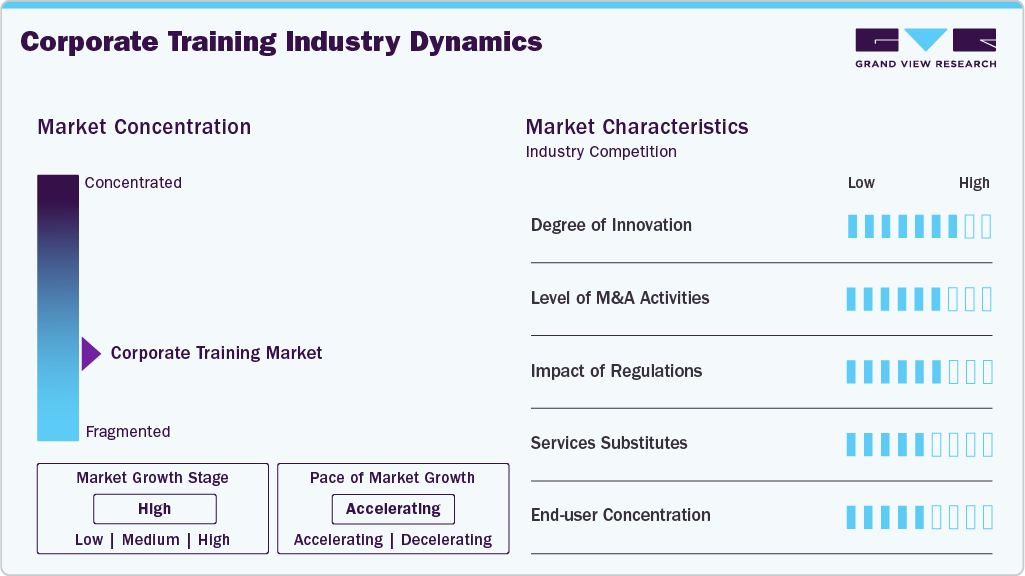
The corporate training market demonstrates a moderately fragmented structure, supported by the presence of multinational training providers, regional institutes, digital learning platforms, and specialized consulting firms. Competitive intensity remains high due to increasing demand for technical training, compliance programs, leadership development, and soft skills enhancement across industries. Market participants are focusing on partnerships, acquisitions, and the expansion of digital learning capabilities to strengthen market positioning. However, the continued presence of numerous regional and niche providers maintains a fragmented competitive landscape.
 To learn more about this report, Download Free Sample Report
 The market is characterized by increasing adoption of AI-enabled learning platforms, virtual training environments, and personalized learning solutions. Organizations are expanding investments in workforce upskilling and reskilling initiatives to address evolving technology requirements and industry skill gaps. Demand for online and hybrid learning models continues to increase across sectors, including IT, BFSI, healthcare, manufacturing, and retail. Ongoing digital transformation initiatives and growing emphasis on workforce productivity and employee retention continue to support market expansion.
Component Insights
The Software segment dominated the corporate training market in 2025, accounting for a 66.4% share. Companies increasingly relied on digital learning platforms and software solutions to deliver training efficiently. The preference for software highlights the growing need for flexible, scalable, and technology-driven training methods. This trend underscores a shift away from traditional approaches toward integrated, software-enabled learning ecosystems. Enterprises are also investing in AI-driven and cloud-based platforms to enhance personalization and engagement. The dominance of the software segment demonstrates the critical role of technology in shaping modern corporate training strategies.
The Services segment is experiencing strong growth in the corporate training market, driven by increasing demand for customized training programs, consulting, and implementation support. Companies are relying more on professional services to design, deploy, and manage learning solutions effectively. This segment includes training delivery, content development, and advisory services that complement software platforms. The growth reflects organizations’ focus on expert guidance and hands-on support to achieve training objectives. Enterprises are leveraging services to ensure smooth adoption, employee engagement, and measurable outcomes. As companies expand their training initiatives, the Services segment is becoming increasingly critical for scalable and effective learning solutions.
Training Type Insights
The Technical Training segment dominated the corporate training market in 2025, driven by the growing need to upskill employees in IT, software, compliance, and specialized industry knowledge. Companies are increasingly investing in digital platforms, simulations, and AI-enabled tools to deliver technical training efficiently. Emphasis on role-specific, continuous learning ensures that employees remain proficient in rapidly evolving technologies. Technical training enhances productivity, accuracy, and operational efficiency across organizations. Enterprises are leveraging cloud-based, on-demand modules to deliver scalable learning solutions.
Soft skills training is gaining attention within the corporate training market. Organizations prioritize leadership, communication, teamwork, and emotional intelligence to improve workforce effectiveness. Digital platforms and interactive workshops are being adopted to enhance engagement. Soft skills programs help employees adapt to collaborative, client-facing, and cross-functional roles. Enterprises are increasingly combining technical and soft skills training to ensure a well-rounded workforce. This shift shows the market’s recognition that effective communication and leadership are essential for organizational success.
End Use Insights
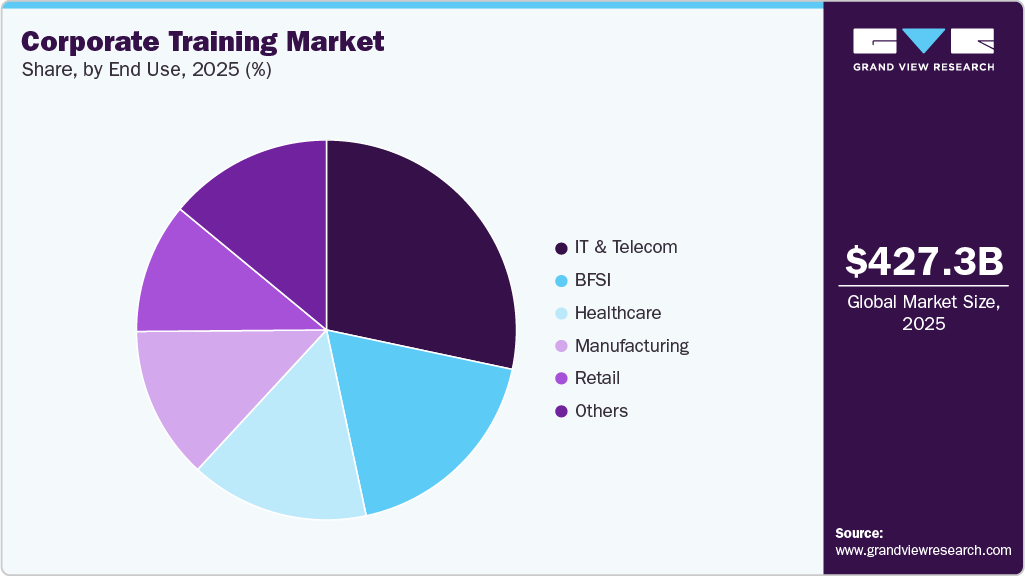
The IT & telecom industry dominated the corporate training market in 2025. Rapid digital adoption and evolving technology roles drove a high demand for upskilling. Companies invested heavily in software platforms and professional services for training delivery. Emphasis was placed on role-specific and continuous learning programs. These initiatives improved employee performance, knowledge retention, and operational efficiency. Enterprises also leveraged AI-driven and cloud-based solutions to scale training globally. The focus on advanced technology skills helped IT & Telecom stay competitive in a fast-changing market. IT & Telecom maintained a leading position due to its focus on technology-driven training solutions.
 To learn more about this report, Download Free Sample Report
 The Healthcare sector is witnessing significant growth in corporate training. Rising requirements for compliance, clinical skills, and digital learning are key drivers. Organizations are adopting interactive platforms, microlearning modules, and professional services. Personalized learning paths effectively address diverse employee needs. The sector is increasingly integrating AI and analytics tools to track learning outcomes. This growth supports workforce competency, patient safety, and organizational performance. Healthcare companies are expanding their training investments to meet evolving regulations and to support technology adoption. The increasing adoption of technology-enabled training shows Healthcare’s expanding role in the corporate training market.
Regional Insights
North America held the largest share in the corporate training market at 37.8% in 2025. High adoption of digital learning platforms, AI-driven solutions, and cloud-based training drives this leadership. Enterprises prioritize technical, compliance, and leadership programs to improve workforce performance. The region’s strong technology infrastructure and focus on upskilling sustain its market dominance. Major corporate and software service providers further strengthen North America’s position in the global training market.
 To learn more about this report, Download Free Sample Report
 U.S. Corporate Training Market Trends
The U.S. market for corporate training is growing steadily, driven by high adoption of digital learning platforms, AI-driven solutions, and cloud-based training. Enterprises are prioritizing technical, compliance, and leadership programs to enhance workforce performance. The country’s strong technology infrastructure and emphasis on employee upskills support widespread training initiatives.
Europe Corporate Training Market Trends
The Europe corporate training market is witnessing steady growth, fueled by increasing adoption of digital learning platforms, e-learning solutions, and cloud-based training systems. Enterprises are investing in technical, compliance, and leadership development programs to enhance employee skills and productivity.
Asia Pacific Corporate Training Market Trends
The Asia Pacific corporate training market is expected to register the fastest CAGR among all regions. This growth is driven by rapid digital adoption, industrialization, and increasing investments in workforce training. Companies in the region are increasingly adopting e-learning platforms, mobile learning, and AI-driven solutions to upskill employees. Enterprises are focusing on technology-enabled, scalable, and continuous learning programs to meet evolving business needs. The combination of expanding workforce requirements and advanced training technologies is fueling strong market expansion across the Asia Pacific.
Key Corporate Training Company Insights
Some of the key companies in the corporate training industry include AI Studios (DeepBrain AI, Inc.), Cornerstone OnDemand, Inc., Coursera, Inc., Degreed, Inc., and others. Organizations are focusing on increasing customer base to gain a competitive edge in the industry. Therefore, key players are taking several strategic initiatives, such as mergers and acquisitions, and partnerships with other major companies.
-
International Business Machines Corporation (IBM) has been expanding its corporate training offerings to meet evolving workforce needs. The company provides digital learning platforms, AI-driven courses, and cloud-based solutions for skill development. Enterprises leverage IBM’s platforms for technical, compliance, and leadership training across global teams. The focus on personalized learning, microlearning, and continuous upskilling helps improve employee performance and knowledge retention.
-
LinkedIn Learning (Microsoft) offers a wide range of digital courses and professional development programs for employees worldwide. Its platforms support technical, leadership, and soft skills training, emphasizing scalable and accessible learning solutions. Enterprises use LinkedIn Learning to implement role-specific and continuous learning programs that enhance workforce efficiency. These initiatives demonstrate the growing importance of technology-enabled corporate training in today’s business environment.
Key Corporate Training Companies:
The following key companies have been profiled for this study on the corporate training market
-
AI Studios (DeepBrain AI, Inc.)
-
Cornerstone OnDemand, Inc.
-
Coursera, Inc.
-
Degreed, Inc.
-
International Business Machines Corporation (IBM)
-
LinkedIn Learning (Microsoft)
-
Pluralsight, Inc.
-
SAP SE
-
Skillsoft Corporation
-
Udemy, Inc.
Competitive Benchmarking
Operating Strategies
Competitive Edge
Weaknesses
Mature Players: IBM; LinkedIn Learning (Microsoft); SAP SE; Coursera, Inc.
- Enterprise subscriptions, content libraries, and partnerships support market expansion.
- AI-enabled learning platforms strengthen customer retention and engagement.
- Strong enterprise presence and global customer base provide a competitive edge.
- Advanced AI capabilities and extensive learning content enhance platform differentiation.
- High competition and content saturation limit platform differentiation and pricing flexibility.
- Dependence on enterprise spending can affect revenue growth during economic slowdowns.
Emerging Players: Degreed, Inc., AI Studios (DeepBrain AI, Inc.)
- Emerging players focus on AI-driven learning solutions and niche skill-based offerings.
- Strategic partnerships and platform innovation support customer acquisition and market expansion.
- AI-native platforms and advanced personalization improve learning efficiency and user engagement.
- Flexible and innovative offerings support faster adaptation to evolving workforce requirements.
- Limited enterprise presence and smaller customer bases restrict market reach.
- Lower brand recognition and limited resources affect large-scale expansion.
Recent Developments
-
In March 2026, Simplilearn partnered with Said Business School, University of Oxford, to launch three AI-focused programs designed for professionals leading AI integration within their organizations. The programs aim to bridge the AI talent gap by equipping leaders with strategic frameworks, technical fluency, and skills for responsible AI-driven enterprise transformation.
-
In December 2025, IBM Corporation and Pearson announced a global partnership to develop AI-powered learning tools and personalized corporate training platforms for businesses, public organizations, and educational institutions. The collaboration uses IBM’s watsonx technologies to deliver digital credentialing, strategic workforce planning, and professional assessments, aiming to enhance skill development and workforce transformation worldwide.
-
In December 2025, Amazon Web Services, Inc. launched digital training products on AWS Skill Builder, including hands-on Builder Labs, Learning Plans, and classroom courses for key certifications. These offerings aim to enhance cloud skills and support professional certification preparation.
Corporate Training Market Report Scope
Report Attribute
Details
Market size in 2025
USD 427.3 billion
Estimated market size in 2026
USD 458.7 billion
Projected market size by 2033
USD 777.5 billion
Growth rate
CAGR of 7.8% from 2026 to 2033
Base year for estimation
2025
Historical data
2021 - 2024
Forecast period
2026 - 2033
Quantitative units
Revenue in USD Billion and CAGR from 2026 to 2033
Report coverage
Revenue forecast, company ranking, competitive sector, growth factors, and trends
Segment scope
Component, training type, end use, region
Region scope
North America; Europe; Asia Pacific; Latin America; Middle East & Africa
Country scope
U.S.; Canada; Mexico; Germany; UK; France; China; Japan; India; Australia; South Korea; Brazil; KSA; UAE; South Africa
Key companies profiled
AI Studios (DeepBrain AI, Inc.); Cornerstone OnDemand, Inc.; Coursera, Inc.;Degreed, Inc.; International Business Machines Corporation (IBM); LinkedIn Learning (Microsoft); Pluralsight, Inc.; SAP SE; Skillsoft Corporation; Udemy, Inc.
Customization scope
Free report customization (equivalent up to 8 analysts’ working days) with purchase. Addition or alteration to country, regional & segment scope
Pricing and purchase options
Avail customized purchase options to meet your exact research needs. Explore purchase options
Global Corporate Training Market Report Segmentation
This report forecasts revenue growth at the global, regional, and country levels and provides an analysis of the latest industry trends and opportunities across sub-segments from 2021 to 2033. For this study, Grand View Research has segmented the global corporate training market in terms of component, training type, end use, and region.
 To learn more about this report, Download Free Sample Report
 -
Component Outlook (Revenue, USD Billion, 2021 - 2033)
-
Software
-
Services
-
-
Training Type Outlook (Revenue, USD Billion, 2021 - 2033)
-
Technical Training
-
Soft Skills Training
-
Compliance Training
-
Product & Sales Training
-
-
End Use Outlook (Revenue, USD Billion, 2021 - 2033)
-
IT & Telecom
-
BFSI
-
Healthcare
-
Manufacturing
-
Retail
-
Others
-
-
Regional Outlook (Revenue, USD Billion, 2021 - 2033)
-
North America
-
U.S.
-
Canada
-
Mexico
-
-
Europe
-
UK
-
Germany
-
France
-
-
Asia Pacific
-
China
-
Japan
-
India
-
Australia
-
South Korea
-
-
Latin America
-
Brazil
-
-
Middle East & Africa (MEA)
-
KSA
-
UAE
-
South Africa
-
-
Delivered Customizations
This report has been delivered with the following In-depth customizations
Client Objective
Custom Research Modules Delivered
Strategic Value / Business Impact
Product Positioning & Competitive Intelligence
LMS platform benchmarking
Pricing model comparison
Training content evaluation
Competitor feature analysis
Improved platform differentiation
Supported pricing optimization
Identified content gaps
Enhanced competitive positioning
Customer & End-User Insights Study
Training preference analysis by industry and organization size
Employee skill gap and workforce development assessment
Learning platform adoption and digital training usage analysis
Corporate spending and investment trend evaluation
Improves workforce productivity and retention
Optimizes training investments and outcomes
Supports targeted training program development
Enhances digital learning engagement
Technology & Innovation Assessment
AI and learning platform technology analysis
Virtual and hybrid training solution assessment
Learning management system (LMS) evaluation
Training content and automation trend analysis
Supports adoption of advanced training technologies
Improves learning efficiency and scalability
Enhances employee engagement and training accessibility
Assists innovation-driven workforce development strategies
Frequently Asked Questions About This Report
The global corporate training market size was valued at USD 427.3 billion in 2025 and is estimated at USD 458.7 billion for 2026.
The global corporate training market is expected to grow at a CAGR of 7.8% from 2026 to 2033, reaching USD 777.5 billion by 2033.
North America dominated with a 37.8% revenue share in 2025.
Asia Pacific is the fastest-growing region over the forecast period.
Key players include AI Studios (DeepBrain AI, Inc.); Cornerstone OnDemand, Inc.; Coursera, Inc.;Degreed, Inc.; International Business Machines Corporation (IBM); LinkedIn Learning (Microsoft); Pluralsight, Inc.; SAP SE; Skillsoft Corporation; Udemy, Inc.
Key factors that are driving the market growth include rising demand for continuous workforce upskilling, rapid digital transformation across enterprises, increasing adoption of e-learning and online training platforms, and growing focus on improving employee productivity and skill development.
The software segment led with a 66.4% revenue share in 2025.
The technical training segment held the largest revenue share in 2025.
The IT & telecom segment held the largest revenue share in 2025.
About the Author(s)
Next Generation Technologies Research Team
Technology · Next Generation TechnologiesThis report was authored by the next generation technologies research team at Grand View Research - comprising two research analysts, one senior research analyst, and one industry expert - with specialized expertise in the next generation technologies segment of the technology industry. All findings are based on proprietary technology databases, executive interviews, and regulatory analysis, subject to internal peer review prior to publication.
Last Updated:
Speak to Analyst

Customize this report to your needs - add regions, segments, or data points, with 20% free customization.
Or view our licence options:


ISO 9001:2015 & 27001:2022 Certified
We are GDPR and CCPA compliant! Your transaction & personal information is safe and secure. For more details, please read our privacy policy.


