
- Home
- »
- Advanced Interior Materials
- »
-
Cryogenic Pump Market Size And Share Report, 2026-2033GVR Report cover

Cryogenic Pump Market (2026 - 2033)
Size, Share & Trends Analysis Report By Type (Centrifugal, Positive Displacement), By Cryogen Type (LNG, Oxygen), By End-use (Oil & Gas, Electronics), By Region, And Segment Forecasts
Market Size, 2025
$2.8BMarket Estimate, 2026
$2.9BMarket Forecast, 2033
$4.2BCAGR, 2026–2033
5.5%Cryogenic Pump Market Summary
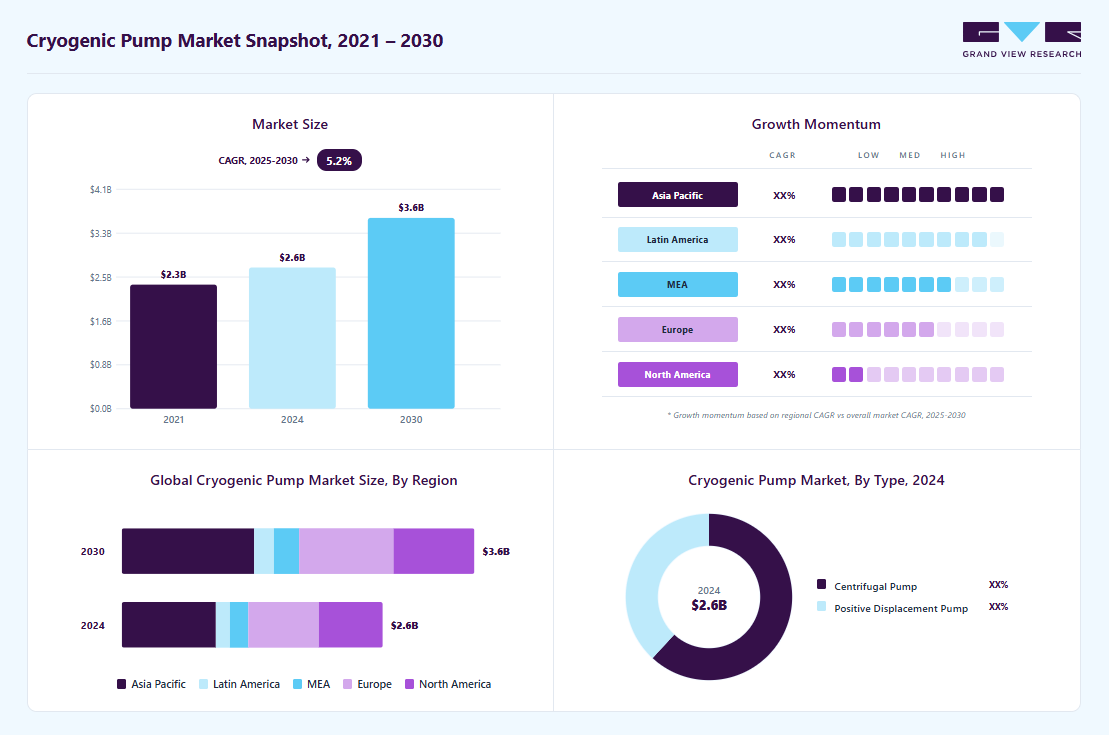
The global cryogenic pump market size was valued at USD 2.8 billion in 2025 and is projected to grow from USD 2.9 billion in 2026 to USD 4.2 billion by 2033, growing at a CAGR of 5.5% from 2026 to 2033. Asia Pacific dominated the market, accounting for the largest share of 35.5% in 2025. The increasing demand for cryogenic pumps in various end-use industries, such as oil & gas, metallurgy, and electronics, is driving market growth.
 Source: Grand View Research, IR Documents, Primary Interviews, Paid DatabasesTo learn more about this report,
 Download Free Sample Report
 Key Market Trends & Insights
- By type: Centrifugal pump segment dominated the market, with a revenue share of 62.4% in 2025.
- By cryogen type: LNG segment held the largest market share of 28.9% in 2025.
- By end use: Oil & gas segment led the market with the largest revenue share of 17.9% in 2025.
Regional Highlights
- Largest regional market: Asia Pacific (35.5% revenue share, 2025)
- By country: China held the largest market share in 2025.
Market Size & Forecast
- Market size in 2025: USD 2.8 Billion
- Estimated market size in 2026: USD 2.9 Billion
- Projected market size by 2033: USD 4.2 Billion
- CAGR (2026-2033): 5.5%
Three ways to get this report
Buy it, customize it, or ask a question.Ask an Analyst
A direct answer, usually in 1 working day
- AccessReport author, directly
- Reply timeWithin 1 working day
- No sales callDirect answer only
- FormatEmail reply
- CostFree, no cost
Get the Full Report
What the study covers
- FormatsPDF · Excel · Dashboard
- Timeline2026–2033 annual, 2025 base
- Coverage20+ countries, 5 regions
- Companies10+ key players profiled
Customize the Report
20% free customization
- IncludeCountries, segments, points
- TailorTo your product definition
- ExtendDeeper competitor detail
- OrA fully bespoke study
- Turnaround5–10 working days
These pumps are essential for handling and transporting cryogenic fluids, including LNG, nitrogen, and oxygen, which are critical for numerous industrial processes. The market is also being driven by stringent environmental regulations and standards aimed at reducing emissions and enhancing energy efficiency. The adoption of cryogenic pumps in renewable energy applications, such as hydrogen production and storage, is anticipated to bolster market growth. Furthermore, the increasing investments in infrastructure development, particularly in emerging economies, are likely to support the demand for cryogenic pumps.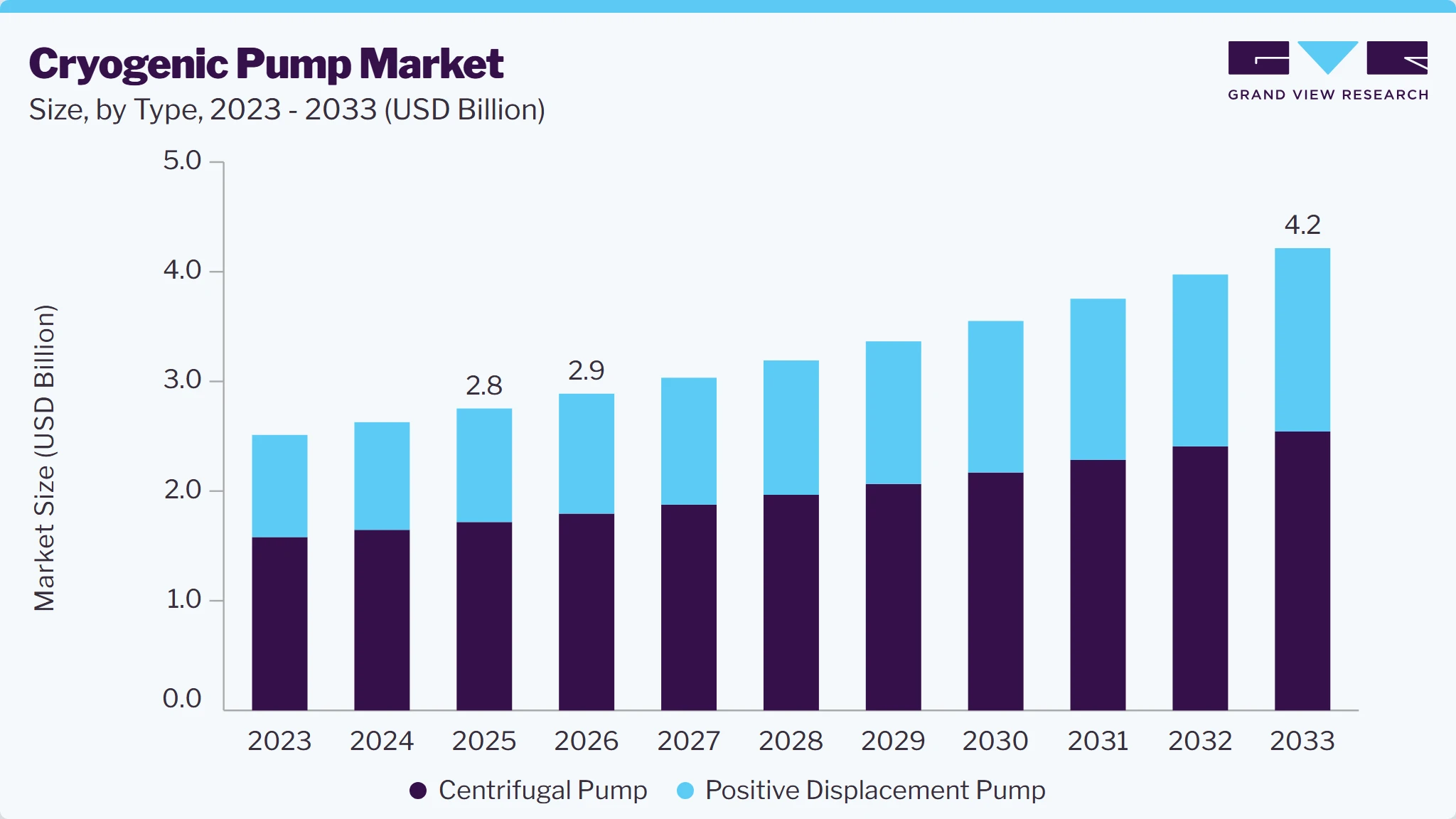 To learn more about this report, Download Free Sample Report
 Advancements in cryogenic technologies, coupled with the integration of automation and digitalization in pumping systems, are further propelling market growth. The development of high-efficiency cryogenic pumps that reduce energy consumption and minimize operational costs is a significant trend in the industry. Furthermore, the rising focus on clean energy and the growing LNG trade are expected to create substantial opportunities for market expansion.
The primary drivers of the cryogenic pump market include the increasing demand for LNG as a cleaner fuel alternative, the growth of the oil & gas and chemical industries, and the rising focus on environmental sustainability. The need for efficient and reliable cryogenic pumps for handling and transporting cryogenic fluids in various industrial processes is also driving market growth.
 To learn more about this report, Download Free Sample Report
 Opportunities for market expansion are significant, particularly in the renewable energy sector. The growing adoption of cryogenic pumps in hydrogen production, storage, and distribution is expected to create new growth avenues. Moreover, the increasing investments in infrastructure development in emerging economies present lucrative opportunities for market players.
Market Dynamics
Increasing demand for liquefied gases across energy, industrial, healthcare, and electronics sectors is driving the cryogenic pump market. Rising investments in liquefied natural gas (LNG) infrastructure, industrial gas production, and clean energy projects are driving the adoption of cryogenic pumping systems for the safe transfer and handling of low-temperature fluids. The expansion of hydrogen and liquefied gas supply chains is further contributing to market growth. However, high manufacturing costs and complex operating requirements may limit adoption in some applications. Opportunities are emerging from hydrogen energy development, LNG trade expansion, and advancements in cryogenic handling technologies.
The cryogenic pump market is primarily driven by the growing development of LNG and industrial gas infrastructure worldwide. Cryogenic pumps play an essential role in transferring and handling liquefied gases such as LNG, liquid oxygen, liquid nitrogen, liquid argon, and liquid hydrogen while maintaining extremely low temperatures. Rising natural gas consumption and increasing investments in LNG export terminals, import facilities, storage systems, and transportation networks are creating substantial demand for reliable cryogenic pumping equipment. Industrial gas manufacturers are also expanding production capacities to meet growing requirements from healthcare, electronics, metal processing, and chemical industries. The increasing use of cryogenic gases in medical applications and advanced manufacturing processes is further supporting market demand. Governments and private companies are investing in energy infrastructure to improve supply security and diversify energy sources, encouraging the deployment of cryogenic handling systems. As LNG trade and industrial gas production continue to expand globally, demand for high-performance cryogenic pumps is expected to increase steadily.
The cryogenic pump market faces challenges due to the high costs associated with manufacturing, installation, and maintenance of specialized pumping systems. Cryogenic pumps are designed to operate under extremely low temperatures and demanding pressure conditions, requiring advanced materials and precision engineering to ensure safe and reliable performance. The use of specialized alloys, sealing technologies, and insulation systems increases production costs and overall project expenditures. Installation often requires supporting cryogenic storage and transfer infrastructure, adding to capital investment requirements. In addition, maintaining cryogenic pumps involves regular inspections and specialized technical expertise to prevent leakage, thermal stress, and operational failures. Industries with limited financial resources may delay investments in advanced cryogenic systems due to these cost considerations. Fluctuations in energy prices and delays in large-scale industrial projects can also affect procurement decisions. These economic and technical challenges may moderate the pace of market growth across certain applications and regions.
Hydrogen is increasingly being recognized as an important energy carrier for industrial decarbonization, transportation, and renewable energy storage. The storage and transportation of liquid hydrogen require advanced cryogenic pumping systems capable of handling extremely low temperatures safely and efficiently. Governments and private companies are investing in hydrogen production facilities, liquefaction plants, fueling stations, and export infrastructure to support clean energy objectives. Cryogenic pumps are also essential for carbon capture and storage projects and the handling of other liquefied industrial gases used in emerging energy applications. Technological advancements are improving pump efficiency, reliability, and operational safety, expanding their range of industrial applications. In addition to hydrogen, growing investments in LNG infrastructure and industrial gas production continue to create demand for advanced cryogenic handling equipment. As clean energy projects and low-carbon technologies expand globally, the cryogenic pump market is expected to benefit from increasing infrastructure development and long-term investment opportunities.
Analyst Perspective
The cryogenic pump market is expected to benefit from the growing consumption of industrial gases, particularly liquid nitrogen, oxygen, argon, and hydrogen, across the energy, metallurgy, chemicals, healthcare, food processing, and electronics industries. Liquid nitrogen is anticipated to remain a key demand driver due to its extensive use in industrial processing, cryopreservation, food freezing, medical applications, and semiconductor manufacturing. Increasing investments in hydrogen value chains and other low-carbon energy projects are also creating new growth opportunities for cryogenic pumping systems. Centrifugal pumps are projected to account for a substantial market share owing to their suitability for high-volume cryogenic fluid transfer, while positive displacement pumps will continue to see demand in high-pressure applications. Competition is increasingly centered on enhancing pump reliability, energy efficiency, and operational safety, with companies possessing specialized cryogenic engineering capabilities and diversified end-use exposure expected to strengthen their market positions over the forecast period.
Type Insights
Based on type, the centrifugal pump segment led the market with the largest revenue share of 62.4% in 2025. These pumps are widely used for their efficiency in handling large volumes of cryogenic fluids, such as LNG and nitrogen. The demand for centrifugal pumps is driven by their high reliability, ease of maintenance, and ability to operate under varying conditions.
Positive displacement pumps are expected to grow at a CAGR of 5.9% over the forecast period, owing to their ability to handle high-pressure applications and deliver precise flow rates, making them ideal for specialized industrial processes. These pumps are crucial for applications requiring consistent and accurate flow control, such as in the chemical and pharmaceutical industries. The market growth is driven by the need for efficient and reliable pumping solutions in these sectors.
Cryogen Type Insights
Based on cryogen type, the LNG segment led the market with the largest revenue share of 28.9% in 2025. The growing adoption of LNG as a cleaner and more efficient energy source is driving the demand for cryogenic pumps in this segment. LNG pumps are essential for the transportation, storage, and regasification of liquefied natural gas.
oxygen is expected to grow at a lucrative CAGR of 5.6% from 2025 to 2030, owing to their extensive use in various industrial applications such as metallurgy, electronics, and healthcare. The argon segment is expected to witness steady growth, driven by its applications in welding, metal fabrication, and electronics manufacturing.
End-use Insights
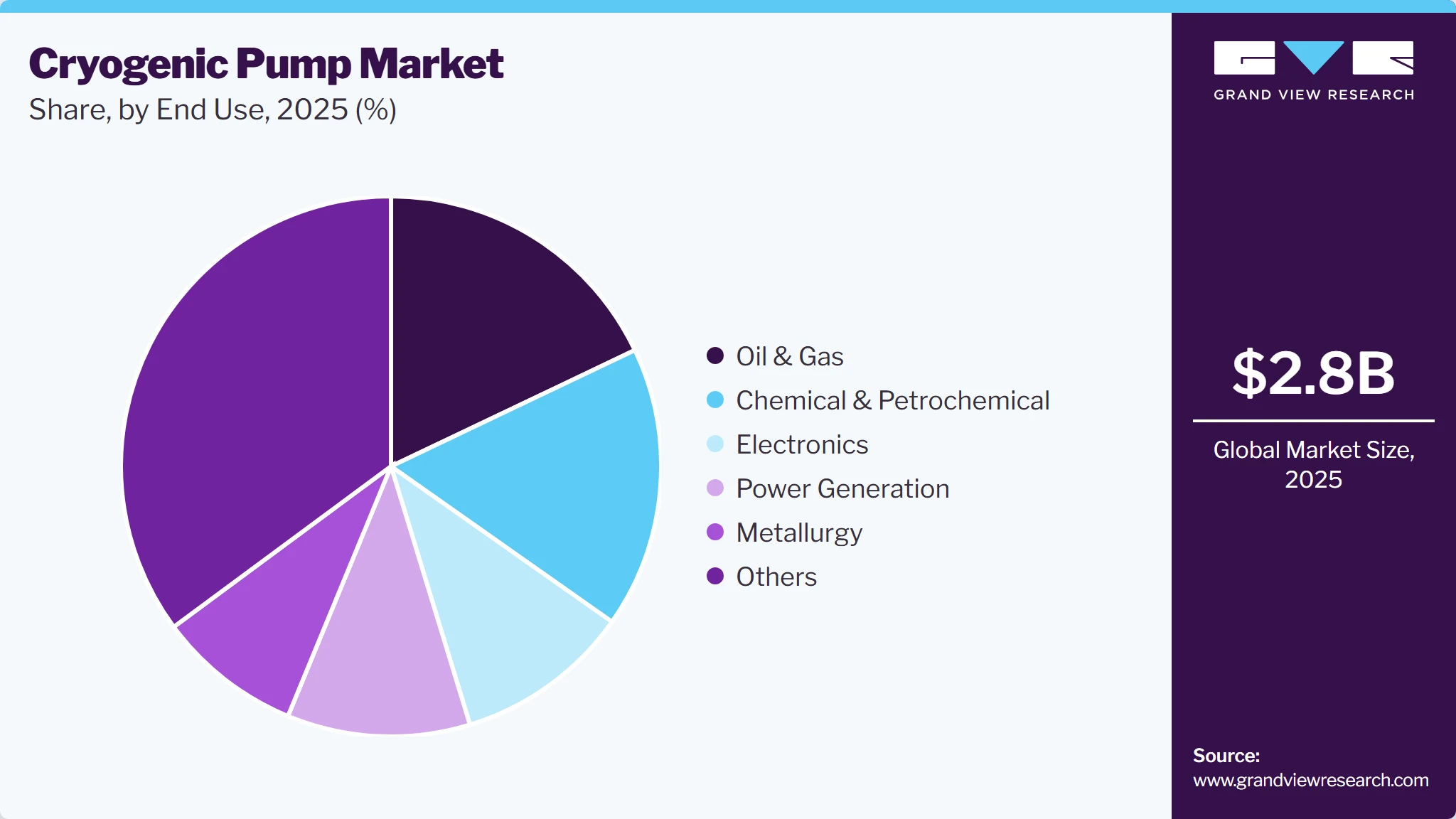
Based on end use, the oil & gas segment led the market with the largest revenue share of 17.9% in 2025. Cryogenic pumps are extensively used in the oil & gas industry for the handling of LNG and other cryogenic fluids. The growing investments in LNG infrastructure and the increasing focus on cleaner energy sources are driving the adoption of cryogenic pumps in this segment.
 To learn more about this report, Download Free Sample Report
 The electronics segment is expected to grow at the fastest CAGR of 6.3% over the forecast period. The electronics industry uses cryogenic pumps for applications such as semiconductor manufacturing and cooling of superconducting materials. The demand for cryogenic pumps in electronics is driven by the need for precise and reliable systems for handling cryogenic fluids in these high-tech applications. The power generation industry is increasingly adopting cryogenic pumps for applications such as LNG-based power plants and renewable energy storage.
Regional Insights
The cryogenic pump market in North America is expected to witness significant growth over the forecast period, owing to a strong demand from the oil & gas and chemical industries. The region's focus on technological innovation and sustainability is driving the adoption of advanced cryogenic pumps. In addition, the growing need for LNG-based power plants, as coal resources deplete, is a significant factor boosting demand. Furthermore, advancements in industrial infrastructure and technological innovation are supporting the adoption of cryogenic pumps. The region's emphasis on sustainability and efficient energy utilization also contributes to the market's robust growth trajectory.
U.S. Cryogenic Pump Market Trends
U.S. cryogenic pump market is witnessing substantial growth due to the booming LNG industry and increasing demand from the healthcare sector for medical gases. The country’s focus on renewable energy and clean fuel alternatives is driving adoption across various industries. Moreover, advancements in natural gas exploration and production are enhancing LNG transportation needs, further stimulating demand for cryogenic pumps. The U.S. also benefits from significant investments in technological development to meet its growing industrial requirements.
Asia Pacific Cryogenic Pump Market Trends
Asia Pacific dominated the cryogenic pump market with the largest revenue share of 35.5% in 2025. This growth is attributed to the rapid industrialization, increasing investments in LNG infrastructure, and the expansion of the electronics and chemical & petrochemical industries. The growing demand for energy and the focus on sustainable industrial processes are driving the adoption of cryogenic pumps in the region.
 To learn more about this report, Download Free Sample Report
 The cryogenic pump market in the China held the largest share in the Asia Pacific region in 2025, driven by expanding energy demand, rapid industrialization, and increasing investments in infrastructure development. The country's focus on environmental sustainability and energy efficiency is supporting the adoption of advanced cryogenic pumps.
Europe Cryogenic Pump Market Trends
The cryogenic pump market in Europe is experiencing steady growth, supported by stringent environmental regulations and a strong emphasis on sustainability. The region's focus on reducing carbon footprints and enhancing industrial efficiency is encouraging the adoption of innovative cryogenic pump solutions.
Latin America Cryogenic Pump Market Trends
Latin America cryogenic pump market is expected to grow at a CAGR of 5.7% over the forecast period, owing to increasing investments in LNG infrastructure and regasification facilities. Governments and corporations are actively implementing projects to enhance LNG production and distribution, which is fueling demand for cryogenic pumps. Furthermore, the region's industrial growth, coupled with a focus on clean energy solutions, is driving adoption in sectors such as power generation and manufacturing. Innovations in cryogenic technology and supportive policies for energy transformation are further propelling market growth across Latin America.
Key Cryogenic Pump Company Insights
Some of the key players operating in the market include Nikkiso Co Ltd, Ebara Corporation, Flowserve Corporation, Fives Group, among others.
-
Nikkiso Co Ltd is a leading provider of cryogenic pumps, offering advanced technologies and reliable solutions for various industrial applications. The company's focus on innovation and customer satisfaction has solidified its position in the market.
-
Ebara Corporation is a prominent player in the market, known for its high-quality products and extensive industry experience. The company's cryogenic pumps are widely used in oil & gas, power generation, and chemical & petrochemical applications.
-
Flowserve Corporation is a global leader in fluid motion and control technologies, offering a comprehensive range of cryogenic pumps. The company's commitment to innovation and sustainability has made it a trusted name in the market.
Key Cryogenic Pump Companies:
The following key companies have been profiled for this study on the cryogenic pump market.
-
Nikkiso Co Ltd
-
Ebara Corporation
-
Flowserve Corporation
-
Fives Group
-
Cryostar SAS
-
Vanzetti Engineering
-
Cryomec LLC
-
Sumitomo Heavy Industries, Ltd.
-
Ruhrpumpen Group
-
PBS Group, a. s.
Competitive Benchmarking
Category
Operating Strategies
Competitive Edge
Weakness
Established Players (e.g. Nikkiso Co., Ltd., Ebara Corporation, Flowserve Corporation, Fives Group, Sumitomo Heavy Industries, Ltd.)
- Focus on expanding cryogenic pump capabilities for LNG, industrial gas, hydrogen, and clean energy applications.
- Strong investments in advanced engineering, energy-efficient pumping systems, and digital monitoring technologies.
- Expansion through strategic partnerships, global service networks, and participation in large-scale LNG and industrial gas projects.
- Strong global brand recognition and established customer relationships across energy and industrial sectors.
- Broad product portfolio with advanced cryogenic engineering capabilities.
- Extensive experience in LNG terminals, industrial gas plants, and clean energy projects.
- High equipment and installation costs compared to smaller regional competitors
- Dependence on LNG investments and energy sector capital expenditure cycles
- Complex manufacturing processes and longer project lead times
Emerging & Regional Players (e.g Cryostar SAS, Vanzetti Engineering, Ruhrpumpen Group, Cryomec LLC, PBS Group)
- Focus on specialized and application-specific cryogenic pumping solutions.
- Increasing presence in LNG fueling, industrial gas distribution, hydrogen mobility, and laboratory applications.
- Flexible engineering capabilities and customized cryogenic system development.
- Competitive pricing and agile operational structure.
- Growing adoption in small- and medium-scale LNG and hydrogen projects.
- Strong technical specialization in cryogenic handling systems.
- Lower investment capacity in large-scale R&D and automation technologies
- Limited participation in very large LNG infrastructure projects
- Dependence on regional demand and niche application markets
Recent Developments
-
In July 2024, Flowserve Corporation acquired the intellectual property and in-process R&D associated with cryogenic Liquefied Natural Gas (LNG) submerged pump technology, systems, and packaging from NexGen Cryogenic Solutions, Inc. This acquisition is anticipated to significantly enhance and expand Flowserve’s LNG product portfolio, complementing its existing range of pumps, valves, and mechanical seals.
-
In January 2023, Cryomotive, a German hydrogen mobility startup, and Fives, a French industrial group, announced a partnership to develop an innovative Cryogenic Pump for hydrogen truck refueling stations. The Cryomec Hy-Filling pump compresses liquid hydrogen into CRYOGAS, enabling trucks to refuel in 10-15 minutes and achieve a 1,000 km range.
Cryogenic Pump Market Report Scope
Report Attribute
Details
Market size in 2025
USD 2.8 billion
Estimated market size in 2026
USD 2.9 billion
Projected market size by 2033
USD 4.2 billion
Growth rate
CAGR of 5.5% from 2026 to 2033
Base year for estimation
2025
Historical data
2021 - 2024
Forecast period
2026 - 2033
Quantitative units
Revenue in USD billion and CAGR from 2026 to 2033
Report coverage
Revenue forecast, company ranking, competitive landscape, growth factors, and trends
Segments covered
Type, cryogen type, end use, region
Regional scope
North America; Europe; Asia Pacific; Latin America; Middle East & Africa
Country scope
U.S.; Canada; Mexico; U.K.; Germany; France; Italy; Spain; China; India; Japan; Australia; South Korea; Brazil; Argentina; Saudi Arabia, UAE; South Africa
Key companies profiled
Nikkiso Co Ltd; Ebara Corporation; Flowserve Corporation; Fives Group; Cryostar SAS; Vanzetti Engineering; Cryomec LLC; Sumitomo Heavy Industries, Ltd.; Ruhrpumpen Group; PBS Group, a. s.
Customization scope
Free report customization (equivalent up to 8 analysts' working days) with purchase. Addition or alteration to country, regional & segment scope.
Pricing and purchase options
Avail customized purchase options to meet your exact research needs. Explore purchase options
Global Cryogenic Pump Market Report Segmentation
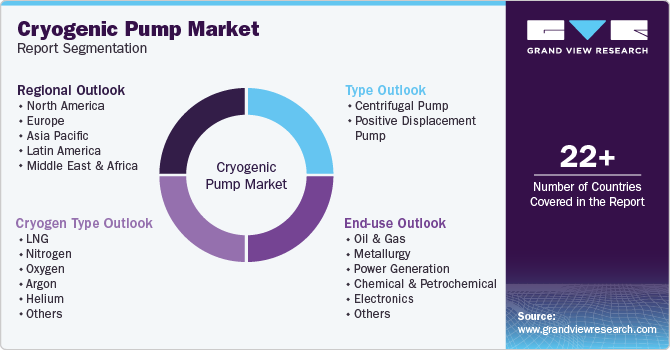
This report forecasts revenue growth at global, regional, and country levels and analyzes the latest industry trends in each sub-segment from 2021 to 2033. For this study, Grand View Research has segmented the global cryogenic pump market report based on type, cryogen type, end-use, and region.
 To learn more about this report, Download Free Sample Report
 -
Type Outlook (Revenue, USD Million, 2021 - 2033)
-
Centrifugal Pump
-
Positive Displacement Pump
-
-
Cryogen Type Outlook (Revenue, USD Million, 2021 - 2033)
-
LNG
-
Nitrogen
-
Oxygen
-
Argon
-
Helium
-
Others
-
-
End Use Outlook (Revenue, USD Million, 2021 - 2033)
-
Oil & Gas
-
Metallurgy
-
Power Generation
-
Chemical & Petrochemical
-
Electronics
-
Others
-
-
Regional Outlook (Revenue, USD Million, 2021 - 2033)
-
North America
-
U.S.
-
Canada
-
Mexico
-
-
Europe
-
Germany
-
France
-
Italy
-
Spain
-
UK
-
-
Asia Pacific
-
China
-
India
-
Japan
-
South Korea
-
Australia
-
-
Latin America
-
Brazil
-
Argentina
-
-
Middle East and Africa
-
Saudi Arabia
-
UAE
-
South Africa
-
-
Research Methodology
The cryogenic pump market figures in this report are based on a proven research process that combines executive interviews with secondary research from proprietary databases, company filings, and recognized regulatory and institutional sources. Market size is built through value-chain sizing - reconciling supply-side and demand-side estimates - and triangulated with bottom-up and top-down approaches. Every estimate passes multiple levels of expert validation before publication, with each cryogenic pump segment quantified using the revenue-capture definitions in the table below.
Segment Definition
Segment -Type
Revenue Capture Definition
Centrifugal Pump
Revenue is generated through the sale of centrifugal cryogenic pumps designed for the continuous transfer of liquefied gases.
Positive Displacement Pump
Revenue is captured through positive displacement cryogenic pumps used for precise, high-pressure transfer of liquefied gases.
Segment - Cryogen Type
Revenue Capture Definition
LNG
Revenue is generated through cryogenic pumps used in the storage, transfer, and transportation of liquefied natural gas.
Nitrogen
Revenue is captured through cryogenic pumps handling liquid nitrogen.
Oxygen
Revenue is generated through cryogenic pumps used for liquid oxygen transfer.
Argon
Revenue is captured through cryogenic pumps used in the handling of liquid argon.
Helium
Revenue is generated through cryogenic pumps designed for liquid helium transfer.
Others
Revenue is captured through cryogenic pumps used for handling other liquefied gases, including hydrogen, carbon dioxide, neon, and specialty gases.
Segment -
End Use
Revenue Capture Definition
Oil & Gas
Revenue is generated through cryogenic pumps used in oil and gas production, storage, transportation, gas processing, and related energy infrastructure.
Metallurgy
Revenue is captured through cryogenic pumps supplying industrial gases for steelmaking, metal fabrication, welding, and heat treatment processes.
Power Generation
Revenue is generated through cryogenic pumps used in power plants, energy storage applications, and industrial gas supply systems.
Chemical & Petrochemical
Revenue is captured through cryogenic pumps used for liquefied gas handling in chemical manufacturing, refining, and petrochemical processing operations.
Electronics
Revenue is generated through cryogenic pumps supplying ultra-high-purity gases for semiconductor manufacturing, display production, and electronics fabrication.
Others
Revenue is captured through cryogenic pumps used across healthcare, aerospace, food processing, pharmaceuticals, research laboratories, and other specialized industries requiring the storage and transfer of liquefied gases.
Estimation Model
Layer Name
Key Question
Description
Cryogenic Gas Consumption Layer
Which cryogenic gases generate demand for cryogenic pumps?
The estimation begins by evaluating the production, storage, and transportation requirements for LNG, nitrogen, oxygen, argon, helium, and other cryogenic gases. Industrial gas consumption, LNG trade, and liquefied gas infrastructure establish the base market demand.
Pump Technology Adoption Layer
Which pump types drive market demand?
This layer refines demand by assessing the adoption of centrifugal and positive displacement cryogenic pumps across different cryogen handling applications. Flow rate requirements, operating pressure, and end-use process conditions influence pump selection.
End-use Industry and Replacement Layer
What determines annual pump installations?
Market demand is estimated through new industrial projects, LNG infrastructure development, industrial gas production capacity additions, and replacement of existing cryogenic pumping equipment. Expansion across oil & gas, metallurgy, power generation, chemical & petrochemical, electronics, and other industries further supports demand.
Revenue Layer
How is total market revenue calculated?
Revenue is estimated by aggregating cryogenic pump sales across pump types, cryogen categories, end-use industries, and regional markets. Equipment pricing, industrial investments, replacement cycles, LNG infrastructure spending, and manufacturer revenues are incorporated to validate the total market size.
Delivered Customizations
This report has been delivered with the following In-depth customizations
Client Request
Customization Delivered
Value Adds
Regional Segmentation
Detailed regional analysis covered North America, Europe, Asia Pacific, Latin America, and the Middle East & Africa, with country-level assessment of key markets. The study evaluated LNG infrastructure development, industrial gas production, oil & gas activities, metallurgy, power generation, chemical processing, electronics manufacturing, and clean energy investments influencing cryogenic pump demand.
Helped identify high-growth regions, country-specific opportunities, and evolving demand trends across LNG, industrial gases, energy, chemicals, metallurgy, and electronics sectors, supporting market entry strategies, regional expansion planning, and identification of emerging cryogenic infrastructure hubs.
Competitive Benchmarking
Comprehensive benchmarking assessed major participants based on product portfolio, cryogenic pump technologies, engineering capabilities, manufacturing strength, regional presence and distribution networks. The study also compared established and emerging players in the cryogenic pump market.
Assisted clients in evaluating competitor positioning, technology capabilities, and market gaps while supporting strategic planning, partnership opportunities, product differentiation, and investment decisions across cryogenic fluid handling and industrial gas applications.
Opportunity Assessment
In-depth opportunity assessment analyzed LNG capacity additions, hydrogen infrastructure development, industrial gas demand, energy transition projects, and investments in cryogenic storage and transportation systems. The study identified emerging opportunities in advanced cryogenic pumping technologies, high-efficiency systems, and clean energy applications.
Enabled clients to identify high-growth investment areas, prioritize regional expansion, and evaluate future revenue opportunities while supporting product development, technology adoption, and long-term growth strategies in the cryogenic pump market.
Frequently Asked Questions About This Report
The global cryogenic pump market size was estimated at USD 2.8 billion in 2025 and is expected to be USD 2.9 billion in 2026.
The global cryogenic pump market, in terms of revenue, is expected to grow at a compound annual growth rate (CAGR) of 5.5% from 2026 to 2033 to reach USD 4.2 billion by 2033.
Some of the key players operating in the cryogenic pump market include Nikkiso Co Ltd, Ebara Corporation, Flowserve Corporation, Fives Group, Cryostar SAS, Vanzetti Engineering, Cryomec LLC, Sumitomo Heavy Industries, Ltd., Ruhrpumpen Group, PBS Group, a. s.
Key factors include rising demand for industrial gases such as nitrogen, oxygen, argon, and hydrogen, expansion of LNG infrastructure, increasing investments in hydrogen production and transportation, and growing demand from the healthcare, electronics, chemicals, and energy sectors.
The centrifugal pump segment led the market with the largest revenue share of 62.4% in 2025.
The LNG segment accounted for the largest revenue share of 28.9% in 2025, supported by growing LNG storage, transportation, and regasification activities worldwide.
The oil & gas segment led the market with the largest revenue share of 17.9% in 2025.
Asia Pacific dominated the cryogenic pump market with the largest revenue share of 35.5% in 2025.
About the Author(s)
Advanced Interior Materials Research Team
Advanced Materials · Advanced Interior MaterialsThis report was authored by the advanced interior materials research team at Grand View Research - comprising two research analysts, one senior research analyst, and one industry expert - with specialized expertise in the advanced interior materials segment of the advanced materials industry. All findings are based on proprietary advanced materials databases, executive interviews, and regulatory analysis, subject to internal peer review prior to publication.
Last Updated:
Speak to Analyst

Customize this report to your needs - add regions, segments, or data points, with 20% free customization.
Or view our licence options:


ISO 9001:2015 & 27001:2022 Certified
We are GDPR and CCPA compliant! Your transaction & personal information is safe and secure. For more details, please read our privacy policy.


