
- Home
- »
- Plastics Polymers & Resins
- »
-
Cryogenic Temperature Polymers Market Size Report, 2033GVR Report cover

Cryogenic Temperature Polymers Market (2026 - 2033)
Size, Share & Trends Analysis Report By Polymer Type (PTFE, PEEK, UHMWPE, Polyimide, Nylon), By Application (Seals & Gaskets, Insulation, Bearings & Bushings, Valve Components, Liners & Coatings), By Region, And Segment Forecasts
Market Size, 2025
$3.2BMarket Estimate, 2026
$3.4BMarket Forecast, 2033
$5.5BCAGR, 2026–2033
7.3%Cryogenic Temperature Polymers Market Summary
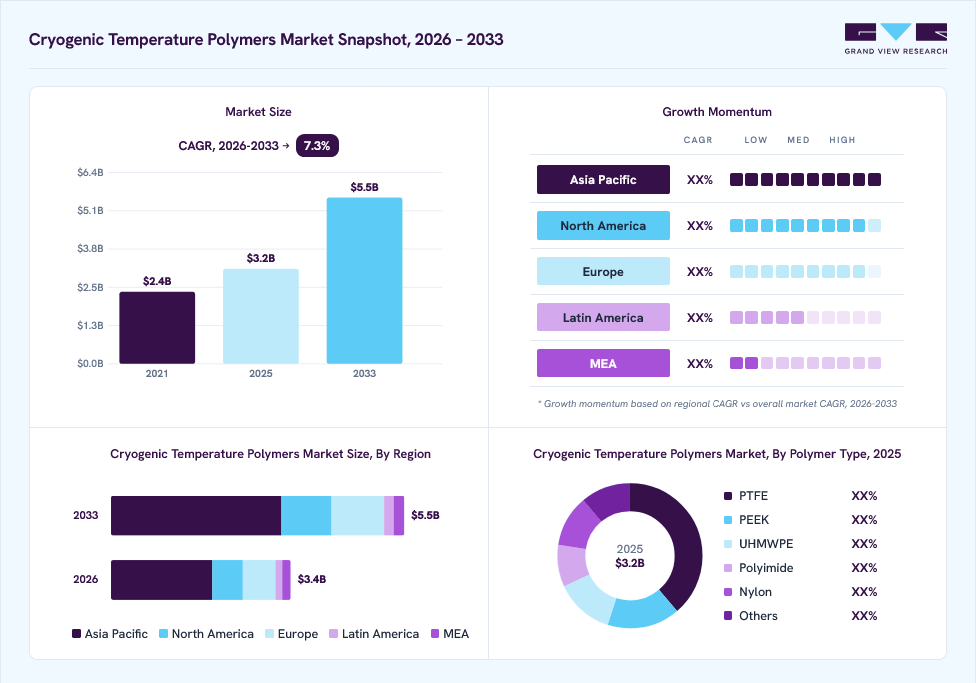
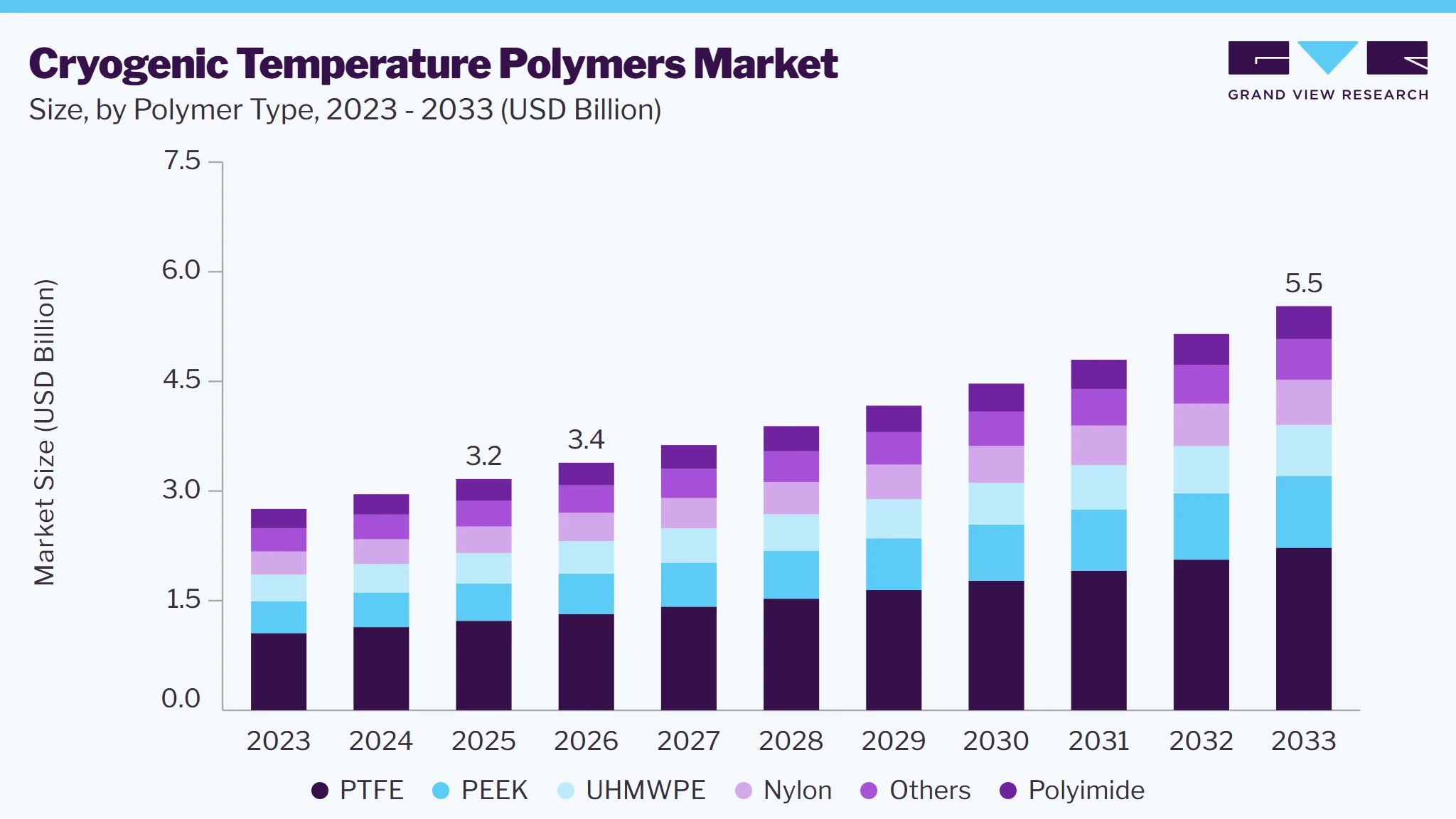
The global cryogenic temperature polymers market size was valued at USD 3.2 billion in 2025 and is projected to grow from USD 3.4 billion in 2026 to USD 5.5 billion by 2033, at a CAGR of 7.3% from 2026 to 2033. The market in Asia Pacific dominated with a revenue share of 56.1% in 2025. Growing demand for cryogenic temperature polymers across healthcare, aerospace, electronics, energy, automotive, and industrial applications is supporting market growth.
 Source: Grand View Research, IR Documents, Primary Interviews, Paid DatabasesTo learn more about this report,
 Download Free Sample Report
Key Market Trends & Insights
- By polymer type: PTFE segment held the largest market share of 38.7% in 2025.
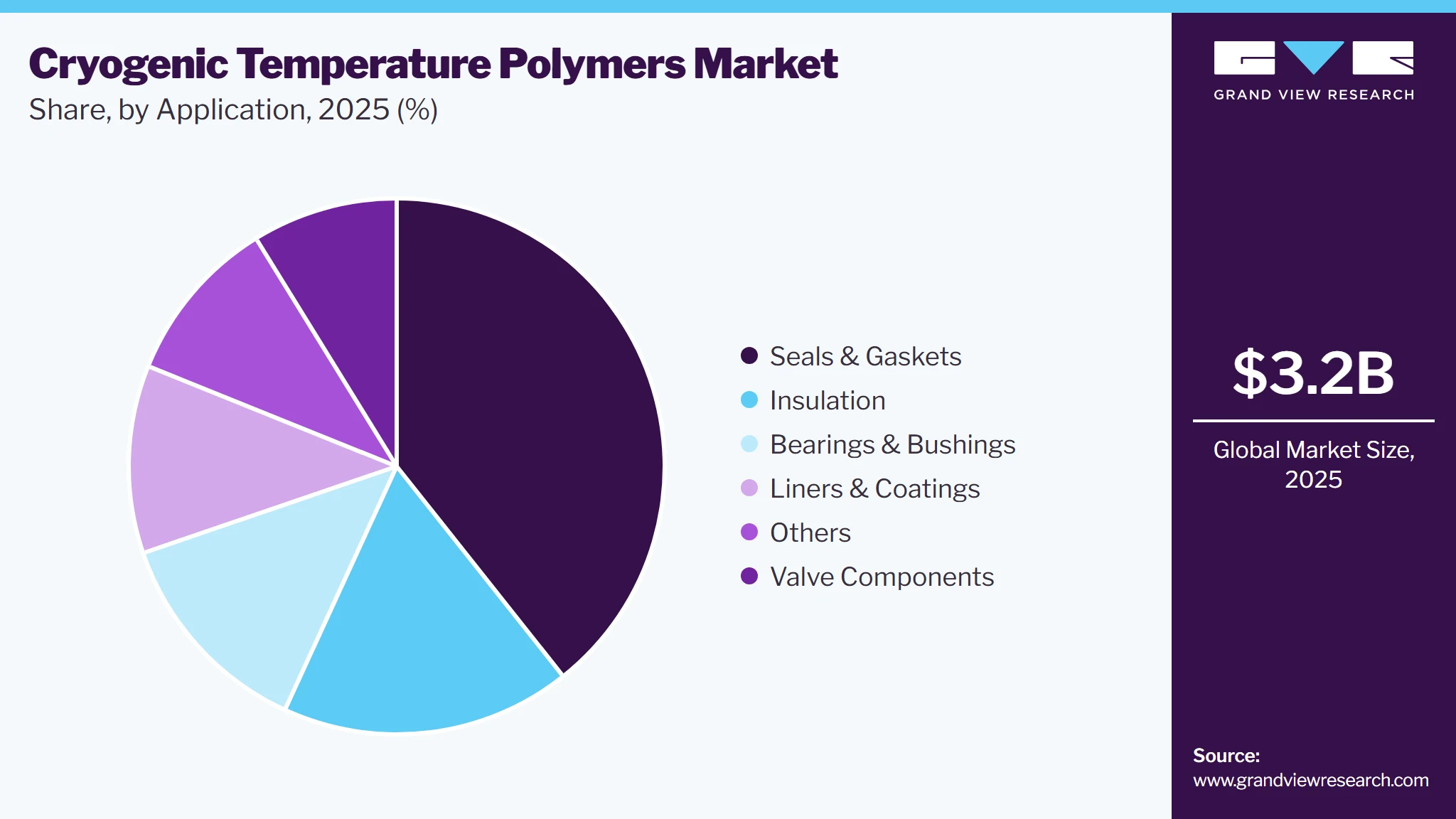
- By application: Seals & gaskets segment held the largest market share of 39.3% in 2025.
Regional Highlights
- Largest regional market: Asia Pacific (56.1% revenue share, 2025)
- By country: China held the largest market share in 2025
Market Size & Forecast
- Market size in 2025: USD 3.2 Billion
- Estimated market size in 2026: USD 3.4 Billion
- Projected market size by 2033: USD 5.5 Billion
- CAGR (2026-2033): 7.3%
Prism AI by Grand View Research Free to tryAsk a question about the cryogenic temperature polymers market✓Every figure cited from GVR research Prefer the report? Download free sample →
The cryogenic temperature polymers market is driven by the increasing adoption of cryogenic technologies across aerospace, LNG, industrial gases, healthcare, semiconductor manufacturing, and advanced energy applications. Growing demand for materials capable of maintaining mechanical strength, chemical resistance, and dimensional stability at extremely low temperatures is supporting the use of high-performance polymers such as PTFE, PEEK, and UHMWPE.The expanding use of cryogenic equipment in medical, energy, and industrial applications is expected to boost market growth over the forecasted period. Polymers are increasingly used in seals, gaskets, bearings, valves, tubing, and other components because of their low-temperature durability, wear resistance, lightweight characteristics, and resistance to chemical degradation.
 To learn more about this report, Download Free Sample Report
Technological advancements in LNG infrastructure, hydrogen systems, aerospace, space exploration, and semiconductor manufacturing are also contributing to market expansion. A key trend is the growing preference for advanced polymers that combine extreme-temperature performance with lightweight construction and extended service life. Increasing investments in cryogenic infrastructure and high-performance material technologies are expected to create further opportunities for PTFE, PEEK, UHMWPE, polyimide, nylon, and other specialized polymers.
Market Dynamics
The cryogenic temperature polymers market is expanding steadily, primarily driven by rising demand for high-performance polymer materials across healthcare, aerospace, energy, electronics, semiconductor manufacturing, and industrial applications. Cryogenic temperature polymers are valued for their excellent low-temperature stability, mechanical strength, chemical resistance, wear resistance, and dimensional stability, making them suitable for demanding environments involving extremely low temperatures. However, market growth is increasingly influenced by the high cost of advanced engineering polymers, complex processing requirements, and the need for specialized material qualification. These developments, combined with expanding applications in LNG, hydrogen, medical cryogenic systems, and advanced energy technologies, are reshaping the future growth trajectory of the market.
The increasing demand for high-performance polymers across critical cryogenic applications is a major driver for the cryogenic temperature polymers market. Industries such as aerospace, healthcare, energy, semiconductor manufacturing, and industrial equipment require materials that can maintain mechanical strength, dimensional stability, chemical resistance, and durability under extremely low temperatures. Polymers such as PTFE, PEEK, UHMWPE, polyimide, and nylon are increasingly used in seals, gaskets, bearings, bushings, liners, coatings, and insulation components due to their ability to withstand demanding operating conditions.
The expansion of cryogenic storage, LNG infrastructure, hydrogen systems, medical cryogenic equipment, and advanced energy technologies is further strengthening demand for these materials.
The high cost and processing complexity associated with advanced cryogenic polymers can constrain market growth, particularly in price-sensitive applications. Materials such as PEEK and specialized PTFE grades require sophisticated manufacturing processes, stringent quality control, and specialized processing equipment to achieve the required performance characteristics. In addition, manufacturers may face higher material qualification, testing, and certification costs when polymers are intended for critical aerospace, healthcare, energy, or cryogenic applications. These factors can increase the overall cost of cryogenic components and encourage some end users to consider conventional materials or alternative engineering solutions.
The growing development of LNG, hydrogen, cryogenic energy storage, semiconductor manufacturing, and medical cryogenic technologies presents significant opportunities for the cryogenic temperature polymers market. Manufacturers are increasingly developing advanced polymer formulations and components designed to provide improved thermal stability, low-temperature flexibility, wear resistance, and extended service life. The rapid expansion of hydrogen infrastructure and clean-energy technologies is further creating opportunities for specialized polymer components used in valves, seals, insulation systems, liners, and other cryogenic equipment.
Market Concentration & Characteristics
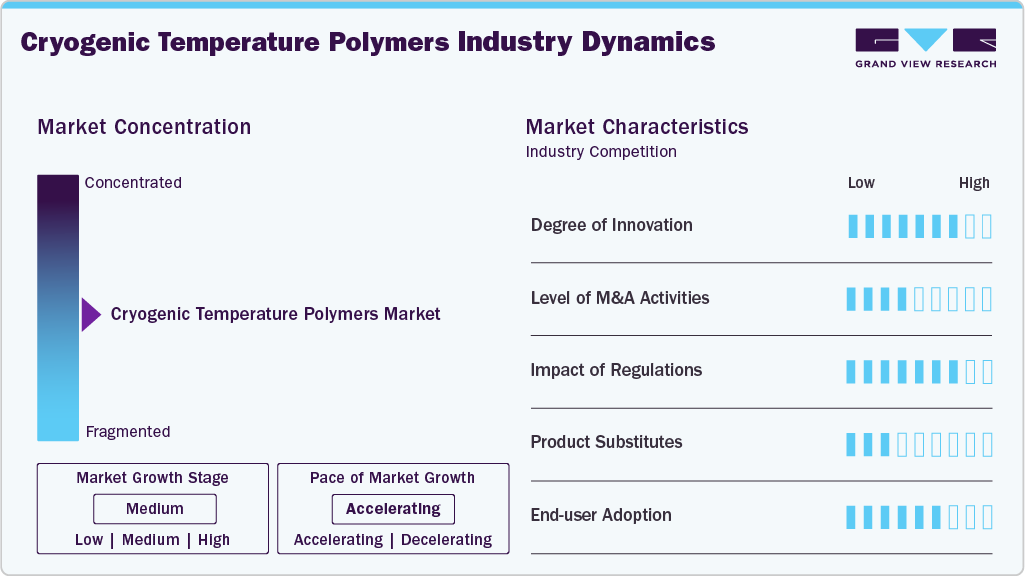
The cryogenic-temperature polymers market is characterized by high material performance requirements and moderate-to-high investment in specialized polymer formulation, processing, and testing capabilities. Demand is increasing for polymers that maintain mechanical strength, dimensional stability, impact resistance, and low-temperature flexibility in cryogenic environments. Manufacturers are focusing on advanced materials such as PTFE, PEEK, UHMWPE, polyimides, and specialized fluoropolymers, while material innovation and customized grades remain important competitive differentiators.
The market is moderately consolidated, with established polymer and specialty-material manufacturers benefiting from strong R&D capabilities, qualified production facilities, and long-term relationships across aerospace, healthcare, energy, semiconductor, and industrial applications. Meanwhile, regional suppliers are gaining opportunities through application-specific formulations and cost-competitive solutions. Prevailing market conditions are also being shaped by increasing demand for LNG infrastructure, space and aerospace systems, cryogenic medical equipment, and semiconductor manufacturing, alongside growing emphasis on material reliability, regulatory compliance, and lifecycle performance.
 To learn more about this report, Download Free Sample Report
Replacement demand is another important market characteristic, as end users increasingly substitute conventional materials that become brittle or lose performance at extremely low temperatures with engineered polymers that offer superior durability, chemical resistance, low friction, and lightweight properties. Growing investments in LNG storage and transportation, hydrogen infrastructure, liquid nitrogen systems, and advanced scientific equipment are expected to further support demand for cryogenic-grade polymers over the forecast period.
Polymer Type Insights
PTFE segment dominated the cryogenic temperature polymers market in 2025, accounting for 38.7% of the revenue share, and is projected to grow at a CAGR of 7.8% from 2026 to 2033, supported by its excellent chemical resistance, low friction, dimensional stability, and reliable performance at extremely low temperatures. Its extensive use in cryogenic valves, seals, gaskets, tubing, insulation components, and fluid-handling systems continues to drive demand across aerospace, healthcare, energy, and industrial applications.
PEEK is expected to witness the fastest growth among major polymer types, registering a CAGR of 8.5% during the forecast period. Its superior mechanical strength, thermal stability, chemical resistance, and lightweight characteristics are increasing adoption in demanding cryogenic applications, particularly aerospace, semiconductor, medical, and advanced industrial equipment. PEEK's revenue is projected to increase owing to the increasing preference for high-performance polymers in critical low-temperature applications.
Application Insights
The seals & gaskets segment dominated the cryogenic temperature polymers market in 2025, accounting for 39.3% of revenue share, driven by its extensive use in cryogenic storage systems, LNG equipment, aerospace systems, healthcare equipment, and industrial machinery. Cryogenic polymer seals and gaskets provide excellent low-temperature flexibility, chemical resistance, leak prevention, and dimensional stability, making them essential for maintaining system integrity under extreme operating conditions. Increasing deployment of cryogenic equipment and the need for reliable sealing solutions are further supporting segment growth.
 To learn more about this report, Download Free Sample Report
The Insulation segment is witnessing the fastest CAGR of 8.3% from 2026 to 2033. Cryogenic polymer insulation materials minimize heat transfer and maintain temperature stability in storage tanks, pipelines, medical systems, LNG facilities, and emerging hydrogen infrastructure. Growing investments in cryogenic energy systems and advanced thermal management technologies are further driving demand for high-performance polymer insulation solutions.
Regional Insights
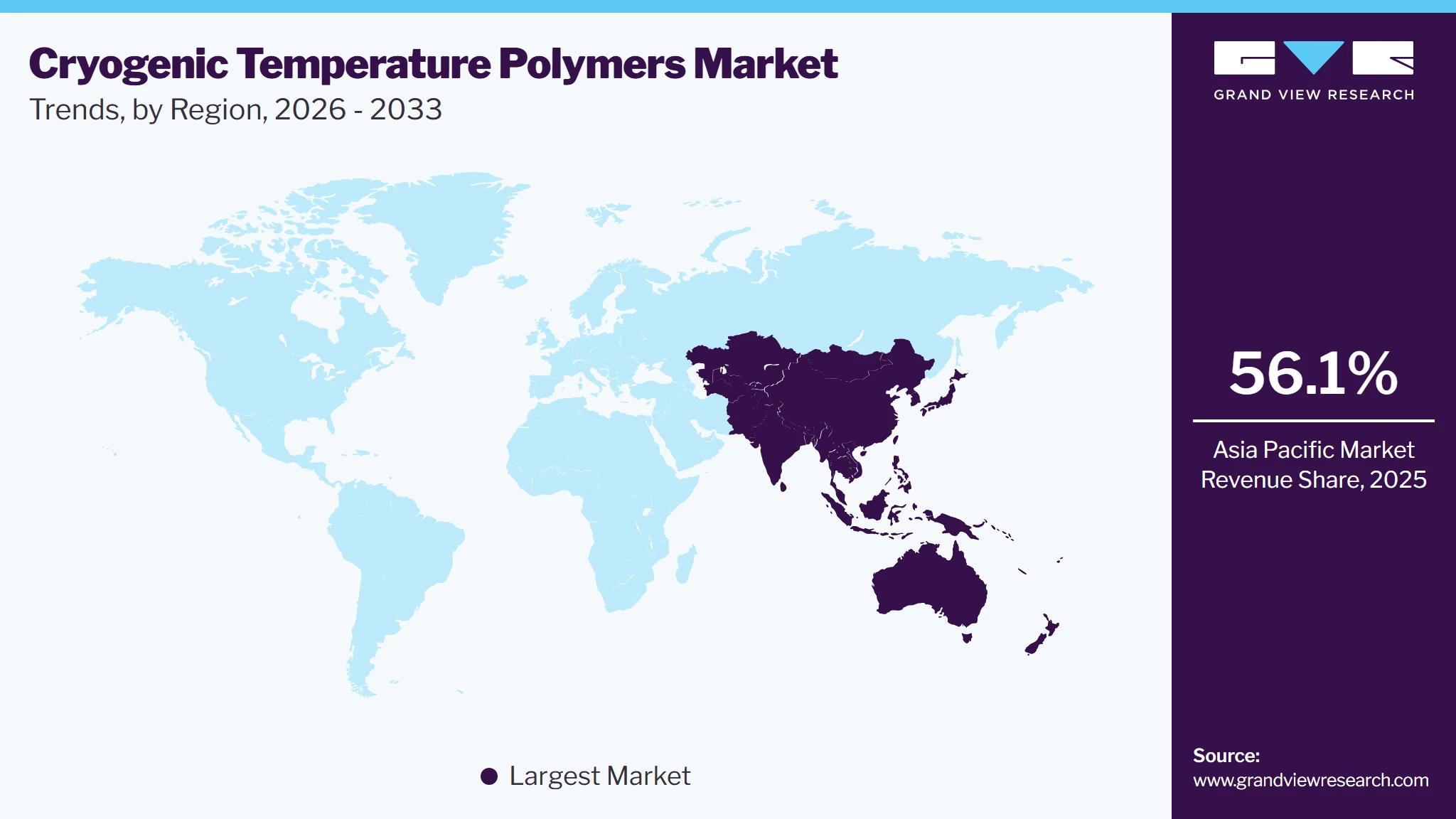
Asia Pacific cryogenic temperature polymers market dominated the global market, with a revenue share of 56.1% in 2025 and is projected to register the fastest regional CAGR of 7.7% from 2026 to 2033. The region’s leadership is driven by rapid industrialization, expanding semiconductor and electronics manufacturing, growing healthcare infrastructure, and increasing investments in LNG, hydrogen, and advanced energy technologies. Rising demand for specialized engineering materials and expanding manufacturing capabilities across emerging economies continue to support regional market dominance.
 To learn more about this report, Download Free Sample Report
The China cryogenic temperature polymers market dominated the Asia Pacific region, supported by its large manufacturing base, expanding semiconductor and electronics industries, and growing investments in energy and industrial infrastructure. Increasing adoption of cryogenic systems across healthcare, aerospace, LNG, and advanced manufacturing applications is expected to sustain the country’s leading position in the regional market.
Cryogenic temperature polymers market in India is expected to register strong growth during the forecast period, supported by expanding industrialization, healthcare infrastructure, semiconductor manufacturing, and energy investments. Growing development of LNG and hydrogen infrastructure, combined with increasing adoption of advanced engineering materials in aerospace and industrial applications, is expected to accelerate demand for cryogenic temperature polymers.
North America Cryogenic Temperature Polymers Market Trends
The North America cryogenic temperature polymers market is expected to witness a strong growth during the forecast period, expanding at a CAGR of 7.4% from 2026 to 2033. Growth is supported by increasing demand for high-performance polymers across aerospace, healthcare, energy, semiconductor, and industrial applications. The region’s established advanced manufacturing base and growing investments in cryogenic storage, LNG infrastructure, and specialized medical equipment are supporting market expansion.
U.S. Cryogenic Temperature Polymers Market Trends
Cryogenic temperature polymers market in the U.S. is expected to grow steadily throughout the forecast period, supported by strong demand from aerospace, healthcare, semiconductor manufacturing, energy, and industrial equipment applications. Increasing investments in LNG, hydrogen technologies, cryogenic storage systems, and advanced materials research are expected to strengthen the adoption of PTFE, PEEK, and other high-performance polymers designed for extreme low-temperature environments.
Europe Cryogenic Temperature Polymers Market Trends
The Europe cryogenic temperature polymers market is projected to experience steady growth during the forecast period, registering a CAGR of 7.1% from 2026 to 2033. Demand is primarily supported by applications in aerospace, healthcare, industrial equipment, energy, and advanced manufacturing, where cryogenic polymers provide low-temperature stability, chemical resistance, and durability. Increasing investments in hydrogen infrastructure, clean energy technologies, and advanced industrial systems are further supporting regional market development.
The Germany cryogenic temperature polymers market accounts for a significant share of the European market due to its well-established automotive, industrial manufacturing, chemical, and engineering sectors. Growing adoption of cryogenic technologies in industrial equipment, energy systems, healthcare, and advanced manufacturing, combined with continued investments in material innovation, is expected to support long-term market growth.
Cryogenic Temperature Polymers market in UK is expected to grow steadily during the forecast period, driven by increasing demand for advanced materials across aerospace, healthcare, energy, and scientific research applications. Growing investments in hydrogen technologies, cryogenic systems, and specialized engineering solutions are expected to encourage the adoption of high-performance polymers with improved low-temperature resistance.
Latin America Cryogenic Temperature Polymers Market Trends
The Latin America cryogenic temperature polymers market is projected to grow steadily during the forecast period, registering a CAGR of 4.9% from 2026 to 2033. Growth is supported by increasing investments in energy, industrial manufacturing, healthcare, and cryogenic storage applications. Expanding infrastructure and rising adoption of high-performance materials are expected to create new opportunities for cryogenic polymer manufacturers across the region.
Middle East and Africa Cryogenic Temperature Polymers Market Trends
The Middle East & Africa cryogenic temperature polymers market is expected to grow at a CAGR of 3.4% from 2026 to 2033. Growth is driven by expanding energy infrastructure, increasing investments in LNG and hydrogen projects, industrial development, and rising demand for specialized materials in extreme operating environments. The development of advanced energy and industrial projects across the region is expected to support the gradual adoption of cryogenic temperature polymers.
Key Cryogenic Temperature Polymers Company Insights
Some key companies in the cryogenic temperature polymers market include Victrex plc., Ensinger, Saint-Gobain, Röchling, DuPont, DAIKIN INDUSTRIES, Ltd., AGC Inc., Mitsubishi Chemical Corporation, Pexco, and Greene Tweed. The market is characterized by continuous innovation in high-performance polymers, advanced fluoropolymer technologies, customized material formulations, and application-specific engineering solutions. Leading manufacturers are focusing on improving low-temperature mechanical performance, chemical resistance, dimensional stability, lightweight properties, and long-term durability. Strategic investments in R&D, advanced processing capabilities, customized components, and partnerships across aerospace, LNG, semiconductor, healthcare, energy, and industrial sectors are further strengthening competitive positions.
-
Victrex plc. is a leading manufacturer of high-performance PEEK-based polymers, offering VICTREX PEEK solutions for demanding applications requiring high mechanical strength, chemical resistance, low friction, and dimensional stability. Its materials are used across aerospace, energy, semiconductor, medical, and industrial applications, supporting the growing demand for lightweight and reliable polymers in extreme-temperature environments.
-
Ensinger is a global engineering plastics manufacturer offering a broad portfolio of PEEK, PTFE, UHMWPE, polyimide, and other high-performance polymers. The company combines material development, machining, and customized component manufacturing capabilities to serve demanding applications across aerospace, medical technology, semiconductor, energy, and industrial sectors, including environments requiring reliable performance at very low temperatures.Worx Flooring Solutions; Swarna Rubber Industries LLP are some of the emerging participants in the Cryogenic Temperature Polymers market.
Key Cryogenic Temperature Polymers Companies
The following key companies have been profiled for this study on the cryogenic temperature polymers market.
-
Victrex plc.
-
Ensinger
-
Saint-Gobain
-
Röchling
-
DuPont
-
DAIKIN INDUSTRIES, Ltd.
-
AGC Inc.
-
Mitsubishi Chemical Corporation
-
Pexco
-
Greene Tweed
Competitive Benchmarking
Category
Operating Strategies
Competitive Edge
Weakness
Established Players (Victrex plc.; Ensinger; Saint-Gobain; Röchling; DuPont; DAIKIN INDUSTRIES, Ltd.; AGC Inc.; Mitsubishi Chemical Corporation)
Focus on R&D, advanced polymer processing, customized formulations, and expanding PEEK, PTFE, polyimide, and other high-performance polymer portfolios for aerospace, semiconductor, healthcare, energy, and industrial applications.
Strong global presence, advanced material expertise, diversified portfolios, established customer relationships, and strong R&D capabilities.
High production and R&D costs, raw material price exposure, and increasing regulatory requirements for certain fluorinated materials.
Specialized Players (Pexco; Greene Tweed)
Focus on customized high-performance polymer components, precision processing, and application-specific solutions for aerospace, semiconductor, energy, medical, and industrial applications.
Strong customization capabilities, technical expertise, flexible production, and specialization in demanding applications.
Smaller scale, narrower geographic reach, and greater dependence on specialized end-use industries and customer qualification cycles.
Recent Developments
-
In April 2026, Daikin Industries, Ltd. announced the construction of a new FFKM production facility at its Kashima Plant in Japan, aimed at expanding supply capacity for high-performance fluorochemical materials used primarily in semiconductor manufacturing. The facility is scheduled for completion in August 2026, with commercial supply expected to begin in 2027. Daikin is targeting more than three times its 2022 FFKM supply capacity to address anticipated semiconductor demand.
-
In May 2026, AGC Inc. completed third-party UL 2809 verification for the fluorine raw materials used in its AFLAS FFKM products, confirming that 100% of the allocated fluorine content can be attributed to recycled circular fluorite under the mass-balance approach. The development strengthens AGC's focus on circular fluorine resources while supporting high-performance FFKM applications, particularly in semiconductor manufacturing.
Cryogenic Temperature Polymers Market Report Scope
Report Attribute
Details
Market size in 2025
USD 3.2 billion
Estimated market size in 2026
USD 3.4 billion
Projected market size by 2033
USD 5.5 billion
Growth rate
CAGR of 7.3% from 2026 to 2033
Base year of estimation
2025
Historical data
2021 - 2024
Forecast period
2026 - 2033
Quantitative units
Revenue in USD billion, volume in kilotons, and CAGR from 2026 to 2033
Report coverage
Revenue & volume forecast, competitive landscape, growth factors, and trends
Segments covered
Polymer type, application, and region
Regional scope
North America; Europe; Asia Pacific; Latin America; Middle East & Africa
Country Scope
U.S.; Canada; Mexico; Europe; Germany; UK; France; Italy; Spain; China; India; Japan; South Korea; Australia; Brazil; Argentina; Saudi Arabia; UAE; South Africa
Key companies profiled
Victrex plc.; Ensinger; Saint-Gobain; Röchling; DuPont; DAIKIN INDUSTRIES Ltd.; AGC Inc.; Mitsubishi Chemical Corporation; Pexco; Greene Tweed
Customization scope
Free report customization (equivalent to up to 8 analyst working days) with purchase. Addition or alteration to country, regional & segment scope
Pricing and purchase options
Avail customized purchase options to meet your exact research needs. Explore purchase options
Global Cryogenic Temperature Polymers Market Report Segmentation
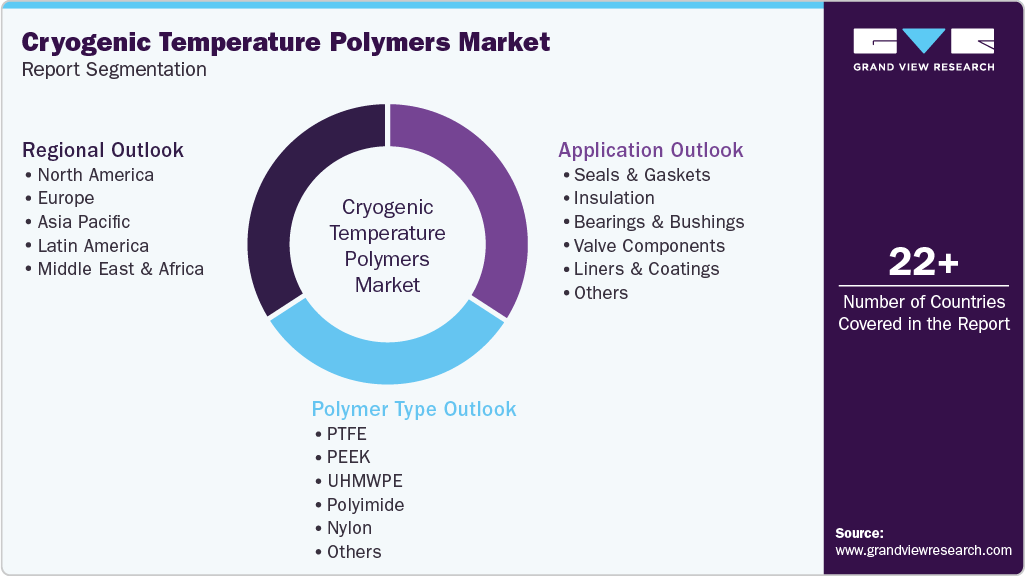
This report forecasts revenue growth at the global, regional, and country levels and provides an analysis of the latest industry trends across sub-segments from 2021 to 2033. For this study, Grand View Research has segmented the global cryogenic temperature polymers market report based on polymer type, application, and region:
 To learn more about this report, Download Free Sample Report
-
Polymer Type Outlook (Volume, Kilotons; Revenue, USD Billion, 2021 - 2033)
-
PTFE
-
PEEK
-
UHMWPE
-
Polyimide
-
Nylon
-
Others
-
-
Application Outlook (Volume, Kilotons; Revenue, USD Billion, 2021 - 2033)
-
Seals & Gaskets
-
Insulation
-
Bearings & Bushings
-
Valve Components
-
Liners & Coatings
-
Others
-
-
Regional Outlook (Volume, Kilotons; Revenue, USD Billion, 2021 - 2033)
-
North America
-
U.S.
-
Canada
-
Mexico
-
-
Europe
-
Germany
-
UK
-
France
-
Italy
-
Spain
-
-
Asia Pacific
-
China
-
India
-
Japan
-
South Korea
-
Australia
-
-
Latin America
-
Brazil
-
Argentina
-
-
Middle East & Africa
-
Saudi Arabia
-
UAE
-
South Africa
-
-
Research Methodology
The cryogenic temperature polymers market figures in this report are based on a proven research process that combines executive interviews with secondary research from proprietary databases, company filings, and recognized regulatory and institutional sources. Market size is built through value-chain sizing-reconciling supply-side and demand-side estimates-and triangulated with bottom-up and top-down approaches. Every estimate passes multiple levels of expert validation before publication, with each cryogenic temperature polymers segment quantified using the revenue-capture definitions in the table below.
Segment Definition
Polymer Type
Revenue capture definition
PTFE
Revenue generated from the sale of polytetrafluoroethylene (PTFE) polymers used in cryogenic applications requiring excellent low-temperature stability, chemical resistance, low friction, and dimensional stability. Includes PTFE supplied for seals, gaskets, insulation components, liners, coatings, bearings, and other cryogenic equipment used across healthcare, aerospace, energy, semiconductor, and industrial applications.
PEEK
Revenue generated from the sale of polyether ether ketone (PEEK) polymers used in high-performance cryogenic components requiring high mechanical strength, wear resistance, chemical resistance, and dimensional stability under extreme temperatures. Includes PEEK supplied for seals, bearings, bushings, valve components, insulation systems, and specialized aerospace, medical, energy, and industrial applications.
UHMWPE
Revenue generated from the sale of ultra-high-molecular-weight polyethylene (UHMWPE) polymers used in cryogenic applications requiring high impact strength, abrasion resistance, low friction, and durability at low temperatures. Includes UHMWPE supplied for bearings, bushings, liners, wear components, seals, and other specialized cryogenic equipment and industrial applications.
Polyimide
Revenue generated from the sale of polyimide polymers used in cryogenic and extreme-temperature applications requiring thermal stability, mechanical strength, chemical resistance, and electrical insulation. Includes polyimide materials supplied for insulation components, seals, coatings, electrical components, aerospace systems, electronics, and other advanced industrial applications.
Nylon
Revenue generated from the sale of nylon polymers used in cryogenic applications requiring mechanical strength, impact resistance, wear resistance, and durability under low-temperature conditions. Includes nylon supplied for bearings, bushings, seals, insulation components, liners, and other industrial, automotive, aerospace, and equipment applications.
Others
Revenue generated from the sale of other cryogenic temperature polymers, including specialized engineering polymers and polymer formulations used in applications requiring low-temperature resistance, chemical stability, thermal performance, and mechanical durability. Includes materials supplied for seals, gaskets, insulation, coatings, bearings, liners, and other specialized cryogenic applications.
Application
Revenue capture definition
Seals & Gaskets
Revenue generated from the sale of cryogenic temperature polymers used in seals and gaskets to provide leak prevention, low-temperature flexibility, chemical resistance, and dimensional stability in cryogenic systems. Includes polymer components used in LNG equipment, storage tanks, pipelines, valves, pumps, aerospace systems, and medical cryogenic equipment.
Insulation
Revenue generated from the sale of cryogenic temperature polymers used for thermal insulation and temperature management in low-temperature systems. Includes polymer-based insulation materials used in cryogenic storage tanks, pipelines, LNG facilities, hydrogen systems, medical equipment, and energy infrastructure to minimize heat transfer and maintain temperature stability.
Bearings & Bushings
Revenue generated from the sale of cryogenic temperature polymers used in bearings and bushings requiring low friction, wear resistance, dimensional stability, and reliable performance at extremely low temperatures. Includes polymer components used in pumps, valves, aerospace equipment, industrial machinery, and cryogenic handling systems.
Valve Components
Revenue generated from the sale of cryogenic temperature polymers used in valve components such as seats, seals, liners, and other internal parts designed to withstand extreme low temperatures, pressure variations, and chemical exposure. Includes polymer components used in LNG, hydrogen, industrial gas, energy, and cryogenic processing systems.
Liners & Coatings
Revenue generated from the sale of cryogenic temperature polymers used as protective liners and coatings to provide chemical resistance, wear resistance, low friction, and surface protection in cryogenic environments. Includes polymer-based liners and coatings used in tanks, pipes, vessels, machinery, and specialized industrial equipment.
Others
Revenue generated from the sale of cryogenic temperature polymers used in other specialized applications, including electrical components, tubing, diaphragms, structural components, protective parts, and customized cryogenic equipment requiring low-temperature stability and durability.
Estimation Model
Layer No.
Layer Name
Key Question
Description
01
End-use Industry Layer
What drives demand?
Estimate demand from key industries including aerospace, healthcare, energy, semiconductor manufacturing, electronics, automotive, and industrial equipment that utilize cryogenic temperature polymers.
02
Application Adoption Layer
Where are cryogenic polymers used?
Assess adoption of cryogenic temperature polymers across major applications based on performance requirements such as low-temperature stability, thermal insulation, chemical resistance, wear resistance, and mechanical durability.
03
Polymer Consumption Layer
Which polymers generate demand?
Evaluate consumption of PTFE, PEEK, UHMWPE, polyimide, nylon, and other specialized polymers across seals & gaskets, insulation, bearings & bushings, valve components, liners & coatings, and other cryogenic applications.
04
Revenue Layer
How is revenue generated?
Revenue is generated through the sale of cryogenic temperature polymers used in seals & gaskets, insulation systems, bearings & bushings, valve components, liners & coatings, and other specialized cryogenic applications.
Delivered Customizations
This report has been delivered with the following In-depth customizations
Client Request
Customization Delivered
Value Adds
Cross-Segmentation Analysis
Comprehensive analysis of the Cryogenic Temperature Polymers market across polymer type, application, and region, covering PTFE, PEEK, UHMWPE, Polyimide, Nylon, and other polymers across Seals & Gaskets, Insulation, Bearings & Bushings, Valve Components, Liners & Coatings, and other applications.
Helps clients identify high-growth polymer-application combinations, prioritize target markets, and optimize product portfolios.
Competitive Benchmarking
Detailed benchmarking of key market participants based on product portfolio, technological capabilities, production capacity, geographic presence, R&D investments, and strategic developments.
Enables clients to assess competitive positioning, identify market gaps, benchmark capabilities, and develop effective expansion strategies.
Pricing Analysis
Assessment of pricing trends across major cryogenic polymer types, considering raw material costs, processing requirements, performance characteristics, supply-demand dynamics, and regional variations.
Supports pricing strategy development, procurement planning, margin management, and supplier negotiations.
Frequently Asked Questions About This Report
Growing demand for cryogenic temperature polymers across healthcare, aerospace, electronics, energy, automotive, and industrial applications is supporting market growth.
Key market players include Victrex plc., Ensinger, Saint-Gobain, Röchling, DuPont, DAIKIN INDUSTRIES, Ltd., AGC Inc., Mitsubishi Chemical Corporation, Pexco, and Greene Tweed.
The increasing demand for high-performance polymers across critical cryogenic applications is a major driver for the cryogenic temperature polymers market. Industries such as aerospace, healthcare, energy, semiconductor manufacturing, and industrial equipment require materials that can maintain mechanical strength, dimensional stability, chemical resistance, and durability under extremely low temperatures.
The growing development of LNG, hydrogen, cryogenic energy storage, semiconductor manufacturing, and medical cryogenic technologies presents significant opportunities for the Cryogenic Temperature Polymers market.
The Seals & Gaskets segment dominated the cryogenic temperature polymers market in 2025, accounting for 39.3% of revenue share, driven by its extensive use in cryogenic storage systems, LNG equipment, aerospace systems, healthcare equipment, and industrial machinery.
The global cryogenic temperature polymers market size was valued at USD 3.2 billion in 2025 and is estimated at USD 3.4 billion for 2026.
The global cryogenic temperature polymers market is expected to grow at a CAGR of 7.3% from 2026 to 2033, reaching USD 5.5 billion by 2033.
PTFE dominated the cryogenic temperature polymers market in 2025, accounting for 38.7% of the revenue share, and is projected to grow at a CAGR of 7.8% from 2026 to 2033, supported by its excellent chemical resistance, low friction, dimensional stability, and reliable performance at extremely low temperatures.
Asia Pacific dominated the global cryogenic temperature polymers market with a revenue share of 56.1% in 2025 and is projected to register the fastest regional CAGR of 7.7% from 2026 to 2033.
About the Author(s)
Plastics Polymers & Resins Research Team
Industry · Plastics Polymers & ResinsThis report was authored by the plastics polymers & resins research team at Grand View Research - comprising two research analysts, one senior research analyst, and one industry expert - with specialized expertise in the plastics polymers & resins segment of the industry industry. All findings are based on proprietary industry databases, executive interviews, and regulatory analysis, subject to internal peer review prior to publication.
Last Updated:
Speak to Analyst

Customize this report to your needs - add regions, segments, or data points, with 20% free customization.
Or view our licence options:


ISO 9001:2015 & 27001:2022 Certified
We are GDPR and CCPA compliant! Your transaction & personal information is safe and secure. For more details, please read our privacy policy.


