
- Home
- »
- Plastics, Polymers & Resins
- »
-
Polyimide Market Size, Growth Report, 2026-2033GVR Report cover

Polyimide Market (2026 - 2033)
Size, Share & Trends Analysis Report By Type (Polyimide Resin, Polyimide Film), By Application (Medical, Energy & Power), By Region (North America, Europe, Asia Pacific, Central & South America, Middle East & Africa), And Segment Forecasts
Market Size, 2025
$1.2BMarket Estimate, 2026
$1.3BMarket Forecast, 2033
$2.5BCAGR, 2026–2033
9.8%Polyimide Market Summary
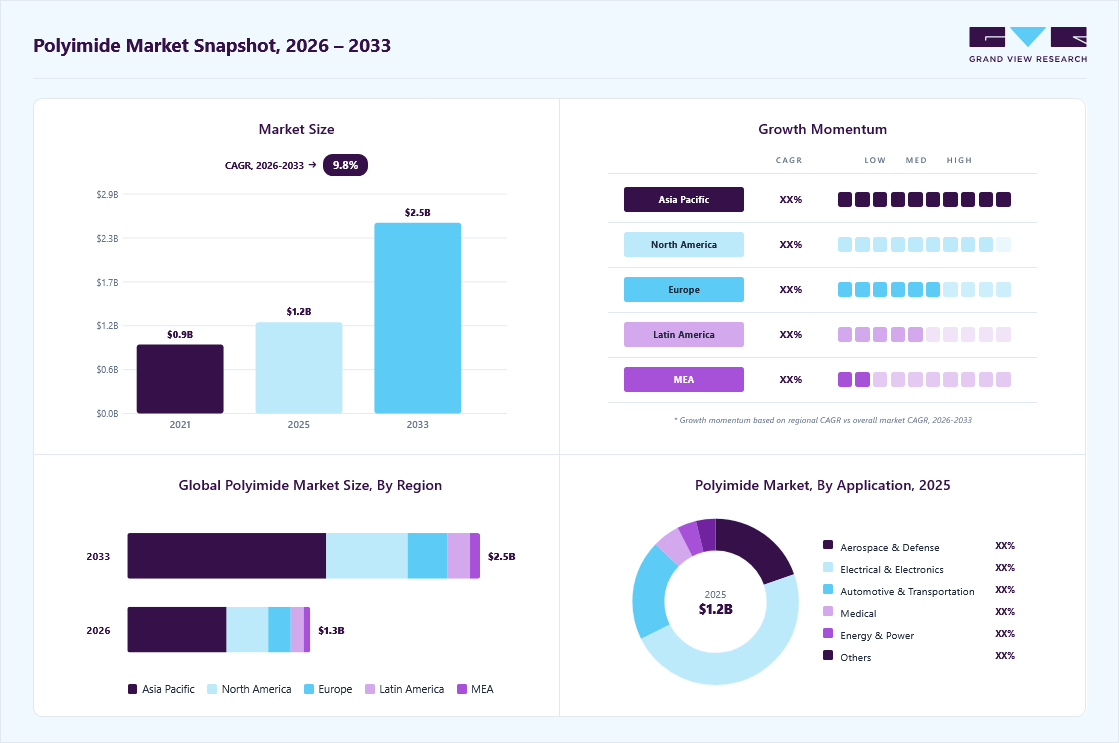
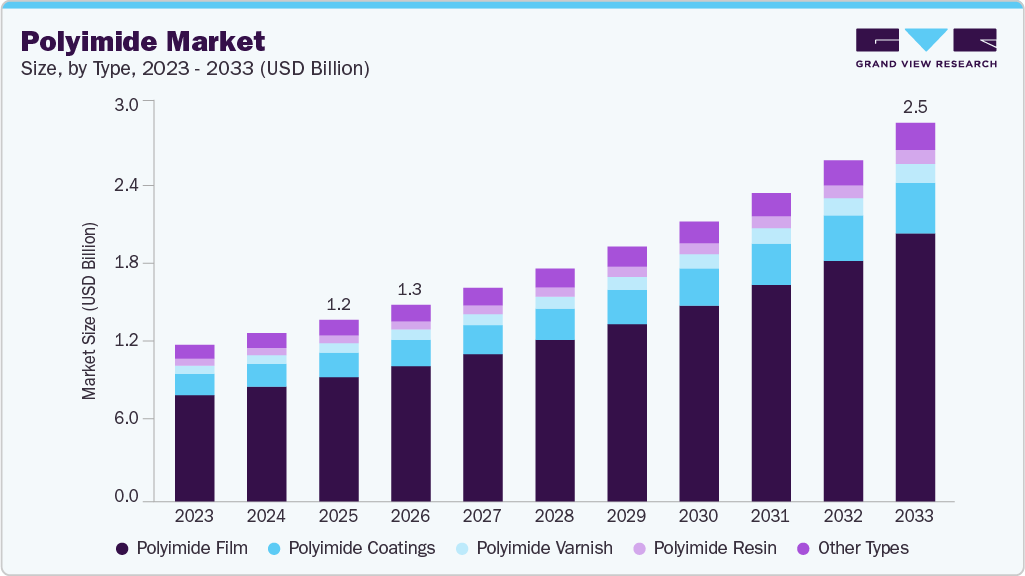
The global polyimide market size was valued at USD 1.2 billion in 2025 and is projected to grow from USD 1.3 billion in 2026 to USD 2.5 billion by 2033, at a CAGR of 9.8% from 2026 to 2033. Asia Pacific dominated the global market, accounting for the largest revenue share of 54.0% in 2025. The rising demand for lightweight and high-performance materials in the electronics and aerospace industries is a significant driver of the global market.
 Source: Grand View Research, IR Documents, Primary Interviews, Paid DatabasesTo learn more about this report,
 Download Free Sample Report
 Key Market Trends & Insights
- By type: Polyimide film segment recorded the largest market revenue share of 68.5% in 2025.
- By application: Automotive & transportation segment is expected to grow at a fastest CAGR of 10.2% from 2026 to 2033 in terms of revenue.
Regional Highlights
- Largest regional market: Asia Pacific (54.0% revenue share, 2025)
- By country: The China polyimide industry is a major contributor to the global market.
Market Size & Forecast
- Market size in 2025: USD 1.2 Billion
- Estimated market size in 2026: USD 1.3 Billion
- Projected market size by 2033: USD 2.5 Billion
- CAGR (2026-2033): 9.8%
Three ways to get this report
Buy it, customize it, or ask a question.Ask an Analyst
Analyst response in 1 business day
- AccessReport author, directly
- Reply timeWithin 1 working day
- No sales callDirect answer only
- FormatEmail reply
- CostFree, no cost
Get the Full Report
What the study covers
- FormatsPDF · Excel · Dashboard
- Timeline2026–2033 annual, 2025 base
- Coverage20+ countries, 5 regions
- Companies10+ key players profiled
Customize the Report
20% free customization
- IncludeCountries, segments, points
- TailorTo your product definition
- ExtendDeeper competitor detail
- OrA fully bespoke study
- Turnaround5–10 working days
Polyimides exhibit excellent thermal stability, mechanical strength, and chemical resistance, making them ideal for applications in flexible printed circuit boards (FPCBs), semiconductor manufacturing, and aerospace components. The increasing miniaturization of electronic devices, such as smartphones, laptops, and wearables, has led to a higher demand for flexible and durable materials. In aerospace, polyimide composites replace traditional metal components in aircraft interiors and structural parts due to their lightweight nature, which contributes to improved fuel efficiency.
 To learn more about this report, Download Free Sample Report
 Drivers, Opportunities & Restraints
The market for polyimide resin is mainly driven by the increasing demand for high-performance materials in sectors like aerospace, automotive, and electronics, where excellent thermal stability, mechanical strength, and chemical resistance are essential. In the electrical and electronics industry, polyimides are commonly used in flexible printed circuits, insulation films, and semiconductor applications because of their superior dielectric properties and ability to endure high temperatures. Furthermore, the rapid miniaturization of electronic devices and the growth of advanced technologies such as 5G infrastructure and electric vehicles are boosting the use of polyimide-based components. In aerospace and defense, the need for lightweight materials that can withstand high temperatures also supports market growth, while the shift toward high-performance polymers in industrial applications continues to fuel demand.
There are significant growth opportunities in emerging sectors like electric mobility, advanced semiconductor packaging, and next-generation flexible electronics. The increasing adoption of electric vehicles is driving higher demand for polyimide resins used in applications such as battery insulation, wire coatings, and thermal management systems. In addition, ongoing progress in electronics manufacturing, including flexible displays and wearable technology, is broadening potential applications for polyimide films and coatings. New opportunities are also arising in the Asia-Pacific region, especially in countries with strong electronics manufacturing sectors, where rising investments in local semiconductor production and high-performance materials are expected to boost consumption. Furthermore, innovations in bio-based and cost-effective polyimide formulations open possibilities for greater adoption in price-sensitive markets.
While polyimide resin exhibits impressive performance features, the market encounters obstacles due to high manufacturing costs and complex processing requirements. Manufacturing polyimides requires costly raw materials and involves several production steps, resulting in higher costs compared to traditional engineering plastics, which may limit their use in budget-conscious applications. In addition, processing issues such as high curing temperatures and reduced ease of fabrication can make operations more difficult for users. Variations in the availability of raw materials, especially for certain monomers, further contribute to price fluctuations. Furthermore, competition from other high-performance polymers like PEEK and PPS in specific applications might hinder market growth, particularly when cost efficiency is a priority.
Market Concentration & Characteristics
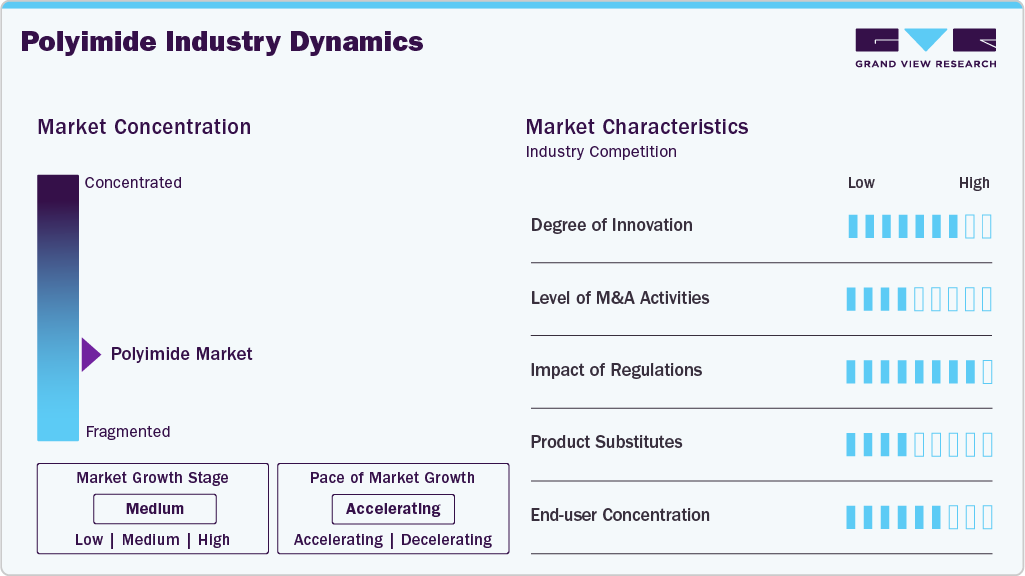
The polyimide resin sector demonstrates significant innovation, driven by ongoing research and development focused on enhancing thermal performance, processability, and compatibility with advanced electronics and semiconductor applications. Major companies are investing resources into developing next-generation formulations, such as low-temperature curable and optically clear polyimides designed for flexible displays and advanced packaging. Mergers and acquisitions activity remains steady, involving targeted purchases, joint ventures, and strategic alliances aimed at boosting technological capabilities and expanding regional presence, especially in the Asia-Pacific region and within the semiconductor supply chain.
Regulatory guidelines concerning environmental protection, chemical handling, and emissions have a moderate effect on the polyimide industry, especially in regions with tight compliance rules like Europe and North America. Although polyimides are known for their exceptional durability and long lifespan, regulations on solvent use and processing chemicals can affect manufacturing methods. Furthermore, the presence of high-performance alternatives such as PEEK, PPS, and PEI creates competitive hurdles, particularly in price-sensitive markets where slightly less efficient materials might be seen as more cost-effective.
 To learn more about this report, Download Free Sample Report
 The polyimide industry features a concentrated group of end users, primarily driven by demand in the electrical & electronics, aerospace, and automotive industries. Specifically, the electronics sector dominates a large share of the market due to its extensive use in semiconductors, flexible circuits, and insulation systems. However, the gradual expansion into industrial, medical, and energy sectors is broadening the end-user base, although the need for high-performance standards still limits widespread adoption in fragmented, low-cost industries.
Type Insights
The polyimide film segment recorded the largest market revenue share of 68.5% in 2025 and is projected to grow at the fastest CAGR of 10.3% during the forecast period. Polyimide resins are high-performance polymers known for their excellent thermal stability, chemical resistance, and mechanical strength. These resins are widely used in high-temperature applications, including aerospace components, electronics, and automotive parts. Due to their exceptional heat resistance, they are commonly used in advanced composites and adhesives.
Polyimide coatings offer excellent protection against extreme temperatures, chemical exposure, and mechanical wear. These coatings are applied to metal, plastic, and electronic components to enhance durability and performance in harsh environments. They are extensively used in aerospace, industrial machinery, and medical devices. In addition, the growing demand for corrosion-resistant coatings in industrial machinery and the rising use of polyimide coatings in medical applications, such as catheters and surgical instruments, are further supporting market growth.
Application Insights
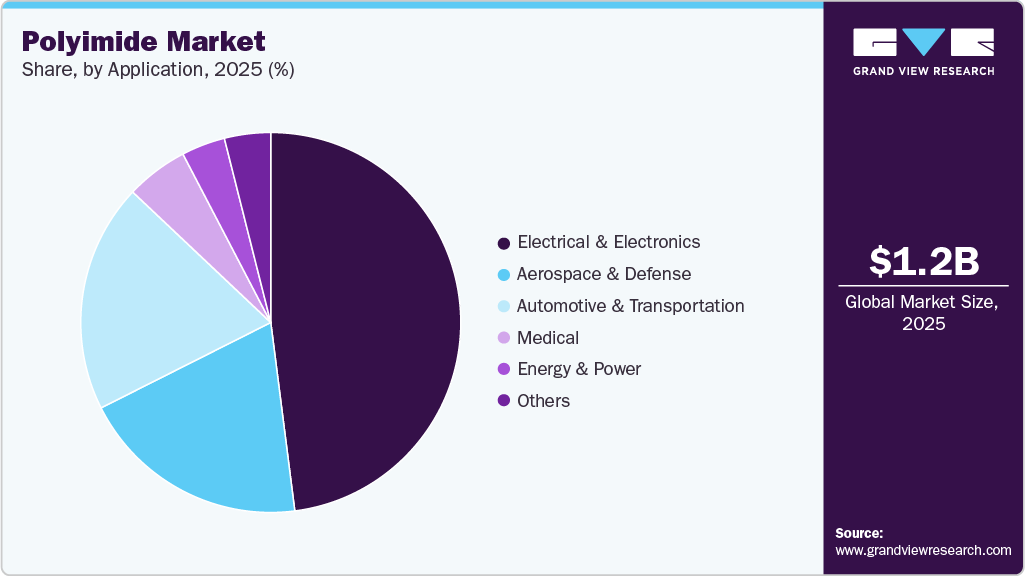
The electrical & electronics segment recorded the largest market share of 48.0% in 2025. Polyimides play a crucial role in the electrical & electronics sector, where they are used in flexible printed circuit boards (PCBs), semiconductors, wire insulation, and displays. Their excellent dielectric properties, high-temperature resistance, and flexibility make them ideal for microelectronic and consumer electronics applications. The growing adoption of 5G technology, IoT devices, and wearable electronics further supports the increasing usage of polyimides in this industry.
 To learn more about this report, Download Free Sample Report
 The automotive & transportation segment is projected to grow at the fastest CAGR of 10.2% during the forecast period. In the automotive & transportation industry, polyimides are used in components such as bearings, seals, gaskets, and electrical insulation for wiring systems. Their high mechanical strength, resistance to wear, and excellent thermal stability make them suitable for demanding automotive applications, including electric vehicles (EVs) and hybrid systems. The shift toward electric and autonomous vehicles is a major driver, as polyimides are essential in EV battery insulation and electronic control units.
The aerospace & defense sector is a key consumer of polyimides due to their exceptional thermal stability, lightweight nature, and resistance to harsh environmental conditions. Polyimide composites, coatings, and films are widely used in aircraft interiors, jet engine components, and insulation materials for spacecraft and satellites. The material’s ability to withstand extreme temperatures and its flame-retardant properties make it ideal for applications in high-performance military and commercial aviation.
Regional Insights
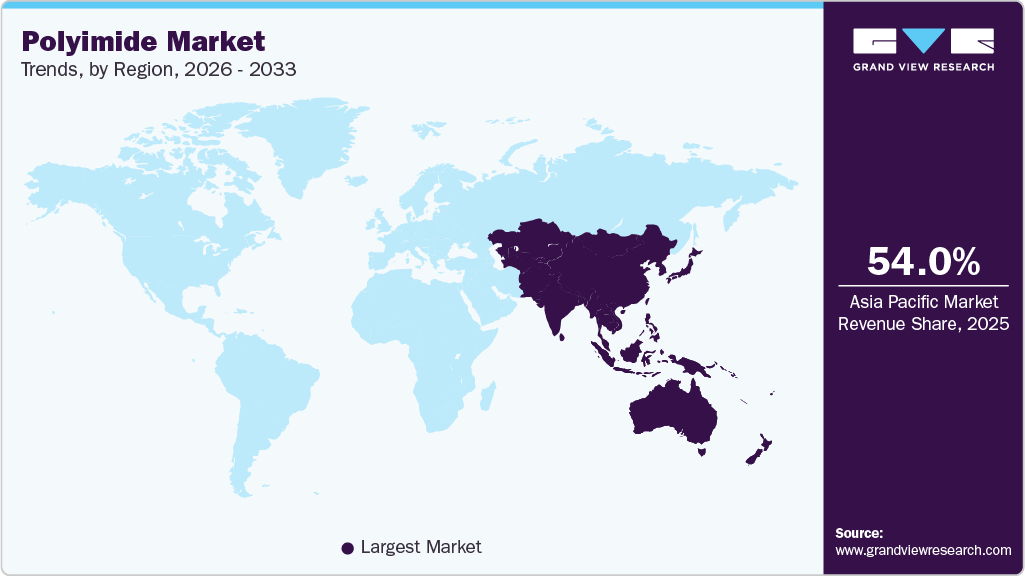
Asia Pacific dominated the market and accounted for the largest revenue share of 54.0% in 2025 and is anticipated to grow at the fastest CAGR of 10.4% over the forecast period. This positive outlook is due to its robust manufacturing base, especially in the electronics and semiconductor industries. Countries such as China, Japan, South Korea, and Taiwan have established themselves as manufacturing powerhouses for electronic components, smartphones, and computers, all of which require polyimide films, resins, and coatings.
 To learn more about this report, Download Free Sample Report
 China Polyimide Market Trends
The polyimide market in China is experiencing robust growth primarily due to its robust electronics manufacturing ecosystem. As the world's largest producer of electronics and electrical equipment, China requires substantial volumes of polyimide materials, which are essential for high-performance insulation in circuit boards, flexible displays, and semiconductor packaging. The country's massive production capacity in these sectors creates unparalleled demand for polyimide films, resins, and composites. The Chinese government's strategic focus on high-technology industries has further accelerated this dominance.
North America Polyimide Market Trends
The polyimide industry in North America is growing due to its robust aerospace and defense sectors, which are primary consumers of these high-performance polymers. The U.S. houses major aerospace manufacturers such as Boeing, Lockheed Martin, and Northrop Grumman, all of which utilize polyimide components in aircraft construction, satellite systems, and military applications due to the material's exceptional thermal stability and mechanical strength.
The U.S. polyimide market growth is majorly driven by its well-established semiconductor and microelectronics sector, where polyimides are crucial components. Companies such as Intel, Micron, and Texas Instruments utilize polyimide films as insulating layers in chips, flexible printed circuit boards, and other electronic components. The continuous miniaturization trend in electronics has increased the demand for high-quality polyimide materials that can withstand the thermal and mechanical stresses of modern manufacturing processes.
Europe Polyimide Market Trends
The polyimide industry in Europe is expected to grow significantly, primarily due to its robust aerospace and automotive industries. European aerospace giants such as Airbus utilize polyimide films in aircraft components, while premium automotive manufacturers such as BMW and Mercedes-Benz incorporate polyimide-based parts in their engine components and electronic systems. In addition, Europe's advanced electronics and semiconductor industries contribute substantially to polyimide demand.
Germany polyimide marketis primarily driven by its robust automotive and aerospace industries. German engineering firms such as BMW, Mercedes-Benz, and Airbus have integrated polyimide components into their designs for applications requiring resistance to extreme temperatures and harsh operating conditions. This industrial demand has catalyzed significant investment in polyimide research and production facilities throughout the country, thus driving market growth.
Key Polyimide Company Insights
The global market is characterized by intense competition among established multinational companies, each leveraging significant R&D capabilities to enhance product performance and innovation. These companies invest heavily in developing polyimides with superior thermal stability, mechanical strength, and chemical resistance to meet the stringent demands of sectors such as aerospace, electronics, automotive, and industrial manufacturing. Market players pursue strategic partnerships, mergers, acquisitions, and geographic expansions to secure a competitive edge, while also adapting to evolving regulatory standards and a growing emphasis on sustainable manufacturing practices. This competitive drive, combined with rapid technological advancements and diversified applications, creates a dynamic and challenging market environment.
-
In August 2025, Asahi Kasei announced the expansion of its production capacity of PIMEL photosensitive polyimide (PSPI) at its facility located in Fuji City, Shizuoka Prefecture, Japan. PSPI serves as an essential material for the global electronics sector, primarily utilized for buffer coatings and passivation layers in semiconductor applications. By increasing its capacity twofold by 2030, Asahi Kasei emphasizes its dedication to growing its electronics division and solidifying its role as a vital supplier for the worldwide semiconductor market.
-
In November 2024, PI Advanced Materials announced the development of a 4-micrometer-thick, casting ultra-thin polyimide (PI) film. This new film was intended for use on smartphones, tablets, and wearables. The company claims the film is expected to improve the slimness, heat resistance, and durability of these devices.
Key Polyimide Companies:
The following key companies have been profiled for this study on the polyimide market.
- DuPont de Nemours, Inc.
- SABIC
- Ube Industries Ltd.
- Kaneka Corporation
- Taimide Tech. Inc.
- PI Advanced Materials Co., Ltd.
- Mitsui Chemicals
- MITSUBISHI GAS CHEMICAL COMPANY, INC.
- Asahi Kasei Corporation
- Huangshan Juxin New Material Co., Ltd.
Polyimide Market Report Scope
Report Attribute
Details
Market size in 2025
USD 1.2 Billion
Estimated market size in 2026
USD 1.3 billion
Projected market size by 2033
USD 2.5 billion
Growth rate
CAGR of 9.8% from 2026 to 2033
Historical data
2021 - 2025
Forecast period
2026 - 2033
Quantitative units
Revenue in USD million/billion, volume in tons, and CAGR from 2026 to 2033
Report coverage
Revenue forecast, volume forecast, competitive landscape, growth factors, and trends
Segments covered
Type, application, region
Regional scope
North America; Europe; Asia Pacific; CSA; MEA
Country scope
U.S.; Canada; Mexico; Germany; France; UK; Italy; Spain; China; India; Japan; South Korea; Australia; Brazil; Argentina; South Africa; Saudi Arabia; UAE
Key companies profiled
DuPont de Nemours, Inc.; SABIC; Ube Industries Ltd.; Kaneka Corporation; Taimide Tech. Inc.; PI Advanced Materials Co., Ltd.; Mitsui Chemicals; MITSUBISHI GAS CHEMICAL COMPANY, INC.; Asahi Kasei Corporation; Huangshan Juxin New Material Co., Ltd.
Customization scope
Free report customization (equivalent to 8 analyst’s working days) with purchase. Addition or alteration to country, regional, and segment scope.
Pricing and purchase options
Avail customized purchase options to meet your exact research needs. Explore purchase options
Global Polyimide Market Report Segmentation
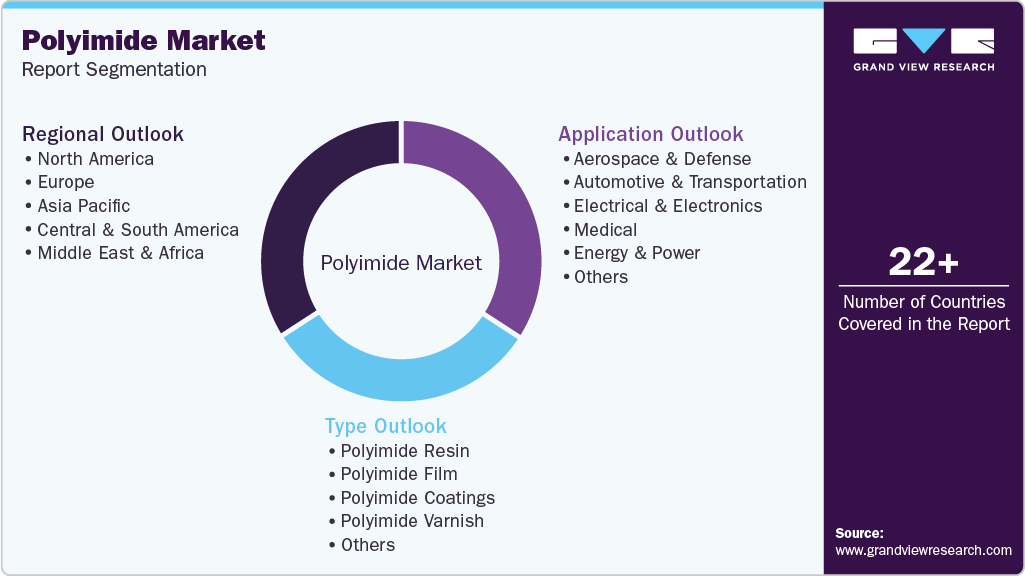
This report forecasts revenue growth at a global level and provides an analysis of the latest industry trends in each of the sub-segments from 2021 to 2033. For this study, Grand View Research has segmented the global polyimide market report based on type, application, and region:
 To learn more about this report, Download Free Sample Report
 -
Type Outlook (Revenue, USD Million; Volume, Tons, 2021 - 2033)
-
Polyimide Resin
-
Polyimide Film
-
Polyimide Coatings
-
Polyimide Varnish
-
Others
-
-
Application Outlook (Revenue, USD Million; Volume, Tons, 2021 - 2033)
-
Aerospace & Defense
-
Automotive & Transportation
-
Electrical & Electronics
-
Medical
-
Energy & Power
-
Others
-
-
Region Outlook (Revenue, USD Million; Volume, Tons, 2021 - 2033)
-
North America
-
U.S.
-
Canada
-
Mexico
-
-
Europe
-
Germany
-
France
-
UK
-
Italy
-
Spain
-
-
Asia Pacific
-
China
-
India
-
Japan
-
South Korea
-
Australia
-
-
Central & South America
-
Brazil
-
Argentina
-
-
Middle East & Africa
-
South Africa
-
Saudi Arabia
-
UAE
-
-
Frequently Asked Questions About This Report
The global polyimide market size was valued at USD 1.2 billion in 2025 and is estimated at USD 1.3 billion for 2026.
Electrical & electronics emerged as the dominant application in the polyimide market, capturing 48.0% of the market share in 2025, primarily due to the material’s exceptional thermal stability, electrical insulation properties, and mechanical strength.
The polyimide market is driven by increasing demand for high-performance materials in aerospace, electronics, and automotive industries due to its superior thermal stability, chemical resistance, and mechanical strength. Additionally, the rising adoption of flexible electronics and miniaturized devices boosts market growth.
The global polyimide market is expected to grow at a CAGR of 9.8% from 2026 to 2033, reaching USD 2.5 billion by 2033.
Asia Pacific dominated with a 54.0% revenue share in 2025.
The polyimide film segment led with a 68.5% revenue share in 2025, and is the fastest-growing type.
Key players include DuPont de Nemours, Inc.; SABIC; Ube Industries Ltd.; Kaneka Corporation; Taimide Tech. Inc.; PI Advanced Materials Co., Ltd.; Mitsui Chemicals; MITSUBISHI GAS CHEMICAL COMPANY, INC.; Asahi Kasei Corporation; Huangshan Juxin New Material Co., Ltd.
About the Author(s)
Plastics, Polymers & Resins Research Team
Bulk Chemicals · Plastics, Polymers & ResinsThis report was authored by the plastics, polymers & resins research team at Grand View Research - comprising two research analysts, one senior research analyst, and one industry expert - with specialized expertise in the plastics, polymers & resins segment of the bulk chemicals industry. All findings are based on proprietary bulk chemicals databases, executive interviews, and regulatory analysis, subject to internal peer review prior to publication.
Last Updated:
Speak to Analyst

Customize this report to your needs - add regions, segments, or data points, with 20% free customization.
Or view our licence options:


ISO 9001:2015 & 27001:2022 Certified
We are GDPR and CCPA compliant! Your transaction & personal information is safe and secure. For more details, please read our privacy policy.


