
- Home
- »
- Plastics, Polymers & Resins
- »
-
Cultured Meat Packaging Market Size, Share Report, 2033GVR Report cover

Cultured Meat Packaging Market (2026 - 2033)
Size, Share & Trends Analysis Report By Material (Plastic, Paper & Paperboard, Bioplastics, Glass, Metal), By Cultivated Meat Type (Poultry, Beef, Seafood), By Packaging Format, By Packaging Technology, By Region, And Segment Forecasts
Market Size, 2025
$377.4MMarket Estimate, 2026
$410.9MMarket Forecast, 2033
$789.6MCAGR, 2026–2033
9.8%Cultured Meat Packaging Market Summary
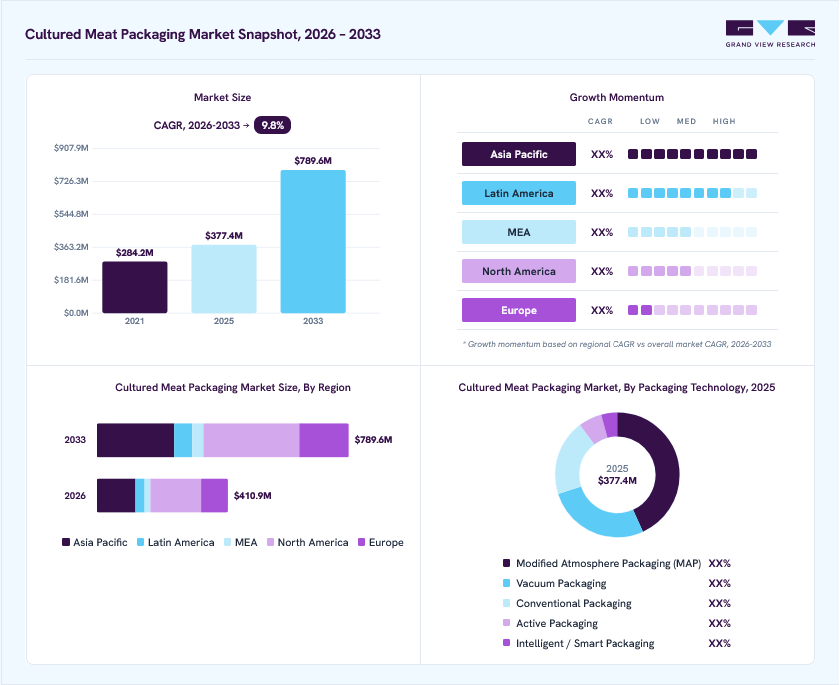
The global cultured meat packaging market size was valued at USD 377.4 million in 2025 and is expected to grow from USD 410.9 million in 2026 to USD 789.6 million in 2033, at a CAGR of 9.8% from 2026 to 2033. North America dominated the global market, accounting for a revenue share of 38.7% in 2025. The market growth is primarily driven by the rapid commercialization of cultivated meat, increasing demand for hygienic and contamination-resistant packaging, and the growing need for specialized packaging solutions that support the shelf life, cold-chain distribution, and regulatory requirements of cell-based meat products.
 Source: Grand View Research, IR Documents, Primary Interviews, Paid DatabasesTo learn more about this report,
 Download Free Sample Report
 Key Market Trends & Insights
- By material: Plastic held the largest revenue share of 61.8% in 2025.
- By cultivated meat type: Poultry dominated with a 41.8% revenue share in 2025.
- By packaging format: Trays dominated the market with a 41.8% revenue share in 2025.
- By packaging technology: Modified Atmosphere Packaging (MAP) held the largest revenue share of 43.2% in 2025.
Regional Highlights
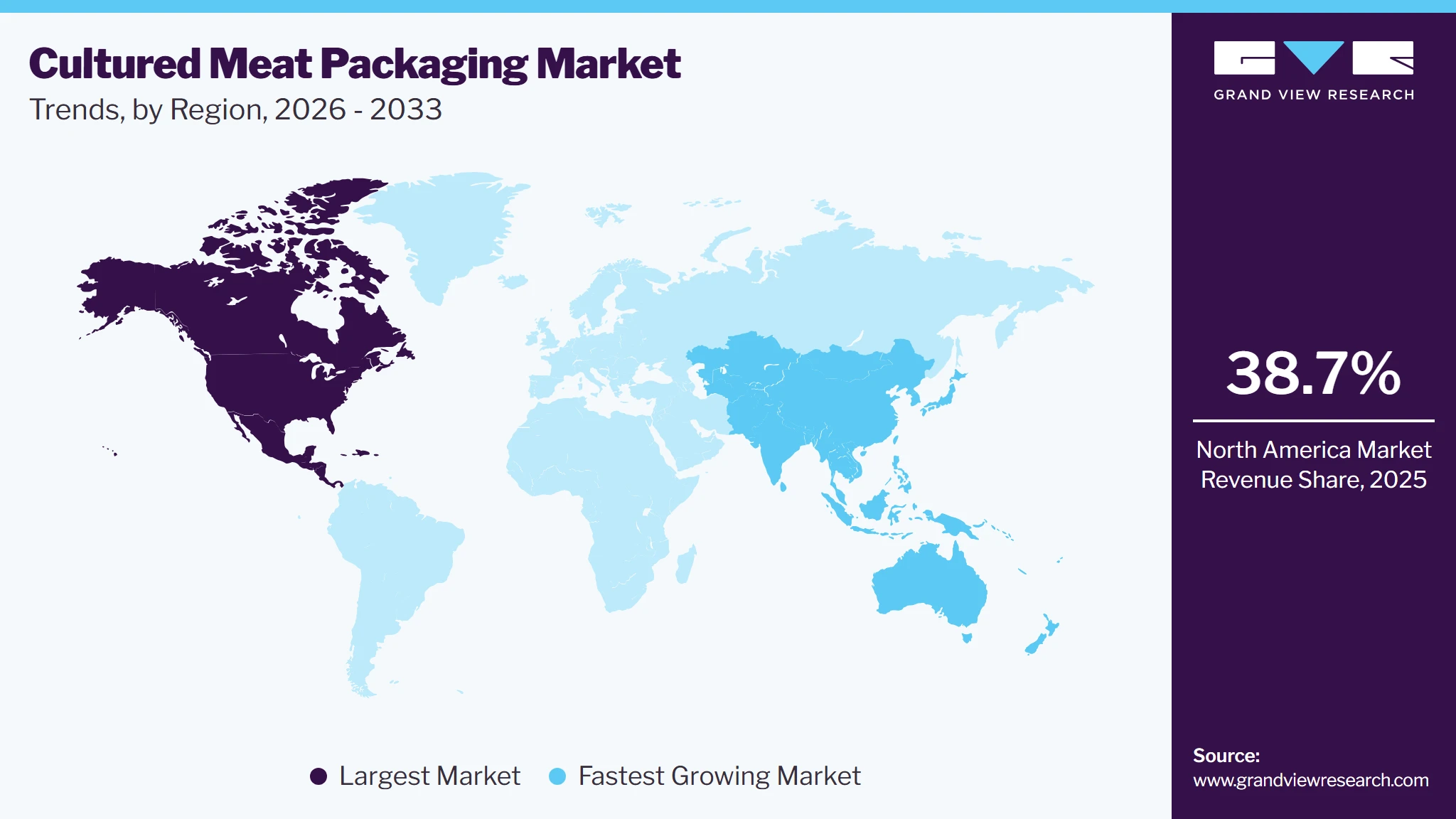
- Largest regional market: North America (38.7% revenue share, 2025.
- Fastest-growing regional market: Asia Pacific (fastest CAGR, 2026-2033)
Market Size & Forecast
- Market Size in 2025: USD 377.4 Million
- Estimated Market size in 2026: USD 410.9 Million
- 2033 Projected Market Size: USD 789.6 Million
- CAGR (2026-2033): 9.8%
Three ways to get this report
Buy it, customize it, or ask a question.Ask an Analyst
A direct answer, usually in 1 working day
- AccessReport author, directly
- Reply timeWithin 1 working day
- No sales callDirect answer only
- FormatEmail reply
- CostFree, no cost
Get the Full Report
What the study covers
- FormatsPDF · Excel · Dashboard
- Timeline2026–2033 annual, 2025 base
- Coverage20+ countries, 5 regions
- Companies10+ key players profiled
Customize the Report
20% free customization
- IncludeCountries, segments, points
- TailorTo your product definition
- ExtendDeeper competitor detail
- OrA fully bespoke study
- Turnaround5–10 working days
The cultured meat packaging market’s growth is driven by the rapid commercialization of cultivated meat and the increasing need for specialized packaging solutions that maintain product quality, freshness, and safety throughout processing, storage, and distribution. As cultivated meat producers increasingly scale production from pilot facilities to commercial operations, there is growing demand for standardized, hygienic, and dimensionally consistent packaging formats that can support cold-chain logistics and high-throughput food handling. Plastic trays and containers offer durability, lightweight construction, moisture resistance, and compatibility with automated filling and sealing systems, making them highly suitable for cultivated poultry, beef, and seafood products. The expansion of foodservice, retail, and direct-to-consumer distribution channels is further accelerating demand for efficient packaging solutions.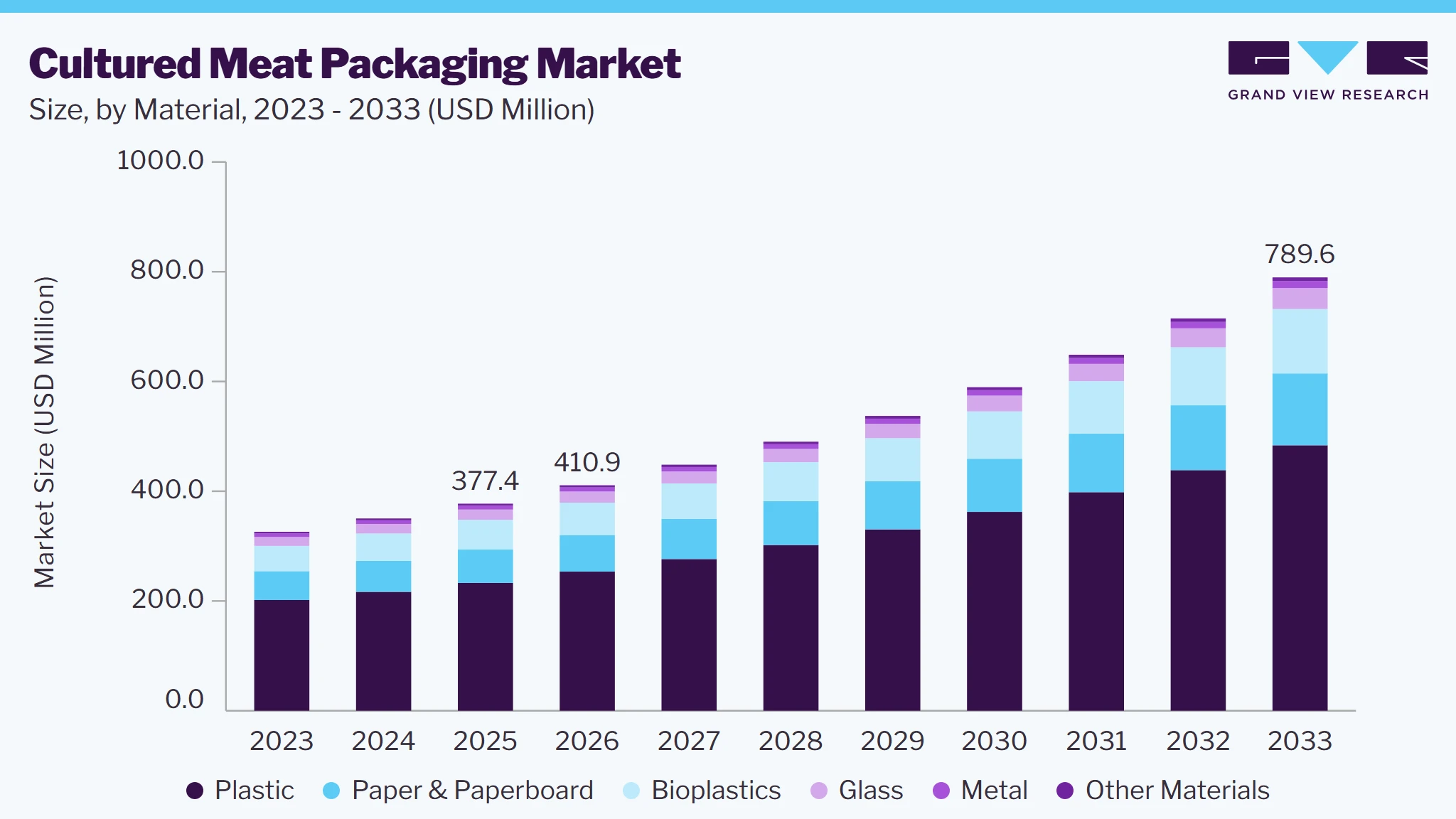 To learn more about this report, Download Free Sample Report
 An increasing focus on food safety, contamination prevention, and extended shelf life across cultivated meat supply chains is expected to boost market growth in the coming years. Cultivated meat products require controlled packaging environments to minimize exposure to oxygen, moisture, and microbial contamination after harvesting and processing. Packaging technologies such as Modified Atmosphere Packaging (MAP) and vacuum packaging are therefore gaining importance because they help preserve freshness and product quality during refrigerated distribution. Regulatory requirements related to food-contact materials, hygiene, traceability, and cold-chain handling are also encouraging producers to adopt reliable packaging formats. In addition, the growing adoption of trays and pouches & bags is supporting flexible packaging configurations suited to different cultivated meat products and portion sizes.
Sustainability initiatives and the transition toward circular packaging systems are also significantly contributing to market development. A defining trend in the cultured meat packaging industry is the accelerated shift toward paper & paperboard and bioplastics, as packaging manufacturers and cultivated meat producers seek to reduce dependence on conventional plastics and improve the environmental profile of packaged products. Based on the provided market data, bioplastics are projected to record the fastest growth among materials, with a CAGR of 10.3% from 2026 to 2033, supported by increasing demand for renewable, recyclable, and lower-impact packaging materials.
For instance, the growing commercialization of cultivated meat is encouraging packaging suppliers to develop recyclable, lightweight, and bio-based packaging formats that can accommodate refrigerated and controlled-atmosphere applications. Such developments are expected to increase the availability of sustainable packaging alternatives for cultivated meat producers, while supporting the market's transition toward resource-efficient and circular packaging systems.
Market Dynamics
The cultured meat packaging market is witnessing significant growth, driven by the rapid commercialization of cultivated meat, increasing demand for hygienic and contamination-resistant packaging, and the need to maintain product freshness throughout refrigerated supply chains. Manufacturers are focusing on packaging formats and technologies that provide effective barrier protection, support cold-chain distribution, and comply with food safety requirements. Additionally, the expansion of cultivated poultry, beef, and seafood production, advancements in modified atmosphere and vacuum packaging, and growing sustainability requirements are supporting market expansion, while the relatively high cost and evolving regulatory requirements for cultivated meat packaging remain key challenges.
The increasing commercialization and production of cultivated meat products is a key driver of the cultured meat packaging market. As cultivated meat companies move from laboratory-scale development toward pilot and commercial production, the need for specialized packaging solutions capable of protecting products during processing, storage, transportation, and retail distribution is increasing. Growing consumer interest in alternative protein sources, rising investments in cellular agriculture, and the expansion of cultivated poultry, beef, and seafood products are creating sustained demand for suitable packaging formats.
As cultivated meat producers expand their product portfolios and distribution networks, the need for efficient, hygienic, and shelf-life-enhancing packaging is growing. Companies are increasingly adopting trays, pouches and bags, and other flexible packaging formats that can support portion control, refrigerated logistics, and automated filling and sealing operations. The growing adoption of Modified Atmosphere Packaging (MAP) and vacuum packaging is further supporting market growth by helping maintain product quality and freshness throughout the cold chain.
A significant restraint for the cultured meat packaging market is the high cost associated with specialized packaging materials and advanced packaging technologies, along with evolving regulatory requirements for cultivated meat products. High-barrier materials, modified atmosphere systems, vacuum packaging, and specialized sealing solutions can increase packaging costs compared with conventional meat packaging. In addition, varying regulatory frameworks across countries create compliance complexities for cultivated meat producers and packaging suppliers, potentially increasing product development, testing, and certification costs and limiting the pace of market adoption.
A major opportunity for the cultured meat packaging market lies in the development of sustainable packaging solutions that also provide strong protection and freshness retention. As cultivated meat producers scale commercial operations, packaging manufacturers can capitalize on demand for recyclable, lightweight, and bio-based materials that align with the sustainability positioning of cultivated meat. In parallel, advanced solutions such as high-barrier films, modified atmosphere packaging, and smart packaging can help improve shelf life, product quality, traceability, and cold-chain performance, creating opportunities for packaging suppliers to develop specialized solutions tailored to the requirements of cultivated meat products.
Market Characteristics
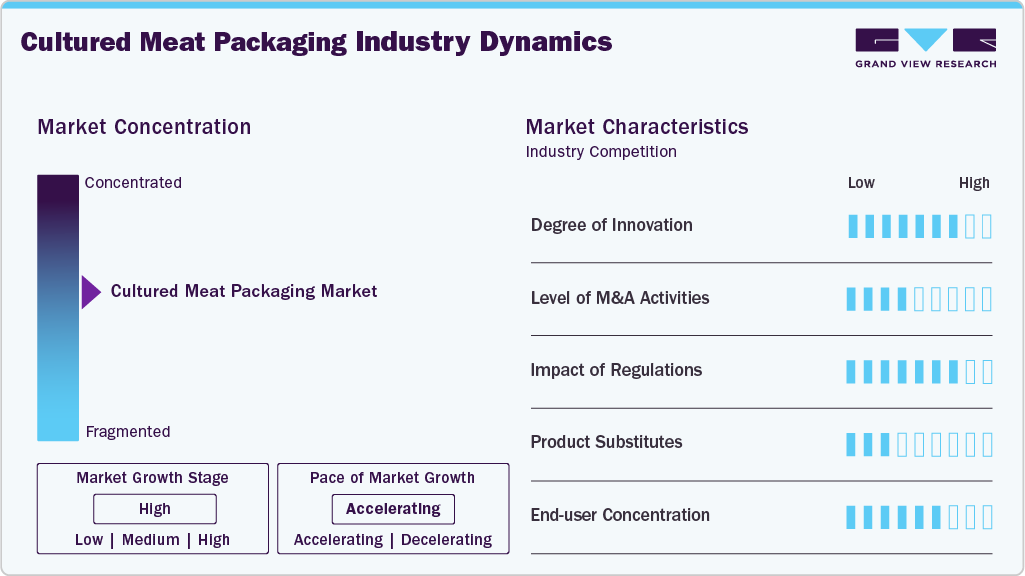
The cultured meat packaging market is characterized by its emerging nature and strong dependence on food safety, product protection, and cold-chain requirements. The industry is closely linked to the commercialization of cultivated meat, with packaging solutions required to maintain freshness, prevent contamination, and support refrigerated distribution. Manufacturers prioritize high-barrier materials, hygienic packaging formats, and technologies such as Modified Atmosphere Packaging (MAP) and vacuum packaging to preserve product quality. As cultivated meat production scales, packaging suppliers are increasingly focusing on automation compatibility, efficient sealing, portion control, and lightweight designs. Leading packaging companies and food-packaging specialists are developing solutions that can address the specific handling and shelf-life requirements of cultivated meat products.
 To learn more about this report, Download Free Sample Report
 A defining feature of the industry is the growing emphasis on sustainable and functional packaging materials. Plastic remains the dominant material because of its flexibility, durability, barrier properties, and compatibility with trays, pouches, and other food packaging formats. However, sustainability considerations are encouraging greater adoption of bioplastics and paper & paperboard alternatives, particularly as cultivated meat brands seek to maintain a lower environmental footprint across the overall product lifecycle. At the same time, innovations in intelligent packaging, freshness monitoring, and traceability are influencing product development, while evolving food-safety regulations and approval frameworks for cultivated meat are shaping packaging
Analyst Perspective
The global cultured meat packaging market has evolved from basic food-packaging applications toward specialized, high-barrier, hygienic, and cold-chain-compatible solutions as cultivated meat has progressed from laboratory research to pilot and early commercial development. Increasing commercialization of cultivated poultry, beef, seafood, and pork is driving demand for MAP, vacuum packaging, trays, pouches, barrier films, and sustainable materials that support freshness, contamination control, shelf-life extension, and product integrity. Going forward, the market is expected to witness strong growth as production scales and distribution expand, with increasing focus on recyclable packaging, bioplastics, lightweight formats, smart packaging, and advanced shelf-life technologies, making packaging an important enabler of the broader cultivated meat industry.
Material Insights
The plastic segment led the cultured meat packaging industry with the largest revenue share of 61.8% in 2025. Plastic is the most widely used material in cultured meat packaging due to its lightweight construction, durability, moisture resistance, and compatibility with trays, pouches, films, and other formats. Plastic packaging is particularly suitable for cultivated poultry, beef, and seafood products because it can provide effective barrier protection and support hygienic handling, sealing, and refrigerated distribution. Its scalability, cost-effectiveness, and compatibility with automated packaging systems further support its dominant position as cultivated meat production moves toward commercial-scale operations.
The bioplastics segment is expected to grow at the fastest CAGR of 10.3% during the forecast period. Bioplastics are gaining traction in cultured meat packaging as producers seek materials that support the sustainability positioning of cultivated meat while maintaining functional packaging performance. These materials can be incorporated into films, trays, and other packaging structures, offering opportunities to reduce dependence on conventional fossil-based plastics. Growing emphasis on recyclable, renewable, and lower-impact packaging, along with increasing sustainability expectations from consumers and food brands, is expected to accelerate the adoption of bioplastics in cultured meat packaging.
Cultivated Meat Type Insights
The poultry segment led the cultured meat packaging market with the largest revenue share of 41.8% in 2025. Poultry is the most prominent cultivated meat category, supported by the relatively strong commercialization potential of cultivated chicken products and their suitability for mainstream foodservice and retail applications. Packaging demand for cultivated poultry is driven by the need for hygienic handling, portion control, freshness preservation, and refrigerated distribution. Trays, pouches, and other sealed formats are widely suited to cultivated poultry products, while MAP and vacuum packaging can provide additional protection against oxygen exposure and contamination throughout the cold chain.
The seafood segment is expected to grow at the fastest CAGR of 10.3% during the forecast period. Increasing development of cultivated seafood products, particularly cell-based fish and other seafood alternatives, is creating new demand for specialized packaging solutions. Packaging for cultivated seafood requires effective moisture and oxygen control, leak resistance, freshness retention, and compatibility with refrigerated distribution. The expansion of cultivated seafood offerings and growing interest in sustainable alternatives to conventional seafood are expected to encourage the adoption of advanced packaging formats and technologies tailored to these products.
Packaging Format Insights
The trays segment led the cultured meat packaging industry with the largest revenue share of 41.8% in 2025. Trays are widely used for cultivated meat products because they provide a stable, hygienic structure for handling, portioning, sealing, and refrigerated storage. Their compatibility with Modified Atmosphere Packaging (MAP), vacuum sealing, and barrier films makes them suitable for cultivated poultry, beef, and seafood products. The growing commercialization of cultivated meat and expansion of retail and foodservice distribution are supporting demand for durable, lightweight, and easily sealable tray formats.
The pouches & bags segment is expected to grow at the fastest CAGR of 10.4% during the forecast period. Pouches and bags are gaining adoption due to their lightweight construction, material efficiency, flexible storage configurations, and suitability for different product portions. They can incorporate high-barrier structures that help protect cultivated meat from oxygen, moisture, and contamination while supporting refrigerated and cold-chain distribution. Increasing demand for convenient, space-efficient, and sustainable packaging formats is expected to further accelerate the adoption of pouches and bags in the market.
Packaging Technology Insights
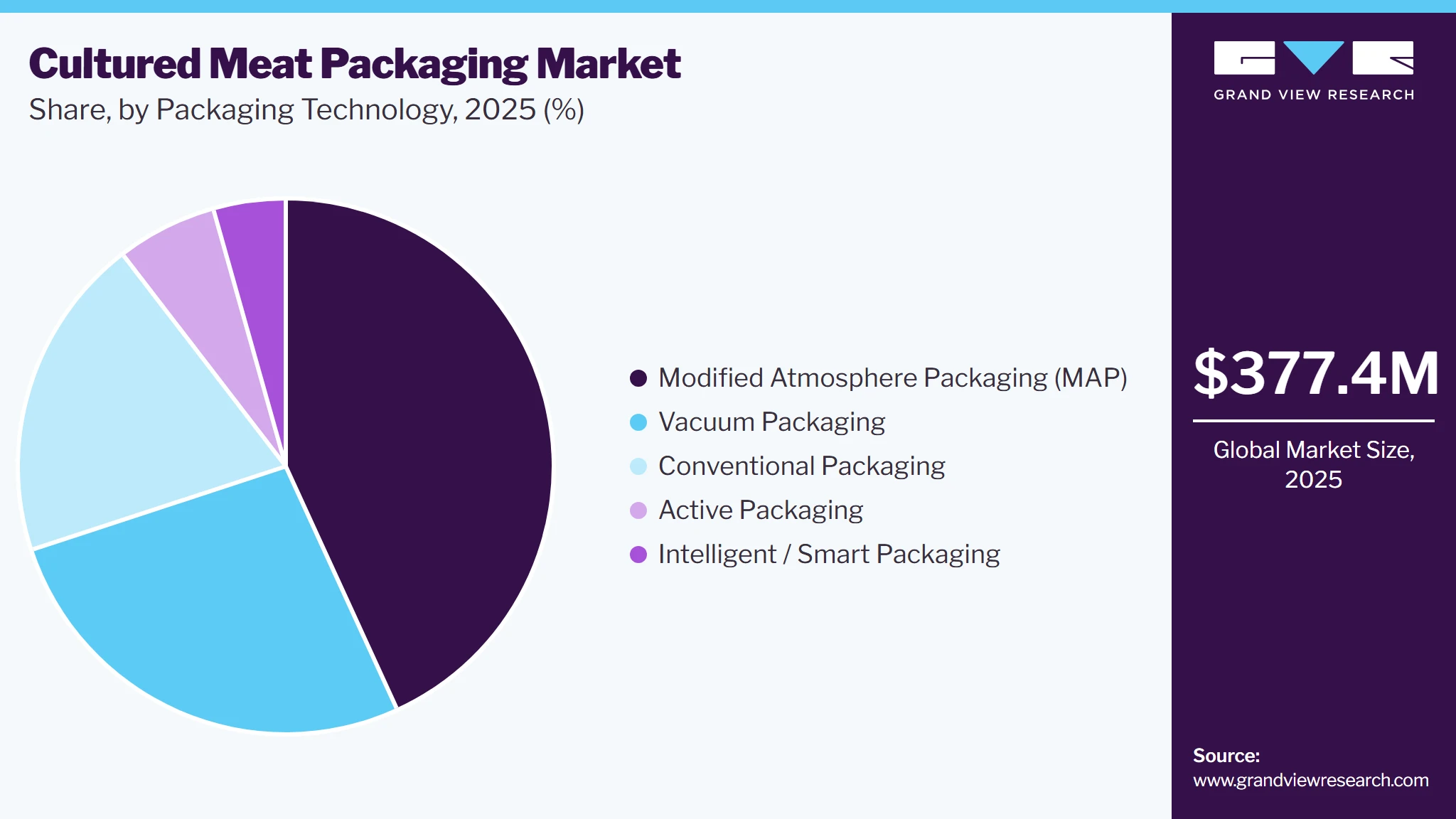
The Modified Atmosphere Packaging (MAP) led the cultured meat packaging market with the largest revenue share of 43.2% in 2025. MAP is widely adopted for cultivated meat products because it helps control oxygen and other gases within the package, supporting freshness, quality retention, and contamination protection during refrigerated storage and distribution. Its compatibility with trays, films, and automated sealing systems makes MAP particularly suitable for cultivated poultry, beef, and seafood products, supporting its dominant position as commercial production scales.
 To learn more about this report, Download Free Sample Report
 The Intelligent / Smart Packaging segment is expected to grow at the fastest CAGR of 11.8% during the forecast period. Intelligent and smart packaging is gaining traction due to its ability to provide freshness indication, temperature monitoring, product condition tracking, and traceability throughout the cold chain. As cultivated meat moves toward broader commercialization, these technologies can help producers monitor product quality and strengthen food safety management, thereby increasing demand for advanced packaging solutions.
Regional Insights
The North America cultured meat packaging market dominated with a revenue share of 38.7% in 2025 and is expected to maintain strong growth during the forecast period, supported by the region’s advanced food packaging infrastructure and early development of cultivated meat technologies. Increasing investments in cellular agriculture, growing demand for alternative proteins, and the expansion of refrigerated food distribution are creating demand for hygienic, high-barrier, and shelf-life-enhancing packaging solutions. The established presence of packaging manufacturers and advanced adoption of MAP, vacuum packaging, and sustainable materials further supports regional market development.
 To learn more about this report, Download Free Sample Report
 U.S. Cultured Meat Packaging Market Trends
The U.S. cultured meat packaging industry is expected to account for a major portion of North American demand throughout the forecast period. Market growth is being supported by increasing cultivated meat commercialization activities, investments in cellular agriculture, and the development of retail and foodservice applications for alternative proteins. Demand for trays, pouches, barrier films, and MAP solutions is expected to increase as producers require packaging that provides freshness retention, contamination protection, and compatibility with refrigerated distribution.
Europe Cultured Meat Packaging Market Trends
The Europe cultured meat packaging industry is projected to experience steady growth, driven by increasing interest in sustainable food production and alternative protein technologies. The region's focus on food safety, packaging sustainability, recyclability, and controlled-atmosphere solutions is encouraging the development of advanced packaging formats for cultivated meat. Growing adoption of bioplastics, paper-based materials, and recyclable packaging structures is also expected to influence product development as cultivated meat producers seek lower-impact packaging solutions.
The cultured meat packaging market in Germany represents a significant revenue share of Europe, supported by the country's strong food-processing, packaging, and advanced manufacturing industries. Increasing interest in alternative proteins and sustainable food technologies is creating opportunities for specialized trays, high-barrier films, and freshness-preserving packaging. Germany's emphasis on packaging efficiency, recycling, and food-quality standards is expected to encourage innovation in cultivated meat packaging solutions.
The UK cultured meat packaging market is expected to grow steadily during the forecast period, supported by increasing interest in cultivated meat, food innovation, and sustainable packaging technologies. Demand is expected to center on lightweight, recyclable, and high-performance formats capable of maintaining product quality during refrigerated distribution. Packaging innovation focused on shelf-life extension, portion control, and traceability is likely to strengthen opportunitiesfor suppliers serving emerging cultivated meat brands.
Asia Pacific Cultured Meat Packaging Market Trends
The Asia Pacific cultured meat packaging industry is projected to grow at the fastest CAGR of 10.4% during the forecast period. The region's rapid growth is supported by expanding alternative protein development, increasing investments in cellular agriculture, a large food-processing industry, and rising consumer interest in innovative food products. Growth in China, India, Japan, South Korea, and other emerging markets is creating opportunities for trays, pouches, MAP, vacuum packaging, and sustainable material solutions. The region's extensive packaging manufacturing base and expanding cold-chain infrastructure are expected to further accelerate demand for cultivated meat packaging.
The China cultured meat packaging market is expected to remain a major contributor to Asia Pacific growth, supported by its large-scale food manufacturing and packaging industries and increasing investments in food technology. The expansion of alternative protein research and growing demand for convenient, hygienic food packaging are creating opportunities for sealed trays, flexible pouches, barrier films, and MAP solutions. Continued development of advanced food-processing capabilities is expected to support the adoption of specialized packaging for cultivated meat products.
The cultured meat packaging market in India is expected to witness significant expansion during the forecast period, supported by a growing food-processing sector, increasing investments in alternative proteins, and rising demand for modern packaged food solutions. Development of cellular agriculture and improvements in cold-chain infrastructure are expected to create additional demand for hygienic and shelf-life-enhancing packaging. Increasing interest in lightweight and sustainable packaging materials is also likely to encourage theadoption of flexible and recyclable packaging formats.
Latin America Cultured Meat Packaging Market Trends
The Latin America cultured meat packaging industry is projected to grow steadily, supported by increasing interest in alternative proteins, modernization of food-processing operations, and expanding demand for packaged and refrigerated food products. The development of cultivated meat applications is expected to create opportunities for trays, flexible packaging, and freshness-preserving technologies. Growing sustainability awareness and improvements in cold-chain logistics are likely to further support the adoption of efficient packaging solutions.
The Brazil cultured meat packaging market is expected to represent a significant portion of Latin American demand, supported by its large food-processing industry and strong meat-production ecosystem. Growing interest in alternative protein technologies is creating opportunities for packaging suppliers to offer formats that support refrigerated storage, product protection, and retail presentation. Expansion of modern food distribution channels is expected to further contribute to market development.
The cultured meat packaging market in Argentina is expected to experience gradual growth as alternative protein technologies and modern food packaging solutions gain greater attention. Demand is likely to emerge from applications requiring hygienic handling, refrigerated transportation, and effective freshness retention. Increasing emphasis on efficient food processing and sustainable packaging could create additional opportunities for flexible and recyclable packaging formats.
Middle East & Africa Cultured Meat Packaging Market Trends
The Middle East & Africa cultured meat packaging industry is expected to show continued growth during the forecast period, supported by increasing investments in food technology, alternative proteins, food security initiatives, and modern food-processing infrastructure. Rising demand for refrigerated and convenience food products is creating opportunities for packaging technologies that provide strong barrier protection and extended shelf life. Development of advanced cold-chain networks and sustainable packaging solutions is expected to further support regional adoption.
Key Cultured Meat Packaging Company Insights
Some key companies in the cultured meat packaging market include Amcor Plc, Sealed Air, Winpak Ltd., MULTIVAC, Mondi, Coveris, Klöckner Pentaplast, ProAmpac, ULMA Group, Novolex, and Tipack Group. The market is characterized by advanced food-packaging technologies, high-barrier materials, modified atmosphere packaging (MAP), vacuum and skin packaging, sustainable packaging development, and increasing adaptation of packaging solutions for alternative proteins. Key participants are focusing on developing lightweight, recyclable, high-barrier, and shelf-life-enhancing packaging formats to address the food-safety, cold-chain, sustainability, and commercialization requirements of cultivated meat products.
-
Amcor Plc is a major packaging company offering solutions for fresh meat and protein applications, including trays, barrier films, lidding, and MAP formats. Its packaging technologies are relevant to cultured meat because they provide protection against oxygen and moisture while supporting freshness, refrigerated distribution, and retail presentation. Amcor is also advancing recyclable and paper-based MAP solutions, supporting the industry's transition toward more sustainable cultured meat packaging.
-
Sealed Air develops CRYOVAC packaging solutions for fresh proteins and alternative proteins, including preformed trays, MAP, vacuum skin packaging, barrier films, and lidding films. Its packaging formats are designed to extend shelf life, improve food protection, and support refrigerated distribution. The company's trays are specifically designed for alternative proteins, making its portfolio highly relevant to emerging cultured meat applications.
Key Cultured Meat Packaging Companies
The following key companies have been profiled for this study of the cultured meat packaging market.
-
Amcor Plc
-
Sealed Air
-
Winpak LTD.
-
MULTIVAC
-
Mondi.
-
Coveris
-
Klöckner Pentaplast
-
ProAmpac
-
ULMA GROUP
-
Novolex
-
Tipack Group
Competitive Benchmarking
Category
Operating Strategies
Competitive Edge
Weakness
Established Players (Amcor; Sealed Air; Winpak; Mondi; Coveris; Klöckner Pentaplast)
- Focus on MAP, vacuum packaging, barrier films, trays, lidding, and recyclable packaging while investing in sustainability and food-packaging innovation.
- Strong global presence, R&D capabilities, protein-packaging expertise, manufacturing scale, and customer networks.
- High production and R&D costs, sustainability transition costs, and dependence on the pace of cultured meat commercialization.
Emerging Players (MULTIVAC; ProAmpac; ULMA Group; Novolex; Tipack Group)
- Focus on thermoformed trays, flexible packaging, MAP, vacuum/skin packaging, barrier films, automation, and customized food-packaging solutions.
- Strong specialization, customization, packaging automation, barrier technology, and flexible formats for emerging protein applications.
- Relatively narrower market reach, specialized portfolios, and dependence on cultured meat production scale-up and customer investments.
Recent Developments
-
In April 2026, Sealed Air’s CRYOVAC brand highlighted new packaging implications for fresh meat and poultry based on its 2025 consumer research, emphasizing varied portion sizes, functional benefits, case-ready formats, and solutions that reduce barriers to trying new protein products. These developments support the adoption of flexible, shelf-life-enhancing, and consumer-oriented packaging formats for emerging cultivated meat products.
-
In February 2026, MULTIVAC showcased sustainable packaging solutions for fish and seafood at Seafood Processing Global, focusing on compact, hygienic, and flexible packaging systems. The development is relevant to cultivated seafood packaging, where hygienic processing, portioning, shelf-life protection, and sustainable packaging are increasingly important.
Cultured Meat Packaging Market Report Scope
Report Attribute
Details
Market size in 2025
USD 377.4 million
Estimated market size in 2026
USD 410.9 million
Projected market size by 2033
USD 789.6 million
Growth rate
CAGR of 9.8% from 2026 to 2033
Base year for estimation
2025
Historical data
2021 - 2024
Forecast period
2026 - 2033
Quantitative units
Revenue in USD million and CAGR from 2026 to 2033
Report coverage
Revenue forecast, company ranking, competitive landscape, growth factors, and trends
Segments covered
Material, cultivated meat type, packaging format, packaging technology, region
Regional scope
North America; Europe; Asia Pacific; Latin America; Middle East & Africa
Key companies profiled
Amcor Plc; Sealed Air; Winpak LTD.; MULTIVAC; Mondi.; Coveris; Klöckner Pentaplast; ProAmpac; ULMA GROUP; Novolex; Tipack Group
Customization scope
Free report customization (equivalent up to 8 analysts working days) with purchase. Addition or alteration to country, regional & segment scope.
Pricing and purchase options
Avail of customized purchase options to meet your exact research needs. Explore purchase options
Global Cultured Meat Packaging Market Report Segmentation
This report forecasts revenue growth at the global, regional & country levels and provides an analysis of the latest industry trends and opportunities in each of the sub-segments from 2021 to 2033. For this study, Grand View Research has segmented the cultured meat packaging market report based on material, cultivated meat type, packaging format, packaging technology, and region:
-
Material Outlook (Revenue, USD Million, 2021 - 2033)
-
Plastic
-
Paper & Paperboard
-
Bioplastics
-
Glass
-
Metal
-
Other Materials
-
-
Cultivated Meat Type Outlook (Revenue, USD Million, 2021 - 2033)
-
Poultry
-
Beef
-
Seafood
-
Pork
-
Other Cultivated Meat
-
-
Packaging Format Outlook (Revenue, USD Million, 2021 - 2033)
-
Trays
-
Pouches & Bags
-
Clamshells & Containers
-
Films & Wraps
-
Other Formats
-
-
Packaging Technology Outlook (Revenue, USD Million, 2021 - 2033)
-
Modified Atmosphere Packaging (MAP)
-
Vacuum Packaging
-
Conventional Packaging
-
Active Packaging
-
Intelligent / Smart Packaging
-
-
Regional Outlook (Revenue, USD Million, 2021 - 2033)
-
North America
-
U.S.
-
Canada
-
Mexico
-
-
Europe
-
Germany
-
France
-
UK
-
Italy
-
Spain
-
-
Asia Pacific
-
China
-
India
-
Japan
-
South Korea
-
Australia
-
-
Latin America
-
Brazil
-
Argentina
-
-
Middle East & Africa
-
Saudi Arabia
-
UAE
-
South Africa
-
-
Research Methodology
The cultured meat packaging market figures in this report are based on a proven research process that combines executive interviews with secondary research from proprietary databases, company filings, and recognized regulatory and institutional sources. Market size is built through value-chain sizing - reconciling supply-side and demand-side estimates - and triangulated with bottom-up and top-down approaches. Every estimate passes multiple levels of expert validation before publication, with each cultured meat packaging segment quantified using the revenue-capture definitions in the table below.
Segment Definition
Segment - Material Type
Revenue capture definition
Plastic
Revenue generated from the sale of plastic packaging materials used for cultivated meat, including trays, containers, films, pouches, bags, and lidding materials. Includes conventional and high-barrier plastics used for MAP, vacuum packaging, refrigerated storage, and cold-chain distribution.
Paper & Paperboard
Revenue generated from paper and paperboard packaging used for cultivated meat, including fiber-based trays, cartons, sleeves, and coated paper packaging. Includes recyclable and barrier-coated paperboard formats designed to provide structural strength, moisture resistance, food safety, and product protection.
Bioplastics
Revenue generated from bio-based and biodegradable plastic materials used in cultivated meat packaging, including trays, films, pouches, and other flexible or rigid formats. Includes bioplastic materials developed to reduce reliance on fossil-based plastics while providing required barrier, sealing, and food-contact performance.
Glass
Revenue generated from glass packaging used for cultivated meat products, including jars, containers, and specialized food-contact formats. Includes glass solutions offering chemical stability, strong barrier properties, transparency, and hygienic product protection for applicable cultivated meat applications.
Metal
Revenue generated from metal-based packaging used for cultivated meat, including aluminum and steel containers, trays, cans, and specialized packaging formats. Includes metal packaging providing high mechanical strength, barrier protection, durability, and resistance to oxygen, moisture, and external contamination.
Other Materials
Revenue generated from other packaging materials used for cultivated meat products, including specialty composites, multilayer structures, molded fiber, and emerging sustainable materials. Includes customized materials designed to provide enhanced barrier properties, sustainability, durability, and shelf-life protection.
Segment - Cultivated Meat Type
Revenue capture definition
Poultry
Revenue generated from packaging solutions used for cultivated poultry products, including chicken and other cell-cultured poultry products. Includes trays, pouches, films, MAP, vacuum packaging, and barrier packaging designed for hygienic handling, freshness retention, and refrigerated distribution.
Beef
Revenue generated from packaging used for cultivated beef products, including cell-based beef cuts, mince, and processed products. Includes high-barrier trays, vacuum packaging, MAP formats, films, and lidding solutions that provide oxygen control, contamination protection, and shelf-life extension.
Seafood
Revenue generated from packaging solutions used for cultivated seafood products, including cell-cultured fish, shellfish, and other seafood products. Includes moisture-resistant, leak-resistant, high-barrier, MAP, vacuum, and flexible packaging formats designed for refrigerated and cold-chain distribution.
Pork
Revenue generated from packaging used for cultivated pork products, including cell-based pork cuts and processed products. Includes trays, pouches, vacuum packaging, MAP, barrier films, and lidding materials designed to maintain freshness, product integrity, and food safety.
Other Cultivated Meat
Revenue generated from packaging solutions used for other cultivated meat products, including emerging cell-based products such as lamb and specialty meats. Includes specialized trays, flexible packaging, barrier materials, MAP, vacuum, and sustainable packaging formats adapted to specific product requirements.
Segment - Packaging Format
Revenue capture definition
Trays
Revenue generated from the sale of trays used for packaging cultivated meat products, including rigid plastic, paper-based, and other tray formats. Includes trays compatible with MAP, vacuum sealing, lidding films, and refrigerated distribution.
Pouches & Bags
Revenue generated from pouches and bags used for cultivated meat packaging, including vacuum pouches, MAP bags, barrier pouches, and flexible bags. Includes solutions designed for lightweight construction, oxygen and moisture protection, sealing, and cold-chain handling.
Clamshells & Containers
Revenue generated from rigid clamshells and containers used to package cultivated meat products. Includes sealed containers designed for product visibility, protection, portion control, hygienic handling, and refrigerated storage.
Films & Wraps
Revenue generated from films and wraps used for cultivated meat packaging, including barrier films, lidding films, stretch films, shrink films, and protective wraps. Includes materials designed for sealing, oxygen control, moisture resistance, freshness preservation, and compatibility with automated packaging systems.
Other Formats
Revenue generated from other packaging formats used for cultivated meat, including cartons, sleeves, specialty packs, and emerging packaging designs. Includes customized formats developed to provide product protection, sustainability, convenience, and shelf-life enhancement.
Segment - Packaging Technology
Revenue capture definition
Modified Atmosphere Packaging (MAP)
Revenue generated from MAP solutions used for cultivated meat, including trays, lidding films, and gas-flush packaging systems. Includes packaging designed to control oxygen and other gases to preserve freshness, quality, and shelf life during refrigerated distribution.
Vacuum Packaging
Revenue generated from vacuum packaging solutions used for cultivated meat, including vacuum pouches, bags, films, and thermoformed packs. Includes systems that remove air from the package to reduce oxidation, contamination risk, and quality deterioration.
Conventional Packaging
Revenue generated from standard packaging solutions used for cultivated meat without specialized atmosphere-control or active/intelligent technologies. Includes basic trays, containers, films, pouches, and wraps used for product protection, handling, storage, and distribution.
Active Packaging
Revenue generated from packaging incorporating active components that interact with the packaged cultivated meat or its surrounding environment. Includes oxygen scavengers, moisture absorbers, antimicrobial systems, and other shelf-life-enhancing solutions.
Intelligent / Smart Packaging
Revenue generated from packaging incorporating sensors, indicators, tracking technologies, or other smart features for cultivated meat products. Includes freshness indicators, temperature-monitoring systems, traceability solutions, and technologies designed to support product quality and cold-chain monitoring.
Estimation Model
Layer Name
Key Question
Description
Cultivated Meat Production Layer
What drives packaging demand?
Estimate packaging demand based on the production and commercialization of cultivated poultry, beef, seafood, pork, and other cultivated meat products across retail, foodservice, and direct-to-consumer channels.
Packaging Format Adoption Layer
Which formats are used?
Assess adoption of trays, pouches & bags, clamshells & containers, films & wraps, and other formats based on product protection, portioning, sealing, shelf-life, and cold-chain requirements.
Packaging Technology & Material Layer
What packaging solutions generate demand?
Evaluate consumption of plastic, paper & paperboard, bioplastics, glass, metal, and other materials across MAP, vacuum, conventional, active, and intelligent/smart packaging technologies.
Revenue Layer
How is revenue generated?
Revenue is generated through the sale of packaging materials, formats, and technologies used to protect cultivated meat products, maintain freshness and hygiene, extend shelf life, and support refrigerated distribution.
Delivered Customizations
We have successfully delivered the following deep-dive customizations
Client Request
Customization Delivered
Value Adds
Regional Segmentation
Detailed assessment of North America, Europe, Asia Pacific, Latin America, and Middle East & Africa, covering cultivated meat adoption, packaging demand, material preferences, regulatory environment, cold-chain infrastructure, and growth outlook.
Identifies high-growth regions, regional demand variations, regulatory influences, and expansion opportunities for cultured meat packaging suppliers.
Cross-Segmentation
Comprehensive analysis across Material (Plastic, Paper & Paperboard, Bioplastics, Glass, Metal, Other Materials), Packaging Format (Trays, Pouches & Bags, Clamshells & Containers, Films & Wraps, Other Formats), Packaging Technology (MAP, Vacuum, Conventional, Active, Intelligent/Smart), and Cultivated Meat Type (Poultry, Beef, Seafood, Pork, Other Cultivated Meat) across regional markets.
Identifies high-potential segment combinations, emerging demand pockets, packaging preferences, and growth opportunities across the cultivated meat value chain.
Pricing Analysis
Assessment of pricing trends for cultured meat packaging materials, trays, flexible packaging, barrier films, MAP and vacuum solutions, considering material costs, packaging technology, production scale, customization, and sustainability requirements.
Provides insights into cost structures, price variations, technology premiums, and competitive pricing strategies to support supplier positioning and procurement decisions.
Frequently Asked Questions About This Report
The global cultured meat packaging market size was valued at USD 377.4 million in 2025 and is estimated at USD 410.9 million in 2026.
The global cultured meat packaging market is expected to grow at a CAGR of 9.8% from 2026 to 2033, reaching USD 789.6 million by 2033.
The cultured meat packaging market is primarily driven by the commercialization of cultivated meat, increasing demand for hygienic and contamination-resistant packaging, growing adoption of refrigerated and cold-chain distribution, shelf-life extension requirements, and increasing use of MAP and vacuum packaging technologies.
North America dominated the cultured meat packaging market with a 38.7% revenue share in 2025.
Asia Pacific is the fastest-growing region in the cultured meat packaging market from 2026 to 2033.
The Plastic segment led the cultured meat packaging market with a 61.8% revenue share in 2025.
The Trays segment led the cultured meat packaging market with a 41.8% revenue share in 2025.
The Poultry segment led the cultured meat packaging market with a 41.8% revenue share in 2025.
Key players in the cultured meat packaging market include Amcor Plc, Sealed Air, Winpak Ltd., MULTIVAC, Mondi, Coveris, Klöckner Pentaplast, ProAmpac, ULMA Group, Novolex, and Tipack Group.
About the Author(s)
Plastics, Polymers & Resins Research Team
Bulk Chemicals · Plastics, Polymers & ResinsThis report was authored by the plastics, polymers & resins research team at Grand View Research - comprising two research analysts, one senior research analyst, and one industry expert - with specialized expertise in the plastics, polymers & resins segment of the bulk chemicals industry. All findings are based on proprietary bulk chemicals databases, executive interviews, and regulatory analysis, subject to internal peer review prior to publication.
Last Updated:
Speak to Analyst

Customize this report to your needs - add regions, segments, or data points, with 20% free customization.
Or view our licence options:


ISO 9001:2015 & 27001:2022 Certified
We are GDPR and CCPA compliant! Your transaction & personal information is safe and secure. For more details, please read our privacy policy.


