
- Home
- »
- Plastics, Polymers & Resins
- »
-
Custom Packaging Market Size & Share Report, 2026-2033GVR Report cover

Custom Packaging Market (2026 - 2033)
Size, Share & Trends Analysis Report By Material (Paper & Paperboard, Plastic, Metal), By End-use (Food & Beverages, Healthcare, Personal Care & Cosmetics, Electrical & Electronics), By Region, And Segment Forecasts
Market Size, 2025
$39.7BMarket Estimate, 2026
$41.6BMarket Forecast, 2033
$59.6BCAGR, 2026–2033
6.0%Custom Packaging Market Summary
The global custom packaging market size was valued at USD 39.7 billion in 2025 and is projected to grow from USD 41.6 billion in 2026 to USD 59.6 billion by 2033, growing at a CAGR of 6.0% from 2026 to 2033. North America dominated with the largest revenue share of 32.1% in 2025. The market growth is driven by increasing brand differentiation needs and rising demand for personalized, sustainable, and innovative packaging solutions that enhance customer experience.
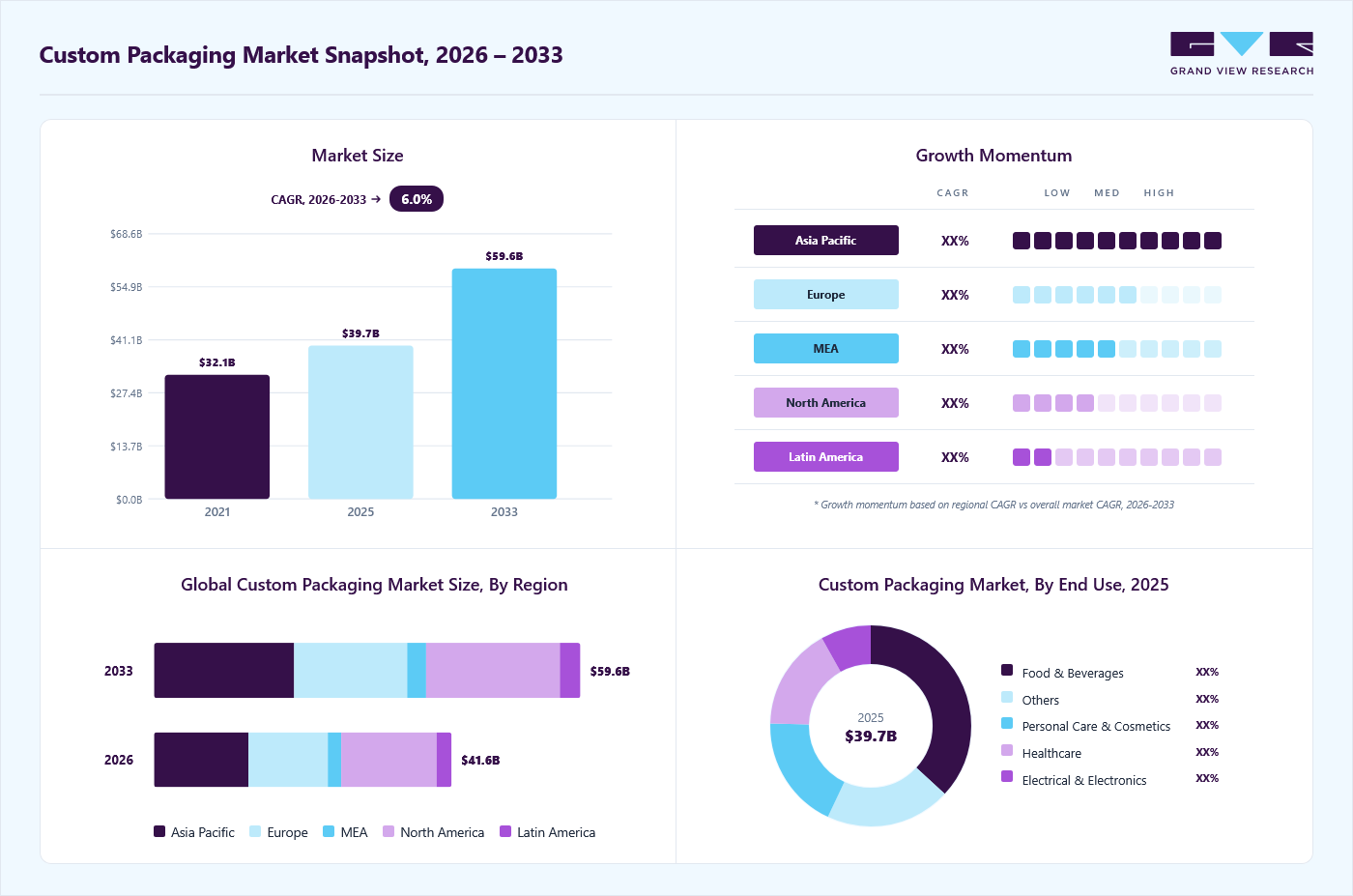 Source: Grand View Research, IR Documents, Primary Interviews, Paid DatabasesTo learn more about this report,
 Download Free Sample Report
 Key Market Trends & Insights
- By material: Paper & paper board segment led the market with the largest revenue share of 47.2% in 2025.
- By end use: Food & beverages segment led the market with the largest revenue share of 36.8% in 2025.
Regional Highlights
- Largest regional market: North America (32.1% revenue share, 2025)
- Fastest-growing regional market: Asia Pacific (highest CAGR, 2026-2033)
- By country: The U.S. held the largest market share in 2025.
Market Size & Forecast
- Market size in 2025: USD 39.7 Billion
- Estimated market size in 2026: USD 41.6 Billion
- Projected market size by 2033: USD 59.6 Billion
- CAGR (2026-2033): 6.0%
Three ways to get this report
Buy it, customize it, or ask a question.Ask an Analyst
Analyst response in 1 business day
- AccessReport author, directly
- Reply timeWithin 1 working day
- No sales callDirect answer only
- FormatEmail reply
- CostFree, no cost
Get the Full Report
What the study covers
- FormatsPDF · Excel · Dashboard
- Timeline2026–2033 annual, 2025 base
- Coverage20+ countries, 5 regions
- Companies10+ key players profiled
Customize the Report
20% free customization
- IncludeCountries, segments, points
- TailorTo your product definition
- ExtendDeeper competitor detail
- OrA fully bespoke study
- Turnaround5–10 working days
Additionally, the growth of e-commerce and product diversification fuels the adoption of customized packaging. Companies are increasingly using packaging as a strategic tool to communicate their brand identity and connect emotionally with consumers. Custom packaging enables unique designs, colors, and messaging that align with brand values, helping products stand out on crowded retail shelves. For instance, luxury brands like Lush and Apple leverage custom packaging to create a premium unboxing experience, which enhances customer loyalty and encourages social media sharing, amplifying brand visibility. This trend is particularly strong in the FMCG, cosmetics, and electronics sectors, where visual appeal significantly influences purchase decisions.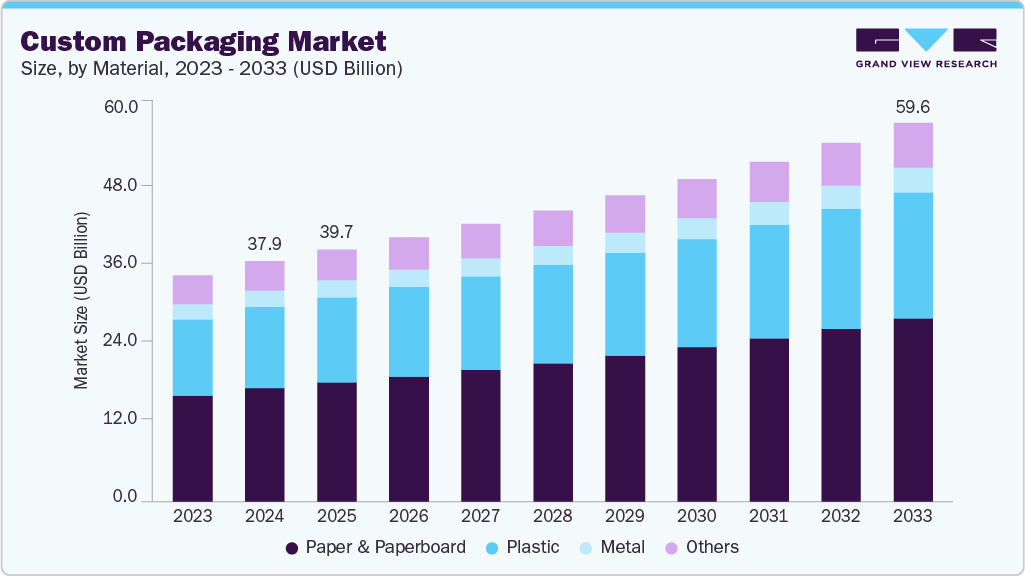 To learn more about this report, Download Free Sample Report
 The rapid expansion of e-commerce and D2C (Direct-to-Consumer) sales channels is fueling the need for custom packaging. Products shipped directly to consumers require packaging that not only protects the product during transit but also provides a memorable brand experience upon delivery. Custom packaging solutions, such as branded mailers, subscription boxes, and eco-friendly inserts, are becoming essential for companies to differentiate themselves in online marketplaces. For example, Glossier’s pink-themed packaging and thoughtful presentation have contributed to its viral marketing success, demonstrating how custom packaging can directly impact online brand perception and customer retention.
Environmental concerns are pushing brands to adopt sustainable custom packaging solutions. Consumers increasingly prefer products packaged in recyclable, biodegradable, or reusable materials, compelling companies to innovate in their packaging designs. Custom packaging can be tailored to incorporate these sustainable materials while maintaining aesthetic appeal and functionality. Companies like Coca-Cola and Unilever are investing in eco-friendly custom packaging innovations, such as plant-based plastics and recyclable cartons, to appeal to environmentally conscious consumers. This trend not only drives market demand but also helps brands comply with stricter global regulations on packaging waste.
Consumer preference for personalized and limited-edition products is another key driver for the custom packaging market. Brands are increasingly offering customized packaging options to enhance customer engagement and drive sales. Personalization can range from printed names on packaging to fully bespoke designs for special occasions. For instance, Coca-Cola’s “Share a Coke” campaign demonstrated the power of personalized packaging, boosting sales and social media engagement through consumer participation. Similarly, seasonal or limited-edition packaging by brands like Starbucks or KitKat encourages impulse purchases and strengthens brand loyalty, fueling the demand for innovative custom packaging solutions globally.
Market Dynamics
The custom packaging market is witnessing significant growth driven by increasing demand for product differentiation, brand enhancement, personalized consumer experiences, and the rapid expansion of e-commerce channels. Businesses across food & beverages, consumer goods, healthcare, cosmetics, electronics, and retail sectors are increasingly adopting customized packaging solutions to improve brand visibility, strengthen customer engagement, and enhance product presentation. Furthermore, advancements in digital printing, short-run manufacturing capabilities, and smart packaging technologies have enabled brands to offer highly customized packaging at competitive costs. As companies continue to prioritize premiumization, sustainability, and customer-centric marketing strategies, demand for custom packaging solutions is expected to grow steadily worldwide.
The increasing need for product differentiation in highly competitive markets is a major factor driving the custom packaging market. Packaging has evolved beyond its traditional protective function and is now a critical marketing tool that influences purchasing decisions, strengthens brand identity, and enhances consumer experiences.
Brands are increasingly investing in customized packaging formats, unique designs, personalized graphics, limited-edition packaging, and premium unboxing experiences to attract customers and improve brand loyalty. The rapid growth of e-commerce has further amplified the importance of custom packaging, as businesses seek to create memorable consumer interactions while ensuring product protection during shipping. Additionally, growing demand for personalized products, direct-to-consumer business models, and digital printing technologies is accelerating adoption of custom packaging solutions across industries.
Higher production costs and increased operational complexity present significant challenges for the Custom Packaging Market. Customized packaging often requires specialized design capabilities, shorter production runs, frequent artwork changes, and advanced printing technologies, which can increase manufacturing costs compared to standardized packaging solutions. Additionally, managing multiple packaging variations, maintaining inventory efficiency, and ensuring consistency across customized packaging programs can create logistical challenges for manufacturers and brand owners. Small and medium-sized businesses may face difficulties in adopting highly customized packaging solutions due to budget constraints and limited access to advanced packaging technologies. These factors can restrict market adoption, particularly in price-sensitive industries.
The growing adoption of digital printing technologies and sustainable packaging solutions presents significant growth opportunities for market participants. Digital printing enables cost-effective short production runs, rapid design changes, variable data printing, and personalized packaging campaigns, allowing brands to respond quickly to changing consumer preferences. Furthermore, increasing consumer awareness regarding environmental sustainability is driving demand for eco-friendly custom packaging solutions made from recyclable, compostable, and renewable materials. Brands are increasingly seeking customized packaging that combines aesthetic appeal with sustainability objectives. The development of smart packaging, interactive packaging, QR-code-enabled designs, and personalized marketing initiatives is creating additional growth opportunities. As businesses continue to prioritize customer engagement and sustainability, demand for innovative custom packaging solutions is expected to increase substantially.
Market Concentration & Characteristics
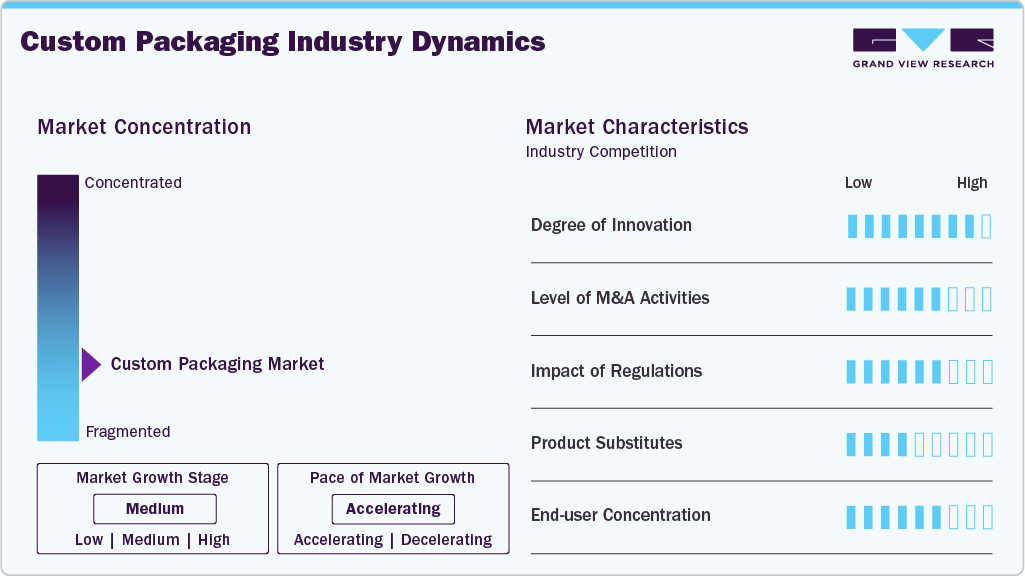
Innovation is at the core of the custom packaging industry. Companies continuously explore new materials, technologies, and printing techniques to meet evolving consumer preferences and regulatory requirements. This includes the adoption of sustainable materials, smart packaging with QR codes or NFC chips, and advanced finishing techniques like embossing, foiling, and holographic printing. For instance, Avery Dennison and Mondi focus on incorporating smart labels and interactive designs to enhance consumer engagement, highlighting how innovation shapes competitive advantage in this sector.
 To learn more about this report, Download Free Sample Report
 The custom packaging market is closely tied to trends in end user industries such as food & beverage, cosmetics & personal care, electronics, and e-commerce. For example, the boom in online retail has increased demand for durable, aesthetically pleasing, and functional packaging that protects products during transit while enhancing the unboxing experience. Similarly, the luxury and cosmetics sectors drive demand for high-end, visually appealing packaging solutions. This interdependence makes the market sensitive to shifts in consumer preferences, seasonal trends, and industry-specific innovations.
Analyst Perspective
The Custom Packaging Market’s next phase of growth will be driven less by basic packaging requirements and more by the industry's ability to deliver differentiated, brand-centric, and consumer-focused packaging solutions. Demand is expanding across e-commerce, food & beverages, cosmetics, healthcare, electronics, and luxury goods, but growth in premium segments will depend on design innovation, digital printing capabilities, sustainability performance, and rapid customization capabilities. Companies offering integrated design, printing, manufacturing, and fulfillment services are expected to strengthen their competitive position, while smaller providers may face challenges related to production scalability, technology investments, and increasingly complex customer requirements. As brands continue to prioritize customer experience and product differentiation, custom packaging will remain a key strategic tool for driving market engagement and brand value.
Material Insights
Based on material, the paper & paper board segment led the market with the largest revenue share of 47.2% in 2025 and is expected to grow at the fastest CAGR over the forecast period. Paper and paperboard are widely used in custom packaging due to their versatility, recyclability, and lightweight properties. They are used in making boxes, cartons, bags, sleeves, and corrugated packaging, which are common in industries such as food & beverage, consumer electronics, cosmetics, and pharmaceuticals. Brands increasingly prefer paper-based packaging to enhance their sustainability profile, as it is biodegradable and easily recyclable.
Plastic remains a major material in custom packaging due to its durability, versatility, and cost-effectiveness. It is widely used in containers, bottles, pouches, shrink wraps, and blister packs across industries like food & beverage, personal care, pharmaceuticals, and consumer electronics. High-performance plastics such as PET, HDPE, and PP are favored for their clarity, barrier properties, and resistance to moisture, chemicals, and temperature variations. Plastic packaging also enables innovative forms like flexible packaging, vacuum-sealed packs, and thermoformed trays, allowing brands to create unique designs and functional solutions tailored to consumer needs.
End-use Insights
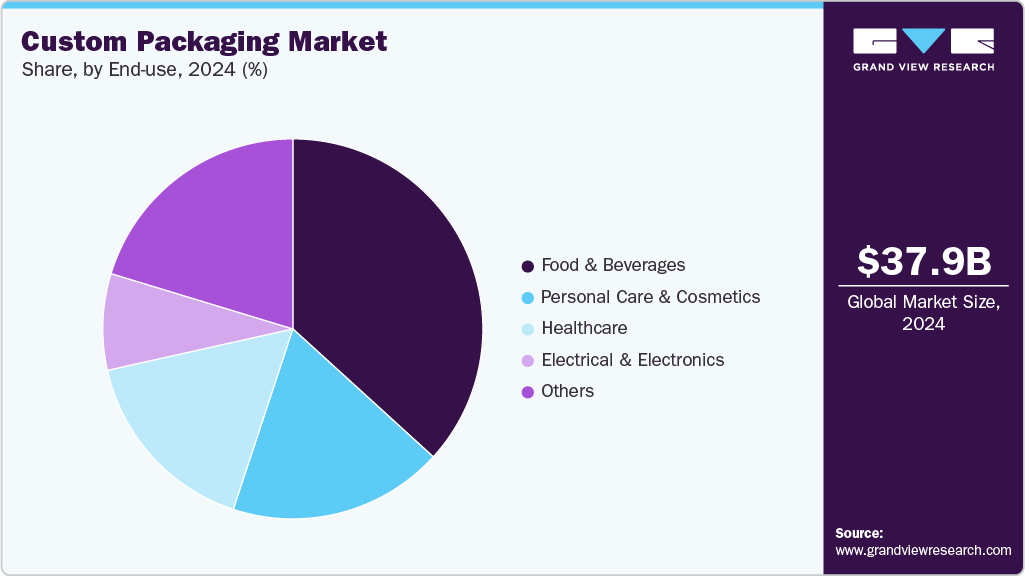
Based on end use, the food & beverages segment led the market with the largest revenue share of 36.8% in 2025. This can be attributed to the industry’s broad consumer base and the critical role of packaging in brand differentiation, safety, and shelf life. Custom packaging in this sector includes tailored box shapes, portion-controlled containers, branded wraps, and sustainable materials that align with growing eco-conscious trends. The rise of online food delivery and meal kits has also expanded the need for customized, durable, and temperature-resistant packaging.
 To learn more about this report, Download Free Sample Report
 The healthcare segment is projected to grow at the fastest CAGR of 5.7% during the forecast period. In the healthcare sector, custom packaging plays a crucial role in ensuring product integrity, safety, and compliance with regulatory standards. Custom blister packs, tamper-evident seals, serialized labels, and dosage-specific containers are designed to enhance patient convenience and minimize counterfeiting risks. Major players such as Pfizer, Johnson & Johnson, and AbbVie invest in highly specialized packaging tailored to different drug formulations and regional regulatory requirements. The growing trend toward personalized medicine and biologics has also increased the need for bespoke packaging solutions that ensure sterility and traceability.
Regional Insights
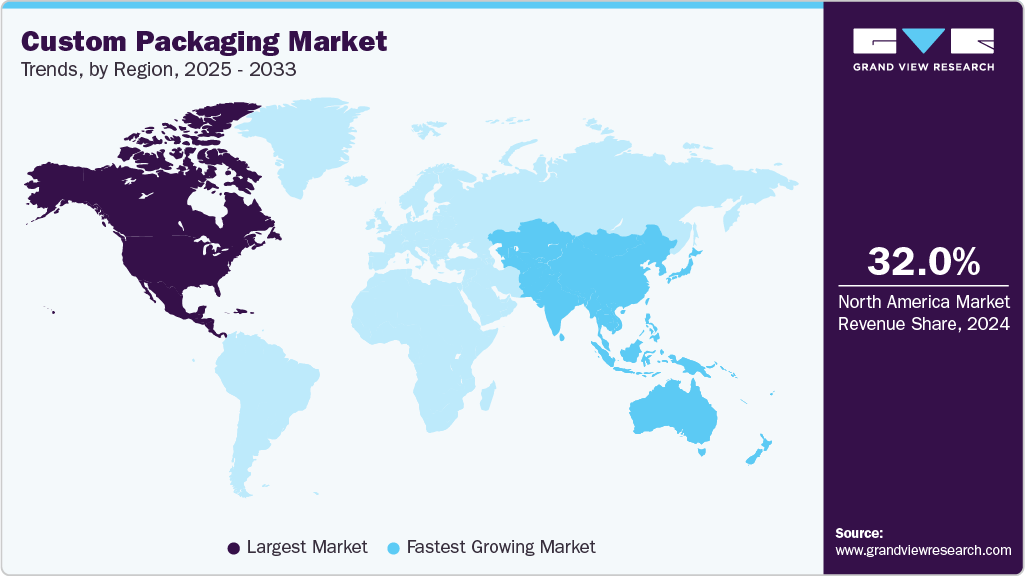
North America dominated the custom packaging market with the largest revenue share of 32.1% in 2025. This positive outlook is due to its mature retail, e-commerce, and food service industries, where brand differentiation through packaging is a critical competitive advantage. The region is witnessing high demand for customized packaging across sectors such as food & beverages, personal care, and electronics. The growing preference for limited-edition packaging, personalized unboxing experiences, and sustainable materials such as paperboard and biodegradable plastics has made custom packaging an essential marketing tool. For instance, major companies such as Amazon and Apple have invested significantly in packaging design that reflects brand identity while ensuring functionality and sustainability.
 To learn more about this report, Download Free Sample Report
 U.S. Custom Packaging Market Trends
The custom packaging market in the U.S. held the largest share in the North America region in 2025. American companies view packaging as a critical component of brand storytelling and consumer engagement, especially in the e-commerce, food delivery, and beauty sectors. The prevalence of advanced digital printing and 3D design tools allows brands to create unique packaging experiences that enhance customer loyalty. For instance, companies such as Coca-Cola and Nike have leveraged personalized packaging campaigns to boost consumer connection and brand visibility.
Europe Custom Packaging Market Trends
Europe drives the custom packaging industry through its strong emphasis on sustainability, premium branding, and regulatory compliance in packaging design. European consumers are highly conscious about environmental impact, pushing brands to develop customized packaging that is not only aesthetically appealing but also recyclable and compliant with EU directives such as the Packaging and Packaging Waste Regulation (PPWR). The region’s luxury goods, cosmetics, and food industries heavily rely on tailor-made packaging for brand differentiation. For example, French luxury brands such as L’Oréal and Chanel invest in high-end, customized packaging to enhance consumer experience and maintain brand prestige.
Asia Pacific Custom Packaging Market Trends
Asia Pacific is witnessing strong growth as it is expected to grow at the fastest CAGR of 6.6% during the forecast period. This positive outlook is due to its vast manufacturing base, rapidly expanding e-commerce sector, and the growing middle-class population demanding personalized and premium packaging. Countries such as China, India, and Japan serve as global production hubs for electronics, food, and consumer goods, industries that heavily rely on customized packaging for branding and differentiation. Moreover, the expansion of food delivery platforms and D2C (Direct-to-Consumer) brands has further accelerated the demand for tailored, sustainable, and visually appealing packaging in the region.
Key Custom Packaging Company Insights
The competitive environment of the custom packaging market is characterized by intense rivalry among global and regional players focusing on innovation, sustainability, and brand differentiation. Major companies such as Smurfit WestRock, DS Smith, Amcor plc, and Mondi dominate the market by offering highly customizable, eco-friendly, and premium packaging solutions tailored to diverse end use industries such as food & beverages, personal care, and e-commerce.
Competition is driven by advancements in digital printing, smart labeling, and sustainable materials such as recycled paper and biodegradable plastics, enabling brands to enhance shelf appeal and align with green regulations. Moreover, emerging players and local converters compete through cost-efficient, short-run, and on-demand packaging services, leveraging e-commerce and digital platforms to reach niche markets. Strategic collaborations, mergers, and technological integrations are increasingly shaping the competitive landscape, as companies aim to deliver personalized, functional, and environmentally responsible packaging solutions.
-
In July 2025, J.L. Clark, a Rockford, Illinois-based packaging manufacturer, announced a USD 10.0 million investment to expand its custom packaging facility in the city. The expansion plan includes the installation of advanced high-speed manufacturing equipment to enhance production efficiency and capacity.
-
In April 2025, Amcor plc completed its all-stock acquisition of Berry Global Inc., creating a global packaging leader with around 400 facilities, 75,000 employees, and operations in 140 countries. The merger, valued at approximately USD 13.0 billion, enhances Amcor's portfolio with expanded material science and innovation capabilities, positioning it to deliver more consistent growth and improved margins.
Key Custom Packaging Companies:
The following key companies have been profiled for this study on the custom packaging market.
-
Amcor plc
-
Huhtamaki
-
Sonoco Products Company
-
Sealed Air
-
Graphic Packaging International, LLC
-
ProAmpac
-
Smurfit Westrock
-
Mondi
-
DS Smith
-
Stora Enso
-
Coveris
-
PakFactory
-
ALPLA
-
Greif
-
Tetra Pak
Competitive Benchmarking
Category Operating Strategies Competitive Edge Weakness Established Players (Amcor plc, Huhtamaki, Sonoco Products Company, Sealed Air, Graphic Packaging International, LLC, Smurfit Westrock, Mondi, DS Smith, Stora Enso, ALPLA, Greif, Tetra Pak) Focus on expanding global manufacturing footprints, enhancing sustainable packaging portfolios, and investing in advanced printing, automation, and digital packaging technologies. Diversify offerings across food & beverages, healthcare, personal care, industrial, and e-commerce applications to strengthen customer relationships and capture larger market share. Strong global supply chains, extensive manufacturing capabilities, established customer bases, and broad product portfolios enable economies of scale and regulatory compliance. Significant investments in sustainable materials, circular packaging solutions, and innovation support long-term competitive positioning. Large organizational structures may reduce flexibility in responding to niche customer requirements and rapidly changing customization trends. High capital requirements and operational complexity can impact profitability during periods of raw material price volatility and economic uncertainty. Emerging Players (ProAmpac, Coveris, PakFactory and regional/custom packaging specialists) Focus on highly customized packaging solutions, shorter production runs, digital printing capabilities, rapid turnaround times, and customer-centric packaging design services. Strengthen market penetration through flexible manufacturing, e-commerce packaging solutions, and value-added design support. Greater agility in serving niche markets, personalized packaging requirements, and small-to-medium volume orders. Ability to provide flexible customization, faster design modifications, and tailored packaging solutions helps differentiate offerings from larger competitors. Limited manufacturing scale and financial resources can constrain investments in advanced technologies, geographic expansion, and large-scale production capabilities. Higher exposure to customer concentration risks, raw material cost fluctuations, and competitive pricing pressure from larger multinational packaging companies. Custom Packaging Market Report Scope
Report Attribute
Details
Market size in 2025
USD 39.7 billion
Estimated market size in 2026
USD 41.6 billion
Projected market size by 2033
USD 59.6 billion
Growth rate
CAGR of 6.0% from 2026 to 2033
Base year for estimation
2025
Historical data
2021 - 2024
Forecast period
2026 - 2033
Quantitative units
Revenue in USD million/billion and CAGR from 2026 to 2033
Report coverage
Revenue forecast, company ranking, competitive landscape, growth factors, and trends
Segments covered
Material, end use, region
Regional scope
North America; Europe; Asia Pacific; Latin America; MEA
Country scope
U.S.; Canada; Mexico; Germany; UK; France; Italy; Spain; China; Japan; India; South Korea; Australia; Brazil; Argentina; Saudi Arabia; South Africa; UAE
Key companies profiled
Amcor plc; Huhtamaki; Sonoco Products Company; Sealed Air; Graphic Packaging International, LLC; ProAmpac; Smurfit Westrock; Mondi; DS Smith; Stora Enso; Coveris; PakFactory; ALPLA; Greif; Tetra Pak
Customization scope
Free report customization (equivalent up to 8 analysts' working days) with purchase. Addition or alteration to country, regional & segment scope.
Pricing and purchase options
Avail customized purchase options to meet your exact research needs. Explore purchase options
Global Custom Packaging Market Report Segmentation
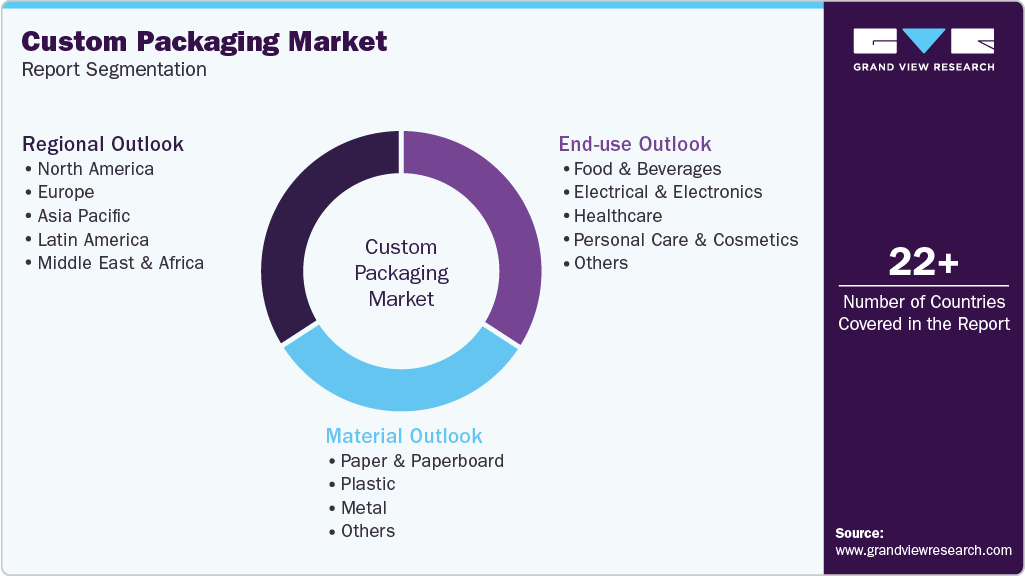
This report forecasts revenue growth at the global, regional & country level and provides an analysis of the latest industry trends in each of the sub-segments from 2021 to 2033. For this study, Grand View Research has segmented the global custom packaging market report based on material, end-use, and region:
 To learn more about this report, Download Free Sample Report
 -
Material Outlook (Revenue, USD Million, 2021 - 2033)
-
Paper & Paperboard
-
Plastic
-
Metal
-
Others
-
-
End-use Outlook (Revenue, USD Million, 2021 - 2033)
-
Food & Beverages
-
Electrical & Electronics
-
Healthcare
-
Personal Care & Cosmetics
-
Others
-
-
Region Outlook (Revenue, USD Million, 2021 - 2033)
-
North America
-
U.S.
-
Canada
-
Mexico
-
-
Europe
-
Germany
-
France
-
UK
-
Italy
-
Spain
-
-
Asia Pacific
-
China
-
India
-
Japan
-
Australia
-
South Korea
-
-
Latin America
-
Brazil
-
Argentina
-
-
Middle East & Africa
-
South Africa
-
Saudi Arabia
-
UAE
-
-
Research Methodology
Segment Definition
Segment - Material
Revenue capture definition
Paper & Paperboard
Revenue generated from custom packaging solutions utilizing paper and paperboard materials, including custom cartons, corrugated boxes, folding cartons, sleeves, inserts, and branded packaging products.
Plastic
Revenue generated from custom packaging solutions utilizing plastic materials such as bottles, containers, pouches, trays, wraps, clamshells, and customized protective packaging formats.
Metal
Revenue generated from custom packaging solutions utilizing customized aluminum, steel, tin, and metallic packaging formats including cans, tins, closures, and decorative packaging products.
Others
Revenue generated from custom packaging solutions utilizing wood, textiles, molded fiber, biodegradable materials, hybrid composites, and other specialty packaging materials.
Segment - End Use
Revenue capture definition
Food & Beverages
Revenue generated from custom packaging solutions supplied for food and beverage products, including customized cartons, corrugated boxes, labels, pouches, bottles, sleeves, trays, and promotional packaging designed to enhance brand visibility, product differentiation, and consumer engagement.
Electrical & Electronics
Revenue generated from custom packaging solutions used for consumer electronics, electrical equipment, components, accessories, and appliances, including branded boxes, protective inserts, anti-static packaging, retail-ready packaging, and e-commerce shipping solutions.
Healthcare
Revenue generated from custom packaging solutions utilized for pharmaceuticals, medical devices, nutraceuticals, diagnostics, and healthcare products, including customized cartons, labels, blister packaging, patient information packaging, and regulatory-compliant packaging formats.
Personal Care & Cosmetics
Revenue generated from custom packaging solutions supplied for cosmetics, skincare, haircare, fragrances, and personal care products, including premium boxes, bottles, jars, tubes, labels, gift packaging, and luxury packaging formats designed to strengthen brand identity and consumer appeal.
Others
Revenue generated from custom packaging solutions supplied across other end-use industries, including consumer goods, industrial products, automotive components, household products, toys, stationery, pet care products, and specialty retail applications requiring customized packaging formats.
Estimation Model
End-Use Product Layer
Customization Adoption Layer
Packaging Consumption Layer
Revenue Generation Layer
Which products require custom packaging solutions?
Which products utilize custom packaging solutions?
How much custom packaging is consumed?
How much revenue is generated?
Analyze global production volumes across food & beverages, cosmetics, pharmaceuticals, electronics, consumer goods, luxury products, e-commerce shipments, and retail merchandise requiring customized packaging.
Apply custom packaging penetration rates across primary, secondary, and tertiary packaging formats based on branding, marketing, premiumization, and product differentiation requirements.
Estimate custom packaging demand based on product production volumes, packaging unit consumption, e-commerce shipments, promotional packaging requirements, and brand-specific packaging programs.
Multiply custom packaging volumes by average selling prices across materials, printing technologies, customization levels, end-use industries, and geographic regions to derive total market revenue.
Delivered Customizations
This report has been delivered with the following In-depth customizations
Client Request
Customization Delivered
Value Adds
Advanced Custom Packaging Technology Trends
Conducted a focused analysis of custom packaging technologies, including digital printing, variable data printing, smart packaging, personalized packaging solutions, sustainable custom materials, and automated design-to-production workflows.
Helps stakeholders identify high-growth technology segments, evaluate innovation trends in customized packaging, and assess opportunities arising from personalization, premiumization, and digital transformation initiatives.
End-Use Industry Demand Assessment
Evaluated demand trends across food & beverages, cosmetics, pharmaceuticals, consumer goods, electronics, luxury products, and e-commerce sectors, including customization requirements and packaging adoption patterns.
Enables stakeholders to identify high-growth end-use sectors, understand evolving customer preferences, and evaluate opportunities for customized packaging solutions.
Custom Packaging Infrastructure & Market Opportunity Analysis
Assessed printing technology investments, packaging manufacturing capacity expansions, sustainability initiatives, e-commerce growth, and regional market developments influencing custom packaging demand globally.
Supports investment and expansion strategies by identifying high-growth regional markets, evaluating technological and regulatory developments, and uncovering opportunities arising from increasing demand for personalized and sustainable packaging solutions.
Frequently Asked Questions About This Report
The global custom packaging market was estimated at around USD 39.7 billion in the year 2025 and is expected to reach around USD 41.6 billion in 2026.
The global custom packaging market is expected to grow at a compound annual growth rate of 6.0% from 2026 to 2033 to reach around USD 59.6 billion by 2033.
The food & beverage segment dominates the custom packaging market due to high demand for attractive, protective, and convenient packaging that boosts brand visibility and ensures product safety.
The key players in the custom packaging market include Amcor plc; Huhtamaki; Sonoco Products Company; Sealed Air; Graphic Packaging International, LLC; ProAmpac; Smurfit Westrock; Mondi; DS Smith; Stora Enso; Coveris; PakFactory; ALPLA; Greif; and Tetra Pak.
The market is driven by rising demand for brand differentiation, personalized and sustainable packaging, and the growth of e-commerce and direct-to-consumer channels. Advanced printing technologies and premium consumer experiences further fuel market adoption.
The paper & paper board segment dominated the global custom packaging market in 2025.
Which end use segment is expected to grow at the fastest CAGR in the global custom packaging market?The healthcare segment is forecasted to grow at the highest CAGR of 6.6% in the global custom packaging market.
The paper & paper board segment is forecasted to grow at the highest CAGR of 6.4% in the global custom packaging market.
North America dominated the global custom packaging market in 2025 with a revenue share of 32.1% in 2025.
About the Author(s)
Plastics, Polymers & Resins Research Team
Bulk Chemicals · Plastics, Polymers & ResinsThis report was authored by the plastics, polymers & resins research team at Grand View Research - comprising two research analysts, one senior research analyst, and one industry expert - with specialized expertise in the plastics, polymers & resins segment of the bulk chemicals industry. All findings are based on proprietary bulk chemicals databases, executive interviews, and regulatory analysis, subject to internal peer review prior to publication.
Last Updated:
Speak to Analyst

Customize this report to your needs - add regions, segments, or data points, with 20% free customization.
Or view our licence options:


ISO 9001:2015 & 27001:2022 Certified
We are GDPR and CCPA compliant! Your transaction & personal information is safe and secure. For more details, please read our privacy policy.


