
- Home
- »
- IT Services & Applications
- »
-
Custom Software Development Market Size Report, 2033GVR Report cover
![Custom Software Development Market (2026 - 2033)Report]()
Custom Software Development Market (2026 - 2033)
Size, Share & Trends Analysis Report By Type (Web-based Solutions, Mobile App, Enterprise Software), By Deployment Mode, By Enterprise Size, By Industry Vertical, By Region, And Segment Forecasts
Market Size, 2025
$45.4BMarket Estimate, 2026
$53.5BMarket Forecast, 2033
$178.9BCAGR, 2026–2033
18.8%Custom Software Development Market Summary
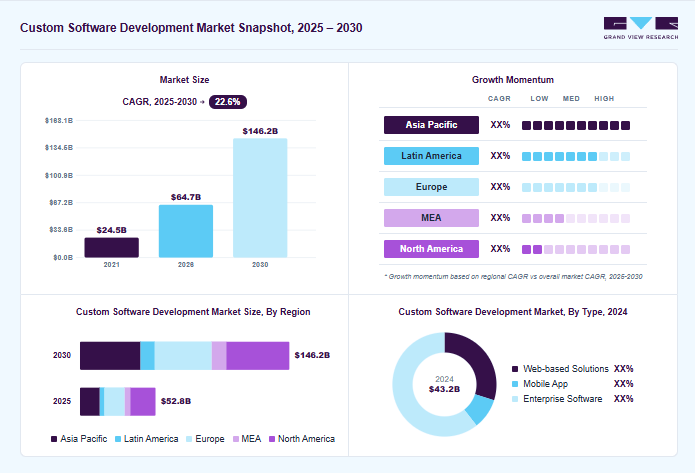
The global custom software development market size was valued at USD 45.4 billion in 2025 and is projected to grow from USD 53.5 billion in 2026 to USD 178.9 billion by 2033, at a CAGR of 18.8% from 2026 to 2033. The market in North America dominated with a revenue share of 33.6% in 2025. This growth is driven by the growing enterprise digital transformation initiatives and increasing demand for AI-enabled, cloud-native business applications.
Key Market Trends & Insights
- By type: Enterprise software segment held the largest market share of 61.1% in 2025.
- By enterprise size: Large enterprises segment held the largest market share of 60.3% in 2025.
- By deployment mode: Cloud segment held the largest market share of 57.5% in 2025.
- By industry vertical: IT & telecom segment held the largest revenue share in 2025.
Regional Highlights
- Largest regional market: North America (33.6% revenue share, 2025)
- Fastest-growing regional market: Asia Pacific (highest CAGR, 2026-2033)
- By country: The U.S. held the largest market share in 2025
Market Size & Forecast
- Market size in 2025: USD 45.4 Billion
- Estimated market size in 2026: USD 53.5 Billion
- Projected market size by 2033: USD 178.9 Billion
- CAGR (2026-2033): 18.8%
There are various factors that contribute to the growth of the custom software development market, such as the growing requirement for industry applications for real-time data analysis, the rising need for flexible workspace to enhance productivity, and the increasing adoption of the low code development platform (LCDP) for easier software development. Moreover, the adoption of analytics with the emergence of a variety of technologies, such as AI-driven Chatbots and robotics automation, is helping boost the growth of the custom software development market.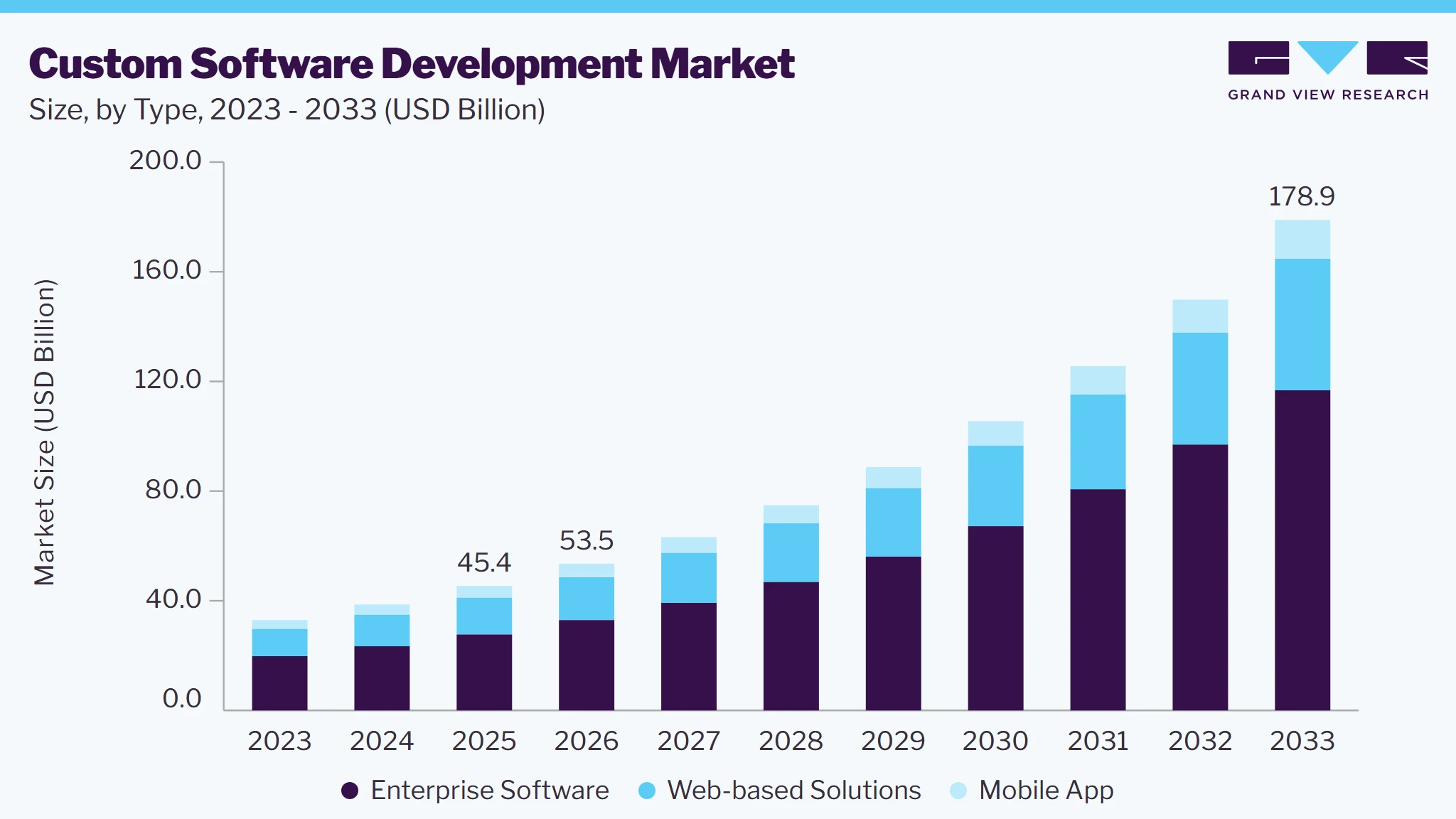
Analytical tools in custom software development, such as business intelligence (BI), machine learning, and artificial intelligence, allow for cross-departmental communication, market trend identification, and process automation. Furthermore, embedding analytics into a company's custom software allows it to understand its customers better and make strategic decisions based on the insight retrieved from the software. For instance, AEC Advisors, an investment banking and corporate finance advisory firm in New York, transformed its business by implementing Fingent Corporation's survey management system and analytics software.
One of the most important aspects of custom software development is cloud technology, as it improves the agility and performance of custom software. In addition, cloud-based software development releases new, high-quality software more quickly and efficiently. Custom software developers collaborate with cloud infrastructure providers to enable companies to accelerate their development process using artificial intelligence. For instance, In March 2023, Replit, Inc., a cloud-based software developer, partnered with Google LLC, a cloud infrastructure provider, to create a generative AI application. The partnership allows Replit developers to access Google Cloud infrastructures, services, and foundation models through Replit, Inc.’s AI software development platform, Ghostwriter. Traditional development of software, such as manual coding, can be challenging. Enterprises need a dedicated team to update the code each time, which usually takes 2 to 8 months.
However, low-code application development enables custom software development teams to develop more applications in less time than traditional coding. The visual development environment makes it easy to design and develop low-code applications. These features allow developers to build customizable sites for multiple devices on a single platform. For instance, in October 2023, The ESDS Software Solution launched a low-code platform called "Low Code Magic." The platform redefines the application development landscape, making it faster, easier, and more efficient for businesses to create custom applications tailored to their needs. Low Code Magic allows organizations to minimize development costs, reduce their time to market, and maximize productivity with minimal coding effort.
Open-source programs are becoming more popular among custom software developers to optimize application development and reduce custom software development expenses. However, it introduces significant risks, including a risk to intellectual property (IP) from restrictive and reciprocal licenses and a security risk from components with vulnerabilities. Open-source development is more problematic for smaller companies that prefer to use it to save time and resources but lack the appropriate security measures to ensure the components they implement are safe. Thus, companies should never open source anything that is core to their business.
Market Dynamics
The global custom software development market is witnessing robust growth as organizations increasingly prioritize digital transformation, business process optimization, and customer-centric innovation through tailored software solutions. Enterprises across industries are investing in custom-built applications to address unique operational requirements, enhance productivity, improve customer experiences, and gain competitive advantages that off-the-shelf software cannot provide. Modern custom software development leverages cloud-native architectures, artificial intelligence (AI), low-code/no-code platforms, DevOps, Agile methodologies, APIs, and microservices to accelerate development cycles, improve scalability, and ensure seamless integration with existing enterprise systems.
The rapid acceleration of digital transformation across enterprises, coupled with the growing need for personalized, scalable, and industry-specific applications, is a significant driver of the global custom software development market. Organizations are increasingly replacing legacy systems with customized software solutions that align with their business processes, regulatory requirements, and customer expectations. Businesses across sectors such as BFSI, healthcare, retail, manufacturing, and government are investing in cloud-native applications, AI-powered platforms, enterprise automation, and data-driven solutions to improve operational efficiency and customer engagement. Modern development practices, including Agile, DevOps, containerization, and microservices, enable faster software delivery, continuous innovation, and seamless integration with enterprise ecosystems. For instance, in February 2026, Fujitsu launched an AI-driven software development platform that uses agentic AI to automate software design, coding, and testing, accelerating custom application development and enterprise modernization.
The significant investment required for designing, developing, deploying, and maintaining custom software remains a key restraint for the market. Organizations must allocate substantial resources toward software architecture, skilled development teams, quality assurance, cybersecurity, integration, and ongoing support to ensure long-term performance and reliability. Large-scale custom software projects often involve evolving business requirements, extended development timelines, scope changes, and integration with legacy enterprise systems, increasing implementation complexity and project risks. Additionally, the shortage of experienced software developers and rising labor costs can further increase total project expenses, making custom software development less accessible for small and medium-sized enterprises with limited IT budgets.
The increasing adoption of AI-assisted software development, cloud-native technologies, and low-code/no-code platforms presents significant growth opportunities for the global custom software development market. Enterprises are investing in intelligent development tools, automated testing, generative AI-powered coding assistants, and cloud-based development environments to accelerate software delivery, improve code quality, and reduce development costs. The rising demand for enterprise modernization, SaaS applications, API-driven ecosystems, IoT integration, and industry-specific digital platforms is creating new opportunities for custom software providers to deliver scalable and highly personalized solutions. Furthermore, increasing investments in cybersecurity, data analytics, AI integration, and multi-cloud architectures are enabling vendors to develop resilient, secure, and future-ready software solutions that support long-term digital transformation initiatives.
Analyst Perspective
The custom software development market sits at the intersection of accelerating digital transformation, widespread cloud adoption, and increasing demand for personalized business applications. Organizations are increasingly investing in tailored software solutions to modernize legacy systems, automate business processes, enhance customer experiences, and support AI-, data-, and cloud-driven operations. As standardized off-the-shelf software becomes insufficient for evolving business requirements, enterprises are adopting custom software built on cloud-native architectures, AI, DevOps, and microservices to deliver greater scalability, flexibility, seamless integration, and long-term competitive advantage.
Type Insights
Based on type, the enterprise software segment led the market with the largest revenue share of 61.1% in 2025. Factors such as a centralized system for multiple departments, improved scalability and integration, and higher security across many different software platforms are contributing to the segment's growth. Moreover, enterprise software automates the business workflow, enhances the efficiency of the daily business process, controls data entry errors, minimizes costs, ensures growth, and integrates the strategies of all business areas for large organizations. Enterprise software comprises plenty of features, and organizations customize it according to their requirement. This software allows tracking and improving supply chains, managing resources, and communicating with customers.
The web-based solutions segment is anticipated to grow at a CAGR of 17.4% during the forecast period due to the ease of remote access, availability of real-time information, and elimination of hardware costs. Moreover, easy data sharing and collaboration due to a centralized software server and adding a new user simply by setting up an access control system are also driving market growth. Additionally, web-based software can help enterprises facilitate more simultaneous processes.
Deployment Mode Insights
Based on deployment mode, the cloud segment led the market with the largest revenue share of 57.5% in 2025. This segment is primarily driven by factors such as ease of access, flexibility, and cost-effectiveness for small and medium-sized businesses. A cloud custom software service has no upfront cost to enterprises and provides a highly flexible environment for managing their business applications. Additionally, cloud computing enables smartphones and other devices to access data from anywhere. The rising number of smartphone users and Bring Your Own Device (BYOD) usage also drives the demand for cloud software development market.
The on-premise segment is expected to expand at a CAGR of 17.3% during the forecast period. On-premise software offers total ownership and control and is considered more reliable in companies; on-premise application development services are preferred as they provide a high level of data security through physical security controls and security protocols. Employees can access the data with on-premise solutions without an internet connection. Moreover, annual maintenance and one-time license fees are lower than recurring expenses associated with cloud software. The system can also be accessed by multiple users simultaneously without affecting performance.
Enterprise Size Insights
Based on enterprise size, the large enterprises segment led the market with the largest revenue share of 60.3% in 2025 in the custom software development industry. Many large corporations rely on custom software for competitive advantage. Custom software development ensures the creation of solutions tailored to meet the specific requirements of enterprises. There is a growing need for custom software in various large enterprises as it allows particular criteria to be fulfilled at a lower cost than purchasing. Additionally, custom solutions can easily be integrated with existing systems and can even be used to extend the functionalities of existing tools. Furthermore, custom software solutions developed from scratch are hard to infiltrate, and the software adds an extra layer of security by encrypting the data.
The SMEs segment is anticipated to grow at the fastest CAGR during the forecast period. Several factors correlate with the growth prospects of this segment, including the growth of small and medium businesses, cost-effectiveness, and scalability. Extra features can be added to the existing system when the business grows. It offers integration of the latest technologies and enhances business operations for SMEs. Custom software solutions are an easy way for businesses to implement business workflow. Businesses don't need to adapt to the software; apparently, it is developed based on what they do. These solutions can streamline repetitive tasks and help boost collaboration within companies.
Industry Vertical Insights
Based on industry vertical, IT & telecom segment led the market with the largest revenue share of 21.3% in 2025 in the custom software development market. Custom software can incorporate all essential security apps and programs that comply with current trends and industry standards. IT solutions tailored to customer needs often provide more flexibility than traditional software. Custom software enables more efficient operations along with low maintenance and licensing costs. By using custom software, businesses can create clear and accessible reports. As a result, they can save time and concentrate on core tasks.
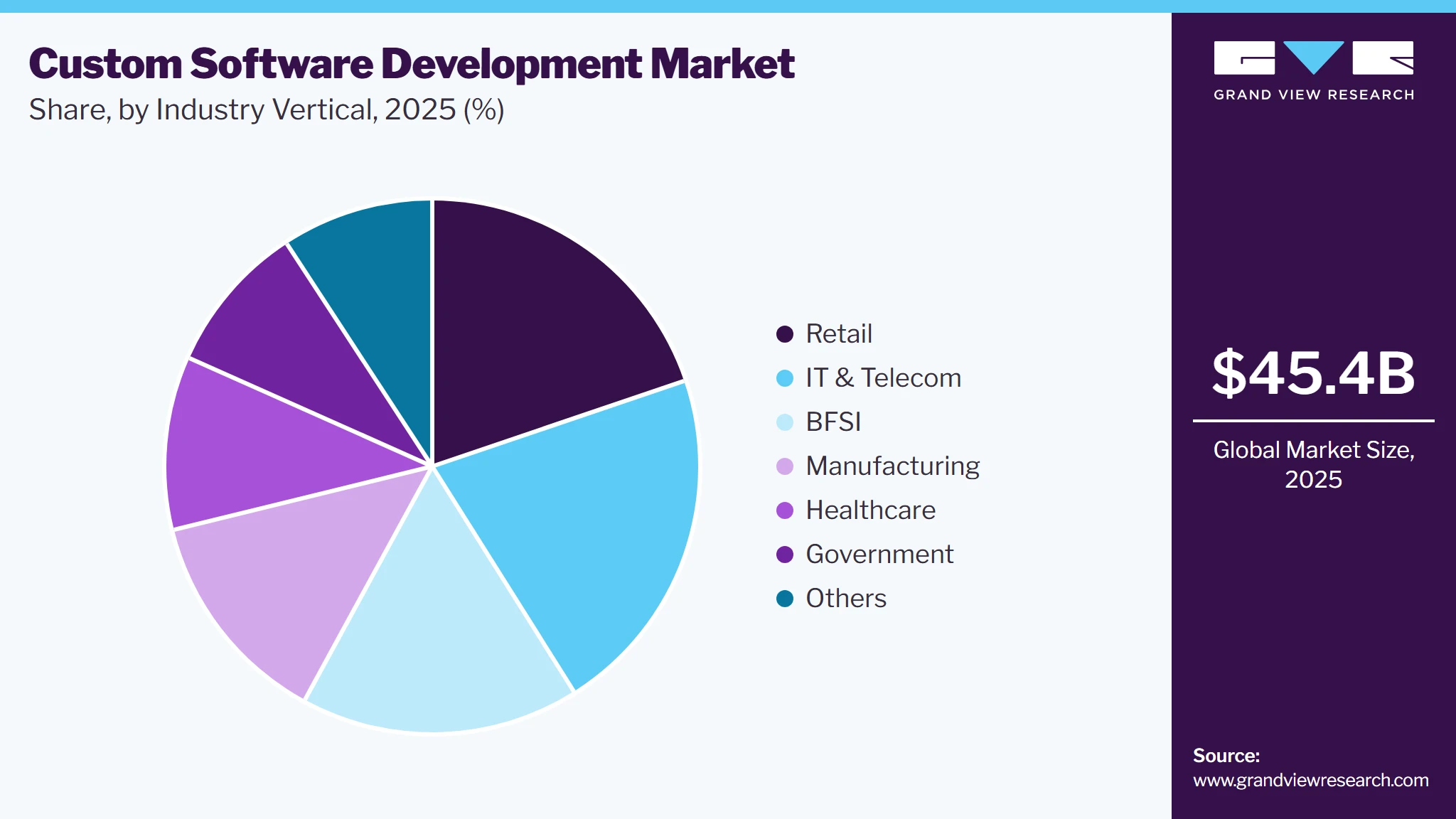
The government segment is anticipated to grow at a CAGR of 21.9% during the forecast period. Governments worldwide know the potential transformation technology can effectuate, translating into improved citizen services, operational efficiencies, and thriving economies. Custom software solutions tailored to the unique needs of government agencies are becoming indispensable tools for modernizing legacy systems, automating processes, and fostering transparency and accountability.
Regional Insights
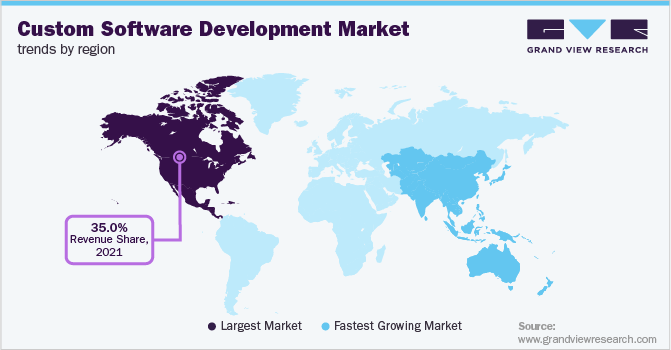
North America dominated the global custom software development market with the largest revenue share of 33.6% in 2025. Various factors contribute to the region's growth, including the widespread use of advanced expertise, the surge in IT services, and the rise of SMEs. Moreover, with growing automation and digital transformation in the region, North America is becoming the preferred destination for custom software development services.
U.S. Custom Software Development Market Trends
The custom software development market in the U.S. held the largest share in the North America region in 2025. The growth of edge computing and IoT (Internet of Things) adoption is fueling custom software demand. The U.S. is experiencing a surge in smart devices, industrial IoT (IIoT) applications, and real-time edge computing solutions that require custom-built software to process, analyze, and secure data at the network edge. Industries such as manufacturing, energy, and transportation rely on custom IoT software to monitor operations, predict maintenance needs, and optimize supply chains. As the adoption of connected devices continues to expand, the demand for custom-built IoT and edge computing solutions will keep increasing.
Europe Custom Software Development Market Trends
The custom software development market in Europe is growing at a CAGR of 19.3% from 2026 to 2033. The promising growth prospects of the European market can be attributed to the presence of various companies in the region that introduce advanced solutions to better serve specific industries. In December 2023, Nokia Corporation announced that its 5G Standalone Core SaaS software was chosen by Telia Company (Finland) as part of an innovation program funded by the European Union (EU).
The custom software development market in UK is growing significantly at a CAGR of 16.5% from 2026 to 2033. The rising complexity of multi-cloud and hybrid cloud environments is driving market growth. Many enterprises operate across multiple cloud providers, such as AWS, Microsoft Azure, and Google Cloud, while also maintaining some on-premises infrastructure. Managing such diverse environments can be challenging without proper visibility and control. Custom software development solutions provide unified dashboards, automated alerts, and analytics-driven insights that enable IT teams to oversee performance across different cloud platforms. This demand for cross-platform monitoring is driving innovation and investment in advanced cloud monitoring technologies.
Germany custom software development market is growing significantly at a CAGR of 18.8% from 2026 to 2033. The rapid adoption of AI, big data, and cloud computing is driving demand for custom software development in Germany. Businesses are increasingly leveraging AI-powered analytics, machine learning models, and cloud-based platforms to improve decision-making and enhance operational efficiency. Custom software development firms are catering to this demand by providing AI-driven applications, data analytics platforms, and cloud-native solutions that are tailored to the specific needs of German enterprises.
Asia Pacific Custom Software Development Market Trends
The custom software development market in Asia Pacific is anticipated to register the highest CAGR from 2026 to 2033 due to the advancement of technological implementation in enterprises. The emergence of SMEs, the growing market for custom software, and the need to modernize legacy software development systems are also driving the market growth. Large tech firms and an increasing number of custom software suppliers in advanced Asian economies such as Japan and South Korea contribute to market growth.
China custom software development market is growing significantly at a CAGR from 2026 to 2033. The expansion of e-commerce and digital payments in China is significantly boosting demand for custom software development. With China being the world’s largest e-commerce market, businesses need specialized digital platforms, payment gateways, and customer engagement tools to stay competitive. Companies are investing in tailored e-commerce platforms that offer seamless user experiences, integrate advanced payment solutions such as WeChat Pay and Alipay, and leverage AI-driven recommendation engines. Moreover, businesses operating in cross-border e-commerce require custom solutions that comply with international trade regulations, handle multi-currency transactions, and optimize logistics.
The custom software development market in India is growing significantly at a CAGR from 2026 to 2033. India’s IT outsourcing and software services industry is a major driver of custom software development. India has some of the largest IT service providers, such as TCS, Infosys, Wipro, and HCL, which serve global clients by providing customized software solutions. Many international companies outsource their custom software development projects to Indian firms due to the availability of highly skilled software engineers, cost-effective solutions, and a strong technical talent pool. With a growing number of enterprises worldwide looking for tailored software solutions, India’s position as an outsourcing hub continues to fuel the expansion of its custom software development market.
Middle East & Africa Custom Software Development Market Trends
The custom software development industry in Middle East & Africa is growing significantly at a CAGR from 2026 to 2033. The increasing demand for fintech and digital banking solutions is fueling the growth of custom software development in MEA. The financial sector is undergoing a massive digital transformation, with banks and fintech startups investing in blockchain, AI-powered risk management, and mobile banking applications. Custom software is crucial for financial institutions looking to develop secure, scalable, and regulation-compliant financial technology solutions. Countries such as the UAE and Saudi Arabia with startups and enterprises seeking tailored financial applications to enhance customer engagement and streamline operations.
Key Custom Software Development Company Insights
Some of the key companies operating in the market Tata Consultancy Services Limited, Capgemini, Tietoevry, and among others are some of the leading participants in the custom software development market.
-
Tata Consultancy Services Limited is an IT services, consulting, and business solutions provider. The company has categorized its services under Cognitive Business Operations, Cloud, Consulting, Data and Analytics, Cybersecurity, Enterprise Solutions, Network Solutions and Services, IoT and Digital Engineering, TCS Interactive, and Sustainability Services. The company also specializes in custom software development services, including complete product and platform development, next-generation product engineering, product integration, and flexible engagement models for products and product lines.
-
Capgemini is a consulting, technology services, and digital transformation company that helps businesses transform their business operations by leveraging cutting-edge technology. The company has been a trusted strategic partner to businesses worldwide for more than 50 years. With deep industry expertise and technology expertise across cloud, data, Artificial Intelligence (AI), software, and digital engineering, the company offers a wide range of services, including strategy formulation, custom software development, and application designing to help businesses address their diverse needs.
Magora, Iflexion, and TRooTech Business Solutions are some of the emerging market participants in the custom software development market.
-
Magora specializes in developing custom applications and software and providing seamless integration services. The company’s collaborative approach prioritizes maximizing value and the return on investment for clients by providing comprehensive technology tools to enhance customer engagement and drive commerce. The company employs a team of specialists to develop mobile applications for Android and iOS and offer software and web development services. The company offers a wide range of services, including web development, mobile app development, custom software development, bespoke software development, outsourcing software development, startup MVP development, AI & Machine Learning (ML) integration, enterprise app development, product discovery, and IoT app development, among others.
-
TRooTech Business Solutions is a custom software development company. The company specializes in developing performance-boosting and purpose-driven tools that can be seamlessly integrated into any business application. The company’s team of experienced custom software developers and consultants offers comprehensive guidance from strategic planning and software optimization to deployment. The company’s software development services include custom software development, custom mobile app development, custom web app development, cloud app development, customized SaaS development, and remaking legacy software. The company also offers other professional services, including technology portfolio consulting, enterprise architecture consulting, software modernization, and application consulting.
Key Custom Software Development Companies:
The following key companies have been profiled for this study on the custom software development market.
-
Accenture plc
-
Brainvire Infotech Inc.
-
Capgemini
-
Cognizant
-
HCL Technologies Limited
-
Iflexion
-
Infopulse
-
Infosys Ltd.
-
Magora
-
Microsoft
-
Tata Consultancy Services Limited
-
Thoughtworks, Inc.
-
Tietoevry
-
Trigent Software, Inc.
-
TRooTech Business Solutions
Competitive Benchmarking
Category
Operating Strategies
Competitive Edge
Weakness
Established Players (Accenture, Capgemini, Cognizant, HCL Technologies Limited, Infosys Ltd., Microsoft, Tata Consultancy Services (TCS), Thoughtworks, and Tietoevry)
- Expand AI-powered custom software development capabilities by leveraging cloud-native architectures, DevOps, low-code/no-code platforms, and industry-specific digital solutions.
- Strengthen partnerships with hyperscalers, enterprise technology vendors, and cloud providers while investing in generative AI, cybersecurity, application modernization, and managed software services.
- Extensive global delivery centers, deep domain expertise, and large engineering workforces enable execution of complex, enterprise-scale digital transformation projects.
- Comprehensive portfolios spanning consulting, software development, cloud migration, system integration, AI, and application management provide end-to-end software lifecycle services and strong customer retention.
- High operating costs, premium pricing, and complex organizational structures may reduce flexibility for smaller projects.
- Longer project approval cycles and dependence on large enterprise contracts can slow responsiveness compared with niche development firms.
Emerging Players (Brainvire, Iflexion, Infopulse, Magora, and Trigent Software, Inc.)
- Focus on customized web, mobile, and enterprise software development for SMEs and mid-sized enterprises through agile delivery, rapid prototyping, cloud application development, and AI integration services.
- Differentiate through flexible engagement models, faster delivery timelines, and industry-specific software expertise.
- Competitive pricing, personalized customer engagement, and agility enable rapid delivery of tailored software solutions.
- Strong expertise in niche technologies and flexible development models helps address specialized client requirements and accelerate project execution.
- Limited global delivery capabilities, smaller talent pools, and lower brand recognition reduce competitiveness for large multinational transformation projects.
- Narrower service portfolios and fewer strategic alliances may constrain expansion into highly regulated industries and large enterprise accounts.
Recent Developments
-
In May 2024, Proxet Group Inc. partnered with Palantir Technologies Inc., a leading provider of AI-powered enterprise solutions. Palantir offers a comprehensive suite of tools for data analysis, collaboration, and operational efficiency. Businesses leverage Palantir's software to enhance vehicle safety, strengthen global supply chains, and advance cancer research. Through this partnership, Proxet expands the development of service options for Palantir customers while maintaining high standards.
-
In January 2024, Brainvire Infotech Inc. announced a collaboration with Sing In Chinese to develop an interactive app for children, with advanced features and modules, such as lessons, games, quizzes, karaoke, pet management, and subscription options. The app offers a user-friendly educational platform for children, thereby revolutionizing the learning landscape.
-
In November 2023, Infopulse announced the release of PACE Suite 6.1, a user-friendly solution that streamlines the complete workflow of application packaging management. The new updates help reduce complex scripting challenges, enhance installation success, and provide consistent deployment experience.
-
In July 2023, Tietoevry announced the acquisition of MentorMate, a provider of digital engineering, consulting, and design services. The acquisition was aimed at accelerating Tietoevry’s software and digital engineering capabilities, along with increasing its customer base and digital talent in the market.
Custom Software Development Market Report Scope
Report Attribute
Details
Market size in 2025
USD 45.4 billion
Estimated market size in 2026
USD 53.5 billion
Projected market size by 2033
USD 178.9 billion
Growth rate
CAGR of 18.8% from 2026 to 2033
Base year for estimation
2025
Historical data
2021 - 2024
Forecast period
2026 - 2033
Quantitative units
Revenue in USD million/billion and CAGR from 2026 to 2033
Report coverage
Revenue forecast, company market share analysis, competitive landscape, growth factors, and trends
Segments covered
Type, deployment mode, enterprise size, industry vertical, and region
Regional scope
North America; Europe; Asia Pacific; Latin America; MEA
Country scope
U.S.; Canada; Mexico; Germany; UK; France; China; Japan; India; South Korea; Australia; Brazil; Saudi Arabia; South Africa; UAE
Key companies profiled
Accenture; Brainvire; Infotech Inc.; Capgemini; Cognizant; HCL Technologies Limited; Iflexion; Infopulse; Infosys Ltd.; Magora; Microsoft; Tata Consultancy Services Limited; Thoughtworks, Inc.; Tietoevry; Trigent Software, Inc.; TRooTech Business Solutions
Customization scope
Free report customization (equivalent up to 8 analysts' working days) with purchase. Addition or alteration to country, regional & segment scope.
Pricing and purchase options
Avail customized purchase options to meet your exact research needs. Explore purchase options
Global Custom Software Development Market Report Segmentation
This report forecasts revenue growth at global, regional, and country levels and provides an analysis of the latest industry trends in each of the sub-segments from 2021 to 2033. For this study, Grand View Research has segmented the global custom software development market report based on type, deployment mode, enterprise size, industry vertical, and region.
-
Type Outlook (Revenue, USD Billion, 2021 - 2033)
-
Web-based Solutions
-
Mobile App
-
Enterprise Software
-
-
Deployment Mode Outlook (Revenue, USD Billion, 2021 - 2033)
-
Cloud
-
On-premise
-
-
Enterprise Size Outlook (Revenue, USD Billion, 2021 - 2033)
-
Large Enterprises
-
SMEs
-
-
Industry Vertical Outlook (Revenue, USD Billion, 2021 - 2033)
-
BFSI
-
Government
-
Healthcare
-
IT & Telecom
-
Manufacturing
-
Retail
-
Others
-
-
Regional Outlook (Revenue, USD Billion, 2021 - 2033)
-
North America
-
U.S.
-
Canada
-
Mexico
-
-
Europe
-
Germany
-
UK
-
France
-
-
Asia Pacific
-
China
-
India
-
Japan
-
South Korea
-
Australia
-
-
Latin America
-
Brazil
-
-
Middle East & Africa
-
UAE
-
Saudi Arabia
-
South Africa
-
-
Research Methodology
The custom software development market figures in this report are based on a proven research process that combines executive interviews with secondary research from proprietary databases, company filings, and recognized regulatory and institutional sources. Market size is built through value-chain sizing - reconciling supply-side and demand-side estimates - and triangulated with bottom-up and top-down approaches. Every estimate passes multiple levels of expert validation before publication, with each custom software development segment quantified using the revenue-capture definitions in the table below.
Segment Definition
Segment - Type
Revenue capture definition
Web-based Solutions
Revenue is generated from the development, customization, deployment, integration, and maintenance of browser-based software applications accessible through the internet or enterprise networks. This includes custom web portals, enterprise web applications, e-commerce platforms, SaaS applications, and related professional services.
Mobile App
Revenue is generated from the design, development, customization, deployment, integration, testing, and maintenance of native, hybrid, and cross-platform mobile applications for iOS, Android, and other mobile operating systems, including associated consulting and support services.
Enterprise Software
Revenue is generated from the development, customization, implementation, integration, and ongoing support of enterprise-grade software solutions such as ERP, CRM, HRM, SCM, finance, workflow automation, analytics, and other business applications tailored to organizational requirements.
Segment - Deployment Mode
Revenue capture definition
Cloud
Revenue is generated from the development and deployment of custom software hosted on public, private, or hybrid cloud environments. It includes cloud-native application development, SaaS solutions, cloud migration, API integration, DevOps, managed services, and ongoing maintenance.
On-premise
Revenue is generated from custom software developed for deployment within an organization's own IT infrastructure. It includes software development, implementation, system integration, customization, upgrades, security enhancements, and long-term technical support.
Segment - Enterprise Size
Revenue capture definition
Large Enterprises
The large enterprises segment, with respect to the number of employees, typically comprises organizations employing more than 1,000 employees for multinational corporations.
SMEs
The SMEs segment, with respect to the number of employees, generally includes organizations employing between 10 and 999 employees.
Segment - Industry Vertical
Revenue capture definition
BFSI
Revenue includes custom software development for banking, financial services, and insurance organizations, covering digital banking platforms, payment solutions, lending systems, wealth management, compliance, fraud detection, and customer engagement applications.
Government
Revenue includes custom software development for public sector organizations, including e-governance platforms, citizen service portals, public administration systems, taxation, licensing, digital identity, and related application modernization projects.
Healthcare
Revenue includes custom software development for healthcare providers, hospitals, pharmaceutical companies, and health technology firms, including electronic health records (EHR), telemedicine, patient engagement, medical billing, healthcare analytics, and clinical management systems.
IT & Telecom
Revenue includes custom software development for IT service providers and telecommunications companies, covering OSS/BSS platforms, network management, cloud platforms, customer experience solutions, enterprise applications, and digital service delivery systems.
Manufacturing
Revenue includes custom software development for manufacturing organizations, including MES, production planning, supply chain management, inventory management, predictive maintenance, industrial IoT applications, and factory automation solutions.
Retail
Revenue includes custom software development for retailers and e-commerce companies, including omnichannel commerce platforms, POS solutions, inventory management, customer loyalty applications, order management, and personalized shopping solutions.
Others
Revenue includes custom software development across education, energy & utilities, transportation & logistics, media & entertainment, travel & hospitality, real estate, and other industries requiring tailored software solutions, digital transformation services, and application modernization.
Estimation Model
Layer
Question
Analysis
Digital Transformation Demand Layer
Who can benefit from custom software development services?
Identify organizations seeking tailored software solutions to improve operational efficiency, customer experience, automation, and competitive advantage. These include enterprises across BFSI, healthcare, retail, manufacturing, IT & telecom, government, education, logistics, and other industries undergoing digital transformation or replacing legacy systems with customized applications.
Technology Readiness Layer
Who can access custom software development services?
Evaluate organizations based on their IT maturity, digitalization initiatives, cloud adoption, software modernization strategies, and budget for technology investments. Enterprises implementing cloud, AI, IoT, data analytics, DevOps, or enterprise automation initiatives represent the primary addressable market for custom software development services.
Adoption & Utilization Layer
Who actively uses custom software development services?
Analyze organizations deploying custom web applications, mobile applications, enterprise software, cloud-native platforms, APIs, and system integration solutions to streamline business processes, enhance customer engagement, improve decision-making, and support industry-specific operational requirements. Active users include enterprises of all sizes across public and private sectors requiring scalable and personalized software solutions.
Monetization Layer
How much revenue is generated?
Assess revenue generated through software consulting, UI/UX design, application development, customization, system integration, API development, cloud migration, testing, deployment, modernization, DevOps implementation, cybersecurity integration, application maintenance, technical support, managed application services, software upgrades, and long-term support contracts delivered as project-based or recurring services.
Delivered Customizations
This report has been delivered with the following In-depth customizations
CLIENT REQUEST
CUSTOMIZATION DELIVERED
VALUE ADDS
AI-Powered Software Development & Generative AI Trends
Conducted a structured analysis of AI-driven software development focused on generative AI, AI coding assistants, intelligent automation, agentic AI, low-code/no-code platforms, and AI-enabled application modernization.
Helps stakeholders understand emerging AI development technologies, identify high-growth software engineering trends, and evaluate commercialization opportunities in AI-powered custom software development.
Cloud-Native Application Development & Modernization Trends
Conducted a comprehensive analysis of cloud-native software development, including microservices, containers, Kubernetes, serverless computing, DevOps, API-first architectures, and legacy application modernization strategies.
Helps stakeholders identify opportunities in cloud transformation, assess enterprise modernization initiatives, and evaluate investments in scalable, resilient, and cloud-ready custom software solutions.
Cloud Migration & Multi-Cloud Development Trends
Conducted a comprehensive analysis of cloud migration services, hybrid and multi-cloud architectures, SaaS development, cloud security, and cloud-native engineering practices.
Helps stakeholders identify cloud adoption opportunities, evaluate migration strategies, and strengthen cloud-based software development capabilities.
Frequently Asked Questions About This Report
The enterprise software segment led with a 61.1% revenue share in 2025.
The cloud segment led with a 57.5% revenue share in 2025.
The large enterprises segment held the largest share (over 60.0%) in 2025, while the SMEs segment is the fastest-growing segment.
Key players operating in the custom software development market include Accenture; Brainvire; Infotech Inc.; Capgemini; Cognizant; HCL Technologies Limited; Iflexion; Infopulse; Infosys Ltd.; Magora; Microsoft; Tata Consultancy Services Limited; Thoughtworks, Inc.; Tietoevry; Trigent Software, Inc.; TRooTech Business Solutions
The global custom software development market size was valued at USD 45.4 billion in 2025 and is estimated at USD 53.5 billion for 2026.
The global custom software development market is expected to grow at a CAGR of 18.8% from 2026 to 2033, reaching USD 178.9 billion by 2033.
Key factors include rapid acceleration of digital transformation across enterprises, coupled with the growing need for personalized, scalable, and industry-specific applications.
North America dominated with 33.6% revenue share in 2025.
Asia Pacific is the fastest-growing region over the forecast period.
About the Author(s)
IT Services & Applications Research Team
Technology · IT Services & ApplicationsThis report was authored by the it services & applications research team at Grand View Research - comprising two research analysts, one senior research analyst, and one industry expert - with specialized expertise in the it services & applications segment of the technology industry. All findings are based on proprietary technology databases, executive interviews, and regulatory analysis, subject to internal peer review prior to publication.
Last Updated:
Speak to Analyst

Customize this report to your needs — add regions, segments, or data points, with 20% free customization.
Or view our licence options:


ISO 9001:2015 & 27001:2022 Certified
We are GDPR and CCPA compliant! Your transaction & personal information is safe and secure. For more details, please read our privacy policy.












