
- Home
- »
- Advanced Interior Materials
- »
-
CVD And CVI Vacuum Furnaces Market Size Report, 2030GVR Report cover
![CVD And CVI Vacuum Furnaces Market Size, Share & Trends Report]()
CVD And CVI Vacuum Furnaces Market (2025 - 2030) Size, Share & Trends Analysis Report By Product (CVD Vacuum Furnaces, CVI Vacuum Furnaces), By Operation, By Orientation (Horizontal, Vertical), By End-use (Aerospace, Automotive), By Region And Segment Forecasts
- Report ID: GVR-4-68040-545-9
- Number of Report Pages: 90
- Format: PDF
- Historical Range: 2018 - 2024
- Forecast Period: 2025 - 2030
- Industry: Advanced Materials
- Report Summary
- Table of Contents
- Interactive Charts
- Methodology
- Download FREE Sample
-
 Download Sample Report
Market Size & Trends
The global CVD and CVI vacuum furnaces market size was estimated at USD 64.1 million in 2024 and is expected to grow at a CAGR of 10.2% from 2025 to 2030. The market is experiencing growth due to the rising demand for high-performance materials in industries like aerospace, automotive, and electronics. These technologies are essential for producing advanced coatings, composites, and components with superior properties such as heat resistance, durability, and corrosion resistance. Aerospace and electronics sectors, particularly in producing turbine blades and semiconductor devices, are driving the adoption of CVD and CVI systems.
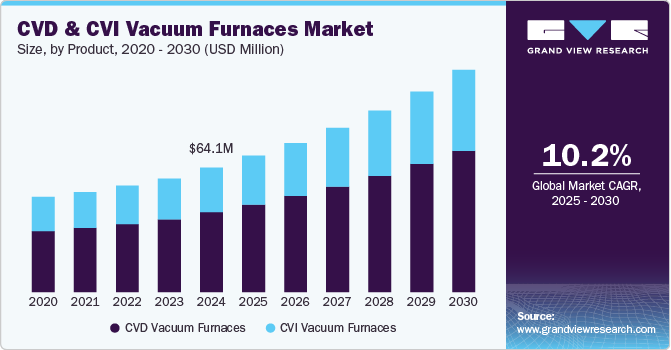
A growing trend is the increasing focus on energy efficiency and sustainability in furnace design. Manufacturers are developing energy-saving technologies that reduce operational costs and carbon footprints. In addition, advancements in furnace technology, such as better temperature control systems and faster cycle times, improve productivity and reduce material waste, making CVD and CVI furnaces more cost-effective and environmentally friendly.
Market Concentration & Characteristics
The CVD and CVI vacuum furnaces industry is moderately concentrated, with a few key players holding significant market share. Leading companies such as Thermionics, Centorr Vacuum Industries, and Applied Materials dominate the market due to their advanced technological capabilities and established reputation in the industry. These companies leverage strong research and development (R&D) resources to provide innovative and high-quality furnace systems that cater to the diverse needs of industries such as aerospace, automotive, and electronics.
The market is characterized by the increasing demand for high-performance materials across various sectors, which drives the adoption of CVD and CVI vacuum furnaces. These systems produce critical components like ceramic matrix composites and thin films, which are essential for industries requiring precision and superior material properties, such as heat resistance, strength, and durability. The versatility of these furnaces enables them to cater to different applications, ranging from semiconductor manufacturing to turbine blade production.
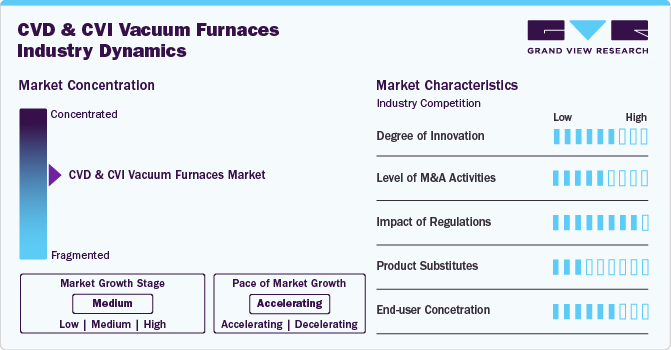
Technological advancements play a key role in shaping the market for CVD and CVI vacuum furnaces, with ongoing innovations focused on automation, improved temperature control, and energy efficiency. Modern furnaces are equipped with advanced sensors and software, which optimize production processes, reduce cycle times, and enhance the overall precision of the manufacturing process. These innovations improve the furnaces' performance and help companies meet sustainability goals by reducing energy consumption and material waste.
Geographically, North America, Europe, and Asia Pacific are the leading regions in the CVD and CVI vacuum furnace market, driven by the presence of advanced manufacturing industries. These regions continue investing in R&D and infrastructure to enhance furnace technologies and cater to the growing demand for high-quality materials in the aerospace, electronics, and automotive sectors. As industrialization expands in emerging markets, the demand for CVD and CVI vacuum furnaces is expected to rise, particularly in countries looking to boost manufacturing capabilities and improve product performance.
Drivers, Opportunities & Restraints
The increasing demand for advanced materials across industries such as aerospace, electronics, and automotive drives the market. As these sectors require high-performance components with exceptional properties like heat resistance, durability, and strength, CVD and CVI technologies play a crucial role in producing materials such as ceramic matrix composites, thin films, and coatings. Moreover, the push for precision manufacturing, higher product quality, and more energy-efficient processes further accelerates the adoption of these advanced furnaces.
A key restraint in the market is the high initial investment and operational costs associated with these systems. The complexity of the technology and the specialized materials required for these furnaces can make them expensive to procure and maintain, limiting their accessibility for smaller companies or emerging markets. Furthermore, the need for skilled operators and ongoing maintenance can further increase the overall cost of ownership, potentially restricting market growth in price-sensitive regions.
The growing emphasis on sustainability and energy efficiency presents significant market innovation opportunities. Manufacturers increasingly focus on developing more energy-efficient systems that reduce consumption and minimize material waste. In addition, the rising demand for advanced materials in emerging sectors like renewable energy and 5G technology opens up new growth avenues. As industries continue to prioritize sustainable practices, the market for energy-efficient and environmentally friendly CVD and CVI furnaces is expected to expand.
Product Insights
The CVD vacuum furnaces product segment accounted for a revenue share of 64.4% in 2024. The CVI vacuum furnaces product segment is expected to grow at a considerable CAGR of 10.6% from 2025 to 2030 in terms of revenue. These furnaces are essential for processes requiring thin-film deposition, surface coatings, and material modification. The growing need for high-quality coatings in the semiconductor, aerospace, and automotive industries drives the demand for CVD furnaces. These systems provide the precision necessary to control chemical reactions and ensure uniform deposition, which is crucial for producing high-performance materials used in electronics and advanced engineering applications.
CVI vacuum furnaces infiltrate porous substrates with high-density, high-strength materials, making them crucial for the aerospace, automotive, and defense sectors. The primary drivers of the CVI furnace market include the growing need for advanced composites in applications like turbine blades, brakes, and other critical components that require high strength and durability. CVI furnaces allow for the controlled infiltration of materials, improving the mechanical properties of composite materials.
Orientation Insights
The vertical furnaces orientation segment accounted for a revenue share of 60.1% in 2024. The vertical furnace segment is poised for steady growth as industries increasingly focus on compact and efficient furnace solutions. In sectors such as semiconductor and material science, the vertical furnace's ability to provide precise control over deposition processes is leading to higher adoption rates.
Horizontal furnaces are widely used in CVD and CVI vacuum furnace applications due to their efficient design, allowing easy material loading and unloading. These furnaces are particularly beneficial in high-volume production and for processing large, flat components. The key drivers for the horizontal furnace market include high throughput and the ability to achieve uniform temperature distribution across substrates, which is essential for industries such as aerospace, electronics, and automotive.
Operation Insights
The batch furnaces operation segment accounted for a revenue share of 71.1% in 2024. Batch furnaces are designed to process materials in discrete batches, which offers great flexibility for industries needing customized processing solutions. These systems are commonly used in applications requiring precise temperature and atmosphere control, making them ideal for industries like aerospace and healthcare, where material properties are critical. The ability to handle varied materials in a single furnace system is a key driver for batch furnaces.
The continuous furnaces operation segment is expected to grow at a considerable CAGR of 10.4% from 2025 to 2030 in terms of revenue. Continuous furnaces are designed to provide uninterrupted, high-volume processing, which is particularly valuable in industries requiring consistent, large-scale production. These systems are critical for applications where high throughput and uniform material processing are essential. Their ability to operate efficiently over extended periods with minimal downtime is a major driver for their use in the automotive, electronics, and energy sectors.
End Use Insights
“The automotive end use segment is expected to grow at a considerable CAGR of 10.8% from 2025 to 2030 in terms of revenue”
The aerospace end use segment accounted for a revenue share of 40.8% in 2024. CVD and CVI vacuum furnaces are critical in the aerospace industry for producing high-performance materials such as turbine blades, aerospace composites, and coatings for components exposed to extreme environments. These furnaces enable the deposition of durable coatings and the infiltration of porous materials to improve the strength, heat resistance, and overall performance of components used in aerospace applications. The precise control over these furnaces' temperature, pressure, and atmosphere is vital for ensuring the reliability and safety of aerospace parts.
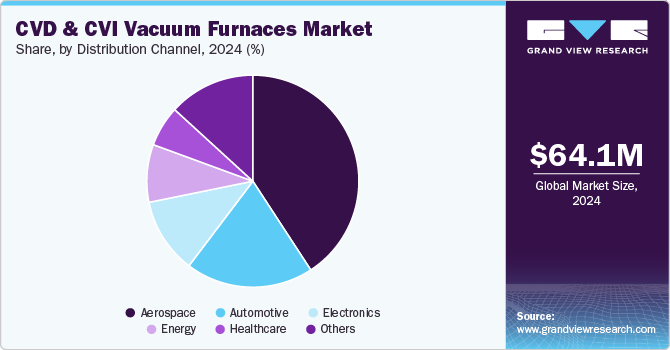
In the automotive industry, CVD and CVI vacuum furnaces are widely used to manufacture high-strength components, coatings, and materials such as brake systems, engine parts, and lightweight structural components. The ability to deposit thin films and create composite materials with superior properties allows these furnaces to meet performance and durability requirements for modern automotive applications. This is especially important as automakers work to develop components that are lighter, more fuel-efficient, and have a longer lifespan.
Regional Insights
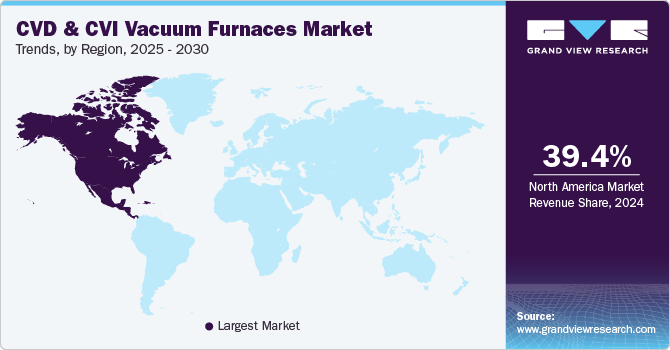
The North America region led the market and accounted for 39.4% of the global CVD and CVI vacuum furnaces market in 2024. The region's market is driven by the aerospace, automotive, and electronics industries' need for advanced materials. The region is increasingly focused on energy efficiency and automation, with companies adopting more sustainable technologies. Innovation in materials like ceramic matrix composites and thin films continues to support market growth. Moreover, stringent manufacturing standards in North America are driving the adoption of high-precision furnace systems.
U.S. CVD And CVI Vacuum Furnaces Market Trends
The CVD and CVI vacuum furnaces market in the U.S. is expected to grow at a CAGR of 10.2% from 2025 to 2030. The aerospace and defense sectors heavily influence the market, which requires high-performance materials for turbine blades and other components. The country invests in research and development to improve furnace technology, focusing on energy efficiency and precision. The rise of semiconductor manufacturing also boosts demand for CVD furnaces, particularly in the electronics industry.
Canada CVD and CVI vacuum furnaces market is expected to grow at a CAGR of 11.1% from 2025 to 2030. Canada's market is driven by the aerospace and automotive industries, which demand high-quality materials like ceramic composites for lightweight and durable components. The country’s emphasis on energy efficiency aligns with the growing trend of developing more sustainable furnace technologies.
Europe CVD And CVI Vacuum Furnaces Market Trends
The CVD and CVI vacuum furnaces market in Europe is expanding due to the demand for high-performance materials in the aerospace, automotive, and electronics industries. The region's focus on sustainability and reducing carbon footprints has accelerated the development of energy-efficient and environmentally friendly furnace technologies.
Germany CVD and CVI vacuum furnaces market held a 30.0% share in the European market. Germany, an advanced manufacturing and aerospace leader, significantly contributes to the European market. The demand for high-performance materials in the automotive and aerospace sectors drives growth, particularly for producing turbine blades and other components. Germany is investing in high-tech R&D for automation and energy-efficient furnace systems.
The CVD and CVI vacuum furnaces market in the UK is driven by rising demand for aerospace, automotive, and electronics. The UK's strong aerospace industry requires high-performance materials like composites, which drives the use of these advanced furnaces. The country's emphasis on reducing carbon emissions and achieving energy efficiency is promoting the development of sustainable and cost-effective furnace solutions.
Asia Pacific CVD And CVI Vacuum Furnaces Market Trends
The CVD and CVI vacuum furnaces market in Asia Pacific is growing rapidly due to increasing industrialization in countries like China and India. The demand for advanced materials in industries such as aerospace, automotive, and electronics is rising. China’s massive manufacturing base and focus on high-performance materials drive the demand for vacuum furnaces, while India is expanding its manufacturing capabilities in sectors like automotive and electronics.
China CVD and CVI vacuum furnaces market held a significant share in the Asia Pacific market. China is a dominant force in the market due to its vast manufacturing sector and the demand for high-performance materials. The country’s aerospace and automotive industries are driving the need for advanced materials, such as ceramic composites and thin films. China’s strong push for energy efficiency and sustainability is also promoting the development of greener furnace technologies.
The CVD and CVI vacuum furnaces market in India is expected to grow at a CAGR of 11.7% from 2025 to 2030. The market is growing as the automotive, aerospace, and electronics industries expand. The country's increasing demand for advanced materials, such as composites and coatings, supports the adoption of these vacuum furnaces. India’s push toward enhancing its manufacturing capabilities and improving product quality drives the need for precision manufacturing systems.
Middle East & Africa CVD And CVI Vacuum Furnaces Market Trends
The CVD and CVI vacuum furnaces market in MEA is growing due to increasing demand from industries such as aerospace, oil & gas, and automotive. The region’s focus on expanding its manufacturing capabilities, particularly in the UAE and Saudi Arabia, drives the need for advanced material processing technologies.
Saudi Arabia CVD and CVI vacuum furnaces market is expanding, driven by the country’s growing investments in the aerospace, automotive, and oil and gas industries. The demand for high-performance materials such as ceramics and composites in these sectors is increasing. Furthermore, the country’s Vision 2030 initiative, focusing on industrial diversification and innovation, is expected to further boost the adoption of advanced furnace technologies.
Latin America CVD And CVI Vacuum Furnaces Market Trends
The CVD and CVI vacuum furnaces market in Latin America is experiencing moderate growth, primarily driven by the automotive and aerospace industries in countries like Brazil. The need for advanced materials in these sectors, such as lightweight and durable components, is increasing. Brazil’s growing manufacturing base and investments in renewable energy technologies also contribute to the rising demand for high-quality furnace systems.
Brazil CVD and CVI vacuum furnaces market is Latin America's largest market, driven by its expanding automotive and aerospace sectors. The demand for high-performance materials, particularly in producing lightweight components, is rising. Brazil’s focus on renewable energy technologies also boosts the need for advanced materials, driving further adoption of CVD and CVI vacuum furnaces.
Key CVD And CVI Vacuum Furnaces Company Insights
Some key players operating in the market include SECO/WARWICK, INC. and CVD Equipment Corporation.
-
SECO/WARWICK, INC., part of the SECO/WARWICK Group, is a global company that designs and manufactures heat treatment and thermal processing equipment. The company operates through multiple divisions across North America, Europe, China, and India, catering to industries such as automotive, aerospace, energy, electronics, medical, and metallurgy. It specializes in vacuum heat treatment, atmosphere heat treatment, aluminum thermal processing, controlled atmosphere brazing (CAB) for aluminum heat exchangers, and vacuum metallurgy.
-
CVD Equipment Corporation manufactures chemical vapor deposition (CVD) and thermal process equipment. The company designs, develops, and manufactures advanced systems for industrial applications and research, focusing on materials and coatings production. Its offerings include chemical vapor deposition systems, physical vapor transport equipment, gas and chemical delivery control systems, and process solutions. Its products are used across various industries, such as aerospace, defense, semiconductors, energy storage, medical devices, and high-power electronics.
Key CVD And CVI Vacuum Furnaces Companies:
The following are the leading companies in the CVD and CVI vacuum furnaces market. These companies collectively hold the largest market share and dictate industry trends.
- PVA TePla AG
- AVS, Inc.
- TevTech, LLC,
- Semicorex Advanced Material Technology Co.,Ltd.
- HTS Vacuum Furnaces
- HHV Thermal Technologies Pvt. Ltd.
- Centorr Vacuum Industries.
- Advanced Corporation for Materials & Equipments.
- Graphite Furnace Systems, LLC
- CVD Equipment Corporation
- SECO/WARWICK, INC.
Recent Developments
-
In August 2024, PVA TePla AG announced a partnership agreement Scientific Visual SA. This partnership, involving a 25% stake acquisition, aims to enhance the company’s silicon carbide (SiC) quality control capabilities. This collaboration leverages Scientific Visual's advanced inspection technology to improve SiC crystal growth and production yield, benefiting sectors like e-mobility. Potentially, this partnership could positively impact PVA TePla's furnace business by increasing demand for high-quality SiC production equipment, such as CVD furnaces, which are crucial for SiC wafer production.
-
In July 2024, SECO/WARWICK Group's North American divisions experienced significant growth. SECO/WARWICK USA has enhanced its local manufacturing capabilities, formed strategic alliances, and opened a sales office in Mexico to support Latin American customers. SECO/VACUUM has relocated to a larger facility to increase domestic manufacturing of products like the Vector furnace, expand control panel assembly, and enhance spare parts storage.
CVD And CVI Vacuum Furnaces Market Report Scope
Report Attribute
Details
Market size value in 2025
USD 70.1 million
Revenue forecast in 2030
USD 114.7 million
Growth rate
CAGR of 10.2% from 2025 to 2030
Actual data
2018 - 2024
Forecast period
2025 - 2030
Quantitative units
Revenue in USD million and CAGR from 2025 to 2030
Report coverage
Revenue forecast, company market position analysis, competitive landscape, growth factors, and trends
Segments covered
Product, orientation, operation, end-use, region
Regional scope
North America; Europe; Asia Pacific; Latin America; Middle East & Africa
Country Scope
U.S.; Canada; Mexico; Germany; France; Italy; Spain; UK; China; India; Japan; South Korea; Australia; Brazil; Argentina; Saudi Arabia; South Africa
Key companies profiled
PVA TePla AG; AVS, Inc.; TevTech, LLC,; Semicorex Advanced Material Technology Co. Ltd.; HTS Vacuum Furnaces HHV Thermal Technologies Pvt. Ltd.; Centorr Vacuum Industries.; Advanced Corporation for Materials & Equipments; Graphite Furnace Systems, LLC; CVD Equipment Corporation; SECO/WARWICK, INC.
Customization scope
Free report customization (equivalent up to 8 analysts working days) with purchase. Addition or alteration to country, regional & segment scope.
Pricing and purchase options
Avail customized purchase options to meet your exact research needs. Explore purchase options
Global CVD And CVI Vacuum Furnaces Market Report Segmentation
This report forecasts revenue growth at global, regional & country levels and provides an analysis on the industry trends in each of the sub-segments from 2018 to 2030. For this study, Grand View Research has segmented the CVD and CVI vacuum furnaces market based on product, orientation, operation, end- use, and region:
-
Product Outlook (Revenue, USD Million, 2018 - 2030)
-
CVD Vacuum Furnaces
-
Low-Pressure CVD (LPCVD)
-
Plasma-Enhanced CVD (PECVD)
-
-
CVI Vacuum Furnaces
-
-
Orientation Outlook (Revenue, USD Million, 2018 - 2030)
-
Horizontal Furnaces
-
Vertical Furnaces
-
-
Operation Outlook (Revenue, USD Million, 2018 - 2030)
-
Batch Furnaces
-
Continuous Furnaces
-
-
End-use Outlook (Revenue, USD Million, 2018 - 2030)
-
Aerospace
-
Automotive
-
Electronics
-
Healthcare
-
Energy
-
Others
-
-
Regional Outlook (Revenue, USD Million, 2018 - 2030)
-
North America
-
U.S.
-
Canada
-
Mexico
-
-
Europe
-
Germany
-
UK
-
France
-
Italy
-
Spain
-
-
Asia Pacific
-
China
-
India
-
Japan
-
Australia
-
South Korea
-
-
Latin America
-
Brazil
-
Argentina
-
-
Middle East & Africa
-
Saudi Arabia
-
South Africa
-
-
Frequently Asked Questions About This Report
b. The global CVD and CVI vacuum furnaces market size was estimated at USD 64.1 million in 2024 and is expected to reach USD 70.1 million in 2025.
b. The global CVD and CVI vacuum furnaces market, in terms of revenue, is expected to grow at a compound annual growth rate of 10.2% from 2025 to 2030 and reach USD 114.7 million by 2030.
b. The batch furnaces operation segment accounted for a revenue share of 71.1% in 2024. Batch furnaces are designed to process materials in discrete batches, which offers great flexibility for industries needing customized processing solutions.
b. Some of the key players operating in the CVD and CVI vacuum furnaces market include PVA TePla AG, AVS, Inc., TevTech, LLC,, Semicorex Advanced Material Technology Co.,Ltd., HTS Vacuum Furnaces HHV Thermal Technologies Pvt. Ltd., Centorr Vacuum Industries., Advanced Corporation for Materials & Equipments., Graphite Furnace Systems, LLC, CVD Equipment Corporation, SECO/WARWICK, INC.
b. The CVD and CVI vacuum furnaces market is experiencing growth due to the rising demand for high-performance materials in industries like aerospace, automotive, and electronics.

Share this report with your colleague or friend.
Need a Tailored Report?
Customize this report to your needs — add regions, segments, or data points, with 20% free customization.


ISO 9001:2015 & 27001:2022 Certified
We are GDPR and CCPA compliant! Your transaction & personal information is safe and secure. For more details, please read our privacy policy.
Trusted market insights - try a free sample
See how our reports are structured and why industry leaders rely on Grand View Research. Get a free sample or ask us to tailor this report to your needs.













