
- Home
- »
- Communications Infrastructure
- »
-
Data Center Blade Server Market Size, Share Report, 2033GVR Report cover

Data Center Blade Server Market (2026 - 2033)
Size, Share & Trends Analysis Report By Form Factor (Half-height, Full-height, Quarter-height), By Channel, By Application (Virtualization & Cloud Computing, AI & ML), By End-use, By Region, And Segment Forecasts
Market Size, 2025
$21.1BMarket Estimate, 2026
$22.4BMarket Forecast, 2033
$38.6BCAGR, 2026–2033
8.1%Data Center Blade Server Market Summary
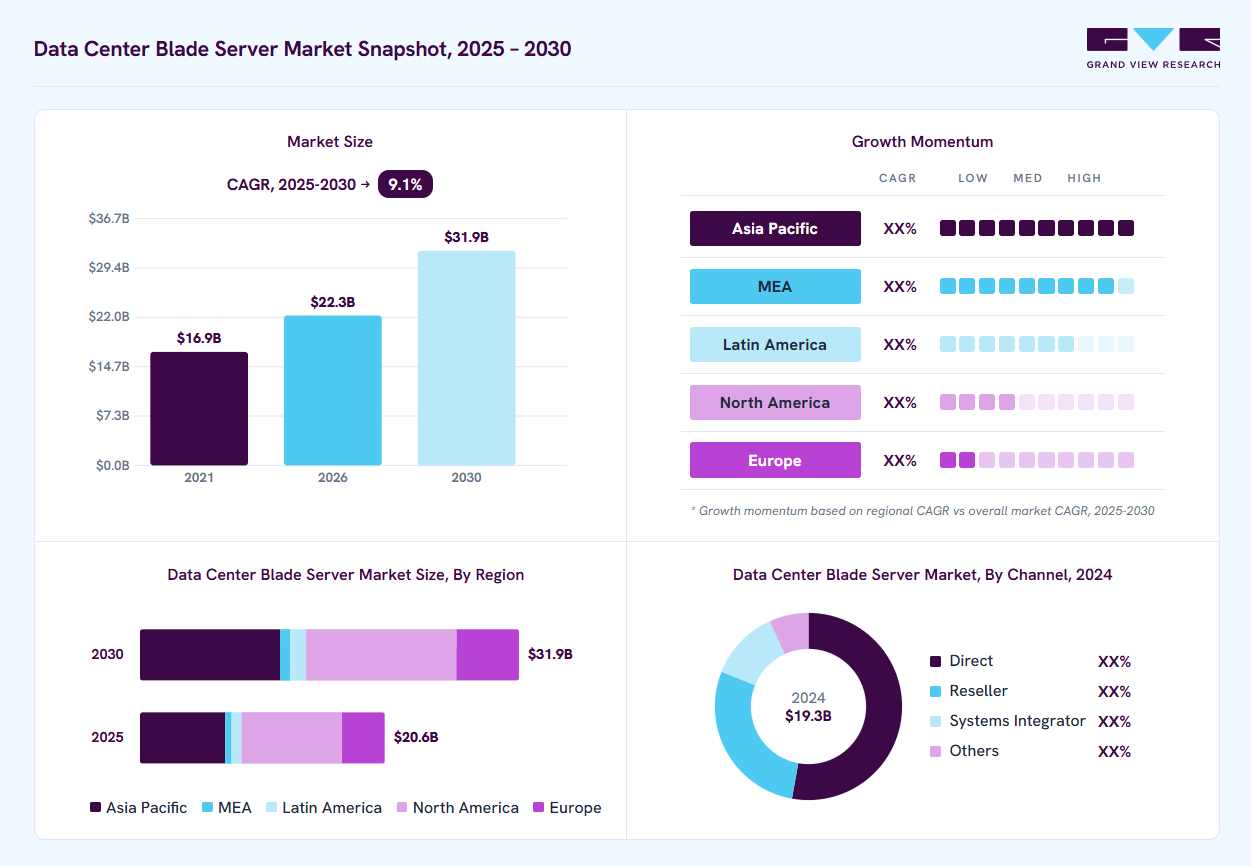
The global data center blade server market size was valued at USD 21.1 billion in 2025 and is projected to grow from USD 22.4 billion in 2026 to USD 38.6 billion by 2033, at a CAGR of 8.1% from 2026 to 2033. North America dominated the market, accounting for a revenue share of 36.9% in 2025. This growth is driven by rising investments in AI-ready hyperscale data centers, cloud infrastructure, and high-density enterprise computing.
 Source: Grand View Research, IR Documents, Primary Interviews, Paid DatabasesTo learn more about this report,
 Download Free Sample Report
Key Market Trends & Insights
- By form factor: Half-height blade server led the market and accounted for a share of 45.1% in 2025.
- By channel: Direct segment dominated the market, with a revenue share of 52.7% in 2025.
- By application: Virtualization and cloud computing segment dominated the market, with a revenue share of 36.0% in 2025.
- By end use: BFSI segment held the largest revenue share in 2025.
Regional Highlights
- Largest regional market: North America (36.9% revenue share, 2025)
- Fastest-growing regional market: Asia Pacific (highest CAGR, 2026-2033)
- By country: The U.S. held the largest market share in 2025.
Market Size & Forecast
- Market size in 2025: USD 21.1 Billion
- Estimated market size in 2026: USD 22.4 Billion
- Projected market size by 2033: USD 38.6 Billion
- CAGR (2026-2033): 8.1%
Three ways to get this report
Buy it, customize it, or ask a question.Ask an Analyst
Analyst response in 1 business day
- AccessReport author, directly
- Reply timeWithin 1 working day
- No sales callDirect answer only
- FormatEmail reply
- CostFree, no cost
Get the Full Report
What the study covers
- FormatsPDF · Excel · Dashboard
- Timeline2026–2033 annual, 2025 base
- Coverage20+ countries, 5 regions
- Companies10+ key players profiled
Customize the Report
20% free customization
- IncludeCountries, segments, points
- TailorTo your product definition
- ExtendDeeper competitor detail
- OrA fully bespoke study
- Turnaround5–10 working days
Organizations prioritize modular server architectures to enhance scalability, optimize space utilization, and reduce power consumption, making blade servers a preferred choice. In addition, the rising adoption of artificial intelligence (AI), big data analytics, and virtualization technologies is accelerating the deployment of high-performance computing environments, further fueling market expansion. The shift toward hybrid and multi-cloud strategies also increases the demand for blade servers as businesses seek flexible, cost-effective solutions to manage diverse workloads.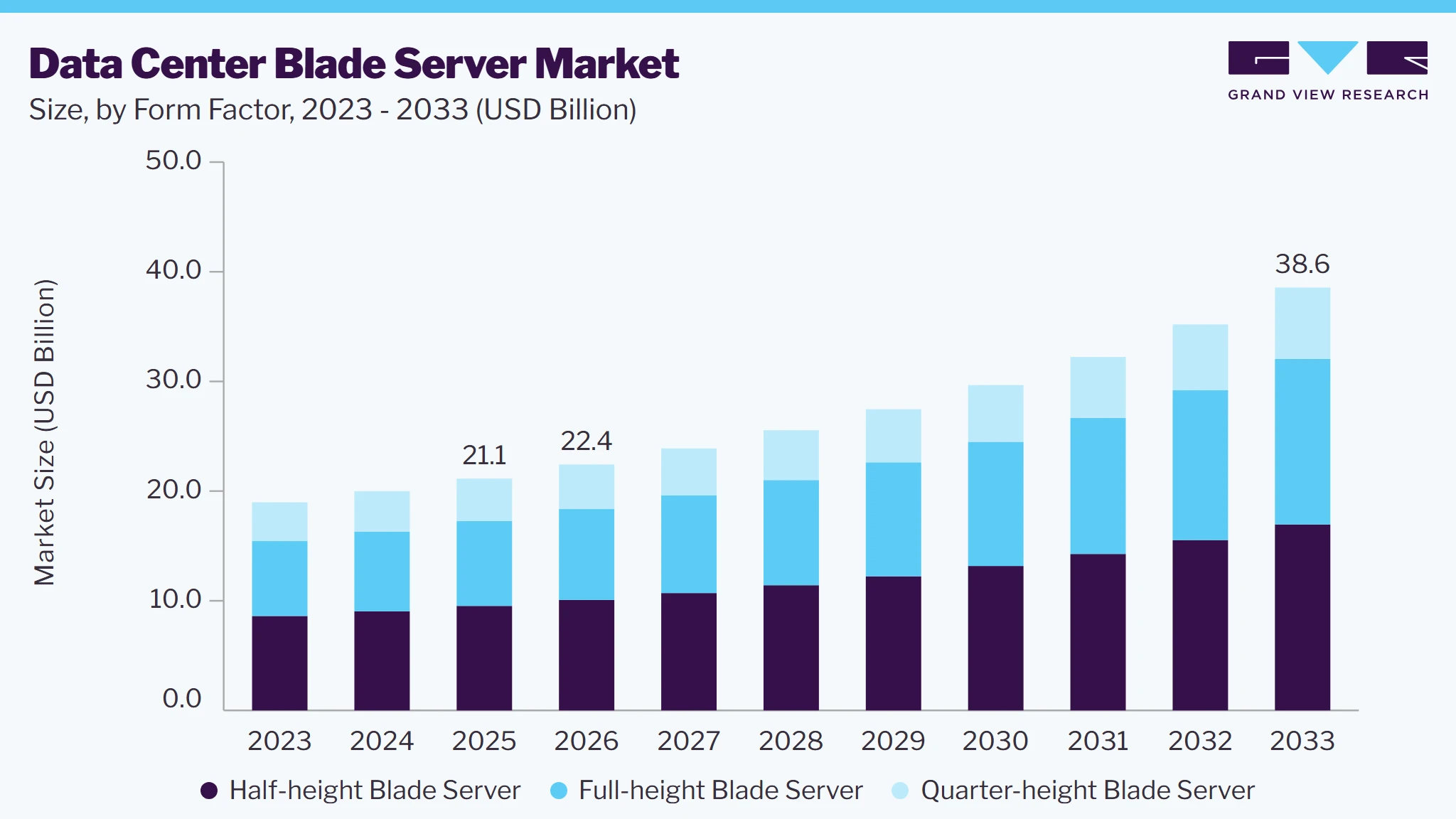 To learn more about this report, Download Free Sample Report
Furthermore, advancements in server management software and automation tools improve operational efficiency and minimize downtime, making blade server deployments more attractive. Regulatory requirements for data security and sustainability further influence investments in energy-efficient blade server solutions, reinforcing their role in modern data center infrastructures.
The increasing demand for high-density and energy-efficient computing solutions is a key driver of the data center blade server industry. As enterprises and cloud service providers seek to maximize computing power while minimizing physical space requirements, blade servers offer a compact, modular architecture that optimizes space utilization. Their shared power and cooling infrastructure significantly reduces energy consumption compared to traditional rack-mounted servers, aligning with sustainability goals and cost-saving initiatives.
Another major factor is the growing adoption of artificial intelligence (AI), big data analytics, and virtualization technologies. Organizations increasingly deploy AI-driven applications and large-scale data processing workloads that require high-performance computing infrastructure. Blade servers, with their ability to support powerful processors, large memory capacities, and high-speed interconnects, are well-suited for these demanding applications. In addition, the widespread use of virtualization in enterprise IT environments enhances the efficiency of blade servers by enabling resource consolidation and workload optimization.
The shift toward hybrid and multi-cloud strategies is also accelerating market growth. Businesses are moving towards flexible IT architectures integrating on-premise infrastructure with public and private cloud environments. Blade servers offer seamless integration capabilities, making them an ideal choice for companies implementing hybrid cloud solutions. Their ability to support software-defined networking (SDN) and hyper-converged infrastructure (HCI) further enhances their appeal in modern cloud-centric environments.
Advancements in server management software and automation tools improve operational efficiency and reduce downtime, further driving adoption. Blade servers come equipped with integrated management solutions that allow IT teams to monitor, configure, and maintain hardware remotely. Automated provisioning, predictive analytics, and AI-driven system optimization reduce manual intervention, ensuring seamless operation while lowering maintenance costs. These features make blade servers an attractive option for enterprises aiming to enhance IT agility and reliability.
Market Dynamics
The global data center blade server market is experiencing strong growth as enterprises, hyperscale cloud providers, colocation operators, telecommunications companies, and government organizations increasingly invest in high-density, energy-efficient computing infrastructure to support digital transformation and AI-driven workloads. Blade servers enable organizations to maximize compute performance while minimizing physical footprint through modular architectures that share power, cooling, networking, and management resources within a single chassis. Modern blade server platforms integrate advanced processors, high-speed memory, GPU accelerators, AI optimization, software-defined infrastructure, virtualization, and automated management capabilities to improve scalability, workload efficiency, and operational agility. The rapid expansion of cloud computing, artificial intelligence, big data analytics, virtualization, hybrid IT environments, and edge computing is accelerating demand for blade servers that deliver higher compute density, simplified infrastructure management, lower total cost of ownership, and efficient utilization of data center resources.
The increasing adoption of artificial intelligence (AI), cloud computing, virtualization, and high-performance enterprise applications is a major driver of the global Data Center Blade Server Market. Enterprises, hyperscale cloud providers, financial institutions, healthcare organizations, telecommunications companies, and research institutions are deploying blade servers to support compute-intensive workloads while optimizing rack space, power consumption, and operational efficiency. Blade server platforms enable centralized management, rapid provisioning, high availability, workload consolidation, and seamless integration with software-defined infrastructure, virtualization platforms, and hybrid cloud environments. Their modular architecture simplifies deployment and maintenance while supporting next-generation processors, GPU acceleration, and high-speed networking required for AI training, inference, analytics, and mission-critical applications. For instance, in January 2026, Lenovo introduced new ThinkSystem AI inferencing servers under its Hybrid AI Advantage portfolio, expanding high-density enterprise server infrastructure with AI-optimized compute, GPU acceleration, and scalable data center solutions to support real-time AI workloads across cloud, data center, and edge environments.
High capital investment requirements and growing competition from advanced rack server architectures remain significant restraints for the global data center blade server market. Blade server deployments require specialized chassis, networking modules, shared power infrastructure, and cooling systems, resulting in higher upfront costs compared to conventional rack-mounted servers for certain deployment scenarios. Organizations must also carefully evaluate workload compatibility, expansion flexibility, and long-term infrastructure planning before adopting blade-based environments. Additionally, advances in high-density rack servers, hyperconverged infrastructure, and composable infrastructure solutions provide alternative deployment models that can offer greater flexibility for some enterprises. These factors may limit blade server adoption among small and medium-sized organizations or businesses with constrained IT budgets and lower compute density requirements.
The rapid expansion of AI-ready infrastructure, edge computing, and sustainable data center initiatives presents a significant growth opportunity for the global data center blade server market. Organizations are increasingly investing in blade server platforms equipped with AI accelerators, high-performance CPUs, GPU support, liquid cooling technologies, and intelligent infrastructure management to support generative AI, machine learning, digital twins, and real-time analytics. The continued growth of edge data centers, 5G networks, Industry 4.0, autonomous systems, and IoT deployments is creating demand for compact, scalable, and remotely managed blade server solutions capable of delivering high compute performance with efficient resource utilization. Furthermore, advancements in energy-efficient processor architectures, software-defined infrastructure, AI-driven workload orchestration, and automated data center management are enabling vendors to deliver scalable, sustainable, and future-ready blade server platforms that support evolving enterprise, cloud, and telecommunications infrastructure requirements.
Analyst Perspective
The data center blade server market is positioned at the convergence of AI-driven digital transformation, cloud computing expansion, and the growing demand for high-density, energy-efficient computing infrastructure. Enterprises, hyperscale cloud providers, telecommunications companies, government organizations, and colocation operators are increasingly adopting blade server platforms to support compute-intensive workloads, optimize data center space, and improve infrastructure efficiency. Unlike traditional standalone server architectures, blade servers offer modular design, centralized management, shared power and cooling resources, and simplified scalability, enabling organizations to maximize compute density while reducing operational complexity. Modern blade server platforms integrate high-performance processors, GPU acceleration, virtualization, software-defined infrastructure, and AI-ready capabilities to support cloud services, enterprise applications, high-performance computing (HPC), and next-generation AI and machine learning workloads.
Form Factor Insights
Based on form factor, the half-height blade server segment led the market with the largest revenue share of 45.1% in 2025. Half-height blade servers dominate the data center blade server market primarily due to their optimal balance of performance, space efficiency, and energy consumption. Their compact design allows for higher server density within a chassis, enabling organizations to maximize computing power while minimizing physical footprint. This particularly benefits enterprises and cloud service providers that require scalable solutions without significantly increasing power and cooling costs. In addition, half-height blade servers are widely adopted due to their versatility in supporting a broad range of workloads, including virtualization, web hosting, and enterprise applications, making them the preferred choice for diverse IT environments.
The full-height blade server segment is expected to grow at the fastest CAGR during the forecast period due to increasing demand for high-performance computing (HPC), AI, and data-intensive applications. These servers offer greater processing power, higher memory capacity, and expanded storage options, making them ideal for complex workloads such as AI training models, big data analytics, and enterprise resource planning (ERP) systems. Organizations requiring advanced computing capabilities are investing in full-height blade servers to meet rising performance demands while benefiting from the modular efficiency of blade architectures. The growth is further driven by industries such as finance, healthcare, and scientific research, where high computing power is crucial for mission-critical applications.
Channel Insights
Based on channel, the direct segment led the market with the largest revenue share of 52.7% in 2025. The direct sales channel dominates the data center blade server market due to its ability to offer customized solutions, dedicated technical support, and cost advantages to enterprises. Large organizations, hyperscale data centers, and cloud service providers prefer procuring blade servers directly from manufacturers to ensure seamless integration with their existing IT infrastructure. Direct sales also provide benefits such as better pricing, tailored configurations, and comprehensive service-level agreements (SLAs), making it the preferred channel for enterprises with specific performance and scalability requirements. In addition, direct engagement with vendors enables organizations to access the latest technological advancements and receive priority support, further strengthening the dominance of this channel.
The reseller segment is expected to grow at a significant rate during the forecast period due to the increasing demand from small and medium-sized enterprises (SMEs) and regional data centers. Resellers are crucial in providing localized support, cost-effective solutions, and value-added services such as installation, maintenance, and financing options. As businesses seek flexible procurement models and managed service offerings, resellers are becoming an essential bridge between manufacturers and end-users. The rise of cloud computing, edge data centers, and hybrid IT environments is further driving the growth of this channel, as resellers cater to organizations looking for scalable, pre-configured, and budget-friendly blade server solutions.
Application Insights
Based on application, the virtualization and cloud computing segment led the market with the largest revenue share of 36.0% in 2025. Virtualization and cloud computing workloads dominate the data center blade server market due to their widespread adoption across enterprises, hyperscale data centers, and cloud service providers. Blade servers are highly optimized for virtualization, allowing organizations to consolidate workloads, improve resource utilization, and reduce operational costs. Their modular architecture supports software-defined data centers (SDDCs) and hyper-converged infrastructure (HCI), making them ideal for cloud-based deployments.
In addition, the increasing shift toward hybrid and multi-cloud environments further reinforces the demand for blade servers in managing scalable, agile, and cost-efficient computing infrastructures. As enterprises continue migrating workloads to cloud platforms, blade servers remain crucial in supporting virtualized applications and cloud-native services.
The AI and machine learning (ML) workloads segment is expected to grow at the fastest rate during the forecast period due to the rising demand for HPC capabilities. Organizations across various industries, including healthcare, finance, and autonomous systems, increasingly deploy AI-driven applications that require powerful processing, high memory bandwidth, and accelerated computing. Full-height blade servers, equipped with GPUs, FPGAs, and specialized AI accelerators, are gaining traction to support deep learning models, predictive analytics, and real-time data processing. As AI adoption expands across sectors and enterprises invest in AI-driven decision-making and automation, the demand for blade servers optimized for AI/ML workloads is expected to surge rapidly.
End-use Insights
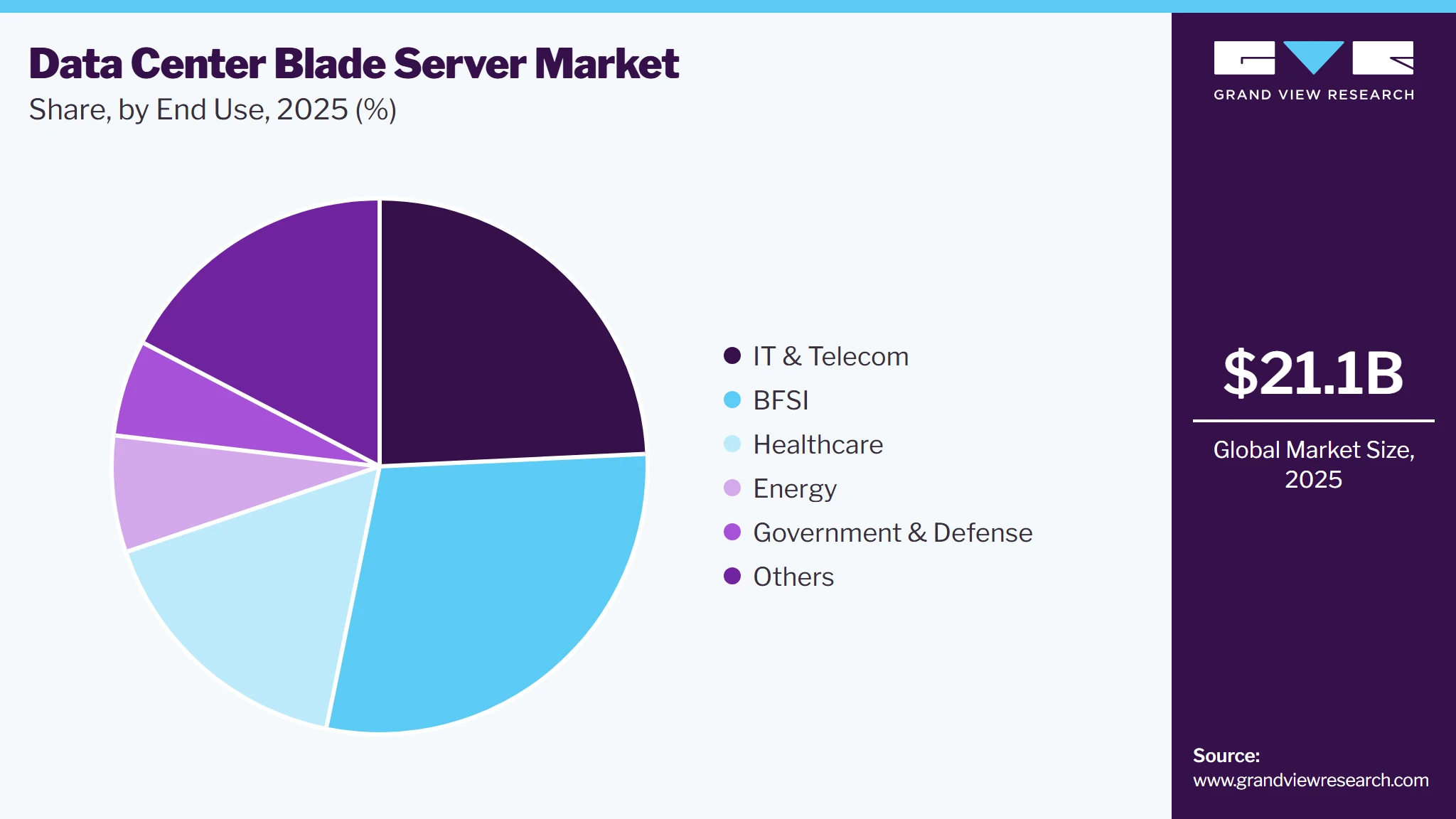
Based on end use, BFSI segment led the market with the largest revenue share of 28.9% in 2025. The BFSI sector dominates the data center blade server market due to its critical need for high-performance computing, data security, and real-time transaction processing. Financial institutions handle vast amounts of sensitive data, requiring robust and scalable IT infrastructure to ensure secure and efficient operations. Blade servers enable BFSI organizations to consolidate workloads, optimize data center space, and enhance operational efficiency while complying with stringent regulatory requirements. In addition, the growing adoption of digital banking, fintech applications, and AI-driven financial analytics further drives the demand for blade servers in this sector. The BFSI industry's reliance on low-latency computing and uninterrupted service delivery reinforces its leading position in the market.
 To learn more about this report, Download Free Sample Report
The IT & telecom segment is expected to grow at a significant rate during the forecast period due to the rapid expansion of cloud computing, 5G infrastructure, and edge data centers. Telecom providers are increasingly deploying blade servers to support network virtualization, software-defined networking (SDN), and high-speed data processing required for next-generation connectivity solutions. In addition, the rising demand for hyperscale and colocation data centers, driven by increased internet usage, IoT proliferation, and digital transformation initiatives, is fueling market growth. As IT and telecom companies scale their infrastructure to meet the growing demand for cloud services, streaming, and mobile applications, the adoption of blade servers is expected to surge, making this segment the fastest-growing end-use industry.
Regional Insights
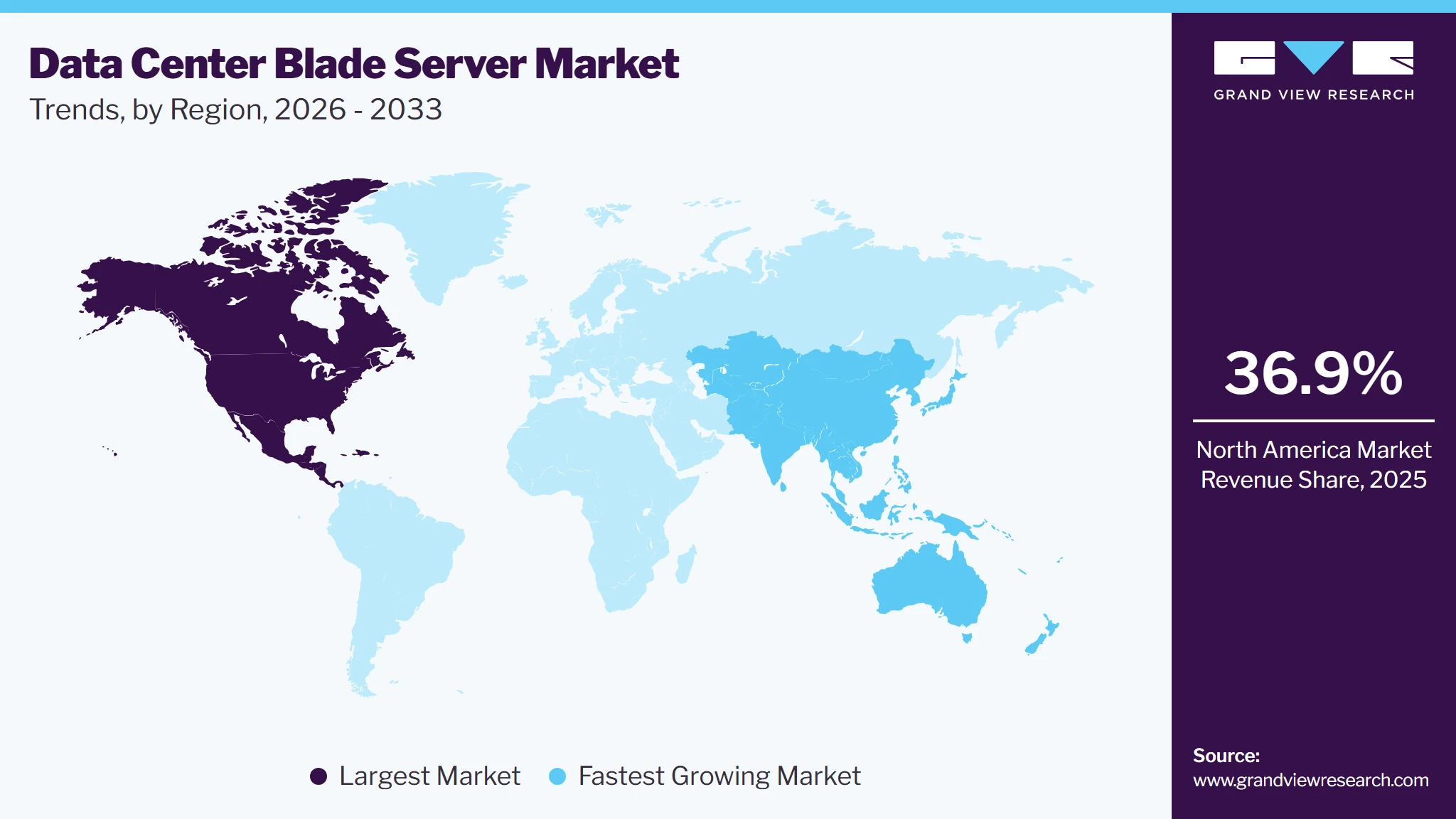
North America dominated the global data center blade server market with the largest revenue share of 36.9% in 2025. The North America data center blade server industry is driven by the rapid expansion of hyperscale data centers, increasing adoption of cloud computing, and strong demand for AI and machine learning workloads. The region's advanced IT infrastructure and investments from major cloud service providers and enterprises support the growing deployment of blade servers. In addition, sustainability initiatives and the push for energy-efficient data centers are leading to the adoption of blade servers with enhanced power management and cooling technologies.
 To learn more about this report, Download Free Sample Report
U.S. Data Center Blade Server Market Trends
The data center blade server market in the U.S. held the largest share in the North America region in 2025. The U.S. remains the largest market for data center blade servers due to the presence of leading cloud providers, technology firms, and hyperscale data centers. The growing need for HPC in AI, big data analytics, and cybersecurity further accelerates market growth. The increasing shift toward hybrid and multi-cloud environments and regulatory compliance requirements is also driving demand for blade servers with advanced security and virtualization capabilities.
Europe Data Center Blade Server Industry Trends
Europe's data center blade server industry is growing significantly at a CAGR of over 7% from 2025 to 2030. The European data center blade server industry is witnessing steady growth, primarily driven by the digital transformation of enterprises, increasing cloud adoption, and the expansion of colocation data centers. The European Union's data protection regulations, such as GDPR, encourage secure and efficient server infrastructure investments. Additionally, sustainability initiatives to reduce data center carbon footprints influence the adoption of energy-efficient blade servers.
The UK data center blade server industry is expected to grow rapidly in the coming years. In the UK, the data center blade server industry is expanding due to increasing cloud service deployments, rising demand for edge computing, and growth in fintech and AI-driven applications. London remains a key data center hub, attracting investments from hyperscale cloud providers and colocation service providers. The shift towards hybrid IT infrastructure and government initiatives supporting digital transformation further fuel market expansion.
The Germany data center blade server industry held a substantial market share in 2024. Germany is one of Europe's leading markets for data center blade servers, driven by its strong industrial base, increasing adoption of Industry 4.0 technologies, and growing demand for AI and HPC applications. Enterprises in Germany are investing in modernized IT infrastructure to support cloud-based operations and IoT-driven smart manufacturing. Stringent data security regulations and sustainability mandates also push companies to adopt energy-efficient and compliant server solutions.
Asia Pacific Data Center Blade Server Industry Trends
The Asia Pacific's data center blade server industry is growing significantly at a CAGR of over 10% from 2025 to 2030. The Asia Pacific region is experiencing significant growth in the data center blade server industry due to rapid digitalization, increasing internet penetration, and rising demand for cloud services. Countries in this region are witnessing a surge in hyperscale and colocation data centers to support expanding IT and telecom networks. The deployment of 5G, edge computing, and AI-driven applications further drives demand for high-performance blade servers across various industries.
The China data center blade server industry held a substantial share in 2024. China is a dominant player in the Asia Pacific data center blade server industry, fueled by the rapid expansion of cloud computing, government-led digital initiatives, and strong investments from tech giants such as Alibaba, Tencent, and Huawei. The increasing deployment of AI, big data, and IoT applications drives demand for high-density, scalable server solutions. Additionally, China's push for self-reliance in semiconductor and IT hardware development is leading to innovation in domestic server manufacturing.
The Japan data center blade server industry held a substantial share in 2024. Japan's data center blade server industry is growing steadily, supported by advancements in AI, fintech, and 5G infrastructure. The country's emphasis on data security, regulatory compliance, and sustainable IT solutions shapes investment trends in energy-efficient blade server technologies. Additionally, Japan's robust IT and telecom sector, coupled with increasing demand for edge computing, is accelerating the adoption of modular and high-performance server architectures.
India's data center blade server industry is expanding rapidly. India is emerging as a high-growth market for data center blade servers, driven by rapid cloud adoption, increasing investments in hyperscale data centers, and expanding digital services. Government initiatives such as Digital India and data localization policies encourage enterprises to invest in domestic IT infrastructure. Additionally, the rise of AI-driven applications, e-commerce, and fintech services fuel demand for scalable and cost-efficient server solutions. The growing presence of global cloud providers and data center operators further supports market expansion.
Key Data Centre Blade Server Company Insights
Key players operating in the data center blade server market include Cisco Systems, Inc., Dell Inc., FUJITSU, Hewlett Packard Enterprise Development LP, Huawei, IBM, INSPUR Co., Ltd., Lenovo, Oracle, and Super Micro Computer, Inc. The companies focus on various strategic initiatives, including new product development, partnerships & collaborations, and agreements to gain a competitive advantage over their rivals. The following are some instances of such initiatives.
-
In June 2024, Super Micro Computer, Inc. unveiled its latest X14 AI, multi-node, rackmount, and edge server families. It is powered by Intel Xeon 6 processors with E-cores, with P-core systems to follow soon, incorporating advanced liquid cooling technology. The new X14 portfolio is designed for optimal performance and energy efficiency while enhancing manageability, security, and compliance with open industry standards. Additionally, the systems are rack-scale optimized, ensuring seamless integration into modern data centers.
-
The launch includes the Intel Xeon 6700-series processors with E-cores, featuring SuperBlade—Supermicro’s high-performance, density-optimized, and energy-efficient multi-node platform. Engineered for AI, data analytics, cloud, HPC, and enterprise workloads, these new blade systems enable a single rack to support up to 34,560 Xeon compute cores, delivering exceptional processing power and efficiency.
-
In October 2024, Hewlett Packard Enterprise Development LP introduced the industry's first 100% fanless direct liquid cooling system architecture, designed to enhance energy and cost efficiency for large-scale AI deployments. This innovative architecture is built on four key pillars: Comprehensive 8-Element Cooling Design - The system features liquid cooling for the CPU, GPU, full server blade, local storage, network fabric, pod/cluster, and coolant distribution unit (CDU), ensuring efficient thermal management across all critical components. High-Density, High-Performance System Design - Engineered for maximum performance, the system undergoes rigorous testing and includes advanced monitoring software and on-site services to facilitate the seamless deployment of sophisticated compute and cooling solutions. Integrated Network Fabric for Massive Scalability - The architecture incorporates an optimized network fabric, utilizing lower-cost and lower-power connections to support large-scale AI workloads efficiently. Open System Design for Accelerator Flexibility - Designed for adaptability, the system allows enterprises to choose from a variety of accelerators, ensuring flexibility in AI and HPC applications. By eliminating fans and leveraging advanced liquid cooling, HPE’s new architecture sets a benchmark for energy-efficient, high-performance AI infrastructure at scale.
Key Data Centre Blade Server Companies
The following key companies have been profiled for this study on the data centre blade server market.
-
Cisco Systems, Inc.
-
Dell Inc.
-
FUJITSU
-
Hewlett Packard Enterprise Development LP
-
Huawei
-
IBM
-
INSPUR Co., Ltd.
-
Lenovo
-
Oracle
-
Super Micro Computer, Inc.
Competitive Benchmarking
Category
Operating Strategies
Competitive Edge
Weakness
Established Players (Hewlett Packard Enterprise (HPE), Dell Inc., Cisco Systems, Inc., Lenovo, Huawei, Fujitsu)
- Established players focus on delivering comprehensive blade server platforms that integrate high-performance processors, GPU acceleration, high-speed networking, virtualization, software-defined infrastructure, AI-ready architectures, and centralized infrastructure management.
- Their strategies emphasize continuous product innovation, energy-efficient system design, liquid cooling technologies, AI infrastructure optimization, hybrid cloud enablement, strategic partnerships with processor and GPU vendors, and expansion of enterprise and hyperscale data center solutions.
- Established players benefit from evanced infrastructure management software, global service xtensive global customer bases, mature enterprise product portfolios, significant R&D investments, robust partner ecosystems, and comprehensive compute, networking, storage, and management capabilities.
- Their adnetworks, AI-ready server platforms, and strong relationships with hyperscale cloud providers, telecommunications companies, and enterprise customers enable large-scale deployments across mission-critical data center environments.
- These companies face challenges associated with complex product portfolios, higher capital investment requirements, lengthy enterprise procurement cycles, and increasing competition from alternative server architectures such as high-density rack servers and hyperconverged infrastructure.
- Maintaining rapid innovation while supporting legacy platforms and meeting growing demands for energy efficiency and AI infrastructure can also increase operational complexity and development costs.
Emerging Players (Super Micro Computer, Inc., Inspur Co., Ltd.)
- Emerging players focus on delivering high-performance, AI-optimized blade and modular server platforms designed for hyperscale data centers, AI training, machine learning, cloud computing, and high-performance computing (HPC).
- Their strategies emphasize rapid product innovation, early adoption of next-generation processors and GPU accelerators, liquid cooling technologies, customizable system configurations, competitive pricing, strategic technology partnerships, and expansion into AI infrastructure and cloud data center markets.
- Emerging players offer agile product development, rapid adoption of the latest compute technologies, flexible server configurations, competitive pricing, and strong expertise in AI, HPC, and hyperscale infrastructure.
- Their ability to quickly introduce next-generation server platforms, optimize performance for compute-intensive workloads, and deliver customized infrastructure solutions enables organizations to accelerate AI deployments and improve data center efficiency.
- Limited global service and support networks, comparatively smaller enterprise customer bases, lower brand recognition in some international markets, and dependence on hyperscale cloud providers and regional demand may restrict broader market expansion.
- They also face challenges in scaling global operations, expanding channel partnerships, maintaining continuous investment in advanced server technologies, and competing against established enterprise infrastructure vendors with broader product portfolios and stronger customer relationships.
Data Center Blade Server Market Report Scope
Report Attribute
Details
Market size in 2025
USD 21.1 billion
Estimated market size in 2026
USD 22.4 billion
Projected market size by 2033
USD 38.6 billion
Growth rate
CAGR of 8.1% from 2026 to 2033
Base year for estimation
2025
Historical data
2021 - 2024
Forecast period
2026 - 2033
Quantitative units
Revenue in USD million/billion and CAGR from 2026 to 2033
Report coverage
Revenue forecast, company market share analysis, competitive landscape, growth factors, and trends
Segments covered
Form factor, channel, application, end use, region
Regional scope
North America; Europe; Asia Pacific; Latin America; MEA
Country scope
U.S.; Canada; Mexico; Germany; UK; France; China; Japan; India; South Korea; Australia; Brazil; Saudi Arabia; South Africa; UAE
Key companies profiled
Cisco Systems, Inc.; Dell Inc.; FUJITSU; Hewlett Packard Enterprise Development LP; Huawei; IBM Corporation; INSPUR Co., Ltd.; Lenovo; Oracle; Super Micro Computer, Inc.
Customization scope
Free report customization (equivalent up to 8 analysts' working days) with purchase. Addition or alteration to country, regional & segment scope.
Pricing and purchase options
Avail customized purchase options to meet your exact research needs. Explore purchase options
Global Data Center Blade Server Market Report Segmentation
This report forecasts revenue growth at global, regional, and country levels and provides an analysis of the latest industry trends in each of the sub-segments from 2021 to 2033. For this study, Grand View Research has segmented the global data center blade server market report based on form factor, channel, application, end-use, and region.
-
Form Factor Outlook (Revenue, USD Billion, 2021 - 2033)
-
Half-height Blade Server
-
Full-height Blade Server
-
Quarter-height Blade Server
-
-
Channel Outlook (Revenue, USD Billion, 2021 - 2033)
-
Direct
-
Reseller
-
Systems Integrator
-
Others
-
-
Application Outlook (Revenue, USD Billion, 2021 - 2033)
-
Virtualization and Cloud Computing
-
High-performance Computing (HPC)
-
Storage and Backup
-
Web Hosting
-
Database Management
-
AI and Machine Learning Workloads
-
-
End-use Outlook (Revenue, USD Billion, 2021 - 2033)
-
BFSI
-
Healthcare
-
Energy
-
IT & Telecom
-
Government & Defense
-
Others
-
-
Regional Outlook (Revenue, USD Billion, 2021 - 2033)
-
North America
-
U.S.
-
Canada
-
Mexico
-
-
Europe
-
Germany
-
UK
-
France
-
-
Asia Pacific
-
China
-
India
-
Japan
-
South Korea
-
Australia
-
-
Latin America
-
Brazil
-
-
Middle East & Africa
-
U.A.E
-
Saudi Arabia
-
South Africa
-
-
Research Methodology
The data center blade server market figures in this report are based on a proven research process that combines executive interviews with secondary research from proprietary databases, company filings, and recognized regulatory and institutional sources. Market size is built through value-chain sizing - reconciling supply-side and demand-side estimates - and triangulated with bottom-up and top-down approaches. Every estimate passes multiple levels of expert validation before publication, with each data center blade server segment quantified using the revenue-capture definitions in the table below.
Segment Definition
Segment - Form Factor
Revenue capture definition
Half-height Blade Server
Revenue is generated from the sale of half-height blade servers, including server blades, integrated compute modules, and associated chassis-based hardware designed for high-density data center deployments. Revenue includes processor, memory, storage, networking interfaces, and embedded management components sold as part of blade server solutions.
Full-height Blade Server
Revenue is generated from the sale of full-height blade servers designed for compute-intensive workloads requiring greater processing power, memory capacity, and expansion capabilities. Revenue includes complete blade modules integrated within blade server chassis and related hardware components.
Quarter-height Blade Server
Revenue is generated from the sale of compact quarter-height blade servers optimized for ultra-high-density computing environments. Revenue includes modular server blades, embedded networking, memory, storage, and management hardware deployed within shared blade enclosures.
Segment - Channel
Revenue capture definition
Direct
Revenue generated from blade server sales made directly by manufacturers to enterprises, hyperscale cloud providers, government organizations, and other end users through direct sales teams and enterprise contracts.
Reseller
Revenue generated through value-added resellers (VARs), distributors, authorized channel partners, and IT solution providers that sell blade server hardware and associated infrastructure solutions.
Systems Integrator
Revenue generated from blade server deployments delivered through systems integrators providing infrastructure design, integration, deployment, migration, consulting, and managed services for enterprise and data center environments.
Others
Revenue generated through OEM partnerships, cloud infrastructure providers, online procurement platforms, and other indirect sales channels not classified under direct sales, resellers, or systems integrators.
Segment - Application
Revenue capture definition
Virtualization and Cloud Computing
Revenue generated from blade servers deployed to support virtualized environments, private and public cloud infrastructure, software-defined data centers, and containerized workloads.
High-Performance Computing (HPC)
Revenue generated from blade servers used for scientific computing, engineering simulations, financial modeling, research, and other high-performance computing applications requiring dense compute resources.
Storage and Backup
Revenue generated from blade server deployments supporting storage management, backup, disaster recovery, software-defined storage, and data protection infrastructure.
Web Hosting
Revenue generated from blade servers deployed for web hosting, content delivery, application hosting, and internet service infrastructure requiring scalable compute resources.
Database Management
Revenue generated from blade servers supporting enterprise database platforms, transaction processing systems, analytics databases, and business-critical data management applications.
AI and Machine Learning Workloads
Revenue generated from blade servers equipped with GPU accelerators and high-performance processors for artificial intelligence, machine learning, deep learning, generative AI, and large-scale data analytics workloads.
Segment - End Use
Revenue capture definition
BFSI
Revenue generated from blade server deployments within banking, financial services, and insurance organizations supporting transaction processing, digital banking, cybersecurity, regulatory compliance, and analytics workloads.
Government & Defense
Revenue generated from blade server deployments across government agencies, defense organizations, public sector institutions, and national security infrastructure supporting mission-critical computing and secure data processing.
Energy
Revenue generated from blade server deployments within oil & gas, utilities, renewable energy, and power generation organizations supporting operational analytics, industrial automation, and asset management applications.
IT & Telecom
Revenue generated from blade server deployments by cloud service providers, telecommunications companies, internet service providers, colocation operators, and enterprise data centers supporting cloud computing, virtualization, network functions, and digital services.
Healthcare
Revenue generated from blade server deployments in hospitals, healthcare providers, research institutions, pharmaceutical companies, and diagnostic laboratories supporting electronic health records (EHR), medical imaging, AI diagnostics, and healthcare analytics.
Others
Revenue generated from blade server deployments across manufacturing, education, retail, media & entertainment, transportation & logistics, and other commercial sectors requiring high-density computing infrastructure.
Estimation Model
Layer
Question
Analysis
Enterprise Compute Demand Layer
Who can benefit from blade server solutions?
Identify organizations that require high-density, scalable, and centralized computing infrastructure to support mission-critical applications and data-intensive workloads. These include hyperscale cloud providers, enterprise data centers, colocation operators, telecommunications companies, financial institutions, government agencies, healthcare organizations, research institutions, and large enterprises. Organizations seeking to improve compute efficiency, optimize rack space, reduce power consumption, simplify infrastructure management, and support virtualization, AI, and cloud workloads represent the core demand base for blade server solutions.
Data Center Infrastructure & Digital Readiness Layer
Who can deploy blade server solutions?
Evaluate organizations based on their data center maturity, IT modernization initiatives, virtualization adoption, hybrid cloud deployment, AI infrastructure investments, software-defined data center implementation, and availability of high-speed networking, storage, and power infrastructure. Enterprises operating modern data centers with advanced cooling systems, virtualization platforms, orchestration software, and centralized infrastructure management possess the operational readiness to deploy blade server environments efficiently.
Adoption & Utilization Layer
Who actively uses blade server solutions?
Analyze blade server deployments across enterprise data centers, hyperscale cloud facilities, colocation providers, telecommunications networks, financial institutions, healthcare organizations, government agencies, manufacturing enterprises, research laboratories, and educational institutions. Active users leverage blade servers to support virtualization, private and hybrid cloud infrastructure, enterprise applications, database management, AI and machine learning, high-performance computing (HPC), storage infrastructure, disaster recovery, and mission-critical business workloads requiring high compute density and centralized management.
Monetization Layer
How much revenue is generated?
Assess revenue generated through the sale of blade server hardware, including blade modules, server chassis, networking modules, storage interfaces, management controllers, processors, memory, GPUs, and related infrastructure components. Additional revenue streams include system integration, installation, infrastructure consulting, deployment services, maintenance and technical support, warranty contracts, infrastructure management software, firmware updates, virtualization management solutions, AI infrastructure optimization, lifecycle management services, and long-term enterprise support agreements associated with blade server deployments.
Delivered Customizations
This report has been delivered with the following In-depth customizations
Client Request
Customization Delivered
Value Adds
AI Infrastructure & High-Performance Computing (HPC) Trends
Conducted a structured analysis of blade server technologies focused on AI-ready architectures, GPU-accelerated computing, high-performance processors, memory optimization, HPC deployments, and infrastructure supporting AI training and inference workloads.
Helps stakeholders understand evolving AI infrastructure technologies, identify high-growth blade server innovations, and evaluate investment opportunities across enterprise, hyperscale, research, and HPC environments.
Cloud Data Center & Hybrid Infrastructure Trends
Conducted a comprehensive analysis of blade server adoption across private cloud, public cloud, hybrid cloud, virtualization, software-defined data centers (SDDC), hyperconverged infrastructure, and enterprise digital transformation initiatives.
Helps stakeholders identify opportunities in cloud infrastructure modernization, assess hybrid IT investment strategies, and evaluate blade server technologies that improve scalability, operational efficiency, and workload performance.
Energy-Efficient Data Center & Sustainable Computing Trends
Conducted a comprehensive analysis of blade server deployments emphasizing energy-efficient processors, high-density computing, liquid cooling technologies, intelligent power management, rack space optimization, and sustainable data center operations.
Helps stakeholders understand infrastructure optimization strategies, evaluate energy-efficient data center investments, and assess growth opportunities driven by sustainability initiatives, lower total cost of ownership (TCO), and next-generation green computing technologies.
Frequently Asked Questions About This Report
The global data center blade server market size was estimated at USD 21.1 billion in 2025 and is expected to reach USD 22.4 billion in 2026.
The global data center blade server market is expected to grow at a compound annual growth rate of 8.1% from 2026 to 2033 to reach USD 38.6 billion by 2033.
Key factors include enterprises, hyperscale cloud providers, colocation operators, telecommunications companies, and government organizations increasingly investing in high-density, energy-efficient computing infrastructure to support digital transformation and AI-driven workloads
The half-height blade server segment led with a 45.1% revenue share in 2025, while the full-height blade server segment is the fastest-growing segment.
The direct segment led with a 52.7% revenue share in 2025, while the reseller segment is the fastest-growing segment.
The virtualization and cloud computing segment held the largest share (over 36.0%) in 2025, while the High-Performance Computing (HPC) segment is the fastest-growing segment.
Key players operating in the data center blade server market include Cisco Systems, Inc.; Dell Inc.; FUJITSU; Hewlett Packard Enterprise Development LP; Huawei; IBM Corporation; INSPUR Co., Ltd.; Lenovo; Oracle; Super Micro Computer, Inc.
North America dominated with 36.9% revenue share in 2025.
Asia Pacific is the fastest-growing region over the forecast period.
About the Author(s)
Communications Infrastructure Research Team
Technology · Communications InfrastructureThis report was authored by the communications infrastructure research team at Grand View Research - comprising two research analysts, one senior research analyst, and one industry expert - with specialized expertise in the communications infrastructure segment of the technology industry. All findings are based on proprietary technology databases, executive interviews, and regulatory analysis, subject to internal peer review prior to publication.
Last Updated:
Speak to Analyst

Customize this report to your needs - add regions, segments, or data points, with 20% free customization.
Or view our licence options:


ISO 9001:2015 & 27001:2022 Certified
We are GDPR and CCPA compliant! Your transaction & personal information is safe and secure. For more details, please read our privacy policy.


