
- Home
- »
- Communications Infrastructure
- »
-
Data Center Generator Market Size Report, 2026-2033GVR Report cover

Data Center Generator Market (2026 - 2033)
Size, Share & Trends Analysis Report By Product Type (Diesel, Gas), By Capacity (<1 MW, 1-2MW, >2MW), By Tier Standards (Tier I & II, Tier III, Tier IV), By Region, And Segment Forecasts
Market Size, 2025
$9.1BMarket Estimate, 2026
$9.7BMarket Forecast, 2033
$14.9BCAGR, 2026–2033
6.3%Data Center Generator Market Summary
The global data center generator market size was valued at USD 9.1 billion in 2025 and is projected to grow from USD 9.7 billion in 2026 to USD 14.9 billion by 2033, at a CAGR of 6.3% from 2026 to 2033. North America dominated the market, accounting for 38.0% of revenue in 2025. Data center generators are critical for uninterrupted operations during power disruptions, with market growth driven by the expansion of hyperscale and colocation facilities, rising demand for digital services, and investments in resilient power infrastructure to support cloud computing, AI, and other high-performance workloads.
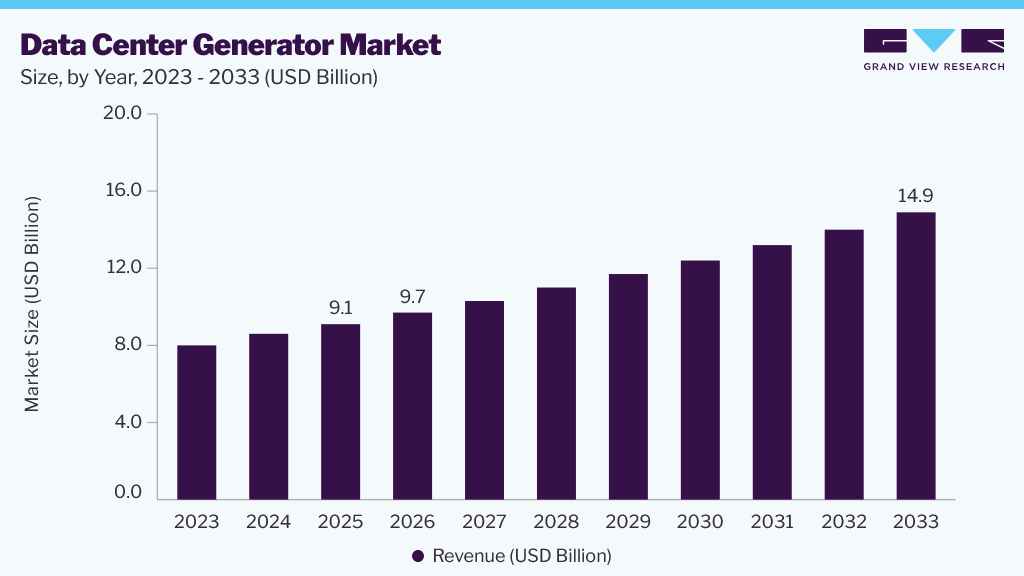 Source: Grand View Research, IR Documents, Primary Interviews, Paid DatabasesTo learn more about this report,
 Download Free Sample Report
Key Market Trends & Insights
- By product type: Diesel segment led the market, accounting for a revenue share of over 75.0% in 2025.
- By tier standards: Tier III segment held the largest market share, exceeding 52.0% in 2025.
- By capacity: <1 MW segment accounted for the largest revenue share, at around 45.0% in 2025.
Regional Highlights
- Largest regional market: North America (38.0% revenue share, 2025)
- Fastest-growing regional market: Asia Pacific (highest CAGR, 2026-2033)
Market Size & Forecast
- Market size in 2025: USD 9.1 Billion
- Estimated market size in 2026: USD 9.7 Billion
- Projected market size by 2033: USD 14.9 Billion
- CAGR (2026-2033): 6.3%
Three ways to get this report
Buy it, customize it, or ask a question.Ask an Analyst
Analyst response in 1 business day
- AccessReport author, directly
- Reply timeWithin 1 working day
- No sales callDirect answer only
- FormatEmail reply
- CostFree, no cost
Get the Full Report
What the study covers
- FormatsPDF · Excel · Dashboard
- Timeline2026–2033 annual, 2025 base
- Coverage20+ countries, 5 regions
- Companies10+ key players profiled
Customize the Report
20% free customization
- IncludeCountries, segments, points
- TailorTo your product definition
- ExtendDeeper competitor detail
- OrA fully bespoke study
- Turnaround5–10 working days
A full power cut-off from a data center might require a total restart for the system, leading to start-up issues, system downtime, and the loss of current/ongoing information. Therefore, data centers are always supported by a backup power supply via generators to prevent outages and errors. A key driver of the market is that these generators do not require an existing power supply to operate. In addition, major manufacturers are developing generators with customized capacities to meet changing customer requirements. Such systems are equipped with a feature to scale up and down as per the power required by the data center. This flexibility is also expected to escalate the demand, thereby augmenting market growth.The increasing importance of overcoming the reliance on power for data center operations is also expected to drive market growth. In addition, the advent of edge computing is contributing to facility development in the secondary data center market. These secondary data centers have low power reliability; thus, the significance of power backup equipment is high. This is expected to positively impact the adoption of data center generators.
Data centers are mission-critical infrastructure that handle and process large volumes of data across multiple industries and, as such, are significant contributors to the global economy. Thus, reliable power backup to prevent data loss during power outages is of prime importance for data center facilities. Generators provide a secure, cost-effective solution for backup and to avoid downtime caused by restarting the entire system. Cummins, Inc. and Himoinsa have introduced features such as remote monitoring to generator sets. Thus, the data center operator can monitor load levels, power system status, and alternator data while remotely controlling the system. Such features result in low maintenance costs and higher operating efficiencies for data center facilities. All these factors are expected to spur the adoption of DC generators globally.
The integration of battery technologies such as fuel cells and Li-ion batteries has led to the emergence of fuel cell power systems, which is expected to hinder market growth. Fuel-powered generators used in data center facilities emit nitrogen oxides, carbon dioxide, particulate matter, and other harmful emissions into the atmosphere. Thus, when installing such generators, data centers need to consider various government regulations on environmental sustainability.
Market Dynamics
The steady growth of the data center generator market is driven by the rapid expansion of hyperscale and colocation data centers, the increasing adoption of cloud computing and artificial intelligence (AI) workloads, and the rising demand for uninterrupted, highly reliable power infrastructure. Data center generators play a critical role as backup power systems during grid failures or power instability, ensuring the continuous operation of mission-critical applications, cloud services, and digital platforms. The market is further driven by the increasing deployment of edge data centers, growing digital transformation across industries, and rising investments in energy-resilient infrastructure. In addition, advancements in generator technologies such as fuel-efficient systems, remote monitoring capabilities, hybrid power integration, and low-emission solutions are supporting the modernization of backup power systems in data center environments.
The rapid expansion of hyperscale and AI-driven data center infrastructure worldwide is primarily driving the market. The increasing demand for cloud computing, machine learning workloads, and high-performance computing (HPC) has led to the development of large-scale data center facilities that require highly reliable backup power systems to ensure zero downtime. Generators remain a critical component in maintaining operational continuity during grid outages, especially in Tier III and Tier IV data center environments where uptime is mission-critical. The growth of AI infrastructure and cloud platforms has significantly increased energy consumption and power density requirements in modern data centers, further driving the adoption of high-capacity diesel and gas generator systems. In addition, colocation service providers and hyperscale operators are continuously expanding their infrastructure footprint across North America, Europe, and the Asia Pacific to meet rising digital demand. For instance, in November 2025, Google announced a USD 6.4 billion investment to expand its data center infrastructure in Germany, including new facilities and expansion of existing campuses to support cloud and AI workloads across Europe, reflecting the continued expansion of hyperscale infrastructure and the associated need for reliable backup power systems.
The data center generator market is increasingly challenged by rising fuel prices, stricter emission regulations, and the accelerating shift toward alternative backup power technologies such as battery energy storage systems (BESS), fuel cells, and renewable-integrated hybrid systems. Diesel and gas generators, while reliable for long-duration backup, face cost pressures from fluctuating fuel prices and higher operating expenses, particularly in large hyperscale and colocation data centers requiring frequent testing and maintenance.
Meanwhile, global sustainability commitments and net-zero targets are pushing data center operators to reduce reliance on fossil-fuel-based backup power systems. This is leading to increased adoption of lithium-ion battery systems and hybrid configurations that combine grid power, renewable energy, and battery storage for short-duration backup, reducing dependence on diesel generators. Companies are aiming to reduce reliance on diesel backup generators and move toward carbon-free backup solutions for short-duration outages, reflecting a major industry shift toward cleaner alternatives.
The data center generator market is expected to see significant growth opportunities driven by the increasing adoption of hybrid power systems and the rapid expansion of edge data centers. Hybrid configurations that combine generators with battery energy storage systems and renewable energy sources are gaining traction for their ability to improve efficiency, reduce emissions, and enhance power reliability. Edge data centers deployed closer to end users to reduce latency and support real-time applications such as IoT, autonomous systems, and 5G networks require highly reliable, distributed backup power systems. This is expected to significantly increase demand for compact, modular, and scalable generator solutions.
Technological advancements such as intelligent load management, remote monitoring, predictive maintenance, and fuel optimization are further enhancing generator efficiency and reducing the risk of operational downtime. Manufacturers are increasingly focusing on developing low-emission gas generators and modular generator sets to align with sustainability goals and evolving data center architectures. For instance, in March 2026, Siemens announced a strategic collaboration with Rittal to develop modular, scalable power infrastructure solutions for next-generation data centers, enabling faster deployment and improved energy efficiency across hyperscale and edge facilities, reinforcing the shift toward integrated, flexible power architectures.
Product Type Insights
The diesel segment held the largest share, exceeding 75.0% in 2025, owing to the widespread adoption of diesel generator systems across hyperscale, colocation, and enterprise data centers. Their proven reliability, rapid start-up capabilities, high power output, and seamless integration with flywheel UPS and battery-based backup systems make them the preferred choice for mission-critical backup power applications. For instance, in March 2025, Rolls-Royce secured a contract to supply two MTU Series 4000 diesel emergency generator sets for the European Commission's Jean Monnet 2 complex in Luxembourg. This development highlights the continued demand for diesel-powered backup solutions to ensure uninterrupted operations across critical data center and infrastructure facilities.
The gas segment is projected to register the fastest CAGR during the forecast period, driven by the increasing adoption of lower-emission backup power solutions as data center operators focus on sustainability and compliance with stringent environmental regulations. Although gas-powered generator systems require higher initial capital investment, they offer lower emissions, reduced operating costs over the long term, and greater environmental benefits than conventional diesel systems.
Tier Standards Insights
The Tier III segment accounted for the largest share of the data center generator market, representing around 52.0% of revenue in 2025. The segment’s growth is driven by the widespread deployment of Tier III data centers across enterprise, colocation, and hyperscale facilities, where high availability and continuous operations are critical. Tier III facilities require power infrastructure that can be maintained concurrently, making reliable backup generators an essential component of their electrical architecture. The rapid expansion of cloud computing, digital transformation initiatives, and AI-driven workloads is encouraging operators to invest in highly resilient backup power systems to minimize downtime and ensure uninterrupted service. For instance, in May 2025, Vertiv announced the deployment of its integrated backup power and critical infrastructure solutions for multiple Tier III-certified data center projects across the Asia Pacific, supporting growing demand for reliable power systems in mission-critical facilities. Such developments continue to strengthen demand for generator systems in Tier III data centers.
The Tier IV segment is anticipated to register the fastest CAGR during the forecast period. Increasing demand for maximum uptime, fault-tolerant infrastructure, and uninterrupted digital services is driving investments in Tier IV data centers, particularly among hyperscale cloud providers, financial institutions, and AI infrastructure operators. These facilities require fully redundant backup power systems capable of maintaining operations even during equipment failures or maintenance activities, significantly increasing demand for high-capacity generator installations. Growing investments in AI-ready campuses, high-performance computing facilities, and mission-critical digital infrastructure are expected to further accelerate the adoption of advanced backup power solutions across Tier IV data centers throughout the forecast period.
Capacity Insights
The <1 MW segment accounted for the largest revenue share of around 45.0% in 2025, driven by the growing deployment of edge and modular data centers, as well as small- and medium-sized enterprise (SME) facilities that require compact, cost-effective backup power solutions. In addition, on-premises data centers in emerging economies often operate with lower IT loads, increasing demand for generators with capacities below 1 MW. The rising adoption of distributed computing, edge AI, and prefabricated modular data centers is further supporting demand for sub-1 MW generators, as these facilities require reliable standby power while maintaining a compact infrastructure footprint.
The >2 MW segment is expected to register the fastest CAGR during the forecast period. The growth is driven by the rapid expansion of hyperscale and large colocation data centers that require high-capacity backup power systems to support increasing IT loads and AI-driven workloads. The proliferation of high-density computing, GPU clusters, and cloud infrastructure is significantly increasing power requirements, prompting operators to deploy multiple high-capacity generators to ensure uninterrupted operations and meet stringent uptime standards. Furthermore, growing investments in hyperscale campuses and AI-ready data centers across North America, Europe, and the Asia Pacific are expected to accelerate demand for generators with capacities exceeding 2 MW throughout the forecast period.
Regional Insights
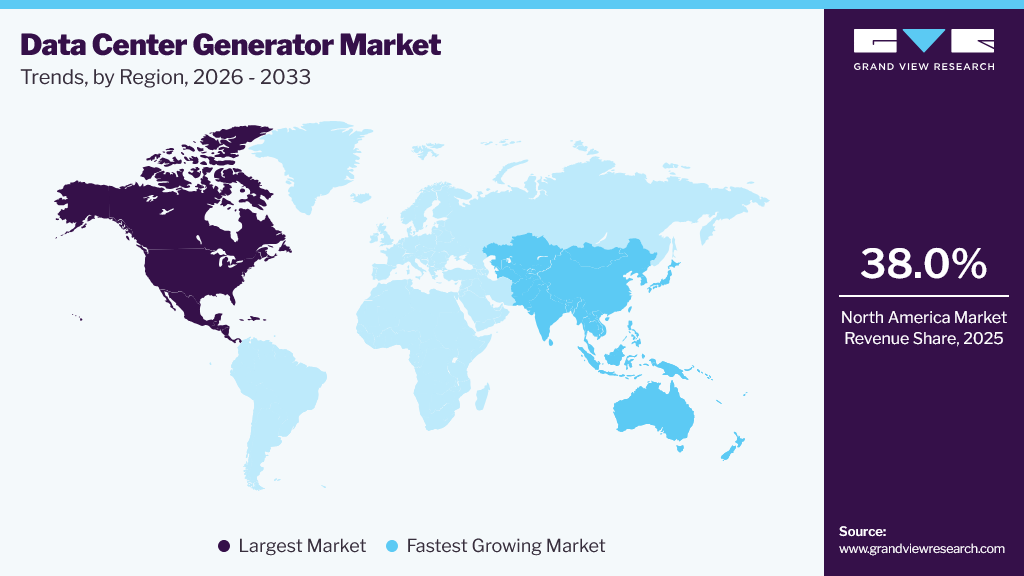
North America data center generator market dominated the global market, accounting for around 38.0% of revenue in 2025. The region's leadership is driven by the strong presence of leading generator manufacturers, including Cummins Inc., Caterpillar Inc., Rolls-Royce Holdings plc, and Generac Holdings Inc., as well as rapid technological advancements and the widespread adoption of reliable backup power solutions. The region has witnessed substantial investments in hyperscale and AI-ready data centers, significantly boosting demand for high-capacity standby generators. For instance, in March 2025, Rolls-Royce announced the expansion of its MTU generator manufacturing facility in Minnesota, U.S., to more than double production capacity in response to surging demand from hyperscale and AI-driven data center projects. Furthermore, the U.S. hosts major cloud service providers, including Amazon, Google, and Meta, all of which continue to invest heavily in large-scale data center infrastructure to support growing cloud computing and AI workloads. These ongoing investments, coupled with the region's mature digital infrastructure and stringent uptime requirements, continue to drive demand for data center generators across North America.
 To learn more about this report, Download Free Sample Report
Asia Pacific Data Center Generator Market Trends
The Asia-Pacific region is expected to experience the fastest CAGR during the forecast period. Investments by market leaders in developing countries such as China and India are expected to drive regional market expansion. Countries such as India and China generate a large volume of data owing to rising internet usage and high smartphone penetration. There has been a significant increase in investments and the construction of hyper-scale data centers across the region. The growing demand for cloud services, AI infrastructure, and colocation facilities is expected to increase the adoption of backup power systems, thereby contributing to market growth.
Latin America Data Center Generator Market Trends
Latin America is expected to see considerable growth opportunities during the forecast period, driven by strategic mergers and acquisitions by leading companies to expand their footprint and strengthen their presence across the region. Additionally, increasing investments in digital infrastructure, growing adoption of cloud computing services, and the expansion of hyperscale and colocation data centers are driving demand for reliable backup power solutions. Rising internet penetration, accelerating digital transformation initiatives, and supportive government efforts to improve connectivity are further contributing to the growth of the data center generator market in the region.
Key Data Center Generator Company Insights
The market is characterized by intense competition, with leading players focusing on product innovation, strategic partnerships, mergers and acquisitions, and geographic expansion to strengthen their market presence. Companies are making significant investments in research and development (R&D) to introduce high-efficiency, low-emission, and digitally connected generator solutions that address the evolving power requirements of hyperscale, colocation, and edge data centers. In addition, key market participants are expanding their product portfolios, enhancing manufacturing capabilities, and integrating advanced monitoring and predictive maintenance technologies to improve operational reliability and gain a competitive advantage.
Key Data Center Generator Companies:
The following key companies have been profiled for this study on the data center generator market.
-
Caterpillar
-
Cummins, Inc.
-
Discovery Energy, LLC dba Rehlko.
-
Eurodiesel Services
-
Generac Power Systems, Inc.
-
HIMOINSA
-
Kirloskar Oil Engines Ltd.
-
MITSUBISHI HEAVY INDUSTRIES, LTD.
-
Piller (Langley Holdings plc)
-
Rolls-Royce plc
Recent Developments
-
In February 2026, Caterpillar Inc. launched the Cat G3520K natural gas generator set, designed for large-scale data center applications. The generator delivers high-efficiency continuous power while supporting lower-emission operations, addressing the growing demand for sustainable backup power solutions in AI and hyperscale data centers.
-
In October 2025, Rolls-Royce Power Systems introduced new mtu Series 4000 fast-start gas generator sets specifically engineered for data centers. The new 2.8 MW solution delivers backup power within approximately 45 seconds, supporting AI-driven facilities seeking lower-emission alternatives to conventional diesel generators while maintaining high operational reliability.
-
In June 2025, Cummins Inc. expanded its Centum Series generator portfolio with higher-capacity backup power solutions for hyperscale and colocation data centers. The new systems offer improved fuel efficiency, digital monitoring capabilities, and enhanced scalability to support mission-critical facilities with increasing power density requirements.
Data Center Generator Market Report Scope
Report Attribute
Details
Market size in 2025
USD 9.1 billion
Estimated market size in 2026
USD 9.7 billion
Projected market size by 2033
USD 14.9 billion
Growth rate
CAGR of 6.3% from 2026 to 2033
Base year for estimation
2025
Historical data
2021 - 2024
Forecast period
2026 - 2033
Quantitative units
Revenue in USD billion, and CAGR from 2026 to 2033
Report coverage
Revenue forecast, company ranking, competitive landscape, growth factors, and trends
Segments covered
Product type, capacity, tier standards, region
Regional scope
North America; Europe; Asia Pacific; Latin America; MEA
Country scope
U.S.; Canada; UK; Germany; France; Japan; China; India; Australia; South Korea; Brazil; Mexico; Saudi Arabia; South Africa; UAE
Key companies profiled
Caterpillar; Kirloskar Oil Engines Ltd.; Cummins, Inc.; Eurodiesel Services; Generac Power Systems, Inc.; HIMOINSA; Discovery Energy, LLC dba Rehlko; MITSUBISHI HEAVY INDUSTRIES, LTD.; Piller (Langley Holdings plc); Rolls-Royce plc.
Customization scope
Free report customization (equivalent to 8 analyst working days) with purchase. Addition or alteration to country, regional & segment scope.
Pricing and purchase options
Avail of customized purchase options to meet your exact research needs. Explore purchase options
Global Data Center Generator Market Report Segmentation
This report forecasts revenue growth at the global, regional, and country levels and provides an analysis of the latest industry trends in each of the sub-segments from 2021 to 2033. For this study, Grand View Research has segmented the global data center generator market report based on product type, capacity, tier standards, and region.
- Product Type Outlook (Revenue, USD Billion, 2021 - 2033)
- Diesel
- Gas
- Others
- Capacity Outlook (Revenue, USD Billion, 2021 - 2033)
- < 1 MW
- 1 MW-2MW
- >2MW
- Tier Standards Outlook (Revenue, USD Billion, 2021 - 2033)
- Tier I & II
- Tier III
- Tier IV
- Regional Outlook (Revenue, USD Billion, 2021 - 2033)
- North America
- U.S.
- Canada
- Europe
- UK
- Germany
- France
- Asia Pacific
- Japan
- China
- India
- Australia
- South Korea
- Latin America
- Brazil
- Mexico
- Middle East & Africa
- South Africa
- Saudi Arabia
- UAE
- North America
Frequently Asked Questions About This Report
North America dominated with an approximately 38.0% revenue share in 2025.
Key players in the market include Caterpillar, Kirloskar Oil Engines Ltd., Cummins, Inc., Eurodiesel Services, Generac Power Systems, Inc., HIMOINSA, Discovery Energy, LLC dba Rehlko, MITSUBISHI HEAVY INDUSTRIES, LTD., Piller (Langley Holdings plc), Rolls-Royce plc, and others.
The diesel segment accounted for the largest revenue share of over 75.0% in 2025.
The global data center generator market size was valued at USD 9.1 billion in 2025 and is estimated at USD 9.7 billion in 2026.
The global data center generator market is expected to grow at a CAGR of 6.3% from 2026 to 2033, reaching USD 14.9 billion by 2033.
About the Author(s)
Communications Infrastructure Research Team
Technology · Communications InfrastructureThis report was authored by the communications infrastructure research team at Grand View Research - comprising two research analysts, one senior research analyst, and one industry expert - with specialized expertise in the communications infrastructure segment of the technology industry. All findings are based on proprietary technology databases, executive interviews, and regulatory analysis, subject to internal peer review prior to publication.
Last Updated:
Speak to Analyst

Customize this report to your needs - add regions, segments, or data points, with 20% free customization.
Or view our licence options:


ISO 9001:2015 & 27001:2022 Certified
We are GDPR and CCPA compliant! Your transaction & personal information is safe and secure. For more details, please read our privacy policy.


