
- Home
- »
- IT Services & Applications
- »
-
Data Center GPU Market Size And Share Report, 2026-2033GVR Report cover

Data Center GPU Market (2026 - 2033)
Size, Share & Trends Analysis By Deployment (On-premises, Cloud), By Function (Training, Inference), By End Use (Cloud Service Providers, Enterprises, Government), By Region, And Segment Forecasts
Market Size, 2025
$91.5BMarket Estimate, 2026
$101.9BMarket Forecast, 2033
$356.9BCAGR, 2026–2033
19.6%Data Center GPU Market Summary
The global data center GPU market size was valued at USD 91.5 billion in 2025 and is projected to grow from USD 101.9 billion in 2026 to USD 356.9 billion in 2033 at a CAGR of 19.6% from 2026 to 2033. The market in North America dominated the market, accounting for a revenue share of 35.7% in 2025. North America is witnessing substantial investments in AI infrastructure as hyperscale cloud providers and enterprises build large GPU clusters for training and deploying generative AI models.
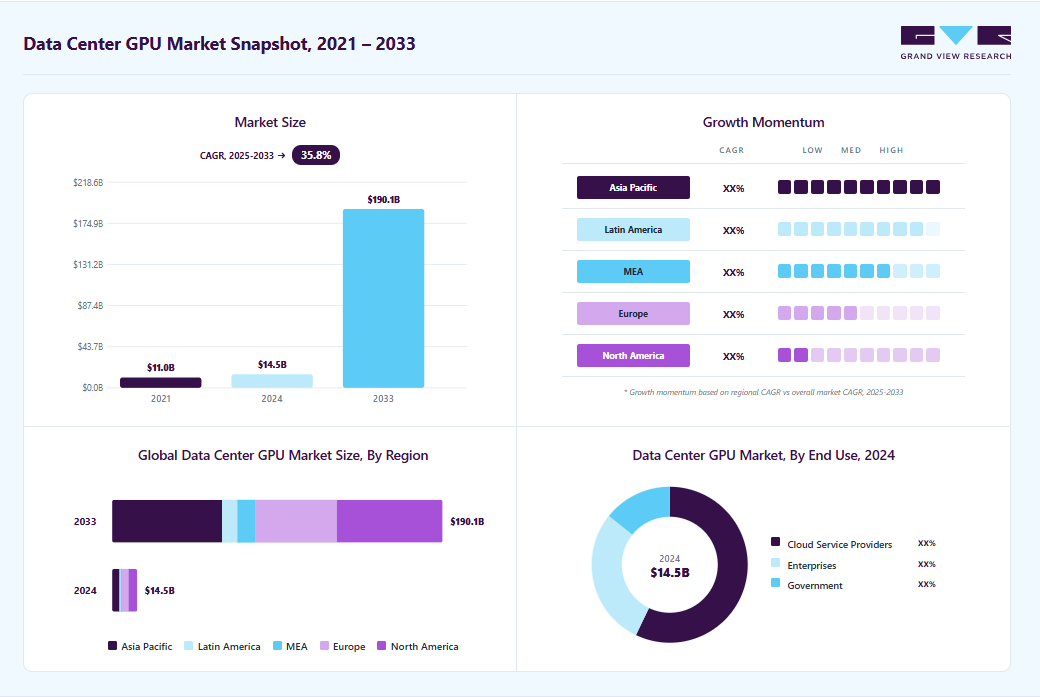 Source: Grand View Research, IR Documents, Primary Interviews, Paid DatabasesTo learn more about this report,
 Download Free Sample Report
Key Market Trends & Insights
- By deployment: Cloud segment dominated the market, with a revenue share of 50.9% in 2025
- By function: Inference segment held the largest market share of 52.7% in 2025
- By end use: Cloud Service Provider segment held the largest revenue share in 2025
Regional Highlights
- Largest regional market: North America (35.7% revenue share, 2025)
- Fastest-growing regional market: Asia Pacific (highest CAGR, 2026-2033)
- By country: The U.S. held the largest market share in 2025.
Market Size & Forecast
- Market size in 2025: USD 91.5 Billion
- Estimated market size in 2026: USD 101.9 Billion
- Projected market size by 2033: USD 356.9 Billion
- CAGR (2026-2033): 19.6%
Prism AI by Grand View Research Free to tryAsk a question about the data center GPU marketTry asking✓Every figure cited from GVR research Prefer the report? Download free sample →This expansion increases demand for high-performance data center GPUs, enabling faster computation, scalable AI workloads, and improved processing efficiency across cloud and enterprise environments. GPUs are highly efficient in handling parallel processing tasks, making them essential for training and inference workloads in AI models. Organizations are increasingly deploying GPU-accelerated computing infrastructure to support applications such as computer vision, natural language processing, and recommendation engines, fueling the demand for powerful, scalable GPU solutions in data centers.
 To learn more about this report, Download Free Sample Report
The global growth of hyperscale data centers operated by tech giants such as Amazon Web Services (AWS), Google Cloud, Microsoft Azure, and Alibaba Cloud is significantly boosting data center GPU industry. These providers are investing in high-performance computing (HPC) infrastructure to meet increasing customer demand for cloud-based AI and data analytics services. The scalability, cost-efficiency, and flexibility of GPU-accelerated cloud instances are further propelling demand across both public and private cloud environments.
Data-driven industries, such as finance, healthcare, e-commerce, and telecom, are increasingly leveraging big data analytics and real-time data processing. GPUs offer enhanced speed and parallel processing capabilities to handle massive datasets, providing a performance edge over traditional CPUs. This need for faster, more efficient computing is accelerating the integration of GPUs into data center architectures, especially in sectors requiring advanced simulations, predictive analytics, and business intelligence.
Market Dynamics
The data center GPU market is witnessing robust growth as organizations increasingly deploy GPU-accelerated infrastructure to support artificial intelligence (AI), machine learning (ML), high-performance computing (HPC), cloud computing, big data analytics, and generative AI workloads. Data center GPUs enable hyperscale cloud providers, enterprises, research institutions, government agencies, and telecommunications companies to accelerate AI model training, inference, scientific simulations, and data-intensive applications while improving computational efficiency and scalability. The rapid adoption of large language models (LLMs), generative AI applications, and AI-powered enterprise solutions is significantly increasing demand for high-performance GPU clusters across global data centers. Furthermore, the expansion of hyperscale and colocation data centers, coupled with rising investments in sovereign AI infrastructure and next-generation cloud services, is driving the deployment of advanced GPU servers equipped with high-bandwidth memory, high-speed interconnects, and liquid cooling technologies. Growing demand for AI-as-a-Service (AIaaS) and GPU-as-a-Service (GPUaaS), increasing digital transformation initiatives, and rising investments in autonomous systems, healthcare research, financial analytics, and digital twin applications are further supporting market growth. Additionally, continuous advancements in GPU architectures, energy-efficient computing technologies, and data center infrastructure modernization are expected to drive the continued expansion of the data center GPU market.
The rapid adoption of artificial intelligence (AI), machine learning (ML), and high-performance computing (HPC) is a major driver of the data center GPU market. Organizations across cloud computing, healthcare, financial services, manufacturing, and research increasingly rely on GPU-accelerated infrastructure to process complex workloads, train large language models (LLMs), and perform real-time AI inference. Compared to traditional CPU-based systems, data center GPUs deliver significantly higher parallel processing capabilities, enabling faster computation, improved energy efficiency, and reduced training times. As enterprises continue investing in AI-driven applications and advanced analytics, demand for high-performance data center GPUs is accelerating globally.
High infrastructure costs and increasing power consumption remain significant restraints for the data center GPU market. Deploying GPU-intensive data centers requires substantial investments in advanced GPU hardware, high-bandwidth networking, liquid cooling systems, power distribution infrastructure, and specialized server architectures. Additionally, next-generation AI GPUs consume considerable amounts of electricity, increasing operational costs and placing greater demands on cooling and energy management systems. Supply chain constraints, limited availability of advanced semiconductor packaging, and the need for skilled personnel to manage GPU infrastructure further challenge adoption, particularly for small and medium-sized enterprises (SMEs) and organizations with constrained IT budgets.
The rapid expansion of AI cloud services and GPU-as-a-Service (GPUaaS) presents a significant opportunity for the data center GPU market. Cloud service providers are increasingly offering on-demand GPU resources, enabling organizations to access high-performance computing without substantial capital investments in physical infrastructure. GPUaaS supports AI model training, inference, scientific computing, and graphics-intensive applications while providing scalability, flexibility, and cost efficiency. Furthermore, growing investments in sovereign AI infrastructure, edge AI deployments, and enterprise private AI clouds are creating new opportunities for GPU vendors and data center operators. As organizations accelerate digital transformation and AI adoption across industries, demand for cloud-based GPU infrastructure and advanced data center GPU solutions is expected to grow substantially.
Analyst Perspective
The data center GPU market is experiencing strong growth driven by AI adoption, generative AI, large language models (LLMs), high-performance computing, and hyperscale cloud infrastructure. Rising investments in GPU-accelerated data centers are supporting AI training, inference, scientific computing, and data analytics. Vendors offering advanced GPU architectures, high-bandwidth memory, energy-efficient designs, high-speed networking, and optimized software ecosystems will gain a competitive advantage. Furthermore, growing demand for sovereign AI infrastructure, GPU-as-a-Service (GPUaaS), edge AI, and liquid-cooled data centers is expected to drive sustained market growth and technological innovation worldwide.
Deployment Insights
Based on deployment, the cloud segment led the market with the largest revenue share of 50.9% in 2025 and is expected to grow at the significant CAGR over the forecast period, driven bythe increasing concerns over data security, compliance, and latency-sensitive workloads that require localized processing. Organizations in highly regulated industries such as finance, healthcare, and government prefer on-premises GPU infrastructure to maintain full control over their data and computing environments. Moreover, enterprises with customized AI models or proprietary datasets often opt for on-premise deployments to optimize performance, reduce data transfer costs, and ensure privacy. The rising need for deterministic performance in AI workloads, combined with advancements in modular, high-density GPU server solutions, is further encouraging businesses to invest in on-premises GPU infrastructure.
The cloud segment is anticipated to grow at the highest CAGR during the forecast period due to the growing demand for scalable, on-demand GPU resources to support fluctuating AI, machine learning, and data analytics workloads without the need for heavy capital investment. Enterprises and startups are leveraging cloud-based GPU services to accelerate time-to-market for AI innovations, benefiting from flexible pricing models and global infrastructure availability.
Function Insights
Based on function, the inference segment led the market with the largest revenue share of 52.7% in 2025, driven by therising deployment of AI-powered applications across industries such as healthcare, finance, retail, and autonomous vehicles, which require real-time decision-making capabilities. The increasing volume of unstructured data and demand for low-latency processing are accelerating the adoption of GPUs for AI inference tasks. Additionally, the proliferation of edge computing and IoT devices necessitates rapid, efficient inference at the data center level.
The training segment is expected to grow at a significant CAGR during the forecast period due tothe growing complexity and scale of deep learning models, which require immense parallel processing power and high memory bandwidth, capabilities by GPUs. The surge in generative AI, natural language processing (NLP), and computer vision applications is fueling demand for GPU-accelerated training environments. In addition, hyperscale cloud providers and AI research institutions are heavily investing in high-performance computing infrastructure to support continuous model development and experimentation.
End Use Insights
Based on end use, the cloud service providers segment led the market with the largest revenue share of 57.6% in 2025, driven by therising demand for scalable, on-demand AI and machine learning capabilities across various industries. Enterprises are increasingly turning to cloud platforms to avoid the high capital and operational costs of maintaining GPU infrastructure, thereby boosting demand for GPU-accelerated instances. The rapid expansion of AI workloads, including model training, inference, and data analytics, is compelling cloud providers to invest in advanced GPU clusters.
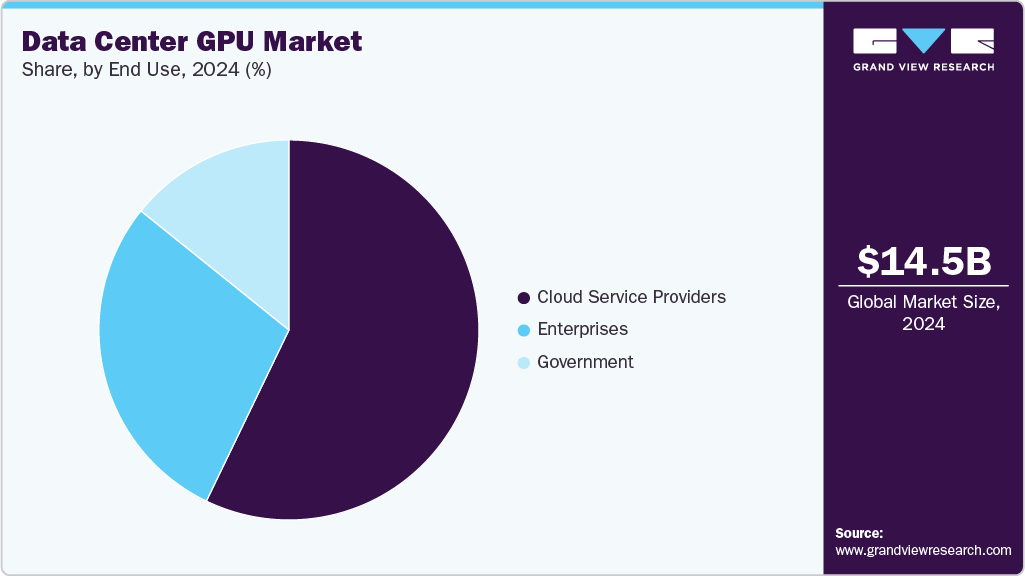 To learn more about this report, Download Free Sample Report
The enterprises segment is expected to grow at a significant CAGR over the forecast period.Enterprises across sectors such as manufacturing, healthcare, and finance are leveraging GPU-accelerated computing for simulation, predictive analytics, and digital twins. Moreover, the integration of GPUs into hybrid cloud architectures enables enterprises to maintain performance while balancing flexibility and control, further fueling market growth in this segment.
Regional Insights
North America dominated the data center GPU market with the largest revenue share of 35.7% in 2025 due to the early adoption of AI technologies, the presence of major cloud and hyperscale data center operators, and a robust startup ecosystem focused on AI and high-performance computing. Significant investments in AI infrastructure by both private and public sectors, along with favorable regulatory frameworks supporting digital transformation, are accelerating GPU deployment. In addition, the region's strong semiconductor R&D capabilities and partnerships between tech companies and academic institutions are driving innovation and adoption of advanced GPU solutions.
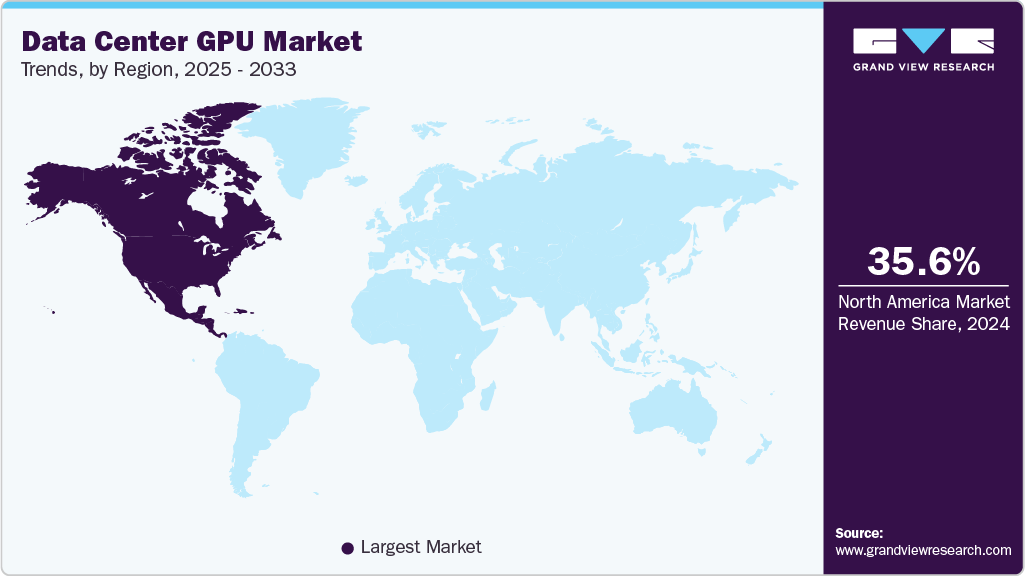 To learn more about this report, Download Free Sample Report
U.S. Data Center GPU Market Trends
The data center GPU market in the U.S. held the largest share in the North America region in 2025, due togovernment initiatives to strengthen national AI capabilities, large-scale digital transformation projects various companies, and surging demand from industries such as defense, automotive, and healthcare. The country’s strong venture capital landscape fuels AI startups, while a mature cloud ecosystem fosters widespread use of GPU-powered services. Moreover, growing concerns around data sovereignty and cybersecurity are prompting enterprises to build GPU-powered private and hybrid data centers.
Europe Data Center GPU Market Trends
The data center GPU market in Europe is anticipated to register considerable growth from 2026 to 2033, driven by the increasing adoption of AI and analytics in industrial automation, smart manufacturing, and energy optimization initiatives. The region’s commitment to sustainability and energy-efficient data center operations is encouraging the deployment of modern, GPU-accelerated infrastructure. EU-backed digital and AI funding programs, combined with a growing focus on building sovereign AI infrastructure and local data processing capabilities, are further supporting market growth across the continent.
The UK data center GPU market is expected to grow rapidly in the coming years as enterprises and research institutions increasingly adopt AI for applications in financial services, pharmaceuticals, and climate modeling. The government’s National AI Strategy and funding for AI research hubs are promoting GPU adoption in both public and private sectors. In addition, post-Brexit efforts to strengthen domestic digital infrastructure and attract international tech investment are further accelerating demand for high-performance GPU-driven data centers.
The Germany data center GPU market held a substantial market share in 2025 due tothe country’s strong industrial base, which is integrating AI and machine learning into manufacturing (Industry 4.0), automotive R&D, and logistics optimization. Public-private initiatives focused on digital transformation, data center modernization, and smart city infrastructure are encouraging GPU investment.
Asia Pacific Data Center GPU Market Trends
Asia Pacific data center GPU market is expected to grow at the highest CAGR of 21.0% from 2026 to 2033, due to rising digitalization, smart city development, and rapid AI adoption across sectors such as fintech, healthcare, and e-commerce. Government-led digital infrastructure projects, along with the expansion of local and international hyperscale data centers, are fueling GPU demand. The region's growing tech talent pool, startup ecosystem, and favorable regulatory support for emerging technologies are also contributing to sustained market expansion.
The Japan data center GPU market is expected to grow rapidly in the coming yearsas the country leverages GPUs for robotics, autonomous systems, and AI-enhanced manufacturing in line with Society 5.0 goals. The aging population is also driving healthcare innovation powered by AI, increasing the need for GPU-based processing. Strategic partnerships between tech companies, research institutes, and the government are fostering AI and HPC development, while ongoing efforts to reduce dependency on foreign cloud services are promoting domestic GPU data center investment.
The China data center GPU market held a substantial market share in 2025, due to thegovernment support for AI development under initiatives such as the New Infrastructure policy. The rapid deployment of AI in surveillance, fintech, and smart city applications is driving demand for GPU-accelerated data centers. Domestic tech giants are investing heavily in AI cloud services, and geopolitical factors are pushing the development of homegrown GPU technologies and self-reliant computing infrastructure, further boosting market momentum.
Key Data Center GPU Company Insights
Key players operating in the data center GPU industry are NVIDIA Corporation, Intel Corporation, Advanced Micro Devices, Inc., Micron Technology, Inc., IBM Corporation, Samsung SDS, Qualcomm Technologies, Inc., Google Cloud. The companies are focusing on various strategic initiatives, including new product development, partnerships & collaborations, and agreements to gain a competitive advantage over their rivals. The following are some instances of such initiatives.
-
In May 2025, Intel Corporationintroduced a new range of GPUs and AI accelerators aimed at professionals and developers, with a focus on enhancing scalable AI performance across diverse workloads. Among the highlights is the Intel Gaudi 3 PCIe card, engineered to enable efficient AI inferencing within existing data center infrastructure. Supporting advanced AI models like Llama, the solution offers flexibility for organizations of all sizes, allowing them to run models from Llama 3.1 8B up to full-scale versions such as Llama 4 Scout and Maverick.
-
In March 2025, NVIDIA Corporation unveiled its latest RTX PRO Blackwell series, in GPU technology for professionals across AI, design, engineering, and creative industries. This new generation delivers cutting-edge capabilities in accelerated computing, AI inference, ray tracing, and neural rendering. The lineup features the NVIDIA RTX PRO 6000 Blackwell Server Edition for data centers, alongside several desktop GPUs including the RTX PRO 6000, 6000 Max-Q, 5000, 4500, and 4000 Blackwell Workstation Editions.
Key Data Center GPU Companies:
The following key companies have been profiled for this study on the data center GPU market.
-
Advanced Micro Devices, Inc.
-
Google Cloud
-
Huawei Cloud Computing Technologies Co., Ltd.
-
IBMCorporation
-
Imagination Technologies
-
Intel Corporation
-
Micron Technology, Inc.
-
NVIDIA Corporation
-
Qualcomm Technologies, Inc.
-
Samsung SDS
Competitive Benchmarking
Category
Operating Strategies
Competitive Edge
Weakness
Established Players (NVIDIA, AMD, Intel, Google, Amazon Web Services (AWS), Microsoft Azure, Oracle Cloud)
- Established players focus on developing high-performance GPU architectures optimized for AI training, AI inference, high-performance computing (HPC), cloud computing, and data analytics. Their strategies emphasize continuous GPU innovation, integration of hardware with AI software ecosystems, partnerships with hyperscale cloud providers, liquid-cooled GPU server solutions, and expansion of AI infrastructure through next-generation data centers.
- Established players benefit from advanced semiconductor design capabilities, strong R&D investments, mature AI software ecosystems, extensive cloud infrastructure, and established relationships with hyperscale cloud providers and enterprise customers. Their proprietary GPU architectures, optimized AI frameworks, high-performance networking technologies, and global supply chains provide significant competitive advantages. Strong financial resources enable continuous innovation, large-scale manufacturing, and rapid commercialization of next-generation AI accelerators.
- These companies face extremely high research and development costs, dependence on advanced semiconductor manufacturing capacity, and supply chain constraints related to high-bandwidth memory (HBM) and advanced packaging. High power consumption, increasing infrastructure costs, export regulations, and intense competition in AI accelerator technologies may impact profitability and market expansion. Long product development cycles and pricing pressures from alternative AI accelerators also present challenges.
Emerging Players (Cerebras Systems, Groq, Tenstorrent, SambaNova Systems)
- Emerging players focus on developing specialized AI accelerators and GPU alternatives optimized for generative AI, large language model (LLM) inference, and energy-efficient AI computing. Their strategies emphasize innovative chip architectures, AI-first hardware designs, cloud-based AI services, strategic partnerships with enterprises and cloud providers, and targeting high-growth AI inference and edge AI markets.
- Emerging players offer innovative AI-centric architectures, faster product innovation cycles, optimized inference performance, and lower power consumption for specific AI workloads. Their ability to rapidly adopt new semiconductor technologies, develop purpose-built AI hardware, and provide flexible deployment models enables them to address niche market opportunities and emerging enterprise AI requirements.
- Limited manufacturing scale, lower brand recognition, smaller customer bases, and dependence on external semiconductor foundries can restrict market penetration. They often lack the mature software ecosystems, developer communities, and global sales channels of established competitors. High capital requirements, rapid technological evolution, and strong competition from leading GPU vendors present significant barriers to long-term scalability and widespread enterprise adoption.
Data Center GPU Market Report Scope
Report Attribute
Details
Market size in 2025
USD 91.5 Billion
Estimated Market size in 2026
USD 101.6 Billion
Projected Market size by 2033
USD 356.9 Billion
Growth rate
CAGR of 19.6% from 2026 to 2033
Base year for estimation
2025
Historical data
2021 - 2024
Forecast period
2026 - 2033
Quantitative units
Revenue in USD billion and CAGR from 2026 to 2033
Report coverage
Revenue forecast, company ranking, competitive landscape, growth factors, and trends
Segments covered
Deployment; Function; End Use; Region
Regional scope
North America; Europe; Asia Pacific; Latin America; MEA
Country scope
U.S.; Canada; Mexico; Germany; UK; France; China; Japan; India; South Korea; Australia; Brazil; Saudi Arabia; South Africa; UAE
Key companies profiled
Advanced Micro Devices, Inc.; Google Cloud; Huawei Cloud Computing Technologies Co., Ltd.; IBM Corporation; Imagination Technologies; Intel Corporation; Micron Technology, Inc.; NVIDIA Corporation; Qualcomm Technologies, Inc.; Samsung SDS
Customization scope
Free report customization (equivalent up to 8 analysts' working days) with purchase. Addition or alteration to country, regional & segment scope.
Pricing and purchase options
Avail customized purchase options to meet your exact research needs. Explore purchase options
Global Data Center GPU Market Report Segmentation
This report forecasts revenue growth at the global, regional, and country levels and provides an analysis of the latest industry trends in each of the sub-segments from 2021 to 2033. For this study, Grand View Research has segmented the data center GPU market report based on deployment, function, end use, and region.
 To learn more about this report, Download Free Sample Report
-
Deployment Outlook (Revenue, USD Billion, 2021 - 2033)
-
On-premises
-
Cloud
-
-
Function Outlook (Revenue, USD Billion, 2021 - 2033)
-
Training
-
Inference
-
-
End Use Outlook (Revenue, USD Billion, 2021 - 2033)
-
Cloud Service Providers
-
Enterprises
-
Government
-
-
Regional Outlook (Revenue, USD Billion, 2021 - 2033)
-
North America
-
U.S.
-
Canada
-
Mexico
-
-
Europe
-
UK
-
Germany
-
France
-
-
Asia Pacific
-
China
-
India
-
Japan
-
South Korea
-
Australia
-
-
Latin America
-
Brazil
-
-
Middle East & Africa
-
UAE
-
Saudi Arabia
-
South Africa
-
-
Research Methodology
The data center GPU market figures in this report are based on a proven research process that combines executive interviews with secondary research from proprietary databases, company filings, and recognized regulatory and institutional sources. Market size is built through value-chain sizing - reconciling supply-side and demand-side estimates - and triangulated with bottom-up and top-down approaches. Every estimate passes multiple levels of expert validation before publication, with each data center GPU segment quantified using the revenue-capture definitions in the table below.
Segment Definition
Segment - Deployment
Revenue capture definition
On-premises
This segment includes GPU infrastructure deployed within an organization's own data centers or private facilities. On-premises deployments provide greater control over data security, regulatory compliance, infrastructure customization, and workload management, making them suitable for organizations with stringent security, latency, or performance requirements.
Cloud
Cloud deployment refers to GPU resources hosted and managed by public or private cloud service providers. Organizations can access GPU computing on demand through subscription or pay-as-you-go models, enabling scalable AI training, inference, HPC, and analytics workloads without significant upfront capital investment.
Segment - Function
Revenue capture definition
Training
The training segment comprises GPUs used to develop and optimize artificial intelligence (AI) and machine learning (ML) models by processing massive datasets and performing complex computations. These GPUs accelerate model development, reduce training time, and support large language models (LLMs), deep learning, and scientific research applications.
Inference
Inference includes GPUs used to execute trained AI models in production environments for real-time predictions and decision-making. These GPUs deliver low-latency, high-throughput performance for applications such as generative AI, recommendation engines, autonomous systems, computer vision, natural language processing, and enterprise AI services.
Segment - End Use
Revenue capture definition
Cloud Service Providers
This segment includes hyperscale cloud providers and managed cloud operators that deploy GPU clusters to offer AI-as-a-Service (AIaaS), GPU-as-a-Service (GPUaaS), cloud computing, and high-performance computing (HPC) services to enterprise and public-sector customers.
Enterprises
The enterprise segment comprises organizations across industries such as healthcare, financial services, manufacturing, retail, telecommunications, media, and automotive that deploy data center GPUs to support AI applications, big data analytics, digital twins, engineering simulations, and business-critical workloads.
Government
This segment includes government agencies, defense organizations, public research laboratories, and academic institutions that utilize GPU-powered data centers for scientific computing, national security, weather forecasting, healthcare research, cybersecurity, and other mission-critical AI and HPC applications.
Estimation Model
Layer
Question
Analysis
GPU Addressable Demand Layer
Who can benefit from Data Center GPUs?
Identify organizations deploying GPU-accelerated computing, including hyperscale cloud providers, colocation operators, enterprises, government agencies, research institutions, universities, AI startups, financial institutions, healthcare organizations, telecommunications companies, manufacturing firms, and media companies. Analyze GPU adoption across AI, HPC, cloud computing, big data analytics, and scientific computing to define the total addressable market.
AI & HPC Workload Generation Layer
Where is demand for Data Center GPUs generated?
Evaluate growth in generative AI, machine learning, large language models (LLMs), AI inference, scientific simulations, digital twins, autonomous systems, cloud computing, and high-performance computing (HPC). Assess AI infrastructure investments, hyperscale data center expansion, enterprise digital transformation, and GPU-intensive application adoption to determine the operationally reachable market.
GPU Infrastructure Adoption & Deployment Layer
Who actively adopts Data Center GPUs?
Analyze GPU deployment across hyperscale cloud providers, enterprises, government organizations, research laboratories, and colocation data centers. Evaluate adoption of on-premises and cloud GPU infrastructure, AI factories, GPU-as-a-Service (GPUaaS), AI-as-a-Service (AIaaS), edge AI infrastructure, and private AI clouds to identify active GPU infrastructure buyers and deployment potential.
Monetization Layer
How is revenue generated?
Assess revenue generated through GPU hardware sales, GPU server platforms, accelerator modules, AI infrastructure systems, cloud GPU instance subscriptions, GPU-as-a-Service (GPUaaS), infrastructure integration services, software and AI ecosystem licensing, maintenance and support contracts, data center infrastructure upgrades, and managed AI computing services to estimate the overall market revenue.
Delivered Customizations
This report has been delivered with the following In-depth customizations
CLIENT REQUEST
CUSTOMIZATION DELIVERED
VALUE ADDS
GPU Vendor Competitive Benchmarking
Assessed leading GPU vendors based on AI accelerator performance, GPU architecture, memory bandwidth, power efficiency, software ecosystem, networking capabilities, pricing strategies, product roadmaps, partnerships, and market share across AI training and inference workloads.
Enables stakeholders to benchmark competitors, identify technology gaps, evaluate product differentiation, and formulate competitive product development and go-to-market strategies.
Regional AI Infrastructure & Data Center GPU Demand Forecast
Evaluated regional AI investments, hyperscale data center expansion, cloud infrastructure development, sovereign AI initiatives, enterprise AI adoption, semiconductor ecosystem maturity, government funding, GPU procurement trends, and demand across Latin America, and the Middle East & Africa.
Provides actionable insights into regional demand hotspots, AI infrastructure investment priorities, competitive landscapes, GPU adoption trends, supply chain dynamics, and long-term growth opportunities across rapidly expanding AI computing markets.
GPU-as-a-Service (GPUaaS) Market Opportunity Assessment
Assessed GPU cloud offerings, consumption models, pricing structures, enterprise adoption, managed AI infrastructure services, workload migration trends, and competitive positioning of major cloud providers.
Helps identify emerging recurring revenue opportunities, optimize cloud strategies, and evaluate market demand for AI infrastructure services.
Frequently Asked Questions About This Report
The global data center GPU market was valued at USD 91.5 billion in 2025 and is expected to reach USD 101.9 billion in 2026.
The global data center GPU market is expected to grow at a compound annual growth rate of 19.6% from 2026 to 2033 to reach USD 356.9 billion by 2033.
The data center GPU market has been experiencing significant growth, driven by the rapid adoption of artificial intelligence (AI), machine learning (ML), and deep learning applications across industries. GPUs are highly efficient in handling parallel processing tasks, making them essential for training and inference workloads in AI models.
North America dominated with 35.7% revenue share in 2025.
Asia Pacific is the fastest-growing region over the forecast period.
The cloud segment led with a 50.9% revenue share in 2025, and is the fastest-growing segment.
The inference segment led with a 52.7% revenue share in 2025, while training segment is the fastest-growing segment.
The cloud service providers segment held the largest share (over 57.0%) in 2025, and is the fastest-growing segment.
Key players in the cloud workflow market include NVIDIA Corporation, Intel Corporation, Advanced Micro Devices, Inc., Micron Technology, Inc., IBM Corporation, Samsung SDS, Qualcomm Technologies, Inc., Google Cloud, Imagination Technologies, Huawei Cloud Computing Technologies Co., Ltd.
About the Author(s)
IT Services & Applications Research Team
Technology · IT Services & ApplicationsThis report was authored by the it services & applications research team at Grand View Research - comprising two research analysts, one senior research analyst, and one industry expert - with specialized expertise in the it services & applications segment of the technology industry. All findings are based on proprietary technology databases, executive interviews, and regulatory analysis, subject to internal peer review prior to publication.
Last Updated:
Speak to Analyst

Customize this report to your needs - add regions, segments, or data points, with 20% free customization.
Or view our licence options:


ISO 9001:2015 & 27001:2022 Certified
We are GDPR and CCPA compliant! Your transaction & personal information is safe and secure. For more details, please read our privacy policy.


