
- Home
- »
- Communications Infrastructure
- »
-
Data Center Substation Market Size Report, 2026-2033GVR Report cover

Data Center Substation Market (2026 - 2033)
Size, Share & Trends Analysis Report By Component, By Voltage (33kV - 110kV, 110kV - 220kV, 220 kV - 500 kV, Above 500 kV), By Channel Partners, By Region, And Segment Forecasts
Market Size, 2025
$10.2BMarket Estimate, 2026
$10.8BMarket Forecast, 2033
$20.8BCAGR, 2026–2033
9.9%Data Center Substation Market Summary
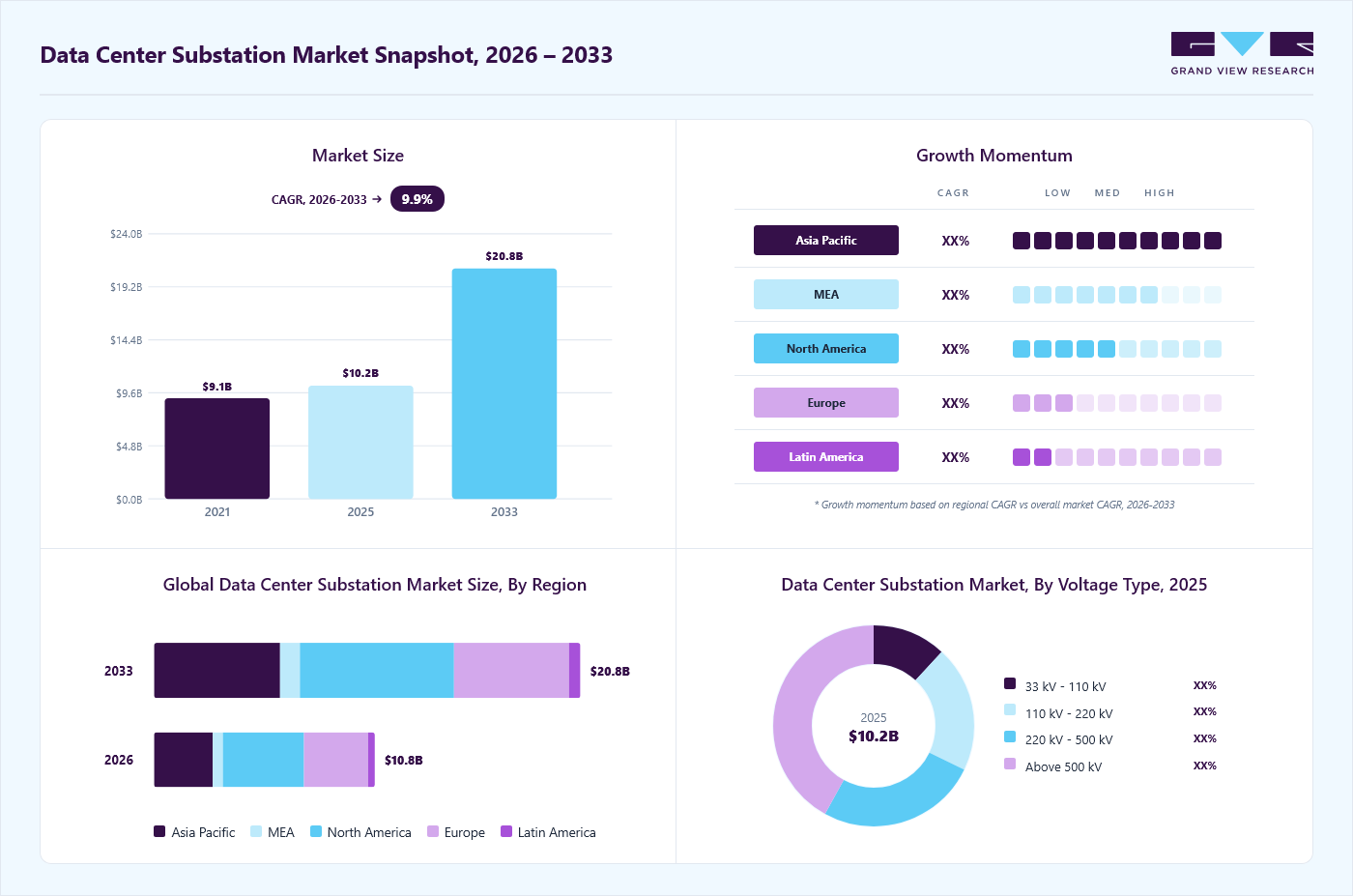
The global data center substation market size was valued at USD 10.2 billion in 2025 and is projected to grow from USD 10.8 billion in 2026 to USD 20.8 billion in 2033, at a CAGR of 9.9% from 2026 to 2033. The market in North America dominated with a revenue share of 36.8% in 2025. The increasing adoption of artificial intelligence, cloud computing, and high-performance computing is accelerating hyperscale data center construction across North America.
 Source: Grand View Research, IR Documents, Primary Interviews, Paid DatabasesTo learn more about this report,
 Download Free Sample Report
 Key Market Trends & Insights
- By component: Switch Gears segment dominated the market, with a revenue share of 41.5% in 2025.
- By voltage type: Above 500 kV segment held the largest market share of 42.0% in 2025.
- By Channel partners: OEMs segment held the largest revenue share in of 76.1% in 2025.
Regional Highlights
- Largest regional market: North America (36.8% revenue share, 2025)
- Fastest-growing regional market: Asia Pacific (highest CAGR, 2026–2033)
- By country: The U.S. held the largest market share in 2025.
Market Size & Forecast
- Market size in 2025: USD 10.2 Billion
- Estimated market size in 2026: USD 10.8 Billion
- Projected market size by 2033: USD 20.8 Billion
- CAGR (2026-2033): 9.9%
GVR research-powered AIAsk Prism AI about the data center substation marketGet cited answers from GVR research on market growth, segments, regulations and forecasts.Start with✓ Source-linked answers ✓ Market-specific context ✓ Traceable figuresExplore Prism AI ↗
These facilities require dedicated, high-capacity substations to manage rising power demands, ensure uninterrupted operations, and support scalable digital infrastructure growth. As businesses and individuals increasingly rely on digital platforms for communication, entertainment, and commerce, the volume of structured and unstructured data continues to rise. This surge necessitates the establishment of more data centers to handle the influx of information.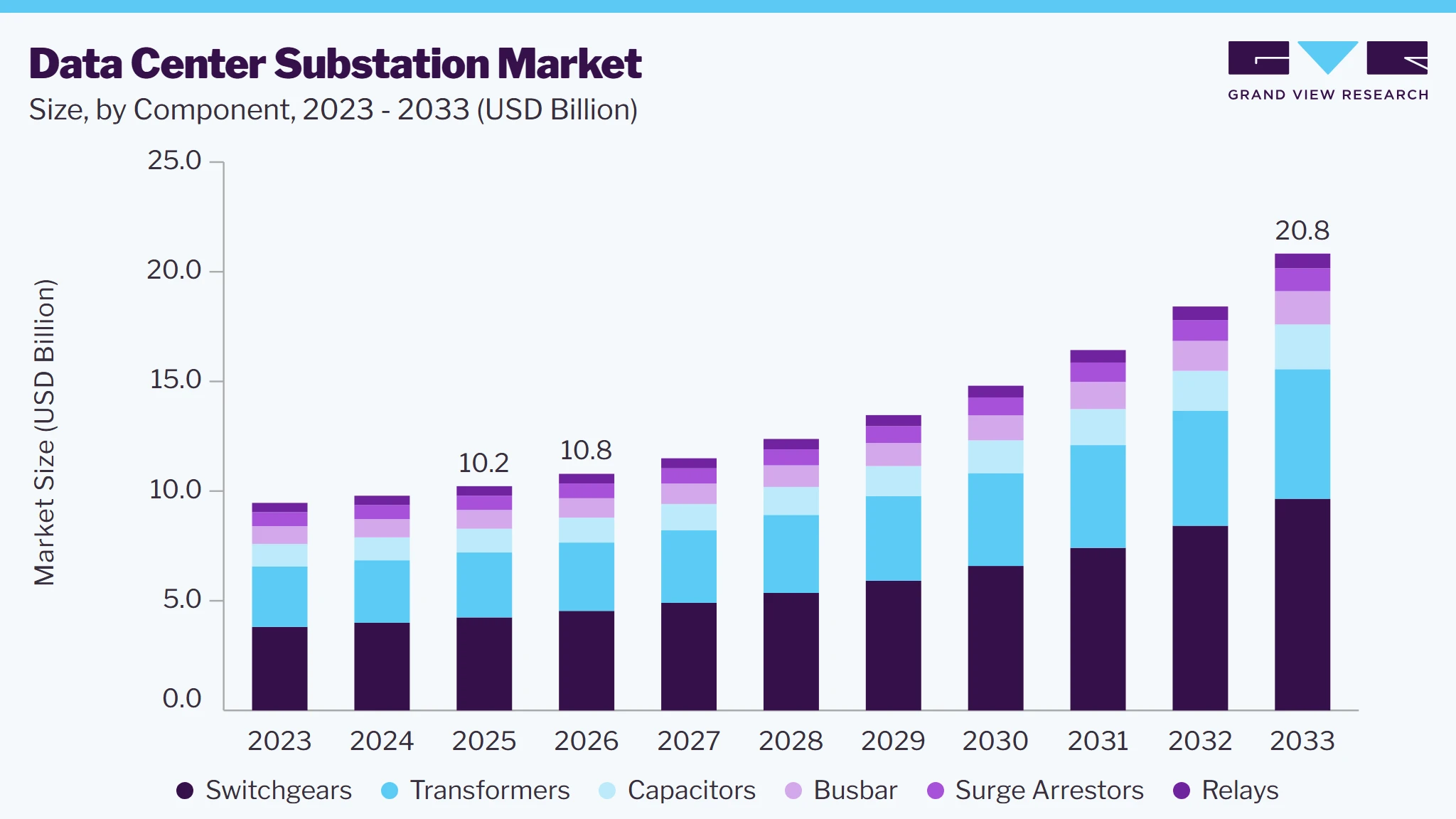 To learn more about this report, Download Free Sample Report
 With organizations transitioning to cloud-based services for their operational needs, their dependence on data centers is increasing. These facilities require robust electrical infrastructure to support their operations, making substations critical components in managing power distribution effectively. In addition, the trend toward edge computing, which involves processing data closer to its source to reduce latency and improve performance, further amplifies the need for strategically located substations that can facilitate efficient energy transmission.
Moreover, the modernization of existing electrical infrastructure plays a crucial role in market growth. Many regions are replacing outdated substations with advanced digital and modular systems that enhance operational efficiency and reliability. The integration of smart technologies into substations allows for better monitoring and management of power flows. For instance, Iberdrola, in Spain, is developing a secondary substation platform (SSP). This platform would enable the implementation of technologies such as Edge computing and virtualization in secondary substations. This initiative aims to enhance the flexibility and efficiency of distribution grids, showcasing how modernization can lead to improved operational reliability and responsiveness.
As companies strive to reduce their carbon footprints and meet regulatory requirements, there is a heightened focus on implementing energy-efficient technologies and practices. Data center operators are investing in substations that provide reliable power and incorporate advanced energy management systems, enabling better load balancing and reducing energy waste. This shift toward sustainable practices is further supported by governmental policies and incentives aimed at promoting green technologies. For instance, the European Union has set ambitious targets for carbon neutrality by 2050, which include significant investments in renewable energy infrastructure.
Market Dynamics
Data center substations are witnessing strong adoption as they serve as critical power infrastructure components that receive, transform, and distribute electricity to support uninterrupted data center operations. These substations enable hyperscale, colocation, enterprise, and edge data center facilities to manage growing power requirements, ensure grid reliability, and maintain high levels of operational resilience. The rapid expansion of cloud computing, artificial intelligence workloads, high-performance computing, and digital transformation initiatives is driving demand for high-capacity electrical infrastructure across global data center markets. Furthermore, advancements in digital substations, intelligent grid management systems, real-time monitoring technologies, renewable energy integration, and high-efficiency power distribution equipment are improving energy management, reliability, and scalability, supporting the continued growth of the data center substation market.
The rapid expansion of hyperscale data centers, artificial intelligence workloads, and cloud computing services is a major driver for the data center substation market. Modern data centers require substantial and reliable power capacity to support high-density computing environments, advanced cooling systems, and mission-critical operations. Dedicated substations enable efficient power transmission, voltage transformation, and distribution while ensuring operational continuity and redundancy. As enterprises and cloud providers continue to expand digital infrastructure, investments in high-capacity substations are increasing to meet escalating electricity requirements and maintain service reliability.
High capital expenditure associated with substation construction, electrical equipment procurement, and grid interconnection remains a significant restraint for data center substation market. Developing dedicated substations requires substantial investments in transformers, switchgear, protection systems, transmission infrastructure, and land acquisition. In addition, obtaining utility approvals, environmental clearances, and grid connection permits can be time-consuming and complex. Rising equipment costs, skilled labor shortages, and long lead times for critical electrical components further increase project costs and deployment timelines, potentially delaying data center expansion initiatives.
The increasing adoption of renewable energy and smart grid technologies presents a significant opportunity for the data center substation market. Data center operators are actively pursuing sustainability goals by integrating solar, wind, battery energy storage systems, and other clean energy sources into their power infrastructure. This transition requires advanced substations capable of managing distributed energy resources, bidirectional power flows, and real-time grid monitoring. Furthermore, the deployment of digital substations, intelligent automation systems, and predictive maintenance technologies is enhancing operational efficiency and power reliability. As utilities and data center operators modernize electrical networks, demand for next-generation substation solutions is expected to accelerate significantly.
Analyst Perspective
The data center substation market sits at the intersection of several powerful digital infrastructure trends, including the rapid expansion of hyperscale and colocation data centers, accelerating adoption of artificial intelligence and high-performance computing workloads, growing cloud computing demand, and increasing investments in grid modernization and energy resilience. As power consumption continues to rise, particularly from AI-driven facilities, the ability to efficiently transmit, transform, distribute, and manage electricity has become a strategic requirement rather than a supporting function. The central competitive moat, however, will belong to providers that successfully integrate digital substation technologies, intelligent grid management systems, advanced protection and control equipment, renewable energy integration capabilities, predictive maintenance platforms, and real-time monitoring solutions into a unified power infrastructure ecosystem. As data center substations evolve from conventional electrical assets into intelligent, automated, and sustainability-focused energy hubs, vendors capable of delivering power reliability, operational efficiency, grid flexibility, scalability, and seamless integration with renewable energy sources will be best positioned to create long-term value and drive sustained market growth.
Components Insights
Based on component, the switchgears segment led the market with the largest revenue share of 41.5% and is expected to grow at the significant CAGR over the forecast period, owing to its reliable power distribution. This segment accounted for a substantial portion of the market, underscoring its importance in managing fluctuating operational voltages and maintaining safety in electrical systems. The use of both air-insulated and gas-insulated switchgear is prevalent, optimizing space and improving safety in high-density environments. For instance, Eaton Corporation has been at the forefront of developing advanced switchgear solutions tailored for data centers. Its Xiria medium-voltage switchgear is designed specifically for high-density environments, providing enhanced safety and reliability while optimizing space.
The capacitors segment is projected to grow at a significant CAGR during the forecast period, as it plays a vital role in enhancing the efficiency of power systems within data centers. Capacitors are integral for power factor correction, voltage stabilization, and improving overall system reliability. By optimizing energy consumption and reducing operational costs through effective capacitor systems, data centers can minimize energy losses and enhance system performance.
Voltage Insights
Based on voltage, above 500 kV segment led the market with the largest revenue share of 42.0% in 2025, reflecting the increasing need for high capacity substations to support critical operations. High voltage substations are specifically designed to meet the power requirements of data centers, ensuring they receive a stable and quality power supply. This investment not only enhances reliability but also allows for the efficient transmission of electricity over long distances, which is crucial given the scale at which these facilities operate. As data centers continue to expand globally, the demand for such high capacity infrastructure will only grow.
The 220 kV - 500 kV segment is expected to grow at a significant CAGR over the forecast period. This voltage range is essential for efficiently stepping down high transmission voltages to levels suitable for distribution within data centers, ensuring a stable and reliable power supply. As data centers expand to accommodate the growing demand for digital services and cloud computing, having robust infrastructure capable of handling significant power loads becomes critical. This segment facilitates optimal power transmission and distribution, which is vital for maintaining the operational continuity of mission critical facilities.
Channel Partners Insights
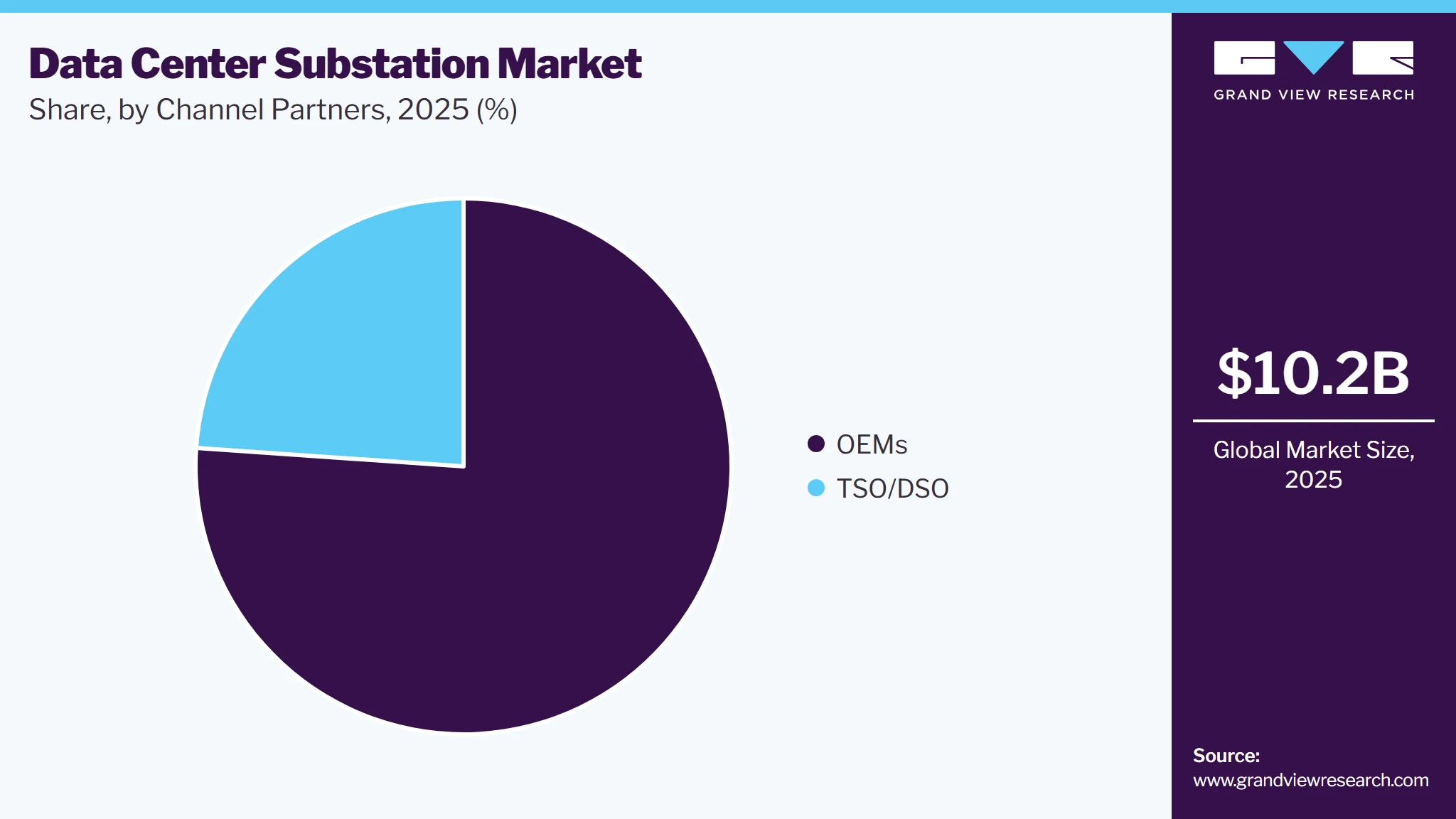
Based on channel partners, OEMs segment led the market with the largest revenue share of 76.1% in 2025, reflecting a strong preference for integrated solutions that ensure compatibility and performance within data center infrastructures. Original Equipment Manufacturers (OEMs) provide tailored equipment that meets specific operational requirements, which is crucial for maintaining optimal performance in energy-intensive environments such as data centers. As the industry continues to evolve, the role of OEMs will be pivotal in delivering innovative solutions that cater to the unique challenges faced by data centers today.
 To learn more about this report, Download Free Sample Report
 The TSO/DSO segment is expected to grow at a significant CAGR over the forecast period. Their involvement is essential for ensuring that data centers receive uninterrupted power supply while adhering to regulatory standards. As demand for reliable electricity continues to rise with the expansion of digital services and cloud computing, Transmission System Operators (TSOs) and Distribution System Operators (DSOs) will increasingly focus on enhancing grid resilience and efficiency to support this growing sector. This collaborative approach ensures reliable service and promotes sustainability within energy consumption practices across data centers. For example, in 2012, Microsoft committed to becoming carbon negative by 2030 and is working closely with Enchanted Rock to enhance the sustainability of its data centers with backup power sourced from California’s upcoming largest microgrid supported by RNG. This partnership aims to leverage microgrid technology that utilizes clean energy sources, thereby reducing reliance on fossil fuels and enhancing the overall resilience of the power supply.
Regional Insights
North America dominated the data center substation market with the largest revenue share of 36.8% in 2025, driven by a combination of robust infrastructure and increasing demand for reliable power solutions. This region's dominance can be attributed to its well-developed IT ecosystem, which supports a high concentration of data centers that require efficient power management systems. For instance, companies such as Amazon Web Services (AWS) and Microsoft Azure have invested heavily in their data center operations across North America, driving the need for advanced substations that can handle significant power loads while ensuring uninterrupted service.
 To learn more about this report, Download Free Sample Report
 U.S. Data Center Substation Market Trends
The data center substation market in the U.S. held the largest share in the North America region in 2025 and is expected to maintain its dominance over the forecast period. In the U.S., the market is thriving due to a well-established IT infrastructure and a high demand for cloud-based solutions. The presence of major technology companies and a surge in data-driven industries, such as finance and healthcare, are driving the construction of new data centers. This has led to significant investments in advanced substation technologies that support high-capacity power requirements, ensuring reliable service for critical operations. For instance, Amazon Web Services (AWS) has been actively constructing its own data centers across various locations, including a significant investment of USD 10 billion in new facilities in Mississippi.
Europe Data Center Substation Market Trends
In Europe, the data center substation market is witnessing significant growth driven by the need for modernization and increased energy efficiency. As many European countries aim to transition to greener energy solutions, there is a strong focus on replacing aging electrical infrastructure with advanced digital substations that utilize fiber optic technology for improved connectivity and reduced installation costs.
Germany is emerging as a key player in the European data center substation market, supported by its strong digital economy and high levels of industrial digitalization. The country’s commitment to renewable energy, particularly wind and solar power, is fostering the development of sustainable data centers. As companies increasingly adopt green technologies, the demand for efficient substations that can integrate renewable energy sources is rising, positioning Germany as a leader in sustainable data center infrastructure.
Asia Pacific Data Center Substation Market Trends
The Asia Pacific region as a whole is witnessing rapid growth in the data center substation market, with countries such as China and India leading the charge. The increasing penetration of smartphones and internet services is fueling the demand for data storage and cloud computing services. In China, substantial investments in smart grid technologies are enhancing the efficiency of power distribution networks. These developments are collectively driving the need for modern substations equipped to handle the evolving energy demands of data centers.
China is experiencing growth in its energy landscape, primarily driven by substantial investments in smart grid technologies and infrastructure upgrades. For instance, the National Development and Reform Commission has outlined a plan to increase investments in key energy sectors by 25% by 2027, focusing on modernizing thermal power, electricity transmission, and distribution systems. This includes renovating old substations and replacing outdated transformers, which is essential for enhancing grid safety and efficiency as the country integrates a growing share of renewable energy sources like wind and solar power.
Key Data Center Substation Company Insights
The data center substation market is characterized by the presence of several key players that significantly influence its dynamics. Major companies include Eaton Corporation, General Electric, ABB Ltd., and Siemens AG, which are known for their innovative technologies and extensive product offerings. These firms are actively involved in developing advanced substation solutions that cater to the growing demand for reliable power distribution in data centers.
-
Eaton Corporation is a global power management company that specializes in providing energy-efficient solutions across various sectors, including electrical, hydraulic, and mechanical power. The company focuses on developing innovative technologies and services that help customers manage power in a reliable and sustainable manner. Eaton serves a diverse range of industries, including utilities, aerospace, automotive, and renewable energy, with a commitment to improving quality of life and environmental sustainability.
-
Siemens AG is a multinational conglomerate based in Germany, primarily focused on industrial manufacturing and technology. The company operates in various sectors, including automation, digitalization, smart infrastructure, mobility, and healthcare. Siemens is recognized for its commitment to innovation and sustainability, leveraging advanced technologies such as artificial intelligence and the Internet of Things (IoT) to enhance efficiency and productivity across industries.
Key Data Center Substation Companies:
The following key companies have been profiled for this study on the data center substation market.
-
ABB Ltd.
-
Bharat Heavy Electricals Limited (BHEL)
-
CG Power and Industrial Solutions Limited
-
Eaton Corporation
-
Fuji Electric Co., Ltd.
-
General Electric
-
Hitachi Energy
-
Hyundai Electric & Energy Systems Co., Ltd.
-
Mitsubishi Electric Corporation
-
NARI Technology Co., Ltd.
-
Schneider Electric SE
-
Siemens AG
-
Sterling & Wilson Pvt Ltd
-
Toshiba Corporation
-
Vertiv Holdings Co.
Competitive Benchmarking
Category
Operating Strategies
Competitive Edge
Weakness
Established Players (ABB, Siemens Energy, Hitachi Energy, Schneider Electric, Eaton, GE Vernova)
Established players focus on delivering comprehensive substation solutions, including transformers, switchgear, protection relays, digital monitoring systems, grid automation technologies, and EPC services. Their strategies emphasize partnerships with hyperscale cloud providers, colocation operators, utilities, and large enterprise data center developers while investing heavily in digital substations, renewable energy integration, and smart grid technologies.
These companies benefit from strong industry reputations, extensive engineering expertise, global manufacturing footprints, and long-standing relationships with utilities and large data center operators. Their ability to provide turnkey solutions, advanced digital substation technologies, grid integration capabilities, and lifecycle maintenance services enables them to support large-scale and mission-critical data center projects worldwide.
High capital requirements, complex organizational structures, and lengthy product development cycles can reduce flexibility in addressing niche customer needs. They also face challenges from supply chain disruptions, long lead times for critical electrical equipment, and increasing competition from regional manufacturers offering cost-effective alternatives.
Emerging Players (CG Power & Industrial Solutions, Hyosung Heavy Industries, Elsewedy Electric, Arteche Group, Powell Industries)
Emerging players focus on specialized substation equipment, grid modernization projects, and cost-effective solutions for hyperscale, colocation, edge, and regional data center developments. Many emphasize digital protection systems, customized engineering services, rapid project execution, and localized manufacturing capabilities to address growing demand for power infrastructure.
Emerging companies offer greater flexibility, competitive pricing, faster customization, and strong regional market knowledge. Their ability to tailor solutions for specific voltage requirements, utility standards, and project timelines allows them to compete effectively in regional and mid-scale data center projects.
Limited global reach, smaller service networks, and lower financial resources may restrict participation in large multinational or hyperscale projects. Dependence on regional markets, fewer long-term utility relationships, and limited R&D budgets can also impact scalability, technological advancement, and competitive positioning against established global players.
Recent Development
-
In May 2023, Mapletree Investments made a significant move by acquiring a new facility in Osaka for over USD 372 million. This acquisition reflects the growing interest of international investors in Japan's data center sector as they seek to capitalize on the rising demand for colocation services and robust digital infrastructure.
-
In July 2022, Eaton completed the acquisition of a 50% stake in Jiangsu Huineng Electric Co., Ltd., a Chinese manufacturer specializing in low-voltage circuit breakers. This strategic partnership aims to enhance Eaton's growth strategy by combining tailored products with its global distribution channels, allowing the company to tap into markets such as renewable energy and grid modernization.
Data Center Substation Market Report Scope
Report Attribute
Details
Market size in 2025
USD 10.2 billion
Estimated Market size in 2026
USD 10.8 billion
Projected Market size by 2033
USD 20.8 billion
Growth rate
CAGR of 9.9% from 2026 to 2033
Base year for estimation
2025
Historical data
2021 - 2024
Forecast period
2026 - 2033
Quantitative units
Revenue in USD billion and CAGR from 2026 to 2033
Report coverage
Revenue forecast, company ranking, competitive landscape, growth factors, and trends
Segments covered
Component; Voltage; Channel Partners; Region
Regional scope
North America; Europe; Asia Pacific; Latin America; MEA
Country scope
U.S.; Canada; Mexico; Germany; UK; France; China; Japan; India; South Korea; Australia; Brazil; Saudi Arabia; South Africa; UAE
Key companies profiled
ABB Ltd.; Bharat Heavy Electricals Limited (BHEL); CG Power and Industrial Solutions Limited; Eaton Corporation; Fuji Electric Co., Ltd.; General Electric; Hitachi Energy; Hyundai Electric & Energy Systems Co., Ltd.; Mitsubishi Electric Corporation; NARI Technology Co., Ltd.; Schneider Electric SE; Siemens AG; Sterling & Wilson Pvt Ltd; Toshiba Corporation; Vertiv Holdings Co
Customization scope
Free report customization (equivalent up to 8 analysts' working days) with purchase. Addition or alteration to country, regional & segment scope.
Pricing and purchase options
Avail customized purchase options to meet your exact research needs. Explore purchase options
Global Data Center Substation Market Report Segmentation
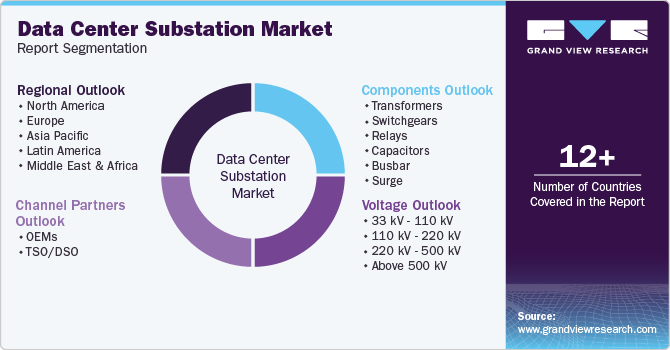
This report forecasts revenue growth at global, regional, and country levels and provides an analysis of the latest industry trends in each of the sub-segments from 2021 to 2033. For this study, Grand View Research has segmented the global data center substation market report based on components, voltage, channel partners, and region.
 To learn more about this report, Download Free Sample Report
 -
Components Outlook (Revenue, USD Million, 2021 - 2033)
-
Transformers
-
Switchgears
-
Air Insulated
-
Circuit
-
Others
-
-
Gas Insulated
-
-
Relays
-
Capacitors
-
Busbar
-
Surge
-
-
Voltage Outlook (Revenue, USD Million, 2021 - 2033)
-
33 kV - 110 kV
-
110 kV - 220 kV
-
220 kV - 500 kV
-
Above 500 kV
-
-
Channel Partners Outlook (Revenue, USD Million, 2021 - 2033)
-
OEMs
-
TSO/DSO
-
-
Regional Outlook (Revenue, USD Million, 2021 - 2033)
-
North America
-
U.S.
-
Canada
-
Mexico
-
-
Europe
-
Germany
-
UK
-
France
-
Italy
-
Spain
-
Netherlands
-
Ireland
-
-
Asia Pacific
-
China
-
Japan
-
India
-
Australia
-
South Korea
-
-
Latin America
-
Brazil
-
-
Middle East and Africa (MEA)
-
UAE
-
Saudi Arabia
-
-
Research Methodology
The data center substation market figures in this report are based on a proven research process that combines executive interviews with secondary research from proprietary databases, company filings, and recognized regulatory and institutional sources. Market size is built through value-chain sizing - reconciling supply-side and demand-side estimates - and triangulated with bottom-up and top-down approaches. Every estimate passes multiple levels of expert validation before publication, with each data center substation segment quantified using the revenue-capture definitions in the table below.
Segment Definition
Segment - Component
Revenue capture definition
Transformers
Transformers are electrical devices that step down or step up voltage levels to enable efficient power transmission and distribution within a data center. They ensure that electricity received from the utility grid is converted to the appropriate voltage required by data center equipment and power distribution systems.
Switchgears
Switchgears are assemblies of switching and protection devices used to control, isolate, and protect electrical circuits and equipment. In data center substations, they help prevent faults, manage power distribution, and ensure uninterrupted operations.
Relays
Relays are protective devices that monitor electrical parameters such as voltage, current, and frequency. When abnormal conditions are detected, relays trigger circuit breakers or other protective equipment to isolate faults and protect critical infrastructure.
Capacitors
Capacitors are electrical components that store and release energy to improve power quality and voltage stability. They help reduce power losses, improve power factor, and enhance the efficiency of electrical distribution systems within data centers.
Busbar
A busbar is a metallic conductor used to collect and distribute electrical power within a substation. It serves as a central connection point for multiple circuits, enabling efficient transmission of high-current electricity between substation components.
Surge Protection Systems
Surge protection systems are devices designed to safeguard electrical equipment from voltage spikes caused by lightning strikes, switching operations, or grid disturbances. They help prevent equipment damage and ensure continuous data center operations.
Segment - Voltage
Revenue capture definition
33 kV - 110 kV
This voltage range is commonly used for medium- to large-scale enterprise, colocation, and regional data centers. It provides efficient power transmission from utility networks to substations while supporting moderate power demands.
110 kV - 220 kV
This range is widely utilized by large colocation and hyperscale data centers requiring substantial power capacity. It supports higher electrical loads and enables efficient transmission over longer distances with reduced energy losses.
220 kV - 500 kV
This high-voltage category is used for major hyperscale campuses and AI-focused data centers with significant power requirements. It facilitates bulk power transmission and supports facilities consuming hundreds of megawatts of electricity.
Above 500 kV
Voltages above 500 kV are primarily associated with ultra-high-voltage transmission networks supplying very large data center clusters and digital infrastructure hubs. They enable efficient long-distance power delivery while minimizing transmission losses.
Segment - Channel Partners
Revenue capture definition
OEMs
(Original Equipment Manufacturers)
OEMs are companies that design, manufacture, and supply key substation equipment such as transformers, switchgear, relays, busbars, and protection systems. They play a critical role in delivering reliable and technologically advanced electrical infrastructure for data centers.
TSO/DSO
(Transmission System Operators /
Distribution System Operators)
TSOs and DSOs are utility organizations responsible for transmitting and distributing electricity from power generation sources to end users. In data center projects, they facilitate grid connectivity, power allocation, network planning, and compliance with electrical infrastructure regulations.
Estimation Model
Layer
Question
Analysis
Addressable Infrastructure Layer
Who requires data center substations?
Identify organizations developing or operating hyperscale, colocation, enterprise, government, telecom, cloud, AI, and edge data centers. Assess facilities requiring dedicated high-voltage power infrastructure to establish the total addressable market for data center substations.
Power Infrastructure Readiness Layer
Which facilities can deploy dedicated substations?
Evaluate grid availability, utility connectivity, transmission network capacity, land availability, power demand forecasts, and regulatory approvals to determine organizations and locations capable of supporting substation deployment.
Adoption & Capacity Expansion Layer
Who actively invests in data center substations?
Analyze expansion activities of hyperscale cloud providers, colocation operators, AI data center developers, telecom companies, and enterprise data centers. Assess investments in new facilities, power upgrades, and capacity expansions to identify active substation adopters.
Monetization Layer
How much revenue is generated?
Quantify revenues generated from substation equipment, engineering and procurement services, construction activities, commissioning, modernization projects, digital monitoring systems, and long-term maintenance contracts.
Delivered Customizations
This report has been delivered with the following In-depth customizations
Client Request
Customization Delivered
Value Adds
Hyperscale, AI & Data Center Power Infrastructure Assessment
Conducted a focused analysis of power infrastructure requirements for hyperscale, colocation, AI, and high-performance computing data centers, including substation capacity planning, power demand forecasting, grid connectivity requirements, and electrical infrastructure investments across major data center hubs.
Helps stakeholders identify high-growth investment opportunities, evaluate future power requirements, assess infrastructure readiness for AI-driven workloads, and develop long-term expansion strategies for data center power ecosystems.
Data Center Substation Ecosystem & Market Opportunity Assessment
Assessed demand for transformers, switchgear, relays, busbars, surge protection systems, digital substations, and grid interconnection solutions across emerging data center markets in Middle East & Africa, along with regulatory considerations and deployment challenges.
Supports market entry and expansion strategies by identifying underserved regions, evaluating competitive dynamics, assessing utility partnerships, and uncovering long-term growth opportunities across the data center power infrastructure value chain.
Regional Power Availability & Utility Partnership Assessment
Analyzed regional power availability, transmission infrastructure, utility interconnection processes, electricity pricing trends, and strategic utility partnerships supporting large-scale data center developments and capacity expansions.
Helps investors, utilities, and data center operators identify favorable deployment locations, reduce power-related project risks, accelerate grid connection timelines, and improve site selection decisions.
Frequently Asked Questions About This Report
North America dominated with 36.8% revenue share in 2025.
The switchgears segment led with a 41.5% revenue share in 2025, and is the fastest-growing segment.
The above 500 kV segment led with a 42.0% revenue share in 2025, and is the fastest-growing segment.
The OEMs segment held the largest share (over 76.1%) in 2025, and is the fastest-growing segment.
Some key players operating in the data center substation market include Eaton, General Electric, Hitachi ABB Powergrids Inc., Schneider Electric, and Seimens Energy among others.
The global data center substation market size was estimated at USD 10.2 billion in 2025 and is expected to reach USD 10.8 billion in 2026.
The global data center substation market is expected to grow at a compound annual growth rate of 9.9% from 2026 to 2033 to reach USD 20.8 billion by 2033.
Key factors that are driving the data center substation market growth include the growing demand for interrupted and smooth transmission and distribution of electricity to power data center facilities.
Asia Pacific is the fastest-growing region over the forecast period.
About the Author(s)
Communications Infrastructure Research Team
Technology · Communications InfrastructureThis report was authored by the communications infrastructure research team at Grand View Research - comprising two research analysts, one senior research analyst, and one industry expert - with specialized expertise in the communications infrastructure segment of the technology industry. All findings are based on proprietary technology databases, executive interviews, and regulatory analysis, subject to internal peer review prior to publication.
Last Updated:
Speak to Analyst

Customize this report to your needs - add regions, segments, or data points, with 20% free customization.
Or view our licence options:


ISO 9001:2015 & 27001:2022 Certified
We are GDPR and CCPA compliant! Your transaction & personal information is safe and secure. For more details, please read our privacy policy.


