
- Home
- »
- IT Services & Applications
- »
-
Data Center Transformation Market Size Report, 2026-2033GVR Report cover

Data Center Transformation Market (2026 - 2033)
Size, Share & Trends Analysis Report By Service (Consolidation, Optimization, Automation), By End-user (Colocation Providers, Enterprises), By Vertical (BFSI, IT & Telecommunications, Energy), By Region, And Segment Forecasts
Market Size, 2025
$21.6BMarket Estimate, 2026
$23.0BMarket Forecast, 2033
$42.3BCAGR, 2026–2033
9.1%Data Center Transformation Market Summary
The global data center transformation market size was valued at USD 21.6 billion in 2025 and is projected to grow from USD 23.0 billion in 2026 to USD 42.3 billion in 2033 at a CAGR of 9.1% from 2026 to 2033. North America dominated the market, accounting for a revenue share of 45.2% in 2025. As organizations shift towards hybrid cloud models to manage scalability, security, and agility, there’s an emphasis on transforming traditional data centers.
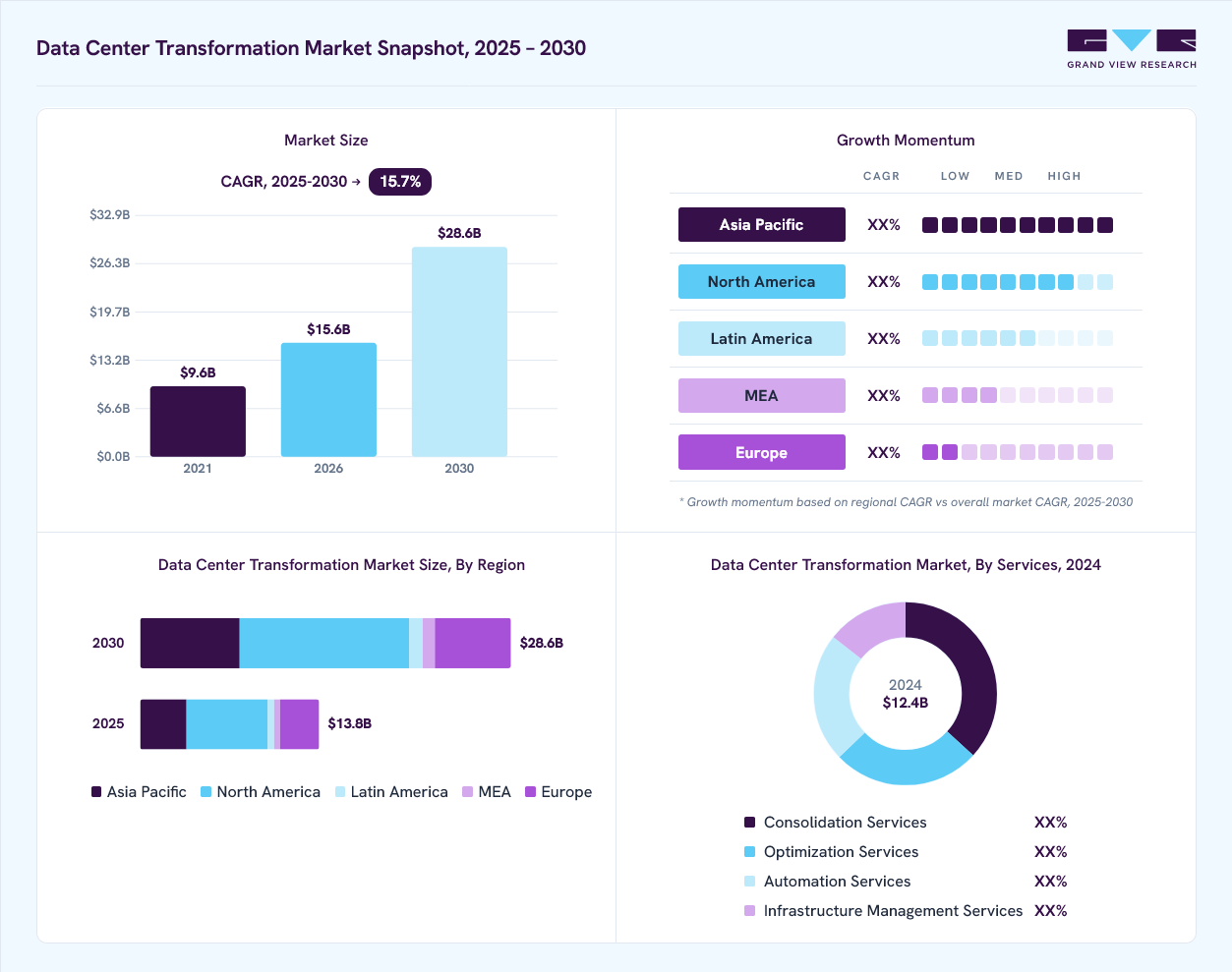 Source: Grand View Research, IR Documents, Primary Interviews, Paid DatabasesTo learn more about this report,
 Download Free Sample Report
 Key Market Trends & Insights
- By services: Consolidation services segment led the market with the largest revenue share of 37.0% in 2025.
- By end-user: Cloud service providers segment held the largest market share of 45.0% in 2025.
- By vertical: IT and Telecommunications segment held the largest revenue share of 26.7% in 2025.
Regional Highlights
- Largest regional market: North America (45.2% revenue share, 2025)
- Fastest-growing regional market: Asia Pacific (highest CAGR, 2026-2033)
- By country: The U.S. held the largest market share in 2025.
Market Size & Forecast
- Market size in 2025: USD 21.6 Billion
- Estimated market size in 2026: USD 23.0 Billion
- Projected market size by 2033: USD 42.3 Billion
Three ways to get this report
Buy it, customize it, or ask a question.Ask an Analyst
Analyst response in 1 business day
- AccessReport author, directly
- Reply timeWithin 1 working day
- No sales callDirect answer only
- FormatEmail reply
- CostFree, no cost
Get the Full Report
What the study covers
- FormatsPDF · Excel · Dashboard
- Timeline2026–2033 annual, 2025 base
- Coverage20+ countries, 5 regions
- Companies10+ key players profiled
Customize the Report
20% free customization
- IncludeCountries, segments, points
- TailorTo your product definition
- ExtendDeeper competitor detail
- OrA fully bespoke study
- Turnaround5–10 working days
North America is witnessing significant investments in AI, cloud computing, and HPC infrastructure, driving large-scale data center transformation initiatives. Enterprises and hyperscale cloud providers are modernizing legacy facilities with AI-ready architectures, high-density computing environments, GPU clusters, and advanced networking technologies. The growing deployment of generative AI, machine learning, and data-intensive applications is accelerating demand for scalable, automated, and energy-efficient data center infrastructure, encouraging organizations to transform existing facilities to support next-generation digital workloads.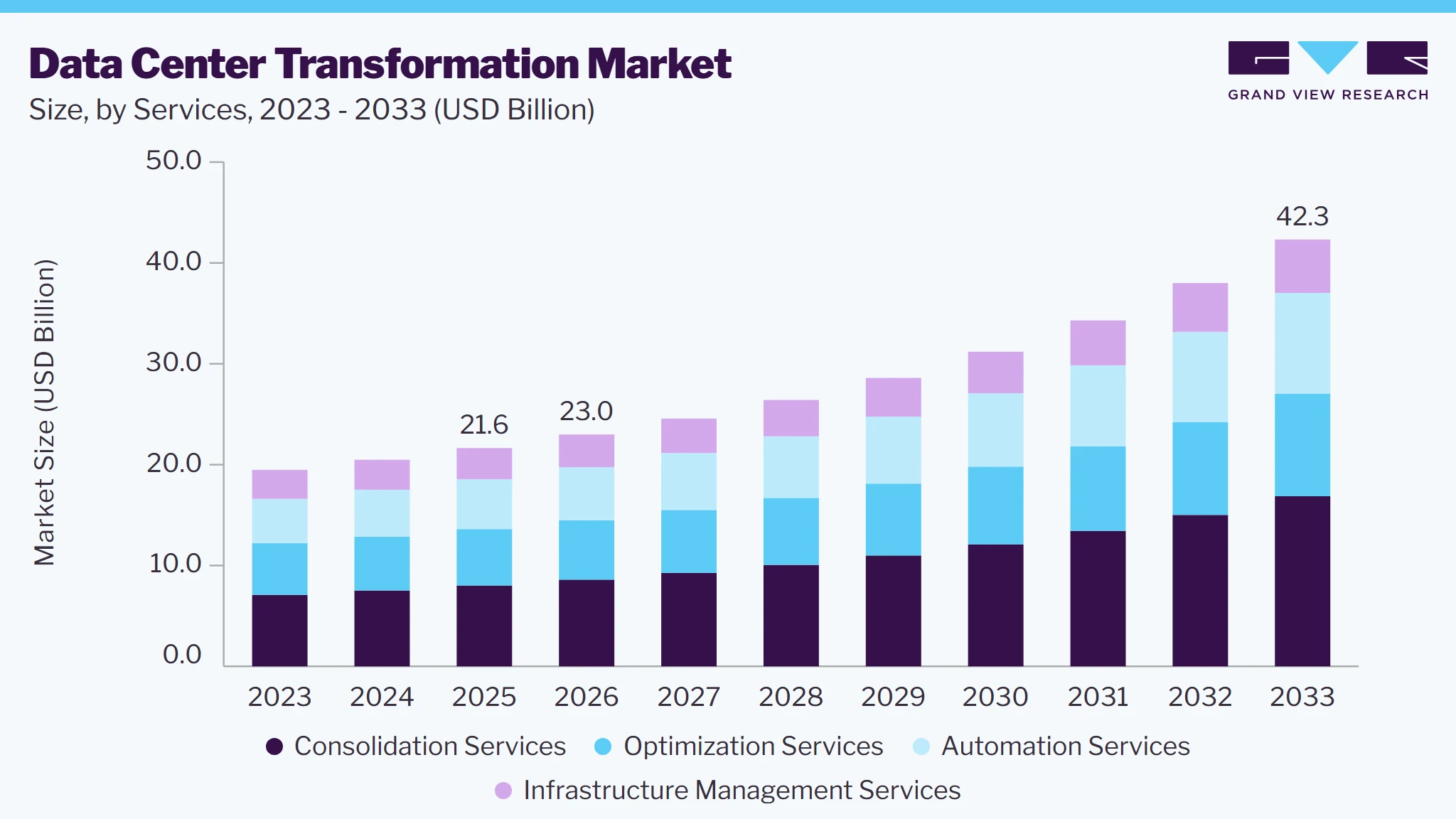 To learn more about this report, Download Free Sample Report
 This transformation involves modernizing infrastructure through virtualization, automation, and the deployment of advanced networking solutions, which collectively enhance performance and reduce operational costs. The increased need for agility to support real-time data processing, a requirement that's heightened by trends such as edge computing and 5G, which rely on highly responsive, localized data centers.
Cost optimization and energy efficiency are also major growth drivers in data center transformation industry. Many organizations are shifting to energy-efficient models, integrating sustainable practices such as renewable energy sources, intelligent cooling systems, and smart power management. This trend is further amplified by regulatory pressures and corporate responsibility initiatives aimed at reducing carbon footprints. Data center transformation aligns with these goals by adopting energy-efficient hardware and software solutions that minimize power consumption while maintaining high-performance standards. According to the International Energy Agency (IEA), data centers consumed approximately 460 terawatt-hours (TWh) of electricity in 2022, with projections suggesting this could exceed 1,000 TWh by 2026 if current trends continue.
Security and compliance requirements also play a crucial role in driving data center transformation industry. As cyber threats become more complex and data protection regulations tighten, organizations are investing in robust, secure data infrastructures. This need is pushing businesses to transition from legacy systems, which are often vulnerable and non-compliant, to secure, modern environments that can better protect sensitive information and ensure regulatory adherence. Advanced encryption, multi-layered security frameworks, and integrated threat detection solutions are increasingly part of the data center transformation process, making security a primary concern for organizations across industries.
Digital transformation initiatives across industries also play a significant role. Sectors such as finance, healthcare, retail, and manufacturing are rapidly embracing digital tools to stay competitive, engaging in multi-cloud strategies, and migrating workloads to virtualized environments. As a result, organizations are overhauling their data centers to support agile IT environments and high-performance computing resources, aiming for improved operational efficiency and a better customer experience.
Data-driven business models are creating an ongoing demand for real-time data processing and analysis. Companies are leveraging big data and artificial intelligence (AI) for predictive analytics, machine learning, and improved decision-making, all of which require high-performance data centers. This shift towards data-centric business operations demands a transformation from traditional infrastructure to one that can handle vast data volumes and perform intensive computations, a necessity that legacy systems often cannot meet effectively.
Market Dynamics
The data center transformation market is experiencing strong growth as organizations modernize legacy data center infrastructure to support artificial intelligence (AI), hybrid and multi-cloud environments, high-performance computing (HPC), edge computing, and increasingly data-intensive digital workloads. Enterprises across industries are transforming traditional data centers into intelligent, software-defined, and highly automated environments to improve operational efficiency, scalability, resilience, and security. The rapid adoption of generative AI, machine learning (ML), Internet of Things (IoT), and real-time analytics is accelerating demand for modern compute, storage, networking, and virtualization technologies capable of supporting next-generation applications. Furthermore, the expansion of hyperscale and colocation data centers, along with growing investments in cloud migration, software-defined infrastructure (SDI), hyperconverged infrastructure (HCI), and edge data centers, is driving comprehensive transformation initiatives worldwide. Organizations are increasingly deploying AI-powered infrastructure management, automation platforms, digital twins, predictive maintenance solutions, intelligent workload orchestration, and advanced cooling technologies to optimize performance while reducing operational costs and energy consumption.
Rising cybersecurity requirements, stricter regulatory compliance, sustainability goals, and carbon reduction initiatives are further encouraging enterprises to modernize aging facilities with energy-efficient power systems, liquid cooling, renewable energy integration, and intelligent energy management solutions. Additionally, continuous advancements in AI-driven automation, software-defined networking (SDN), software-defined storage (SDS), composable infrastructure, and cloud-native technologies are expected to accelerate digital infrastructure modernization and support the long-term growth of the Data Center Transformation Market.
The growing adoption of digital transformation initiatives and hybrid cloud strategies is a key driver of the data center transformation Market. Organizations across banking, healthcare, manufacturing, retail, telecommunications, and government are modernizing legacy data center infrastructure to support cloud-native applications, AI workloads, edge computing, and data-intensive operations. Enterprises are increasingly deploying software-defined infrastructure (SDI), hyperconverged infrastructure (HCI), virtualization, and intelligent automation to improve scalability, operational efficiency, and business agility. As businesses continue migrating mission-critical applications to hybrid and multi-cloud environments, demand for modern, resilient, and highly automated data center infrastructure is accelerating worldwide.
High capital expenditure and the complexity of modernizing existing data center environments remain significant restraints for the data center transformation market. Transforming legacy facilities requires substantial investments in next-generation servers, storage systems, networking equipment, AI-enabled management platforms, advanced cooling technologies, power infrastructure, and cybersecurity solutions. Many organizations also face challenges integrating modern technologies with legacy applications while minimizing operational disruptions and downtime. Additionally, shortages of skilled IT professionals, extended implementation timelines, and concerns regarding data migration, interoperability, and regulatory compliance further increase transformation costs, particularly for small and medium-sized enterprises (SMEs) and organizations operating under limited IT budgets.
The increasing deployment of AI-ready infrastructure, sustainable data centers, and edge computing presents a significant opportunity for the data center transformation market. Organizations are investing in intelligent, energy-efficient facilities capable of supporting AI model training, high-performance computing (HPC), real-time analytics, and latency-sensitive applications. Growing adoption of liquid cooling, renewable energy integration, AI-driven infrastructure management, digital twins, software-defined networking (SDN), and predictive maintenance is enabling operators to improve operational efficiency while reducing energy consumption and carbon emissions. Furthermore, expanding hyperscale cloud investments, 5G deployments, sovereign cloud initiatives, and distributed edge data centers are creating substantial opportunities for technology vendors, infrastructure providers, and managed service providers as enterprises continue accelerating digital infrastructure modernization.
Analyst Perspective
The data center transformation market is at the forefront of enterprise digital modernization, driven by accelerating cloud adoption, hybrid and multi-cloud strategies, artificial intelligence (AI), automation, edge computing, and growing demand for resilient, energy-efficient digital infrastructure. Organizations across enterprises, hyperscale cloud providers, colocation operators, government agencies, financial institutions, telecommunications companies, healthcare providers, and manufacturers are investing heavily in modernizing legacy data centers to improve scalability, operational efficiency, cybersecurity, business continuity, and support next-generation digital workloads. As digital transformation initiatives continue to expand, organizations require flexible, software-defined, and intelligent data center environments capable of supporting AI applications, high-performance computing (HPC), data-intensive analytics, and mission-critical operations.
Service Insights
Based on services, the consolidation services segment led the market with the largest revenue share of 37.0% in 2025 and is expected to grow at the significant CAGR over the forecast period. Organizations aim to reduce their IT overhead while maximizing output, and consolidation services offer a streamlined way to achieve this by combining disparate data centers, reducing the number of physical servers, and integrating legacy systems into unified platforms. By consolidating data centers, businesses can lower their hardware and maintenance costs, conserve energy, and reduce their physical footprint, creating significant cost savings while maintaining, or even improving, performance.
The automation services segment is expected to grow at a CAGR of 16.2% over the forecast period. As companies work towards reducing their carbon footprint, automation plays a vital role in optimizing energy usage within data centers. Automated energy management systems, for instance, can monitor and adjust power usage, cooling systems, and workload distribution based on real-time demand, leading to significant reductions in energy consumption and operational costs. This focus on green IT initiatives aligns with corporate social responsibility goals and positions data centers as more environmentally sustainable infrastructure.
End-user Insights
Based on end-user, the cloud service providers segment led the market with the largest revenue share of 45.0% in 2025 owing to the increasing demand for hybrid and multi-cloud environments. As organizations seek to take advantage of both on-premises and cloud solutions, they are adopting hybrid cloud strategies to facilitate a smooth flow of data and applications between these environments. In addition, multi-cloud strategies are becoming more popular. These involve using multiple Cloud Service Providers (CSPs) to prevent vendor lock-in, improve flexibility, and optimize costs.
The colocation providers segment is expected to grow at a significant CAGR over the forecast period due to the improved connectivity and lower latency demands, fueled by advancements in 5G and edge computing. Colocation providers are increasingly establishing data centers in strategically located edge regions, closer toeEnd users, to reduce latency for real-time applications such as online gaming, video streaming, and autonomous systems. These facilities are optimized for low-latency requirements, making colocation an appealing option for businesses that need faster data processing speeds and closer proximity to customers.
Vertical Insights
Based on vertical, the IT and telecommunications segment led the market with the largest revenue share of 26.7% in 2025. Growing data traffic is a critical factor driving the transformation of data centers in the IT and telecommunications sectors. The explosive rise in data generated by mobile devices, video streaming, and IoT sensors is pushing telecom companies to modernize their data infrastructure to accommodate increased volumes and more complex data types. This modernization includes upgrades to storage and networking capabilities and integration with cloud environments to ensure seamless data flow and access. Telecom companies are adopting scalable, cloud-based solutions to handle these surges in data, allowing for faster processing and improved data management across networks.
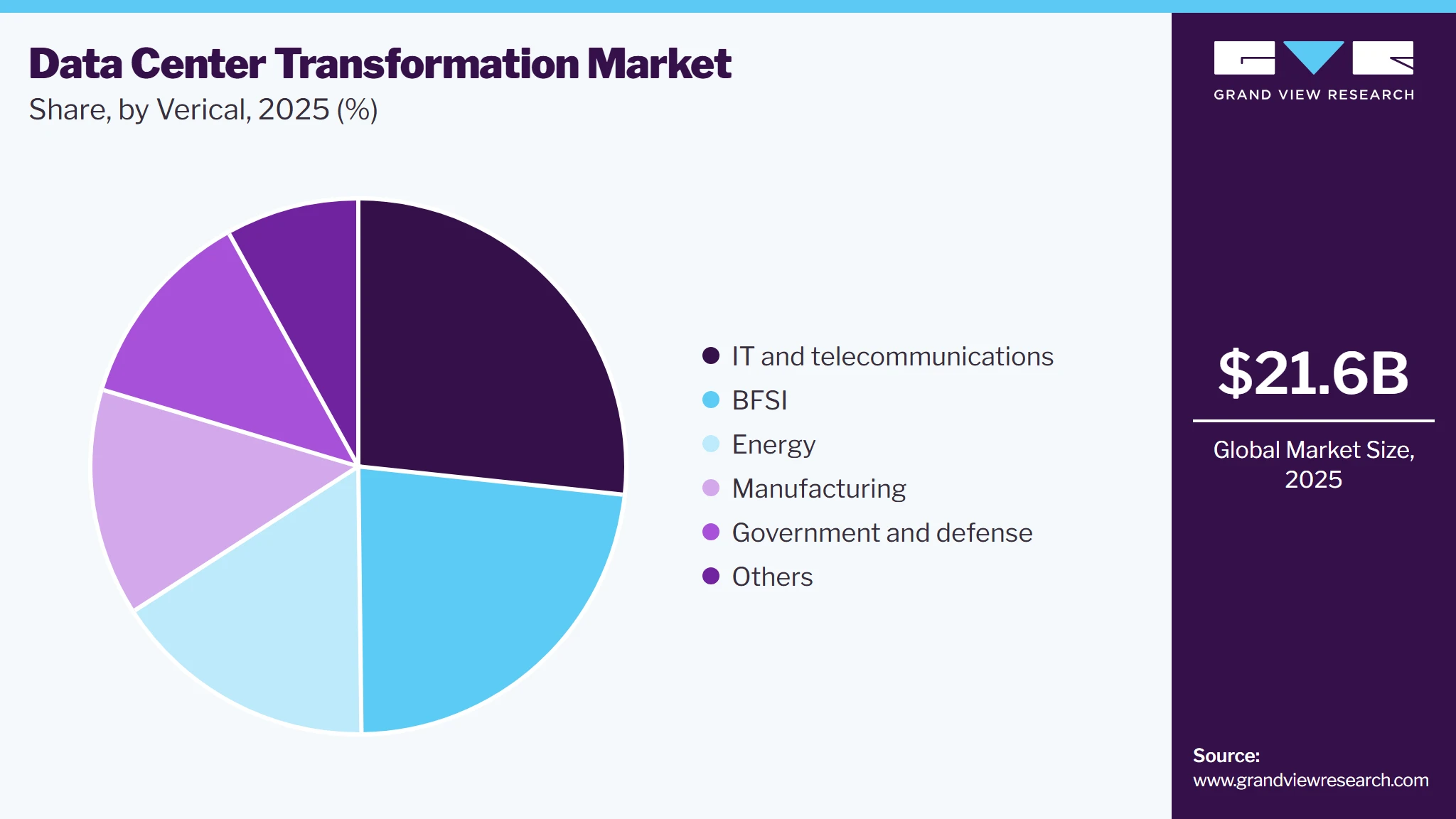 To learn more about this report, Download Free Sample Report
 The BFSI segment is expected to grow at a significant CAGR over the forecast period. Data security and regulatory compliance are essential in the BFSI sector, driving significant investment in secure, modern data centers. With stringent regulations such as GDPR, PCI-DSS, and CCPA governing data protection, financial institutions are modernizing their data centers to ensure compliance and prevent costly data breaches. Advanced data centers provide enhanced security frameworks, including multi-factor authentication, encryption, and AI-powered threat detection, which help institutions manage compliance risks and protect sensitive customer information.
Regional Insights
North America dominated the data center transformation market with the largest revenue share of 45.2% in 2025. Software-defined networking (SDN), software-defined storage (SDS), and other SDI solutions are enabling more efficient resource management within data centers. In North America, SDI adoption is rising, as it allows organizations to virtualize and dynamically manage infrastructure, boosting agility and scalability.
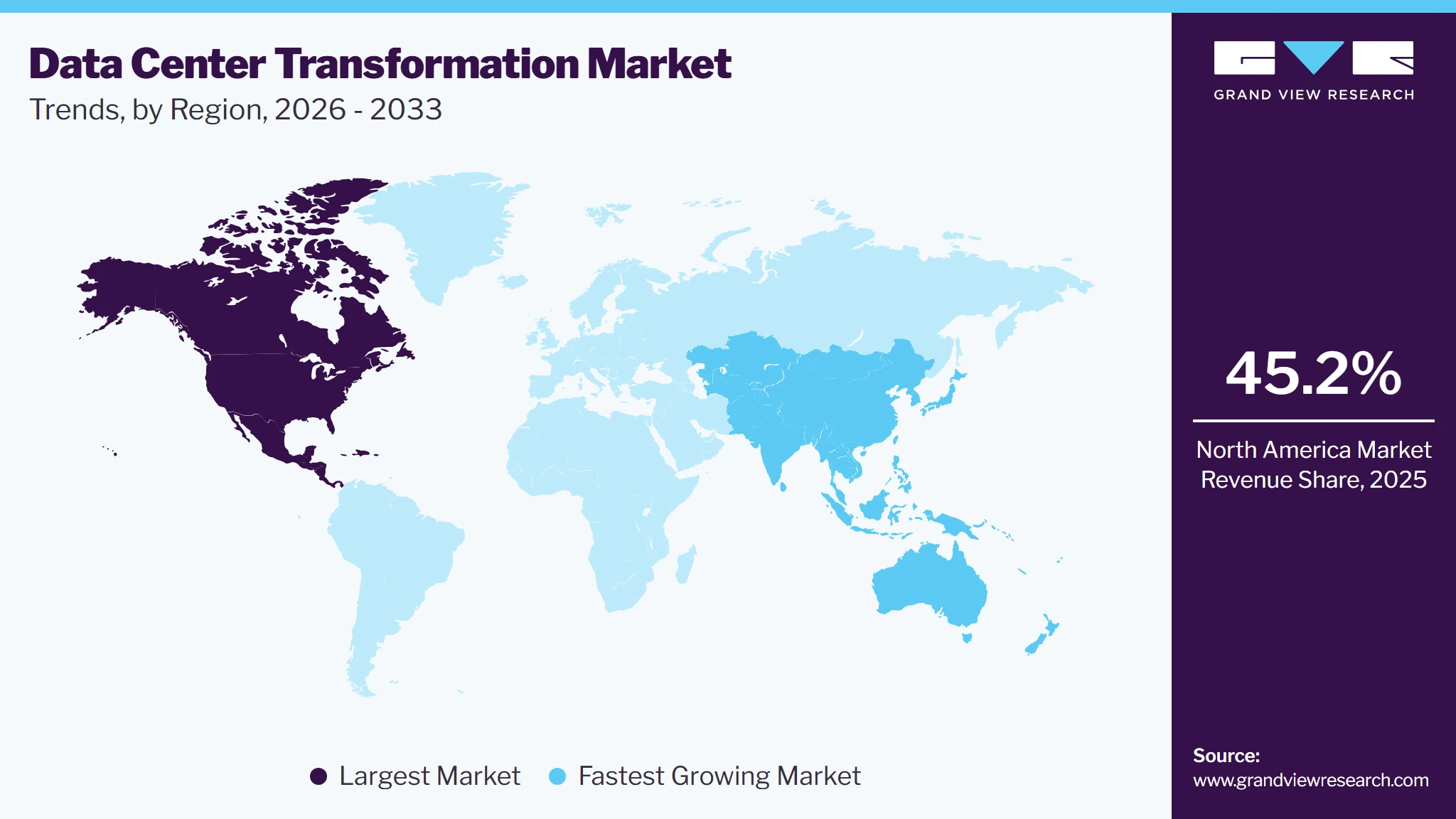 To learn more about this report, Download Free Sample Report
 U.S. Data Center Transformation Industry Trends
The data center transformation market in the U.S. held the largest share in the North America region in 2025. U.S. organizations are adopting hybrid and multi-cloud infrastructures at a rapidly, allowing them to blend on-premises data centers with public and private cloud resources. This model offers flexibility and scalability, helping businesses manage diverse workloads across different cloud environments while maintaining control over sensitive data.
Europe Data Center Transformation Industry Trends
The data center transformation market in Europe is growing with a significant CAGR from 2025 to 2030. Sustainability and Green Data Centers are a primary trend, as European companies and governments prioritize reducing carbon footprints. Many organizations are investing in energy-efficient data center solutions, such as renewable energy sources (wind, solar, hydro), advanced cooling technologies, and power usage effectiveness (PUE) optimizations. Initiatives such as the EU's Green Deal and the Climate Neutral Data Centre Pact push data centers toward net-zero emissions targets, promoting energy-efficient equipment, intelligent cooling systems, and renewable power integration.
The UK data center transformation market is expected to grow rapidly in the coming years. Many UK businesses are turning to colocation services as part of their data center transformation strategy. By partnering with colocation providers, organizations benefit from shared infrastructure, enhanced security, and access to advanced technologies without the high capital expenditures associated with building and maintaining their own data centers.
The Germany data center transformation market held a substantial market share in 2024. Artificial intelligence (AI) and automation are becoming integral to data center operations in Germany. Organizations are utilizing AI-driven tools for predictive maintenance, workload optimization, and security threat detection. Automation technologies are streamlining operations and reducing the need for manual intervention, leading to improved efficiency and reduced operational costs.
Asia Pacific Data Center Transformation Industry Trends
Asia Pacific is growing significantly at a CAGR of 16.5% from 2025 to 2030. The rollout of 5G networks is significantly impacting data center transformation in the region. As telecommunications companies invest in 5G infrastructure, the need for robust and flexible data centers to support increased bandwidth and low-latency applications is growing. This trend is leading to the establishment of new data center facilities that are optimized for 5G use cases, such as smart cities, autonomous vehicles, and augmented reality.
The Japan data center transformation market is expected to grow rapidly in the coming years. The demand for colocation services is rising as companies seek to reduce capital expenditures while gaining access to advanced data center facilities. Colocation providers offer scalable solutions, enabling businesses to expand their IT infrastructure without the need for significant upfront investment.
The China data center transformation market held a substantial market share in 2024 as China is witnessing a surge in cloud computing adoption across various sectors, including finance, healthcare, and e-commerce. Major cloud service providers, such as Alibaba Cloud, Tencent Cloud, and Huawei Cloud, are investing heavily in expanding their data center footprints to meet the growing demand for cloud services.
Key Data Center Transformation Company Insights
Key players operating in the data center transformation market IBM, Microsoft, Cisco Systems, Inc., Dell Inc., and Schneider Electric SE. The companies are focusing on various strategic initiatives, including new product development, partnerships & collaborations, and agreements to gain a competitive advantage over their rivals. The following are some instances of such initiatives.
-
In October 2024, Dell Inc. launched new rack-scalable systems, servers, and storage innovations within its Dell AI Factory, tailored for high-density computing and scalable AI workloads. The 21-inch Dell IR7000 rack, designed for high CPU and GPU density, includes native liquid cooling capable of managing up to 480KW and capturing nearly 100% of heat. Dell's Integrated Rack Scalable Systems (IRSS) simplifies AI infrastructure setup with a plug-and-play approach, while new PowerEdge models like the XE9712 (NVIDIA-based) and M7725 (AMD-based) support large AI clusters and dense compute. PowerScale advancements boost capacity, AI performance, and data discoverability, with Dell’s Generative AI Solutions delivering optimized, scalable systems.
-
In June 2024, Cisco Systems, Inc. introduced its Nexus HyperFabric AI Clusters, a streamlined data center solution developed in partnership with NVIDIA to support generative AI workloads. This solution combines Cisco and NVIDIA technologies to simplify the deployment of generative AI applications, providing extensive visibility and analytics across the entire AI infrastructure stack. The Nexus HyperFabric AI Clusters enable enterprises to build AI models and inference application infrastructure without needing advanced IT expertise. In addition, the exclusive cloud management capabilities make it easier for customers to deploy, handle, and monitor their data centers, colocation facilities, and edge sites efficiently.
Key Data Center Transformation Companies
The following key companies have been profiled for this study on the data center transformation market.
-
Accenture
-
Atos
-
Cisco Systems, Inc.
-
Cognizant
-
Dell Inc.
-
HCL Technologies
-
IBM
-
Schneider Electric SE
-
Wipro
Competitive Benchmarking
Category
Operating Strategies
Competitive Edge
Weakness
Established Players (IBM, Accenture, Cisco Systems, Inc., Dell Inc., Schneider Electric SE)
- Established players focus on delivering end-to-end data center transformation solutions encompassing consulting, infrastructure modernization, hybrid and multi-cloud migration, virtualization, automation, AI-driven operations (AIOps), software-defined infrastructure, and sustainability initiatives.
- Their strategies emphasize strategic partnerships with cloud providers, continuous investment in digital infrastructure, integrated hardware-software-service offerings, and long-term managed services to support enterprise modernization.
- These companies benefit from extensive global delivery capabilities, comprehensive solution portfolios, strong R&D investments, mature partner ecosystems, and longstanding relationships with enterprise and government customers.
- Their expertise across compute, networking, storage, power and cooling, cybersecurity, and cloud platforms enables them to execute complex, large-scale transformation projects while offering integrated lifecycle services and global support.
- These companies face challenges from high implementation costs, lengthy project execution cycles, integration complexities involving legacy infrastructure, and increasing competition from cloud-native service providers and specialized transformation firms.
- Maintaining profitability amid pricing pressures, evolving customer requirements, rapid technological advancements, and shortages of skilled infrastructure professionals can also impact growth.
Emerging Players (Atos, Cognizant, HCL Technologies, Wipro)
- Emerging players focus on expanding cloud migration, infrastructure modernization, automation, managed infrastructure services, and digital transformation consulting.
- Their strategies emphasize partnerships with hyperscale cloud providers, AI-enabled IT operations, hybrid cloud deployment, application modernization, and industry-specific transformation solutions to strengthen their position in enterprise infrastructure modernization.
- These companies offer flexible service delivery models, competitive pricing, strong expertise in IT consulting and managed services, and the ability to rapidly deploy transformation projects across global enterprises.
- Their strengths in automation, cloud integration, application modernization, and offshore delivery models enable cost-effective implementation while addressing industry-specific digital transformation requirements.
- Compared with established leaders, these companies have relatively limited proprietary infrastructure technologies, smaller portfolios of integrated hardware solutions, and greater dependence on third-party technology vendors and cloud platforms.
- They also face intense competition from global consulting firms, infrastructure OEMs, and hyperscale cloud providers, while managing margin pressures, talent shortages, and rapidly evolving enterprise technology requirements.
Data Center Transformation Report Scope
Report Attribute
Details
Market size value in 2025
USD 21.6 billion
Estimated market size in 2026
USD 23.0 billion
Projected market size by 2033
USD 42.3 billion
Growth rate
CAGR of 9.1% from 2026 to 2033
Base year for estimation
2025
Historical data
2021 - 2024
Forecast period
2026 - 2033
Quantitative units
Revenue in USD billion and CAGR from 2026 to 2033
Report coverage
Revenue forecast, company ranking, competitive landscape, growth factors, and trends
Segments covered
Service, end-user, vertical, region
Regional scope
North America; Europe; Asia Pacific; Latin America; MEA
Country scope
U.S.; Canada; Mexico; Germany; UK; France; China; Japan; India; South Korea; Australia; Brazil; Saudi Arabia; South Africa; UAE
Key companies profiled
Accenture; Atos; Cisco Systems, Inc.; Cognizant; Dell Inc.; HCL Technologies; IBM; Microsoft; Schneider Electric SE; Wipro
Customization scope
Free report customization (equivalent up to 8 analysts' working days) with purchase. Addition or alteration to country, regional & segment scope.
Pricing and purchase options
Avail customized purchase options to meet your exact research needs. Explore purchase options
Global Data Center Transformation Market Segmentation
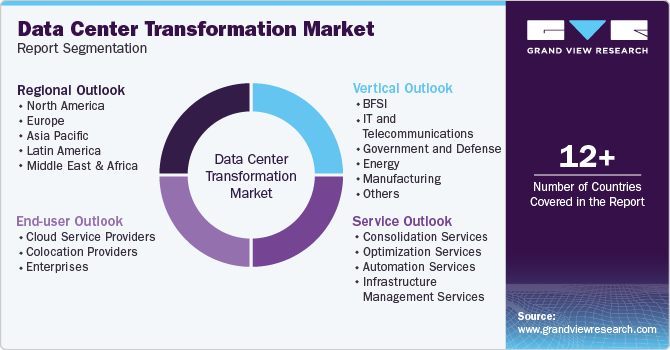
This report forecasts revenue growth at global, regional, and country levels and provides an analysis of the latest industry trends in each of the sub-segments from 2021 to 2033. For this study, Grand View Research has segmented the data center transformation market report based on services, end-user, vertical, and region.
 To learn more about this report, Download Free Sample Report
 -
Service Outlook (Revenue, USD Billion, 2021 - 2033)
-
Consolidation Services
-
Optimization Services
-
Automation Services
-
Infrastructure Management Services
-
-
End-user Outlook (Revenue, USD Billion, 2021 - 2033)
-
Cloud Service Providers
-
Colocation Providers
-
Enterprises
-
-
Vertical Outlook (Revenue, USD Billion, 2021 - 2033)
-
BFSI
-
IT and telecommunications
-
Government and defense
-
Energy
-
Manufacturing
-
Others
-
-
Regional Outlook (Revenue, USD Billion, 2021 - 2033)
-
North America
-
U.S.
-
Canada
-
Mexico
-
-
Europe
-
UK
-
Germany
-
France
-
-
Asia Pacific
-
China
-
India
-
Japan
-
South Korea
-
Australia
-
-
Latin America
-
Brazil
-
-
Middle East & Africa
-
UAE
-
Saudi Arabia
-
South Africa
-
-
Research Methodology
The data center transformation market figures in this report are based on a proven research process that combines executive interviews with secondary research from proprietary databases, company filings, and recognized regulatory and institutional sources. Market size is built through value-chain sizing-reconciling supply-side and demand-side estimates-and triangulated with bottom-up and top-down approaches. Every estimate passes multiple levels of expert validation before publication, with each data center transformation segment quantified using the revenue-capture definitions in the table below.
Segment Definition
Segment - Services
Revenue capture definition
Consolidation Services
The segment includes revenue generated from services that consolidate multiple physical servers, storage systems, applications, and data center assets into fewer, more efficient platforms through virtualization, workload migration, infrastructure rationalization, and facility consolidation projects.
Optimization Services
This segment includes revenue generated from consulting and implementation services that improve data center performance, energy efficiency, capacity utilization, cooling systems, network architecture, storage efficiency, and workload distribution to maximize operational efficiency and reduce total cost of ownership.
Automation Services
This segment includes revenue generated from the deployment of automation solutions for infrastructure provisioning, orchestration, configuration management, policy enforcement, monitoring, AI-driven operations (AIOps), workload scheduling, and automated lifecycle management across data center environments.
Infrastructure Management Services
This segment includes revenue generated from managed and professional services for monitoring, maintaining, securing, upgrading, and operating compute, storage, networking, power, cooling, and hybrid cloud infrastructure throughout the data center lifecycle.
Segment - End User
Revenue capture definition
Cloud Service Providers
This segment includes revenue generated from data center transformation solutions and services adopted by public, private, and hybrid cloud providers to modernize infrastructure, improve scalability, enhance automation, optimize resource utilization, and support cloud-native service delivery.
Colocation Providers
This segment includes revenue generated from transformation projects undertaken by colocation operators to upgrade facilities, improve power and cooling efficiency, expand capacity, deploy intelligent infrastructure management, and support high-density computing environments for tenant organizations.
Enterprises
This segment includes revenue generated from data center modernization initiatives undertaken by enterprises across industries to migrate legacy infrastructure, enhance operational efficiency, improve cybersecurity, support digital transformation, and enable hybrid and multi-cloud environments.
Segment - Vertical
Revenue capture definition
BFSI
This segment includes revenue generated from data center transformation solutions and services deployed by banking, financial services, and insurance organizations to enhance security, regulatory compliance, disaster recovery, digital banking infrastructure, and mission-critical application performance.
IT and telecommunications
This segment includes revenue generated from modernization projects implemented by IT service providers and telecommunications companies to support cloud services, 5G infrastructure, edge computing, high-performance networking, and scalable digital service delivery.
Government and defense
This segment includes revenue generated from data center transformation initiatives within government agencies and defense organizations focused on secure infrastructure modernization, sovereign cloud adoption, cybersecurity enhancement, and mission-critical operational resilience.
Energy
This segment includes revenue generated from transformation projects adopted by energy and utilities organizations to support smart grid operations, industrial automation, predictive analytics, operational technology (OT) integration, and secure management of critical infrastructure data.
Manufacturing
This segment includes revenue generated from data center modernization solutions implemented by manufacturing organizations to enable Industry 4.0, industrial IoT, AI-driven production analytics, digital twins, edge computing, and real-time factory operations.
Others
This segment includes revenue generated from data center transformation solutions and services adopted across healthcare, retail, education, transportation and logistics, media and entertainment, life sciences, hospitality, and other industry verticals requiring modern, scalable, and resilient digital infrastructure.
Estimation Model
Layer
Question
Analysis
Addressable Infrastructure Layer
Who can benefit from data center transformation?
Identify organizations operating or modernizing data center infrastructure, including hyperscale cloud providers, colocation operators, enterprises, government agencies, telecommunications companies, financial institutions, healthcare providers, manufacturers, educational institutions, and managed service providers. Analyze legacy infrastructure footprints, digital transformation initiatives, and IT modernization requirements to define the total addressable market.
Transformation Demand Generation Layer
Where is demand for data center transformation generated?
Evaluate demand driven by cloud migration, hybrid and multi-cloud adoption, AI and HPC infrastructure expansion, virtualization, edge computing, digital transformation, cybersecurity modernization, sustainability initiatives, data center consolidation, and increasing regulatory compliance requirements. Assess enterprise IT investments and expansion of hyperscale and edge data centers to determine the operationally reachable market.
Transformation Adoption & Deployment Layer
Who actively adopts data center transformation solutions?
Analyze adoption across cloud service providers, colocation providers, enterprises, and public sector organizations. Evaluate deployment of infrastructure modernization, workload migration, automation, software-defined infrastructure, DCIM platforms, energy-efficient technologies, storage and network upgrades, and managed transformation services to identify active buyers and implementation potential.
Monetization Layer
How is revenue generated?
Assess revenue generated through consulting and assessment services, infrastructure consolidation, optimization and automation services, migration and modernization projects, managed infrastructure services, hardware refresh and integration, software licensing, implementation services, maintenance and support contracts, and recurring infrastructure management services to estimate the overall market revenue.
Delivered Customizations
This report has been delivered with the following In-depth customizations
Client Request
Customization Delivered
Value Adds
Data Center Sustainability & Green Infrastructure Analysis
Evaluated energy-efficient server technologies, intelligent cooling systems, renewable energy integration, carbon reduction initiatives, liquid cooling adoption, power usage effectiveness (PUE) improvements, and ESG-driven modernization investments.
Supports sustainability planning, improves regulatory compliance, identifies energy-saving opportunities, and strengthens long-term environmental strategies.
Legacy Data Center Modernization Roadmap
Analyzed legacy infrastructure replacement strategies, virtualization adoption, workload migration, storage modernization, software-defined infrastructure implementation, and phased transformation approaches for enterprise data centers.
Assists organizations in prioritizing modernization investments, minimizing migration risks, and maximizing return on infrastructure investments.
Data Center Transformation Vendor Competitive Benchmarking
Assessed leading vendors based on infrastructure modernization capabilities, cloud migration expertise, automation and AIOps solutions, hybrid and multi-cloud integration, software-defined infrastructure, sustainability initiatives, service portfolio, strategic partnerships, pricing models, and market positioning.
Enables stakeholders to benchmark competitors, identify capability gaps, evaluate service differentiation, and formulate effective technology investment and go-to-market strategies.
Frequently Asked Questions About This Report
The consolidation services segment led with a 37.0% revenue share in 2025, and is the fastest-growing segment for the forecast period.
The cloud service providers segment led with a 45.0% revenue share in 2025, while the colocation providers segment is the fastest-growing segment.
The IT and telecommunications segment held the largest share (over 26.0%) in 2025, and is the fastest-growing segment for the forecast period.
Key players operating in the data center transformation market include Accenture; Atos; Cisco Systems, Inc.; Cognizant; Dell Inc.; HCL Technologies; IBM; Microsoft; Schneider Electric SE; Wipro
Key factors include organizations across banking, healthcare, manufacturing, retail, telecommunications, and government are modernizing legacy data center infrastructure to support cloud-native applications, AI workloads, edge computing, and data-intensive operations.
The global data center transformation market size was estimated at USD 21.6 billion in 2025 and is expected to reach USD 23.0 billion in 2026.
The global data center transformation market is expected to grow at a compound annual growth rate of 9.1% from 2026 to 2033 to reach USD 42.3 billion by 2033.
North America dominated with 45.2% revenue share in 2025.
Asia Pacific is the fastest-growing region over the forecast period.
About the Author(s)
IT Services & Applications Research Team
Technology · IT Services & ApplicationsThis report was authored by the it services & applications research team at Grand View Research - comprising two research analysts, one senior research analyst, and one industry expert - with specialized expertise in the it services & applications segment of the technology industry. All findings are based on proprietary technology databases, executive interviews, and regulatory analysis, subject to internal peer review prior to publication.
Last Updated:
Speak to Analyst

Customize this report to your needs - add regions, segments, or data points, with 20% free customization.
Or view our licence options:


ISO 9001:2015 & 27001:2022 Certified
We are GDPR and CCPA compliant! Your transaction & personal information is safe and secure. For more details, please read our privacy policy.


