
- Home
- »
- Next Generation Technologies
- »
-
Data Marketplace Platform Market Size Report, 2026-2033GVR Report cover

Data Marketplace Platform Market (2026 - 2033)
Size, Share & Trends Analysis Report By Component (Platform, Services), By Type, By Revenue Model (Subscription, Commission), By Enterprise Size, By End-user, By Region, And Segment Forecasts
Market Size, 2025
$1.9BMarket Estimate, 2026
$2.3BMarket Forecast, 2033
$10.2BCAGR, 2026–2033
23.6%Data Marketplace Platform Market Summary
The global data marketplace platform market size was valued at USD 1.9 billion in 2025 and is projected to grow from USD 2.3 billion in 2026 to USD 10.2 billion by 2033, at a CAGR of 23.6% from 2026 to 2033. North America dominated the market, accounting for a revenue share of 34.7% in 2025. This growth is driven by the rising monetization of enterprise data assets through commercial data exchanges.
 Source: Grand View Research, IR Documents, Primary Interviews, Paid DatabasesTo learn more about this report,
 Download Free Sample Report
Key Market Trends & Insights
- By component: Platform segment dominated the market, with a revenue share of 61.4% in 2025.
- By type: B2B data marketplace segment held the largest market share of 57.5% in 2025.
- By revenue model: Subscription segment held the largest market share of 53.1% in 2025.
- By enterprise size: Large enterprises segment held the largest market share of 56.9% in 2025.
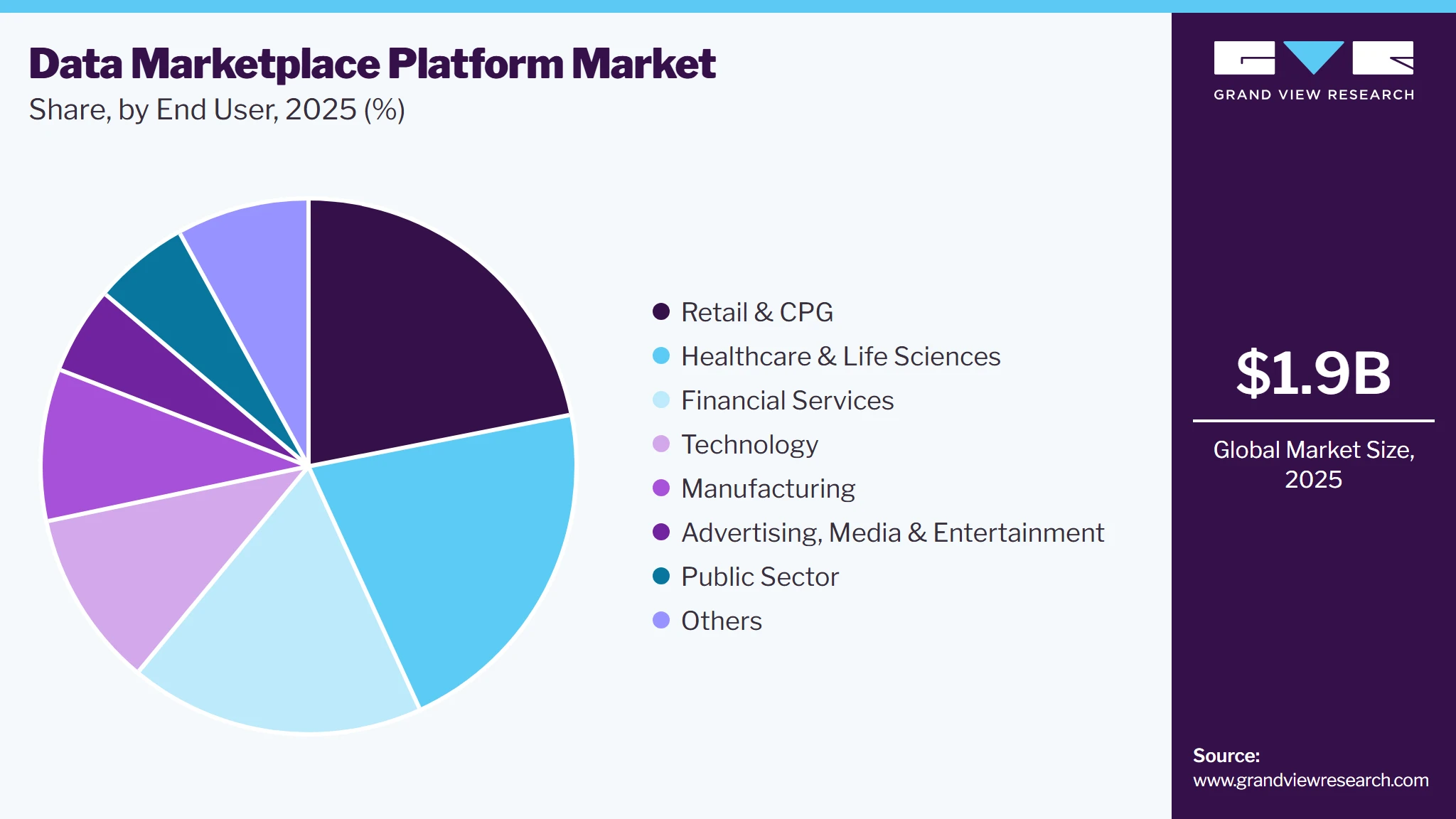
- By end use: Retail & CPG segment held the largest market share of 21.9% in 2025.
Regional Highlights
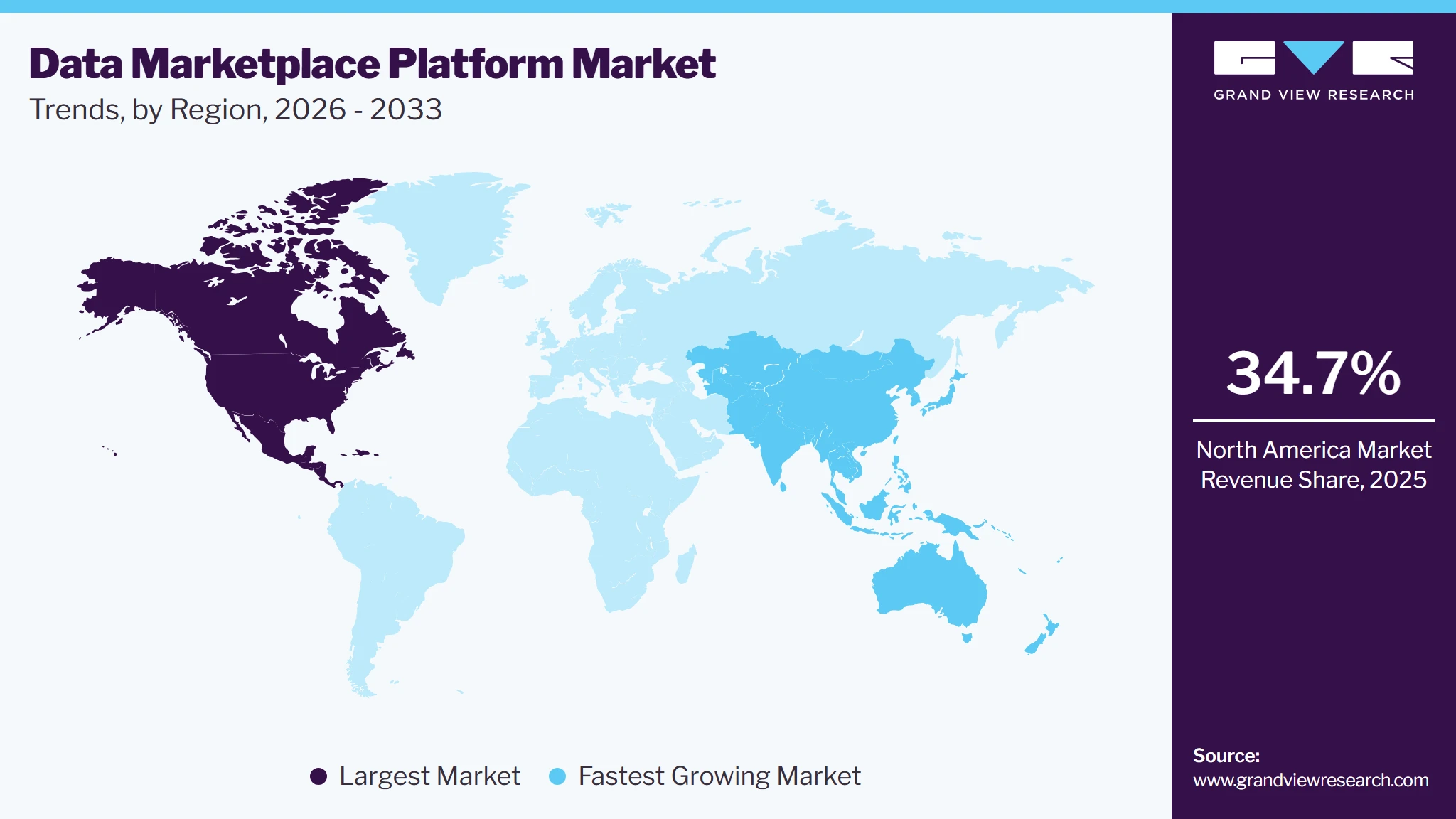
- Largest regional market: North America (34.7% revenue share, 2025)
- Fastest-growing regional market: Asia Pacific (highest CAGR, 2026-2033)
- By country: The U.S. held the largest market share in 2025.
Market Size & Forecast
- Market size in 2025: USD 1.9 Billion
- Estimated market size in 2026: USD 2.3 Billion
- Projected market size by 2033: USD 10.2 Billion
- CAGR (2026-2033): 23.6%
Three ways to get this report
Buy it, customize it, or ask a question.Ask an Analyst
Analyst response in 1 business day
- AccessReport author, directly
- Reply timeWithin 1 working day
- No sales callDirect answer only
- FormatEmail reply
- CostFree, no cost
Get the Full Report
What the study covers
- FormatsPDF · Excel · Dashboard
- Timeline2026–2033 annual, 2025 base
- Coverage20+ countries, 5 regions
- Companies10+ key players profiled
Customize the Report
20% free customization
- IncludeCountries, segments, points
- TailorTo your product definition
- ExtendDeeper competitor detail
- OrA fully bespoke study
- Turnaround5–10 working days
A data marketplace platform is a transactional platform that facilitates the buying and selling of different types of data, offering a streamlined user experience. It comprises cloud services where businesses or individuals can upload data to the cloud. The different data types, such as demographic, business intelligence, firmographic, personal data, are available in a data marketplace platform. The platform enables self-service data access, maintaining a high quality of data, consistency, and security for both parties. Businesses and organizations are commencing to augment internal data sets with external data propelling the growth of the market. It is a process of facilitating data exchange securely and efficiently that supports multiple data sharing models meeting the requirements of different data sets and customer needs. It also enables data sharing among enterprises via data marketplace platforms inducing data-driven innovation and integrating third-party providers into data marketplace platforms. They are also responsible for improving the competitiveness amongst small and medium-sized enterprises.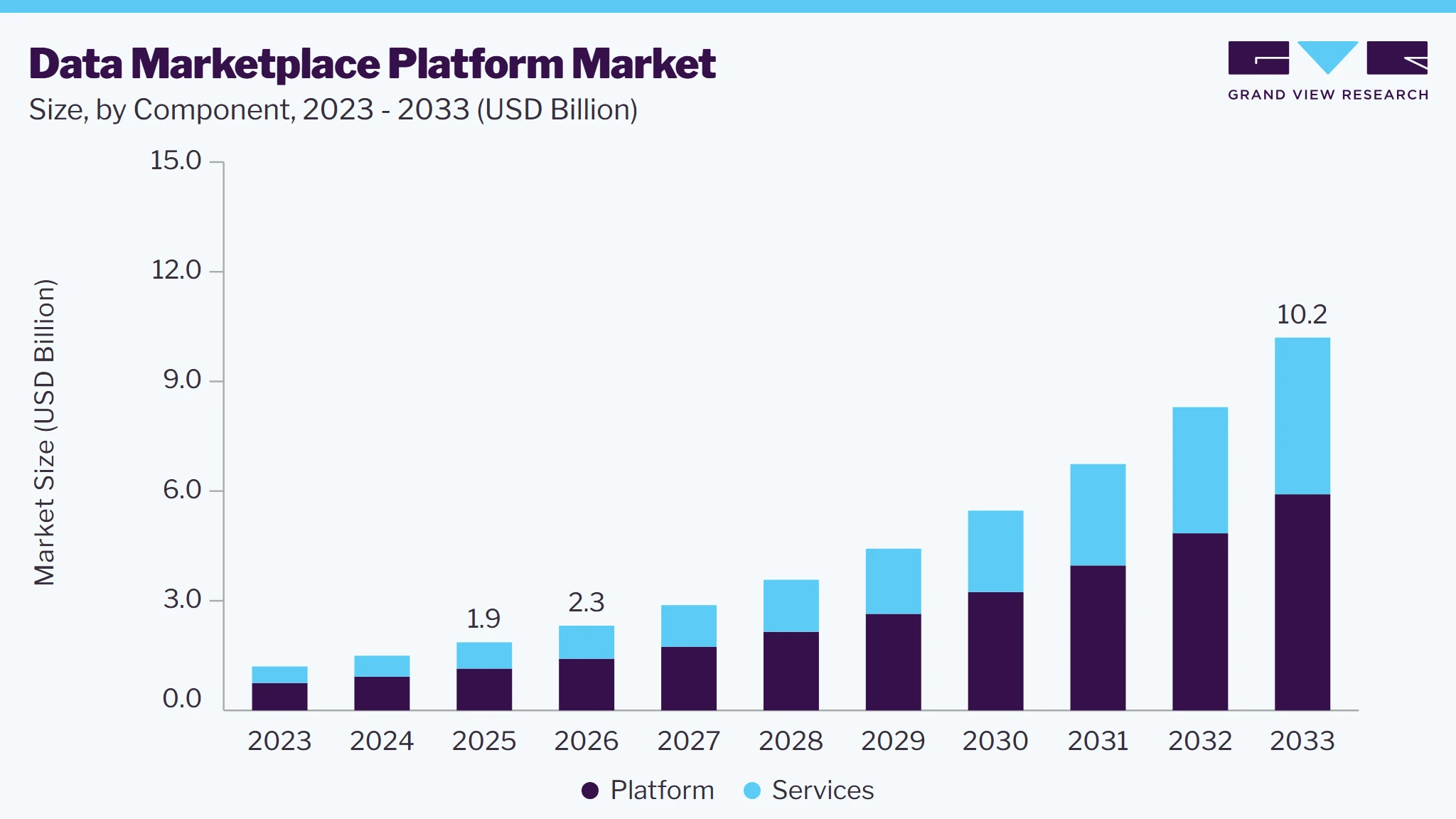 To learn more about this report, Download Free Sample Report
The market is projected to witness significant growth attributed to the increasing adoption of Internet of Things (IoT) solutions and the deployment of cutting-edge technologies such as AI, AR/VR orchestration capabilities, and machine-to-machine (M2M) advancements in communications networks. A growing emphasis on the usage of cloud services is anticipated to boost the market growth. Furthermore, the rising adoption of this platform in several verticals such as BFSI, healthcare, retail & consumer goods, and media & entertainment, contribute positively to the growth. It also enables efficient usage and management of data resulting in a maximized return on investment (ROI). It also provides businesses and organizations access to data marketplace platforms such as personal, business-to-business (B2B), and IoT data marketplace platform to meet specific requirements efficiently and cost-effectively secured by blockchain. Additionally, number of organizations are launching data marketplace platforms to promote data sharing among data service providers and End users resulting in augmented demand for these platform and services.
It enables buyers with segmented, dependable, and relevant data to access data via analytical tools and platforms to meet business needs. For instance, the Microsoft Azure marketplace provides data through a uniform interface, and developers can access data via Microsoft Excel and PowerPivot. The growth of this market is attributed to the emergence of Big Data, web scraping, and advancements in blockchain, as it provides access to considerable data to enhance performance and generate revenue. Web scraping is an automatic process of extracting data from websites; it automates data collection, unlocks web data sources, and suggests data-driven decisions that add value to decision-making. The increasing adoption of AI, data mesh, data management, and blockchain in data & analytics is propelling the usage of self-service analytics solutions. It enables an in-depth understanding of data analytics without a technical background to access or customize analyses.
Market Dynamics
The data marketplace platform market is gaining momentum as organizations increasingly recognize data as a strategic business asset that can be securely exchanged, monetized, and integrated across industries. Enterprises are adopting data marketplace platforms to access external datasets, enrich internal analytics, improve AI model performance, and accelerate data-driven decision-making without the time and cost associated with traditional data acquisition methods. Growing investments in artificial intelligence, machine learning, and cloud-based data ecosystems are increasing demand for trusted platforms that facilitate standardized data discovery, licensing, and governance. At the same time, rising regulatory emphasis on data privacy, ownership, and secure sharing is encouraging organizations to adopt marketplace solutions that provide robust access controls, compliance management, and transparent data usage policies.
The growing implementation of data fabric and data mesh architectures is driving market growth in the data marketplace platform market as enterprises increasingly move away from centralized data management models toward distributed and intelligent data ecosystems. Modern organizations generate structured and unstructured data across cloud platforms, on-premise infrastructure, edge devices, business applications, and external partner networks, making centralized management increasingly difficult. Data fabric and data mesh frameworks enable organizations to connect, govern, and access data across multiple environments without physically consolidating all datasets into a single repository. As data becomes more accessible across distributed business domains, organizations require marketplace platforms that enable secure discovery, sharing, monetization, and consumption of trusted data assets. This transformation significantly increases demand for advanced data marketplace platforms capable of managing decentralized data environments.
Data privacy regulations limiting cross-organizational data sharing are restraining the growth of the data marketplace platform market by reducing the willingness of organizations to exchange valuable datasets outside their internal environments. Enterprises increasingly collect large volumes of customer, financial, healthcare, operational, and behavioral information, but strict privacy obligations require organizations to carefully control how this information is processed, transferred, stored, and shared. Data marketplace platforms depend on the availability of diverse, high-quality datasets from multiple contributors to create value for buyers and ecosystem participants. When regulatory requirements impose strict limitations on data transfers, organizations often reduce external data-sharing activities to minimize legal, financial, and reputational risks. This cautious approach limits the volume of commercially available datasets and slows marketplace expansion.
The increasing use of geospatial intelligence within logistics and transportation is driving market growth by encouraging organizations to purchase and exchange real-time location datasets through digital platforms. Fleet operators, shipping companies, warehouse managers, delivery providers, and supply chain organizations require detailed mapping data, traffic conditions, infrastructure updates, weather patterns, and route-optimization datasets to improve operational performance. Data marketplace platforms simplify the acquisition of trusted location intelligence from multiple commercial providers through standardized licensing models. Better access to spatial information improves route planning, asset utilization, and delivery efficiency across transportation networks. The continued digitalization of logistics operations strengthens opportunities within the marketplace ecosystem.
Analyst Perspective
The data marketplace platform market is evolving from a transactional data exchange model into a strategic ecosystem that enables collaboration between data providers, enterprises, and application developers. Unlike conventional data management markets, long-term success is determined by the quality, trustworthiness, interoperability, and commercial value of the datasets available rather than the platform itself. Providers that can establish strong governance frameworks, simplify data licensing, and create network effects by attracting both high-quality data suppliers and active buyers are likely to build sustainable competitive advantages. As organizations increasingly seek external data to strengthen AI initiatives and business intelligence capabilities, marketplace platforms that foster trusted, compliant, and scalable data-sharing environments are expected to emerge as critical infrastructure within the digital economy.
Component Insights
Based on component, the platform segment led the market with the largest revenue share of 61.4% in 2025. The growth of this segment is attributed to the emergence of cloud platforms, increasing adoption of IoT, AI, ML, and big data for data management. The aforementioned technological advancements make data sharing, exchange, and management easier without the need for huge hardware equipment with flexible revenue models. The data marketplace platform segment enables buyers to browse data, compare, support on-platform communication with data providers, and purchase data. These benefits facilitated by the data marketplace platform are fueling the growth of this segment.
The services segment is anticipated to witness the fastest CAGR of 24.9% throughout the forecast period. The services segment include professional, strategic, advisory, and support services. These services enable buyers to connect to the support center of data marketplace platforms to track service requests, gain expertise on data virtualization, and provide buyers with tailored advice and strategic engagement to overcome organizations' challenges and achieve business objectives. It also provides expertise and resolves logistical issues. For instance, if two organizations utilize different currencies, then data marketplace platforms offer independent advice during the data commerce experience to ensure data provider and buyer are satisfied.
Type Insights
Based on type, the B2B data marketplace segment led the market with the largest revenue share of 57.5% in 2025. The B2B data marketplace platform segment can be attributed to the increasing adoption of big data, the emergence of AI and ML, and business-to-business data marketplace platforms solutions. Additionally, the key market participants are introducing enhanced data marketplace platforms solutions such as Oracle, AWS, and Snowflake, to meet End users’ requirements. The demand for business data platforms is increasing as data providers can integrate their data easily, fueling this market's growth. The aforementioned benefits offered by data marketplace platforms are encouraging the data providers and SaaS vendors to invest in research and development to enable low-cost and effective solutions, which is expected to provide lucrative opportunities for the market.
The IoT data marketplace platforms segment is anticipated to witness the fastest growth, growing at a CAGR of 25.5% throughout the forecast period. The growth is attributed to the ease of data integration and growing network of connected devices. An IoT data marketplace platform is a platform that produces real-time data collected from connected devices available for buying and selling. IoT data marketplace platforms ensure the unification of harnessed and structured data produced on a global scale yielding insights into technological development, consumer preferences, and trends. IoT marketplaces offer an accessible open network with flexible pricing options such as 'pay-per-hour enabling an opportunity for businesses to monetize data. Huge amounts of data are being produced with the increasing volumes of hardware used in the technology stack, which is often considered a by-product. The by-product or IoT-sourced data enables tapping into the revenue streams by utilizing products/connected devices already in use.
Revenue Model Insights
Based on revenue model, the subscription segment led the market with the largest revenue share of 53.1% in 2025. It is anticipated to witness a CAGR of 25.5% during the forecast period. Data marketplace platforms charge a commission fee for the services and solutions in exchange for data to the buyers. The subscription revenue model can be further categorized into one-off data purchases, ongoing data subscriptions, and usage-based data licenses. One-off data purchases enable buyers to pay for a single dataset at a fixed price. This type of subscription transaction does not guarantee rights on further dataset updates. The ongoing data subscription allows buyers to access the data on a fixed-term subscription that can be renewed periodically, such as monthly or yearly. The usage-based data license comprises an ongoing agreement between the provider and the buyer, wherein the buyer pays for the data as and when they need it.
End-user Insights
Based on end use, the retail & CPG segment led the market with the largest revenue share of 21.9% in 2025. It is witnessing a CAGR of 27.8% during the forecast period. Cloud platforms allow financial organizations to leverage big data for financial use cases, such as delivering personalized recommendations, generating new revenue streams through data-driven suggestions, and creating efficient services to gain a competitive advantage. Data marketplace platforms allow financial firms to scale digital platforms, meet shifting regulatory requirements, and navigate a complex data landscape. It also enables financial organizations to thrive in a data-intensive environment with tailored solutions and highly-regulated data marketplace platforms capabilities such as built-in performance optimizations, administration as a service, and data management. For instance, in 2021, Snowflake launched industry-tailored financial services data cloud platform to accelerate data-driven and customer-centric innovations in the BFSI industry.
 To learn more about this report, Download Free Sample Report
The retail and consumer goods (CG) segment is anticipated to witness the fastest CAGR of 30.0% throughout the forecast period. Data marketplace platforms enable manufacturers and retailers to access, exchange, and share data and shift toward an online data-intensive infrastructure. The data marketplace platforms offer retail market data providing information related to the performance of the retail businesses & markets and optimized layouts of market trends. Retail organizations and enterprises are rapidly adopting cloud platforms to improve customer experience, transform end-to-end supply chains, and leverage data from ecommerce and digital channels. Additionally, it also optimizes supply chain and logistics, increases personalization opportunities, and enables data-driven merchandising.
Enterprise Size Insights
Based on enterprise size, the large enterprises segment led the market with the largest revenue share of 56.9% in 2025. Increasing demand for business and IoT data marketplace platforms to meet the End user's requirements is driving the growth of the market. The key data service providers and SaaS vendors are investing in research and development activities to create a robust platform for sharing data & information and enable direct and indirect monetization from revenue streams. Additionally, large enterprises are actively engaged in partnerships and collaborations to increase their applicability in multiple use cases. For instance, in March 2022, Nokia announced a collaboration with Equideum Health to utilize Nokia data marketplace platform (NDM) blockchain solutions to enable a multi-party ecosystem. It will allow varied person-centric use cases by harnessing advanced technologies in the data marketplace platform, data exchange, and data management.
The SMEs segment is anticipated to witness a significant growth at a CAGR of 24.3% throughout the forecast period. The growth of this segment is attributed to the rising demand for robust data marketplace platforms allowing monetization opportunities among SMEs. The data marketplace platform solutions facilitate exponential values leveraging the economies of scale via information exchange. SMEs are mainly focusing on advanced technologies such as AI, ML, and Big data and are investing heavily in data marketplace platforms to gain insights into these technologies, which is expected to provide numerous opportunities for the market in the forecasted period.
Regional Insights
North America dominated the global data marketplace platform market with the largest revenue share of 34.7% in 2025. The growth is attributed to the increasing adoption of Internet of Things (IoT) solutions and the deployment of cutting-edge technologies such as AI, AR/VR orchestration capabilities, and machine-to-machine (M2M) advancements in communications networks in the region. The key factor driving data marketplace platform services in North America is the presence of significant players such as Acxiom LLC, AWS, Snowflake, and Quandl, among others, which have propelled the market growth.
 To learn more about this report, Download Free Sample Report
A number of companies operating in this region are developing innovative data marketplace platform services & solutions to provide end-to-end efficient usage and management of network services, contributing to the growth of the data marketplace platform market. Moreover, cloud platforms such as data exchange platforms and data sharing are promoting the adoption of the data marketplace platform as a number of companies are heavily investing, and early adoption of advanced technologies owing to high digital End user engagement are contributing to the growth. Furthermore, considerable adoption of IoT in North America is expected to provide numerous opportunities for the market in the forecasted period.
U.S. Data Marketplace Platform Market Trends
The data marketplace platform market in the U.S. held the largest share in the North America region in 2025. The U.S. is a global leader in technology and innovation, making it a prime market for data marketplace platforms. The increasing adoption of data-driven decision-making across various industries, from healthcare to finance, is fueling the demand for reliable and secure data. The presence of numerous tech giants and startups in the U.S. is driving the development of advanced data marketplace solutions. Additionally, the country's strong venture capital ecosystem is providing significant funding to support the growth of these platforms. However, stringent data privacy regulations, such as CCPA, pose challenges to data sharing and monetization.
Europe Data Marketplace Platform Market Trends
The Europe data marketplace platform market is expected to grow at a significant CAGR from 2026 to 2033. Europe is home to a diverse range of industries and a strong focus on data privacy and security. The increasing adoption of AI and machine learning, coupled with the need for data-driven innovation, is driving the demand for data marketplaces. The European Union's General Data Protection Regulation (GDPR) has set a high standard for data protection, which is encouraging the development of secure and compliant data marketplaces. However, fragmented regulatory landscapes across different European countries can pose challenges to cross-border data sharing.
The data marketplace platform market in the UK is expected to grow at a significant CAGR from 2026 to 2033. The UK has emerged as a leading technology hub, with a strong focus on data-driven innovation. The government's support for digital transformation and its commitment to creating a data-driven economy are driving the demand for data marketplaces. The presence of a large number of research institutions and universities in the UK is contributing to the development of advanced data analytics and AI technologies. However, Brexit has created uncertainties for businesses operating in the UK, which may impact the growth of the data marketplace market.
The Germany data marketplace platform market is expected to grow at a significant CAGR from 2026 to 2033. Germany is a major industrial powerhouse, with a strong focus on manufacturing and automotive industries. The increasing adoption of Industry 4.0 and the need for data-driven manufacturing processes are driving the demand for data marketplaces. The German government's support for digitalization and its emphasis on data privacy and security are creating a favorable environment for the growth of data marketplaces. However, a relatively conservative approach to data sharing and a complex regulatory landscape may hinder the market's growth.
Asia Pacific Data Marketplace Platform Market Trends
APAC is expected to develop substantially by the projection period and grow at a CAGR of 26.6% over the forecast period. India and China have an extensive and distributed customer base driving the demand and creating new opportunities for data marketplace platform solutions and services. The growth of the market is prominently due to the increasing developments of IoT technologies and data infrastructure and the growing adoption of data marketplace platform services in several applications, such as healthcare, government, manufacturing, and financial services, among others.
Furthermore, the region's untapped potential generates new investment opportunities for data service providers. An emerging number of small and medium enterprises (SMEs) and startups in APAC is fueling the growth of the data marketplace platform market. Moreover, many companies are expanding their presence across the APAC region, resulting in a broad customer base, which provides lucrative opportunities for the market.
The data marketplace platform market in Japan is expected to grow at a significant CAGR from 2026 to 2033. Japan is a technologically advanced country with a strong focus on data-driven innovation. The government's support for digital transformation and its emphasis on data privacy and security are creating a favorable environment for the growth of data marketplaces. The presence of a large number of technology-driven companies and a strong focus on AI and IoT are driving the demand for data-driven solutions. However, cultural factors and language barriers may pose challenges to the adoption of data marketplaces.
The China data marketplace platform market is expected to grow at a significant CAGR from 2026 to 2033. China is one of the world's largest and fastest-growing economies, with a massive population and a rapidly developing digital landscape. The Chinese government's strong support for digital innovation and its emphasis on data-driven development are driving the demand for data marketplaces. The country's large amount of data generated by its population and businesses is creating significant opportunities for data monetization. However, stringent data privacy regulations and geopolitical tensions may pose challenges to the growth of the data marketplace market.
Key Data Marketplace Platform Company Insights
The data marketplace platform market is highly competitive, with a diverse range of players, including established technology giants and emerging startups. Key players focus on developing robust and secure platforms that can facilitate the seamless exchange of data while ensuring data privacy and security. These companies are investing heavily in research and development to enhance their platform capabilities, expand their data offerings, and improve user experience. The competitive landscape is characterized by intense competition, with players differentiating themselves through unique value propositions, such as specialized data offerings, advanced analytics tools, and strong partnerships with data providers. As the market continues to evolve, consolidation and strategic partnerships are expected to play a significant role in shaping the competitive landscape.
In addition to established players, a growing number of startups are entering the market with innovative solutions and disruptive technologies. These startups are often focused on niche market segments or specific data types, offering specialized services and tailored solutions to meet the needs of specific customer groups. The increasing adoption of cloud computing, AI, and machine learning is further fueling innovation and driving the market growth.
Some data marketplace companies include Acxiom LLC; AWS; Dawex; Snowflake; Quandl; BattleFin; Narrative; Datatrade; Oracle; Microsoft; Adobe; and SAP SE. These companies are also collaborating with local & regional players to gain a competitive edge over their peers and capture a significant market share. Players operating in this market are adopting different key strategies and developments to occupy substantial market share in the market. For instance, in March 2022, Nokia announced a collaboration with Equideum Health to utilize Nokia data marketplace platform (NDM) blockchain solutions to enable a multi-party ecosystem. It will allow varied person-centric use cases by harnessing advanced technologies in the data marketplace platform, data exchange, and data management.
Some of the key companies operating in the data marketplace platform market include Oracle, Microsoft, and SAP SE.
-
Oracle's competitive advantage in the data marketplace platform market stems from its deep-rooted expertise in database technologies and its comprehensive cloud offerings. Oracle Cloud Infrastructure (OCI) provides a robust and secure platform for hosting and managing data marketplaces. Additionally, Oracle's advanced analytics and machine learning tools enable organizations to extract valuable insights from diverse datasets. By leveraging its existing customer base and strong brand reputation, Oracle is well-positioned to capitalize on the growing demand for data marketplace solutions.
-
Microsoft's competitive advantage in the data marketplace platform industry lies in its extensive ecosystem of cloud services, including Azure, Power BI, and Azure Synapse Analytics. These tools provide a powerful platform for data ingestion, storage, analysis, and visualization. Microsoft's strong partnerships with data providers and its global reach enable it to offer a wide range of high-quality data products. Furthermore, Microsoft's focus on AI and machine learning enables organizations to derive advanced insights from their data.
-
SAP SE's competitive advantage in the market is rooted in its deep understanding of enterprise data and its strong presence in various industries. SAP's data management and analytics solutions, combined with its extensive data integration capabilities, enable organizations to seamlessly connect to various data sources and extract valuable insights. SAP's focus on industry-specific solutions and its strong customer relationships position it well to capitalize on the growing demand for data marketplace solutions. Additionally, SAP's commitment to data privacy and security ensures that organizations can safely and securely share and consume data.
Acxiom LLC and Snowflake are some of the emerging companies in the target market.
-
Acxiom LLC leverages its extensive data assets and advanced analytics capabilities to provide valuable insights to businesses. By combining traditional data with emerging data sources, Acxiom offers a comprehensive view of consumer behavior. The company's strong focus on data privacy and security ensures that organizations can safely and securely utilize data-driven insights.
-
Snowflake's unique data cloud architecture provides a scalable and flexible platform for data storage, processing, and analysis. Its ability to handle massive amounts of data and its seamless integration with various data sources make it a powerful tool for data-driven organizations. Snowflake's strong focus on data governance and security ensures that organizations can comply with data regulations and protect sensitive information.
Key Data Marketplace Platform Companies:
The following key companies have been profiled for this study on the data marketplace platform market.
-
Acxiom LLC
-
AWS
-
Dawex
-
Snowflake
-
Quandl
-
BattleFin
-
Narrative
-
Datatrade
-
Oracle
-
Microsoft
-
Adobe
-
SAP SE
Competitive Benchmarking
Category
Operating Strategies
Competitive Edge
Weakness
Established Players (Snowflake; AWS Data Exchange; Microsoft Azure Marketplace; SAP; Oracle)
- Mature players focus on building comprehensive data marketplace ecosystems that enable secure data sharing, monetization, and enterprise collaboration across multiple industries. Their strategies emphasize seamless integration with cloud data warehouses, governance frameworks, regulatory compliance, AI-ready datasets, and value-added analytics services to encourage long-term customer retention and ecosystem expansion.
- These companies benefit from large enterprise customer bases, mature cloud infrastructure, and extensive partner ecosystems that attract both data providers and data consumers. Strong security capabilities, standardized data governance, and broad integration with enterprise applications build customer confidence and enable large-scale commercial data exchange.
- Large platforms often face challenges in maintaining consistent data quality across thousands of external providers while managing complex governance requirements. Their extensive infrastructure and broad service portfolios can also increase implementation complexity and slow the rollout of specialized marketplace capabilities for niche industry needs.
Emerging Players (SEPCO; Greenshine New Energy; SolarOne Solutions; EnGoPlanet; Clear Blue Technologies)
- Emerging players focus on decentralized data exchange, industry-specific data marketplaces, privacy-preserving data collaboration, and blockchain-enabled data monetization models. Their strategies prioritize flexible pricing mechanisms, automated data licensing, API-driven access, and trusted data-sharing environments that simplify transactions between data owners and buyers.
- These companies deliver highly specialized platforms that enable faster onboarding, transparent data ownership, and innovative monetization models for organizations seeking alternative data sources. Their agile development approach allows rapid adoption of emerging technologies such as decentralized data infrastructure, privacy-enhancing computation, and AI data marketplaces.
- Emerging providers generally operate with smaller marketplace ecosystems and lower transaction volumes than established competitors, making network expansion more challenging. Limited enterprise brand recognition, fewer strategic partnerships, and the need to build trust in newer data-sharing models can slow adoption among large organizations.
Recent Developments
-
In October 2024, Presight launched a new data marketplace platform, Presight Datahub, in the UAE. This platform aims to empower organizations to create, exchange, and monetize data products. By leveraging Microsoft Azure, the platform ensures data security and sovereignty while providing flexibility and customization options. Presight Datahub is designed to help businesses unlock the value of their data and drive growth.
-
In January 2024, Zeenea launched its Enterprise Data Marketplace, a platform that enables seamless interaction between data producers and consumers. This innovative solution is designed to facilitate the discovery, publishing, and procurement of data products, addressing the growing demand for Data Mesh architectures. By providing a user-friendly interface and robust data management capabilities, Zeenea empowers organizations to unlock the full potential of their data assets.
-
In June 2023, TCS launched a new data marketplace platform, TCS Dexam, on Google Cloud. This platform aims to facilitate secure and efficient data sharing between enterprises and their ecosystem partners. By leveraging Google Cloud's robust infrastructure and security features, TCS Dexam enables organizations to democratize and monetize their data, leading to improved decision-making, innovation, and revenue generation.
Data Marketplace Platform Market Report Scope
Report Attribute
Details
Market size in 2025
USD 1.9 billion
Estimated Market size in 2026
USD 2.3 billion
Projected Market size by 2033
USD 10.2 billion
Growth rate
CAGR of 23.6% from 2026 to 2033
Base year for estimation
2025
Historical data
2021 - 2024
Forecast period
2026 - 2033
Quantitative units
Revenue in USD million/billion and CAGR from 2026 to 2033
Report coverage
Revenue forecast, company market share analysis, competitive landscape, growth factors, and trends
Segments covered
Component, type, revenue model, enterprise size, end use, region
Regional scope
North America; Europe; Asia Pacific; Latin America; MEA
Country scope
U.S.; Canada; Mexico; UK; Germany; France; China; India; Japan; Australia; South Korea; Brazil; UAE; Saudi Arabia; South Africa
Key companies profiled
Acxiom LLC; AWS; Dawex; Snowflake; Quandl; BattleFin; Narrative; Datatrade; Oracle; Microsoft; Adobe; SAP SE
Customization scope
Free report customization (equivalent up to 8 analysts' working days) with purchase. Addition or alteration to country, regional & segment scope.
Pricing and purchase options
Avail customized purchase options to meet your exact research needs. Explore purchase options
Global Data Marketplace Platform Market Report Segmentation
This report forecasts revenue growths at global, regional, and country levels and provides an analysis of the industry trends in each of the sub-segments from 2021 to 2033. For the purpose of this study, Grand View Research has segmented the global data marketplace platform market report based on component, type, revenue model, enterprise size, end-user, and region:
-
Component Outlook (Revenue, USD Million, 2021 - 2033)
-
Platform
-
Services
-
-
Type Outlook (Revenue, USD Million, 2021 - 2033)
-
Personal Data Marketplace Platforms
-
B2B Data Marketplace Platforms
-
IoT Data Marketplace Platforms
-
-
Revenue Model Outlook (Revenue, USD Million, 2021 - 2033)
-
Subscription
-
Commission
-
Paid features
-
Others
-
-
Enterprise Size Outlook (Revenue, USD Million, 2021 - 2033)
-
Large Enterprises
-
SME's
-
-
End-user Outlook (Revenue, USD Million, 2021 - 2033)
-
Financial Services
-
Advertising, Media & Entertainment
-
Retail & CPG
-
Healthcare & Life Sciences
-
Technology
-
Public Sector
-
Manufacturing
-
Other (Education, Automotive, Energy, Oil & Gas)
-
-
Regional Outlook (Revenue, USD Million, 2021 - 2033)
-
North America
-
U.S.
-
Canada
-
Mexico
-
-
Europe
-
UK
-
Germany
-
France
-
Italy
-
-
Asia Pacific
-
China
-
Japan
-
India
-
South Korea
-
Australia
-
-
Latin America
-
Brazil
-
-
Middle East & Africa
-
UAE
-
KSA
-
South Africa
-
-
Research Methodology
The data marketplace platform market figures in this report are based on a proven research process that combines executive interviews with secondary research from proprietary databases, company filings, and recognized regulatory and institutional sources. Market size is built through value-chain sizing - reconciling supply-side and demand-side estimates - and triangulated with bottom-up and top-down approaches. Every estimate passes multiple levels of expert validation before publication, with each data marketplace platform segment quantified using the revenue-capture definitions in the table below.
Segment Definition
Segment - Component
Revenue capture definition
Platform
The core source of market value, platforms enable data discovery, cataloging, exchange, governance, and secure transactions between data providers and buyers. Providers monetize through platform subscriptions, transaction processing capabilities, API access, and premium data management functionalities that facilitate trusted data sharing.
Services
Revenue is derived from data onboarding, marketplace implementation, integration, consulting, governance advisory, quality assessment, and managed data exchange services. Organizations frequently engage service providers to accelerate marketplace adoption while ensuring regulatory compliance and interoperability.
Segment - Type
Revenue capture definition
Personal Data Marketplace
Commercial activity is centered on platforms that enable individuals to securely share or monetize their personal information with explicit consent. Platform operators generate value by providing privacy-preserving technologies, consent management tools, and transparent compensation mechanisms for data contributors.
B2B Data Marketplace
The largest segment, driven by enterprises buying and selling business datasets for analytics, AI model development, market intelligence, and operational optimization. Long-term enterprise agreements and industry-specific data offerings contribute significantly to platform growth.
Sensor/IoT Data Marketplace
Demand is fueled by the increasing volume of connected device data generated across smart cities, manufacturing, transportation, agriculture, and energy infrastructure. Marketplace operators benefit by facilitating real-time data exchanges and enabling organizations to commercialize machine-generated information assets.
Segment - Revenue Model
Revenue capture definition
Subscription
Recurring income is secured through monthly or annual access to curated datasets, analytics tools, and marketplace services. This model provides predictable cash flow while allowing customers continuous access to updated data assets and platform capabilities.
Commission
Platform operators earn a percentage of every successful data transaction between buyers and sellers. The model aligns marketplace growth with trading volume, encouraging providers to expand ecosystem participation and data availability.
Paid Features
Monetization extends beyond core marketplace access through premium capabilities such as advanced analytics, enhanced search, API integrations, automated governance, priority support, and enriched data visualization tools. These value-added features increase average customer spending.
Others
This category includes pay-per-download pricing, usage-based billing, licensing fees, advertising revenue, and customized enterprise contracts. Flexible monetization approaches allow providers to address diverse customer purchasing preferences and data consumption patterns.
Segment - Revenue Model
Revenue capture definition
Large Enterprises
High-value contracts originate from multinational organizations managing extensive internal and external data ecosystems. These customers invest in enterprise-grade governance, security, compliance, and integration capabilities to support large-scale data commercialization and collaboration initiatives.
Small and Medium Enterprises (SMEs)
Adoption is supported by cloud-native platforms that provide affordable access to external datasets without requiring significant infrastructure investment. SMEs leverage marketplace platforms to obtain market intelligence, enrich customer insights, and accelerate data-driven decision-making.
Segment - End Use
Revenue capture definition
Financial Services
Financial institutions utilize marketplace platforms to access alternative data, credit intelligence, fraud detection datasets, investment research, and customer behavior insights. The growing reliance on data-driven financial modeling continues to stimulate demand in this segment.
Advertising, Media & Entertainment
Organizations acquire audience intelligence, consumer behavior data, content performance metrics, and campaign measurement datasets to improve targeting and advertising effectiveness. Data marketplaces support more personalized and measurable digital marketing strategies.
Retail & CPG
Retailers and consumer goods companies access transaction data, shopper behavior insights, pricing intelligence, and demand forecasting datasets to strengthen merchandising, supply chain planning, and customer engagement initiatives.
Healthcare & Life Sciences
Demand is driven by the need for clinical research data, real-world evidence, genomic datasets, patient outcome information, and pharmaceutical analytics. Marketplace platforms facilitate secure data collaboration while supporting privacy and regulatory requirements.
Technology
Technology companies utilize external datasets to train AI models, improve software products, strengthen cybersecurity solutions, and develop advanced digital services. Access to diverse, high-quality data has become a strategic competitive advantage within the sector.
Public Sector
Government agencies leverage data marketplaces to support urban planning, transportation management, environmental monitoring, public health initiatives, and evidence-based policymaking. Secure data-sharing frameworks enable collaboration across departments and external stakeholders.
Manufacturing
Manufacturers acquire operational, supply chain, market, and IoT datasets to optimize production, improve predictive maintenance, and strengthen industrial analytics capabilities. Data-sharing ecosystems increasingly support smart manufacturing and Industry 4.0 initiatives.
Others
This segment includes energy, telecommunications, logistics, education, agriculture, travel, and professional services. Organizations across these industries participate in data marketplaces to enhance operational intelligence, develop new digital services, and unlock additional value from proprietary data assets.
Estimation Model
Layer
Question
Analysis
Data Exchange Ecosystem Layer
Who creates and consumes data within marketplace platforms?
Identify the ecosystem of data providers and data consumers, including enterprises, financial institutions, healthcare organizations, telecom operators, governments, research institutions, IoT solution providers, and AI developers. This layer evaluates the supply and demand for structured, unstructured, geospatial, transactional, and real-time datasets that can be securely exchanged to support business intelligence, product innovation, and AI model development.
Data Commercialization Readiness Layer
What enables organizations to monetize and acquire data?
Assess factors such as data quality, metadata standardization, governance frameworks, privacy compliance, licensing models, interoperability, and secure access mechanisms. Organizations participate in data marketplaces when they can confidently publish, discover, purchase, and share datasets while maintaining regulatory compliance, ownership rights, and data integrity.
Marketplace Transaction Layer
How are datasets discovered, accessed, and integrated?
Analyze the mechanisms through which users search, evaluate, subscribe to, and integrate datasets into enterprise applications. Modern data marketplace platforms support API-based delivery, cloud-native integration, automated cataloging, data enrichment, usage monitoring, and AI-powered dataset recommendations, enabling faster data acquisition and seamless incorporation into analytics, machine learning, and operational workflows.
Platform Monetization Layer
How is revenue generated across the data marketplace ecosystem?
Evaluate revenue streams from dataset subscriptions, one-time data purchases, transaction commissions, API consumption fees, premium marketplace memberships, managed data services, and value-added offerings such as data cleansing, enrichment, governance, and analytics. Long-term value is driven by recurring data consumption, expanding partner ecosystems, and increasing enterprise demand for trusted, high-quality data assets that accelerate digital transformation and AI adoption.
Delivered Customizations
This report has been delivered with the following In-depth customizations
Client Request
Customization Delivered
Value Adds
Enterprise Data Exchange & Data Monetization Trends
Conducted a focused analysis of data marketplace platforms enabling secure buying, selling, and sharing of structured, unstructured, and real-time datasets across financial services, healthcare, retail, manufacturing, and public sector organizations.
Helps stakeholders identify high-value data monetization opportunities, evaluate enterprise data-sharing trends, and assess commercialization potential for data exchange platforms.
Third-Party Data Procurement & API-Based Data Delivery Adoption Trends
Evaluated adoption trends for API-driven data marketplaces, subscription-based data services, industry-specific data exchanges, and on-demand data delivery models, including metadata management, data cataloging, and automated access controls.
Provides insights into evolving enterprise data sourcing requirements, emerging revenue models, and commercially attractive platform capabilities supporting faster access to trusted datasets.
Trusted Data Ecosystem & Governance Opportunity Assessment
Assessed demand for data quality validation, data lineage tracking, usage governance, consent management, and secure data collaboration platforms, along with challenges related to interoperability, licensing complexity, regulatory compliance, and trust between data providers and consumers.
Supports investment and expansion strategies by identifying underserved data exchange opportunities, evaluating governance readiness, and strengthening long-term growth potential in secure, compliant, and scalable data marketplace ecosystems.
Frequently Asked Questions About This Report
The global data marketplace platform market size was estimated at USD 1.9 billion in 2025 and is expected to reach USD 2.3 billion in 2026.
The global data marketplace platform market is expected to grow at a compound annual growth rate of 23.6% from 2026 to 2033 to reach USD 10.2 billion by 2033.
Key factors include rising monetization of enterprise data assets through commercial data exchanges, growing implementation of data fabric and data mesh architectures, and increasing use of geospatial intelligence within logistics and transportation.
North America dominated with 34.7% revenue share in 2025.
Asia Pacific is the fastest-growing region over the forecast period.
The platform segment led with a 61.4% revenue share in 2025, while services segment is the fastest-growing segment.
The B2B data marketplace segment led with an 57.5% revenue share in 2025, while Sensor/IoT data marketplace segment is the fastest-growing segment.
The subscription held the largest share (over 53%) in 2025 and it is the fastest-growing segment.
Key players operating in the data marketplace platform market include Acxiom LLC; AWS; Dawex; Snowflake; Quandl; BattleFin; Narrative; Datatrade; Oracle; Microsoft; Adobe; SAP SE.
About the Author(s)
Next Generation Technologies Research Team
Technology · Next Generation TechnologiesThis report was authored by the next generation technologies research team at Grand View Research - comprising two research analysts, one senior research analyst, and one industry expert - with specialized expertise in the next generation technologies segment of the technology industry. All findings are based on proprietary technology databases, executive interviews, and regulatory analysis, subject to internal peer review prior to publication.
Last Updated:
Speak to Analyst

Customize this report to your needs - add regions, segments, or data points, with 20% free customization.
Or view our licence options:


ISO 9001:2015 & 27001:2022 Certified
We are GDPR and CCPA compliant! Your transaction & personal information is safe and secure. For more details, please read our privacy policy.


