
- Home
- »
- Next Generation Technologies
- »
-
Data Masking Market Size & Share, Industry Report, 2033GVR Report cover

Data Masking Market (2026 - 2033) Size, Share & Trends Analysis Report By Type (Static, Dynamic), By Solution (Software, Services), By Deployment (On-Premise, Cloud), By End Use (BFSI, IT & Telecom, Healthcare, Retail & E-Commerce), By Region, And Segment Forecasts
Market Size, 2025
$1.1BMarket Estimate, 2026
$1.3BMarket Forecast, 2033
$2.9BCAGR, 2026–2033
13.0%Data Masking Market Summary
The global data masking market size was valued at USD 1.1 billion in 2025 and is projected to grow from USD 1.3 billion in 2026 to USD 2.9 billion by 2033, at a CAGR of 13.0% from 2026 to 2033. North America held the largest share of over 37% of the global market in 2025. The market growth is driven by the rising need for advanced data protection technologies that enable secure digital transformation across enterprises.
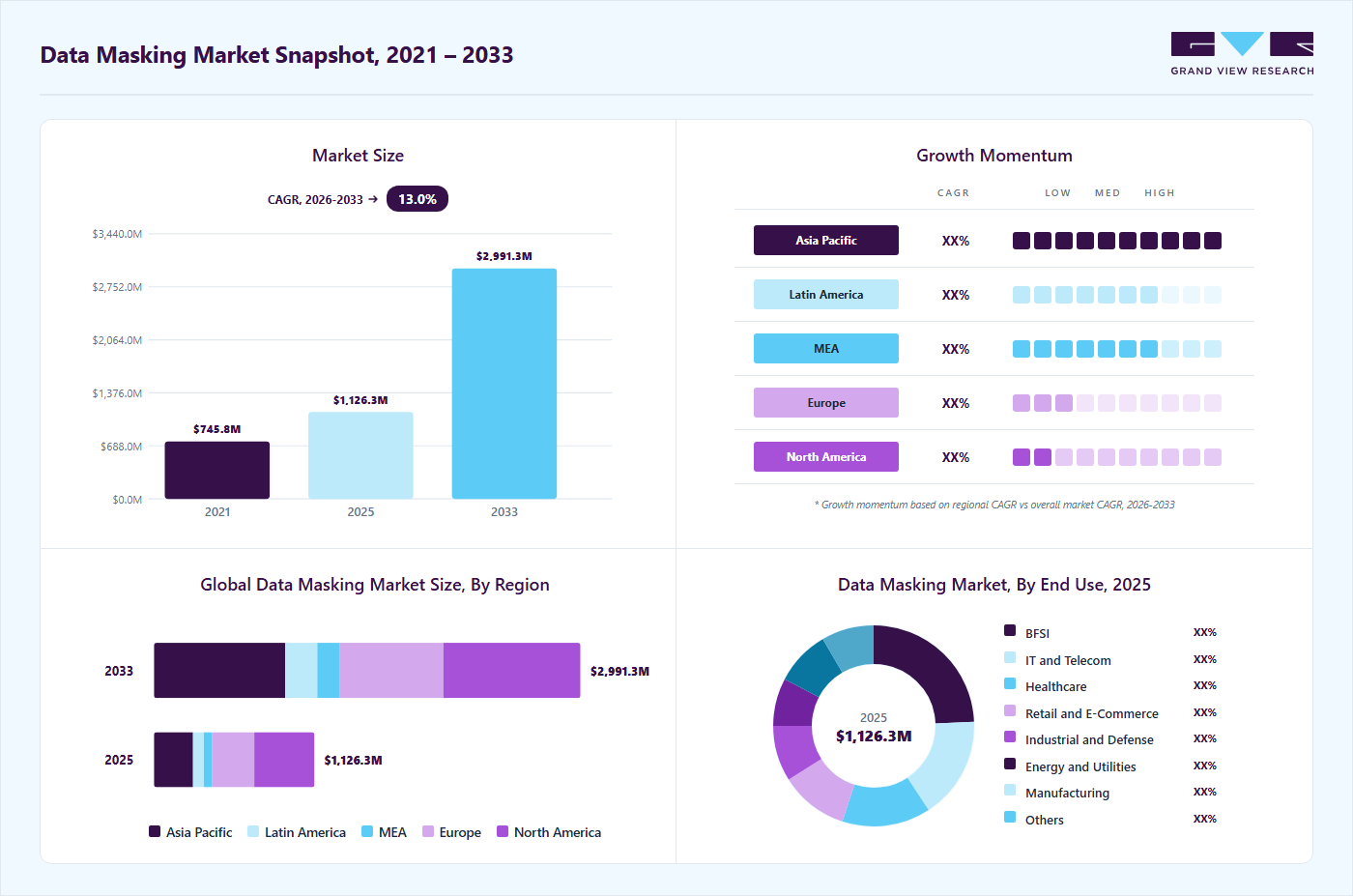 Source: Grand View Research, IR Documents, Primary Interviews, Paid DatabasesTo learn more about this report,
 Download Free Sample Report
 Key Market Trends & Insights
- By type: Static segment dominated the market, with a revenue share of over 59% in 2025.
- By solution: Software segment accounted for the largest market share of over 69% in 2025.
- By deployment: On-premise segment held the largest revenue share of over 59% in 2025.
- By end use: BFSI segment accounted for the largest revenue share of over 24% in 2025.
Regional Highlights
- Largest regional market: North America (over 37% revenue share, 2025)
- Fastest-growing regional market: Asia Pacific (highest CAGR, 2026-2033)
- By country: The U.S. held the largest market share of over 85% in 2025.
Market Size & Forecast
- Market size in 2025: USD 1.1 Billion
- Estimated market size in 2026: USD 1.3 Billion
- Projected market size by 2033: USD 2.9 Billion
- CAGR (2026-2033): 13.0%
Three ways to get this report
Buy it, customize it, or ask a question.Ask an Analyst
Analyst response in 1 business day
- AccessReport author, directly
- Reply timeWithin 1 working day
- No sales callDirect answer only
- FormatEmail reply
- CostFree, no cost
Get the Full Report
What the study covers
- FormatsPDF · Excel · Dashboard
- Timeline2026–2033 annual, 2025 base
- Coverage20+ countries, 5 regions
- Companies10+ key players profiled
Customize the Report
20% free customization
- IncludeCountries, segments, points
- TailorTo your product definition
- ExtendDeeper competitor detail
- OrA fully bespoke study
- Turnaround5–10 working days
Rapid advancements in cloud computing, AI-driven analytics, and automated data governance platforms are enabling wider adoption of masking solutions, further accelerating the growth of the data masking industry.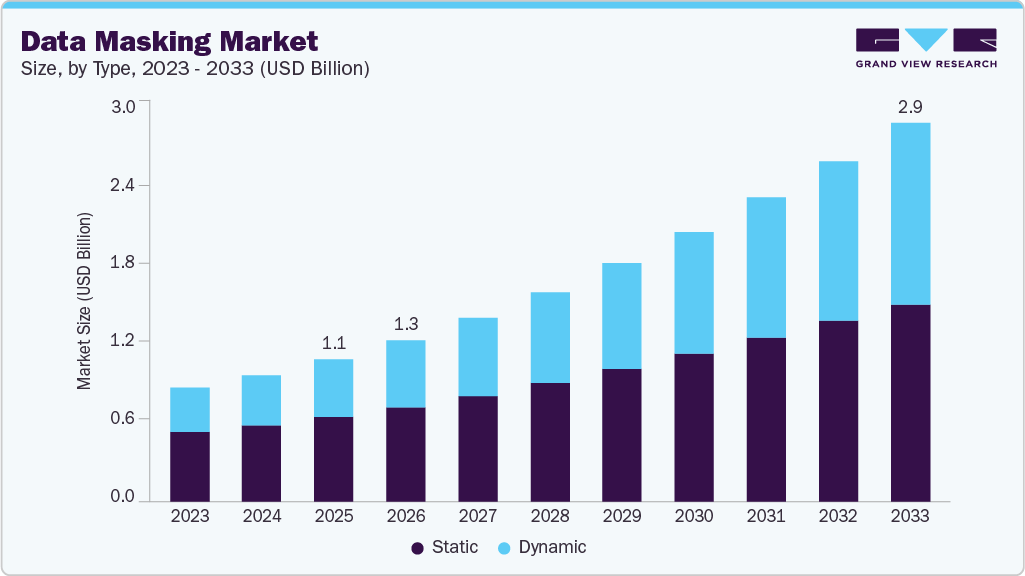 To learn more about this report, Download Free Sample Report
 The increasing adoption of next-generation data masking technologies, such as AI-driven data discovery tools, cloud-native security platforms, automated compliance monitoring systems, and dynamic data masking engines, is expected to strengthen enterprise data protection, improve regulatory readiness, and enable secure data utilization across business functions. The growing emphasis on privacy-by-design frameworks, zero-trust security architectures, and large-scale cloud migration, along with rising demand for secure analytics and real-time data sharing across distributed environments, is accelerating enterprise investments in advanced data masking solutions, thereby contributing to the sustained expansion of the data masking industry.
The rising adoption of advanced data security innovations, including AI-powered data discovery, automated sensitive data classification, privacy-enhancing technologies (PETs), and tokenization-based masking, is anticipated to strengthen enterprise data governance, reduce exposure of regulated information, and enable secure data sharing at scale. The increasing focus on zero-trust security models, cloud-native application development, and hybrid multi-cloud environments, combined with demand for real-time protection of customer and transaction data across banking, healthcare, and e-commerce platforms, is driving security modernization and fueling market growth.
In addition, growing integration of data masking into DevOps and test data management workflows, such as CI/CD pipelines, synthetic data generation, automated provisioning, and API-based masking orchestration, is expected to improve software delivery speed, reduce compliance risks, and enhance data usability across development teams. The expanding demand for faster application releases, continuous testing, and secure analytics sandboxes, along with increasing adoption of agile and microservices-based architectures, is strengthening the deployment of dynamic and scalable data masking solutions across enterprises.
Moreover, the rapid expansion of global privacy regulations and compliance enforcement, such as GDPR, CCPA/CPRA, HIPAA, PCI DSS, and emerging AI governance requirements, is expected to increase organizational accountability and accelerate investments in privacy-by-design frameworks. The growing focus on audit readiness, third-party risk management, and secure outsourcing of data processing, combined with rising penalties for data breaches and non-compliance, is driving large-scale adoption and sustained expansion of the data masking industry.
Type Insights
The static segment accounted for the largest market share of over 59% in 2025, driven by the strong demand for repeatable production datasets, lower operational complexity, and high compatibility. Static data masking remains highly preferred for test and development environments, data migration projects, and large-scale analytics sandboxes where organizations require persistent masked copies for repeated use. The growing need for secure data sharing across internal teams, compliance-driven database replication, and reduced exposure of personally identifiable information (PII) continues to support the sustained dominance of the static segment in the data masking industry.
The dynamic segment is expected to register the fastest CAGR of over 15% from 2026 to 2033. This growth is attributed to the rising adoption of real-time data access models, API-driven applications, and hybrid cloud architectures. Enterprises are increasingly shifting toward dynamic data masking due to benefits such as on-the-fly protection of sensitive fields and improved control over user-based data visibility. The growing deployment of zero-trust security frameworks, role-based access governance, and modern DevSecOps pipelines, along with increasing demand for secure analytics and live reporting, is accelerating the dynamic segment in the data masking industry.
Deployment Insights
The on-premise segment accounted for the largest market share in 2025, driven by the strong demand for maximum data residency control, low-latency masking execution, and strict compliance with internal security policies. On-premises data masking deployments remain highly preferred for highly regulated industries such as BFSI, government, and healthcare, where organizations manage sensitive PII, financial records, and confidential customer datasets within private infrastructure. The growing need for full governance over database environments and reduced exposure of critical datasets to third-party cloud ecosystems continues to support the dominance of the on-premises segment.
The cloud segment is expected to witness the fastest CAGR from 2026 to 2033. This growth is primarily driven by the rapid expansion of cloud-native data warehouses, SaaS-based analytics platforms, and multi-cloud enterprise modernization programs. Enterprises are increasingly shifting toward cloud-based data masking due to faster deployment and native compatibility with modern data pipelines and API-driven applications. The growing adoption of hybrid cloud architectures and AI/ML-driven analytics workloads, along with improvements in cloud security and identity governance, is accelerating the cloud segment in the data masking industry.
End Use Insights
The BFSI segment accounted for the largest market share in 2025, driven by the strong demand for protection of highly sensitive customer financial data, strict regulatory compliance, and rising cybersecurity threats targeting banks and payment networks. The growing need for secure fintech integrations, safe data sharing across internal risk teams, and compliance with regulations such as PCI DSS, GDPR, and regional banking data privacy laws continues to support the sustained dominance of the BFSI segment in the data masking industry.
The healthcare segment is expected to register the fastest CAGR from 2026 to 2033. This growth is primarily driven by the rapid digitization of electronic health records (EHRs), the expansion of telehealth platforms, and the increasing adoption of AI-driven clinical analytics. Healthcare organizations are increasingly shifting toward advanced data masking due to benefits such as secure de-identification of patient records and support for compliant data access across multi-stakeholder ecosystems. The growing adoption of health data interoperability frameworks and medical research collaborations is accelerating the healthcare segment in the data masking industry.
Solution Insights
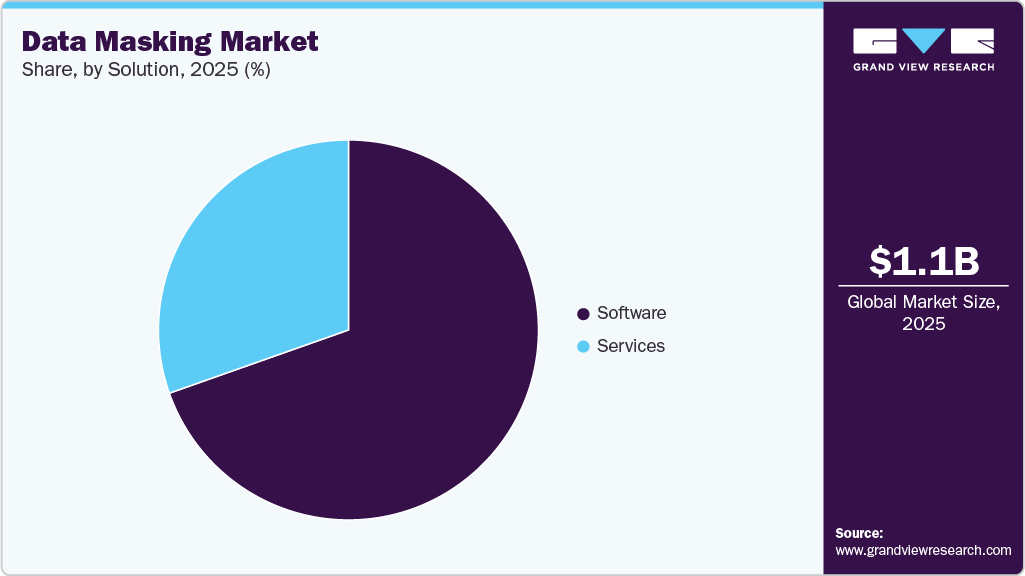
The software enterprise segment accounted for the largest market share in 2025, driven by the strong demand for scalable automated masking capabilities, built-in compliance enforcement, and seamless integration with enterprise databases. Data masking software remains highly preferred for large-scale data governance programs, continuous DevOps testing environments, and multi-database enterprise deployments. The growing need for centralized masking rule management, support for structured and semi-structured data, and tight integration with identity and access management (IAM) frameworks continues to support the sustained dominance of the software segment in the data masking industry.
 To learn more about this report, Download Free Sample Report
 The services segment is expected to witness the fastest CAGR from 2026 to 2033. This growth is primarily driven by the increasing complexity of multi-cloud data ecosystems, legacy modernization initiatives, and regulatory-driven implementation requirements. Enterprises are increasingly shifting toward professional and managed data masking services due to benefits such as faster deployment cycles and compliance reporting support. The growing adoption of enterprise-wide data privacy programs, migration of sensitive workloads to cloud environments, and demand for specialized expertise in masking validation are accelerating the services segment in the data masking industry.
Regional Insights
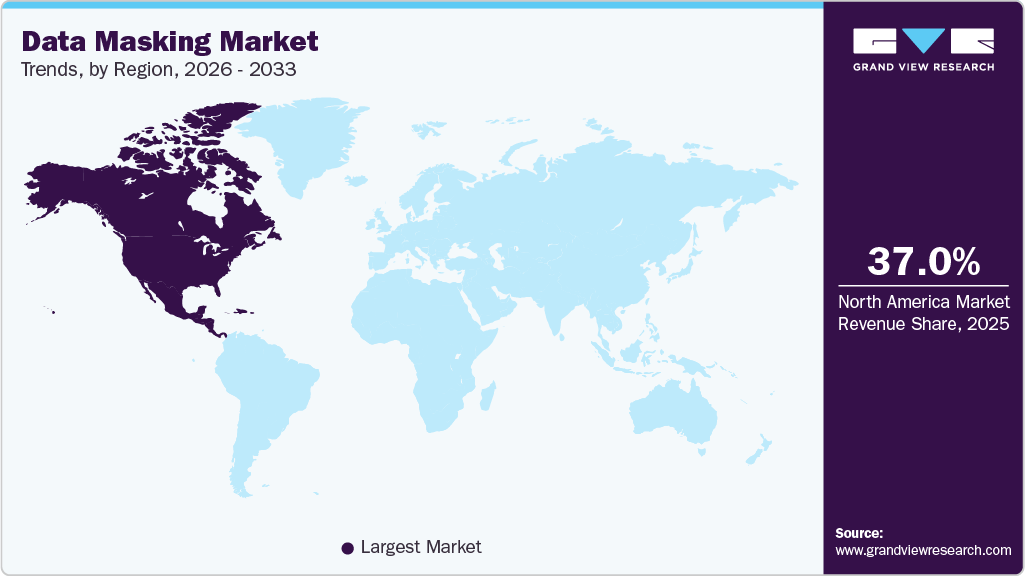
The North America data masking industry accounted for the largest market share of over 37% in 2025, fueled by the region’s strong presence of large-scale cloud service providers, high enterprise adoption of data-driven business models, and the rapid expansion of privacy-first cybersecurity investments. The widespread use of SaaS applications, along with strong demand for secure data sharing across hybrid IT environments, continues to support consistent adoption of data masking platforms. The growing integration of automated data discovery, dynamic masking, and zero-trust security frameworks is improving enterprise compliance readiness, thereby strengthening long-term data masking industry growth in the region.
 To learn more about this report, Download Free Sample Report
 U.S. Data Masking Market Trends
The U.S. data masking industry accounted for the largest share of over 85% in 2025, driven by the dominance of large enterprises managing massive volumes of customer and transactional data and the rapid expansion of cloud-native application development. The country benefits from high adoption of DevOps, CI/CD pipelines, and test data management practices. The increasing enforcement of privacy regulations, combined with the rising adoption of AI analytics and data monetization strategies across industries, is accelerating enterprise masking deployment, thereby supporting continued market growth in the country.
Europe Data Masking Market Trends
Europe data masking industry is expected to grow at a CAGR of over 11% from 2026 to 2033. In Europe, the market is driven by strict data privacy enforcement under GDPR, a strong focus on privacy-by-design practices, and the growing need for secure cross-border data transfers across multinational enterprises. The region’s emphasis on regulatory compliance, audit readiness, and robust governance frameworks is strengthening market stability. The rising adoption of cloud migration programs, secure analytics environments, and data masking for outsourced IT and third-party processing is increasing enterprise demand, thereby supporting steady market expansion across Europe.
The UK data masking industry is expected to grow at a significant rate in the coming years. This expansion is supported by the country’s strong adoption of cloud-based business services, increasing cybersecurity spending across BFSI and public sector organizations, and rising demand for secure data handling in outsourced IT operations. The growing emphasis on compliance with GDPR-aligned privacy standards, expanding ransomware defense strategies, and increasing adoption of automated governance platforms are strengthening long-term market growth.
The Germany data masking industry is rapidly expanding, driven by strong enterprise focus on data sovereignty, rising adoption of Industry 4.0 initiatives, and growing demand for secure handling of industrial data. Germany’s strong regulatory environment and emphasis on secure enterprise IT modernization continue to support market stability. The increasing adoption of hybrid cloud architectures and privacy-compliant analytics across automotive and industrial sectors is accelerating enterprise adoption, reinforcing Germany’s position as a key growth market in the data masking industry.
Asia-Pacific Data Masking Market Trends
The Asia-Pacific data masking industry is expected to register the fastest CAGR of over 16% from 2026 to 2033, fueled by rapid digital transformation across emerging economies, rising adoption of cloud services among SMEs and large enterprises, and increasing regulatory focus on data privacy and cybersecurity. The region’s expanding fintech ecosystem, growing e-commerce activity, and rising digital payments penetration are enabling faster growth in sensitive data generation and protection requirements. The increasing deployment of AI analytics, expanding IT outsourcing operations, and rising demand for secure data sharing across multi-country business operations are positioning Asia Pacific as a high-growth region for the data masking industry.
The Japan data masking industry is gaining momentum, driven by strong adoption of enterprise automation, increasing demand for secure data governance across financial services and healthcare, and the growing shift toward cloud-based infrastructure modernization. The increasing focus on secure AI adoption, growing demand for privacy-compliant customer analytics, and expanding use of masked datasets for software testing and digital service upgrades are further strengthening long-term market expansion in the country.
The China data masking industry is witnessing robust expansion, fueled by rapid growth in large-scale digital platforms, rising adoption of cloud computing and big data analytics, and strong demand for secure handling of massive consumer and transaction datasets. The increasing focus on data security laws, rising investments in domestic cybersecurity infrastructure, and growing adoption of secure data-sharing practices across fintech, telecom, and e-commerce sectors are driving widespread deployment, thereby supporting the strong growth of the market in China.
Key Data Masking Company Insights
Some of the key players operating in the market are IBM Corporation and Oracle Corporation, among others.
-
IBM Corporation is a leading global technology provider offering comprehensive data masking solutions as part of its broader data security and privacy portfolio. The company’s masking tools are integrated with enterprise-grade data governance, analytics, and hybrid cloud security frameworks, enabling large organizations to protect sensitive information across on-premises and cloud environments. With extensive expertise in AI-driven threat detection, automated compliance reporting, and scalable data protection architectures, IBM continues to support secure digital transformation and regulatory readiness.
-
Oracle Corporation is a major player in the data masking industry, delivering robust masking capabilities embedded within its database, cloud security, and enterprise application platforms. Oracle’s solutions focus on safeguarding sensitive data throughout development, testing, and analytics workflows while ensuring seamless integration with existing enterprise systems. By combining real-time dynamic masking with policy-based controls and support for multi-cloud deployments, Oracle helps enterprises reduce exposure to data breaches, meet global privacy regulations, and enable secure data utilization at scale.
Mentis Systems and K2view Ltd. are some of the emerging participants in the market.
-
Mentis Systems is an emerging data masking innovator focused on delivering flexible and high-performance masking solutions for hybrid and cloud environments. The company’s platform emphasizes automated sensitive data discovery, rule-driven masking logic, and compatibility with modern DevOps pipelines, enabling secure test data management without disrupting development workflows. As demand for secure engineering practices and privacy-compliant data provisioning grows across digital transformation initiatives, Mentis Systems is gaining traction in the data masking industry.
-
K2view Ltd. is an emerging technology provider that combines data masking with real-time data products and secure data delivery frameworks. K2view’s approach centers on creating masked, privacy-compliant data sets that preserve business context for analytics, machine learning, and application development. With increasing enterprise focus on secure analytics, privacy-enhanced data sharing, and multi-domain data protection, K2view is strengthening its position as an innovative force in the data masking industry.
Key Data Masking Companies:
The following key companies have been profiled for this study on the data masking market.
- IBM Corporation
- Oracle Corporation
- Informatica Inc.
- SAP SE
- Perforce Software Inc.
- Mentis Systems
- Microsoft Corporation
- K2view Ltd.
- Solix Technologies, Inc.
- Open Text Corporation.
Recent Developments
-
In January 2026, Perforce Software’s Delphix Compliance Services (a Perforce offering) expanded its data masking functionality through integration with Microsoft Azure, enabling automated masking workflows across hybrid cloud DevOps pipelines, thereby accelerating secure test data provisioning and compliance enforcement for cloud-native applications. This development positions Perforce as an emerging specialist in automated masking for modern software delivery ecosystems.
-
In November 2025, IBM Corporation strengthened its data protection portfolio with strategic integrations that embed data masking capabilities into broader enterprise data governance and security frameworks, aligning masking with hybrid cloud, compliance reporting, and privacy workflows. While specific product launch details are embedded within broader capability updates, IBM’s InfoSphere Optim and Guardium offerings now play a central role in automated sensitive data masking across regulated environments.
-
In August 2025, Oracle expanded its Data Masking and Subsetting solution by adding a significantly larger library of sensitive data types and an expanded suite of 66 built-in masking formats, along with auto-assignment capabilities that automate mapping appropriate masking techniques to sensitive fields, reducing manual effort and streamlining enterprise-scale deployments. This enhancement improves masking accuracy, regulatory coverage, and policy consistency in the data masking industry.
Data Masking Market Report Scope
Report Attribute
Details
Market size in 2025
USD 1.1 billion
Estimated Market size in 2026
USD 1.3 billion
Projected Market size by 2033
USD 2.9 billion
Growth rate
CAGR of 13.0% from 2026 to 2033
Base year for estimation
2025
Historical data
2021 - 2024
Forecast period
2026 - 2033
Quantitative units
Revenue in USD million and CAGR from 2026 to 2033
Report Product
Revenue forecast, company ranking, competitive landscape, growth factors, and trends
Segments covered
Type, solution, deployment, end use, region
Country scope
U.S.; Canada; Mexico; UK; Germany; France; China; Japan; India; South Korea; Australia; Brazil; UAE; Saudi Arabia; South Africa
Key companies profiled
IBM Corporation; Oracle Corporation; Informatica Inc.; SAP SE; Perforce Software Inc.; Mentis Systems; Microsoft Corporation; K2view Ltd.; Solix Technologies, Inc.; Open Text Corporation.
Customization scope
Free report customization (equivalent to up to 8 analyst’s working days) with purchase. Addition or alteration to country, regional & segment scope.
Pricing and purchase options
Avail customized purchase options to meet you exact research needs. Explore purchase options
Global Data Masking Market Report Segmentation
This report forecasts revenue growth at global, regional, and country levels and provides an analysis of the latest technology trends in each of the sub-segments from 2021 to 2033. For this study, Grand View Research has segmented the data masking market report based on type, solution, deployment, end use, and region:
-
Type Outlook (Revenue, USD Million, 2021 - 2033)
-
Static
-
Dynamic
-
-
Solution Outlook (Revenue, USD Million, 2021 - 2033)
-
Software
-
Services
-
-
Deployment Outlook (Revenue, USD Million, 2021 - 2033)
-
On-Premise
-
Cloud
-
-
End Use Outlook (Revenue, USD Million, 2021 - 2033)
-
BFSI
-
IT and Telecom
-
Healthcare
-
Retail and E-Commerce
-
Industrial and Defense
-
Energy and Utilities
-
Manufacturing
-
Others
-
-
Regional Outlook (Revenue, USD Million, 2021 - 2033)
-
North America
-
U.S.
-
Canada
-
Mexico
-
-
Europe
-
UK
-
Germany
-
France
-
-
Asia Pacific
-
China
-
Japan
-
India
-
South Korea
-
Australia
-
-
Latin America
-
Brazil
-
-
Middle East & Africa
-
Saudi Arabia
-
South Africa
-
UAE
-
-
Frequently Asked Questions About This Report
The on-premise segment held the largest share of over 59% in 2025.
The global data masking market size was valued at USD 1.1 billion in 2025 and is estimated at USD 1.3 billion for 2026.
Key factors that are driving the rising need for advanced data protection technologies that enable secure digital transformation across enterprises. Rapid advancements in cloud computing, AI-driven analytics, and automated data governance platforms are enabling wider adoption of masking solutions, further accelerating the growth of the data masking industry.
North America dominated with a revenue share of over 37% in 2025.
The global data masking market is expected to grow at a CAGR of 13.0% from 2026 to 2033, reaching USD 2.9 billion.
Key players include IBM Corporation, Oracle Corporation, Informatica Inc., SAP SE, Perforce Software Inc., Mentis Systems, Microsoft Corporation, K2view Ltd., Solix Technologies, Inc., Open Text Corporation, Electric Corporation.
Asia Pacific is the fastest-growing region over the forecast period.
The static segment led with a revenue share of over 59% in 2025.
The software segment accounted for the largest revenue share of over 69% in 2025.
About the Author(s)
Next Generation Technologies Research Team
Technology · Next Generation TechnologiesThis report was authored by the next generation technologies research team at Grand View Research - comprising two research analysts, one senior research analyst, and one industry expert - with specialized expertise in the next generation technologies segment of the technology industry. All findings are based on proprietary technology databases, executive interviews, and regulatory analysis, subject to internal peer review prior to publication.
Last Updated:
Speak to Analyst

Customize this report to your needs - add regions, segments, or data points, with 20% free customization.
Or view our licence options:


ISO 9001:2015 & 27001:2022 Certified
We are GDPR and CCPA compliant! Your transaction & personal information is safe and secure. For more details, please read our privacy policy.


