
- Home
- »
- Next Generation Technologies
- »
-
Data Pipeline Tools Market Size, Share Report, 2026-2033GVR Report cover

Data Pipeline Tools Market (2026 - 2033)
Size, Share & Trends Analysis Report By Component (Tools, Services), By Type (ETL Data Pipeline, ELT Data Pipeline, Real-time Data Pipeline), By Deployment, By Enterprise
Market Size, 2025
$14.7BMarket Estimate, 2026
$18.3BMarket Forecast, 2033
$114.3BCAGR, 2026–2033
30.0%Data Pipeline Tools Market Summary
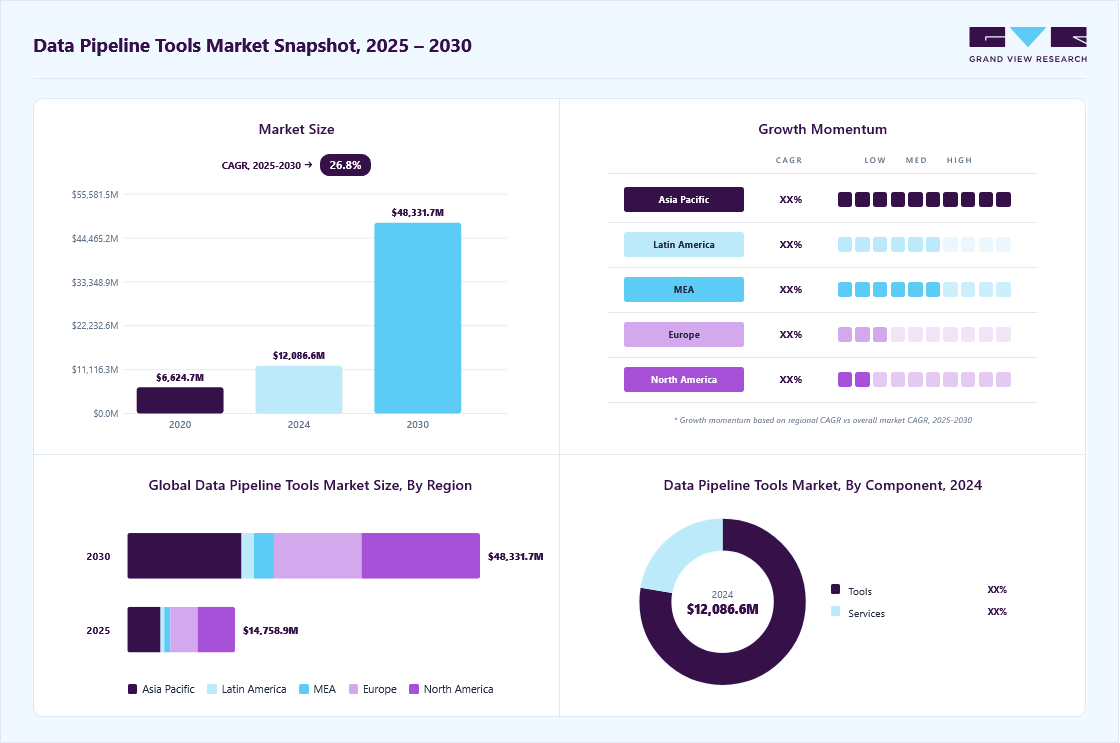
The global data pipeline tools market size was valued at USD 14.7 billion in 2025 and is projected to grow from USD 18.3 billion in 2026 to USD 114.3 billion by 2033, at a CAGR of 30.0% from 2026 to 2033. North America dominated the market, accounting for a revenue share of 33.6% in 2025. This market expansion is driven by the integration of AI-driven automation for pipeline monitoring, optimization, and anomaly detection across enterprises.
 Source: Grand View Research, IR Documents, Primary Interviews, Paid DatabasesTo learn more about this report,
 Download Free Sample Report
 Key Market Trends & Insights
- By component: Tools segment dominated the market, with a revenue share of 77.4% in 2025.
- By type: ETL data pipeline segment held the largest market share of 39.1% in 2025.
- By enterprise size: Large size enterprises segment held the largest market share of 71.3% in 2025.
- By deployment: Cloud segment held the largest market share of 71.4% in 2025.
- By application: Real-time analytics segment held the largest market share of 23.1% in 2025.
- By end user: IT & telecommunications segment held the largest market share of 44.8% in 2025.
Regional Highlights
- Largest regional market: North America (33.6% revenue share, 2025)
- Fastest-growing regional market: Asia Pacific (highest CAGR, 2026-2033)
- By country: The U.S. held the largest market share in 2025
Market Size & Forecast
- Market size in 2025: USD 14.7 Billion
- Estimated market size in 2026: USD 18.3 Billion
- Projected market size by 2033: USD 114.3 Billion
- CAGR (2026-2033): 30.0%
Three ways to get this report
Buy it, customize it, or ask a question.Ask an Analyst
A direct answer, usually in 1 working day
- AccessReport author, directly
- Reply timeWithin 1 working day
- No sales callDirect answer only
- FormatEmail reply
- CostFree, no cost
Get the Full Report
What the study covers
- FormatsPDF · Excel · Dashboard
- Timeline2026–2033 annual, 2025 base
- Coverage20+ countries, 5 regions
- Companies10+ key players profiled
Customize the Report
20% free customization
- IncludeCountries, segments, points
- TailorTo your product definition
- ExtendDeeper competitor detail
- OrA fully bespoke study
- Turnaround5–10 working days
Published in September 2022, the State of IoT Spring 2022 report stated that, with over 12.2 billion active endpoints, the IoT connections have grown by 8% globally since last year.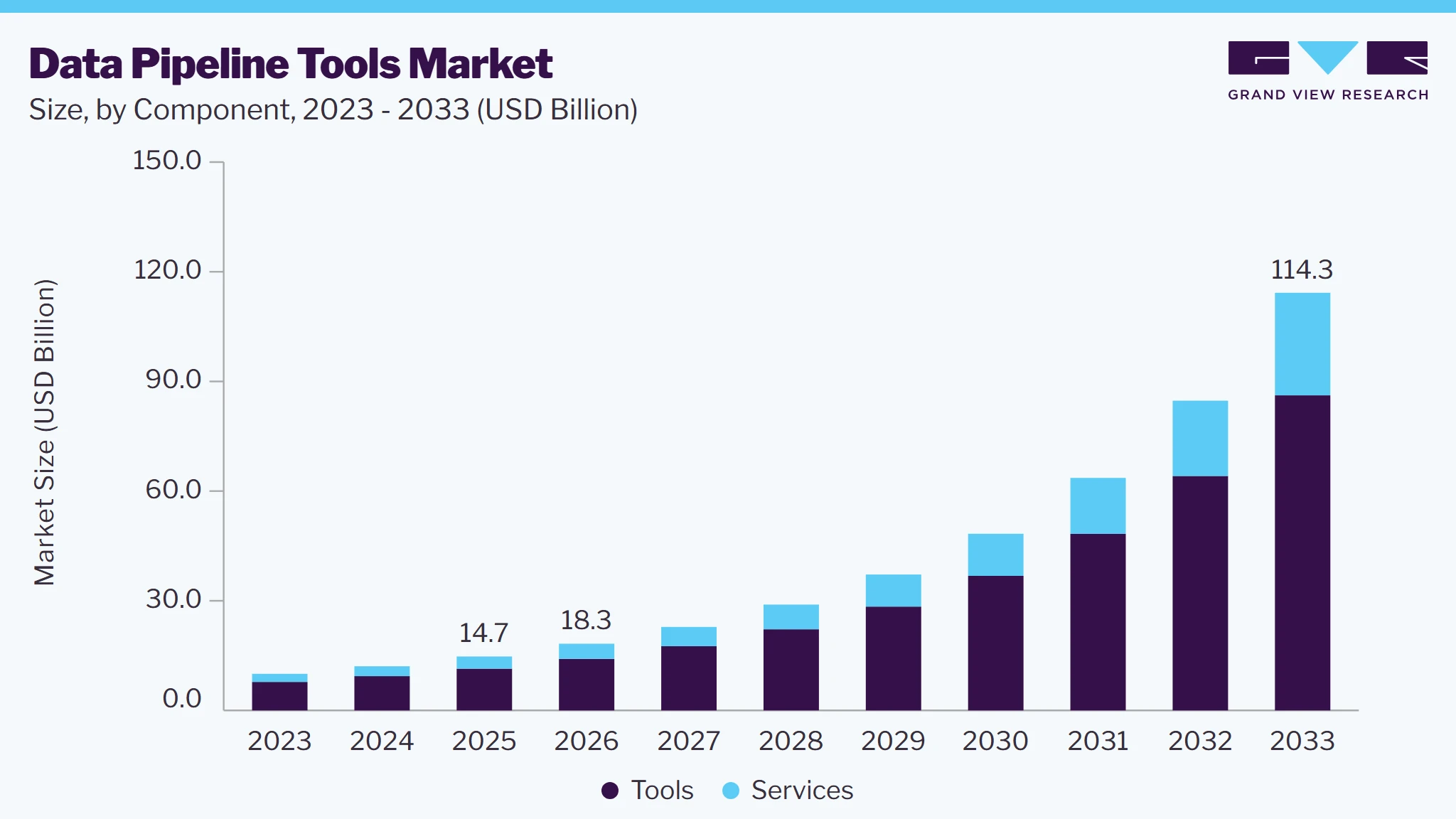 To learn more about this report, Download Free Sample Report
 The COVID-19 pandemic had a positive impact on the market growth. The majority of the people started to adopt work-from-home culture, which generated large volumes of structured, semi-structured, and unstructured data in the form of video, audio, emails, and several others on online platforms. Furthermore, various data pipeline providers such as Talend, Hevo Data Inc., and several others provided COVID-19 datasets to users. For instance, in collaboration with Bytecode, Talend developed an ETL COVID-19 datasets tool. The tool was specifically developed to help healthcare researchers.
Market Dynamics
The growing volume of data generated from cloud applications, connected devices, enterprise systems, and digital platforms is driving demand for data pipeline tools that can efficiently collect, integrate, transform, and move data across diverse environments. Organizations are increasingly relying on real-time analytics, AI, and machine learning models, creating a need for scalable and automated data workflows. Data pipeline tools help reduce data silos, improve data quality, and accelerate access to actionable insights. As businesses expand their data-driven operations, investment in modern data integration and orchestration solutions continues to increase.
Organizations across industries are increasingly relying on data to guide strategic planning, operational improvements, customer engagement, and business performance management. The growing use of business intelligence platforms, predictive analytics, and AI-driven applications has increased the need for consistent and reliable data flows across multiple sources. Data pipeline tools enable enterprises to automate data collection, transformation, and delivery processes, ensuring that decision-makers have timely access to accurate information.
As businesses continue to expand their digital operations, the volume and variety of data generated from applications, databases, cloud environments, and connected devices are growing rapidly. Managing this data manually can lead to delays, inconsistencies, and limited visibility into business performance. Data pipeline tools help streamline data movement and integration, improving data accessibility and supporting faster, evidence-based decision-making across the enterprise.
Data pipeline tools frequently process and transfer large volumes of sensitive business and customer information across multiple systems, cloud environments, and third-party platforms. This increases concerns regarding unauthorized access, data breaches, and data misuse, particularly in industries such as healthcare, finance, and government where data protection requirements are stringent. Organizations must implement strong encryption, access controls, and monitoring mechanisms to safeguard data throughout the pipeline lifecycle.
In addition, evolving regulatory frameworks such as data residency requirements and privacy laws create compliance complexities for enterprises operating across multiple regions. Ensuring that data collection, storage, processing, and transfer activities align with changing regulations often requires additional investments in governance and compliance management. These challenges can lengthen deployment timelines, increase operational costs, and restrain the adoption of data pipeline tools among organizations with strict regulatory obligations.
These applications depend on large volumes of high-quality, well-structured, and continuously updated data to train, fine-tune, and deploy models effectively. As organizations expand AI initiatives across business functions, the need for reliable data ingestion, transformation, and orchestration capabilities continues to grow. Data pipeline tools enable enterprises to automate complex data workflows, integrate data from multiple sources, and ensure timely delivery of datasets to AI and ML environments. The emergence of retrieval-augmented generation (RAG), foundation models, and real-time AI applications is further increasing demand for scalable data infrastructure. Hence, vendors offering AI-ready data pipeline solutions have opportunities to support the growing data management requirements of next-generation intelligent applications.
Market Concentration & Characteristics
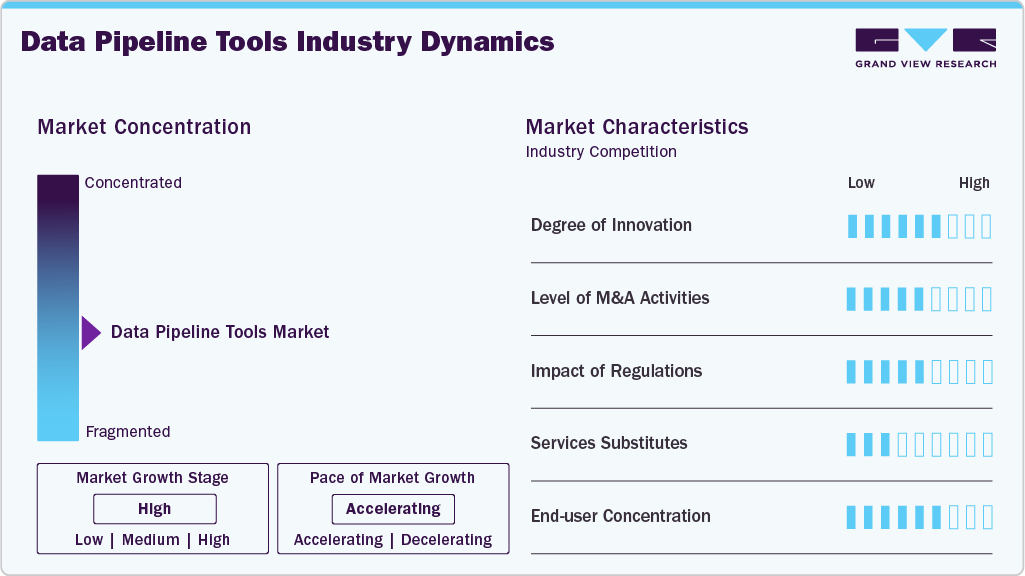
The market is experiencing a moderate level of mergers and acquisitions as established software vendors and cloud providers seek to strengthen their data integration and analytics portfolios. Acquisitions are primarily focused on expanding cloud capabilities, improving real-time data processing, and enhancing AI-enabled data management functionalities. While consolidation is occurring among niche vendors, the presence of numerous specialized players maintains a competitive market environment. Strategic acquisitions are helping companies broaden their product offerings and address evolving enterprise data requirements.
 To learn more about this report, Download Free Sample Report
 The threat of substitutes in the market remains relatively low, as enterprises increasingly require specialized solutions to manage complex and large-scale data workflows. While organizations can develop custom-built data integration frameworks using open-source technologies, such approaches often require significant technical expertise, maintenance, and operational resources. Dedicated data pipeline platforms provide scalability, automation, monitoring, and governance capabilities that are difficult to replicate efficiently. As data environments become more complex, enterprises continue to prefer purpose-built solutions over alternative approaches.
Analyst Perspective
The data pipeline tools market driven by the rapid growth of cloud computing, real-time analytics, and enterprise AI initiatives. As organizations generate increasing volumes of data across applications, platforms, and connected devices, the focus has shifted from data collection to the efficient movement, transformation, and orchestration of data at scale. Market demand is closely linked to long-term digital transformation investments, creating a stable growth environment. The key competitive advantage belongs to vendors that can unify batch, streaming, and AI-ready data workflows within a single platform while ensuring scalability, governance, and multi-cloud interoperability. As generative AI, machine learning, and real-time decision-making become more embedded in enterprise operations, data pipeline tools are evolving into core infrastructure components that directly influence the speed, quality, and value of data-driven business outcomes.
Component Insights
Based on component, the tools segment led the market with the largest revenue share of 77.4% in 2025 and is expected to grow at a significant CAGR over the forecast period. The growth in the use of data pipeline tools will be driven by the rise in big data, as it consists of large volumes of structured, unstructured, large, and complex data sources, which are required to be transferred to data repositories.
The services segment is projected to register at the fastest CAGR over the forecast period. The services segment is likely to witness the highest growth, as the software and applications provided by the companies require time-to-time updates and maintenance. Data pipeline tools are essential for organizations looking to streamline the flow of data from various sources to destinations such as data warehouses or lakes. These tools automate the processes of extraction, transformation, and loading (ETL), significantly reducing manual effort and minimizing errors that can disrupt data integrity.
Type Insights
Based on type, the ETL data pipeline segment led the market with the largest revenue share of 39.1% in 2025 and is expected to grow at a significant CAGR over the forecast period. In terms of type, the market is divided into ELT, ETL, real-time, and batch data pipelines. The growing volumes of unstructured streaming data is driving the growth of data pipeline tools; moreover, streaming data from sensors is likely to grow in the upcoming years owing to the growth in the adoption of the Internet of Things (IoT).
Based on application, the real-time analytics segment led the market with the largest revenue share of 23.1% in 2025. This is owing to the initiatives taken by various firms and governments to promote Industry 4.0, which involves the integration and adoption of nanotechnology, the Internet of Things (IoT), machine learning, artificial intelligence, and other cutting-edge technologies.
Deployment Insights
Based on deployment, the cloud segment led the market with the largest revenue share of 71.4% in 2025. Cloud-based deployment in data pipeline tools has revolutionized how organizations manage and process data, offering scalability, flexibility, and cost-effectiveness. These tools enable seamless integration and orchestration of data workflows across various cloud environments, allowing businesses to harness vast amounts of data from diverse sources without the need for extensive on-premises infrastructure.
The on-premises segment is anticipated to grow at a significant CAGR from 2025 to 2030. On-premises deployment of data pipeline tools refers to the installation and operation of these tools on a company’s own hardware and network infrastructure. This approach offers distinct advantages and challenges compared to cloud-based solutions. As businesses evaluate their data strategy, understanding these factors is crucial for making informed decisions about their data pipeline architecture.
Enterprise Size Insights
Based on enterprise size, the large size enterprises segment led the market with the largest revenue share of 71.3% in 2025. Large enterprises increasingly rely on sophisticated data pipeline tools to manage the complexities of their data ecosystems. These tools are essential for automating the extraction, transformation, and loading (ETL) of vast amounts of data from diverse sources, enabling organizations to derive actionable insights efficiently. Solutions like AWS Data Pipeline and Google Cloud Dataflow offer scalability and flexibility, allowing enterprises to handle both batch and real-time data processing seamlessly. Moreover, tools such as Fivetran, and Hevo Data provide advanced automation features that minimize manual intervention, ensuring high reliability and data integrity.
The small and medium enterprise segment is projected to grow at the fastest CAGR over the forecast period. Small and medium enterprises (SMEs) are increasingly adopting data pipeline tools to streamline their data management processes and enhance decision-making capabilities. These tools, such as Hevo Data, and Fivetran, provide user-friendly, no-code solutions that allow SMEs to integrate data from various sources-like CRM systems and marketing platforms-into a centralized data warehouse without requiring extensive technical expertise. This ease of use is particularly beneficial for smaller teams that may lack dedicated data engineering resources.
Application Insights
Based on application, the real-time analytics segment led the market with the largest revenue share of 22.92% in 2024. The market is segmented into real-time analytics, predictive maintenance, sales and marketing data, customer relationship management, data traffic management, data migration, and others. The increasing need for real-time data streamlining and management tools, especially in weather forecasts, share markets, energy & utilities, logistics & transportation industries, is fueling the demand for data pipeline tools.
The data migration segment is projected to register at the fastest CAGR over the forecast period. The emergence of 5G connectivity, the rise in the number of IoT-connected devices, and Industry 4.0 are anticipated to boost market growth in the near future. Data migration is a critical component of data pipeline tools, enabling organizations to transfer data efficiently between systems while minimizing downtime and ensuring data integrity. These tools streamline the migration process through features such as automated data mapping, transformation, and validation, which are essential for maintaining data quality during transfers.
End-use Insights
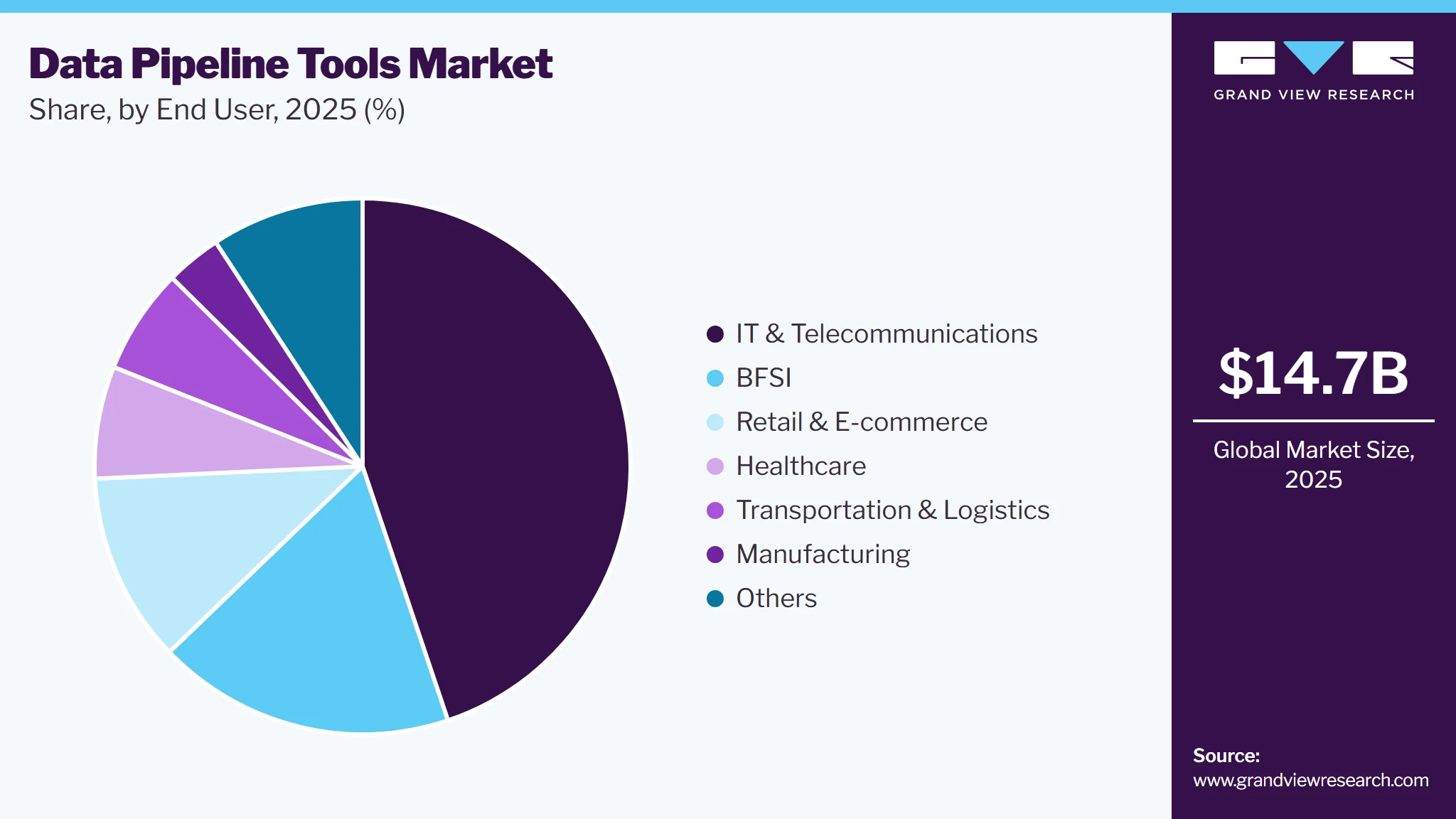
Based on end user, the IT & telecommunications segment led the market with the largest revenue share of 44.8% in 2025 and is expected to grow at a significant CAGR over the forecast period. Increased deployment of the 5G network is driving the demand for data pipeline systems in the industry as the 5G network constantly requires performance monitoring of the network. The IT and telecommunications sectors are increasingly leveraging data pipeline tools to enhance operational efficiency and data management capabilities. These tools facilitate seamless integration, transformation, and analysis of vast amounts of data generated from various sources, such as network devices, customer interactions, and service usage metrics. Solutions like Fivetran and Hevo Data provide robust automation features that enable real-time data processing, allowing organizations to respond swiftly to changing market conditions and customer needs.
 To learn more about this report, Download Free Sample Report
 The healthcare segment is projected to register at the fastest CAGR over the forecast period. The healthcare industry is increasingly utilizing data pipeline tools to enhance data management and improve patient outcomes. These tools automate the extraction, transformation, and loading (ETL) of complex healthcare data from various sources, such as electronic health records (EHRs), insurance claims, and patient management systems. For example, platforms like CloverDX facilitate the integration of diverse data formats, including HL7 and FHIR, streamlining workflows and reducing manual errors. By automating data ingestion and processing, healthcare organizations can ensure timely access to accurate information, which is crucial for making informed clinical decisions.
Regional Insights
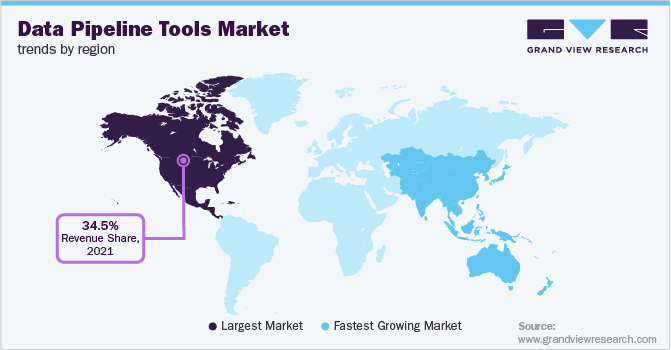
North America dominated the data pipeline tools market with the largest revenue share of 33.6% in 2025. One of the reasons North America is a leading market is its large investments in AI and other advanced technologies. Moreover, this would increase the usage of data pipeline tools as the transformed data from pipelines are used for performing AI algorithms. For instance, according to the Artificial Intelligence Index Report published in 2022, the amount of newly funded AI companies in the U.S. is two times higher than in China.
 To learn more about this report, Download Free Sample Report
 U.S. Data Pipeline Tools Market Trends
The data pipeline tools market in the U.S. held the largest share in the North America region in 2025. U.S.-based data pipeline tools play a pivotal role in facilitating the efficient transfer and transformation of data from various sources to destinations like data warehouses or data lakes. These tools, such as Fivetran, Hevo Data, and Stitch Data, automate tasks like data extraction, transformation, and loading (ETL), thereby minimizing manual effort and ensuring data integrity. Platforms like Fivetran stand out with their fully managed ETL pipelines that require minimal maintenance, supporting over 150 data sources and incorporating features like data mapping and schema updates.
Europe Data Pipeline Tools Market Trends
The data pipeline tools market in Europe is anticipated to grow at the fastest CAGR during the forecast period. The landscape of data pipeline tools in Europe is rapidly evolving, driven by the increasing demand for efficient data management solutions across various industries. The European market for data pipeline tools is marked by a strong focus on real-time analytics, cloud adoption, AI integration, and regulatory compliance, positioning it for continued growth and innovation in the forecast year.
Asia Pacific Data Pipeline Tools Market Trends
The data pipeline tools market in Asia Pacific is anticipated to grow at a significant CAGR from 2025 to 2030. The Asia Pacific region is witnessing rapid growth in data pipeline tools, driven by increasing digital transformation across industries. Companies are increasingly adopting tools like Apache Kafka, Apache Airflow, and cloud-based solutions such as Google Cloud Dataflow and AWS Glue to manage and streamline data flows. These tools facilitate real-time data processing and integration, enabling businesses to harness large volumes of data efficiently.
Key Data Pipeline Tools Company Insights
The market is characterized by strong competition, with a few major worldwide competitors owning a significant market share. The major focus is developing new products and collaborating among the key players.
Google LLC, a subsidiary of Alphabet Inc., is a leading provider of internet-based services, primarily focused on search and advertising. Its extensive product portfolio encompasses well-known services such as Google Search, YouTube, Google Drive, and Google Cloud. Within the realm of data management, Google has developed robust data pipeline tools that facilitate the extraction, transformation, and loading (ETL) of data. These tools are essential for businesses looking to harness the power of big data and machine learning. For instance, Google Cloud's Dataflow allows users to create and manage data pipelines that efficiently process both batch and streaming data, enhancing operational efficiency and decision-making capabilities.
IBM, a global provider of technology and consulting, has a rich history of innovation in computing and data management. Headquarters in Armonk, New York, IBM offers a wide array of products and services, including cloud computing, artificial intelligence, and data analytics. Central to its offerings are advanced data pipeline tools that facilitate the efficient movement and transformation of data. IBM DataStage, for instance, is a powerful data integration tool that supports both ETL (Extract, Transform, Load) and ELT (Extract, Load, Transform) processes, enabling organizations to design and deploy complex data workflows seamlessly.
Key Data Pipeline Companies:
The following are the leading companies in the data pipeline tools market.
- Google LLC
- IBM
- Microsoft Corporation
- Software AG
- Actian Corporation
- Oracle
- Amazon Web Services, Inc.
- Hevo Data Inc.
- K2VIEW
- SnapLogic Inc.
Competitive Benchmarking
Category
Operating Strategies
Competitive Edge
Weakness
Established Players (Google LLC; IBM; Microsoft Corporation; Software AG; Actian Corporation; Oracle; Amazon Web Services, Inc.)
- Focus on expanding integrated data ecosystems that combine data integration, analytics, AI, and cloud services within a unified platform.
- Invest in strategic partnerships, product enhancements, and multi-cloud capabilities to strengthen enterprise adoption and long-term customer retention.
- Extensive global customer base and strong brand recognition support large-scale enterprise deployments.
- Broad product portfolios and advanced R&D capabilities enable end-to-end data management and integration offerings.
- Complex platform architectures can increase deployment timelines and implementation costs for customers.
- Large product portfolios may reduce flexibility and slow feature innovation compared to specialized vendors.
Emerging Players (Hevo Data Inc.; K2VIEW; SnapLogic Inc.)
- Focus on cloud-native architectures, low-code development, and simplified deployment models to address modern data integration requirements.
- Emphasize niche use cases such as real-time data movement, data virtualization, and automated pipeline management.
- Agile product development enables faster innovation cycles and quicker response to evolving customer requirements.
- User-friendly interfaces and streamlined implementation processes support faster time-to-value for enterprises.
- Limited global presence and smaller customer bases compared to established enterprise software providers.
- Lower financial resources may constrain large-scale expansion, ecosystem development, and market reach.
Recent Developments
-
InDecember 2023, IBM announced a definitive agreement to acquire StreamSets and webMethods, Software AG's Super iPaaS (integration platform-as-a-service) enterprise technology platforms, for €2.13 billion in cash. The acquisition of StreamSets and webMethods underscores IBM's strong commitment to AI and hybrid cloud technologies. StreamSets will enhance data ingestion capabilities within watsonx, IBM's AI and data platform, while webMethods will provide clients and partners with additional integration and API management tools for their hybrid multi-cloud environments.
-
In May 2023, Informatica, a provider in enterprise cloud data management, strengthened its long-standing partnership with Amazon Web Services (AWS) through a new announcement aimed at enhancing product integrations across data, analytics, and artificial intelligence (AI). This initiative will support go-to-market strategies, foster innovative vertical solutions, and expedite cloud transformation for customers. These developments were presented at Informatica World 2023, the company’s annual customer conference taking place in Las Vegas.
Data Pipeline Tools Market Report Scope
Report Attribute
Details
Market size in 2025
USD 14.7 billion
Estimated market size in 2026
USD 18.3 billion
Projected market size by 2033
USD 114.3 billion
Growth rate
CAGR of 30.0% from 2026 to 2033
Base year for estimation
2025
Historical data
2021 - 2024
Forecast period
2026 - 2033
Quantitative units
Revenue in USD million/billion and CAGR from 2026 to 2033
Report coverage
Revenue forecast, company ranking, competitive landscape, growth factors, and trends
Segments covered
Component, deployment, enterprise size, type, application, end user, region
Regional scope
North America, Asia Pacific; Europe; MEA; Latin America
Country scope
U.S.; Canada; Mexico; Germany; UK; France; Italy; Spain; Netherlands; China; Japan; India; South Korea; Australia; Brazil; Argentina; Chile; Saudi Arabia; South Africa; UAE
Key companies profiled
Google; IBM; Microsoft; Software AG; Actian Corporation; Oracle; Amazon Web Services, Inc.; Hevo Data Inc.; K2VIEW; SnapLogic Inc.
Customization scope
Free report customization (equivalent up to 8 analysts' working days) with purchase. Addition or alteration to country, regional & segment scope.
Pricing and purchase options
Avail customized purchase options to meet your exact research needs. Explore purchase options
Global Data Pipeline Tools Market Report Segmentation
This report forecasts revenue growth at global, regional, and country levels and provides an analysis of the latest industry trends in each of the sub-segments from 2021 to 2033. For this study, Grand View Research has segmented the global data pipeline tools market report based on component, type, deployment, enterprise size, application, end-use, and region:
-
Component Outlook (Revenue, USD Million, 2021 - 2033)
-
Tools
-
Services
-
-
Type Outlook (Revenue, USD Million, 2021 - 2033)
-
ETL Data Pipeline
-
ELT Data Pipeline
-
Real-time Data Pipeline
-
Batch Data Pipeline
-
-
Deployment Outlook (Revenue, USD Million, 2021 - 2033)
-
On-premise
-
Cloud Based
-
-
Enterprise Size Outlook (Revenue, USD Million, 2021 - 2033
-
Large Enterprises
-
Small and Medium Enterprises
-
-
Application Outlook (Revenue, USD Million, 2021 - 2033)
-
Real Time Analytics
-
Predictive Maintenance
-
Sales and Marketing Data
-
Customer Relationship Management
-
Data Traffic Management
-
Data Migration
-
Others
-
-
End-use Outlook (Revenue, USD Million, 2021 - 2033)
-
BFSI
-
Retail & E-commerce
-
IT & Telecom
-
Healthcare
-
Transportation and Logistics
-
Manufacturing
-
Others
-
-
Regional Outlook (Revenue, USD Million, 2021 - 2033)
-
North America
-
U.S.
-
Canada
-
Mexico
-
-
Europe
-
UK
-
Germany
-
France
-
-
Asia Pacific
-
China
-
India
-
Japan
-
Australia
-
South Korea
-
-
Latin America
-
Brazil
-
-
Middle East & Africa
-
United Arab Emirates (UAE)
-
KSA
-
South Africa
-
-
Research Methodology
The data pipeline tools market figures in this report are based on a proven research process that combines executive interviews with secondary research from proprietary databases, company filings, and recognized regulatory and institutional sources. Market size is built through value-chain sizing - reconciling supply-side and demand-side estimates - and triangulated with bottom-up and top-down approaches. Every estimate passes multiple levels of expert validation before publication, with each data pipeline tools segment quantified using the revenue-capture definitions in the table below.
Segment Definition
Segment - Component
Revenue capture definition
Tools
Revenue for the tools segment is generated from software platforms that support data ingestion, integration, transformation, orchestration, monitoring, and movement across diverse data environments. These solutions enable organizations to automate data workflows and manage large-scale data operations efficiently.
Services
The services segment captures revenue from consulting, implementation, customization, integration, training, and ongoing support associated with data pipeline deployments. Service providers assist organizations in optimizing data workflows, improving system performance, and managing operational complexities.
Segment - Deployment
Revenue capture definition
Cloud
Revenue in the cloud segment is generated from subscription-based and consumption-driven data pipeline platforms that enable data ingestion, transformation, and orchestration across cloud environments. Growth is supported by increasing adoption of scalable analytics, AI workloads, and multi-cloud data architectures.
On-premises
Revenue in the on-premises segment comes from software deployments hosted within an organization’s own infrastructure, providing greater control over data management and security. Adoption remains significant among enterprises operating under strict compliance, governance, and data residency requirements.
Segment - Enterprise Size
Revenue capture definition
Large Size Enterprises
Large enterprises account for a significant share of Data Pipeline Tools revenue due to their complex data ecosystems, multi-cloud environments, and extensive analytics operations. Demand is supported by investments in scalable data integration, governance, and real-time data processing platforms.
Small & Medium Sized Enterprises
SMEs contribute growing revenue through the adoption of cloud-based and subscription-driven data pipeline solutions that simplify data management. Cost-effective deployment models and increasing use of business analytics are supporting segment expansion.
Segment - Mode
Revenue capture definition
ETL Data Pipeline
Revenue for this segment is generated from tools that extract data from multiple sources, transform it into a standardized format, and load it into data warehouses or enterprise repositories. Demand is driven by organizations requiring structured data integration, governance, and reporting workflows.
ELT Data Pipeline
This segment captures revenue from platforms that extract and load raw data into cloud-based storage environments before transformation. Adoption is supported by scalable cloud architecture and the growing use of large-scale analytics platforms.
Real-time Data Pipeline
Revenue includes solutions designed to ingest, process, and deliver data continuously with minimal latency. Growth is supported by applications requiring immediate insights, such as fraud detection, operational monitoring, and customer engagement analytics.
Batch Data Pipeline
This segment comprises revenue from tools that process and transfer data in scheduled intervals or predefined batches. Utilization remains strong in reporting, data warehousing, compliance management, and large-volume processing environments where real-time execution is not required.
Segment - Application
Revenue capture definition
Real-time Analytics
This segment captures revenue from data pipeline tools used to ingest, process, and deliver streaming data for immediate analysis and operational decision-making. Revenue includes platforms supporting low-latency data movement across analytics environments.
Predictive Maintenance
Revenue in this segment is generated from data pipeline solutions that collect and integrate equipment, sensor, and operational data for maintenance forecasting. These tools support continuous data flow required for asset performance monitoring and failure prediction.
Sales and Marketing Data
This segment includes revenue from tools that consolidate customer, campaign, and sales data from multiple sources into unified analytics environments. Solutions enable efficient data preparation for performance measurement and audience analysis.
Customer Relationship Management
Revenue is derived from data pipeline platforms that synchronize and transform customer information across CRM systems, support platforms, and business applications. These solutions help maintain consistent and accessible customer data records.
Data Traffic Management
This segment captures revenue from tools designed to manage, route, and optimize large volumes of data moving across enterprise networks and platforms. Solutions focus on maintaining data availability, reliability, and processing efficiency.
Data Migration
Revenue includes data pipeline solutions used for transferring data between databases, applications, cloud environments, and storage platforms. These tools support structured migration processes while maintaining data integrity and continuity.
Others
This segment covers revenue from data pipeline applications supporting use cases such as compliance reporting, business intelligence, supply chain analytics, and operational monitoring. It includes specialized implementations across various industry-specific requirements.
Segment - End User
Revenue capture definition
BFSI
Revenue in the BFSI segment is generated from the adoption of data pipeline tools for real-time transaction processing, fraud detection, risk analytics, and regulatory reporting. Financial institutions invest in scalable data integration platforms to manage large volumes of structured and unstructured data across banking operations.
Retail & E-commerce
This segment captures revenue from solutions that support customer analytics, inventory management, demand forecasting, and omnichannel data integration. Retailers utilize data pipeline tools to consolidate information from online platforms, stores, and supply chain systems for faster decision-making.
IT & Telecommunications
Revenue is derived from the deployment of data pipeline platforms that process network, application, and customer data across distributed environments. Telecom operators and IT service providers leverage these tools to improve service monitoring, operational analytics, and infrastructure performance.
Healthcare
The healthcare segment generates revenue using data pipeline tools for integrating clinical, operational, and patient-generated data. Healthcare organizations adopt these solutions to enhance interoperability, support analytics initiatives, and streamline data management processes.
Transportation & Logistics
Revenue contribution comes from the implementation of data pipeline technologies that connect fleet, shipment, warehouse, and route management data sources. Logistics providers use these platforms to improve operational visibility and optimize transportation workflows.
Manufacturing
This segment includes revenue from data pipeline deployments that integrate information from production systems, industrial equipment, and supply chain networks. Manufacturers utilize these solutions to support predictive maintenance, process optimization, and operational analytics.
Others
Revenue under this segment is generated from industries such as energy, media, education, government, and hospitality that require efficient data integration capabilities. Organizations adopt data pipeline tools to unify diverse data sources and improve business intelligence outcomes.
Estimation Model
Layer Name
Key Questions
Description
Data Generation Layer
How much data is being generated?
Estimate the volume of enterprise data generated across cloud applications, databases, IoT devices, business systems, and digital platforms. This establishes the total addressable data ecosystem requiring ingestion, integration, and movement across organizations.
Data Processing Layer
How much data requires integration?
Apply data integration and processing adoption rates to determine the volume of data that requires transformation, orchestration, and movement between multiple systems. This converts the data ecosystem into active data pipeline workloads.
Deployment Layer
Where are data pipeline tools deployed?
Measure the distribution of deployments across cloud, hybrid, and on-premises environments, as well as across industries such as BFSI, healthcare, retail, manufacturing, and telecommunications. This reflects enterprise penetration and utilization of data pipeline solutions.
Monetization Layer
How much revenue is generated?
Apply average spending on data pipeline software, subscriptions, managed services, and support offerings across enterprises. Aggregate revenues from platform licensing, cloud-based subscriptions, professional services, and maintenance contracts to estimate total market revenue.
Delivered Customizations
This report has been delivered with the following In-depth customizations
Client Request
Customization Delivered Value Adds Market Entry & Expansion Assessment
Regional demand sizing and forecasting
Customer segmentation and buying behavior analysis
Competitive landscape benchmarking
Regulatory and distribution channel assessment
Identified high-growth market opportunities
Supported go-to-market strategy development
Highlighted investment priorities and risks
Enabled data-driven expansion planning
Technology & Innovation Assessment
Emerging technology trend analysis
Innovation pipeline
Technology adoption readiness assessment
Ecosystem and partnership mapping
Identified future growth areas
Supported innovation roadmap planning
Evaluated commercialization potential
Strengthened strategic partnership decisions
Customer & End-User Insights Study
Consumer awareness and adoption analysis
Purchase decision journey mapping
Satisfaction and loyalty assessment
Usage pattern and pain-point evaluation
Revealed key adoption drivers and barriers
Supported customer-centric product development
Improved targeting and engagement strategy
Identified opportunities for retention and upselling
Frequently Asked Questions About This Report
The global data pipeline tools market size was valued at USD 14.7 billion in 2025 and is projected to grow from USD 18.3 billion in 2026
The data pipelines tools market is estimated to grow at a CAGR of 30.0% from 2026 to 2033 and reach USD 114.3 billion by 2033
Some key players operating in the data pipeline tools market are Google; IBM; Microsoft; Software AG; Actian Corporation; Oracle; Amazon Web Services, Inc.; Hevo Data Inc.; K2VIEW; SnapLogic Inc.
Key factors driving the market expansion is driven by the integration of AI-driven automation for pipeline monitoring, optimization, and anomaly detection across enterprises.
Asia Pacific is the fastest-growing region over the forecast period.
The Tools segment led with a 77.4% revenue share in 2025, while Services is the fastest growing segment.
ETL Data Pipeline held the largest revenue share in 2025, while Real-time Data Pipeline is the fastest growing segment.
IT & Telecommunications held the largest revenue share in 2025, while Healthcare is the fastest growing segment.
North America dominated the data pipeline tools with a share of 33.6% in 2025. This is attributable to the presence of prominent players in the market such as Google LLC, Amazon Web Services, Inc., Microsoft Corporation, Oracle, Integra SnapLogic Inc., Talend, and several others.
About the Author(s)
Next Generation Technologies Research Team
Technology · Next Generation TechnologiesThis report was authored by the next generation technologies research team at Grand View Research - comprising two research analysts, one senior research analyst, and one industry expert - with specialized expertise in the next generation technologies segment of the technology industry. All findings are based on proprietary technology databases, executive interviews, and regulatory analysis, subject to internal peer review prior to publication.
Last Updated:
Speak to Analyst

Customize this report to your needs - add regions, segments, or data points, with 20% free customization.
Or view our licence options:


ISO 9001:2015 & 27001:2022 Certified
We are GDPR and CCPA compliant! Your transaction & personal information is safe and secure. For more details, please read our privacy policy.


