
- Home
- »
- IT Services & Applications
- »
-
Data Quality Tools Market Size & Share Report, 2026-2033GVR Report cover

Data Quality Tools Market (2026 - 2033) Size, Share & Trends Analysis Report By Component (Software, Services), By Deployment (On-premises, Cloud-based), By Organization Size, By Data Type, By End Use, By Region, And Segment Forecasts
Market Size, 2025
$2.8BMarket Estimate, 2026
$3.5BMarket Forecast, 2033
$10.9BCAGR, 2026–2033
17.5%Data Quality Tools Market Report Summary
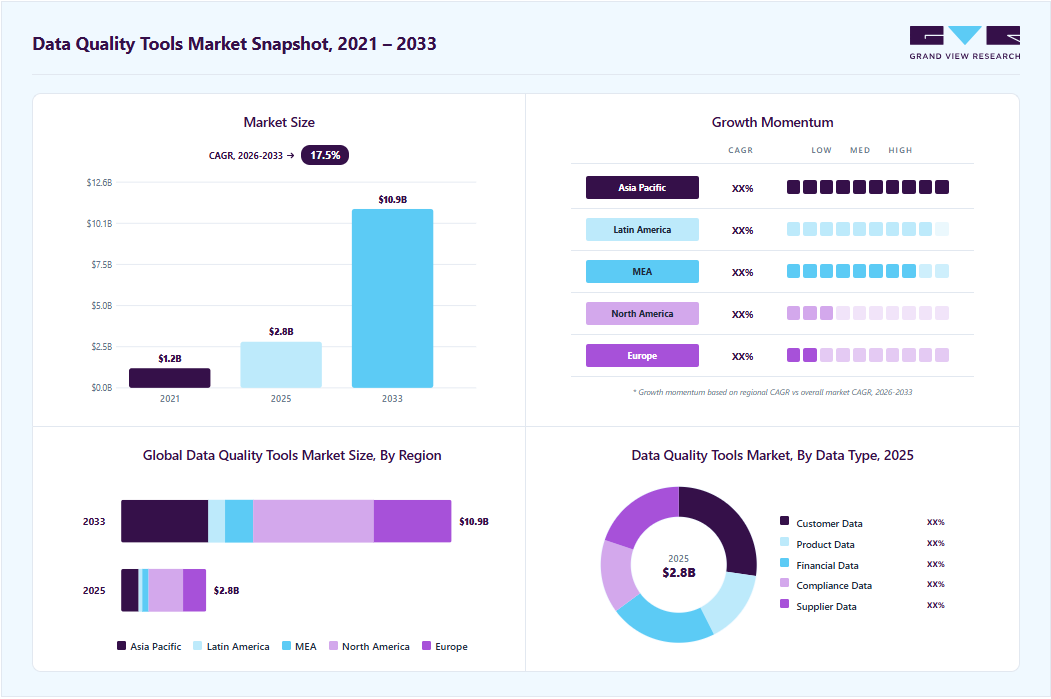
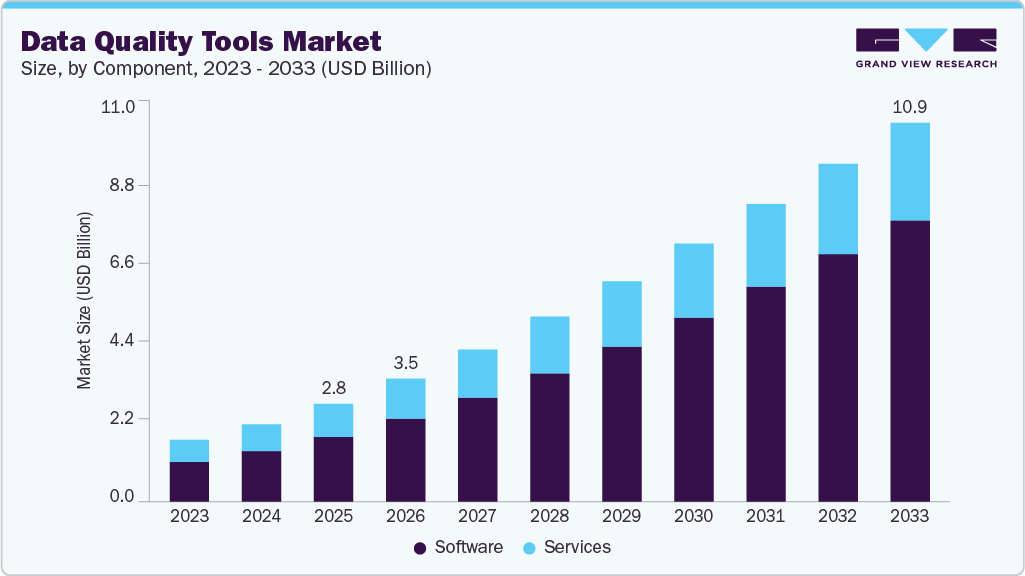
The global data quality tools market size was valued at USD 2.8 billion in 2025 and is projected to grow from USD 3.5 billion in 2026 to USD 10.9 billion by 2033, at a CAGR of 17.5% from 2026 to 2033. The North America data quality tools market accounted for the largest revenue share of over 40% in 2025. The surging data volumes from diverse sources such as IoT and big data, growing stringent regulations, such as GDPR and CCPA that mandate accurate, compliant data management, and rising financial and reputational risks from poor data quality are the key factors driving the market growth.
 Source: Grand View Research, IR Documents, Primary Interviews, Paid DatabasesTo learn more about this report,
 Download Free Sample Report
 Key Market Trends & Insights
- By component: Software segment dominanted the market, with the revenue share of over 66% in 2025.
- By deployment: Cloud-based segment is expected to grow at the highest CAGR of 22.7% from 2026 to 2033.
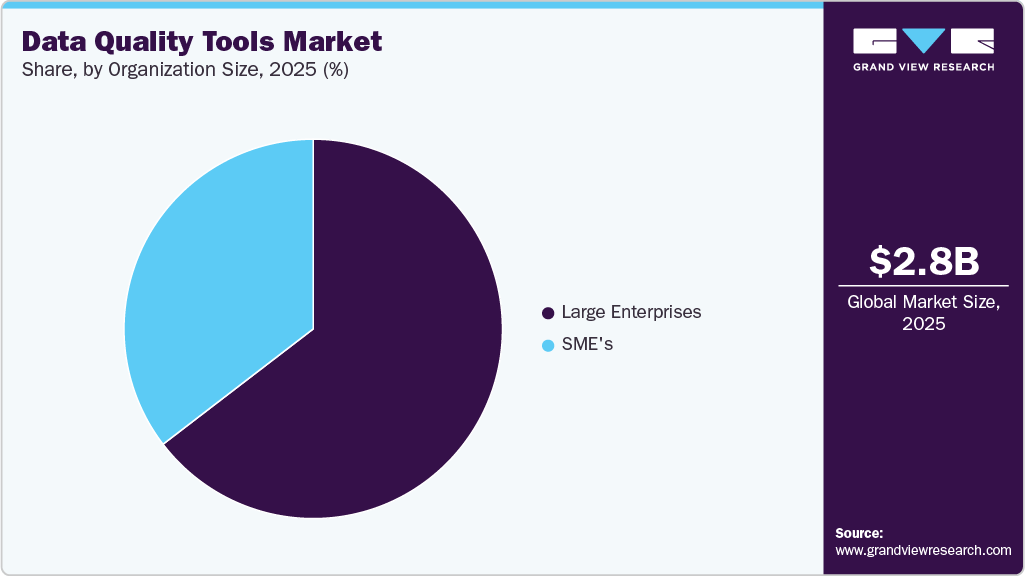
- By organization size: Large enterprises segment accounted for the largest share of over 64% in 2025.
- By end use: BFSI segment accounted for the largest revenue share in 2025.
- By data type: Customer data segment accounted for the largest revenue share in 2025.
Regional Highlights
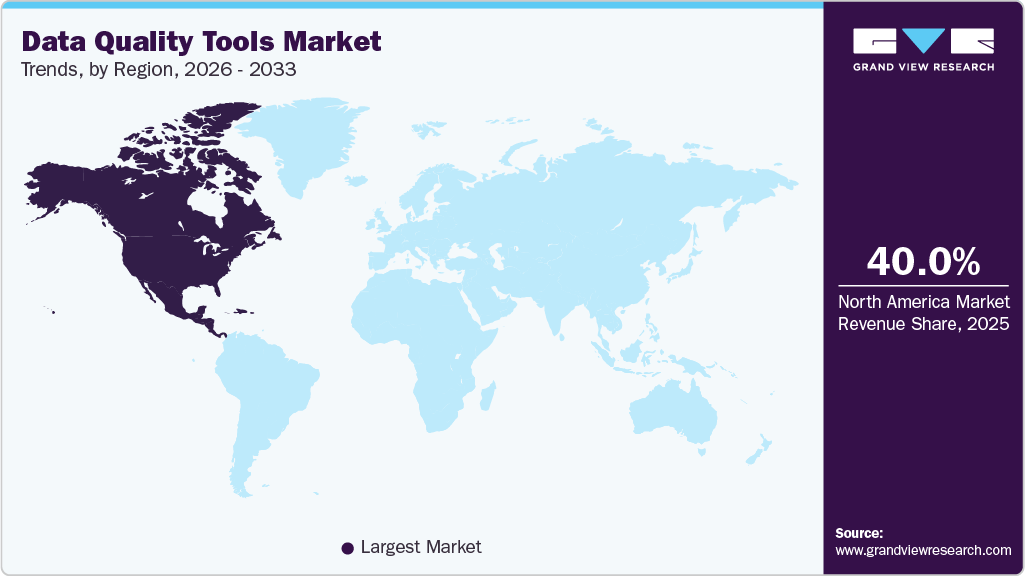
- Largest regional market: North America (40.0% revenue share, 2025)
- Fastest-growing regional market: Asia Pacific (highest CAGR, 2026-2033)
- The U.S. data quality tools market dominated the North American region with the largest revenue share of over 84% in 2025
Market Size & Forecast
- Market size in 2025: USD 2.8 Billion
- Estimated market size in 2026: USD 3.5 Billion
- Projected market size by 2033: USD 10.9 Billion
- CAGR (2026-2033): 17.5%
Three ways to get this report
Buy it, customize it, or ask a question.Ask an Analyst
Analyst response in 1 business day
- AccessReport author, directly
- Reply timeWithin 1 working day
- No sales callDirect answer only
- FormatEmail reply
- CostFree, no cost
Get the Full Report
What the study covers
- FormatsPDF · Excel · Dashboard
- Timeline2026–2033 annual, 2025 base
- Coverage20+ countries, 5 regions
- Companies10+ key players profiled
Customize the Report
20% free customization
- IncludeCountries, segments, points
- TailorTo your product definition
- ExtendDeeper competitor detail
- OrA fully bespoke study
- Turnaround5–10 working days
The rising investments in tools for cleansing, profiling, and governance to support data-driven decisions are further accelerating the data quality tools industry. Global data privacy laws such as GDPR, CCPA, and sector-specific rules in BFSI and healthcare (HIPAA) are driving widespread adoption of data quality tools, particularly in high-stakes sectors where data accuracy directly ensures regulatory compliance, mitigates multimillion-dollar penalties, and supports audit trails through features such as lineage tracking and anomaly alerts. This trend is amplified by broader digital transformation initiatives, where trustworthy data underpins AI deployments, thereby driving the growth of the industry.Additionally, AI and machine learning automation for anomaly detection, predictive cleansing, rule generation, and real-time monitoring represent a transformative trend within the industry, dramatically enhancing efficiency in tools from market players such as Informatica, where interactive ML dashboards automate manual quality tasks. These capabilities are pivotal for GenAI workflows, ensuring high-fidelity training data amid the explosion of unstructured inputs from voice, video, and sensors, with adoption surging as enterprises prioritize "AI-ready" data to avoid model biases and hallucinations.
 To learn more about this report, Download Free Sample Report
 Furthermore, there is a rising emphasis on holistic data governance frameworks encompassing lineage tracking, automated cataloging, metadata management, and observability, shifting the market toward integrated platforms vital for sectors managing complex, siloed datasets in retail, manufacturing, and telecom. This focus supports advanced analytics, real-time business intelligence, and collaborative stewardship amid explosive growth in e-commerce transactions and mobile data, enabling organizations to operationalize quality as a strategic asset rather than a reactive fix. These factors are expected to play a pivotal role in accelerating the industry.
Moreover, the companies are investing in data quality tools to ensure accurate, reliable, and compliant data crucial for powering AI models, advanced analytics, and real-time decision-making amid growing data volumes from IoT, cloud migrations, and digital transactions. This increase helps prevent large financial losses caused by poor data quality while also meeting strict regulations such as GDPR, CCPA, and sector-specific mandates in BFSI and healthcare that require auditable lineage, anomaly detection, and validation features. These factors are expected to collectively drive the data quality tools industry expansion in the coming years.
Component Insights
The software segment accounted for the largest share of over 66% in 2025, driven by demand for scalable, automated platforms that enable real-time data cleansing, profiling, enrichment, and monitoring across cloud, hybrid, and on-premise environments. Enterprises seek AI/ML-powered solutions from leaders like Informatica and IBM to handle the exploding volumes from IoT, e-commerce, and GenAI workflows, ensuring trustworthy inputs for analytics while reducing manual intervention and integration with ecosystems such as SAP or AWS.
The services segment is expected to grow at a significant CAGR of over 13% from 2026 to 2033, driven by the complexity of implementing customized data quality strategies, including consulting on governance frameworks, migration support from legacy systems to cloud-native tools, and managed services for ongoing profiling and remediation. Organizations rely on professional expertise to navigate regulatory compliance like GDPR, train teams on advanced features, and optimize deployments amid siloed data challenges in BFSI, healthcare, and retail.
Deployment Insights
The cloud-based segment accounted for the largest market revenue share in 2025, driven by its scalability, cost-efficiency, and seamless integration with hybrid/multi-cloud ecosystems, enabling real-time processing for massive data streams from IoT, e-commerce, and analytics platforms. Enterprises favor cloud solutions from providers such as Informatica and IBM for rapid deployment, pay-as-you-go pricing, and built-in AI features that automate cleansing and governance without heavy infrastructure investments.
The on-premises segment is expected to grow rapidly from 2026 to 2033, driven by stringent security requirements, data sovereignty regulations, and the need to integrate with legacy systems in regulated sectors such as BFSI and healthcare, where full control over sensitive data is paramount. Organizations opt for these deployments to maintain customization, comply with local laws such as GDPR, and achieve reliable performance in air-gapped environments, despite higher upfront costs.
Data Type Insights
The customer data segment accounted for the largest revenue share in 2025, driven by the critical need for unified, accurate customer profiles to enable personalized marketing, seamless omnichannel experiences, and compliance with privacy regulations like GDPR across retail, BFSI, and telecom sectors. Enterprises leverage tools for deduplication, enrichment, and real-time validation to build trusted 360-degree customer views, powering AI-driven segmentation, churn prediction, and loyalty programs while mitigating risks from fragmented records across CRM, e-commerce, and social sources.
The product data segment is expected to grow rapidly from 2026 to 2033, driven by demands for consistent, enriched catalogs that support e-commerce scalability, supply chain visibility, and inventory optimization in retail, manufacturing, and logistics industries. Organizations use quality tools for standardization, classification, and anomaly detection to ensure accurate pricing, availability, and descriptions across marketplaces, ERP systems, and PIM platforms, fueling recommendation engines and global trade compliance.
End Use Insights
The BFSI segment accounted for the largest revenue share in 2025, driven by stringent regulatory compliance needs for fraud detection, risk management, and anti-money laundering across fragmented transaction data from multiple channels and systems. Banks, insurers, and financial firms prioritize real-time validation, anomaly detection, and auditable lineage in tools from Informatica and IBM to unify customer profiles, ensure accurate reporting under GDPR and Basel standards, and power AI-driven insights for personalized services while minimizing operational risks.
The healthcare & life sciences segment is expected to grow rapidly from 2026 to 2033, driven by demand for accurate patient data, interoperability across EHR systems, and compliance with HIPAA and privacy laws to support clinical trials, personalized medicine, and predictive analytics. Providers and pharma companies rely on quality tools for deduplication, enrichment, and standardized formats to enable secure data sharing, drug discovery workflows, and population health management amid rising volumes of telemedicine and genomic data.
Organization Size Insights
The large enterprises segment accounted for the largest market share in 2025, driven by the need to manage massive, complex data ecosystems spanning multiple silos, clouds, and legacy systems, requiring enterprise-grade platforms for comprehensive governance, AI-powered automation, and global compliance across operations. These organizations prioritize scalable solutions from leaders like Informatica and IBM to unify customer data, fuel GenAI initiatives, and mitigate risks in high-stakes sectors like BFSI and healthcare.
 To learn more about this report, Download Free Sample Report
 The SME’s segment is anticipated to grow at the highest CAGR over the forecast period, driven by affordable, user-friendly cloud-native tools that offer quick setup, self-service profiling, and cost-effective scalability without dedicated IT teams, enabling smaller firms to achieve data trustworthiness for analytics, personalization, and growth. SMEs favor agile vendors like Talend and Precisely for streamlined integrations and ML-driven quality to compete in e-commerce and digital transformation amid limited budgets.
Regional Insights
North America data quality tools market dominated with a revenue share of over 40% in 2025, driven by advanced digital transformation across enterprises, widespread cloud adoption, and heavy integration of AI/ML for analytics in tech-savvy sectors like BFSI and retail. Strong regulatory frameworks alongside the presence of innovation hubs from leaders like Informatica and IBM fuel demand for robust governance to support big data initiatives and operational decision-making.
 To learn more about this report, Download Free Sample Report
 U.S. Data Quality Tools Market Trends
The data quality tools industry in the U.S. accounted for the largest market share of over 84% in 2025. The market is propelled by pioneering big data analytics, stringent compliance needs in financial services, and rapid enterprise AI deployments that require trustworthy data pipelines. Tech giants and Fortune 500 firms drive adoption through investments in hybrid solutions for customer insights and fraud prevention, positioning the US as a global leader in data quality innovation.
Europe Data Quality Tools Market Trends
The data quality tools industry in Europe accounted for a significant share of over 27% in 2025. In Europe, the market is heavily influenced by rigorous data protection regulations like GDPR, emphasizing privacy, lineage tracking, and cross-border compliance across diverse industries. Digital single market initiatives and rising analytics in manufacturing push for standardized tools to unify siloed data and enable secure AI applications.
The U.K. data quality tools industry is expected to grow rapidly in the coming years, driven by strong demand from the financial services, retail, and fintech sectors, which handle large volumes of customer and transactional data. Organizations increasingly require data quality solutions to support risk management, regulatory reporting, and advanced analytics. Strict data governance and privacy regulations, including GDPR and national data policies, push enterprises to implement robust data management frameworks.
The data quality tools industry in Germany is driven by its strong industrial and manufacturing base, particularly sectors such as automotive, engineering, and finance that rely heavily on precise and high-integrity operational data. Industry 4.0 initiatives and the increasing digitization of supply chains are generating massive data volumes, creating demand for advanced data profiling, validation, and cleansing solutions.
Asia Pacific Data Quality Tools Market Trends
The data quality tools industry in Asia Pacific is anticipated to register the highest CAGR of over 21% from 2026 to 2033, fueled by rapid digital transformation, expansion of cloud computing, and the explosive growth of data generated through e-commerce, fintech, and 5G ecosystems. Organizations across industries are increasingly adopting data-driven strategies for analytics, customer insights, and operational optimization, which require reliable, accurate data management. Additionally, government initiatives around digital infrastructure, smart cities, and digital public platforms are generating large volumes of data that must be governed and validated.
The Japan data quality tools industry is gaining momentum, driven by the country’s strong emphasis on data accuracy, operational efficiency, and process automation across sectors such as manufacturing, financial services, and healthcare. Enterprises are increasingly implementing data quality solutions to ensure reliable analytics outputs and support advanced technologies like AI, IoT, and predictive analytics in Industry 4.0 environments.
The data quality tools industry in China is witnessing robust expansion. The market is accelerated by large-scale digital ecosystems, rapid enterprise modernization, and the massive volume of consumer and industrial data generated by e-commerce, fintech, and smart manufacturing initiatives. Enterprises require advanced data quality tools to manage, validate, and standardize large datasets for analytics, AI applications, and business intelligence. Government-led digital transformation programs and strict data governance regulations are also encouraging organizations to implement robust data management frameworks.
Key Data Quality Tools Companies Insights
Some of the key players operating in the market are Informatica and IBM, among others.
-
Informatica, Inc. offers Intelligent Data Management Cloud (IDMC), an AI-powered platform featuring the CLAIRE engine that automates data profiling, cleansing, anomaly detection, rule generation, and real-time remediation across hybrid and multi-cloud environments for enterprise-scale governance and GenAI readiness.
-
IBM Corporation offers watsonx.data intelligence, a comprehensive solution providing AI-assisted data quality rules, automated remediation workflows, end-to-end lineage tracking, and proactive observability tailored for large-scale analytics, compliance, and trusted AI pipelines in regulated sectors.
Some of the emerging players operating in the market include Alteryx, Collibra Data Quality, among others.
-
Alteryx offers Alteryx One, an AI-guided analytics platform that unifies data preparation, blending, and governance through low-code/no-code workflows, enabling self-service profiling, cleansing, business rule application, and lineage tracking for AI-ready datasets across cloud, on-premise, and hybrid environments.
-
Collibra Data Quality offers a data intelligence platform capabilities focused on governance-centric quality, featuring automated observability, policy enforcement, metadata-driven validation, and collaboration tools that link quality metrics to business stewardship for trusted analytics and compliance in enterprise ecosystems.
Key Data Quality Tools Companies:
The following key companies have been profiled for this study on the data quality tools market.
- Informatica Inc.
- IBM
- Talend Inc.
- Precisely
- Ataccama ONE
- Oracle Enterprise Data Quality
- SAP Data Services
- SAS Data Management
- Alteryx
- Collibra Data Quality
Recent Developments
-
In January 2026, Informatica, Inc. launched Real-time Data Quality and Data Quality Agent enhancements in early 2026, accelerating hybrid/multi-cloud implementations for GenAI trust through automated rule generation, anomaly detection, and proactive remediation within its Intelligent Data Management Cloud (IDMC) platform.
-
In February 2026, IBM Corporation was named a Leader in the 2026 Gartner Magic Quadrant for Augmented Data Quality Solutions, with watsonx.data intelligence recognized for AI-assisted rule creation, automated remediation workflows, and end-to-end governance across a hybrid/multi-cloud environment.
-
In February 2026, SAP released its monthly security patch updates, including new and updated Security Notes addressing critical vulnerabilities such as code injection in SAP CRM and S/4HANA, missing authorization checks in NetWeaver ABAP, and denial-of-service risks in BusinessObjects BI Platform, urging customers to implement patches promptly for enhanced data integrity and system protection.
Data Quality Tools Market Report Scope
Report Attribute
Details
Market size in 2025
USD 2.8 billion
Estimated Market size in 2026
USD 3.5 billion
Projected Market size by 2033
USD 10.9 billion
Growth rate
CAGR of 17.5% from 2026 to 2033
Base year for estimation
2025
Historical data
2021 - 2024
Forecast period
2026 - 2033
Quantitative units
Revenue in USD million/billion and CAGR from 2026 to 2033
Report Product
Revenue forecast, company ranking, competitive landscape, growth factors, and trends
Segments covered
Component, deployment, organization size, data type, end use, region
Regional scope
North America; Asia Pacific; Europe; MEA; Latin America
Country scope
U.S.; Canada; Mexico; UK; Germany; France; China; Japan; India; South Korea; Australia; Brazil; UAE; Saudi Arabia; South Africa
Key companies profiled
Informatica Inc.; IBM; Talend Inc.; Precisely; Ataccama ONE; Oracle Enterprise Data Quality; SAP Data Services; SAS Data Management; Alteryx; Collibra Data Quality
Customization scope
Free report customization (equivalent to up to 8 analyst’s working days) with purchase. Addition or alteration to country, regional & segment scope.
Pricing and purchase options
Avail customized purchase options to meet you exact research needs. Explore purchase options
Global Data Quality Tools Market Report Segmentation
This report forecasts revenue growth at the global, regional, and country levels and provides an analysis of the latest industry trends across sub-segments from 2021 to 2033. For this study, Grand View Research has segmented the global data quality tools market report based on component, deployment, organization size, data type, end use, and region.
-
Component Outlook (Revenue, USD Million, 2021 - 2033)
-
Software
-
Services
-
-
Deployment Outlook (Revenue, USD Million, 2021 - 2033)
-
On-premises
-
Cloud-based
-
-
Organization Size Outlook (Revenue, USD Million, 2021 - 2033)
-
Large Enterprises
-
SME's
-
-
Data Type Outlook (Revenue, USD Million, 2021 - 2033)
-
Customer Data
-
Product Data
-
Financial Data
-
Compliance Data
-
Supplier Data
-
-
End Use Outlook (Revenue, USD Million, 2021 - 2033)
-
BFSI
-
Healthcare & Life Sciences
-
Retail & eCommerce
-
IT & Telecommunications
-
Manufacturing
-
Transportation & Logistics
-
Government & Public Sector
-
-
Regional Outlook (Revenue, USD Million, 2021 - 2033)
-
North America
-
U.S.
-
Canada
-
Mexico
-
-
Europe
-
UK
-
Germany
-
France
-
-
Asia Pacific
-
China
-
India
-
Japan
-
Australia
-
South Korea
-
Australia
-
-
Latin America
-
Brazil
-
-
MEA
-
UAE
-
South Africa
-
Kingdom of Saudi Arabia (KSA)
-
-
Frequently Asked Questions About This Report
North America dominated with a 40.0% revenue share in 2025.
Asia Pacific is the fastest-growing region over the forecast period.
Cloud-based segment held the largest revenue share in 2025, while on-premises is the fastest growing segment.
Customer data held the largest share in 2025, while product data is the fastest growing segment.
The global data quality tools market size was valued at USD 2.8 billion in 2025 and is expected to reach 3.5 billion by 2026.
The market is projected to reach USD 10.9 billion by 2033, growing at a compound annual growth rate (CAGR) of 17.5% from 2026 to 2033
The software segment led with a 66.0% revenue share in 2025, while services is is expected to grow at a significant CAGR.
Key players operating in the market include Informatica Inc., IBM, Talend Inc., Precisely, Ataccama ONE, Oracle Enterprise Data Quality, SAP Data Services, SAS Data Management, Alteryx, and Collibra Data Quality.
The surging data volumes from diverse sources such as IoT and big data, growing stringent regulations, such as GDPR and CCPA that mandate accurate, compliant data management, and rising financial and reputational risks from poor data quality are the key factors driving the market growth
About the Author(s)
IT Services & Applications Research Team
Technology · IT Services & ApplicationsThis report was authored by the it services & applications research team at Grand View Research - comprising two research analysts, one senior research analyst, and one industry expert - with specialized expertise in the it services & applications segment of the technology industry. All findings are based on proprietary technology databases, executive interviews, and regulatory analysis, subject to internal peer review prior to publication.
Last Updated:
Speak to Analyst

Customize this report to your needs - add regions, segments, or data points, with 20% free customization.
Or view our licence options:


ISO 9001:2015 & 27001:2022 Certified
We are GDPR and CCPA compliant! Your transaction & personal information is safe and secure. For more details, please read our privacy policy.


