
- Home
- »
- Advanced Interior Materials
- »
-
Dense Medium Separation Market Share Analysis, Industry Report, 2026-2033GVR Report cover

Dense Medium Separation Market (2026 - 2033)
Size, Share & Trends Analysis Report By End Use (Mining, Recycling, Mineral Processing), By Application (Coal, Ferrous Metals, Non-Ferrous Metals, Industrial Minerals), By Region, And Segment Forecasts
Market Size, 2025
$102.5BMarket Estimate, 2026
$106.7BMarket Forecast, 2033
$142.0BCAGR, 2026–2033
4.2%Dense Medium Separation Market Summary
The global dense medium separation market size was valued at USD 102.5 billion in 2025 and is projected to grow from USD 106.7 billion in 2026 to USD 142.0 billion by 2033, at a CAGR of 4.2% from 2026 to 2033. Asia Pacific dominated the market, accounting for a revenue share of 73.9% in 2025. The growth is driven by the increasing need to efficiently process low-grade and complex mineral ores, improve ore pre-concentration, and reduce the quantity of material subjected to downstream energy-intensive beneficiation processes.
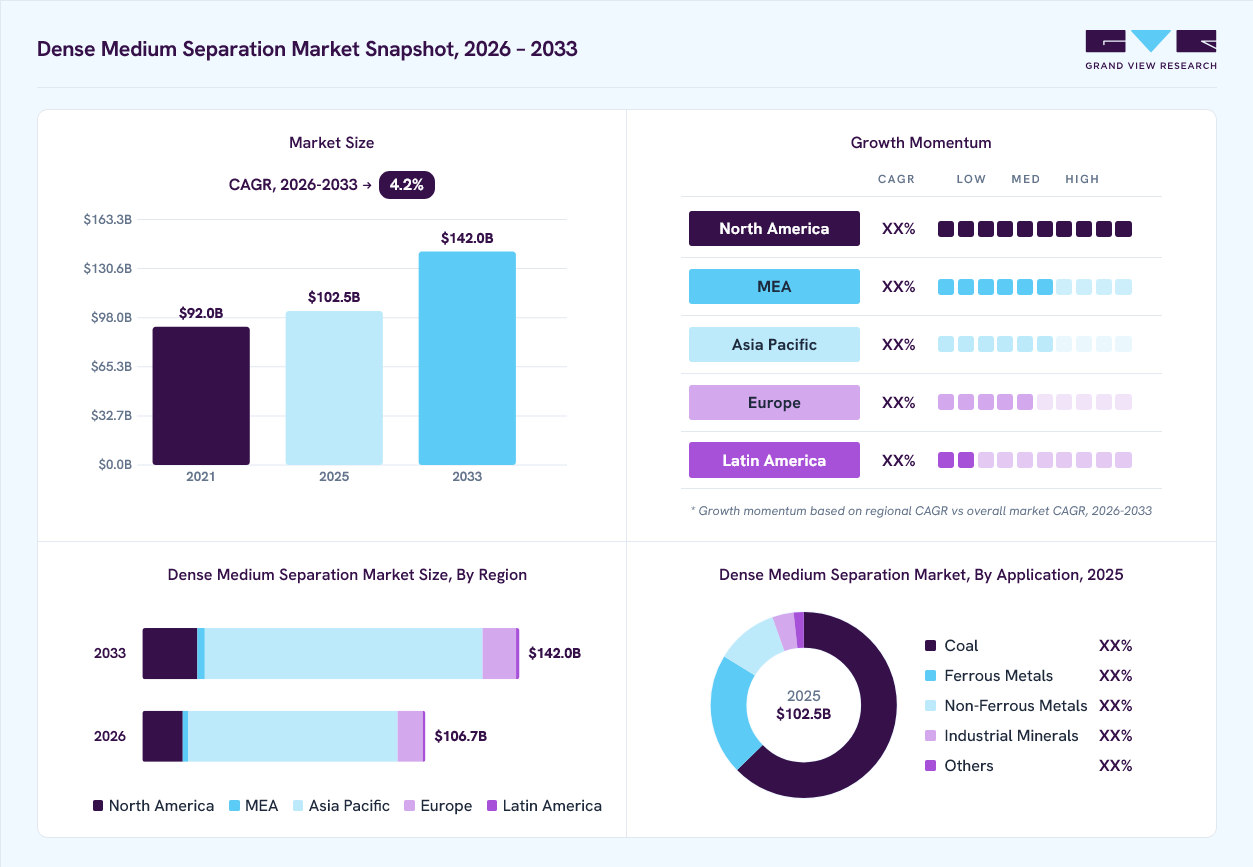 Source: Grand View Research, IR Documents, Primary Interviews, Paid DatabasesTo learn more about this report,
 Download Free Sample Report
Key Market Trends & Insights
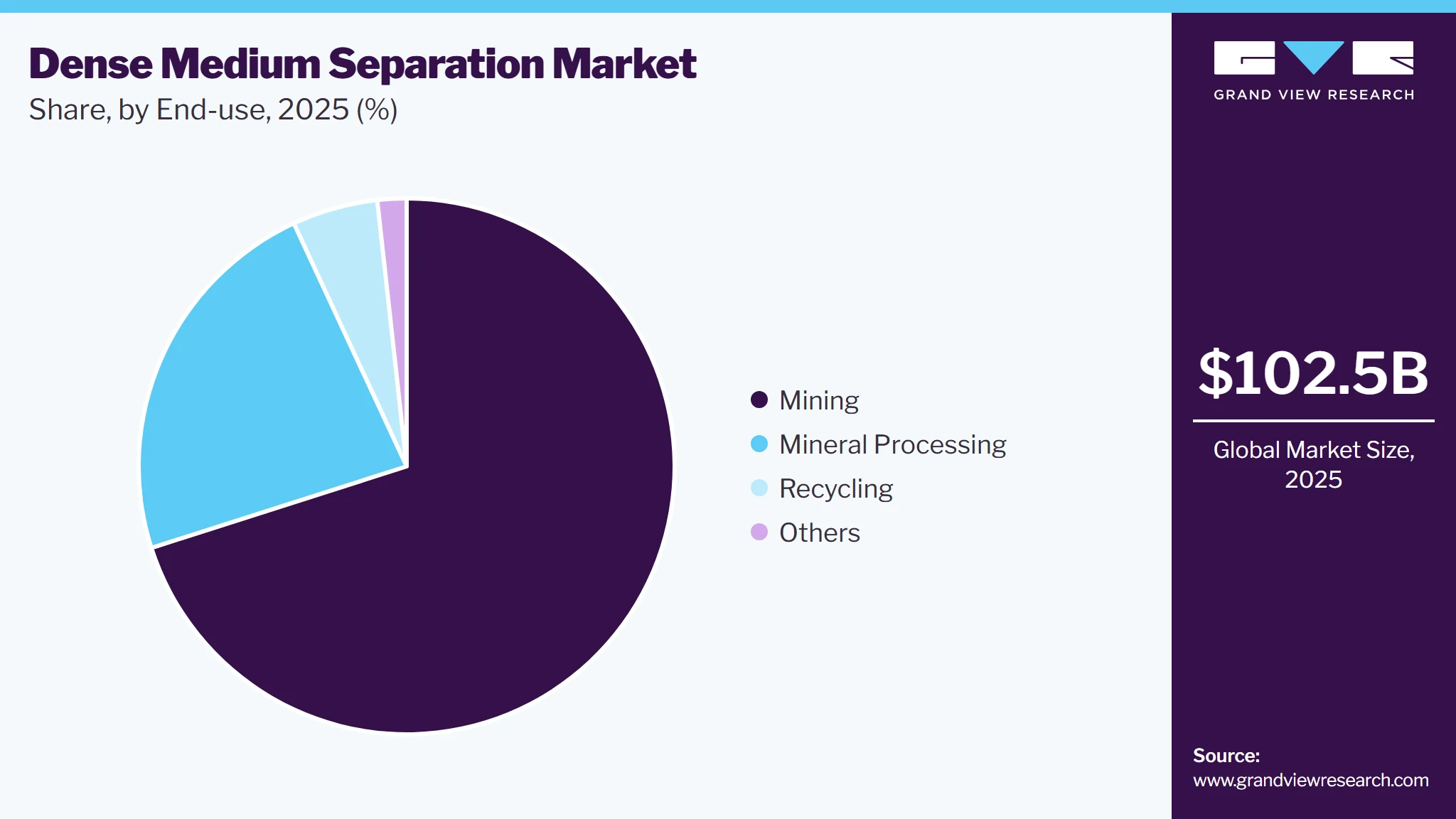
- By end use: Mining segment accounted for the largest revenue share of 70.1% in 2025.
- By application: Coal segment led the market with the largest revenue share of 62.6% in 2025.
Regional Highlights
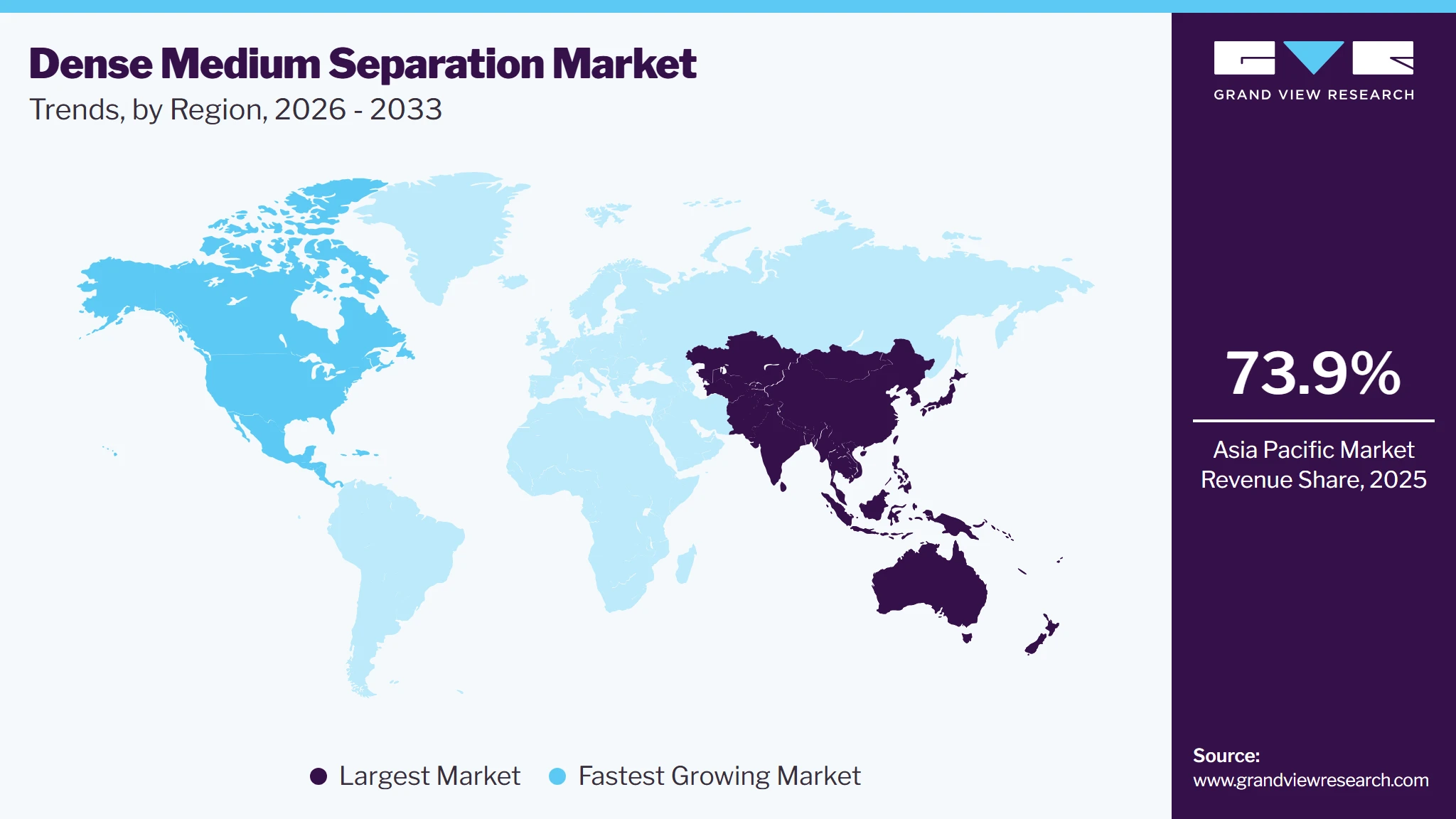
- Largest Market in 2025: Asia Pacific (73.9% revenue share, 2025)
- Fastest Growing Market: North America (highest CAGR, 2026-2033)
- By country: The U.S. held the largest market share in 2025.
Market Size & Forecast
- Market Size in 2025: USD 102.5 billion
- Estimated Market Size in 2026: USD 106.7 billion
- Projected Market Size in 2033: USD 142.0 billion
- CAGR (2026-2033): 4.2%
Prism AI by Grand View Research Free to tryAsk a question about the dense medium separation market✓Every figure cited from GVR research Prefer the report? Download free sample →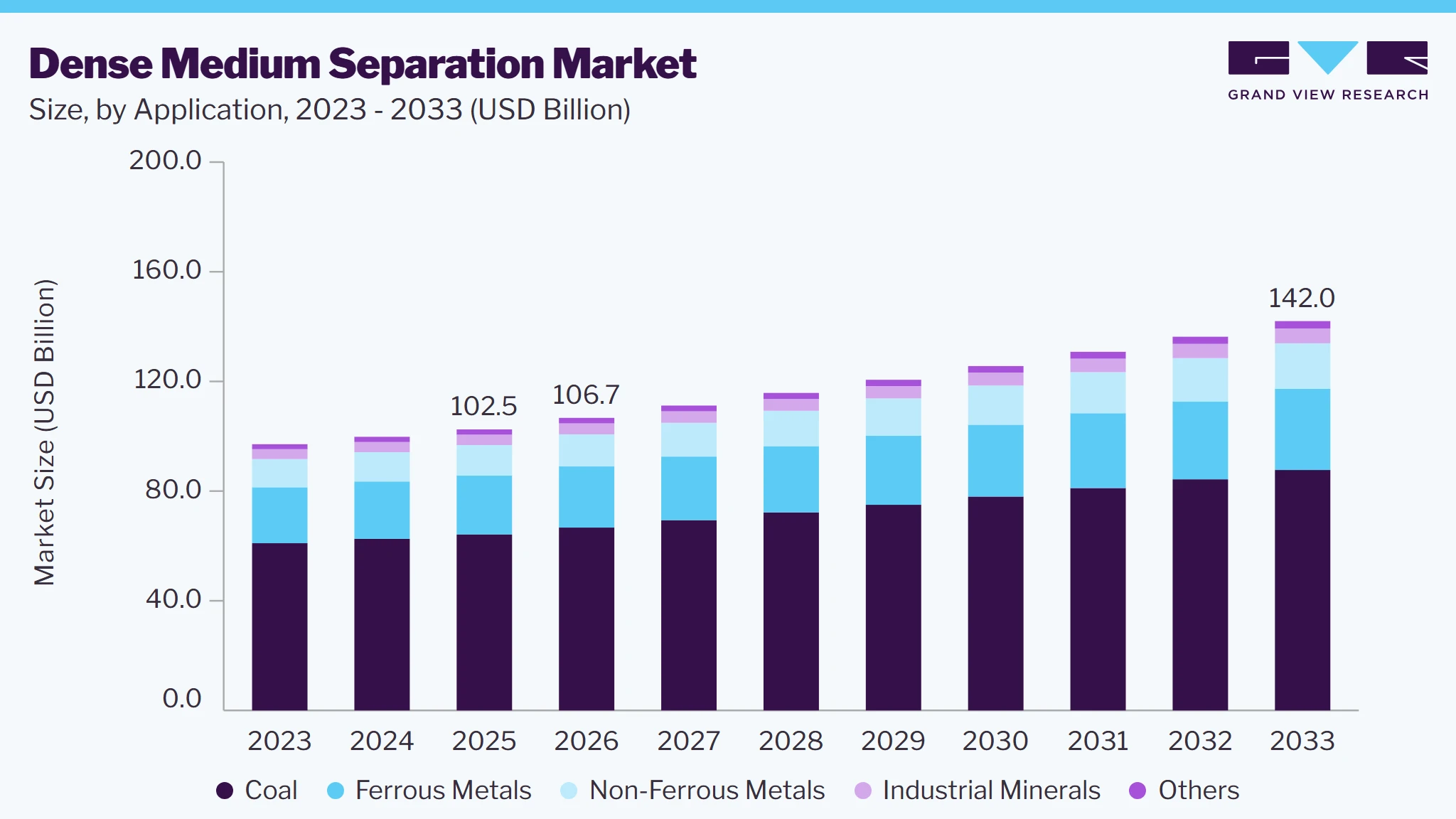 To learn more about this report, Download Free Sample Report
The mining industry is focusing on efficient and sustainable mineral processing methods that can reduce energy consumption, material handling, and waste generation. Dense medium separation (DMS) supports this transition by enabling the pre-concentration of suitable ores and early rejection of low-density gangue before energy-intensive downstream processing. By reducing the quantity of material requiring grinding and subsequent beneficiation, DMS can improve resource utilization and overall processing efficiency.Market Dynamics
Growing emphasis on energy conservation, water efficiency, lower processing costs, and improved mineral recovery is encouraging mining companies to optimize conventional beneficiation circuits. The adoption of DMS in lithium, iron ore, chromite, manganese, diamond, and other suitable mineral applications can enable greater recovery of valuable mineral-bearing material while reducing the quantity of barren material entering downstream processing stages.
The increasing demand for metals and critical minerals is encouraging mining companies to improve the efficiency of ore beneficiation and maximize recovery from available resources. Dense medium separation enables the early rejection of low-density gangue and barren material, allowing mining operations to increase the concentration of valuable minerals before downstream crushing, grinding, and separation processes. The growing production of lithium, iron ore, chromite, manganese, diamond, tungsten, tin, and other mineral commodities is supporting the adoption of DMS where sufficient density differences and coarse liberation characteristics exist. By reducing the amount of waste entering downstream processing circuits, DMS can lower material handling and grinding requirements while improving overall plant throughput and resource utilization.
DMS circuits require specialized equipment, including dense medium cyclones, drums or vessels, medium preparation systems, pumps, screens, magnetic separators, and medium recovery systems. Maintaining the appropriate medium density and minimizing medium losses also requires continuous monitoring and process control. The associated capital investment, maintenance requirements, magnetite or ferrosilicon consumption, and water-management requirements can increase operating costs. These considerations may limit DMS adoption where alternative beneficiation technologies provide a more economical solution.
The expansion of critical-mineral production presents a significant opportunity for DMS, particularly in hard-rock lithium, chromite, manganese, tungsten, tin, and other dense mineral-bearing ores. As mining companies increasingly process lower-grade and more complex resources, pre-concentration can help remove waste before downstream processing and improve the economics of mineral recovery. Lithium-bearing spodumene ores represent a particularly important opportunity because DMS can be used to pre-concentrate coarse spodumene before subsequent processing. Similar opportunities exist in other deposits where valuable minerals can be separated from gangue based on density differences.
Analyst Perspective
The market is gaining momentum as mining companies increasingly seek efficient pre-concentration and beneficiation solutions for low-grade, complex, and variable mineral ores. Dense medium separation offers the ability to remove low-density gangue at an early stage, potentially reducing downstream grinding, material handling, and processing requirements while improving the concentration of valuable minerals. Rising demand for lithium, iron ore, chromite, manganese, diamonds, tungsten, tin, and other critical minerals, together with greater emphasis on processing efficiency and resource utilization, is expected to support adoption.
End Use Insights
The mining segment represented the largest share of 70.1% in 2025, supported by the extensive use of dense medium separation for ore pre-concentration, gangue rejection, and beneficiation at mining and mineral-processing operations. The established processing infrastructure across coal, iron ore, diamonds, chromite, and other mineral applications provides a broad installed base. Continued development of mineral resources and increasing focus on improving recovery from lower-grade ores are expected to maintain mining as the dominant end-use segment.
 To learn more about this report, Download Free Sample Report
The recycling segment is expected to record the highest CAGR of 6.8% during the forecast period, driven by increasing efforts to recover valuable metals and mineral fractions from secondary resources, processing residues, and waste streams. Growing emphasis on resource efficiency, circularity, and recovery of critical materials is encouraging the application of density-based separation in suitable recycled and secondary feedstocks.
Application Insights
The coal segment accounted for the largest share of 62.6% in 2025, reflecting the established use of dense medium separation in coal preparation and washing operations. The technology is widely used to remove high-density rock and mineral impurities and produce higher-quality coal feed. Continued modernization of coal preparation facilities and demand for improved product quality are expected to sustain its significant contribution. However, growth is likely to remain more moderate than emerging mineral applications.
The non-ferrous metals segment is projected to register the highest CAGR of 5.2% during the forecast period, supported by increasing investment in the processing of copper, lead, zinc, and other non-ferrous mineral resources. Growing demand for efficient pre-concentration of complex and lower-grade ores is encouraging the use of density-based separation to reject gangue before downstream beneficiation, particularly where ore characteristics provide sufficient density contrast. Expansion of critical and strategic mineral supply chains is expected to create opportunities across suitable non-ferrous deposits further.
Regional Insights
The North America dense medium separation market is emerging as the fastest-growing region and is supported by mining activities in the U.S. and Canada, particularly across critical minerals, iron ore, and other metallic resources. Efforts to strengthen domestic mineral supply chains and expand local beneficiation are encouraging investments in efficient ore pre-concentration and processing technologies.
U.S. Dense Medium Separation Market Trends
The dense medium separation market in the U.S. is supported by increasing investments in critical mineral production, domestic processing, and resource security. Development of lithium, rare earth elements, copper, and other strategic resources is creating opportunities for density-based pre-concentration in suitable ore bodies, particularly where early gangue rejection can reduce downstream processing requirements.
Europe Dense Medium Separation Market Trends
The dense medium separation market in Europe is strengthening domestic and diversified supplies of critical raw materials while improving mineral-processing efficiency. Investments in lithium, tungsten, chromite, and other strategic mineral projects, together with greater emphasis on resource efficiency and circularity, are supporting the adoption of advanced beneficiation technologies.
Asia Pacific Dense Medium Separation Market Trends
Asia Pacific dominated the audio codec market with the largest revenue share of 73.9% in 2025. The dense medium separation market in Asia Pacific remains a major market owing to its large mining and mineral-processing base, particularly in China, Australia, India, and Southeast Asia. Strong production of lithium, iron ore, chromite, manganese, tin, and other minerals, combined with expanding beneficiation capacity, is driving demand for advanced separation and pre-concentration systems.
 To learn more about this report, Download Free Sample Report
The China dense medium separation market is a major market due to its large mining and mineral-processing base. Key applications include lithium, iron ore, manganese, and chromite processing. Rising investment in domestic beneficiation capacity is supporting adoption. Critical mineral supply chain development is also creating demand. Modernization of processing facilities is further supporting growth. DMS is particularly relevant for ores with suitable density differences and coarse liberation characteristics.
Latin America Dense Medium Separation Market Trends
The dense medium separation market in Latin America is witnessing increasing investment in mineral beneficiation due to its substantial lithium, copper, iron ore, tin, and other mineral resources. New mining and processing projects, particularly in Brazil, Chile, Peru, and Argentina, are creating opportunities for density-based separation where ore characteristics are favorable.
Middle East & Africa Dense Medium Separation Market Trends
The dense medium separation market in the MEA region is supported by expanding mining investments and efforts to increase local processing and beneficiation. South Africa, Saudi Arabia, and Namibia offer opportunities across diamond, chromite, manganese, iron ore, and other metallic minerals as mining companies seek to improve recovery and increase the value derived from domestic resources.
Key Dense Medium Separation Companies Insights
Some of the key players operating in the dense medium separation market include Multotec, Consulmet, and others.
-
Multotec, established in 1973, is a South Africa-based mineral-processing equipment manufacturer specializing in separation, classification, screening, and beneficiation solutions. The company offers a dedicated portfolio of dense medium separation equipment, including dense medium cyclones, cyclone densifiers, magnetic separation systems, and associated medium-recovery equipment. Its DMS solutions are used for pre-concentration and upgrading of minerals, with applications spanning iron ore, platinum, diamonds, tungsten, and other mineral commodities.
-
Consulmet, established in 1994, is a South Africa-based minerals and metals process engineering company specializing in the design, construction, commissioning, and operation of mineral-processing plants. The company has developed dedicated DMS capabilities, including pre-engineered DMS modules, multi-stage plants, super-high-density DMS systems, and in-house DMS test facilities. Its solutions cover a broad range of commodities, including lithium, iron ore, diamonds, manganese, nickel, copper, antimony, tin, tungsten, zinc, and lead.
-
Sepro Mineral Systems, established in 1987, is a Canada-based mineral-processing equipment and plant engineering company specializing in gravity concentration, leaching, and mineral beneficiation technologies. Its Condor Dense Medium Separator is designed for pre-concentration and concentration of metals, oxides, sulfides, and industrial minerals. The system can process particles typically ranging from 1-50 mm and uses multi-stage separation to produce multiple products while enabling early rejection of barren material.
Key Dense Medium Separation Companies
Some prominent players in the dense medium separation market include:
-
Consulmet
-
DRA Global
-
FLSmidth
-
Gekko Systems
-
Manhattan Corporation
-
Metso
-
Mineral Technologies
-
Multotec
-
Sepro Mineral Systems
-
Weir Minerals
Competitive Benchmarking
Category
Operating Strategies
Competitive Edge
Weakness
Established Players (DRA Global, FLSmidth, Metso, Mineral Technologies, Weir Minerals)
- Provide integrated mineral-processing solutions covering DMS, classification, screening, separation, material handling, and downstream beneficiation.
- Leverage established engineering, procurement, construction, commissioning, and after-sales networks to secure large mining projects.
- Adapt DMS and separation technologies to commodity-specific processing flowsheets and integrate them with broader plant operations.
- Broad mineral-processing portfolios allow these companies to participate across multiple stages of a beneficiation circuit.
- •Global project experience established customer relationships, and extensive technical service networks support adoption by major mining companies.
- Strong engineering capabilities enable integration of DMS with complex, multi-stage mineral-processing plants.
- DMS represents only one part of their broader mineral-processing portfolios, limiting their specialization compared with dedicated DMS providers.
- Large organizational structures and complex project execution processes can result in longer implementation cycles.
- Exposure to large capital projects makes business performance sensitive to mining investment cycles and project delays.
Emerging & Regional Players (Consulmet, Gekko Systems, Manhattan Corporation, Multotec, Sepro Mineral Systems)
- Develop specialized DMS plants, modules, cyclones, separators, and integrated beneficiation circuits for specific mineral applications.
- Use metallurgical testwork, pilot-scale trials, and customized flowsheet development to optimize separation performance before commercial deployment.
- Target opportunities in lithium, diamonds, iron ore, chrome, manganese, base metals, and other minerals where density-based pre-concentration can improve processing economics.
- Strong DMS-specific expertise enables customized solutions based on ore characteristics, feed size, density differential, and required recovery.
- Modular and scalable plant configurations can support projects ranging from pilot operations to commercial-scale processing facilities.
- Experience with difficult and variable ore types provides an advantage in designing application-specific beneficiation circuits.
- Smaller scale relative to diversified global mining-equipment suppliers can limit access to very large international projects.
- Demand is dependent on the availability of mineral deposits with suitable density contrasts and coarse liberation characteristics.
- Project revenues can fluctuate with mining investment, commodity prices, permitting timelines, and the development of new mineral-processing facilities.
Recent Development
-
In 2026, Consulmet continued to offer its dedicated DMS testing and plant-development capabilities through its in-house DMS test plant, which supports bulk testwork, product configuration evaluation, and development of DMS equipment for difficult-to-separate ores. The facility incorporates a medium-recovery circuit designed to maintain stable medium density during testing.
-
In 2026, Sepro continued commercial deployment and promotion of its Condor Dense Medium Separator and modular DMS plants, targeting pre-concentration of metallic ores and other minerals. The Condor system provides multi-stage separation and can process coarse feed while rejecting barren material before downstream milling and beneficiation.
Dense Medium Separation Market Report Scope
Report Attribute
Details
Market Definition
The dense medium separation market represents the value of materials recovered or concentrated using DMS processes, including coal, ferrous metals, non-ferrous metals, industrial minerals, and other materials.
Market size value in 2025
USD 102.5 billion
Market size value in 2026
USD 106.7 billion
Revenue forecast in 2033
USD 142.0 billion
Growth rate
CAGR of 4.2% from 2026 to 2033
Base year for estimation
2025
Historical data
2021 - 2024
Forecast period
2026 - 2033
Quantitative units
Revenue in USD billion and CAGR from 2026 to 2033
Report coverage
Revenue forecast, competitive landscape, growth factors, and trends
Segments covered
End use, application, region
Regional scope
North America; Europe; Asia Pacific; Latin America; Middle East & Africa
Country scope
U.S.; Canada; Mexico; Germany; Finland; Norway; China; Australia; India; Brazil
Key companies profiled
Consulmet; DRA Global; FLSmidth; Gekko Systems; Manhattan Corporation; Metso; Mineral Technologies; Multotec; Sepro Mineral Systems; Weir Minerals
Customization scope
Free report customization (equivalent up to 8 analysts working days) with purchase. Addition or alteration to country, regional & segment scope.
Pricing and purchase options
Avail customized purchase options to meet your exact research needs. Explore purchase options
Dense Medium Separation Market Report Segmentation
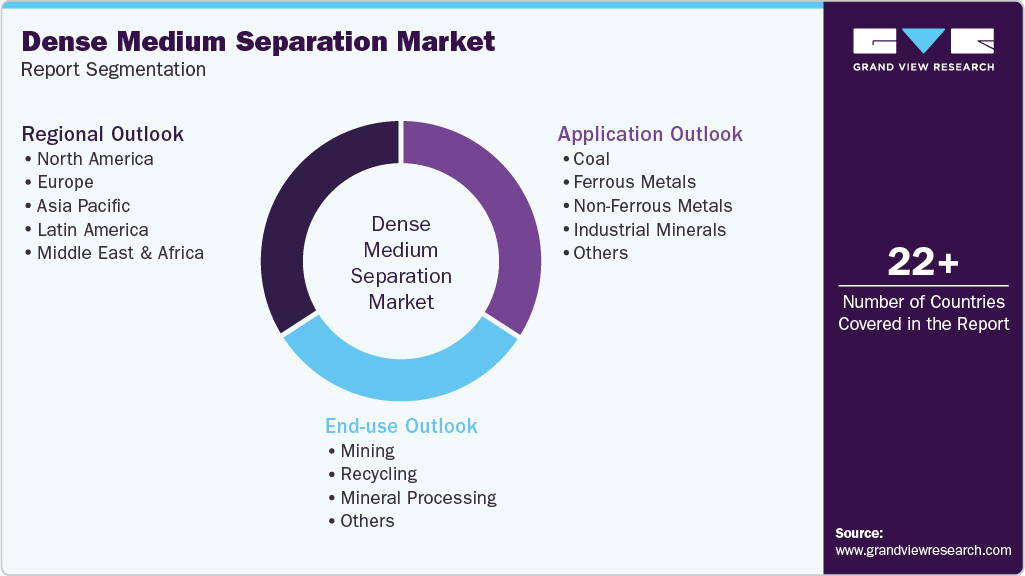
This report forecasts revenue growth at global, regional, and country levels and provides an analysis of the latest industry trends in each of the sub-segments from 2021 to 2033. For this study, Grand View Research has segmented the global dense medium separation market report on the basis of end use, application, and region.
 To learn more about this report, Download Free Sample Report
-
End Use Outlook (Revenue, USD Billion, 2021-2033)
-
Mining
-
Recycling
-
Mineral Processing
-
Others
-
-
Application Outlook (Revenue, USD Billion, 2021-2033)
-
Coal
-
Ferrous Metals
-
Non-Ferrous Metals
-
Industrial Minerals
-
Others
-
-
Regional Outlook (Revenue, USD Billion, 2021-2033)
-
-
North America
-
U.S.
-
Canada
-
Mexico
-
-
Europe
-
Germany
-
Finland
-
Norway
-
-
-
Asia Pacific
-
China
-
Australia
-
India
-
-
Latin America
-
Brazil
-
-
Middle East & Africa
-
Research Methodology
The dense medium separation market figures in this report are based on a proven research process that combines executive interviews with secondary research from proprietary databases, company filings, and recognized regulatory and institutional sources. Market size is built through value-chain sizing - reconciling supply-side and demand-side estimates - and triangulated with bottom-up and top-down approaches. Every estimate passes multiple levels of expert validation before publication, with each dense medium separation segment quantified using the revenue-capture definitions in the table below.
Segment Definition
End Use
Revenue Capture Definition
Mining
Revenue is captured from the processing and beneficiation of mined ore using dense medium separation to remove low-density waste, pre-concentrate valuable minerals, and improve feed quality for subsequent processing.
Recycling
Revenue is derived from the processing of mineral-bearing secondary materials, recycled metals, and mining-related waste streams through density-based separation to recover valuable mineral fractions and reduce unwanted material.
Mineral Processing
Revenue is generated from the beneficiation of mineral-bearing feed using dense medium separation to separate valuable minerals from gangue, improve feed grade, and increase the efficiency of downstream processing.
Others
Includes revenue associated with DMS-based treatment of mineral-bearing materials in specialized processing, pilot-scale, demonstration, and other recovery applications.
Application
Revenue Capture Definition
Coal
Revenue is generated from coal preparation through dense medium separation to remove rock, shale, and other high-density impurities and produce a higher-quality coal fraction.
Ferrous Metals
Revenue is derived from the processing of iron ore and other ferrous mineral resources through density-based separation to reject low-density gangue and increase the concentration and quality of valuable ferrous minerals.
Non-Ferrous Metals
Revenue is captured from the beneficiation of non-ferrous mineral ores, including suitable copper, lead, zinc, and other base-metal deposits, through the separation of valuable mineral-bearing particles from waste based on differences in density.
Industrial Minerals
Revenue is generated from the processing of industrial and mineral resources such as chromite and other suitable minerals, where dense medium separation is used for pre-concentration, upgrading, and gangue rejection.
Others
Includes revenue from DMS-based processing of other mineral resources, including lithium, tungsten, tin, tantalum, niobium, diamonds, manganese, and other metallic and critical minerals where density-based separation is technically suitable.
Estimation Model
Layer Name
Key Question
Description
Ore & Processing Base Layer
What mineral resources are suitable for dense medium separation?
Establish the addressable ore base across iron ore, lithium, chromite, manganese, diamond, tungsten, tin, lead, zinc, and other suitable mineral resources. Identify mines and processing operations using or evaluating DMS based on ore characteristics, particle size, liberation, density differential, processing route, and geographical location.
DMS Application & Deployment Layer
Where and to what extent is DMS being used?
Map operating, planned, and expansion-stage DMS facilities and determine their application across ore pre-concentration, gangue rejection, upgrading, and beneficiation. Assess deployment by mineral type, processing plant, DMS configuration, feed size, and processing capacity.
Throughput & Recovery Layer
How much mineral feed is processed through DMS?
Estimate annual DMS feed throughput using ore-processing capacity, operating days, plant utilization, feed rate, and DMS circuit share. Apply mineral-specific recovery rates, mass yield, and concentrate grades to determine the quantity of valuable mineral-bearing material upgraded or recovered through the process.
Revenue Layer
How is market revenue generated?
Calculate the market value associated with DMS processing by applying processing charges, beneficiation value added, or DMS-specific revenue per ton of feed processed to the estimated throughput. Where processing charges are unavailable, derive the value using operating economics and applicable per-ton processing benchmarks, while avoiding inclusion of the underlying commodity value to prevent double-counting.
Delivered Customizations
This report has been delivered with the following In-depth customizations
Client Request
Customization Delivered
Value Adds
DMS Technology Cost & Economics Analysis
Assessment of capital and operating costs for DMS circuits, including dense medium cyclones/drums, medium preparation and recovery, screens, pumps, magnetic separators, water, power, magnetite/ferrosilicon consumption, labor, maintenance, and associated infrastructure.
Identifies major cost drivers and establishes processing economics across different DMS configurations, helping assess technology selection and project feasibility.
Ore & Project Pipeline Assessment
Evaluation of DMS-applicable mining and beneficiation projects by mineral, country, ore type, project stage, processing capacity, DMS capacity, commissioning timeline, operator, and technology provider.
Identifies high-potential projects, emerging DMS applications, geographic opportunities, and future processing capacity additions.
DMS CAPEX & OPEX Benchmarking
Benchmarking of DMS plant CAPEX, cost per ton of installed capacity, operating cost per ton of ore processed, medium consumption, energy consumption, water consumption, labor requirements, maintenance costs, and infrastructure expenditure across minerals and regions.
Enables comparison of project economics and identifies cost-efficient DMS configurations across different ore-processing applications.
Frequently Asked Questions About This Report
The global dense medium separation market size was estimated at USD 102.5 billion in 2025 and is expected to reach USD 106.7 billion in 2026.
The global dense medium separation market is expected to grow at a compound annual growth rate of 4.2% from 2026 to 2033 to reach USD 142.0 billion by 2033.
The mining segment represented the largest share of 70.1% in 2025 while recycling segment is second fastest growing market
Asia Pacific dominated the dense medium separation market with the largest revenue share of 73.9% in 2025.
The key factor driving the growth of the global dense medium separation market is the increasing adoption of ore pre-concentration technologies to efficiently process low-grade and complex mineral ores while reducing downstream energy, water, and processing requirements.
Some of the key players of the global dense medium separation market are Consulmet, DRA Global, FLSmidth, Gekko Systems, Manhattan Corporation, Metso, Mineral Technologies, Multotec, Sepro Mineral Systems, Weir Minerals, and others.
North America is the fastest-growing region over the forecast period.
By application, the coal accounted for the largest market revenue share of 62.6% in 2025.
About the Author(s)
Advanced Interior Materials Research Team
Advanced Materials · Advanced Interior MaterialsThis report was authored by the advanced interior materials research team at Grand View Research - comprising two research analysts, one senior research analyst, and one industry expert - with specialized expertise in the advanced interior materials segment of the advanced materials industry. All findings are based on proprietary advanced materials databases, executive interviews, and regulatory analysis, subject to internal peer review prior to publication.
Last Updated:
Speak to Analyst

Customize this report to your needs - add regions, segments, or data points, with 20% free customization.
Or view our licence options:


ISO 9001:2015 & 27001:2022 Certified
We are GDPR and CCPA compliant! Your transaction & personal information is safe and secure. For more details, please read our privacy policy.


