
- Home
- »
- Next Generation Technologies
- »
-
Drone Communication System Market Size Report, 2033GVR Report cover

Drone Communication System Market (2026 - 2033)
Size, Share & Trends Report Analysis By Component (Hardware, Software, Services), By Frequency Band (ISM Band, L Band), By Range (Medium Range, Short Range), By Connectivity, By Application, By Region, And Segment Forecasts
Market Size, 2025
$2.1BMarket Estimate, 2026
$2.3BMarket Forecast, 2033
$4.1BCAGR, 2026–2033
8.6%Drone Communication System Market Summary
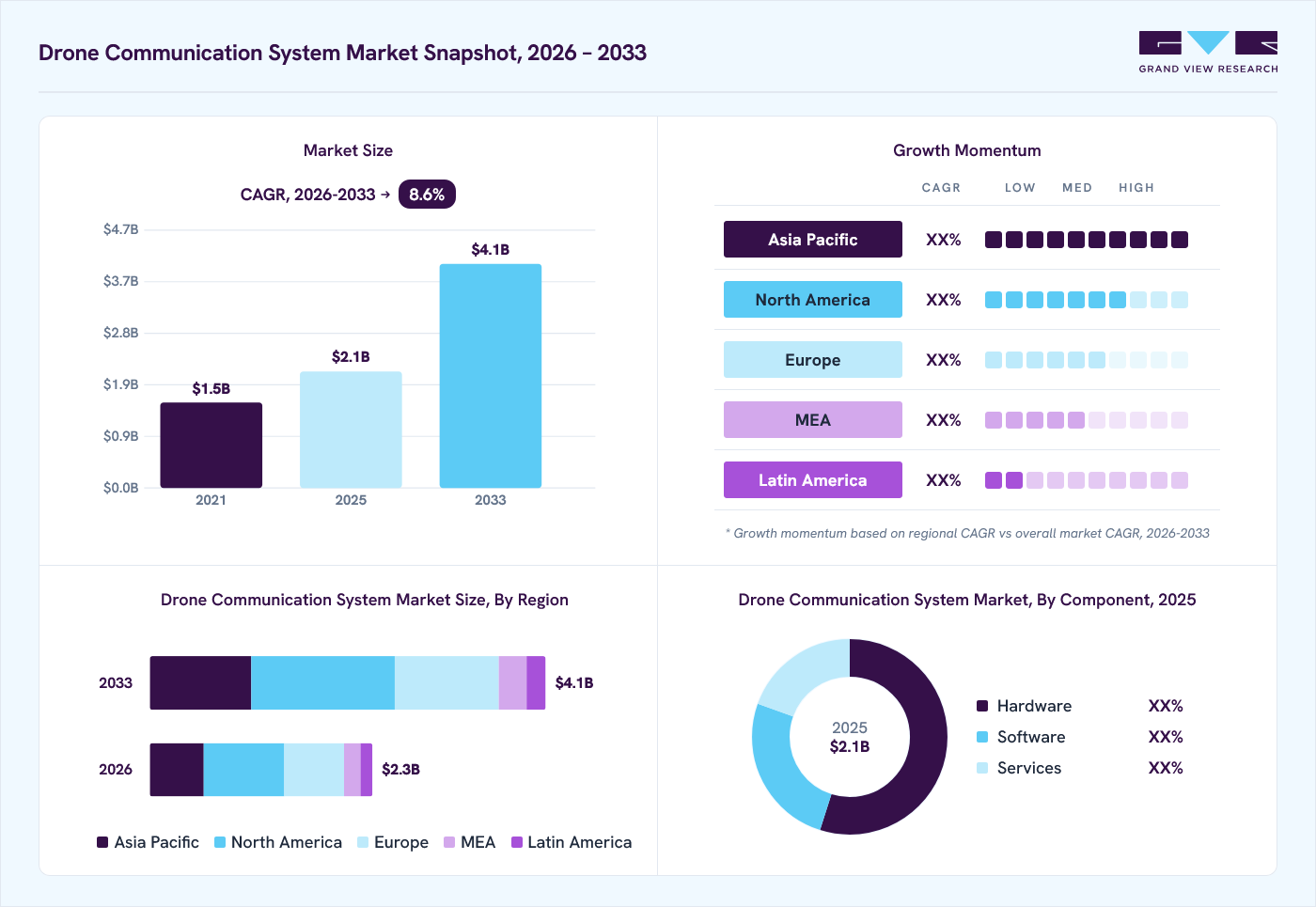
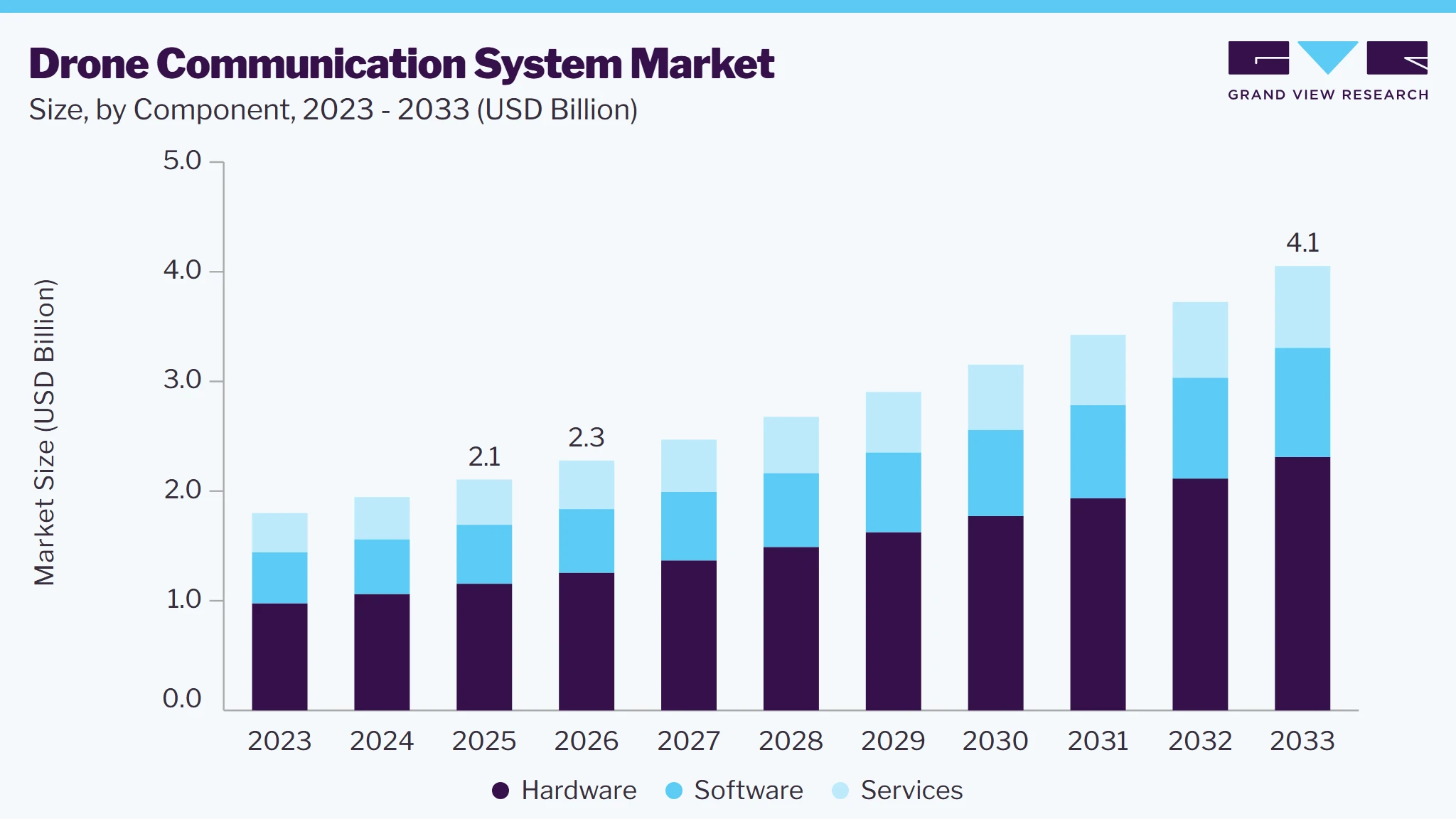
The global drone communication system market size was valued at USD 2.1 billion in 2025 and is projected to grow from USD 2.3 billion in 2026 to USD 4.1 billion by 2033, at a CAGR of 8.6% from 2026 to 2033. North America dominated the market, accounting for a revenue share of 36.1% in 2025. The market is driven by increasing defense modernization programs, widespread adoption of UAVs across commercial industries, strong investments in secure communication technologies, and the rapid deployment of 5G and satellite-enabled BVLOS operations.
 Source: Grand View Research, IR Documents, Primary Interviews, Paid DatabasesTo learn more about this report,
 Download Free Sample Report
 Key Market Trends & Insights
- By Component: Hardware segment led the market and held the largest revenue share of over 54.9% in 2025.
- By Frequency: ISM Band segment led the market and held the largest revenue share of over 37.9% in 2025.
- By application: Surveillance & reconnaissance segment dominates with over 37.0% of the market share in 2025.
- By range: The medium range segment led the market and held the largest revenue share of over 50.3% of in 2025.
- By connectivity: The Terrestrial Network (TN) segment led the market and held the largest revenue share of 77.4% in 2025.
Regional Highlights
- Largest regional market: North America (36.1% revenue share, 2025)
- Fastest-growing market regional market: Asia Pacific (highest CAGR, 2026 - 2033)
- By Country: The U.S. held the largest revenue share in 2025.
Market Size & Forecast
- Market size in 2025: USD 2.1 Billion
- Estimated market size in 2026: USD 2.3 Billion
- Projected market size by 2033: USD 4.1 Billion
- CAGR (2026-2033): 8.6%
Three ways to get this report
Buy it, customize it, or ask a question.Ask an Analyst
Analyst response in 1 business day
- AccessReport author, directly
- Reply timeWithin 1 working day
- No sales callDirect answer only
- FormatEmail reply
- CostFree, no cost
Get the Full Report
What the study covers
- FormatsPDF · Excel · Dashboard
- Timeline2026–2033 annual, 2025 base
- Coverage20+ countries, 5 regions
- Companies10+ key players profiled
Customize the Report
20% free customization
- IncludeCountries, segments, points
- TailorTo your product definition
- ExtendDeeper competitor detail
- OrA fully bespoke study
- Turnaround5–10 working days
 To learn more about this report, Download Free Sample Report
The demand for drone communication technologies is increasing as governments, defense organizations, and commercial enterprises expand the deployment of unmanned aerial vehicles (UAVs) across a wide range of applications. Defense agencies are investing in secure communication systems, RF data links, satellite communication (SATCOM), 4G/5G connectivity, and Beyond Visual Line of Sight (BVLOS) capabilities to enhance intelligence, surveillance, and reconnaissance (ISR), border security, and tactical operations. At the same time, commercial sectors such as agriculture, energy, infrastructure inspection, logistics, and public safety are adopting advanced drone communication solutions to enable reliable real-time command, control, telemetry, and high-definition video transmission.Market Dynamics
The drone communication system market is experiencing significant growth, driven by the rapid adoption of unmanned aerial vehicles (UAVs) across defense, commercial, and industrial applications. Increasing demand for secure, reliable, and low-latency communication technologies is accelerating investments in RF data links, 4G/5G connectivity, satellite communication (SATCOM), mesh networking, and Beyond Visual Line of Sight (BVLOS) communication systems. The growing deployment of autonomous drones for intelligence, surveillance and reconnaissance (ISR), infrastructure inspection, precision agriculture, logistics, emergency response, and border security is further fueling market growth. However, cybersecurity risks, spectrum limitations, and the high cost of advanced communication technologies remain key challenges. At the same time, advancements in AI-enabled autonomous drones, non-terrestrial networks (NTN), and 5G-enabled drone ecosystems are creating significant growth opportunities for market participants.
The Drone Communication System Market is primarily driven by the increasing deployment of drones in defense, public safety, agriculture, energy, logistics, and infrastructure inspection. Defense organizations are investing in secure communication systems, RF data links, encrypted command-and-control (C2) networks, and satellite communication technologies to enhance intelligence, surveillance and reconnaissance (ISR), tactical operations, and border security. Simultaneously, commercial enterprises are expanding drone operations for asset monitoring, mapping, surveying, precision agriculture, and package delivery, driving demand for reliable real-time communication solutions. The growing adoption of BVLOS operations and autonomous drone missions is further increasing the need for high-performance communication systems capable of supporting long-range, secure, and uninterrupted connectivity.
Despite strong growth prospects, the drone communication system market faces challenges associated with the high cost of advanced communication hardware and network infrastructure. Technologies such as satellite communication terminals, 5G communication modules, encrypted data links, and AI-enabled communication systems require significant investment, increasing the overall cost of drone deployment. In addition, regulatory restrictions on BVLOS operations, spectrum allocation, communication frequency licensing, and cybersecurity compliance vary across countries, limiting large-scale commercial adoption. Integrating multiple communication technologies while ensuring interoperability, low latency, and secure data transmission also adds to technical complexity.
The growing deployment of 5G networks, Low Earth Orbit (LEO) satellite constellations, and non-terrestrial network (NTN) technologies is creating substantial opportunities for the drone communication system market. These technologies enable reliable long-range connectivity, real-time command and control, and high-definition video transmission, supporting next-generation autonomous drone operations. Increasing investments in smart cities, drone delivery services, digital infrastructure inspection, disaster management, and defense modernization are further driving demand for advanced communication solutions. Moreover, continuous advancements in AI, edge computing, mesh networking, and secure communication protocols are expected to enhance drone connectivity, operational efficiency, and mission reliability, creating long-term growth opportunities for communication technology providers, component manufacturers, and UAV system integrators.
Market Concentration & Characteristics
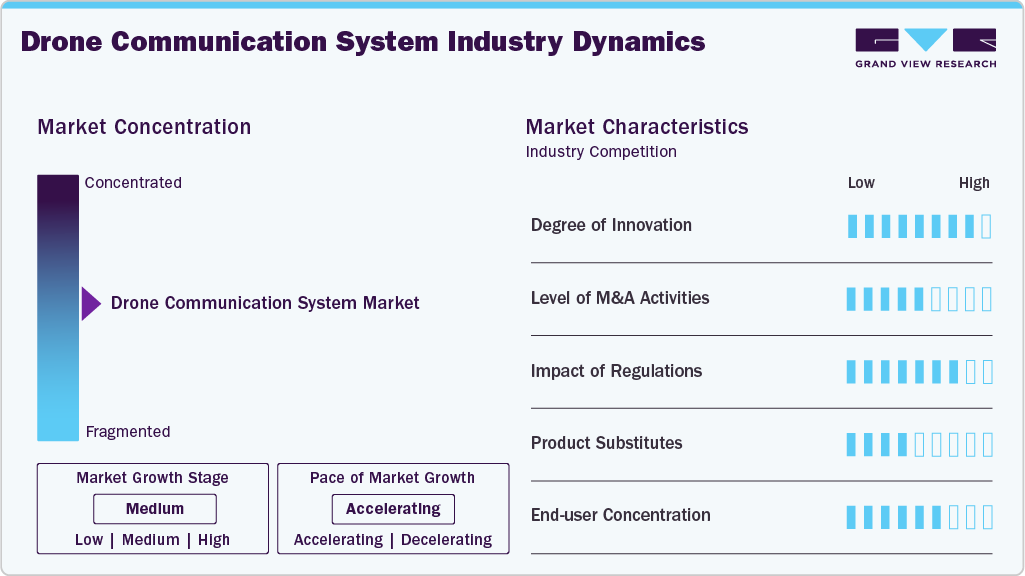
The Drone Communication System Market is moderately concentrated, with competition led by established defense electronics, wireless communication, satellite communication, and UAV technology companies. The market is characterized by continuous advancements in RF data links, 4G/5G communication modules, satellite communication (SATCOM), mesh networking, encrypted command-and-control (C2) systems, and Beyond Visual Line of Sight (BVLOS) communication technologies. High research and development costs, stringent aviation and spectrum regulations, cybersecurity requirements, and the need for highly reliable, low-latency communication systems create significant barriers to entry, enabling established technology providers to maintain a strong competitive position through innovation, strategic partnerships, and long-term contracts with defense agencies and commercial UAV manufacturers.
 To learn more about this report, Download Free Sample Report
 Major players such as Qualcomm, Honeywell International Inc., L3Harris Technologies, Viasat Inc., Iridium Communications Inc., Silvus Technologies, Doodle Labs, Elsight, Microhard Systems Inc., and RTX Corporation are strengthening their market presence by investing in 5G-enabled drone communication, satellite-based connectivity, secure RF communication systems, AI-enabled networking, and non-terrestrial network (NTN) technologies. These companies are focused on improving communication range, cybersecurity, bandwidth, and reliability while supporting autonomous drone operations and BVLOS missions. As the adoption of drones continues to expand across defense, public safety, industrial inspection, agriculture, and logistics, the market is expected to witness increasing investments, strategic collaborations, and sustained technological innovation.
Analyst Perspective
The drone communication system market is experiencing robust growth driven by expanding UAV adoption across defense, commercial, and industrial sectors. To support missions like ISR, infrastructure inspection, precision agriculture, and logistics, governments and enterprises are investing heavily in RF links, 4G/5G, SATCOM, mesh networking, and BVLOS capabilities. This demand is further accelerated by advancements in autonomous, AI-enabled drones alongside emerging tech like LEO satellite constellations, edge computing, and non-terrestrial networks, which enhance real-time data transmission and operational range. Despite challenges surrounding high deployment costs, cybersecurity threats, spectrum management, and evolving regulatory frameworks, ongoing innovation and expanding BVLOS operations ensure sustained long-term market expansion.
Component Insights
The hardware segment dominates the drone communication system market, accounting for 54.9% of the market share in 2025, owing to the widespread deployment of critical communication components such as radio transceivers, communication modules, antennas, modems, and data links across commercial and military drones. These hardware components are essential for enabling secure command-and-control (C2), real-time telemetry, high-definition video transmission, and Beyond Visual Line of Sight (BVLOS) operations.
The software segment is expected to witness the fastest growth during the forecast period, driven by the increasing adoption of AI-powered communication management, autonomous flight control, network optimization, cybersecurity solutions, and cloud-based drone fleet management platforms. The growing demand for Beyond Visual Line of Sight (BVLOS) operations, real-time data analytics, secure command-and-control (C2) systems, and seamless integration with 5G and satellite communication networks is accelerating the adoption of advanced software solutions across defense and commercial drone applications.
Frequency Insights
The ISM Band segment dominates the drone communication system market, accounting for 37.9% of the market share in 2025, owing to its widespread adoption in commercial and consumer drones operating on the 2.4 GHz and 5.8 GHz frequency bands. The ISM band provides a cost-effective, license-free, and reliable communication solution for command-and-control (C2), telemetry, and real-time video transmission.
The C Band segment is expected to witness significant growth during the forecast period, driven by the increasing demand for high-bandwidth, low-latency communication in advanced drone operations. Its ability to support reliable data transmission over longer distances makes it well suited for Beyond Visual Line of Sight (BVLOS) missions, infrastructure inspection, defense surveillance, disaster response, and industrial monitoring.
Range Insights
The medium range segment dominates the drone communication system market, accounting for over 50.3% of the market share in 2025, owing to its widespread use across commercial, industrial, and defense drone operations. Medium-range communication systems provide an optimal balance between coverage, reliability, and cost, making them ideal for applications such as infrastructure inspection, precision agriculture, mapping and surveying, public safety, and intelligence, surveillance, and reconnaissance (ISR). The growing adoption of Beyond Visual Line of Sight (BVLOS) operations and advancements in RF, 4G/5G, and satellite-enabled communication technologies continue to strengthen the demand for medium-range drone communication systems.
The Long-Range segment is expected to witness significant growth during the forecast period, driven by the increasing demand for Beyond Visual Line of Sight (BVLOS) operations across defense, border surveillance, pipeline and powerline inspection, maritime monitoring, disaster management, and long-distance logistics. Advancements in satellite communication (SATCOM), 5G connectivity, high-power RF data links, and Low Earth Orbit (LEO) satellite networks enabling reliable, secure, and low-latency communication over extended distances.
Connectivity Insights
The Terrestrial Network (TN) segment dominates the drone communication system market, accounting for 77.4% of the market share in 2025, owing to its widespread use of RF, LTE/4G, and 5G communication networks for reliable, low-latency, and cost-effective drone connectivity. Terrestrial networks are extensively deployed across commercial, industrial, and defense applications, including infrastructure inspection, precision agriculture, public safety, intelligence, surveillance and reconnaissance (ISR), and mapping. Their broad network availability established communication infrastructure, and ease of integration with ground control stations continue to drive their market leadership.
The Non-Terrestrial Network (NTN) segment is expected to witness significant growth during the forecast period, driven by the increasing adoption of Low Earth Orbit (LEO) satellite constellations, satellite communication (SATCOM), and Beyond Visual Line of Sight (BVLOS) operations. NTN enables reliable connectivity in remote, offshore, and disaster-affected areas where terrestrial networks have limited coverage, making it ideal for defense missions, maritime surveillance, long-range infrastructure inspection, emergency response, and logistics.
Application Insights
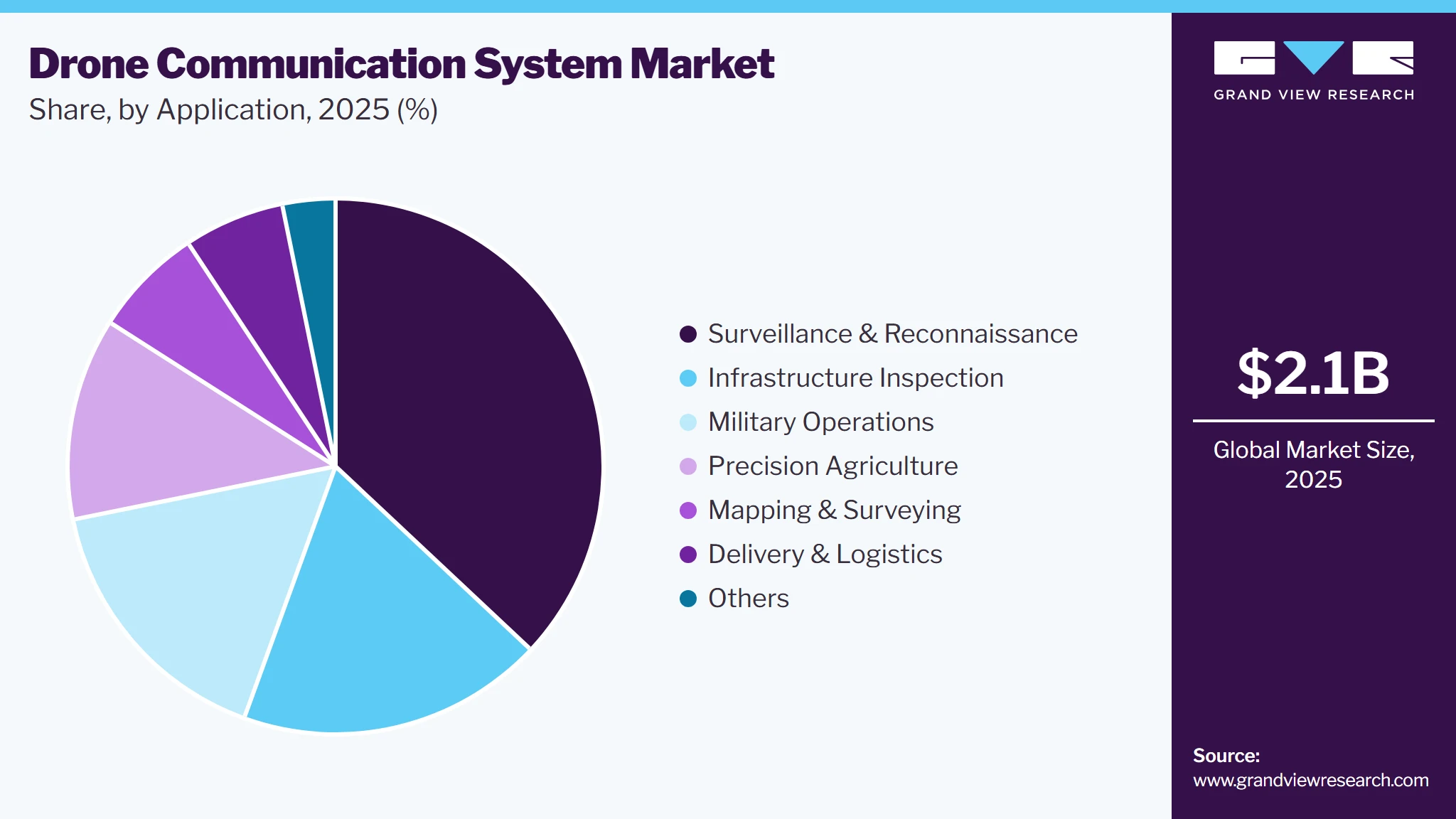
The surveillance & reconnaissance segment dominates the drone communication system market, accounting for over 37.0% of the market share in 2025, driven by the increasing deployment of drones for intelligence, surveillance and reconnaissance (ISR), border security, military operations, law enforcement, and critical infrastructure monitoring. These applications require secure, real-time communication for command-and-control (C2), telemetry, and high-definition video transmission to support mission-critical decision-making. Rising defense investments, growing geopolitical tensions, and the increasing adoption of autonomous UAVs are further strengthening the demand for advanced drone communication systems in surveillance and reconnaissance operations.
 To learn more about this report, Download Free Sample Report
 The precision agriculture segment is expected to witness significant growth during the forecast period, owing to the increasing adoption of drones for crop monitoring, precision spraying, soil health assessment, irrigation management, and yield optimization. Farmers are increasingly utilizing UAVs equipped with advanced communication systems to enable real-time data transmission, remote monitoring, and autonomous field operations. Growing investments in smart farming technologies, expanding use of AI-driven analytics, and rising demand for data-driven agricultural practices are further accelerating the adoption of drone communication systems in precision agriculture.
Regional Insights
North America dominates the drone communication system market, accounting for over 36.1% of the market share in 2025, driven by strong defense spending, widespread adoption of unmanned aerial vehicles (UAVs), and rapid advancements in communication technologies. The region, led by the United States, benefits from the presence of leading drone manufacturers, defense contractors, and communication technology providers, alongside increasing investments in secure RF data links, 5G connectivity, satellite communication (SATCOM), and Beyond Visual Line of Sight (BVLOS) capabilities. Growing deployment of drones for intelligence, surveillance and reconnaissance (ISR), border security, infrastructure inspection, public safety, and commercial applications, coupled with supportive regulatory initiatives and continuous innovation in autonomous UAV technologies, continues to strengthen North America's leadership in the global drone communication system market.
 To learn more about this report, Download Free Sample Report
 U.S. Drone Communication System Market Trends
The U.S. dominates the North America drone communication system market due to its substantial defense budget, advanced UAV ecosystem, and continuous investments in secure drone communication technologies. The country leads the deployment of drones for intelligence, surveillance and reconnaissance (ISR), border security, military operations, public safety, infrastructure inspection, and commercial applications. The presence of leading drone manufacturers, defense contractors, and communication technology companies, along with increasing investments in RF data links, 5G-enabled connectivity, satellite communication (SATCOM), and Beyond Visual Line of Sight (BVLOS) capabilities, is accelerating the development and adoption of next-generation drone communication systems
Europe Drone Communication System Market Trends
The Europe drone communication system market is witnessing steady growth due to increasing defense modernization initiatives, expanding commercial drone adoption, and rising investments in advanced UAV communication technologies. European countries are strengthening investments in secure drone communication systems, 5G connectivity, satellite communication (SATCOM), and Beyond Visual Line of Sight (BVLOS) capabilities to support defense operations, border surveillance, infrastructure inspection, public safety, and precision agriculture.
The UK drone communication system market is witnessing steady growth due to increasing defense modernization initiatives, expanding deployment of UAVs across commercial and public safety applications, and rising investments in advanced communication infrastructure. The country is strengthening the adoption of secure RF data links, 5G connectivity, satellite communication (SATCOM), and Beyond Visual Line of Sight (BVLOS) capabilities to support defense and surveillance operations, infrastructure inspection, emergency response, logistics, and industrial monitoring. Growing emphasis on autonomous drone operations and the development of advanced air mobility and drone ecosystems are further supporting market growth.
The Germany drone communication system market is experiencing significant growth, supported by increasing defense modernization spending, strong industrial drone adoption, and the country's advanced telecommunications and manufacturing ecosystem. The growing deployment of UAVs across defense, automotive, energy and utilities, construction, agriculture, and infrastructure inspection is driving demand for reliable and secure communication technologies. Increasing adoption of 5G-enabled connectivity, RF communication systems, SATCOM, and BVLOS capabilities, coupled with investments in autonomous UAV technologies and industrial digitalization, is further strengthening the growth of the drone communication system market in Germany.
Asia Pacific Drone Communication System Market Trends
The Asia Pacific drone communication system market is witnessing the fastest growth due to rising defense budgets, increasing adoption of unmanned aerial vehicles (UAVs), and expanding investments in advanced communication technologies across countries such as China, India, Japan, South Korea, and Australia. Governments and commercial enterprises are accelerating the deployment of drones for intelligence, surveillance and reconnaissance (ISR), border security, precision agriculture, infrastructure inspection, disaster management, and logistics, driving demand for secure and reliable communication systems.
Key Drone Communication System Company Insights
The drone communication system market is characterized by the presence of leading defense electronics, wireless communication, satellite communication, and UAV technology companies that are driving innovation in RF data links, secure command-and-control (C2) systems, 5G connectivity, satellite communication (SATCOM), mesh networking, and Beyond Visual Line of Sight (BVLOS) technologies.
-
L3Harris Technologies is a leading provider of secure tactical communication systems, RF data links, and integrated mission solutions for defense and commercial UAVs. The company focuses on developing resilient communication networks, encrypted command-and-control systems, and advanced ISR communication capabilities to support autonomous drone operations and next-generation defense missions.
-
Viasat Inc. is a prominent provider of satellite communication (SATCOM) solutions for unmanned aerial systems, enabling reliable Beyond Visual Line of Sight (BVLOS) connectivity and real-time data transmission. The company continues to invest in high-capacity satellite networks and secure communication technologies to enhance long-range drone operations across defense, public safety, and commercial applications.
Key Drone Communication System Companies:
The following key companies have been profiled for this study on the drone communication system market
-
Qualcomm Incorporated
-
Honeywell International Inc.
-
RTX Corporation
-
Iridium Communications Inc.
-
Doodle Labs
-
Silvus Technologies
-
Elsight
-
Microhard Systems Inc.
-
UAV Navigation (Grupo Oesía)
Competitive Benchmarking
Category
Operating Strategies
Competitive Edge
Weakness
Mature Players: Qualcomm Incorporated, Honeywell International Inc., RTX Corporation, L3Harris Technologies, Iridium Communications Inc., Viasat Inc.
- Expand drone communication capabilities through long-term defense contracts, commercial UAV partnerships, and investments in RF data links, SATCOM, 5G, and secure command-and-control (C2) technologies.
- Invest in AI-enabled communication systems, Beyond Visual Line of Sight (BVLOS) connectivity, mesh networking, and non-terrestrial network (NTN) solutions to support next-generation autonomous drone operations.
- Strong expertise in wireless communication, satellite connectivity, defense electronics, and secure networking enables large-scale deployment across military and commercial UAV platforms.
- Established customer relationships, global distribution networks, and extensive R&D capabilities provide a significant competitive advantage in developing advanced drone communication solutions.
- High R&D expenditure and lengthy product development cycles increase operational costs.
- Dependence on defense spending, spectrum regulations, and aviation certification requirements can delay commercialization and large-scale deployments.
Emerging Players: Doodle Labs, Silvus Technologies, Elsight, Microhard Systems Inc., UAV Navigation (Grupo Oesía)
- Focus on specialized drone communication technologies such as mesh networking, wireless broadband, secure RF links, autonomous networking, and edge communication for defense and industrial UAV applications.
- Expand market presence through technology innovation, OEM partnerships, and integration with autonomous drone and BVLOS ecosystems.
- Strong specialization in niche communication technologies enables faster innovation and customization for specific UAV applications.
- Agile product development and advanced networking capabilities support rapid adoption in defense, public safety, industrial inspection, and robotics markets.
- Smaller global footprint and limited financial resources compared with established communication and defense companies may restrict participation in large-scale government programs.
- Greater dependence on strategic partnerships, OEM collaborations, and regional contracts can limit global market expansion.
Recent Development
-
In May 2026, Lockheed Martin was selected by the U.S. Space Force's Space Systems Command to develop capabilities for the Space-Based Interceptor (SBI) program, supporting the next generation of layered missile defense. The program focuses on advancing space-based interceptors to strengthen homeland defense against ballistic and hypersonic missile threats while enhancing the resilience of future military space architectures
-
In January 2026, Qualcomm Technologies expanded its intelligent edge AI portfolio by launching new Qualcomm Dragonwing Q-series processors, designed to power drones, industrial robotics, and edge AI applications. The new processors enhance on-device AI processing, high-speed wireless connectivity, and real-time communication capabilities, supporting next-generation autonomous drone operations and advanced UAV communication systems
Drone Communication System Market Report Scope
Report Attribute
Details
Market size in 2025
USD 2.1 billion
Estimated market size in 2026
USD 2.3 billion
Projected market size by 2033
USD 4.1 billion
Growth rate
CAGR of 8.6% from 2026 to 2033
Actual data
2021 - 2025
Forecast period
2026 - 2033
Quantitative units
Revenue in USD million/billion and CAGR from 2026 to 2033
Report coverage
Revenue forecast, company ranking, competitive landscape, growth factors, and trends
Segments covered
Component, frequency, range, connectivity, application, region
Regional scope
North America; Europe; Asia Pacific; Latin America; MEA
Country scope
U.S.; Canada; Mexico; Germany; UK; France; China; India; Japan; Australia; South Korea; Brazil; UAE; South Africa; KSA
Key companies profiled
Qualcomm Incorporated; Honeywell International Inc.; RTX Corporation; L3Harris Technologies, Inc.; Viasat, Inc.; Iridium Communications Inc.; Doodle Labs LLC; Silvus Technologies, Inc.; Elsight Ltd.; Microhard Systems Inc.; UAV Navigation-Grupo Oesía
Customization scope
Free report customization (equivalent up to 8 analysts working days) with purchase. Addition or alteration to country, regional & segment scope.
Pricing and purchase options
Avail customized purchase options to meet your exact research needs. Explore purchase options
Global Drone Communication System Market Segmentation
This report forecasts revenue growth at global, regional, and country levels and provides an analysis of the latest industry trends in each of the sub-segments from 2021 to 2033. For this study, Grand View Research has segmented the global drone communication system market report based on component, frequency, range, connectivity, application, and region:
-
Component Outlook (Revenue, USD Million, 2021 - 2033)
-
Hardware
-
Communication Modules
-
Radio Transceivers
-
Antennas
-
Data Links
-
Modems
-
-
Software
-
Services
-
-
Frequency Band Outlook (Revenue, USD Million, 2021 - 2033)
-
-
ISM Band
-
L Band
-
S Band
-
C Band
-
Ku Band
-
Ka Band
-
-
-
Range Outlook (Revenue, USD Million, 2021 - 2033)
-
Medium Range
-
Short Range
-
Long Range
-
Beyond Visual Line of Sight
-
-
Connectivity Outlook (Revenue, USD Million, 2021 - 2033)
-
Terrestrial Network (TN)
-
Non-Terrestrial Network (NTN)
-
-
Application Outlook (Revenue, USD Million, 2021 - 2033)
-
Surveillance & Reconnaissance
-
Infrastructure Inspection
-
Military Operations
-
Precision Agriculture
-
Mapping & Surveying
-
Delivery & Logistics
-
Others
-
-
Regional Outlook (Revenue, USD Million, 2021 - 2033)
-
North America
-
U.S.
-
Canada
-
Mexico
-
-
Europe
-
UK
-
Germany
-
France
-
-
Asia Pacific
-
China
-
Japan
-
India
-
Australia
-
South Korea
-
-
Latin America
-
Brazil
-
-
Middle East and Africa (MEA)
-
KSA
-
UAE
-
South Africa
-
-
Research Methodology
The drone communication system market figures in this report are based on a proven research process that combines executive interviews with secondary research from proprietary databases, company filings, and recognized regulatory and institutional sources. Market size is built through value-chain sizing - reconciling supply-side and demand-side estimates - and triangulated with bottom-up and top-down approaches. Every estimate passes multiple levels of expert validation before publication, with each drone communication system segment quantified using the revenue-capture definitions in the table below.
Segment Definition
Segment - Component
Revenue capture definition
Hardware
Revenue in this segment is generated through the design, manufacturing, and integration of physical communication components used in unmanned aerial vehicles (UAVs). These include communication modules, radio transceivers, antennas, modems, data links, and satellite communication (SATCOM) terminals that enable secure command-and-control (C2), telemetry, real-time video transmission, and data exchange.
Software
Revenue in this segment is generated through the development and deployment of software platforms that enable secure, intelligent, and reliable drone communication. These include communication management software, command-and-control (C2) platforms, network optimization solutions, encryption and cybersecurity software, flight communication protocols, cloud-based drone fleet management systems, and AI-enabled communication applications.
Services
Revenue in this segment is generated through installation, system integration, maintenance, technical support, network management, consulting, training, and communication system upgrades for drone communication solutions. These services ensure the reliable deployment, operation, and optimization of RF, 4G/5G, satellite communication (SATCOM), and Beyond Visual Line of Sight (BVLOS) communication systems.
Segment - Frequency Band
Revenue capture definition
ISM Band
Revenue in this segment is generated through communication systems operating in the Industrial, Scientific, and Medical (ISM) frequency bands, primarily 2.4 GHz and 5.8 GHz, which are widely used for drone command-and-control (C2), telemetry, and real-time video transmission.
L Band
Revenue in this segment is generated through communication systems operating in the L Band frequency range (approximately 1-2 GHz), which provides reliable long-range connectivity with strong signal penetration and resistance to adverse weather conditions. L Band is widely used for satellite communication (SATCOM), Beyond Visual Line of Sight (BVLOS) operations, telemetry, navigation, and command-and-control (C2) in defense and commercial drones.
S Band
Revenue in this segment is generated through communication systems operating in the S Band frequency range (approximately 2-4 GHz), which offers a balance of data transmission speed, signal reliability, and communication range. S Band is widely used for command-and-control (C2), telemetry, payload data transmission, and radar communication in both commercial and defense UAVs.
C Band
Revenue in this segment is generated through communication systems operating in the C Band frequency range (approximately 4-8 GHz), which provides high-bandwidth, low-latency, and reliable data transmission for advanced drone operations. C Band is increasingly used for Beyond Visual Line of Sight (BVLOS) communication, high-definition video streaming, command-and-control (C2), telemetry, and payload data transmission in commercial and defense UAVs
Ku Band
Revenue in this segment is generated through communication systems operating in the Ku Band frequency range (approximately 12-18 GHz), which enables high-speed satellite communication (SATCOM) for long-range and Beyond Visual Line of Sight (BVLOS) drone operations. Ku Band is widely used for command-and-control (C2), high-definition video transmission, telemetry, and real-time data exchange in defense and commercial UAVs.
Ka Band
Revenue in this segment is generated through communication systems operating in the Ka Band frequency range (approximately 26.5-40 GHz), which provides ultra-high bandwidth, high-speed satellite communication (SATCOM), and low-latency data transmission for advanced drone operations. Ka Band is increasingly used for Beyond Visual Line of Sight (BVLOS) missions, command-and-control (C2), high-definition video streaming, telemetry, and real-time payload data transmission in defense and commercial UAVs
Segment - Range
Revenue capture definition
Medium Range
Revenue in this segment is generated through drone communication systems designed to provide reliable connectivity over distances typically ranging from 5 km to 50 km. These systems utilize RF data links, LTE/4G, 5G, and hybrid communication technologies to enable secure command-and-control (C2), telemetry, real-time video transmission, and payload data exchange
Short Range
Revenue in this segment is generated through drone communication systems designed for short-distance operations, typically within 5 km. These systems primarily utilize Wi-Fi, RF data links, and ISM band communication technologies to provide reliable command-and-control (C2), telemetry, and real-time video transmission.
Long Range
Revenue in this segment is generated through drone communication systems designed to support operations beyond 50 km, utilizing satellite communication (SATCOM), high-power RF data links, LTE/5G, and hybrid communication networks for continuous, secure connectivity. These systems enable Beyond Visual Line of Sight (BVLOS) missions by providing reliable command-and-control (C2), telemetry, real-time video streaming, and payload data transmission over extended distances.
Beyond Visual Line of Sight
Revenue in this segment is generated through drone communication systems that enable operations beyond the pilot's direct visual line of sight, utilizing satellite communication (SATCOM), 4G/5G networks, high-power RF data links, and hybrid communication technologies. These systems provide secure command-and-control (C2), telemetry, real-time video streaming, and payload data transmission over extended distances, ensuring continuous and reliable connectivity
Segment - Connectivity
Revenue capture definition
Terrestrial Network (TN)
Revenue in this segment is generated through drone communication systems that rely on ground-based communication infrastructure, including radio frequency (RF) data links, Wi-Fi, LTE/4G, and 5G cellular networks, to enable reliable connectivity between drones and ground control stations. These networks support command-and-control (C2), telemetry, real-time video streaming, and payload data transmission with low latency and high reliability.
Non-Terrestrial Network (NTN)
Revenue in this segment is generated through drone communication systems that utilize space-based and aerial communication infrastructure, including satellite communication (SATCOM), Low Earth Orbit (LEO) satellites, High Altitude Platform Systems (HAPS), and hybrid satellite-terrestrial networks, to provide seamless connectivity beyond the coverage of conventional ground networks.
Segment - Application
Revenue capture definition
Surveillance & Reconnaissance
Revenue in this segment is generated through drone communication systems deployed for real-time monitoring, intelligence gathering, and situational awareness across defense, security, and commercial applications. These systems utilize RF data links, SATCOM, LTE/5G, and hybrid communication networks to enable secure command-and-control (C2), telemetry, high-definition video streaming, and real-time data transmission between drones and ground control stations.
Infrastructure Inspection
Revenue in this segment is generated through drone communication systems used for the inspection and monitoring of critical infrastructure, including power transmission lines, oil & gas pipelines, bridges, railways, roads, telecommunications towers, wind turbines, and solar farms. These systems leverage RF data links, LTE/5G, SATCOM, and hybrid communication technologies to support secure command-and-control (C2), telemetry, real-time video streaming, and high-resolution data transmission for efficient remote inspections.
Military Operations
Revenue in this segment is generated through drone communication systems deployed for defense and combat missions, enabling secure and reliable communication between unmanned aerial vehicles (UAVs), ground control stations, and military command centers. These systems utilize encrypted RF data links, SATCOM, LTE/5G, and hybrid communication networks to support command-and-control (C2), telemetry, real-time intelligence sharing, high-definition video transmission, and payload data exchange in contested environments.
Precision Agriculture
Revenue in this segment is generated through drone communication systems used to support data-driven farming and crop management operations. These systems utilize RF data links, LTE/5G, Wi-Fi, and satellite communication (SATCOM) to enable reliable command-and-control (C2), telemetry, real-time image transmission, and sensor data exchange between drones and ground control platforms
Mapping & Surveying
Revenue in this segment is generated through drone communication systems used for aerial mapping, land surveying, and geospatial data collection across commercial and government applications. These systems utilize RF data links, LTE/5G, Wi-Fi, and satellite communication (SATCOM) to enable secure command-and-control (C2), telemetry, real-time image transmission, and high-resolution geospatial data transfer between drones and ground control stations.
Delivery & Logistics
Revenue in this segment is generated through drone communication systems used to support autonomous and remotely piloted package delivery, inventory transportation, and last-mile logistics operations. These systems utilize RF data links, LTE/5G, satellite communication (SATCOM), and hybrid communication networks to enable reliable command-and-control (C2), telemetry, real-time tracking, navigation, and payload data transmission throughout the delivery process.
Others
Revenue in this segment is generated through drone communication systems used across a broad range of specialized and emerging applications beyond the primary categories. These include environmental monitoring, wildlife conservation, disaster management, search and rescue, media and entertainment, scientific research, weather monitoring, firefighting, and emergency response.
Estimation Model
Layer Name
Key Question
Description
Addressable Drone Communication Base Layer
Which drones require dedicated communication systems?
Estimate the global installed and annual deployment base of commercial, defense, government, and industrial UAVs requiring communication capabilities for command-and-control (C2), telemetry, video, and payload data transmission. The assessment considers drone type, application, operating range, and communication requirements across major regions.
Communication Technology Adoption Layer
Which communication technologies are being integrated into drones?
Apply adoption rates for RF data links, ISM/L/S/C/Ku/Ka bands, LTE/4G, 5G, SATCOM, mesh networks, and terrestrial/non-terrestrial networks (TN/NTN) based on drone range, application, connectivity requirements, and LOS/BVLOS operations.
Communication System Content & Deployment Layer
What communication equipment and solutions are deployed per drone?
Estimate communication system value based on the penetration and average content of radio transceivers, antennas, modems, communication modules, data links, communication software, and associated services. The model also considers short-, medium-, and long-range communication requirements, hardware replacement cycles, software upgrades, and system integration.
Drone Communication Revenue Layer
How much revenue is generated from drone communication systems?
Calculate market revenue by multiplying the addressable UAV base by communication system penetration and average selling price (ASP)/communication content per UAV, supplemented by revenues from software licenses, connectivity, integration, maintenance, upgrades, and technical support. The results are validated across component, frequency band, range, connectivity, application, Range, and region to determine the overall Drone Communication System Market size.
Delivered Customization
We have successfully delivered the following deep-dive customizations:
Client Request
Customization Delivered
Value Adds
Drone Communication System Market Entry & Growth Strategy for UAV Communication Technology Providers
Assessment of demand for drone communication hardware, software, and services across defense and commercial UAV applications.
Analysis of opportunities across RF data links, LTE/5G, SATCOM, mesh networking, and TN/NTN connectivity.
Benchmarking of key drone communication companies based on product portfolio, technology capabilities, application focus, regional presence, and competitive positioning.
Identified high-growth communication technologies, applications, and geographic markets.
Supported market entry, product positioning, partnership identification, and long-term expansion strategies.
Next-Generation Drone Communication Technology & BVLOS Assessment
Assessment of emerging technologies including 5G-enabled UAV connectivity, LEO satellite communication, AI-enabled network management, secure C2 data links, mesh networking, and hybrid terrestrial/non-terrestrial connectivity.
Evaluation of communication requirements across short-, medium-, long-range, and BVLOS drone operations.
Assessment of technology maturity, adoption potential, and key technical challenges.
Identified technology gaps and high-potential innovation areas within the drone communication ecosystem.
Supported technology roadmap development, R&D prioritization, and next-generation product development decisions
Drone Communication Component & Connectivity Opportunity Assessment
Detailed assessment of demand for radio transceivers, antennas, modems, communication modules, and data links across UAV platforms.
Evaluation of component penetration, average selling prices, replacement cycles, and application-specific communication requirements.
Identified high-value hardware components and connectivity technologies with strong growth potential.
Supported product portfolio optimization, technology investment decisions, and identification of addressable revenue opportunities.
Frequently Asked Questions About This Report
North America dominated the drone communication system market, accounting for over 36.1% of the market share in 2025
The increasing defense modernization programs, widespread adoption of UAVs across commercial industries, strong investments in secure communication technologies, and the rapid deployment of 5G and satellite-enabled BVLOS operations are key factors driving the market growth.
Key companies include Qualcomm Incorporated, Honeywell International Inc., RTX Corporation, L3Harris Technologies, Inc., Viasat, Inc., Iridium Communications Inc., Doodle Labs LLC, Silvus Technologies, Inc., Elsight Ltd., Microhard Systems Inc., and UAV Navigation–Grupo Oesía.
The global drone communication system market size was valued at USD 2.1 billion in 2025 and is projected to reach USD 2.3 billion in 2026.
The global drone communication system market is expected to to grow at a CAGR of of 8.6% from 2026 to 2033, reaching USD 4.1 billion by 2033.
The hardware segment dominates the drone communication system market, accounting for 54.9% of the market share in 2025, while software segment is fastest growing component.
The ISM Band segment led the Market and held the largest revenue share of over 37.9% in 2025, while C Band segment is fastest growing frequency.
Surveillance & reconnaissance segment dominates the drone communication system market, accounting for over 37.0% of the market share in 2025, while precision agriculture segment is fastest growing application.
Asia Pacific is the fastest-growing region over the forecast period.
About the Author(s)
Next Generation Technologies Research Team
Technology · Next Generation TechnologiesThis report was authored by the next generation technologies research team at Grand View Research - comprising two research analysts, one senior research analyst, and one industry expert - with specialized expertise in the next generation technologies segment of the technology industry. All findings are based on proprietary technology databases, executive interviews, and regulatory analysis, subject to internal peer review prior to publication.
Last Updated:
Speak to Analyst

Customize this report to your needs - add regions, segments, or data points, with 20% free customization.
Or view our licence options:


ISO 9001:2015 & 27001:2022 Certified
We are GDPR and CCPA compliant! Your transaction & personal information is safe and secure. For more details, please read our privacy policy.


