
- Home
- »
- Next Generation Technologies
- »
-
Military Drone Market Size And Growth Report, 2026-2033GVR Report cover

Military Drone Market (2026 - 2033)
Size, Share & Trends Analysis Report By Type (Fixed-wing, Rotary Blade, Hybrid), By Operation Mode, By Range, By Application, By Maximum Take-off Weight, By End Use, By Region, And Segment Forecasts
Market Size, 2025
$47.4BMarket Estimate, 2026
$54.2BMarket Forecast, 2033
$98.2BCAGR, 2026–2033
8.9%Military Drone Market Summary
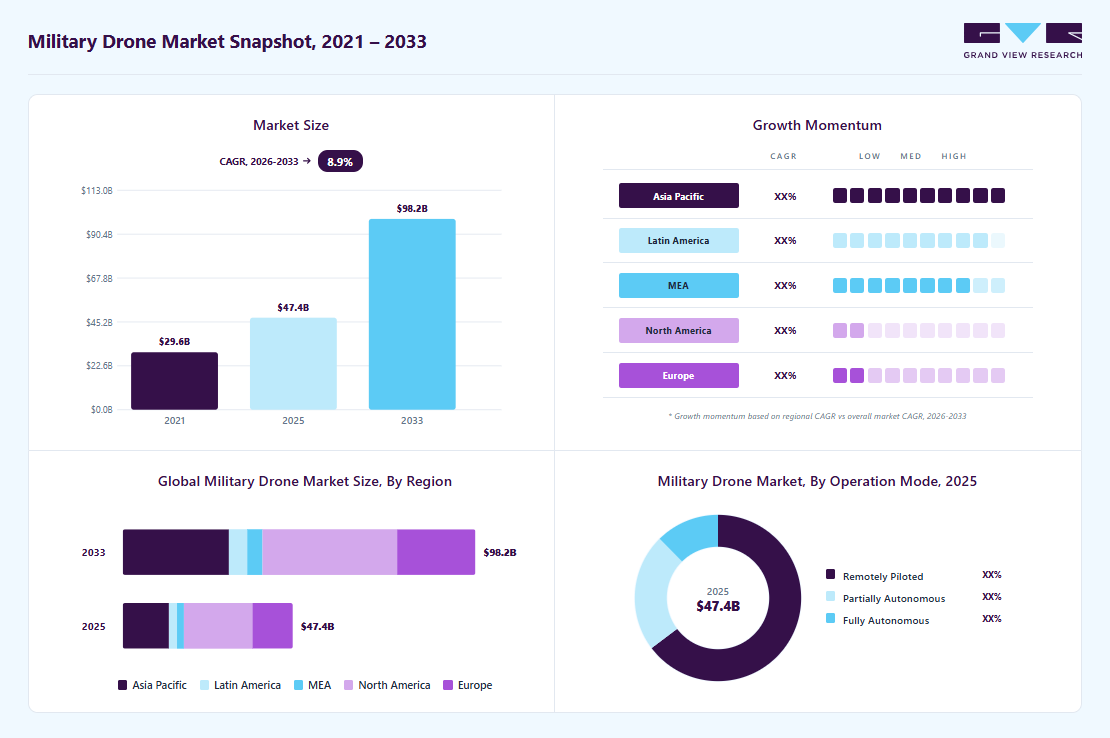
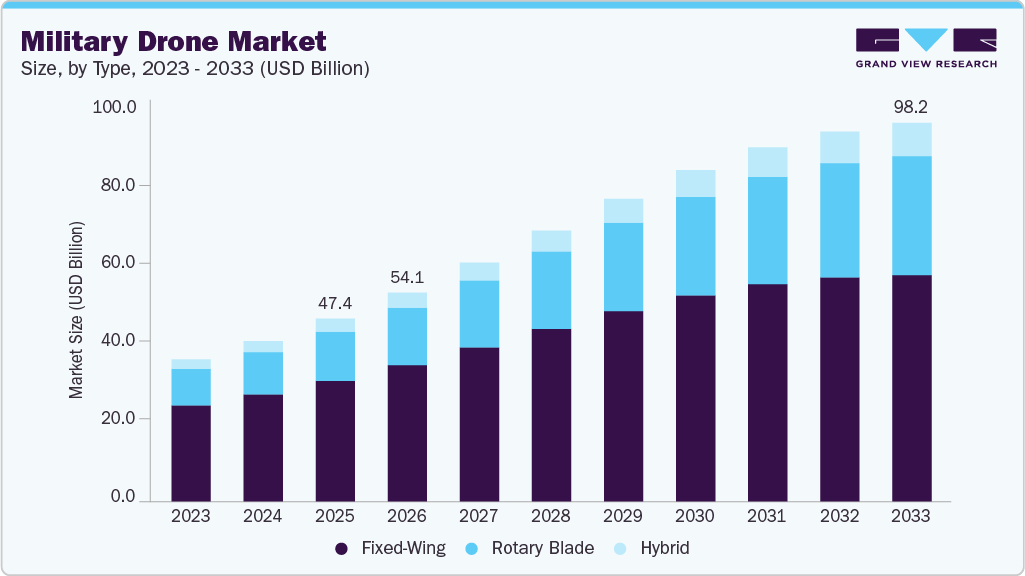
The global military drone market size was valued at USD 47.4 billion in 2025 and is projected to grow from USD 54.2 billion in 2026 to USD 98.2 billion by 2033, at a CAGR of 8.9% from 2026 to 2033. The market in North America dominated with a revenue share of 40% in 2025. The market growth is driven by rapid technological advancements in AI, machine learning, and autonomous navigation, enabling real-time decision-making and swarm operations, as well as escalating demands for border security, counterterrorism, and electronic warfare capabilities that leverage long-endurance platforms with enhanced payload capacities.
 Source: Grand View Research, IR Documents, Primary Interviews, Paid DatabasesTo learn more about this report,
 Download Free Sample Report
 Key Market Trends & Insights
- By type: Fixed-wing segment held the largest market share of 66% in 2025.
- By operation mode: Remotely piloted segment held the largest market share in 2025.
- By range: Beyond visual line of sight segment held the largest market share in 2025.
- By application: Intelligence, surveillance, and reconnaissance segment held the largest market share in 2025.
Regional Highlights
- Largest regional market: North America (40% revenue share, 2025)
- Fastest-growing regional market: Asia Pacific (highest CAGR, 2026-2033)
- By country: U.S. held the largest market share in 2025
Market Size & Forecast
- Market size in 2025: USD 47.4 Billion
- Estimated market size in 2026: USD 54.2 Billion
- Projected market size by 2033: USD 98.2 Billion
- CAGR (2026-2033): 8.9%
Three ways to get this report
Buy it, customize it, or ask a question.Ask an Analyst
Analyst response in 1 business day
- AccessReport author, directly
- Reply timeWithin 1 working day
- No sales callDirect answer only
- FormatEmail reply
- CostFree, no cost
Get the Full Report
What the study covers
- FormatsPDF · Excel · Dashboard
- Timeline2026–2033 annual, 2025 base
- Coverage20+ countries, 5 regions
- Companies10+ key players profiled
Customize the Report
20% free customization
- IncludeCountries, segments, points
- TailorTo your product definition
- ExtendDeeper competitor detail
- OrA fully bespoke study
- Turnaround5–10 working days
Rising investments from major players such as the U.S. DoD's Replicator initiative, NATO modernization programs, and partnerships between defense contractors and tech firms are accelerating R&D in stealth, 5G-enabled real-time communication, and counter-drone defenses.
The adoption of military drones is also being propelled by technological innovations that enhance operational capabilities, such as improved sensor systems, high-resolution cameras, advanced avionics, and seamless integration with real-time data networks, including 5G. These advancements enable drones to perform a variety of critical missions, including intelligence, surveillance, and reconnaissance (ISR), target acquisition, and precision strikes with increased accuracy and efficiency, thereby driving the military drone industry.
 To learn more about this report, Download Free Sample Report
 Additionally, the strategic importance of drones in modern warfare, with their ability to conduct multi-domain operations and swarm tactics, is leading to increased military procurement and modernization programs. Governments worldwide are recognizing the cost-effectiveness of unmanned systems compared to traditional manned aircraft, which motivates substantial investments to expand military drone fleets. The Asia Pacific region, particularly countries such as India and China, is experiencing rapid growth due to ongoing defense modernization initiatives and increasing regional security concerns, making it one of the fastest-growing markets for military drones in the years to come. These combined factors create a dynamic and expanding market landscape for the military drone industry.
Furthermore, the growing focus on advanced C4ISR (Command, Control, Communications, Computers, Intelligence, Surveillance, and Reconnaissance) capabilities is a critical driver reshaping modern military operations. The rapid advancement of C4ISR capabilities is transforming modern military operations by enabling seamless manned-unmanned teaming, greater situational awareness, and mission adaptability. A leading example is the U.S. Department of Defense’s Collaborative Combat Aircraft (CCA) Program, launched in 2025, which focuses on developing semi-autonomous, jet-powered drones to serve as loyal wingmen alongside manned fighters. Such factors are expected to drive the military drone industry in coming years.
Moreover, the escalating geopolitical tensions are enhancing defense budgets by prompting nations to prioritize investments in advanced military technologies, particularly in the development and deployment of sophisticated unmanned aerial systems. Countries are allocating greater portions of their GDP to defense in response to emerging threats, contested borders, and the need for technologically advanced armed forces. According to the Stockholm International Peace Research Institute (SIPRI), global military spending reached a record high in 2025, driven largely by major powers such as the U.S., China, Russia, and Germany, among others. These rising expenditures reflect traditional security challenges and the urgency to modernize militaries with cutting-edge technologies such as AI-driven C4ISR systems, autonomous drones, and hypersonic weapons.
Market Dynamics
The escalating geopolitical tensions are enhancing defense budgets by prompting nations to prioritize investments in advanced military technologies, particularly in the development and deployment of sophisticated unmanned aerial systems. Countries are allocating greater portions of their GDP to defense in response to emerging threats, contested borders, and the need for technologically advanced armed forces.
According to the Stockholm International Peace Research Institute (SIPRI), global military spending reached a record high in 2025, driven largely by major powers such as the U.S., China, Russia, and Germany. These rising expenditures reflect traditional security challenges and the urgency to modernize militaries with cutting-edge technologies such as AI-driven C4ISR systems, autonomous drones, and hypersonic weapons.
For instance, in July 2025, Defense Secretary Pete Hegseth unveiled a transformative Pentagon drone policy called “Unleashing U.S. Military Drone Dominance.” Moreover, the increasing complexity of modern warfare and rapid technological advancements have made unmanned aerial systems indispensable assets for military forces worldwide. Such initiatives are expected to drive accelerated adoption, enhanced technological advancements, and expanded operational capabilities of military drones in the coming years.
Cybersecurity and electronic warfare (EW) threats are becoming increasingly critical restraints in the military drone market, as modern UAVs rely heavily on interconnected digital systems, autonomous software, and wireless communication links. This growing digital dependency exposes drones to sophisticated cyber intrusions that can disrupt command systems, corrupt mission data, or disable operational capabilities.
The risk of hacking and system infiltration remains a major concern, as adversaries can exploit vulnerabilities in onboard software, navigation systems, or ground control interfaces to gain unauthorized access. Such breaches may lead to mission diversion, intelligence leakage, or complete loss of drone control. This has intensified the demand for advanced encryption technologies, secure firmware development, and continuous cybersecurity upgrades to maintain operational integrity in contested environments.
Electronic warfare further compounds these risks by targeting navigation and communication systems through GPS jamming, spoofing, and signal disruption techniques. In high-intensity conflict zones, drones may face degraded performance or complete operational failure if counter-EW measures are not in place. This has accelerated investments in anti-jamming technologies, autonomous navigation systems, and resilient multi-channel communication networks to ensure mission continuity even in GPS-denied or heavily contested environments.
The rapid advances in artificial intelligence and autonomous flight are revolutionizing military drones by enabling smarter navigation, more accurate target recognition, and greater mission adaptability. AI-powered swarms and obstacle-avoidance capabilities allow drones to operate effectively in contested or GPS-denied environments, opening new operational horizons. Companies investing in next-gen AI-driven drone platforms position themselves to capture emerging defense contracts.
In addition, advancements in autonomous mission execution and real-time data processing are significantly enhancing the operational efficiency of military drones. Integration of edge computing and machine learning algorithms enables drones to process battlefield data on board, reducing reliance on remote command centers and improving response times in dynamic combat scenarios. This shift toward autonomous decision-support systems is increasing demand for highly intelligent UAV platforms capable of executing complex missions.
Furthermore, the convergence of AI with advanced sensor fusion technologies is expanding the scope of multi-domain operations, allowing military drones to seamlessly coordinate with ground forces, naval units, and satellite systems. Enhanced situational awareness, predictive threat detection, and adaptive mission planning are becoming critical capabilities in modern defense strategies. These factors are expected to drive long-term growth opportunities for technology providers in the military drone market.
Market Concentration & Characteristics
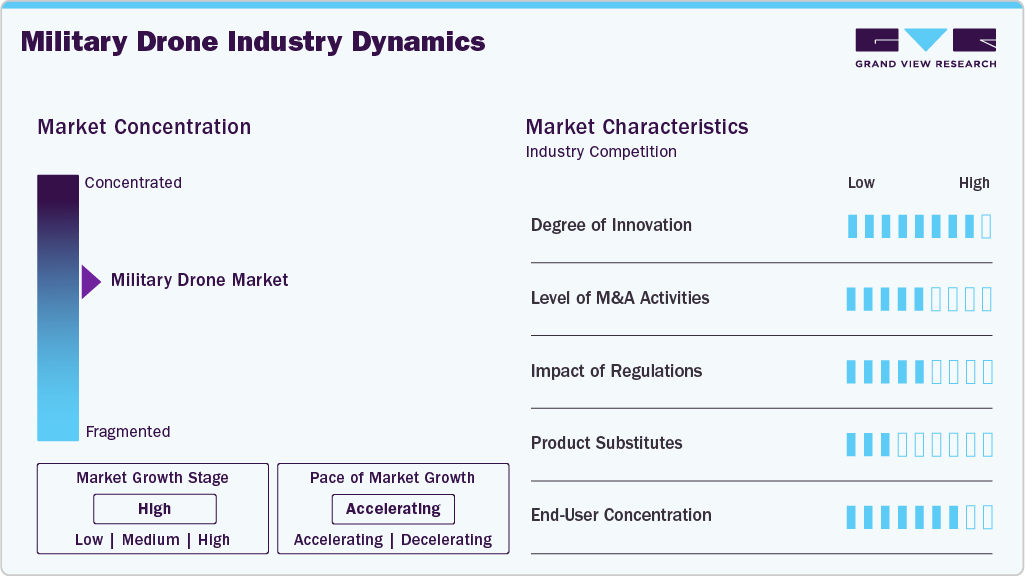
The global military drone market is moderately concentrated, with a mix of established defense contractors and emerging unmanned systems developers driving capability development and deployment. Competitive advantage is primarily determined by combat-proven reliability, autonomous mission capability, payload versatility, sensor and communication integration, and compliance with stringent defense procurement standards. The industry is experiencing rapid innovation in AI-enabled autonomy, swarm drone technologies, advanced ISR (intelligence, surveillance, reconnaissance) systems, electronic warfare resistance, long-endurance propulsion systems, and secure battlefield communication networks.
 To learn more about this report, Download Free Sample Report
 The market has limited direct substitutes, with manned military aircraft, surveillance satellites, and ground-based reconnaissance systems serving as partial alternatives depending on mission requirements and threat environments. However, regulatory and geopolitical influence remains high, as defense ministries, export control regimes, and military certification authorities strictly govern development, deployment, and cross-border transfers. Adoption is currently strong and expanding, driven by intelligence gathering, border security, tactical strike missions, and reconnaissance operations, with increasing integration into modern network-centric warfare systems as costs decline and operational doctrines evolve.
Type Insights
The fixed-wing segment dominated the market, accounting for over 66% of the market share in 2025, driven by its superior endurance, long-range capabilities, and efficiency in intelligence, surveillance, and reconnaissance (ISR) missions, which align with rising defense budgets and demand for persistent aerial coverage in contested environments. Continued investments in MALE and HALE UAV programs, along with rising border security and defense modernization initiatives, have further reinforced the dominance of fixed-wing military drones.
The hybrid segment is expected to register the fastest CAGR of 12% from 2026 to 2033, driven by its unique versatility in combining fixed-wing range with rotary-wing hover precision for vertical takeoffs and pinpoint landings, enabling multi-mission adaptability for tactical strikes, logistics resupply in rugged terrain, and urban counter-insurgency operations. This is further accelerated by breakthroughs in lightweight composite materials, high-density lithium-sulfur batteries that extend flight times by 30-50%, and AI-driven flight controls that optimize energy use in dynamic battlefields.
Operation Mode Insights
The remotely piloted segment dominated the market in 2025, driven by its proven reliability in providing real-time human oversight for high-stakes combat scenarios, precision targeting with minimal collateral damage via laser-guided munitions, and substantial risk reduction to human pilots through ground control stations, bolstered by mature satellite communication networks like Link 16, extensive training ecosystems, and widespread adoption across NATO and Indo-Pacific forces for ISR, electronic warfare, and armed overwatch roles in asymmetric conflicts.
The fully autonomous segment is expected to register the fastest CAGR from 2026 to 2033, driven by exponential progress in AI algorithms, edge computing, and machine learning for real-time object recognition and path planning, enabling scalable swarm tactics involving hundreds of low-cost drones overwhelming air defenses, independent decision-making in GPS-denied environments via inertial navigation, and resilience in high-threat zones, spurred by geopolitical flashpoints such as Ukraine and Taiwan Strait tensions alongside U.S. DoD's Replicator initiative investing billions in attritable autonomous systems.
Range Insights
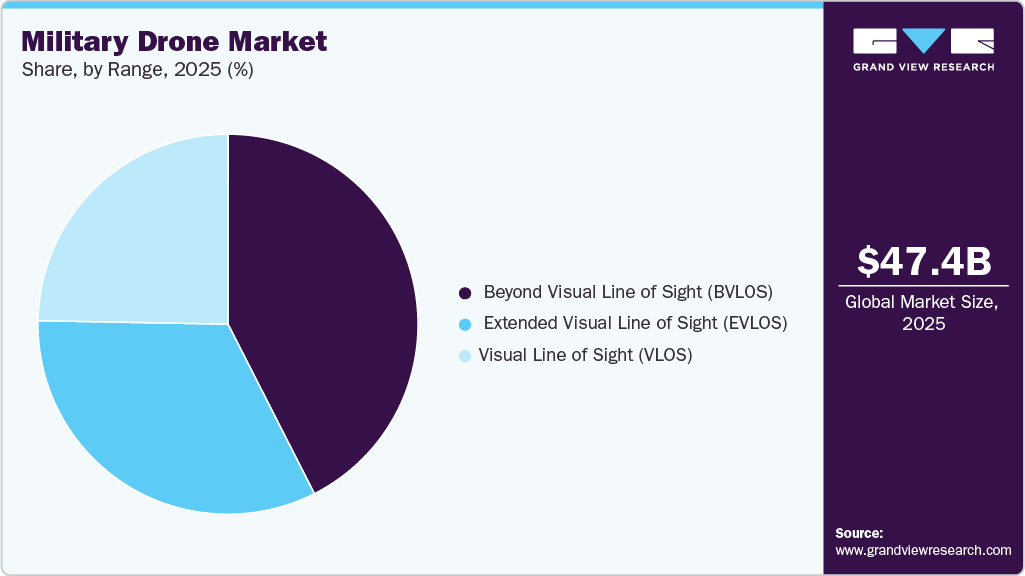
The beyond visual line of sight (BVLOS) segment dominated the market in 2025, driven by its capacity for extended operational ranges beyond 100 km using high-altitude long-endurance (HALE) designs, persistent surveillance over expansive theaters like maritime domains, and seamless integration with low-earth orbit satellite constellations for global command-and-control, addressing escalating requirements for power projection in hybrid warfare, border patrol against smuggling, and strategic deterrence amid rising investments from China, Russia, and the U.S. in networked kill chains.
 To learn more about this report, Download Free Sample Report
 The extended visual line of sight (EVLOS) segment is expected to register a significant CAGR from 2026 to 2033, driven by its lower regulatory complexity compared to BVLOS and growing use in tactical surveillance, training, and localized military operations. EVLOS offers an effective balance between operational range and control, supporting cost-efficient deployments. Increasing adoption of portable ground control systems, improved sensor integration, and networked battlefield operations is further accelerating demand for EVLOS-capable military drones.
Application Insights
The intelligence, surveillance, and reconnaissance (ISR) dominated the market in 2025, driven by rising defense investments in real-time battlefield awareness, miniaturized high-resolution sensors, and AI-enhanced data analytics for target detection and rapid decision-making. The proliferation of lightweight tactical ISR drones and enhanced swarming capabilities further propels deployment across diverse theaters. Integrated battlefield connectivity and secure C2 (command-and-control) systems reinforce operational resilience. This reflects the segment’s strategic upward trajectory and adoption in the military drone industry.
The logistics & supply segment is expected to register a significant CAGR from 2026 to 2033, driven by the growing need for efficient and rapid delivery of supplies and equipment in military operations. Military drones are increasingly being utilized for transporting critical supplies, equipment, and medical aid to remote or combat zones where traditional supply chains face challenges. Militaries seek to streamline and optimize their supply chains, the demand for drones in logistics is expected to surge, driving robust growth in this segment. The adoption of autonomous aerial cargo systems is also being accelerated by defense modernization programs worldwide.
Regional Insights
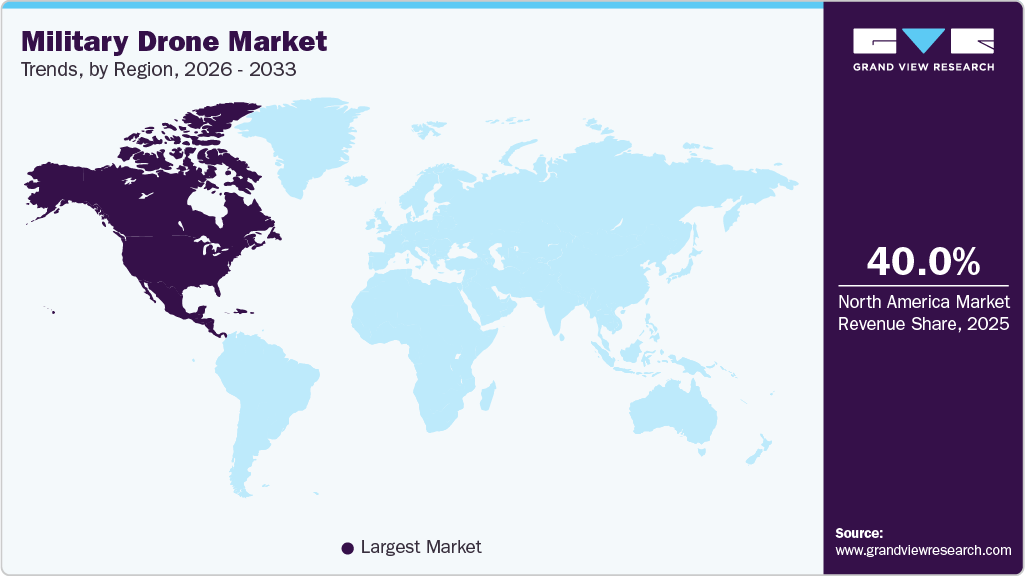
North America dominated the market with a share of over 40% in 2025, driven by the growing need for efficient and rapid delivery of supplies and equipment in military operations. Military drones are increasingly being utilized for transporting critical supplies, equipment, and medical aid to remote or combat zones where traditional supply chains face challenges. Militaries seek to streamline and optimize their supply chains, the demand for drones in logistics is expected to surge, driving robust growth in this segment. The adoption of autonomous aerial cargo systems is also being accelerated by defense modernization programs worldwide.
 To learn more about this report, Download Free Sample Report
 U.S. Military Drone Market Trends
The U.S. military drone market dominated the market with a share of 85% in 2025, driven by the growing need for efficient and rapid delivery of supplies and equipment in military operations. Military drones are increasingly being utilized for transporting critical supplies, equipment, and medical aid to remote or combat zones where traditional supply chains face challenges. Militaries seek to streamline and optimize their supply chains, the demand for drones in logistics is expected to surge, driving robust growth in this segment. The adoption of autonomous aerial cargo systems is also being accelerated by defense modernization programs worldwide.
Europe Military Drone Market Trends
The Europe military drone market accounted for a share of over 23% in 2025, driven by a strong defense modernization agenda and efforts to enhance strategic autonomy. The drivers include sustained funding and procurement for joint drone development, substantial grants for UAV research and innovation, streamlined defense procurement processes, and increased venture capital investment, fostering agile drone technologies. Cross-border drone training centers and airspace integration trials improve interoperability and operational readiness in the region. The surge in production contracts supports the market expansion of the military drone. These factors collectively fuel the region’s rapid advancement in military drone capabilities.
The Germany military drone market is expected to grow significantly in the coming years, driven by the government’s strategic focus on autonomous defense technologies and modernizing armed forces with advanced UAVs. Increasing investment in AI-driven drone systems and indigenous defense capabilities is boosting domestic development. The emphasis on real-time battlefield intelligence and enhanced situational awareness fuels demand for high-performance drones.
The UK military drone market is rapidly expanding, driven by the government’s strategic focus on autonomous defense technologies and modernizing armed forces with advanced UAVs. Increasing investment in AI-driven drone systems and indigenous defense capabilities is boosting domestic development. The emphasis on real-time battlefield intelligence and enhanced situational awareness fuels demand for high-performance drones.
Asia Pacific Military Drone Market Trends
The Asia Pacific market is expected to grow at the fastest CAGR of over 10% from 2026 to 2033, driven by rising geopolitical tensions in the Indo-Pacific region, government-led defense modernization programs, and increasing demand for advanced surveillance and reconnaissance capabilities. The adoption of UAVs with enhanced payload capacity, endurance, and autonomous operation is further propelling the market.
The China military drone market is driven by rising geopolitical tensions in the Indo-Pacific region, government-led defense modernization programs, and increasing demand for advanced surveillance and reconnaissance capabilities. The adoption of UAVs with enhanced payload capacity, endurance, and autonomous operation is further propelling the market.
The Japan military drone market is rapidly expanding, owing to the Japan's strategic emphasis on enhancing national security and defense capabilities, particularly in response to regional. The nation's advanced technological infrastructure, coupled with a strong focus on innovation, supports the development and deployment of sophisticated unmanned aerial systems (UAS).
Key Military Drone Company Insights
Some of the key players operating in the market include Northrop Grumman Corporation, and Lockheed Martin Corporation., among others.
-
Northrop Grumman Corporation provides advanced aerospace and defense technology solutions to government, military, and commercial customers worldwide. The company operates across key segments including unmanned systems, autonomous technologies, C4ISR, cybersecurity, mission systems, and space systems. Its product offerings span military aircraft, missile defense, advanced weapons, space technologies, and specialized engineering, logistics, and modernization services.
-
Lockheed Martin Corporation provides advanced technology systems, products, and services focused on aerospace and defense. The company segments its operations into areas such as aeronautics, missiles and fire control, rotary and mission systems, and space. Its product portfolio includes military aircraft, rotary-wing aircraft, airlifters, ground vehicles, missiles, radar systems, sensors, unmanned systems, and naval systems.
Shield AI Inc. and SZ DJI Technologies Co., Ltd. are some of the emerging market participants in the military drone market.
-
Shield AI is an artificial intelligence robotics company that develops autonomous AI pilots for aircraft and drones to enhance surveillance and security operations. The company primarily serves the defense and security sectors, offering intelligent systems designed to protect military personnel and civilians. Its key products include AI-powered autonomous flight systems, such as Nova, an advanced drone capable of operating in GPS-denied environments for reconnaissance and tactical missions.
-
SZ DJI Technologies Co. Ltd is a prominent manufacturer of drones and handheld imaging devices, offering solutions for aerial photography, videography, and industrial applications. The company serves various sectors, including consumer, commercial, and industrial markets such as agriculture, construction, and emergency services. Its product lineup includes popular drone models like the DJI Mini 3, Mavic 3, and Air 2S, as well as imaging devices such as the Osmo Action 3 and Ronin 4D.
Key Military Drone Companies:
The following are the leading companies in the military drone market. These companies collectively hold the largest market share and dictate industry trends.
- Northrop Grumman Corporation
- RTX Corporation
- Israel Aerospace Industries Ltd.
- General Atomics Aeronautical Systems Inc.
- Teledyne FLIR LLC
- Lockheed Martin Corporation
- Boeing
- BAE Systems plc
- Elbit Systems Ltd.
- Thales Group
- Textron Inc
- AeroVironment Inc
- Leonardo S.p.A.
- Turkish Aerospace Industries
- Insitu Inc
- Shield AI Inc.
- Baykar
- SZ DJI Technologies Co. Ltd
Competitive Benchmarking
Operating Strategies
Competitive Edge
Weaknesses
Mature Players: Northrop Grumman Corporation; Teledyne FLIR LLC; Lockheed Martin Corporation
- Focus on integrated, high-reliability drone systems with strong defense interoperability and proven operational performance
- Rely on established procurement relationships, large-scale manufacturing, and advanced payload and sensor integration
- Strong reliability and proven combat performance across diverse mission environments
- Deep integration with defense ecosystems and long-standing procurement relationships
- Slower innovation cycles due to complex legacy systems and compliance-heavy processes
- High production and development costs limiting rapid scalability and experimentation.
Emerging Players: Shield AI, Inc.; Aerovironment, Inc.; General Atomics
- Focus on AI-driven autonomy, modular designs, and rapid development for specialized mission needs
- Target niche applications like tactical surveillance, swarm systems, and low-cost deployment solutions.
- Rapid innovation capability with agile development of AI-driven and modular drone systems
- Cost efficiency enabling deployment in high-volume and niche tactical applications.
- Limited large-scale operational track record in real combat environments
- Constrained access to defense procurement channels and scaling limitations
Recent Developments
-
In November 2025, BAE Systems PLC signed a Memorandum of Understanding (MoU) with Turkish Aerospace Industries (TAI) to explore the joint development of advanced uncrewed air systems (UAS). The goal is to merge UK combat air integration expertise with Turkish drone manufacturing for next-generation joint drones for NATO and other allied fleets.
-
In July 2025, Northrop Grumman Corporation partnered with Red 6 to integrate its Advanced Tactical Augmented Reality System (ATARS) into Northrop’s Beacon autonomous mission testbed. This collaboration enables realistic virtual training environments that replicate complex, near-peer threat scenarios while reducing safety risks and airspace limitations.
-
In June 2025, General Atomics Aeronautical Systems Inc. unveiled the PELE Small UAS, a versatile, uncrewed launched effect designed for multi-mission capabilities. The PELE is tailored for international customers seeking adaptable unmanned aerial solutions. This launch underscores GA-ASI's commitment to expanding its small UAS portfolio.
Military Drone Market Report Scope
Report Attribute
Details
Market size in 2025
USD 47.4 billion
Estimated market size in 2026
USD 54.2 billion
Projected market size by 2033
USD 98.2 billion
Growth rate
CAGR of 8.9% from 2026 to 2033
Base Year of estimation
2025
Actual Data
2021 - 2024
Forecast period
2026 - 2033
Quantitative units
Revenue in USD Million/Billion and CAGR from 2026 to 2033
Report coverage
Revenue forecast, company ranking, competitive landscape, growth factors, and trends
Segments covered
Type, Operation Mode, Range, Application, Maximum Take-off Weight, End Use, Region
Regional scope
North America; Europe; Asia Pacific; Latin America; Middle East & Africa
Country scope
U.S.; Canada; Mexico; Germany; UK; France; China; Japan; India; South Korea; Australia; Brazil; UAE; Saudi Arabia; South Africa
Key companies profiled
Northrop Grumman Corporation, RTX Corporation, Israel Aerospace Industries Ltd., General Atomics Aeronautical Systems Inc., Teledyne FLIR LLC, Lockheed Martin Corporation, Boeing, BAE Systems plc, Elbit Systems Ltd., Thales Group, Textron Inc., AeroVironment Inc., Leonardo S.p.A., Turkish Aerospace Industries, Insitu Inc., Shield AI Inc., Baykar, and SZ DJI Technologies Co. Ltd
Customization scope
Free report customization (equivalent up to 8 analysts working days) with purchase. Addition or alteration to country, regional & segment scope.
Global Military Drone Market Report Segmentation
This report forecasts revenue growth at global, regional, and country levels and provides an analysis of the latest industry trends in each of the sub-segments from 2021 to 2033. For this study, Grand View Research has segmented the global military drone market report based on type, operation mode, range, application, maximum take-off weight, end use, and region.
-
Type Outlook (Revenue, USD Million, 2021 - 2033)
-
Fixed-Wing
-
Rotary Blade
-
Hybrid
-
-
Operation Mode Outlook (Revenue, USD Million, 2021 - 2033)
-
Remotely Piloted
-
Partially Autonomous
-
Fully Autonomous
-
-
Range Outlook (Revenue, USD Million, 2021 - 2033)
-
Visual Line of Sight (VLOS)
-
Extended Visual Line of Sight (EVLOS)
-
Beyond Visual Line of Sight (BVLOS)
-
-
Application Outlook (Revenue, USD Million, 2021 - 2033)
-
Intelligence, Surveillance and Reconnaissance (ISR)
-
Logistics & Supply
-
Others
-
-
Maximum Take-off Weight Outlook (Revenue, USD Million, 2021 - 2033)
-
<150 Kg
-
150 - 1000 Kg
-
>1000 Kg
-
-
End Use Outlook (Revenue, USD Million, 2021 - 2033)
-
Air Force
-
Army
-
Navy
-
-
Regional Outlook (Revenue, USD Million, 2021 - 2033)
-
North America
-
U.S.
-
Canada
-
Mexico
-
-
Europe
-
Germany
-
UK
-
France
-
-
Asia Pacific
-
China
-
Japan
-
India
-
South Korea
-
Australia
-
-
Latin America
-
Brazil
-
-
Middle East and Africa (MEA)
-
UAE
-
Saudi Arabia
-
South Africa
-
-
Delivered Customizations
This report has been delivered with the following In-depth customizations
Client Objective
Custom Research Modules Delivered
Strategic Value / Business Impact
Product Positioning & Competitive Intelligence
- Benchmarking military drones for autonomy, surveillance, and mission integration
- Analysis of defense procurement, pricing, and operational strategies
- Study of adoption trends, mission effectiveness, and military acceptance
- Evaluation of competitor strategies in UAV design and interoperability
- Improved differentiation via route optimization, efficiency, and mission-specific use cases
- Aligned pricing models with flight-hour economics and subscription services
- Identified gaps in airspace integration, regulation, and real-time systems
- Strengthened positioning through scalable deployment models
Technology & Innovation Assessment
- Analysis of trends in AI, autonomous navigation, sensors, and propulsion
- Review of defense R&D, innovation pipelines, and patents
- Assessment of deployment readiness across regulation and infrastructure
- Mapping of partnerships across defense and technology stakeholders
- Identified growth opportunities in surveillance, combat, and reconnaissance drones
- Supported innovation roadmaps for next-generation military UAVs
- Evaluated deployment potential through compliance and operational viability
- Strengthened strategic collaborations through ecosystem analysis
Frequently Asked Questions About This Report
The military drone market in North America accounted for a significant revenue share of over 39% in 2025. The region's focus on technological innovation, strategic defense initiatives, and the modernization of military assets have driven high demand and market growth for military drones.
Some key players operating in the military drone market include AeroVironment, Inc., Elbit Systems Ltd., Lockheed Martin Corporation, Nothrop Grumman Corporation, RTX Corporation, Shield AI, SZ DJI Technologies Co. Ltd., Teal Drones, Inc., Thales Group, The Boring Company
Key factors that are driving military drone market growth include rapid technological advancements, growing trend towards the adoption of autonomous and semi-autonomous drone systems in military operations, and an increased focus on developing counter-drone technologies.
Asia Pacific is the fastest-growing region over the forecast period.
The fixed-wing segment led with a 66% revenue share in 2025, while the hybrid segment is the fastest-growing.
The remotely piloted segment held the largest revenue share in 2025, while the fully autonomous segment is the fastest-growing.
The global military drone market size was estimated at USD 47.4 billion in 2025 and is expected to reach USD 41.6 billion in 2026.
The global military drone market is expected to grow at a compound annual growth rate of 9.2% from 2026 to 2033 to reach USD 77.3 billion by 2033.
About the Author(s)
Next Generation Technologies Research Team
Technology · Next Generation TechnologiesThis report was authored by the next generation technologies research team at Grand View Research - comprising two research analysts, one senior research analyst, and one industry expert - with specialized expertise in the next generation technologies segment of the technology industry. All findings are based on proprietary technology databases, executive interviews, and regulatory analysis, subject to internal peer review prior to publication.
Last Updated:
Speak to Analyst

Customize this report to your needs - add regions, segments, or data points, with 20% free customization.
Or view our licence options:


ISO 9001:2015 & 27001:2022 Certified
We are GDPR and CCPA compliant! Your transaction & personal information is safe and secure. For more details, please read our privacy policy.


