
- Home
- »
- Advanced Interior Materials
- »
-
Dry Mix Mortar Market Size And Share Report, 2026-2033GVR Report cover

Dry Mix Mortar Market (2026 - 2033)
Size, Share & Trends Analysis Report By Product Type (Cement-based Mortar, Gypsum-based Mortar, Polymer-modified Mortar), By Application (Plaster, Tile Adhesive, Render), By End Use (Residential), By Region, And Segment Forecasts
Market Size, 2025
$55.0BMarket Estimate, 2026
$57.9BMarket Forecast, 2033
$83.1BCAGR, 2026–2033
5.3%Dry Mix Mortar Market Summary
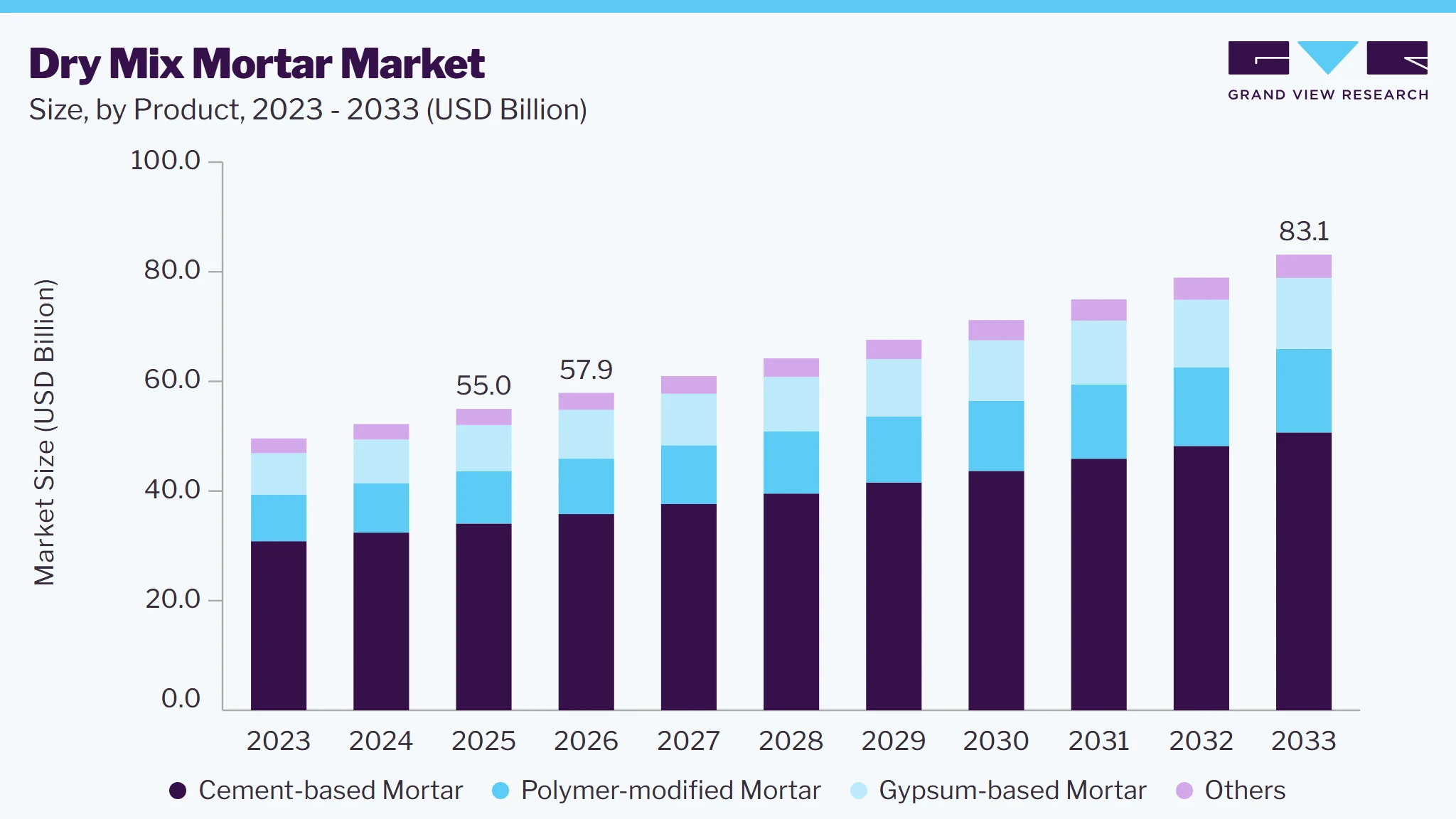
The global dry mix mortar market size was valued at USD 55.0 billion in 2025 and is projected to grow from USD 57.9 billion in 2026 to USD 83.1 billion by 2033, at a CAGR of 5.3% from 2026 to 2033. Asia Pacific dominated the dry mix mortar market with the largest revenue share of 46.7% in 2025. The dry mix mortar market is witnessing increasing demand due to the expansion of residential, commercial, and infrastructure construction activities.
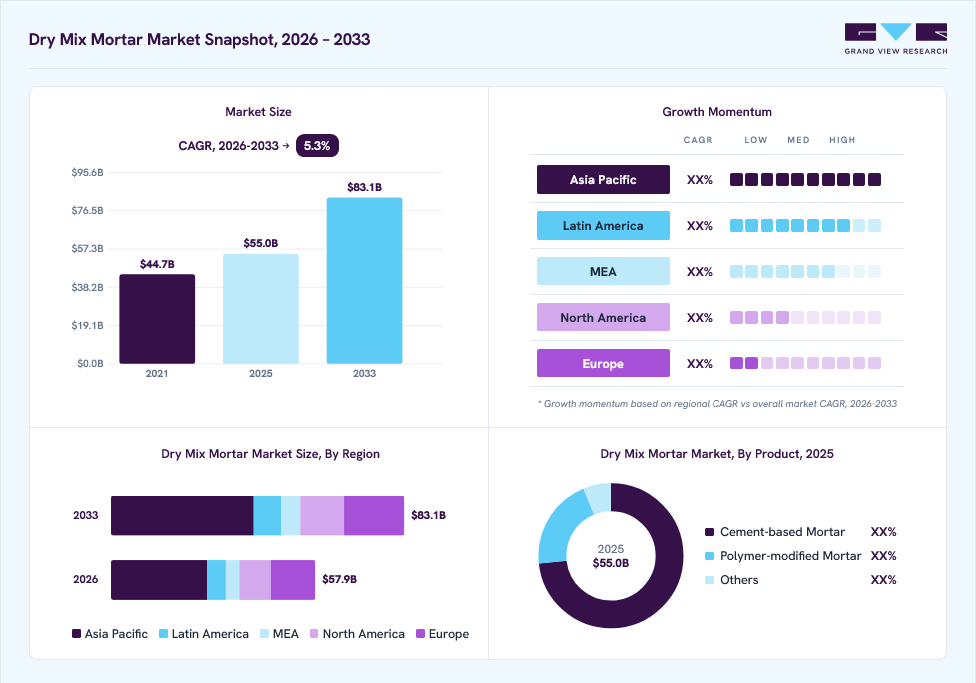 Source: Grand View Research, IR Documents, Primary Interviews, Paid DatabasesTo learn more about this report,
 Download Free Sample Report
Key Market Trends & Insights
- By product type: Cement-based mortar segment held the highest revenue share of is 62.0% in 2025.
- By application: Plaster segment dominated the market with a revenue share of 33.2% in 2025.
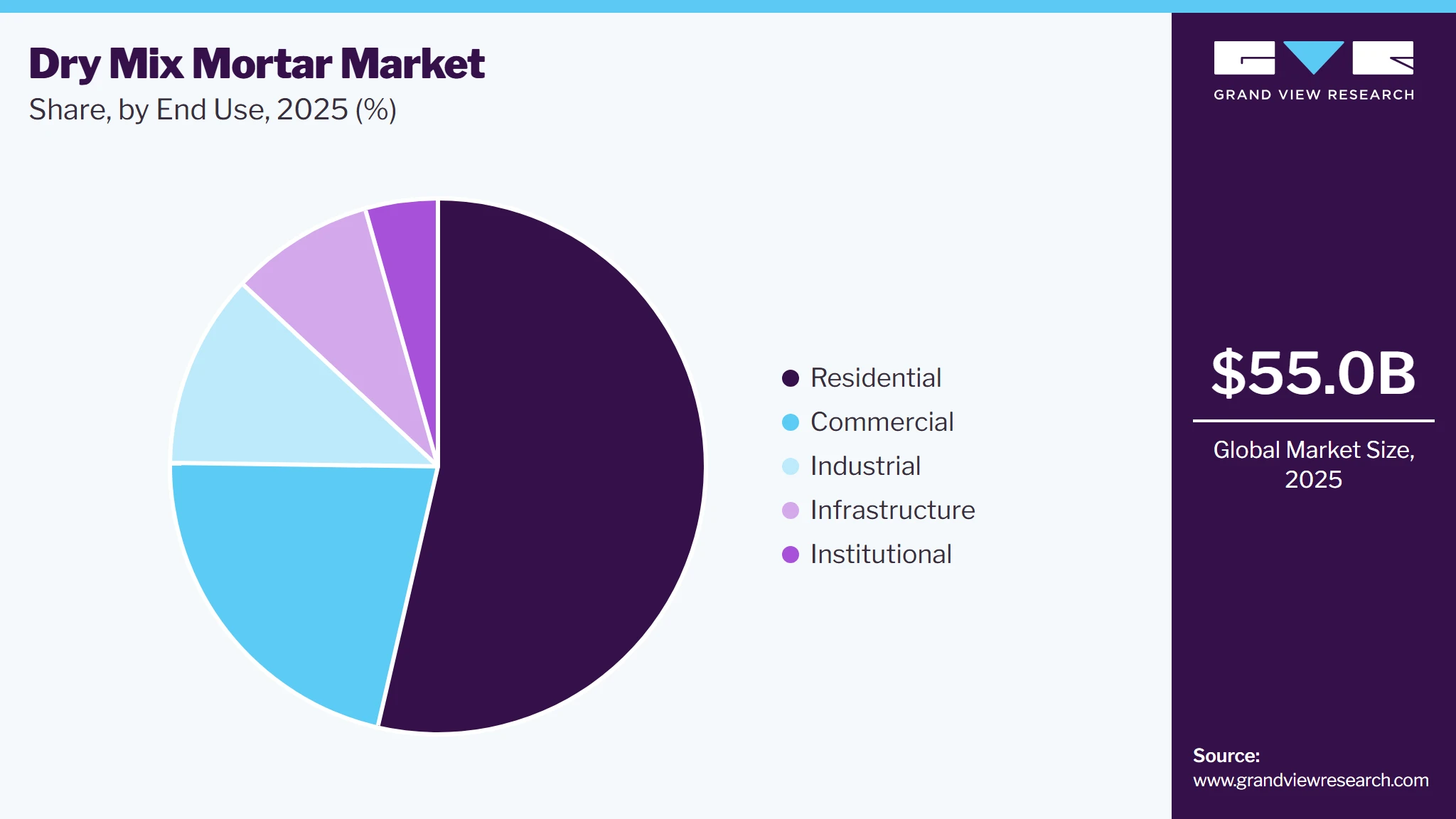
- By end use: Residential segment held the highest revenue market share of 53.6% in 2025.
Regional Highlights
- Largest regional market: Asia Pacific (46.7% revenue share, 2025)
- China held the largest market share in 2025
Market Size & Forecast
- Market Size in 2025: USD 55.0 Billion
- Estimated Market Size in 2026: USD 57.9 Billion
- Projected Market Size by 2033: USD 83.1 Billion
- CAGR (2026-2033): 5.3%
GVR research-powered AIAsk Prism AI about the dry mix mortar marketGet cited answers from GVR research on market growth, segments, regulations and forecasts.Start with✓ Source-linked answers ✓ Market-specific context ✓ Traceable figuresExplore Prism AI ↗
Growing urbanization is increasing the need for faster and more efficient construction methods, particularly in developing economies. Pre-mixed mortar products reduce on-site preparation requirements and provide greater consistency in material quality and application.The growing construction of residential buildings, commercial facilities, and infrastructure projects is a major driver for dry mix mortar demand. Increasing labor costs and shortages of skilled construction workers are encouraging contractors to adopt products that require less manual preparation. Factory-controlled production enables manufacturers to provide consistent formulations with controlled cement, sand, additives, and performance-enhancing chemicals. Demand is also rising for specialized mortars offering improved adhesion, water resistance, durability, flexibility, and workability.
 To learn more about this report, Download Free Sample Report
Government investments in housing, transportation, urban development, and infrastructure are supporting construction activity and indirectly increasing demand for dry mix mortar. Building codes and construction standards increasingly emphasize structural durability, energy efficiency, fire performance, and material quality. Green building initiatives are encouraging manufacturers to develop mortars with lower environmental impact and improved resource efficiency. Governments are also promoting standardized and industrialized construction practices to improve building quality and reduce construction waste. Regulations covering cementitious materials, construction chemicals, worker safety, and building performance are influencing product formulation and manufacturing processes.
Market Dynamics
The dry mix mortar market is experiencing increasing demand as construction companies, contractors, and developers shift toward faster, more efficient, and standardized construction practices. Growing urbanization, infrastructure development, residential construction, and renovation activities are encouraging the replacement of conventional site-mixed mortar with factory-produced dry formulations. Dry mix mortar provides consistent material quality, reduces on-site preparation requirements, minimizes material wastage, and improves application efficiency. Demand is expanding across masonry, plastering, flooring, tile installation, repair, waterproofing, insulation, and other construction applications.
The growing emphasis on construction productivity, consistent quality, and reduced labor requirements is a major driver for the dry mix mortar market. Contractors and construction companies are increasingly adopting factory-produced mortar products to reduce mixing time, improve material consistency, and simplify on-site operations. Rising labor costs and shortages of skilled construction workers are further encouraging the use of ready-to-use dry formulations. Increasing construction activity across residential, commercial, and infrastructure projects is also creating sustained demand for specialized mortar products.
Increasing adoption of application-specific and high-performance construction materials is further strengthening market growth. Manufacturers are developing polymer-modified, rapid-setting, waterproof, self-leveling, fiber-reinforced, and high-adhesion mortar formulations for specific construction requirements. Growing demand for energy-efficient buildings, advanced façade systems, tile installation, and renovation applications is encouraging the use of specialized dry mix products. Automation in mortar production and improvements in additive technology are also enabling manufacturers to provide more consistent and performance-oriented solutions.
High transportation and logistics costs remain key restraints for the dry mix mortar market because the products are relatively bulky and require efficient distribution networks. Transportation over long distances can increase product costs and reduce competitiveness against locally sourced materials. Conventional site-mixed mortar also remains widely used in price-sensitive and less organized construction markets because contractors can adjust formulations according to project requirements and use locally available raw materials. Limited awareness and adoption of standardized construction materials in developing markets can further restrict market penetration.
The development of low-carbon, sustainable, and high-performance dry mortar formulations presents significant opportunities for the market. Manufacturers can incorporate supplementary cementitious materials, recycled inputs, alternative binders, and advanced chemical additives to reduce environmental impact while maintaining product performance. Growing demand for energy-efficient buildings and green construction is creating opportunities for specialized mortars designed for insulation systems, façades, waterproofing, and renovation. Advances in automated production, digital quality control, and application-specific formulations can further improve manufacturing efficiency and product performance.
Market Concentration & Characteristics
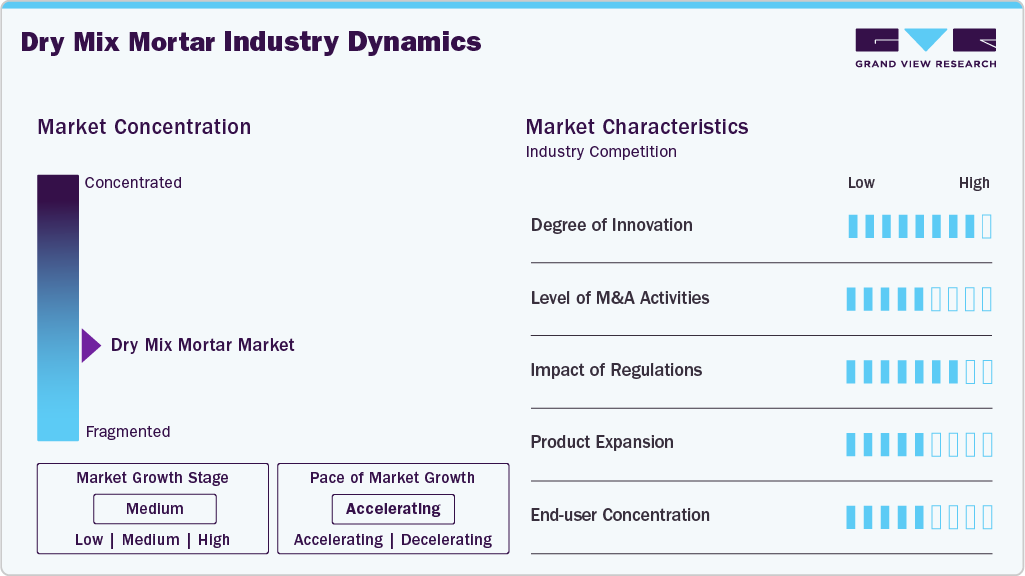
The dry mix mortar market is characterized by a combination of large multinational construction-material manufacturers and regional producers serving localized construction markets. Large companies benefit from established distribution networks, technical expertise, broad product portfolios, and strong relationships with construction contractors and developers. Regional manufacturers compete through proximity to customers, customized formulations, competitive pricing, and knowledge of local construction practices. The market remains relatively fragmented in several developing regions because transportation costs and the availability of local raw materials encourage localized production.
 To learn more about this report, Download Free Sample Report
Traditional site-mixed mortar remains the primary substitute for factory-produced dry mix mortar, particularly in price-sensitive and less organized construction markets. Site mixing can provide contractors with greater flexibility in adjusting material proportions according to project requirements. However, inconsistent batching, material wastage, labor requirements, and variable product quality can limit its suitability for large-scale and quality-sensitive projects. Ready-mixed and other specialized construction materials can also substitute for dry mortar in selected applications. The increasing emphasis on construction productivity, quality control, and standardized material performance reduces the attractiveness of conventional site mixing.
Analyst Perspective
The dry mix mortar market is positioned for steady growth as construction practices increasingly shift toward standardized, efficient, and application-specific building materials. Demand is being supported by urbanization, infrastructure development, renovation activities, rising labor costs, and the need to reduce on-site material wastage. Product innovation is moving beyond conventional mortar toward polymer-modified, rapid-setting, waterproof, self-leveling, and low-carbon formulations, creating opportunities for manufacturers to differentiate through performance and sustainability. Adoption is expected to remain strongest in regions with organized construction sectors and higher use of modern building systems, while price sensitivity and competition from site-mixed mortar may limit penetration in less developed markets.
Product Type Insights
The cement-based mortar segment held the highest revenue share of 62.0% in 2025, supported by its widespread use across residential, commercial, and infrastructure construction. Its established application in masonry, plastering, flooring, and repair activities, combined with broad availability of raw materials and compatibility with conventional construction practices, continues to sustain demand. Cement-based mortars also benefit from their durability, strength, and cost-effectiveness, making them a preferred choice for large-scale construction projects.
The polymer-modified mortar segment is expected to grow at a CAGR of 6.0% over the forecast period, as construction projects increasingly require materials offering enhanced adhesion, flexibility, water resistance, and durability. Polymer additives improve the performance of conventional mortar and enable its use in demanding applications such as tile installation, façade systems, waterproofing, and repair works. Growing adoption of advanced construction materials and increasing emphasis on long-lasting building solutions are expected to support segment expansion.
Application Insights
The plaster segment held the highest revenue market share of 33.2% in 2025, due to its extensive use for finishing and protecting walls and ceilings across residential, commercial, and institutional buildings. Dry mix plaster products provide consistent composition, easier application, reduced material wastage, and improved surface quality compared with manually prepared mixtures. Rising construction and renovation activities, along with demand for efficient finishing solutions, continue to support the strong position of plaster applications.
The tile adhesive segment is expected to grow at a CAGR of 5.6% over the forecast period, with increasing adoption of ceramic, porcelain, stone, and large-format tiles in residential and commercial construction. Dry mix tile adhesives offer improved bonding strength, workability, and application consistency while reducing installation time and material wastage. The expansion of modern flooring and wall-covering applications, particularly in renovation, hospitality, retail, and high-end residential projects, is expected to further drive demand.
End Use Insights
The residential segment held the highest revenue market share of 53.6% in 2025, supported by sustained demand for dry mix mortar in new housing construction, renovation, refurbishment, plastering, masonry, flooring, and tile installation. Increasing urbanization, housing development, and consumer preference for higher-quality interior and exterior finishes are encouraging the use of factory-produced mortar solutions. The segment also benefits from the convenience, consistent quality, and reduced labor requirements associated with ready-to-use dry mix products.
 To learn more about this report, Download Free Sample Report
The commercial segment is expected to grow at a CAGR of 6.0% over the forecast period, driven by increasing construction of offices, retail spaces, hotels, healthcare facilities, and other commercial buildings. Rising demand for durable finishes, efficient installation, and consistent construction quality is encouraging the adoption of dry mix mortar solutions in commercial projects.
Regional Insights
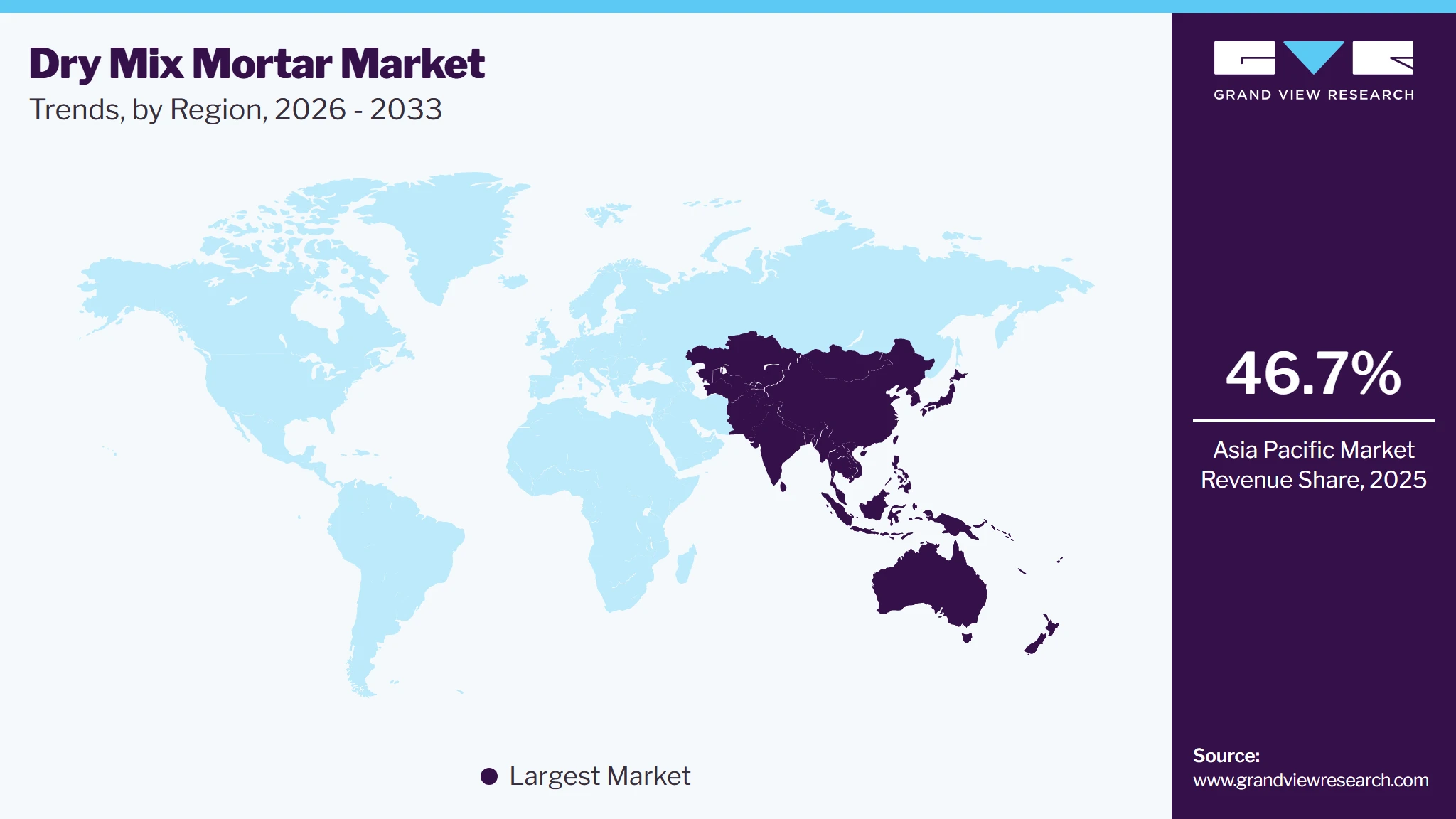
Asia Pacific dominated the global dry mix mortar market and accounted for the largest revenue share of 46.7% in 2025, due to rapid urbanization, infrastructure development, and residential construction. China, India, Southeast Asia, and other developing economies are witnessing increasing construction activity and modernization of building practices. Growing adoption of organized construction methods is encouraging the replacement of manually prepared mortar with factory-produced alternatives. Infrastructure investments and expanding housing requirements are creating demand across masonry, plastering, flooring, tiling, and repair applications.
 To learn more about this report, Download Free Sample Report
China Dry Mix Mortar Market Trends
China remains an important market due to its large construction sector, infrastructure development, renovation activities, and increasing adoption of modern building materials. Demand is supported by commercial construction, residential refurbishment, transportation infrastructure, and urban redevelopment projects. The transition toward more standardized construction practices is encouraging the use of factory-produced mortar solutions. Manufacturers are increasingly focusing on energy-efficient, environmentally improved, and application-specific mortar products. Automation and advanced manufacturing processes are also gaining importance among larger producers.
North America Dry Mix Mortar Market Trends
North America is supported by residential construction, commercial development, infrastructure modernization, and building renovation activities. Demand is particularly influenced by the need for high-performance materials that improve construction efficiency and building durability. Specialized products for tile installation, masonry, repair, flooring, and façade applications are gaining importance. Manufacturers are increasingly emphasizing low-emission formulations, improved workability, and sustainable raw materials. The presence of established construction-material suppliers provides strong distribution and technical support capabilities.
The U.S. dry mix mortar market benefits from residential construction, commercial projects, infrastructure upgrades, and renovation activities. Contractors increasingly value products that provide consistent performance while reducing preparation time and labor requirements. Demand is supported by tile adhesives, repair mortars, grouts, masonry products, flooring compounds, and specialized construction applications. Sustainability requirements are encouraging manufacturers to develop lower-impact formulations and improve manufacturing efficiency. Product certification, building standards, and performance requirements influence product development and market adoption.
Europe Dry Mix Mortar Market Trends
Europe represents a mature market characterized by strong adoption of standardized construction materials and advanced building practices. Renovation of aging buildings and improvements in building energy performance are major sources of demand for specialized mortar products. The region's emphasis on resource efficiency and lower-carbon construction is encouraging manufacturers to improve product formulations. Demand is increasing for lightweight, insulating, repair, waterproofing, and high-performance mortar systems. Strict construction standards and sustainability requirements influence raw material selection and manufacturing processes.
Germany has a well-established construction-materials industry supported by renovation, infrastructure development, and energy-efficient building upgrades. Demand for dry mix mortar is supported by plastering, masonry, tile installation, flooring, repair, and insulation applications. The country's focus on building efficiency is encouraging the use of specialized products compatible with modern insulation and façade systems. Manufacturers are increasingly developing formulations that reduce material consumption while improving durability and application performance. Automation and quality-controlled production are relevant to maintaining consistent product specifications.
Central & South America Dry Mix Mortar Market Trends
Central and South America is supported by residential construction, urbanization, infrastructure development, and increasing housing requirements. Growing construction activity is encouraging greater use of standardized building materials in major urban centers. Dry mix mortar adoption is increasing as contractors seek improved productivity and more consistent material performance. Demand is particularly relevant for masonry, plastering, tile adhesives, flooring, and repair applications. Local manufacturers benefit from access to regional raw materials and established distribution networks.
Middle East & Africa Dry Mix Mortar Market Trends
The Middle East & Africa market is supported by infrastructure development, urban expansion, commercial construction, housing projects, and large-scale development programs. Demand for dry mix mortar is particularly relevant to masonry, plastering, tile installation, flooring, repair, and façade applications. Harsh climatic conditions increase the need for products offering improved durability, water resistance, adhesion, and thermal performance. Major construction projects are encouraging the adoption of standardized materials capable of meeting demanding quality requirements.
Key Dry Mix Mortar Company Insights
-
Saint-Gobain is a global building-materials company focused on light and sustainable construction solutions for residential, non-residential, and infrastructure markets. Its portfolio includes construction materials, insulation, plasterboard, construction chemicals, mortars, and façade solutions, with brands such as Weber and Fosroc strengthening its presence in construction chemicals and dry-mix solutions.
-
MAPEI is an Italian multinational manufacturer of chemical products and specialized solutions for the construction industry. Its portfolio covers tile adhesives, renders, bedding mortars, skim coats, flooring systems, waterproofing, concrete repair, thermal insulation, and cement additives, making it a significant player in dry mix mortar and related construction-material applications.
Pidilite Industries and Fosroc International are some of the emerging market participants in the dry mix mortar market.
-
Pidilite Industries is an Indian manufacturer of adhesives, construction chemicals, waterproofing, tile and stone fixing, maintenance, and repair products. Through brands such as Dr. Fixit and Roff, the company serves residential and commercial construction applications, including waterproofing, tile installation, grouting, and repair solutions.
-
Fosroc is a global manufacturer of high-performance construction chemicals and materials, with particular expertise in concrete and cement-related applications. Its portfolio includes concrete repair, adhesives, waterproofing, grouts, cement additives, protective coatings, and related construction solutions, supported by a broad international manufacturing and distribution network.
Key Dry Mix Mortar Companies
The following key companies have been profiled for this study on the dry mix mortar market.
-
Saint-Gobain
-
Mapei S.p.A.
-
Holcim
-
Ardex Group
-
Knauf Group
-
Bostik
-
Fosroc International
-
Pidilite Industries
-
MYK Laticrete
-
Quikrete Holdings
Competitive Benchmarking
Category
Operating Strategies
Competitive Edge
Weakness
Established Players (Saint-Gobain, Mapei S.p.A., Holcim, Ardex Group, Knauf Group, Bostik)
- Invest in advanced dry mix mortar formulations, construction chemicals, and application-specific products to improve adhesion, durability, workability, setting time, and water resistance.
- Expand production capacity and geographic reach through new manufacturing facilities, acquisitions, distribution networks, and partnerships with contractors, distributors, and construction companies.
- Strengthen sustainability initiatives through low-carbon formulations, alternative raw materials, reduced packaging, energy-efficient manufacturing, and products designed for green building applications.
- Strong global presence, extensive product portfolios, and established expertise across dry mortars, tile adhesives, renders, plasters, grouts, repair mortars, flooring, and waterproofing systems.
- Established relationships with contractors, developers, architects, distributors, and construction-material retailers support broad market access.
- Significant investment in R&D, manufacturing automation, technical support, and product certification provides a strong competitive position.
- Large-scale operations can result in higher manufacturing and distribution costs compared with smaller regional producers.
- Complex global supply chains and extensive product portfolios can make rapid customization for highly localized construction requirements more difficult.
- Dependence on cement, aggregates, chemical additives, and other raw materials exposes companies to fluctuations in input costs and supply conditions.
Emerging / Regional Players (Fosroc International, Pidilite Industries, MYK Laticrete, Quikrete Holdings)
- Focus on expanding specialized mortar and construction-chemical portfolios for tile installation, repair, waterproofing, flooring, masonry, plastering, and other high-value applications.
- Expand market presence through partnerships with contractors, distributors, construction companies, architects, and infrastructure developers, particularly in high-growth regional markets.
- Develop application-specific and performance-oriented formulations that address local climatic conditions, construction practices, labor requirements, and sustainability needs.
- Strong specialization in construction chemicals, tile adhesives, repair mortars, grouts, waterproofing products, and other specialized dry mix solutions.
- Greater operational flexibility and strong regional market knowledge enable faster adaptation to customer requirements and local construction practices.
- Well-positioned to benefit from increasing demand for standardized construction materials, renovation, infrastructure development, and higher-performance mortar systems.
- Smaller geographic reach and production scale compared with the largest multinational construction-material manufacturers.
- Greater dependence on regional construction cycles, distributor networks, raw material availability, and project-based demand can affect market expansion.
- Competition from established global brands and low-cost local site-mixed mortar producers can create pricing and market penetration challenges.
Recent Developments
-
In May 2025, Saint-Gobain launched the FutuRE sustainable construction program in Indonesia, including Weber and Mortar Utama products with mortars incorporating recycled materials.
-
In March 2026, Holcim agreed to acquire Cemex's building-materials and solutions operations in Colombia, adding more than 20 sites, including mortars and admixtures plants.
Dry Mix Mortar Market Report Scope
Report Attribute
Details
Market size in 2025
USD 55.0 billion
Estimated market size in 2026
USD 57.9 billion
Projected market size by 2033
USD 83.1 billion
Growth rate
CAGR of 5.3% from 2026 to 2033
Base year for estimation
2025
Actual estimates/Historical data
2021 - 2024
Forecast period
2026 - 2033
Quantitative units
Revenue in USD billion and CAGR from 2026 to 2033
Report coverage
Revenue forecast, company ranking, competitive landscape, growth factors, and trends
Segments covered
Product type, application, end use, and region
Regional scope
North America; Asia Pacific; Europe; CSA; MEA
Country scope
U.S., Canada, Mexico, Germany, UK, France, Italy, Spain, China, Japan, India, South Korea, Brazil, Saudi Arabia
Key companies profiled
Saint-Gobain, Mapei S.p.A., Holcim, Ardex Group, Knauf Group, Bostik, Fosroc International, Pidilite Industries, MYK Laticrete, Quikrete Holdings
Customization scope
Free report customization (equivalent up to 8 analysts working days) with purchase. Addition or alteration to country, regional & segment scope.
Pricing and purchase options
Avail customized purchase options to meet your exact research needs. Explore purchase options
Global Dry Mix Mortar Market Report Segmentation
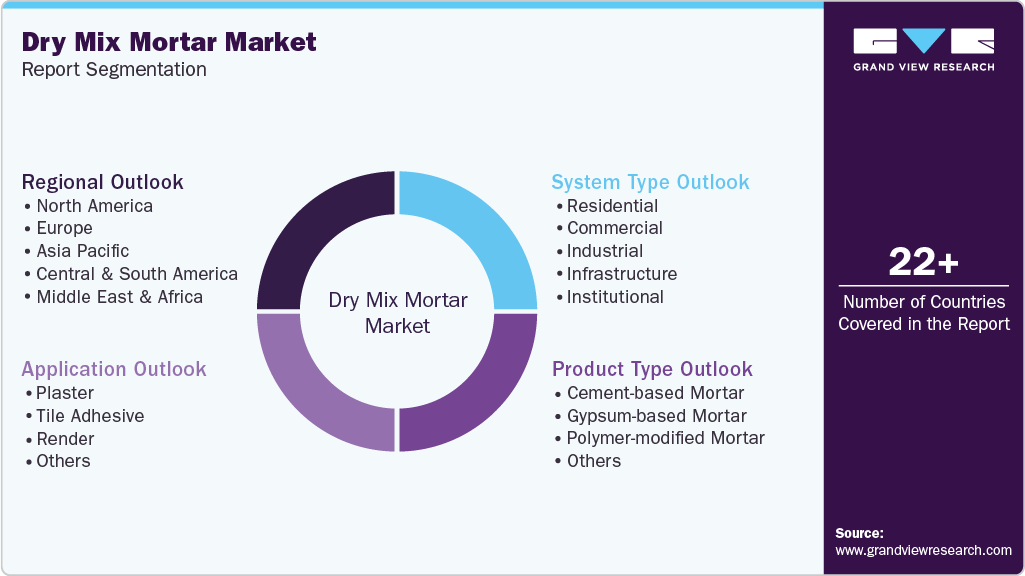
This report forecasts revenue growth at regional & country levels and provides an analysis on the industry trends in each of the sub-segments from 2021 to 2033. For this study, Grand View Research has segmented the global dry mix mortar market on the basis of product type, application, end use, and region:
 To learn more about this report, Download Free Sample Report
-
Product Type Outlook (Revenue, USD Million, 2021 - 2033)
-
Cement-based Mortar
-
Gypsum-based Mortar
-
Polymer-modified Mortar
-
Others
-
-
Application Outlook (Revenue, USD Million, 2021 - 2033)
-
Plaster
-
Tile Adhesive
-
Render
-
Others
-
-
End Use Outlook (Revenue, USD Million, 2021 - 2033)
-
Residential
-
Commercial
-
Industrial
-
Infrastructure
-
Institutional
-
-
Regional Outlook (Revenue, USD Million, 2021 - 2033)
-
North America
-
U.S.
-
Canada
-
Mexico
-
-
Europe
-
UK
-
Germany
-
France
-
Italy
-
Spain
-
-
Asia Pacific
-
China
-
Japan
-
India
-
South Korea
-
-
Central and South America
-
Brazil
-
-
Middle East and Africa
-
Saudi Arabia
-
-
Research Methodology
The dry mix mortar market figures in this report are based on a proven research process that combines executive interviews with secondary research from proprietary databases, company filings, and recognized regulatory and institutional sources. Market size is built through value-chain sizing - reconciling supply-side and demand-side estimates - and triangulated with bottom-up and top-down approaches. Every estimate passes multiple levels of expert validation before publication, with each dry mix mortar segment quantified using the revenue-capture definitions in the table below.
Segment Definition
Segment - Product Type
Revenue capture definition
Cement-based Mortar
Revenue generated from the sale of dry mix mortars primarily formulated with cement as the binding material, used for masonry, plastering, rendering, repair, and other general construction applications.
Gypsum-based Mortar
Revenue generated from the sale of gypsum-based dry mix mortars used primarily for interior plastering, wall finishing, surface leveling, and related indoor construction applications.
Polymer-modified Mortar
Revenue generated from the sale of dry mix mortars incorporating polymer additives to enhance adhesion, flexibility, water resistance, durability, workability, and other performance characteristics, including products used for tile installation, repair, waterproofing, and specialized construction applications.
Others
Revenue generated from the sale of other dry mix mortar formulations not classified under cement-based, gypsum-based, or polymer-modified mortar, including specialized, lime-based, and application-specific formulations.
Segment - Application
Revenue capture definition
Plaster
Revenue generated from the sale of dry mix mortar used for applying protective and finishing layers to interior and exterior walls and ceilings, including products designed for surface leveling, smooth finishing, and improved adhesion.
Tile Adhesive
Revenue generated from the sale of dry mix mortar formulated for fixing ceramic, porcelain, stone, and other tiles to floors and walls, including standard and high-performance adhesive formulations.
Render
Revenue generated from the sale of dry mix mortar used as exterior or interior rendering layers to provide surface protection, weather resistance, durability, and decorative finishes on building façades and walls.
Others
Revenue generated from the sale of dry mix mortar used in other applications, including masonry, flooring and screed, repair, waterproofing, insulation, grouting, and specialty construction applications.
Segment - End Use
Revenue capture definition
Residential
Revenue generated from dry mix mortar supplied for residential construction, renovation, and refurbishment projects, including houses, apartments, condominiums, and other residential buildings.
Commercial
Revenue generated from dry mix mortar used in commercial buildings and facilities, including offices, retail stores, shopping centers, hotels, restaurants, and other commercial properties.
Industrial
Revenue generated from dry mix mortar used in industrial facilities, including factories, warehouses, manufacturing plants, processing facilities, and other industrial structures.
Infrastructure
Revenue generated from dry mix mortar used in infrastructure construction and maintenance projects, including transportation facilities, utilities, public infrastructure, and other civil engineering applications.
Institutional
Revenue generated from dry mix mortar used in institutional buildings and facilities, including schools, universities, hospitals, government buildings, and other public or institutional structures.
Estimation Model
Layer Name
Key Question
Description
Parent Market Analysis
What is the overall size and growth outlook of the global construction materials, cementitious products, and mortar market?
The estimation begins by evaluating the broader construction materials and mortar market, including cement, aggregates, concrete, masonry materials, construction chemicals, and traditional mortar products. Construction activity, residential and commercial development, infrastructure investments, renovation projects, raw material availability, and construction spending are analyzed to establish the total addressable market for dry mix mortar.
Dry Mix Mortar Penetration Analysis
What proportion of the overall mortar market is represented by dry mix mortar across different product types and applications?
This layer estimates the penetration of dry mix mortar across key product categories, including plastering and rendering mortar, masonry mortar, tile adhesives, flooring and screed mortar, repair mortar, waterproofing mortar, insulation mortar, and other specialized formulations. Adoption is assessed based on construction practices, labor requirements, product performance, application efficiency, and the shift from site-mixed to factory-produced mortar.
Regional & End Use Demand Assessment
Which regions and end-use construction applications drive the highest demand for dry-mix mortar?
Market demand is evaluated across major regions based on construction activity, urbanization, infrastructure investment, renovation requirements, building standards, labor costs, and adoption of standardized construction materials. Demand is further assessed across residential, commercial, industrial, and infrastructure construction, as well as applications such as masonry, plastering, tiling, flooring, repair, waterproofing, and insulation.
Company Revenue Validation & Market Forecasting
How is the final market size validated and forecast?
Final estimates are validated using company revenues, production capacities, manufacturing facilities, product portfolios, geographic presence, distribution networks, new plant investments, acquisitions, and strategic partnerships. Bottom-up and top-down approaches are triangulated using company-level and industry-level data to generate reliable market estimates and forecasts.
Delivered Customizations
We have successfully delivered the following deep-dive customizations
Client Request
Customization Delivered
Value Adds
Evaluation of construction-sector demand
Detailed assessment of construction activity across residential, commercial, industrial, and infrastructure sectors, with analysis of new construction, renovation, refurbishment, urbanization, infrastructure investments, and building development trends. Demand is further mapped to key dry mix mortar applications such as masonry, plastering, tile adhesives, flooring, repair, waterproofing, insulation, and façade systems.
Identifies high-demand construction segments and applications, helps assess future mortar consumption, and highlights regions and project types with strong potential for capacity expansion and market penetration.
Competitive landscape assessment
Comprehensive benchmarking of major dry mix mortar manufacturers based on product portfolio, application coverage, production capacity, manufacturing footprint, geographic presence, distribution networks, pricing positioning, technology capabilities, sustainability initiatives, partnerships, and recent capacity expansions. Competitors are also assessed based on their presence across standard and specialized mortar categories.
Helps identify market leaders, regional specialists, product gaps, competitive advantages, and whitespace opportunities. Supports benchmarking of the client's positioning and development of strategies for product differentiation, geographic expansion, partnerships, and capacity investment.
Evaluation of technology trends
Assessment of emerging dry mix mortar technologies, including polymer-modified mortars, rapid-setting formulations, self-leveling systems, waterproof and repair mortars, fiber-reinforced products, advanced chemical additives, automated production and batching, digital quality control, and low-carbon formulations. The analysis also evaluates adoption drivers, performance improvements, commercialization status, and future potential of these technologies.
Identifies high-potential technologies for investment and product development, supports modernization of manufacturing processes, and highlights opportunities to improve workability, adhesion, durability, application speed, sustainability, and overall product performance.
Frequently Asked Questions About This Report
The dry mix mortar market size was estimated at USD 55.0 billion in 2025 and is expected to reach USD 57.9 billion in 2026.
The dry mix mortar market is expected to grow at a compound annual growth rate of 5.3% from 2026 to 2033 to reach USD 83.1 billion by 2033.
The cement-based mortar segment accounted for the highest revenue share of 62.0% in 2025, due to its widespread use, durability, cost-effectiveness, and versatility across construction applications.
Asia Pacific held the highest revenue market share of 46.7% in 2025, driven by rapid urbanization, infrastructure development, and expanding construction activities across the region.
Rising construction and renovation activities, increasing demand for high-performance building materials, and growing adoption of ready-to-use construction solutions are key factors driving the dry mix mortar market.
Some key players in the dry mix mortar market include Saint-Gobain, Mapei S.p.A., Holcim, Ardex Group, Knauf Group, Bostik, Fosroc International, Pidilite Industries, Quikrete Holdings, and MYK Laticrete.
The polymer-modified mortar segment is the fastest-growing product type in the dry mix mortar market.
The tile adhesive segment is the fastest growing application in the dry mix mortar market.
The residential segment accounted for the largest revenue share of 53.6% in 2025, supported by rising housing construction, renovation activities, and increasing demand for efficient and high-quality building materials.
About the Author(s)
Advanced Interior Materials Research Team
Advanced Materials · Advanced Interior MaterialsThis report was authored by the advanced interior materials research team at Grand View Research - comprising two research analysts, one senior research analyst, and one industry expert - with specialized expertise in the advanced interior materials segment of the advanced materials industry. All findings are based on proprietary advanced materials databases, executive interviews, and regulatory analysis, subject to internal peer review prior to publication.
Last Updated:
Speak to Analyst

Customize this report to your needs - add regions, segments, or data points, with 20% free customization.
Or view our licence options:


ISO 9001:2015 & 27001:2022 Certified
We are GDPR and CCPA compliant! Your transaction & personal information is safe and secure. For more details, please read our privacy policy.


