
- Home
- »
- Advanced Interior Materials
- »
-
Supplementary Cementitious Materials Market Report, 2033GVR Report cover

Supplementary Cementitious Materials Market (2026 - 2033) Size, Share & Trends Analysis Report By Type (Fly Ash, Slag Cement, Silica Fume), By Application (Residential, Commercial, Industrial & Infrastructural), By Region, And Segment Forecasts
Market Size, 2025
$16.5BMarket Estimate, 2026
$17.7BMarket Forecast, 2033
$28.8BCAGR, 2026–2033
7.2%Supplementary Cementitious Materials Market Summary
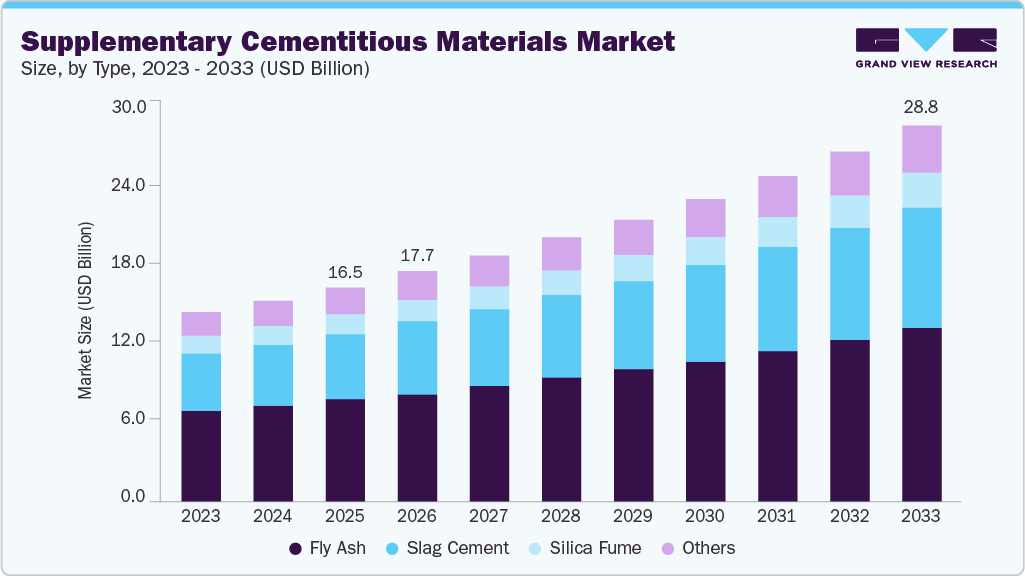
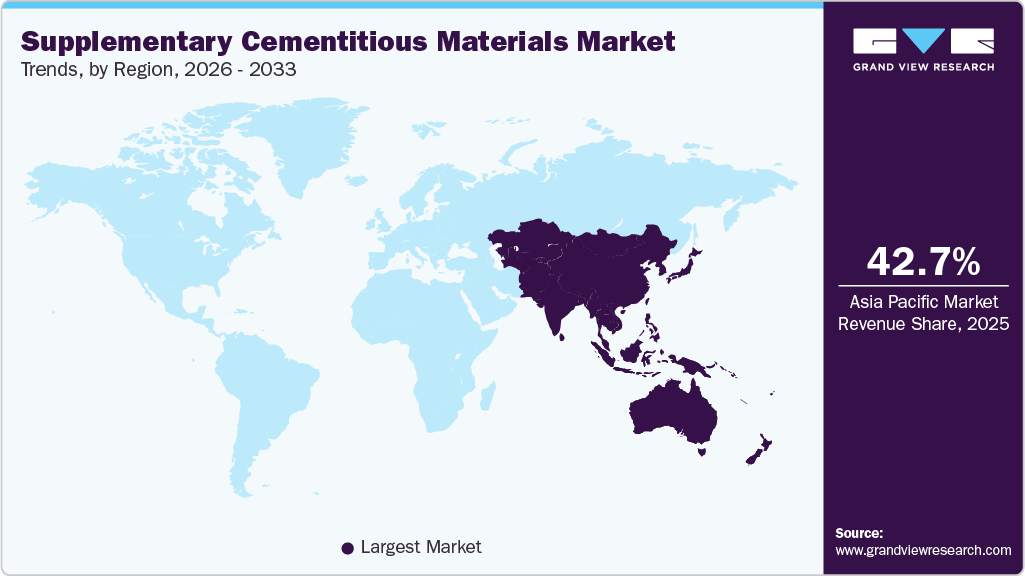
The global supplementary cementitious materials market size was valued at USD 16.5 billion in 2025 and is projected to grow from USD 17.7 billion in 2026 to USD 28.8 billion by 2033, at a CAGR of 7.2% from 2026 to 2033. The Asia Pacific supplementary cementitious materials market held the largest share of 42.7% of the global market in 2025. The demand for supplementary cementitious materials (SCMs) is increasing due to the growing emphasis on sustainable construction and the need to reduce the carbon footprint of cement production.
 Source: Grand View Research, IR Documents, Primary Interviews, Paid DatabasesTo learn more about this report,
 Download Free Sample Report
 Key Market Trends & Insights
- By type: Fly ash segment accounted for the highest revenue share of 47.4% in 2025.
- By type: Silica fume segment is expected to grow at the fastest CAGR of 7.9% over the forecast period.
- By application: Industrial & infrastructural segment is expected to grow at a CAGR of 7.7% over the forecast period.
Regional Highlights
- Largest regional market: Asia Pacific (42.7% revenue share, 2025)
- By country: The supplementary cementitious materials market in China is expanded to grow rapidly over the forecast period.
Market Size & Forecast
- Market size in 2025: USD 16.5 Billion
- Estimated market size in 2026: USD 17.7 Billion
- Projected market size by 2033: USD 28.8 Billion
- CAGR (2026-2033): 7.2%
Three ways to get this report
Buy it, customize it, or ask a question.Ask an Analyst
Analyst response in 1 business day
- AccessReport author, directly
- Reply timeWithin 1 working day
- No sales callDirect answer only
- FormatEmail reply
- CostFree, no cost
Get the Full Report
What the study covers
- FormatsPDF · Excel · Dashboard
- Timeline2026–2033 annual, 2025 base
- Coverage20+ countries, 5 regions
- Companies10+ key players profiled
Customize the Report
20% free customization
- IncludeCountries, segments, points
- TailorTo your product definition
- ExtendDeeper competitor detail
- OrA fully bespoke study
- Turnaround5–10 working days
SCMs such as fly ash, slag cement, and silica fume partially replace Portland cement in concrete mixtures, thereby lowering greenhouse gas emissions. The construction industry is increasingly adopting these materials to meet environmental standards and green building certifications. Rapid urbanization and infrastructure development across emerging economies are also contributing to increased concrete consumption, indirectly boosting the use of SCMs.Key demand drivers for SCMs include the rising cost of traditional cement production and the need for more efficient construction materials. SCMs improve the mechanical properties of concrete, including strength, durability, and resistance to chemical attacks. Infrastructure expansion projects such as highways, bridges, ports, and commercial buildings are major consumers of SCM-blended concrete. The increasing adoption of ready-mix concrete and precast construction methods is also supporting SCM integration into standard concrete formulations. Many construction companies prefer SCMs because they enhance workability and reduce the heat of hydration in mass concrete structures.
 To learn more about this report, Download Free Sample Report
 Technological advancements and material innovations are shaping the SCM market landscape. Researchers and manufacturers are developing new types of SCMs derived from industrial waste streams and natural pozzolans. Advanced grinding and processing technologies are improving the reactivity and consistency of SCM materials, making them more suitable for high-performance concrete. The growing interest in low-carbon cement alternatives such as geopolymer concrete is further accelerating the development of innovative SCM formulations. Digital concrete mix optimization tools are also helping producers design efficient mixes that maximize SCM usage while maintaining performance.
Market Dynamics
Growing emphasis on reducing carbon emissions from the construction industry is significantly driving the demand for supplementary cementitious materials (SCMs). Materials such as fly ash, slag cement, silica fume, and calcined clay are increasingly used as partial replacements for Portland cement to reduce the carbon footprint of cement production. SCMs help improve concrete durability, reduce heat generation, and enhance long-term performance, making them highly suitable for sustainable infrastructure and green building projects. Governments and construction companies are increasingly adopting low-carbon construction practices and environmental regulations, which is accelerating the use of SCMs across residential, commercial, and infrastructure developments.
In addition, rapid urbanization and large-scale infrastructure investments are further supporting market growth. The increasing construction of bridges, highways, airports, dams, and smart city projects is creating strong demand for high-performance and durable concrete materials. SCMs improve resistance to chemical attacks, enhance strength development, and extend the lifespan of concrete structures, making them valuable for critical infrastructure applications. Growing awareness regarding lifecycle cost reduction and sustainable construction practices is also encouraging wider adoption of supplementary cementitious materials worldwide.
The supplementary cementitious materials market faces challenges due to inconsistent raw material availability and variations in quality. Many SCMs, particularly fly ash and slag, are by-products of coal-fired power plants and steel manufacturing processes, making their supply highly dependent on industrial production trends. The gradual shift toward renewable energy and reduced coal usage in several countries is limiting fly ash availability, while regional differences in material composition can affect concrete performance and standardization. In addition, transportation costs and the need for strict quality control measures may increase operational complexity and limit adoption in certain construction markets.
Market Concentration & Characteristics
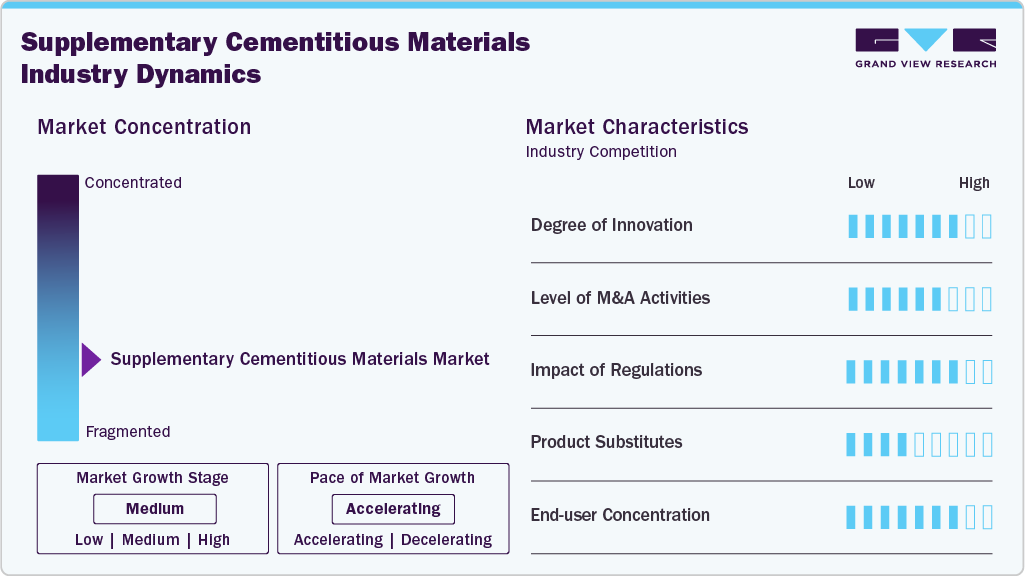
The supplementary cementitious materials market exhibits a moderately fragmented structure due to the presence of both large cement manufacturers and regional suppliers of industrial by-products. Major cement companies often produce blended cement products that incorporate SCMs, while independent suppliers provide materials such as fly ash and slag to ready-mix concrete producers. Market concentration varies depending on the availability of raw materials, which are often tied to specific industrial activities like coal power generation or steel manufacturing. In regions with strong industrial bases, SCM supply chains are relatively established and competitive.
 To learn more about this report, Download Free Sample Report
 The primary substitutes for supplementary cementitious materials include alternative low-carbon binders and advanced cement formulations that reduce clinker content without relying heavily on traditional SCMs. Materials such as calcined clay, limestone fillers, and geopolymer binders are emerging as viable alternatives in certain applications. These substitutes aim to deliver similar durability and sustainability benefits while addressing supply constraints of traditional SCMs such as fly ash. In regions where coal-fired power plants are being phased out, the availability of fly ash is expected to decline, prompting the exploration of alternative materials. However, SCMs remain widely preferred due to their proven performance and compatibility with conventional concrete production systems.
Type Insights
The fly ash segment accounted for the highest revenue share of 47.4% in 2025, driven by its widespread availability and cost-effectiveness in concrete production. Fly ash, a by-product of coal-fired power plants, is extensively used as a partial replacement for Portland cement to enhance the workability, durability, and long-term strength of concrete. Its ability to reduce the heat of hydration and improve resistance to chemical attacks makes it suitable for large infrastructure projects such as dams, bridges, and highways. Additionally, the increasing emphasis on recycling industrial by-products and reducing carbon emissions from cement manufacturing has supported the adoption of fly ash in construction applications.
The silica fume segment is expected to grow at a CAGR of 7.9% over the forecast period, driven by its superior performance in high-strength and high-performance concrete applications. Silica fume is an ultrafine by-product generated during the production of silicon and ferrosilicon alloys and is known for improving concrete strength, durability, and resistance to permeability. It is widely used in demanding construction applications such as bridges, marine structures, and high-rise buildings where enhanced structural performance is required. The increasing adoption of advanced construction materials and high-performance concrete in modern infrastructure projects is expected to drive demand for silica fume.
Application Insights
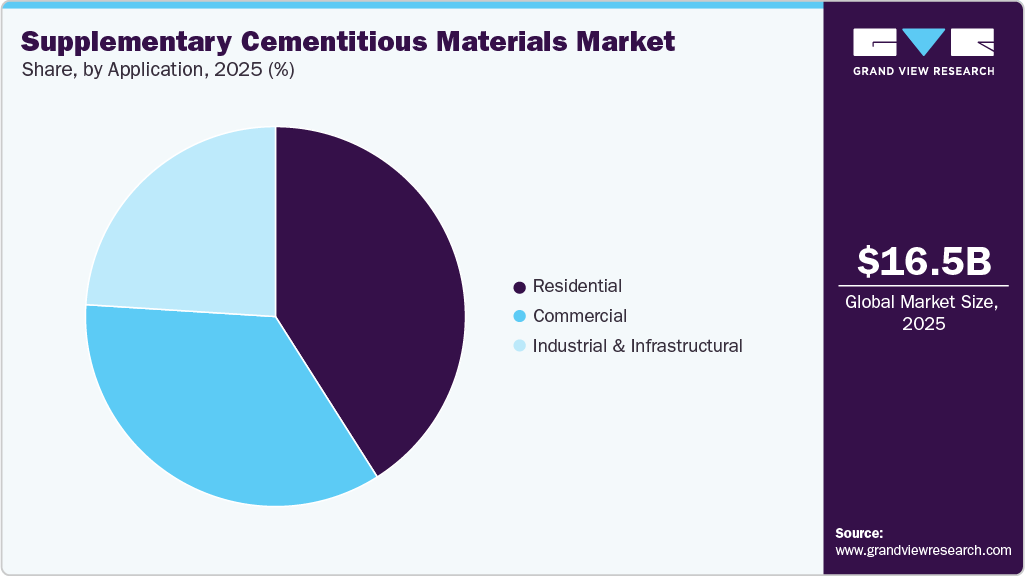
The residential segment dominated the market, accounting for 40.6% of revenue in 2025, driven by rapid urbanization and increased housing construction across both developed and developing economies. The rising demand for affordable housing, urban residential complexes, and smart city developments has significantly increased the consumption of concrete in residential projects. SCMs are commonly used in residential construction to improve concrete durability, reduce costs, and enhance workability during construction. The growing emphasis on sustainable building practices has also encouraged developers to use blended cement and SCM-based concrete to reduce environmental impact.
 To learn more about this report, Download Free Sample Report
 The industrial & infrastructural segment is expected to grow at a significant CAGR of 7.7% over the forecast period, due to increasing investments in transportation networks, energy facilities, and large-scale public infrastructure projects. Construction activities such as highways, bridges, airports, railways, and industrial plants require high-performance and durable concrete, which drives the demand for supplementary cementitious materials. SCMs help improve resistance to environmental conditions, reduce cracking in mass concrete structures, and enhance long-term structural performance.
Regional Insights
Asia Pacific dominated the global supplementary cementitious materials market, accounting for the largest revenue share of 42.7% in 2025, driven by large-scale infrastructure development and rapid urbanization in countries such as China and India. The region consumes vast volumes of concrete for residential construction, transportation infrastructure, and industrial facilities. High cement production levels combined with strong availability of industrial by-products support SCM adoption in blended cement. Governments across the region are also introducing sustainability standards to reduce emissions from cement manufacturing. The increasing adoption of ready-mix concrete and prefabricated construction methods further encourages the use of SCM-based mixtures.
 To learn more about this report, Download Free Sample Report
 China Supplementary Cementitious Materials Market Trends
China is one of the largest markets for supplementary cementitious materials, driven by its massive cement production capacity and ongoing infrastructure investments. The country has a significant availability of fly ash and slag generated from coal power plants and steel manufacturing facilities. These materials are widely used in cement blending to improve sustainability and reduce clinker consumption. Government initiatives to reduce industrial emissions have further promoted the use of SCMs in construction materials. Large-scale urban redevelopment and transportation infrastructure projects continue to sustain high concrete demand.
Europe Supplementary Cementitious Materials Market Trends
Europe’s supplementary cementitious materials market is strongly influenced by strict climate policies and decarbonization targets within the construction sector. The region has been actively promoting blended cement and low-carbon building materials to meet sustainability goals. SCMs such as blast furnace slag and natural pozzolans are widely used in cement production across several European countries. Infrastructure renovation projects and green building initiatives are driving demand for durable and environmentally friendly concrete. Cement manufacturers are also investing in innovative processing technologies to optimize SCM performance.
The Germany supplementary cementitious materials market represents an important European market due to its strong industrial base and advanced construction technologies. The country utilizes blast furnace slag from steel manufacturing as a major SCM in blended cement production. Sustainable construction practices and strict environmental regulations encourage the adoption of low-carbon building materials. Infrastructure modernization and energy-efficient building projects are major demand drivers for SCM-based concrete. German cement manufacturers are also investing in research and innovation to improve the performance of alternative cementitious materials.
North America Supplementary Cementitious Materials Market Trends
North America has a well-established market for supplementary cementitious materials, supported by strict environmental regulations and mature construction practices. The region has long integrated SCMs such as fly ash and slag cement into concrete production to improve durability and sustainability. Infrastructure rehabilitation projects, particularly in transportation and energy sectors, are driving demand for high-performance concrete mixtures. Ready-mix producers commonly use SCM blends to enhance strength and reduce permeability in large infrastructure structures. The increasing focus on reducing carbon emissions from cement manufacturing is encouraging further adoption.
U.S. Supplementary Cementitious Materials Market Trends
The U.S. supplementary cementitious materials market is witnessing significant growth. U.S. is a major consumer of supplementary cementitious materials due to its advanced construction sector and strict environmental regulations. Infrastructure modernization initiatives including highway repair, bridge reconstruction, and public transit development are key demand drivers. The use of SCMs is widely specified in construction standards to enhance concrete durability and reduce environmental impact. Many ready-mix concrete producers incorporate fly ash or slag to achieve improved performance characteristics in structural applications. The decline in coal-fired power generation is gradually reducing fly ash supply, encouraging the development of alternative SCM materials.
Latin America Supplementary Cementitious Materials Market Trends
The Latin American supplementary cementitious materials market is expanding due to growing infrastructure development and urbanization across major economies. Countries such as Brazil and Mexico are investing heavily in transportation networks, housing projects, and commercial infrastructure. These developments are increasing the demand for concrete and cementitious materials. SCMs are increasingly used to enhance concrete durability while reducing production costs. The region also benefits from the availability of industrial by-products such as slag and natural pozzolans. Government infrastructure initiatives and construction modernization efforts are further supporting market growth.
Middle East & Africa Supplementary Cementitious Materials Market Trends
The Middle East and Africa market for supplementary cementitious materials is growing due to extensive infrastructure and urban development projects. Large construction initiatives including airports, commercial complexes, and residential developments are driving concrete demand in the region. Countries in the Gulf Cooperation Council are increasingly adopting sustainable building materials to align with environmental goals. SCMs are used to improve concrete durability in harsh climatic conditions characterized by high temperatures and saline environments. Infrastructure diversification projects and investments in smart cities are further boosting demand.
Key Supplementary Cementitious Materials Company Insights
Some of the key players operating in the market include Heidelberg Materials, CEMEX S.A.B. de C.V.
-
Heidelberg Materials is a German multinational building‑materials company and one of the world’s leading producers of cement, aggregates, and concrete. It supplies a range of supplementary cementitious materials such as ground granulated blast‑furnace slag (GGBFS), fly ash, pozzolana, and silica fume used to enhance concrete performance and sustainability, supporting lower‑carbon cement solutions.
-
CEMEX S.A.B. de C.V. is a Mexican multinational building materials company headquartered in Monterrey, Mexico. It is among the world’s largest cement producers, manufacturing and distributing cement, ready‑mix concrete, and aggregates across more than 50 countries.
Tata Steel Ltd. and Sika AG are some of the emerging market participants in the supplementary cementitious materials market.
-
Tata Steel Ltd. is one of India’s largest and most geographically diversified steel producers, with integrated operations spanning mining, steel production, and downstream products. While Tata Steel itself is primarily a steel manufacturer rather than a dedicated SCM producer, its by‑products such as slag (from steelmaking) are often processed and supplied as ground granulated blast‑furnace slag (GGBFS) for use as a supplementary cementitious material in concrete blends.
-
Sika AG is a Swiss specialty chemicals and construction materials company headquartered in Baar, Switzerland. Through strategic acquisitions and product development, Sika has expanded its presence in SCM‑related materials and technologies, supporting high‑performance and low‑carbon concrete formulations.
Key Supplementary Cementitious Materials Companies:
The following key companies have been profiled for this study on the supplementary cementitious materials market.
- Holcim Group
- CEMEX S.A.B. de C.V.
- Heidelberg Materials
- Boral Limited
- Eco Material Technologies
- Ferroglobe PLC
- Sika AG
- Tata Steel Ltd.
- CRH plc
- Elkem ASA
Competitive Benchmarking
Operating Strategies
Competitive Edge
Weakness
Mature Players: Holcim Group; CEMEX S.A.B. de C.V.; Heidelberg Materials; CRH plc
- Focus on large-scale production of low-carbon cement and supplementary cementitious materials
- Investment in sustainable construction technologies and circular economy initiatives
- Strong global manufacturing footprint and distribution network
- Advanced R&D capabilities and established construction industry partnerships
- Strict environmental and emission compliance requirements
Emerging Players: Eco Material Technologies; Ferroglobe PLC; Elkem ASA
- Focus on alternative SCM development and industrial by-product utilization
- Expansion in sustainable and specialty construction material applications
- Flexible production capabilities and niche material expertise
- Strong focus on sustainable material innovation
- Dependence on industrial by-product availability and regional demand
Recent Developments
-
In December 2025, Holcim announced a major expansion of its circular construction materials capacity across Europe by acquiring multiple recycling companies to strengthen supply of recycled industrial by‑products like fly ash and slag for low‑carbon building materials.
-
In November 2023, Sika completed the acquisition of a 30% stake in Concria Oy, strengthening its capabilities in advanced concrete and cement additive technologies, which supports cementitious innovation.
-
In July 2025, CRH agreed to acquire Eco Material Technologies for US$2.1 billion, a strategic move to secure long‑term supply and expand offerings of SCMs such as fly ash and synthetic gypsum in North America.
Supplementary Cementitious Materials Market Report Scope
Report Attribute
Details
Market size in 2025
USD 16.5 billion
Estimated market size in 2026
USD 17.7 billion
Projected market size by 2033
USD 28.8 billion
Growth rate
CAGR of 7.2% from 2026 to 2033
Base year for estimation
2025
Actual estimates/Historical data
2021 - 2025
Forecast period
2026 - 2033
Quantitative units
Revenue in USD billion and CAGR from 2026 to 2033
Report coverage
Revenue forecast, company ranking, competitive landscape, growth factors, and trends
Segments covered
Type, application, region.
Regional scope
North America, Europe, Asia Pacific, Latin America, Middle East & Africa
Country scope
U.S.; Canada; Mexico; Germany; UK; Italy; France; China; Japan; India
Key companies profiled
Holcim Group; CEMEX S.A.B. de C.V.; Heidelberg Materials; Boral Limited; Eco Material Technologies; Ferroglobe PLC; Sika AG; Tata Steel Ltd.; CRH plc; Elkem ASA
Customization scope
Free report customization (equivalent up to 8 analysts working days) with purchase. Addition or alteration to country, regional & segment scope.
Pricing and purchase options
Avail customized purchase options to meet your exact research needs. Explore purchase options
Global Supplementary Cementitious Materials Market Report Segmentation
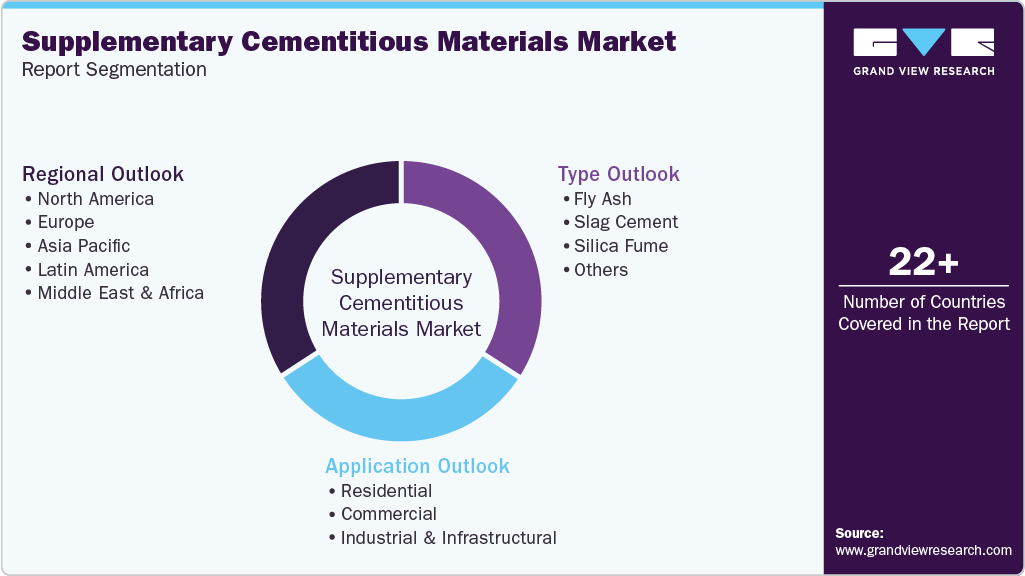
This report forecasts revenue growth at regional & country levels and provides an analysis on the industry trends in each of the sub-segments from 2021 to 2033. For the purpose of this study, Grand View Research has segmented the supplementary cementitious materials market on the basis of material type, application, and region:
 To learn more about this report, Download Free Sample Report
 -
Type Outlook (Revenue, USD Billion, 2021 - 2033)
-
Fly Ash
-
Slag Cement
-
Silica Fume
-
Others
-
-
Application Outlook (Revenue, USD Billion, 2021 - 2033)
-
Residential
-
Commercial
-
Industrial & Infrastructural
-
-
Regional Outlook (Revenue, USD Billion, 2021 - 2033)
-
North America
-
U.S.
-
Canada
-
Mexico
-
-
Europe
-
UK
-
Germany
-
France
-
Italy
-
-
Asia Pacific
-
China
-
Japan
-
India
-
-
Latin America
-
Middle East and Africa
-
Delivered Customizations
This report has been delivered with the following In-depth customizations
Client Request
Customization Delivered
Value Adds
Competitor Analysis
In-depth analysis of key market participants based on product portfolio, production capacity, sustainability initiatives, regional presence, pricing strategies, partnerships, and utilization of industrial by-products in supplementary cementitious materials production
Enables understanding of competitive positioning, product differentiation strategies, and strategic developments among SCM manufacturers
Opportunity Analysis
Comprehensive evaluation of growth opportunities across green buildings, infrastructure modernization, precast construction, low-carbon cement production, and emerging alternative SCM technologies
Supports identification of high-growth application areas, sustainable construction trends, infrastructure investment opportunities, and long-term market expansion potential
Potential Risks
Detailed assessment of market risks including raw material availability, regulatory changes related to carbon emissions, raw material supply constraints, transportation challenges, and fluctuations in construction activity
Helps understand operational, regulatory, and supply chain risks affecting market stability, production efficiency, and long-term investment decisions in the SCM industry
Frequently Asked Questions About This Report
The global supplementary cementitious materials market is expected to grow at a CAGR of 7.2% from 2026 to 2033, reaching USD 28.8 billion by 2033.
The fly ash segment led with a 47.4% revenue share in 2025, while silica fume is the fastest-growing type.
Key players include Holcim Group; CEMEX S.A.B. de C.V.; Heidelberg Materials; Boral Limited; Eco Material Technologies; Ferroglobe PLC; Sika AG; Tata Steel Ltd.; CRH plc; Elkem ASA.
Key factors include growing emphasis on sustainable construction and the need to reduce the carbon footprint of cement production, rising cost of traditional cement production and the need for more efficient construction materials.
The global supplementary cementitious materials market size was valued at USD 16.5 billion in 2025 and is estimated at USD 17.7 billion for 2026.
Asia Pacific dominated with a 42.7% revenue share in 2025.
The residential segment led with a 40.6% revenue share in 2025.
About the Author(s)
Advanced Interior Materials Research Team
Advanced Materials · Advanced Interior MaterialsThis report was authored by the advanced interior materials research team at Grand View Research - comprising two research analysts, one senior research analyst, and one industry expert - with specialized expertise in the advanced interior materials segment of the advanced materials industry. All findings are based on proprietary advanced materials databases, executive interviews, and regulatory analysis, subject to internal peer review prior to publication.
Last Updated:
Speak to Analyst

Customize this report to your needs - add regions, segments, or data points, with 20% free customization.
Or view our licence options:


ISO 9001:2015 & 27001:2022 Certified
We are GDPR and CCPA compliant! Your transaction & personal information is safe and secure. For more details, please read our privacy policy.


