
- Home
- »
- Renewable Energy
- »
-
Dual-axis Solar Tracker Market Size Report, 2026-2033GVR Report cover

Dual-axis Solar Tracker Market (2026 - 2033) Size, Share & Trends Analysis Report By Type (Altitude-azimuth, Tip-tilt, Polar-aligned), By Application (Utility-scale, Commercial & Industrial, Residential, CSP/CPV, Off-grid), By Region, And Segment Forecasts
Market Size, 2025
$3.4BMarket Estimate, 2026
$3.8BMarket Forecast, 2033
$8.5BCAGR, 2026–2033
12.1%Dual-axis Solar Tracker Market Summary
The global dual-axis solar tracker market size was valued at USD 3.4 billion in 2025 and is projected to grow from USD 3.8 billion in 2026 to USD 8.5 billion by 2033, at a CAGR of 12.1% from 2026 to 2033. The North America dual-axis solar tracker market held the largest share of 38.0% of the global market in 2025. The industry is expanding due to rising utility-scale solar installations and increasing demand for higher solar energy generation efficiency.
 Source: Grand View Research, IR Documents, Primary Interviews, Paid DatabasesTo learn more about this report,
 Download Free Sample Report
 Key Market Trends & Insights
- The dual-axis solar tracker market in the U.S. is expected to grow at a CAGR of 10.0% over the forecast period.
- By type, the Altitude-Azimuth segment accounted for the largest revenue share of 42.3% in 2025.
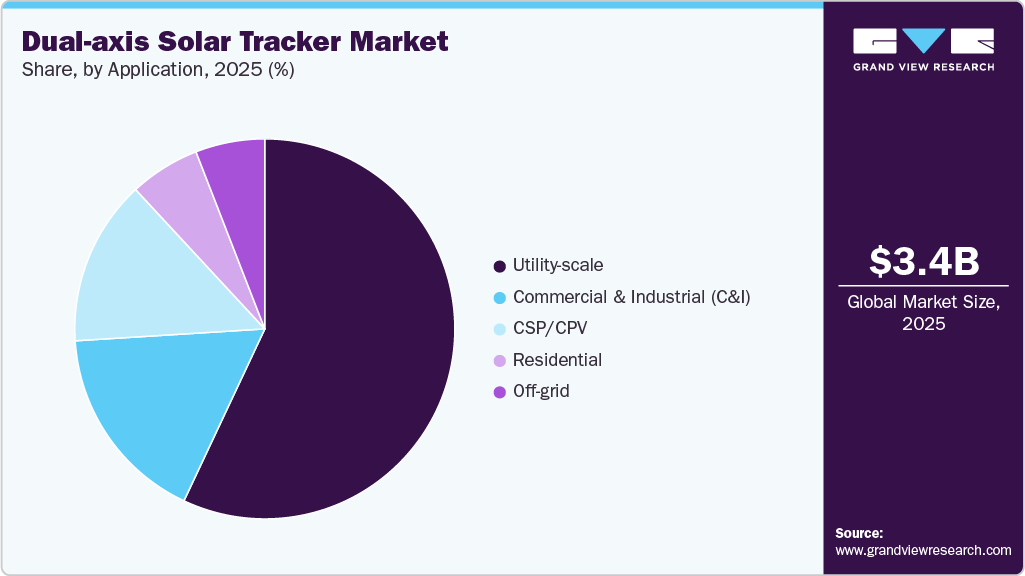
- By application, the utility-scale segment held the largest revenue share of 57.0% in 2025.
Market Size & Forecast
- 2025 Market Size: USD 3.4 Billion
- 2033 Projected Market Size: USD 8.5 Billion
- CAGR (2026-2033): 12.1%
- North America: Largest market in 2025
- Asia Pacific: Fastest growing market
Three ways to get this report
Buy it, customize it, or ask a question.Ask an Analyst
Analyst response in 1 business day
- AccessReport author, directly
- Reply timeWithin 1 working day
- No sales callDirect answer only
- FormatEmail reply
- CostFree, no cost
Get the Full Report
What the study covers
- FormatsPDF · Excel · Dashboard
- Timeline2026–2033 annual, 2025 base
- Coverage20+ countries, 5 regions
- Companies10+ key players profiled
Customize the Report
20% free customization
- IncludeCountries, segments, points
- TailorTo your product definition
- ExtendDeeper competitor detail
- OrA fully bespoke study
- Turnaround5–10 working days
Growing investments in renewable energy infrastructure and advancements in smart solar tracking technologies are also supporting the growth of this market. The industry is experiencing strong growth as governments, utilities, and private developers accelerate investments in renewable energy infrastructure and utility-scale solar power generation. Increasing focus on maximizing solar energy output and improving land-use efficiency is driving the adoption of dual-axis tracking systems, which can generate significantly higher electricity output compared to fixed-tilt systems. Supportive government policies, clean energy targets, and large-scale solar deployment programs are further contributing to market expansion. For instance, according to the IEA, global renewable electricity capacity additions reached record levels in recent years, with solar PV accounting for the largest share of new power capacity installations worldwide. To learn more about this report, Download Free Sample Report
 Growing demand for high-efficiency solar technologies and improved project economics is another major factor supporting market growth. Dual-axis trackers are increasingly being deployed in utility-scale solar farms, concentrated solar power (CSP), and concentrated photovoltaic (CPV) projects to optimize solar irradiation capture throughout the day and across seasons. Advancements in smart tracking technologies, including AI-enabled controllers, IoT-based monitoring systems, weather-adaptive tracking, and wind protection mechanisms, are improving operational performance and reducing maintenance requirements.
Market Dynamics
The increasing deployment of utility-scale solar power projects is a major factor driving the growth of the industry. Solar project developers and utilities are increasingly adopting dual-axis tracking systems to maximize solar energy capture and improve overall power generation efficiency compared to fixed-tilt systems. Dual-axis trackers continuously adjust panel orientation based on the sun’s movement, enabling higher energy yield and improved land-use optimization, particularly in high solar irradiation regions. Growing global focus on decarbonization, renewable energy adoption, and clean electricity generation is further accelerating demand for advanced solar tracking technologies.
Rising investments in large-scale solar infrastructure projects are supporting greater adoption of dual-axis trackers across utility-scale photovoltaic installations. According to the International Energy Agency, global renewable capacity additions reached around 800 GW in 2025, driven primarily by solar PV, which accounted for more than three-quarters of total additions, reflecting the continued expansion of large-scale solar deployment and strengthening demand for high-efficiency solar tracking solutions worldwide.
The industry faces challenges due to the high initial capital investment required for system installation and deployment. Dual-axis tracking systems involve additional components such as motorized drives, sensors, actuators, controllers, and advanced structural assemblies, making them significantly more expensive than fixed-tilt solar systems. These higher upfront costs can limit adoption, particularly among small-scale developers and cost-sensitive solar projects where budget optimization remains a key priority.
Industry momentum is being reinforced by the rapid professionalization of the resale ecosystem, which is redefining how luxury watches are distributed and trusted outside primary retail. Certified pre-owned platforms are increasingly positioning themselves as retail-grade channels, offering authentication, warranties, and full refurbishment standards that reduce buyer risk and elevate confidence. According to a Watchfinder & Co. article in 2024, the distinction between “new” and “pre-owned” is becoming less relevant as consumers expect the same level of service, transparency, and brand storytelling regardless of purchase channel. This shift is pushing the market toward structured; luxury watch secondary market institutionalized resale models rather than informal secondary trade.
Installation and maintenance complexity further increases the overall project expenditure associated with dual-axis trackers. According to industry estimates, dual-axis tracking systems can cost approximately 30% more than fixed-tilt solar installations due to additional hardware and operational requirements. In regions where land availability and solar irradiation conditions already support efficient energy generation through lower-cost alternatives, project developers may prefer single-axis or fixed-tilt systems to reduce overall CAPEX and shorten project payback periods.
Type Insights
The altitude-azimuth segment accounted for the largest revenue share of 42.3% in 2025, primarily due to its ability to continuously track the sun on both the horizontal axis (azimuth) and vertical axis (altitude). This dual-axis continuous tracking enables solar panels to adjust according to the sun’s daily east-to-west movement as well as seasonal changes in solar angle, resulting in higher energy generation efficiency. The segment is widely adopted in utility-scale solar and CPV projects where maximizing solar irradiation capture is critical. Increasing demand for high-efficiency solar power generation systems is further supporting segment growth.
The polar-aligned segment is expected to register a CAGR of 10.5% during the forecast period, driven by its relatively limited deployment compared to altitude-azimuth and tip-tilt tracking systems. Polar-aligned trackers generally involve more complex installation and alignment requirements, making them less preferred for large-scale commercial solar projects. Advancements in altitude-azimuth systems offering higher tracking flexibility and improved energy optimization are reducing the adoption rate of polar-aligned configurations.
Application Insights
The utility-scale segment held the largest revenue share of 57.0% in 2025. This segment is driven by increasing investments in large-scale solar power projects and rising global demand for renewable electricity generation. Utility-scale solar developers are increasingly adopting dual-axis tracking systems to maximize solar energy capture and improve overall power output efficiency. These systems help optimize land utilization and enhance project economics by increasing electricity generation compared to fixed-tilt installations. Supportive government policies, renewable energy targets, and expanding solar infrastructure development are further contributing to segment growth.
 To learn more about this report, Download Free Sample Report
 The commercial & industrial segment is projected to register the fastest CAGR of 15.1% over the forecast period due to the increasing adoption of solar energy systems by commercial buildings, manufacturing facilities, warehouses, and industries. Rising corporate sustainability initiatives and net-zero emission commitments are encouraging businesses to invest in high-efficiency solar technologies, including dual-axis trackers. These systems help maximize energy generation within limited installation spaces, making them increasingly suitable for commercial and industrial applications. Growing investments in distributed solar infrastructure and smart energy management solutions are further supporting segment growth.
Regional Insights
The Asia Pacific dual-axis solar tracker market is projected to register the fastest CAGR of 14.9%, driven by a rapid expansion of utility-scale solar projects, rising renewable energy investments, and strong government support for clean energy deployment. Countries across the region continue to scale up large solar infrastructure to meet growing electricity demand and achieve decarbonization targets. For instance, according to China’s National Energy Administration (NEA), China added 216.9 GW of new solar power capacity in 2025, reflecting sustained record-level solar deployment and reinforcing its position as the largest solar market globally. This rapid expansion of large-scale solar installations is further increasing demand for advanced solar tracking systems that enhance energy generation efficiency and optimize performance in utility-scale projects.
The dual-axis solar tracker market in China is shaped by rapid utility-scale solar capacity expansion, strong government support for renewable energy deployment, increasing investments in high-efficiency solar technologies, and growing demand for advanced tracking systems to maximize power generation efficiency across large-scale solar projects. The presence of large domestic solar equipment manufacturers and ongoing grid modernization initiatives are further supporting market growth. Growing investments in desert-based solar power projects and ultra-high-voltage transmission infrastructure are also creating new opportunities for market expansion.
Europe Dual-axis Solar Tracker Market Trends
The dual-axis solar tracker market in Europe is driven by increasing investments in renewable energy infrastructure, ambitious carbon neutrality targets, and rising deployment of utility-scale solar power projects across the region. Growing focus on maximizing solar energy generation efficiency and reducing dependence on fossil fuels is encouraging the adoption of advanced dual-axis tracking systems. The European Union aims to achieve at least 42.5% renewable energy consumption by 2030 under the revised Renewable Energy Directive, significantly accelerating solar power installations across member countries.
North America Dual-axis Solar Tracker Market Trends
The dual-axis solar tracker market in North America holds the largest revenue share of 38.0%, primarily due to strong growth in utility-scale solar installations, increasing investments in renewable energy infrastructure, and the need to maximize energy output from large solar farms. The region continues to witness rapid expansion in solar capacity additions, particularly in the U.S., which remains the leading contributor to regional solar deployment. According to the SEIA, the U.S. installed 43.2 GW of solar capacity in 2025, reflecting sustained momentum in large-scale solar development and reinforcing the strong pipeline of utility-scale projects. This ongoing expansion, supported by favorable policy frameworks and rising corporate procurement of clean energy, is accelerating the adoption of advanced solar tracking technologies, including dual-axis systems, to enhance efficiency and optimize project performance across large solar installations.
 To learn more about this report, Download Free Sample Report
 U.S. Dual-axis Solar Tracker Market Trends
The dual-axis solar tracker market in the U.S. is driven by increasing deployment of utility-scale solar farms, rising focus on energy efficiency, and growing investments in advanced renewable energy infrastructure. Supportive federal policies and tax incentives are encouraging solar developers to adopt high-efficiency tracking systems to maximize electricity generation. The U.S. Department of Energy aims to achieve a fully decarbonized power sector by 2035, significantly accelerating investments in large-scale solar projects across the country. Growing adoption of smart solar technologies and automation-enabled tracking systems is further supporting market growth.
Latin America Dual-axis Solar Tracker Market Trends
The dual-axis solar tracker market in Latin America is driven by rising investments in utility-scale solar projects and an increasing focus on improving solar energy generation efficiency. Favorable solar irradiation conditions and ambitious renewable energy targets across the region are further supporting market growth. The expansion of large-scale solar capacity in countries such as Brazil, along with the growing deployment of advanced solar tracking technologies in utility-scale installations, is strengthening demand for high-performance tracking systems. As developers continue to prioritize higher energy yield and improved project economics in large solar PV plants, the adoption of advanced solar tracker solutions is expected to increase steadily across the region.
Middle East & Africa Dual-axis Solar Tracker Market Trends
The dual-axis solar tracker market in the Middle East & Africa is driven by rising investments in utility-scale solar projects, increasing focus on energy diversification, and growing adoption of high-efficiency solar technologies across the region. High solar irradiation levels and expanding renewable energy infrastructure development are encouraging the deployment of advanced solar tracking systems to maximize energy generation efficiency. Supportive government clean energy initiatives and increasing demand for sustainable power generation are further contributing to market growth.
Key Dual-axis Solar Tracker Companies Insights
Some of the key players operating in the global dual-axis solar tracker market include Array Technologies, Inc. and ARCTECH, among others.
-
Array Technologies, Inc. is a leading participant in the dual-axis solar tracker market, recognized for its large-scale solar tracking systems, utility-grade deployment capabilities, and strong engineering expertise in solar mounting and tracking technologies. The company focuses on high-reliability tracker solutions designed to optimize energy yield, reduce the levelized cost of electricity and enhance performance in utility-scale solar installations. Array Technologies emphasizes robust mechanical design, advanced control systems, and field-proven durability, enabling efficient operation under diverse environmental conditions. Its strategy is centered on expanding tracker efficiency, improving system adaptability, and supporting large solar power projects that contribute to renewable energy integration and decarbonization goals.
-
ARCTECH is a prominent global player in the dual-axis solar tracker market, known for its advanced tracking solutions, strong R&D capabilities, and extensive international project deployment. The company offers high-precision solar tracking systems designed to maximize solar irradiation capture, improve energy generation efficiency, and support utility-scale and commercial solar power plants. Arctech focuses on innovative tracker architectures, intelligent control systems, and AI-enabled performance optimization to enhance operational efficiency and reduce maintenance requirements. Its strategy emphasizes global expansion, technological innovation, and integrated solar mounting solutions that support accelerated adoption of renewable energy infrastructure worldwide.
Key Dual-axis Solar Tracker Companies
The following key companies have been profiled for this study on the dual-axis solar tracker market.
-
All Earth Renewables
-
ARCTECH
-
Array Technologies, Inc.
-
DEGERENERGIE GMBH & CO.
-
GameChange Solar
-
MECASOLAR
-
Mechatron Trackers
-
Nextpower Inc.
-
PVH Solar
-
Soltec
Competitive Benchmarking
Operating Strategies
Competitive Edge
Weaknesses
Mature Players: ARCTECH; Array Technologies, Inc.; DEGERENERGIE GMBH & CO.; GameChange Solar; PVH Solar; Soltec
- Mature participants primarily focus on utility-scale deployment of advanced dual-axis and single-axis tracker systems integrated with smart monitoring and high-efficiency mechanical designs. They emphasize global EPC partnerships, standardized product platforms, and large project execution capabilities.
- Established players benefit from strong manufacturing scale, proven field reliability, extensive global project portfolios, and long-term relationships with utility developers and EPC contractors. They also have advanced engineering capabilities and optimized tracker designs for maximum energy yield.
- Despite strong market positions, mature players face pricing pressure, increasing competition from low-cost manufacturers, and project-dependent revenue volatility. Some also experience limitations in customization flexibility and exposure to supply chain disruptions.
Emerging Players: All Earth Renewables; MECASOLAR; Mechatron Trackers; Nextpower Inc.
- Emerging participants focus on niche applications such as distributed solar, modular dual-axis systems, and flexible tracker configurations for smaller or specialized installations. They emphasize innovation, localized deployment models, and adaptive tracking technologies.
- Emerging companies benefit from high design flexibility, faster innovation cycles, and the ability to address underserved or niche market segments. They are often more agile in adopting new technologies and customized project requirements.
- Emerging participants face significant constraints related to limited manufacturing scale, weaker global distribution networks, and dependency on regional demand. They also struggle with financing capacity and limited penetration in large utility-scale projects.
Recent Developments
- In August 2025, Array Technologies, Inc. completed its acquisition of APA Solar to expand its product portfolio with engineered foundation and fixed-tilt mounting solutions. The integration enhances solar project execution through a domestically manufactured, integrated tracker and foundation system designed for challenging soil conditions. This move is expected to help EPC companies and developers reduce installation costs and optimize energy production across diverse project sites more efficiently.
Dual-axis Solar Tracker Market Report Scope
Report Attribute
Details
Market Definition
The global Dual-Axis Solar Tracker market size represents the revenue generated from the sale and deployment of dual-axis solar tracking systems designed to optimize solar panel orientation for enhanced energy generation efficiency across utility-scale, commercial, and industrial solar projects.
Market size value in 2025
USD 3.4 billion
Market size value in 2026
USD 3.8 billion
Revenue forecast in 2033
USD 8.5 billion
Growth rate
CAGR of 12.1% from 2026 to 2033
Base year for estimation
2025
Historical data
2021 - 2024
Forecast period
2026 - 2033
Quantitative units
Revenue in USD million/billion, and CAGR from 2026 to 2033
Report coverage
Revenue forecast, competitive landscape, growth factors, and trends
Segments covered
Type, application, region
Regional scope
North America; Europe; Asia Pacific; Latin America; Middle East & Africa
Country scope
U.S.; Canada; Mexico; Germany; UK; France; Italy; Spain; China; India; Australia;Japan; South Korea; Brazil; Argentina; Saudi Arabia; UAE; South Africa
Key companies profiled
All Earth Renewables; ARCTECH ; Array Technologies, Inc.; DEGERENERGIE GMBH & CO.; GameChange Solar; MECASOLAR; Mechatron Trackers; Nextpower Inc.; PVH Solar; Soltec
Customization scope
Free report customization (equivalent up to 8 analysts working days) with purchase. Addition or alteration to country, regional & segment scope.
Pricing and purchase options
Avail customized purchase options to meet your exact research needs. Explore purchase options
Global Dual-axis Solar Tracker Market Report Segmentation
This report forecasts revenue growth at global, regional, and country levels and provides an analysis of the latest industry trends in each of the sub-segments from 2021 to 2033. For this study, Grand View Research has segmented the global dual-axis solar tracker market report on the basis of type, application, and region.
 To learn more about this report, Download Free Sample Report
 -
Type Outlook (Revenue, USD Billion, 2021 - 2033)
-
Altitude-azimuth
-
Tip-tilt
-
Polar-aligned
-
Others
-
-
Application Outlook (Revenue, USD Billion, 2021 - 2033)
-
Utility-scale
-
Commercial & Industrial (C&I)
-
Residential
-
CSP/CPV
-
Off-grid
-
-
Regional Outlook (Revenue, USD Billion, 2021 - 2033)
-
North America
-
U.S.
-
Canada
-
Mexico
-
-
Europe
-
Germany
-
UK
-
France
-
Italy
-
Spain
-
-
Asia Pacific
-
China
-
India
-
Australia
-
Japan
-
South Korea
-
-
Latin America
-
Brazil
-
Argentina
-
-
Middle East & Africa
-
Saudi Arabia
-
UAE
-
South Africa
-
-
Delivered Customizations
This report has been delivered with the following In-depth customizations
Client Request
Customization Delivered
Value Adds
Regional Opportunity Assessment
Country-level analysis was conducted to evaluate dual-axis solar tracker adoption trends based on utility-scale solar capacity additions, renewable energy targets, solar irradiation conditions, and upcoming solar infrastructure projects.
Identified high-potential countries with strong demand outlook for dual-axis trackers supported by increasing solar investments and growing focus on maximizing energy generation efficiency.
Cross-Segmentation Growth Opportunity Analysis
Cross-segment analysis was provided across the Altitude-Azimuth and Tip-Tilt segments to assess deployment trends in utility-scale solar projects.
Helped identify the most attractive tracker segments with strong growth potential, supporting strategic expansion, product positioning, and investment planning.
Company Profiling
Apart from the companies profiled in the standard report, additional companies were analyzed. Each profile covered company overview, tracker technology portfolio, product innovations, regional presence, strategic partnerships, project developments, and competitive positioning in the dual-axis solar tracker market.
Helped benchmark key market participants and evaluate strategies related to smart solar tracking systems, automation integration, utility-scale project expansion, and advanced energy optimization technologies.
Frequently Asked Questions About This Report
The global dual-axis solar tracker market was estimated at USD 3.4 billion in 2025 and is expected to reach USD 3.8 billion in 2026.
The global dual-axis solar tracker market is expected to grow at a CAGR of 12.1% from 2026 to 2033 to reach USD 8.5 billion by 2033.
Based on type, the altitude-azimuth segment held the largest revenue share of 42.3% in 2025.
Some of the key participants in the global dual-axis solar tracker market include All Earth Renewables; ARCTECH; Array Technologies, Inc.; DEGERENERGIE GMBH & CO.; GameChange Solar; MECASOLAR; Mechatron Trackers; Nextpower Inc.; PVH Solar; Soltec; among others.
Some of the key factors driving the growth of the global dual-axis solar tracker market are increasing utility-scale solar installations, rising demand for higher energy generation efficiency, growing investments in renewable energy infrastructure, and advancements in smart solar tracking technologies.
About the Author(s)
Renewable Energy Research Team
Energy & Power · Renewable EnergyThis report was authored by the renewable energy research team at Grand View Research - comprising two research analysts, one senior research analyst, and one industry expert - with specialized expertise in the renewable energy segment of the energy & power industry. All findings are based on proprietary energy & power databases, executive interviews, and regulatory analysis, subject to internal peer review prior to publication.
Last Updated:
Speak to Analyst

Customize this report to your needs - add regions, segments, or data points, with 20% free customization.
Or view our licence options:


ISO 9001:2015 & 27001:2022 Certified
We are GDPR and CCPA compliant! Your transaction & personal information is safe and secure. For more details, please read our privacy policy.


