
- Home
- »
- Next Generation Technologies
- »
-
Dye Sublimation Printing Market Size Report, 2026-2033GVR Report cover

Dye Sublimation Printing Market (2026 - 2033)
Size, Share & Trends Analysis Report By Product Type (Inks & Consumables, Printers, Transfer Papers & Substrates, Heat Press Equipment), By Printing Technique, By Application, By End User, By Region, And Segment Forecasts
Market Size, 2025
$16.4BMarket Estimate, 2026
$18.2BMarket Forecast, 2033
$39.0BCAGR, 2026–2033
11.5%Dye Sublimation Printing Market Summary
The global dye sublimation printing market size was valued at USD 16.4 billion in 2025 and is projected to grow from USD 18.2 billion in 2026 to USD 39.0 billion by 2033, at a CAGR of 11.5% from 2026 to 2033. The market in Asia Pacific dominated with a revenue share of 36.5% in 2025. The market is experiencing strong growth, fueled by the rising demand for customized apparel and promotional merchandise, particularly from small businesses and e-commerce platforms.
 Source: Grand View Research, IR Documents, Primary Interviews, Paid DatabasesTo learn more about this report,
 Download Free Sample Report
 Key Market Trends & Insights
- By product type: Inks & consumables segment held the largest market share of 41.8% in 2025.
- By printing technique: Transfer dye sublimation printing segment held the largest market share in 2025.
- By application: Textile & apparel printing segment held the largest market share in 2025.
- By end user: Textile manufacturers segment held the largest market share in 2025.
Regional Highlights
- Largest regional market: Asia Pacific (36.5% revenue share, 2025)
- By country: China held the largest market share in 2025
Market Size & Forecast
- Market size in 2025: USD 16.4 Billion
- Estimated market size in 2026: USD 18.2 Billion
- Projected market size by 2033: USD 39.0 Billion
- CAGR (2026-2033): 11.5%
Three ways to get this report
Buy it, customize it, or ask a question.Ask an Analyst
Analyst response in 1 business day
- AccessReport author, directly
- Reply timeWithin 1 working day
- No sales callDirect answer only
- FormatEmail reply
- CostFree, no cost
Get the Full Report
What the study covers
- FormatsPDF · Excel · Dashboard
- Timeline2026–2033 annual, 2025 base
- Coverage20+ countries, 5 regions
- Companies10+ key players profiled
Customize the Report
20% free customization
- IncludeCountries, segments, points
- TailorTo your product definition
- ExtendDeeper competitor detail
- OrA fully bespoke study
- Turnaround5–10 working days
The rapid adoption of dye sublimation technologies in textile manufacturing, especially across the Asia Pacific, is significantly expanding the industry's footprint. Additionally, the ongoing shift toward eco-friendly, waterless printing solutions is further accelerating market adoption.The development of hybrid printing technologies, which incorporate dye sublimation with DTG and UV methods, is driving innovation and enabling new business models.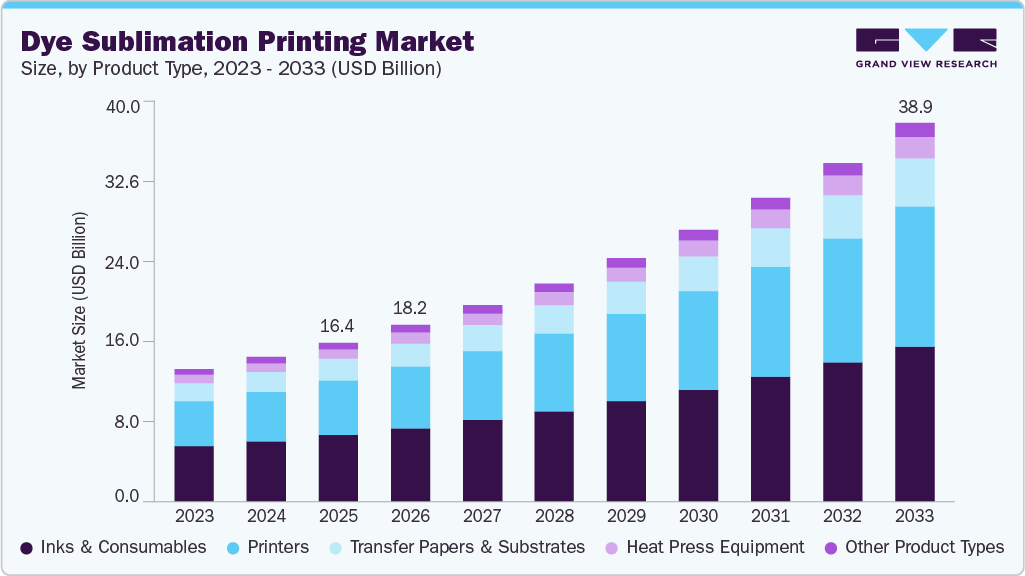 To learn more about this report, Download Free Sample Report
 The rising demand for customized apparel and merchandise is a key driver for the dye sublimation printing market. As consumers increasingly seek personalized clothing for self-expression, sports, or promotional purposes, businesses are turning to technologies such as dye sublimation to meet this demand. Dye sublimation offers high-quality, durable prints on polyester fabrics, making it ideal for customized t-shirts, sportswear, and other merchandise. In the apparel and textile sector, brands are leveraging dye sublimation printing to respond to fast fashion cycles, on-demand manufacturing, and mass customization strategies. Sportswear brands, for instance, are increasingly offering customized jerseys, team uniforms, and athleisure products with player names, numbers, and unique design elements. Dye sublimation’s ability to produce durable, fade-resistant prints on synthetic fabrics such as polyester makes it particularly attractive for performance apparel and activewear applications.
As per insights from Maker’s Row, Inc., the apparel market is led by casualwear (36%) and sportswear (21%), followed by formalwear (14%), intimatewear (10%), workwear & uniforms (9%), and other categories such as kidswear and maternity (10%), highlighting a strong shift toward comfort-driven, performance-oriented, and lifestyle apparel. This demand mix strongly supports the growth of the dye sublimation printing market, as the technology is well suited for polyester-based fabrics widely used in casual and sportswear, enabling vibrant, durable prints and rapid design changes.
The textile industry is increasingly focusing on sustainable production methods to reduce environmental impact. In February 2025, Mimaki Engineering Co., Ltd. launched the Tx330-1800 and Tx330-1800B printers, designed to minimize water usage and eliminate the need for extensive pre- and post-processing. These printers offer high-quality results with the ability to switch between textile pigment and dye sublimation inks, making them more versatile and eco-friendly. This shift towards waterless and efficient printing is driving the adoption of dye sublimation technology, supporting more sustainable and on-demand textile manufacturing.
The integration of dye sublimation with direct-to-garment (DTG) and UV (Ultraviolet) technologies in hybrid systems presents a significant opportunity for businesses to meet the growing demand for customized products. This hybrid system allows for printing on a wide range of materials: dye sublimation works best with polyester, DTG is ideal for cotton, and UV technology can print on hard surfaces such as wood or metal. This versatility enables businesses produce high-quality, personalized items more efficiently while also reducing waste. As the demand for eco-friendly and on-demand products rises, this integration offers a competitive edge in the market.
Dye sublimation is most effective on polyester or polyester-blend fabrics, as the ink bonds with the synthetic fibers at a molecular level when exposed to heat. However, it is challenging to use on natural fibers such as cotton, linen, or wool, which do not react well to the sublimation process. This creates limitations for businesses trying to meet demand for products made from natural fibers. As consumers increasingly prefer eco-friendly, natural materials, this challenge becomes more pronounced.
Product Type Insights
The inks & consumables segment accounted for the largest share of 41.8% in 2025, increasing demand for high-quality, on-demand, and customized printing. The growing adoption of digital printing technologies in textile and promotional product markets is a key factor behind this demand. Moreover, advancements in ink formulations, including eco-friendly options and faster drying times, are further fueling market growth. In August 2024, Prism Inks announced the launch of FUZION Ink Technology at Printing United. This patented innovation enables seamless integration across multiple printing methods, excelling in both Direct-to-Film (DTF) and Sublimation Printing. FUZION Ink allows printers to handle various materials, including polyester, cotton, and hard surfaces, using a single printer.
The printers segment is expected to grow at the fastest CAGR from 2026 to 2033. Factors such as the increasing adoption of digital printing solutions in textile and apparel manufacturing and, rise of on-demand printing for customized products, coupled with advancements in printer technologies that enhance speed, efficiency, and color accuracy, is propelling the segment growth. In addition, the growing demand for wide-format and industrial printers in sectors such as signage, sportswear, and promotional products likely to continue to fuel the market expansion.
Printing Technique Insights
The transfer dye sublimation printing segment accounted for the largest share in 2025, driven by its high efficiency and quality in applications such as sportswear, fashion, and promotional textiles. This printing technique’s ability to produce durable, vibrant designs on polyester and polyester-blend fabrics is a key factor in its dominance. Additionally, its low environmental impact due to the use of waterless printing technology and minimal waste further contributes to its widespread adoption, especially as demand for sustainable manufacturing increases.
The direct-to-fabric (D2F) segment is expected to grow at a significant CAGR during the forecast period. D2F technology’s ability to print directly onto fabric without the need for transfer paper reduces material waste and increases production efficiency. This makes it particularly attractive for custom textile manufacturers and businesses offering personalized apparel. Factors such as the rising demand for on-demand, short-run textile production, especially in the fashion and home decor sectors, is further contributing to the growth of this segment. In addition, D2F's quick turnaround times and ability to handle diverse fabric types make it highly relevant to the evolving needs of the textile industry.
Application Insights
The textile & apparel printing segment accounted for the largest share in 2025. The major factor expected to drive the segment growth is the global shift toward polyester-based performance fabrics. Polyester remains the dominant synthetic fiber globally, making it inherently compatible with dye sublimation technology. In addition, the acceleration of fast-fashion and demand-responsive supply chains is reducing batch sizes and increasing design turnover, which is another factor expected to support the segment growth. Moreover, the structural growth of athleisure and sportswear categories supports sublimation due to superior color vibrancy and durability on stretch fabrics. Also, sustainability pressure on water-intensive dyeing processes is accelerating digital dyeing alternatives further accelerating the segment growth.
The soft signage segment is expected to register a notable CAGR from 2026 to 2033. Factors such as the increasing demand for lightweight, foldable, and reusable display materials in retail, exhibitions, and trade shows, rising adoption of polyester-based fabrics over traditional PVC for sustainability, and the need for vibrant, high-resolution graphics are driving growth. Companies are introducing advanced printing solutions tailored for wide-format, high-speed production to meet the rising demand for soft signage.
End User Insights
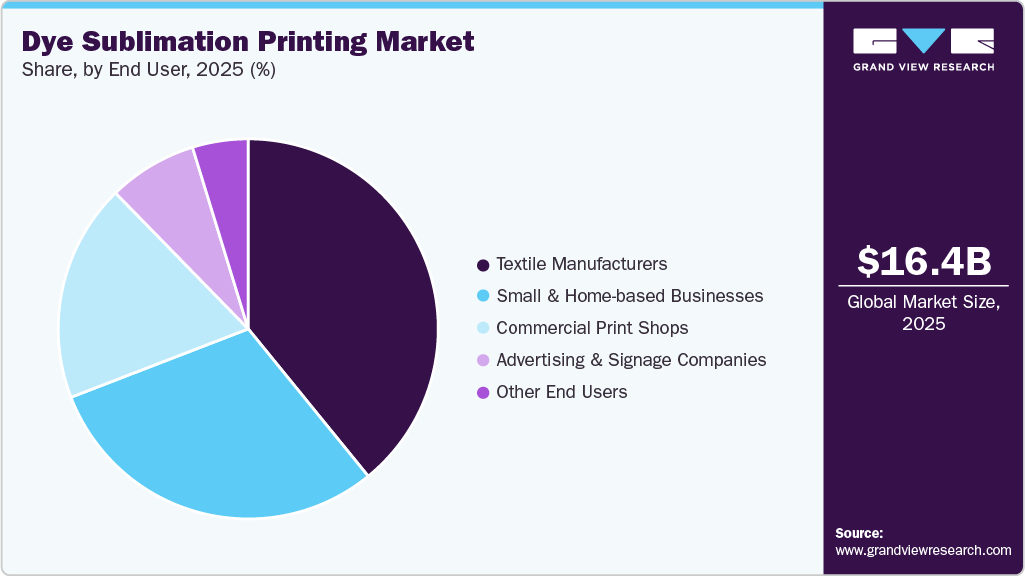
The textile manufacturers segment accounted for the largest share in 2025. The segment growth is attributed to industrial shift from analog dyeing and rotary screen printing to digital textile production systems. Conventional dyeing processes are water- and chemical-intensive also sustainability pressure from global environmental frameworks is accelerating adoption of lower-effluent digital technologies. In addition, polyester remains the dominant fiber in global textile production, supporting sublimation compatibility at scale.
 To learn more about this report, Download Free Sample Report
 The small & home-based businesses segment is expected to register a notable CAGR from 2026 to 2033. Small & home-based businesses segment includes individuals or small-scale entrepreneurs who operate printing businesses from home or small workshops, often focusing on personalized products. Factors such as the rising popularity of personalized merchandise, increasing accessibility of compact and affordable dye sublimation printers, growth of online platforms including Redbubble, Etsy and Shopify, expanding side-hustle culture, and the availability of user-friendly design software and plug-and-play printing systems are supporting the segment growth during forecast period.
Regional Insights
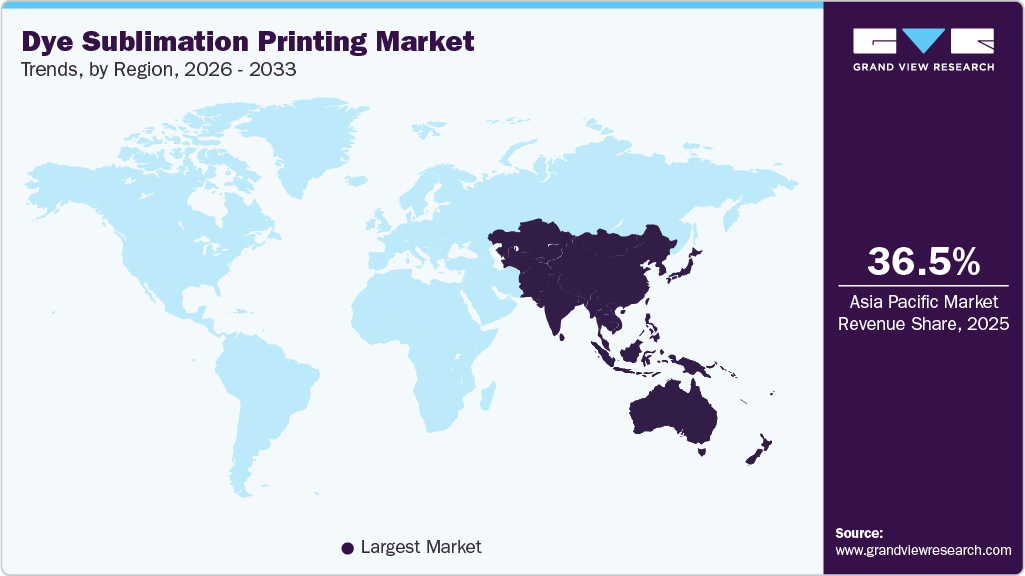
The Asia Pacific dye sublimation printing market accounted for 36.46% of the global share in 2025, driven by factors such as the rapid growth of the textile and apparel sector, rising demand for personalized and on-demand printing, and the expansion of e-commerce platforms. Key drivers include the increasing adoption of digital printing technologies for custom apparel and home decor, the growth of the fashion industry in countries such as India and Vietnam, the surge in demand for high-quality promotional products, and advancements in printing equipment that enable faster production speeds and improved print quality.
 To learn more about this report, Download Free Sample Report
 Countries such as Vietnam, India, Japan, and China are emerging as key players in the global textile sector. According to the Vietnam Textile and Apparel Association, Vietnam's textile exports reached USD 44 billion in 2023, with the US as its largest market. Additionally, according to the India Brand Equity Foundation, the India’s textile market is projected to grow at a 10% CAGR to USD 350 billion by 2030, with exports expected to reach USD 100 billion. China, the world's largest textile exporter, also saw textile and garment exports rise to USD 293.6 billion in 2023.The rapid growth in textile manufacturing in these countries is driving the demand for advanced printing technologies, including dye sublimation, as businesses aim to meet the growing need for customized and personalized textile products.
Dye sublimation printing market in China held a substantial market share in 2025, driven by the increasing demand for eco-friendly printing solutions, the shift toward faster turnaround times in production, the need for cost-effective solutions in mass customization, and the growing trend of on-demand manufacturing in fashion and textiles. This is further supported by the country’s position as the world’s largest textile exporter. According to the General Administration of Customs, China's textile and apparel exports in 2025 amounted to USD 293.77 billion. The textile sector continues to expand, with textile exports rising by 0.5% to USD 142.58 billion in 2025. This growth in the textile industry is driving the adoption of advanced printing technologies, including dye sublimation, as manufacturers aim to meet global market needs for personalized apparel and textiles. Additionally, the rising demand for vibrant, high-quality prints in the signboard industry, coupled with the growing adoption of sustainable printing practices, further contributes to the expansion of dye sublimation technologies in China.
Japan dye sublimation printing market held a significant share in 2025, supported by Japan’s strong position as a global fashion influencer, high demand for premium-quality prints, and growing preference for sustainable production methods. Additionally, the increasing popularity of anime culture, with its demand for vibrant, high-resolution prints on various products, and the rising interest in customized home decor, are fueling further growth in the dye sublimation printing market in Japan.
According to the EU-Japan Centre for Industrial Cooperation, while the domestic apparel market has experienced slight contraction, the industry remains strong, with the top 60 companies generating over USD 52 billion (YEN 8 trillion) in 2022. This ongoing strength in the apparel sector, coupled with the growing demand for high-quality, customized prints, continues to drive the adoption of advanced printing technologies in the production of personalized fashion items and on-demand textiles in the country.
The India dye sublimation printing market held a substantial market share in 2025, driven by the growing demand for personalized home décor, the expansion of the fashion and textiles export market, and the rising popularity of on-demand production. According to the India Brand Equity Foundation, the interior design market in India is projected to reach USD 81.2 billion by 2030, growing at a CAGR of 14.3%. This surge is pushing the demand for high-quality, customized printing solutions, especially in areas like home furnishings and apparel.
India’s robust textile and apparel manufacturing base, along with its position as the sixth-largest textile exporter globally, further supports the adoption of dye sublimation printing technologies for both domestic and international markets. Additionally, the rise of e-commerce and custom printing services is driving the demand for quick turnaround times and affordable production in the region.
Europe Dye Sublimation Printing Market Trends
The European dye sublimation printing industry was identified as a lucrative region in 2025. The European dye sublimation printing market is witnessing significant transformation, driven by the region's strong position as a major apparel exporter and increasing adoption of digital printing for both local and international markets, rapid expansion of the apparel and textile export markets, growing demand for high-quality, customizable products, and advancements in eco-friendly printing technologies. According to a report by CBI (a Dutch governmental organisation), Europe (EU) apparel exports grew at an average annual rate of 5.5% from 2021 to 2023, with Germany, Italy, the Netherlands, France, Spain, and Poland accounting for 75.2% of the region’s apparel exports. The EU, as the second-largest apparel exporter globally, shipped USD 150.12 billion (EUR 140.3 billion) worth of apparel in 2023, showcasing the region’s growing prominence in the global textile and fashion market. The continuous demand for innovative, high-quality, and personalized fashion items is fueling the expansion of dye sublimation printing technologies across Europe.
The German dye sublimation printing market is being shaped by Germany’s position as Europe’s largest apparel importer, the growing demand for customized textile products, and the trend toward faster and more sustainable production methods. In 2023, Germany imported apparel worth USD 42.06 billion (EUR 38.94 billion), with nearly half (49.4%) coming from other EU countries. Between 2021 and 2023, intra-EU apparel imports grew at an average annual rate of 6.9%, significantly outpacing the 1.5% growth of extra-EU imports. Germany's dominant role as Europe’s largest apparel importer, combined with the rising demand for customized and sustainable textiles, is driving the adoption of dye sublimation printing technologies.
Dye sublimation printing market in the UK is witnessing a significant growth, particularly in areas including home decor, personalized fashion, and promotional products. This surge has driven the demand for dye sublimation printing solutions, especially for high-quality, customized textile products. Factors such as the growing trend of personalized fashion and home decor items, the increasing use of dye sublimation for promotional product printing, and the expansion of eco-conscious manufacturing methods are supporting the growth in the country. Moreover, advancements in printing technology, such as improved color accuracy and faster production times, are further fueling the adoption of dye sublimation printing in the country.
North America Dye Sublimation Printing Market Trends
The North American dye sublimation printing market in 2025 is primarily driven by the rising demand for customized textiles, the growth of e-commerce, and the shift toward sustainable production methods. As consumers demand personalized products, manufacturers are turning to advanced technologies, including dye sublimation, for high-quality, on-demand fashion. In addition, faster production timelines and eco-friendly alternatives are boosting adoption. The U.S. textile sector's investments in technology further support this trend, while Mexico's competitive production costs and skilled workforce contribute to regional textile manufacturing growth. Furthermore, expanding applications in signboard printing, promotional product printing, home decor, and photo & art printing are further fueling the region's growing demand for dye sublimation printing technologies.
U.S. Dye Sublimation Printing Market Trends
The U.S. dye sublimation printing industry held a dominant position in 2025. The dye sublimation printing market in the U.S. is witnessing significant transformation, driven by increasing demand for personalized and on-demand apparel, the growth of e-commerce retail, and the shift toward localizing textile production to improve speed and supply chain reliability. According to the U.S. Census Bureau, clothing and accessories retail sales surged to USD 25.3 billion in October 2024, up from USD 15.9 billion in January 2022. As consumer expectations shift toward speed and personalization, dye sublimation printing is emerging as a vital tool for brands to stay competitive and meet market demands effectively.
Key Dye Sublimation Printing Company Insights
Some of the key players operating in the market include Seiko Epson Corporation, Mimaki Engineering Co., Ltd., Roland DG Corporation, HP Inc., and Sawgrass Technologies, Inc.
-
Founded in 1942 and headquartered in Nagano, Japan, Seiko Epson Corporation is a prominent manufacturer of printing and imaging equipment. The company specializes in dye sublimation printing through its extensive portfolio of high-performance printers used in textile, signage, and industrial printing applications. Epson’s dye sublimation solutions are known for their precision, speed, and energy efficiency. The company leverages its proprietary PrecisionCore technology and eco-friendly innovations to support sustainable and on-demand printing.
-
Founded in 1975 and headquartered in Nagano, Japan, Mimaki Engineering Co., Ltd. is a provider of industrial inkjet printers and cutting plotters. The company is a key player in the dye sublimation printing space, offering a wide range of textile printers designed for apparel, sportswear, and soft signage. Mimaki is known for its advanced printhead technology, high-resolution output, and eco-conscious ink systems.
Key Dye Sublimation Printing Companies:
The following key companies have been profiled for this study on the dye sublimation printing market.
- Seiko Epson Corporation
- Mimaki Engineering Co., Ltd.
- Roland DG Corporation
- HP Inc.
- Sawgrass Technologies, Inc.
- FUJIFILM Corporation.
- Durst Group Ag
- MeiTu Digital Industry Co.
- Dover Industries Italy S.r.l
- Mutoh Industries Ltd.
Recent Developments
-
In September 2025, Seiko Epson Corporation appointed Nova Chrome UK as an official UK reseller for Epson’s SC-F series of desktop dye-sublimation printers. This partnership broadens Nova Chrome UK’s hardware portfolio while providing customers with direct access to Epson’s compact dye-sublimation solutions, including the SureColor SC-F500.
-
In September 2025, MS Printing Solutions and JK Group launched the MP Series, a new range of five multi-pass digital textile printers. The series offers models spanning sublimation paper to direct-to-fabric printing, with up to 16 print heads, multiple ink options (reactive, disperse, acid, and pigment), and speeds up to 630 m²/h. Built on a new platform, the printers feature improved body design, electronics, safety, and durability, with fewer parts for easier maintenance.
-
In March 2025, Seiko Epson Corporation and Currie Group announced a partnership under which Currie Group will incorporate Epson’s solutions into its portfolio for the sign, graphics, and wide-format printing sector. This collaboration expands Epson’s market reach while further strengthening Currie Group’s sign and display offerings. Under this partnership, Currie Group is expected to add Epson’s products to its already broad lineup, including 64-inch Epson SureColor eco-solvent printers, as well as resin and dye-sublimation solutions, enabling high-productivity printing across a wide range of applications.
Dye Sublimation Printing Market Report Scope
Report Attribute
Details
Market size in 2025
USD 16.4 billion
Estimated Market size in 2026
USD 18.2 billion
Projected Market size by 2033
USD 39.0 billion
Growth rate
CAGR of 11.5% from 2026 to 2033
Base year for estimation
2025
Historical data
2021 - 2024
Forecast period
2026 - 2033
Quantitative units
Revenue in USD million/billion and CAGR from 2026 to 2033
Report Coverage
Revenue forecast, company market share, competitive landscape, growth factors, and trends
Segments Covered
Product type, printing technique, application, end user, region
Regional scope
North America; Europe; Asia Pacific; Latin America; MEA
Country scope
U.S.; Canada; Mexico; UK; Germany; France; China; India; Japan; Australia; South Korea; Brazil; UAE; Kingdom of Saudi Arabia (KSA); South Africa
Key companies profiled
Seiko Epson Corporation; Mimaki Engineering Co.; Ltd.; Roland DG Corporation; HP Inc.; Sawgrass Technologies, Inc.; FUJIFILM Corporation.; Durst Group Ag; MeiTu Digital Industry Co.; Dover Industries Italy S.r.l; Mutoh Industries Ltd.
Customization scope
Free report customization (equivalent up to 8 analysts working days) with purchase. Addition or alteration to country, regional & segment scope.
Pricing and purchase options
Avail customized purchase options to meet your exact research needs. Explore purchase options
Global Dye Sublimation Printing Market Report Segmentation
This report forecasts revenue growth at global, regional, and country levels and provides an analysis of the latest industry trends in each of the sub-segments from 2021 to 2030. For this study, Grand View Research has segmented the global dye sublimation printing market report based on product type, printing technique, application, end user, and region.
-
Product Type Outlook (Revenue, USD Billion, 2021 - 2033)
-
Inks & Consumables
-
Printers
-
Transfer Papers & Substrates
-
Heat Press Equipment
-
Other Product Types
-
-
Printing Technique Outlook (Revenue, USD Billion, 2021 - 2033)
-
Transfer Dye Sublimation Printing
-
Direct-to-Fabric (D2F)
-
Hybrid Printing
-
-
Application Outlook (Revenue, USD Billion, 2021 - 2033)
-
Textile & Apparel Printing
-
Soft Signage
-
Promotional Product Printing
-
Home Decor & Furnishing
-
Photo & Art Printing
-
-
End User Outlook (Revenue, USD Billion, 2021 - 2033)
-
Textile Manufacturers
-
Small & Home-based Businesses
-
Commercial Print Shops
-
Advertising & Signage Companies
-
Other End Users
-
-
Regional Outlook (Revenue, USD Billion, 2021 - 2033)
-
North America
-
U.S.
-
Canada
-
Mexico
-
-
Europe
-
UK
-
Germany
-
France
-
-
Asia Pacific
-
China
-
India
-
Japan
-
Australia
-
South Korea
-
-
Latin America
-
Brazil
-
-
Middle East & Africa (MEA)
-
UAE
-
Kingdom of Saudi Arabia (KSA)
-
South Africa
-
-
Frequently Asked Questions About This Report
The inks & consumables segment led with a 41.8% revenue share in 2025.
Transfer dye sublimation printing held the largest revenue share in 2025.
Textile & apparel printing held the largest share in 2025.
Some key players operating in the dye sublimation printing market include Seiko Epson Corporation, Mimaki Engineering Co., Ltd., Roland DG Corporation, HP Inc., Sawgrass Technologies, Inc., Kornit Digital Ltd., Durst Group Ag, Ricoh Company, Ltd., Dover Industries Italy S.r.l, Mutoh Industries Ltd.
Key factors that are driving the market growth include the rising demand for customized apparel and promotional merchandise, particularly from small businesses and e-commerce platforms.
The global dye sublimation printing market size was estimated at USD 16.4 billion in 2025 and is expected to reach USD 18.2 billion in 2026.
The global dye sublimation printing market is expected to grow at a compound annual growth rate of 11.5% from 2026 to 2033 to reach USD 39.0 billion by 2033.
The Asia Pacific market accounted for 36.5% of the global share in 2025.
About the Author(s)
Next Generation Technologies Research Team
Technology · Next Generation TechnologiesThis report was authored by the next generation technologies research team at Grand View Research - comprising two research analysts, one senior research analyst, and one industry expert - with specialized expertise in the next generation technologies segment of the technology industry. All findings are based on proprietary technology databases, executive interviews, and regulatory analysis, subject to internal peer review prior to publication.
Last Updated:
Speak to Analyst

Customize this report to your needs - add regions, segments, or data points, with 20% free customization.
Or view our licence options:


ISO 9001:2015 & 27001:2022 Certified
We are GDPR and CCPA compliant! Your transaction & personal information is safe and secure. For more details, please read our privacy policy.


