
- Home
- »
- Healthcare IT
- »
-
Edge Computing In Healthcare Market Report, 2026-2033GVR Report cover

Edge Computing In Healthcare Market (2026 - 2033)
Size, Share & Trends Analysis Report By Component (Hardware, Software & Services), By Application (Telehealth & Remote Patient Monitoring, Diagnostics & Imaging), By End Use, By Region, And Segment Forecasts
Market Size, 2025
$5.8BMarket Estimate, 2026
$7.0BMarket Forecast, 2033
$24.8BCAGR, 2026–2033
19.8%Edge Computing In Healthcare Market Summary
The global edge computing in healthcare market size was valued at USD 5.8 billion in 2025 and is projected to grow from USD 7.0 billion in 2026 to USD 24.8 billion by 2033, at a CAGR of 19.8% from 2026 to 2033. The market in North America dominated with a revenue share of 55.9% in 2025. Rising adoption of connected medical devices and IoT in healthcare, growing demand for real-time patient monitoring and clinical decision support, and growth in telemedicine and remote healthcare services are factors contributing to market growth.
 Source: Grand View Research, IR Documents, Primary Interviews, Paid DatabasesTo learn more about this report,
 Download Free Sample Report
 Key Market Trends & Insights
- By component: Hardware segment held the largest market share of 53.9% in 2025.
- By end use: Hospitals segment held the largest market share of 42.9% in 2025.
- By application: Telehealth & remote patient monitoring segment held the largest market share of 29.9% in 2025.
Regional Highlights
- Largest regional market: North America (55.9% revenue share, 2025)
- Fastest-growing regional market: Asia Pacific (highest CAGR, 2026-2033)
- By country: The U.S. held the largest market share in 2025
Market Size & Forecast
- Market size in 2025: USD 5.8 Billion
- Estimated market size in 2026: USD 7.0 Billion
- Projected market size by 2033: USD 24.8 Billion
- CAGR (2026-2033): 19.8%
Three ways to get this report
Buy it, customize it, or ask a question.Ask an Analyst
Analyst response in 1 business day
- AccessReport author, directly
- Reply timeWithin 1 working day
- No sales callDirect answer only
- FormatEmail reply
- CostFree, no cost
Get the Full Report
What the study covers
- FormatsPDF · Excel · Dashboard
- Timeline2026–2033 annual, 2025 base
- Coverage20+ countries, 5 regions
- Companies10+ key players profiled
Customize the Report
20% free customization
- IncludeCountries, segments, points
- TailorTo your product definition
- ExtendDeeper competitor detail
- OrA fully bespoke study
- Turnaround5–10 working days
 To learn more about this report, Download Free Sample Report
 Market Dynamics
The increasing deployment of connected medical devices, wearable sensors, and Internet of Medical Things (IoMT) platforms is a major market driver. Healthcare organizations generate large volumes of real-time patient data that require immediate processing for clinical decision-making and continuous monitoring. Edge computing enables local data processing near the source, reducing latency and improving responsiveness in critical care environments. The growing use of smart infusion pumps, remote cardiac monitors, connected imaging systems, and ICU monitoring devices continues to accelerate demand for edge-enabled healthcare infrastructure. For instance, in patient management, Medtronic’s edge AI-enabled insulin delivery systems demonstrate clinical-grade, real-time decision-making by fusing biosensor streams for dynamic insulin dose adjustment. This system highlights the capability of AI-enabled wearables to deliver responsive, personalized interventions without requiring external connectivity, thereby supporting precision medicine in ambulatory settings.
Moreover, healthcare providers are increasingly adopting edge computing solutions to support real-time patient monitoring, rapid diagnostics, and AI-assisted clinical workflows. Edge-enabled systems process and analyze patient data locally, enabling faster alerts, predictive analytics, and timely interventions in emergency and critical care settings. The expansion of telehealth services, remote patient monitoring programs, and decentralized healthcare delivery models has further strengthened the need for low-latency computing capabilities. Hospitals and care providers are leveraging edge computing to improve operational efficiency, patient outcomes, and care continuity. For instance, in November 2025, CVS Health’s Aetna launched an edge conversational AI-powered healthcare navigation solution to simplify member engagement and improve access to benefits information. The platform uses generative AI and large language models to provide personalized support, guide members through healthcare services, and enhance customer experience while reducing administrative complexity and improving operational efficiency.
Furthermore, AI-powered healthcare applications, including medical imaging analysis, clinical decision support, predictive diagnostics, and personalized treatment planning, require rapid data processing capabilities. Edge computing enables the efficient execution of AI algorithms closer to healthcare devices and endpoints, reducing reliance on centralized cloud infrastructure. Increasing adoption of AI-driven diagnostics and intelligent healthcare systems is contributing significantly to market growth. For instance, in April 2026, Marquette University’s Biomedical Sciences department partnered with NVIDIA to develop advanced AI-driven neuroscience tools to accelerate brain research and neurological disease studies. The collaboration leverages NVIDIA’s edge computing and AI technologies to support large-scale data analysis, neural modeling, and innovative research applications, strengthening precision neuroscience capabilities and biomedical research innovation.
Market Concentration & Characteristics
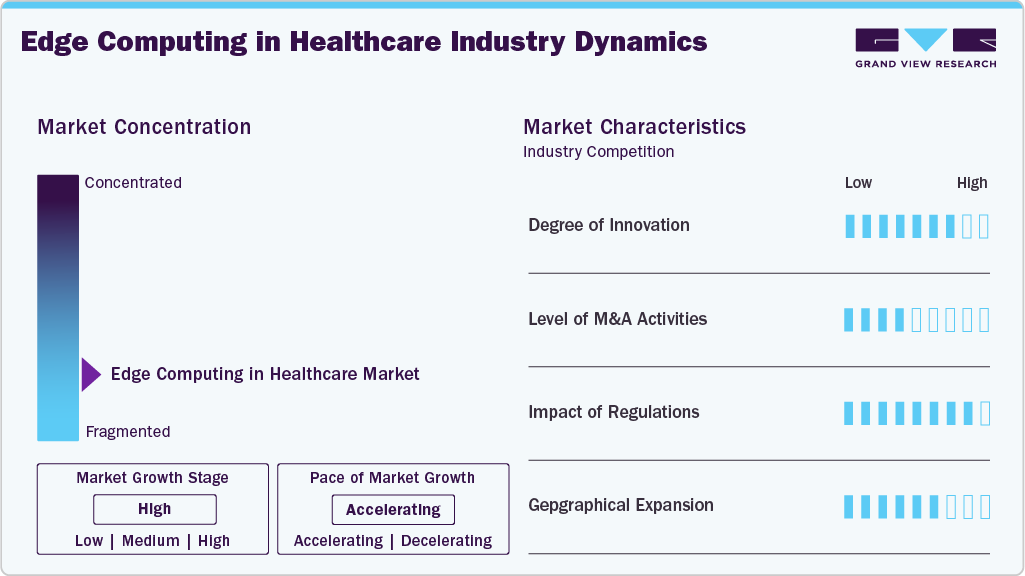
The chart below illustrates the relationship between industry concentration, characteristics, and participants. The x-axis represents the level of industry concentration, ranging from low to high. The y-axis represents various industry characteristics, including industry competition, level of partnerships & collaboration activities, degree of innovation, impact of regulations, and regional expansion. The edge computing in healthcare industry is slightly fragmented, with the presence of several emerging solution providers dominating the market. The degree of innovation is high, and the level of merger and acquisition activities is moderate. The impact of regulations on industry and the regional expansion of the industry is high.
The edge computing in healthcare industry experiences a high degree of innovation driven by technological advancements. For instance, in October 2025, NVIDIA introduced the IGX Thor platform to support physical AI applications across industrial and medical edge environments. The platform integrates advanced AI computing, real-time processing, and functional safety capabilities to enable autonomous systems, medical devices, robotics, and edge AI workloads, improving performance, reliability, and secure deployment in mission-critical applications.
 To learn more about this report, Download Free Sample Report
 The industry is experiencing a moderate level of merger and acquisition activities undertaken by several key players. This is due to the desire to gain a competitive advantage in the industry, enhance technological capabilities, and consolidate in a rapidly growing market.
Regulations, such as HIPAA in the U.S. and the GDPR in Europe, establish standards for safeguarding patient data privacy and security. Compliance with these regulations is crucial for AI applications in healthcare to ensure the safe and secure handling of patient information, reducing the risk of data breaches and unauthorized access.
Companies within the edge AI sector seek geographic expansion strategies to maintain their foothold in emerging markets and attract customers from these regions.Moreover, the industry is witnessing significant geographical expansion, driven by an increasing customer base for generative AI software. With the growing adoption of digital healthcare solutions, the market is expected to grow significantly in the coming years, especially in developing countries.
Application Insights
The telehealth & remote patient monitoring segment dominated the edge computing in healthcare industry with a revenue share of 29.9% in 2025. In addition, this segment is anticipated to grow at the fastest CAGR during the forecast period. Edge computing enables real-time processing of patient data generated from wearable sensors, home monitoring systems, and telehealth applications, improving response times and clinical decision-making. Healthcare providers are leveraging edge-enabled systems to support continuous monitoring of chronic disease patients and high-risk populations outside traditional healthcare settings.
The clinical workflow management segment is expected to grow significantly during the forecast period, due to increasing demand for real-time data access, workflow automation, and efficient care coordination across healthcare facilities. Edge computing enables rapid processing of patient information at the point of care, improving clinical responsiveness and reducing delays in decision-making. In addition, demand for automated alert systems, predictive workflow analytics, and real-time operational monitoring is increasing across acute care and emergency settings.
Component Insights
Hardware dominated the market with a revenue share of 53.9% in 2025. This is due to the increasing deployment of edge servers, gateways, routers, sensors, and connected medical devices across healthcare facilities. Hospitals and diagnostic centers rely on advanced hardware infrastructure to support real-time data processing, remote patient monitoring, and AI-enabled clinical applications. The growing adoption of Internet of Medical Things (IoMT) devices is further driving demand for high-performance edge hardware solutions.
The software & services segment is expected to grow at the fastest CAGR during the forecast period due to increasing demand for real-time analytics, device management, and decentralized healthcare data processing solutions. Healthcare organizations are adopting edge software platforms to support AI-driven diagnostics, remote patient monitoring, and clinical workflow optimization. These solutions enable seamless integration between connected medical devices, hospital information systems, and cloud infrastructure. Moreover, the services component is expanding as healthcare providers increasingly require consulting, deployment, integration, and maintenance support for edge computing infrastructure.
End Use Insights
The hospitals segment dominated the market, with the largest revenue share of 42.9% in 2025. This is due to the increasing adoption of connected medical devices, digital health platforms, and AI-enabled clinical systems across hospital environments. Hospitals generate large volumes of patient and operational data that require real-time processing for diagnostics, monitoring, and clinical decision-making.
 To learn more about this report, Download Free Sample Report
 The long-term care & homecare settings segment is projected to grow at the fastest CAGR from 2026 to 2033 due to increasing demand for remote healthcare delivery and continuous patient monitoring solutions. Edge computing enables real-time processing of patient data generated through wearable devices, home monitoring systems, and connected medical equipment, supporting timely clinical interventions. The segment is also benefiting from advancements in Internet of Medical Things (IoMT) devices, AI-driven monitoring systems, and high-speed healthcare connectivity infrastructure.
Regional Insights
North America dominated the edge computing in healthcare market with the largest revenue share of 55.9% in 2025. The region benefits from advanced healthcare IT infrastructure, strong cloud and network connectivity, and widespread adoption of connected medical devices, creating a favorable environment for edge computing deployment across healthcare settings. Moreover, rising demand for real-time patient monitoring, low-latency data processing, and secure decentralized healthcare data management has accelerated market expansion. Strong investments from healthcare providers, technology companies, and government initiatives focused on digital healthcare transformation continue to strengthen the adoption of edge-enabled healthcare systems across hospitals, diagnostic centers, and remote care environments.
 To learn more about this report, Download Free Sample Report
 U.S. Edge Computing in Healthcare Market Trends
The edge computing in healthcare market in the U.S. is expanding rapidly, supported by increasing deployment of IoT-enabled medical devices, growing telehealth adoption, and rising demand for real-time healthcare analytics. Healthcare organizations are increasingly leveraging edge computing platforms to process patient data locally, improve response times, and enhance clinical decision-making while reducing network dependency and latency. Hospitals and health systems are integrating edge infrastructure into critical care monitoring, imaging systems, and remote patient management applications to improve operational efficiency and patient outcomes. The presence of major technology providers and strong investment in digital healthcare infrastructure further support market growth in the country.
Europe Edge Computing in Healthcare Market Trends
The edge computing in healthcare market in Europe is steadily growing, supported by advanced healthcare systems, increasing digitization of hospitals, and growing emphasis on secure and efficient healthcare data processing. Countries such as the UK, Germany, and France are actively implementing edge computing technologies across healthcare facilities to support connected care, medical imaging, remote diagnostics, and AI-enabled clinical applications. The region is also witnessing rising adoption of edge-enabled solutions to comply with healthcare data privacy regulations while improving data accessibility and reducing latency in healthcare operations.
The UK edge computing in healthcare market is advancing as healthcare providers increasingly adopt decentralized computing technologies to improve care delivery and operational efficiency within the National Health Service (NHS). Growing investments in digital health infrastructure and connected healthcare ecosystems are driving the deployment of edge-enabled systems for remote patient monitoring, diagnostic imaging, and hospital workflow optimization. Healthcare organizations are also leveraging edge computing to support AI-powered healthcare applications and manage rising healthcare data volumes more efficiently across clinical environments. For instance, in December 2023, DeepTek.ai partnered with UK-based AiOne Healthcare Technologies to deploy Augmento, an FDA-cleared AI radiology orchestration platform.
The edge computing in healthcare market in Germany is expanding as the country accelerates healthcare digitalization and strengthens integration of advanced computing technologies across hospitals and medical research facilities. Healthcare providers and technology companies are increasingly deploying edge computing infrastructure to support real-time analytics, connected medical devices, and AI-assisted diagnostics. Growing focus on secure healthcare data processing, industrial-grade connectivity, and smart hospital initiatives is further contributing to market expansion across the country’s healthcare ecosystem.
Asia Pacific Edge Computing in Healthcare Market Trends
The edge computing in healthcare market in the Asia Pacific is expected to grow at the fastest CAGR from 2026 to 2033. Asia Pacific is rapidly emerging as a major hub for edge computing adoption in healthcare, driven by expanding digital healthcare infrastructure, increasing penetration of connected medical devices, and rising healthcare data generation across the region. Governments and healthcare providers are investing in advanced computing technologies to improve healthcare accessibility, strengthen telemedicine capabilities, and support real-time patient monitoring and analytics. Rapid urbanization, growing healthcare expenditure, and ongoing smart healthcare initiatives are further accelerating market growth across the Asia Pacific.
China edge computing in healthcare market is expected to grow significantly over the forecast period. China has emerged as a key market for healthcare edge computing, supported by strong government-backed digital health initiatives, expanding 5G infrastructure, and large-scale adoption of connected healthcare technologies. Healthcare institutions are increasingly deploying edge-enabled platforms to support real-time diagnostics, intelligent hospital systems, remote patient monitoring, and AI-driven healthcare applications. Strategic investments in smart hospitals and healthcare digital transformation programs are strengthening the country’s position as a major innovation hub for edge-enabled healthcare services and infrastructure.
The edge computing in healthcare market in Indiais expected to grow significantly over the forecast period. The country is increasingly adopting edge computing technologies to strengthen healthcare delivery, driven by rising telemedicine adoption, expanding digital health initiatives, and increasing deployment of connected medical devices. Government programs promoting healthcare digitization and growing investments in healthcare IT infrastructure are supporting the integration of edge-enabled systems across hospitals, diagnostic centers, and remote healthcare networks. Collaborations between healthcare providers, technology companies, and research institutions are also accelerating the development of scalable and cost-effective edge healthcare solutions across the country.
Latin America Edge Computing in Healthcare Market Trends
The edge computing in healthcare market in Latin America is expected to grow significantly over the forecast period. Latin America is progressively adopting edge-enabled healthcare technologies to improve healthcare accessibility, operational efficiency, and patient monitoring capabilities across healthcare systems. Regional healthcare providers are investing in connected healthcare infrastructure, telemedicine platforms, and decentralized data processing solutions to manage increasing healthcare data volumes and support real-time clinical decision-making. Growing demand for remote healthcare services and digital transformation initiatives is contributing to the expansion of edge computing applications across the region.
Middle East & Africa Edge Computing in Healthcare Market Trends
The edge computing in healthcare market in MEA is expected to grow lucratively from 2026 to 2033. In the MEA region, healthcare providers and governments are increasingly investing in digital healthcare infrastructure and smart hospital initiatives to improve healthcare accessibility and operational efficiency. Edge computing technologies are gaining traction across healthcare facilities to support connected medical devices, remote patient monitoring, AI-enabled diagnostics, and secure local data processing. Rising adoption of telehealth services and increasing focus on healthcare modernization are further supporting the deployment of edge-enabled healthcare platforms across the region.
Key Edge Computing In Healthcare Company Insights
Key players operating in the edge computing in healthcare market are undertaking various initiatives to strengthen their market presence and increase the reach of their products and services. Strategies such as new product launches and partnerships are playing a key role in propelling the market growth. Market players such as NVIDIA Corporation; Huawei Technologies Co., Ltd.; IBM Corporation; Microsoft Corporation; Amazon Web Services (AWS) and others dominate the market. These key players have been developing novel technologies to cater to different end-use applications.
Key Edge Computing In Healthcare Companies:
The following key companies have been profiled for this study on the edge computing in healthcare market.
- Huawei Technologies Co., Ltd.
- Advantech Co., Ltd.
- Koninklijke Philips N.V.
- Cognizant
- NVIDIA Corporation
- IBM Corporation
- Microsoft Corporation
- Amazon Web Services (AWS)
Recent Developments
-
In April 2026, Penguin AI launched Gwen, a build-your-own AI platform enabling healthcare teams to create/deploy governed AI workflows.
-
In January 2026, NXP Semiconductors and GE HealthCare partnered to develop edge AI solutions for acute care. Concepts include voice-command control of anesthesia equipment and neonatal monitoring, as well as detection of cries, objects, and sleep positions.
-
In October 2025, Penguin AI partnered with UPMC Enterprises to co-develop healthcare AI models using the Ahavi data platform. Access to secure, de-identified real-world data accelerates Patient 360 and Enhanced Prior Authorization solutions, strengthening doctor-patient relationships and operational efficiency.
Edge Computing In Healthcare Market Report Scope
Report Attribute
Details
Market size in 2025
USD 5.8 billion
Estimated market size in 2026
USD 7.0 billion
Projected market size by 2033
USD 24.8 billion
Growth rate
CAGR of 19.8% from 2026 to 2033
Actual data
2021 - 2025
Forecast period
2026 - 2033
Quantitative units
Market value in USD million/billion, and CAGR from 2026 to 2033
Report coverage
Revenue forecast, company ranking, competitive landscape, growth factors, and trends
Segments covered
Component, application, end use, region
Regional scope
North America; Europe; Asia Pacific; Latin America; MEA
Country scope
U.S.; Canada; Mexico; Germany; UK; France; Italy; Spain; Norway; Denmark; Sweden; China; Japan; India; South Korea; Australia; Thailand; Brazil; Argentina; Saudi Arabia; South Africa; UAE; Kuwait
Key companies profiled
Huawei Technologies Co., Ltd.; Advantech Co., Ltd.; Koninklijke Philips N.V.; Cognizant; NVIDIA Corporation; IBM Corporation; Microsoft Corporation; Amazon Web Services (AWS)
Customization scope
Free report customization (equivalent up to 8 analysts working days) with purchase. Addition or alteration to country, regional & segment scope.
Pricing and purchase options
Avail customized purchase options to meet your exact research needs. Explore purchase options
Global Edge Computing In Healthcare Market Report Segmentation
This report forecasts revenue growth at the global, regional, and country levels and provides an analysis of the industry trends in each of the sub-segments from 2021 to 2033. For this study, Grand View Research has segmented the global edge computing in healthcare market report based on component, end use, application, and region:
 To learn more about this report, Download Free Sample Report
 -
Component Outlook (Revenue, USD Million, 2021 - 2033)
-
Hardware
-
Software & Services
-
-
Application Outlook (Revenue, USD Million, 2021 - 2033)
-
Telehealth & Remote Patient Monitoring
-
Diagnostics & Imaging
-
Robotic & AI-Assisted Surgery
-
Connected Ambulances & Emergency Care
-
Clinical Workflow Management
-
Others
-
-
End Use Outlook (Revenue, USD Million, 2021 - 2033)
-
Hospitals
-
Physician Practices & Ambulatory Clinics
-
Diagnostic & Imaging Centers
-
Long-Term Care & Homecare Settings
-
Others
-
-
Regional Outlook (Revenue, USD Million, 2021 - 2033)
-
North America
-
U.S.
-
Canada
-
Mexico
-
-
Europe
-
Germany
-
UK
-
France
-
Italy
-
Spain
-
Denmark
-
Sweden
-
Norway
-
-
Asia Pacific
-
China
-
Japan
-
India
-
South Korea
-
Australia
-
Thailand
-
-
Latin America
-
Brazil
-
Argentina
-
-
Middle East and Africa
-
Saudi Arabia
-
UAE
-
South Africa
-
Kuwait
-
-
Frequently Asked Questions About This Report
Key factors that are driving the edge computing in healthcare market are rising adoption of connected medical devices and IoT in healthcare, growing demand for real-time patient monitoring and clinical decision support, and growth in telemedicine and remote healthcare services.
North America dominated with a 55.9% revenue share in 2025.
Asia Pacific is the fastest-growing region over the forecast period.
The telehealth & remote patient monitoring segment led with a 29.9% revenue share in 2025.
The hospitals segment led with a 42.9% revenue share in 2025, while long-term care & homecare settings is the fastest-growing segment.
The global edge computing in healthcare market size was valued at USD 5.8 billion in 2025 and is estimated at USD 7.0 billion for 2026.
The global edge computing in healthcare market is expected to grow at a CAGR of 19.8% from 2026 to 2033, reaching USD 24.8 billion by 2033.
The hardware segment led with a 53.9% revenue share in 2025, while software & services is the fastest-growing component.
Key players include Huawei Technologies Co., Ltd.; Advantech Co., Ltd.; Koninklijke Philips N.V.; Cognizant; NVIDIA Corporation; IBM Corporation; Microsoft Corporation; Amazon Web Services (AWS).
About the Author(s)
Healthcare IT Research Team
Healthcare · Healthcare ITThis report was authored by the healthcare it research team at Grand View Research - comprising two research analysts, one senior research analyst, and one industry expert - with specialized expertise in the healthcare it segment of the healthcare industry. All findings are based on proprietary healthcare databases, executive interviews, and regulatory analysis, subject to internal peer review prior to publication.
Last Updated:
Speak to Analyst

Customize this report to your needs - add regions, segments, or data points, with 20% free customization.
Or view our licence options:


ISO 9001:2015 & 27001:2022 Certified
We are GDPR and CCPA compliant! Your transaction & personal information is safe and secure. For more details, please read our privacy policy.


