
- Home
- »
- Food Additives & Nutricosmetics
- »
-
Edible Coatings Market Size & Share, Industry Report, 2033GVR Report cover
![Edible Coatings Market Size, Share & Trends Report]()
Edible Coatings Market (2025 - 2033) Size, Share & Trends Analysis Report By Product (Polysaccharides, Proteins, Lipids, Composite Products), By Application (Fruits & Vegetables, Pharmaceutical, Dairy Products), By Region, And Segment Forecasts
- Report ID: GVR-4-68040-776-7
- Number of Report Pages: 80
- Format: PDF
- Historical Range: 2018 - 2023
- Forecast Period: 2025 - 2033
- Industry: Specialty & Chemicals
- Report Summary
- Table of Contents
- Segmentation
- Methodology
- Download FREE Sample
-
 Download Sample Report
Edible Coatings Market Summary
The global edible coatings market size was estimated at USD 2,156.34 million in 2024 and is projected to reach USD 3811.80 million by 2033, growing at a CAGR of 6.7% from 2025 to 2033. The edible coatings industry is experiencing significant growth driven by rising consumer demand for fresh, chemical-free, and longer-lasting food products.
Key Market Trends & Insights
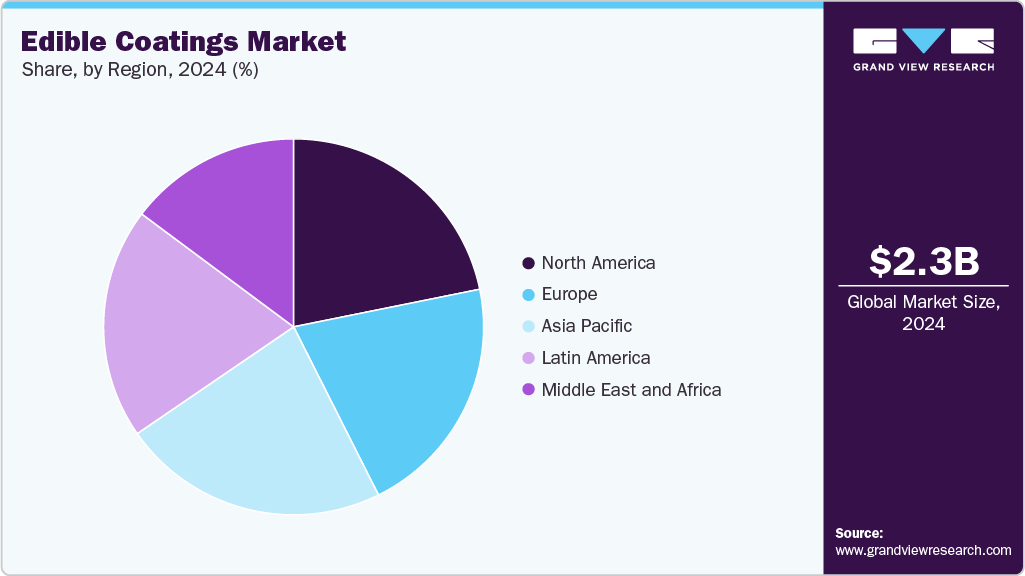
- North America edible coatings industry dominated globally with the largest global revenue share of 34.41% in 2024.
- Asia Pacific is expected to grow fastest with a CAGR of 7.1% from 2025 to 2033.
- The polysaccharides segment dominated the market and accounted for the largest revenue share of 42.22% in 2024.
- The fruits & vegetables segment is expected to grow fastest with a CAGR of 7.0% from 2025 to 2033
Market Size & Forecast
- 2024 Market Size: USD 2,156.34 Million
- 2033 Projected Market Size: USD 3,811.80 Million
- CAGR (2025-2033): 6.7%
Increasing regulatory focus on food safety and waste reduction is accelerating the adoption of natural, plant-based coatings that preserve freshness and extend shelf life across various perishable categories. These sustainable solutions enable manufacturers to meet clean-label expectations, enhance product quality, and align with corporate sustainability objectives, thereby strengthening brand value and market competitiveness.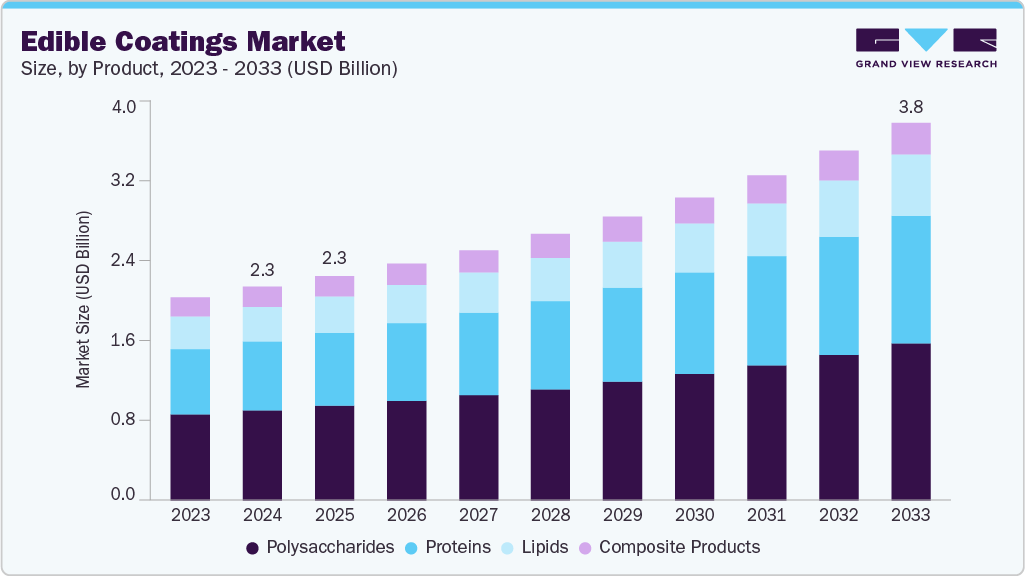
The market is witnessing accelerating growth as the food industry seeks sustainable solutions to reduce post-harvest losses and extend shelf life without relying on synthetic packaging. Growing global concerns over food waste, coupled with regulatory emphasis on natural and biodegradable preservation technologies, driving adoption across fruits, vegetables, meat, and dairy segments. Authorities such as the U.S. FDA and EFSA have endorsed the use of safe, food-grade Products like polysaccharides, proteins, and lipids for edible coatings, further strengthening market credibility. Rising consumer awareness and preference for clean-label, chemical-free products are significantly driving the demand for edible coatings. These coatings align with the growing “green packaging” and “zero-waste” initiatives adopted by manufacturers and retailers to promote sustainability and reduce environmental impact.
However, the market faces several challenges that restrain the rapid scale-up of edible coating technologies across the global food industry. The high production cost of advanced coatings, especially those incorporating active antimicrobial or antioxidant compounds, can limit adoption among small producers in cost-sensitive markets. Technical constraints such as maintaining consistent coating thickness, sensory neutrality, and compatibility with different food surfaces pose difficulties in achieving uniform product performance, maintaining the desired taste and appearance, and ensuring efficient large-scale manufacturing without compromising quality standards.
Despite existing challenges, the long-term growth outlook for the edible coatings industry remains highly optimistic, driven by sustained investments in biopolymer research, nanotechnology, and advanced functional formulations that are enhancing cost efficiency, scalability, and overall performance across global food manufacturing and preservation applications. Major food exporters are increasingly adopting edible coatings to minimize post-harvest losses, extend product shelf life, and meet international sustainability and regulatory standards. Simultaneously, the rapid expansion of retail and e-commerce channels is opening new distribution opportunities, enabling broader market penetration and faster adoption of these innovative coating solutions.
Market Concentration & Characteristics
The global edible coatings industry is moderately fragmented, with a mix of established players and emerging innovators competing across edible coating product and application segments. Key participants focus on biopolymer innovation, cost optimization, and strategic partnerships to enhance market presence. Market concentration is gradually increasing as major food and packaging companies pursue vertical integration and technology collaborations to secure a competitive advantage.
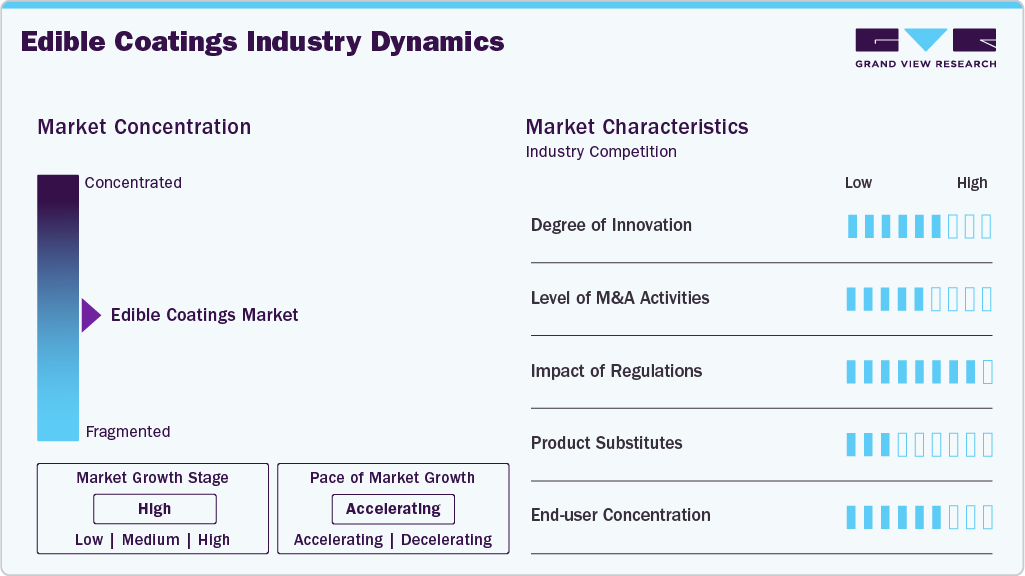
Leading global players such as Cargill, Inc., and Apeel Sciences have established strong market positions in the edible coatings industry through advanced R&D capabilities, diversified product portfolios, and early alignment with global food safety and sustainability standards. These companies collaborate closely with major food producers, retailers, and exporters to integrate natural coating solutions that enhance shelf life, reduce waste, and support compliance with international regulations. Meanwhile, regional and emerging players, particularly across Asia-Pacific and Latin America, are entering the market with cost-effective, plant-based formulations tailored to local consumer preferences and agricultural supply chains. This evolving competitive landscape is characterized by a mix of innovation-driven leadership and price-focused regional expansion, as established firms leverage technology and global partnerships, while new entrants emphasize affordability and adaptability to regional needs.
Product Insights
The polysaccharides segment dominated the market with a revenue share of 42.22% in 2024. Products such as starch, cellulose, alginate, and chitosan are popular for their biodegradability and compatibility with many foods. These coatings are widely used on fruits, vegetables, and confectionery to reduce moisture loss, delay spoilage, and keep products fresh without changing taste or appearance. Their transparency and ability to add active ingredients like antimicrobials and antioxidants increase their use. Growing demand for natural ingredients and new advances in coating technology are further driving this segment’s growth.
The protein segment is anticipated to be the fastest-growing segment with a CAGR of 7.2% over the forecast period. This growth is primarily driven by the rising demand for natural, biodegradable, and nutritionally functional products that meet clean-label and sustainability standards. Proteins such as whey, soy, and casein offer excellent film-forming, oxygen-barrier, and mechanical properties, making them ideal for protecting perishable foods like meat, dairy, and fresh produce. In addition, the shift toward reducing plastic usage and the ability of protein coatings to enhance shelf life without altering taste or appearance are accelerating their adoption among food processors.
Application Insights
The fruits and vegetables segment dominated the market with a revenue share of 39.99% in 2024. The market is driven by the increasing global emphasis on reducing post-harvest losses, extending shelf life, and maintaining freshness during long-distance transportation. With consumers demanding fresh, natural, and minimally processed produce, edible coatings offer an effective, sustainable alternative to synthetic preservatives and plastic packaging. Producers are increasingly adopting polysaccharide- and protein-based coatings to control moisture loss, delay ripening, and enhance visual appeal, particularly for export-grade fruits and vegetables.
The meat, poultry & seafood segment is anticipated to be the fastest-growing segment with a CAGR of 7.2% over the forecast period. Growth is driven by the need to reduce spoilage, extend shelf life, and meet stringent export standards for high-value protein products. North America leads adoption due to advanced food safety systems, while Asia-Pacific shows rapid uptake supported by expanding meat exports and improved cold-chain logistics. Increasing demand for natural, clean-label preservation solutions further accelerates investment in bio-based coating technologies that enhance product quality and global market competitiveness.
Regional Insights
North America edible coatings industry dominated globally with the largest global revenue share of 34.41% in 2024. The market is driven by the strong presence of established food processing industries, advanced R&D capabilities, and early adoption of sustainable food preservation technologies. High consumer awareness of clean-label and eco-friendly products, combined with the widespread use of modern cold-chain logistics, further supports regional market growth. Additionally, the strong focus on reducing food waste and meeting corporate sustainability goals among major retailers and food brands continues to propel innovation and large-scale implementation of edible coating solutions across North America.
U.S. Edible Coatings Market Trends
U.S. edible coatings industry dominated the market with a revenue share of 68.75%, driven by strong consumer demand for clean-label and sustainable food products, leading food processors and retailers are adopting edible coatings to enhance shelf life, preserve freshness, and meet corporate sustainability goals. Backed by stringent FDA regulations and high investment in biopolymer and active coating technologies, the U.S. market is expanding applications across fresh produce, dairy, and ready-to-eat foods. With its advanced regulatory framework and strong innovation ecosystem, the U.S. is expected to remain the global center for edible coating development in the coming years.
Asia Pacific Edible Coatings Market Trends
The Asia-Pacific edible coatings industry continues to grow in market fueled by the rapid expansion of the food processing industry and increasing demand for fresh and minimally processed foods. Countries such as China, India, Japan, and Thailand are witnessing strong adoption as producers seek cost-effective and sustainable solutions to extend shelf life and reduce food waste. Growing exports of fruits, vegetables, and seafood from the region have further accelerated the use of edible coatings to meet international quality standards.
China’s edible coatings industry continues to grow because its regulatory push toward sustainable and minimal packaging is indirectly supporting the growth of the market. Policies such as GB 43284-2023, which restrict excessive packaging for fresh agricultural products, and GB 23350-2021, targeting over-packaging in food and cosmetics, are encouraging the adoption of alternative, eco-friendly preservation methods. As edible coatings help reduce packaging waste while maintaining product quality, these regulations create a favorable environment for wider market adoption and innovation in coating technologies.
Europe Edible Coatings Market Trends
The edible coatings industry in Europe is advancing steadily as manufacturers focus on replacing synthetic preservatives with sustainable, bio-based alternatives. Stringent EU regulations promoting food safety and environmental protection have accelerated adoption, particularly across the bakery, confectionery, and fresh produce sectors. High consumer preference for natural, clean-label ingredients and strong R&D capabilities support innovation in advanced coating formulations. Collaborations between food producers and research institutions are enhancing performance and compliance standards, thereby proliferating the product adoption. With sustainability now central to food manufacturing strategies, Europe continues to lead in the development of premium and eco-friendly edible coating solutions.
Germany’s edible coatings industry is driven by the strong regulatory framework promoting sustainability and thus creating favorable conditions for the market. The revised Packaging Act (VerpackG) emphasizes waste reduction, reusable systems, and higher recycled content in food packaging, encouraging manufacturers to explore natural, biodegradable alternatives. In addition, Germany’s alignment with the EU Green Deal and Circular Economy Action Plan is driving the shift toward bio-based Products in the food sector. These policies indirectly support the adoption of edible coatings as eco-friendly solutions that reduce reliance on plastic and improve food preservation. Growing consumer awareness and corporate sustainability commitments further reinforce innovation and investment in advanced coating technologies.
Latin America Edible Coatings Market Trends
Latin America’s edible coatings industry is expanding steadily. The region’s strong export portfolio - including fruits like avocados, grapes, bananas, peaches, plums, and berries from Mexico, Chile, Costa Rica & Peru - is sending more producers to adopt coatings to reduce spoilage during long transit and meet tighter import standards abroad. Rising consumer and regulatory focus on food safety plus expansion of modern retail and cold-chain infrastructure are accelerating the adoption of edible coatings applications for fresh produce, dairy, and ready-to-eat foods in Latin America.
Middle East & Africa Edible Coatings Market Trends
The Middle East & Africa edible coatings industry driven by high temperature and arid climate conditions is shaping key trends in the Middle East market, driving innovation toward heat-stable and moisture-retentive formulations suitable for extreme environments. Manufacturers are prioritizing R&D in lipid- and polymer-based coatings that can maintain product integrity during long-distance transport and storage. The growing investment in temperature-controlled logistics and cold-chain systems is further supporting product reliability and export quality. Additionally, regional producers are collaborating with research institutions to develop climate-adapted coating solutions, positioning the Middle East as an emerging hub for sustainable, performance-driven edible coating technologies.
Key Edible Coatings Company Insights
Ingredion and Tate & Lyle dominate the market due to their strong focus on sustainable, plant-based technologies and innovative solutions that effectively extend food shelf life while meeting global demand for natural preservation methods.
-
Ingredion headquartered a global leader in starch-based and biopolymer coating solutions for the food industry. The company develops innovative, sustainable edible coatings that enhance shelf life, texture, and freshness across fruits, vegetables, bakery, and confectionery products. Leveraging strong R&D capabilities and advanced formulation technology, Ingredion delivers clean-label, plant-based solutions aligned with global sustainability and food safety trends, solidifying its position as a key innovator in the market.
-
Tate & Lyle is a prominent global manufacturer specializing in starch- and fiber-based edible coating solutions for the fruits & vegetables industry. The company focuses on developing sustainable, clean-label formulations that enhance moisture control, texture, and product stability across bakery, dairy, and confectionery applications. With strong R&D expertise and a global innovation network, the company integrates functional biopolymers and natural ingredients to meet evolving consumer and regulatory demands. Its commitment to sustainability and performance-driven innovation positions the company as a trusted partner for food manufacturers seeking advanced, eco-friendly coating technologies that improve quality and extend shelf life.
Key Edible Coatings Companies:
The following are the leading companies in the edible coatings market. These companies collectively hold the largest market share and dictate industry trends.
- Cargill, Inc.
- Apeel Sciences
- Ingredion
- Tate & Lyle
- Kerry Group plc
- dsm-firmenich
- Mantrose-Haeuser Co., Inc.
- AgroFresh
- Sufresca
Recent Developments
-
In February 2025, Ingredion invested USD100 million in its Indianapolis facility to modernize operations and expand the production of starch-based specialty ingredients.. The expansion enhances Ingredion’s ability to supply clean-label, plant-based ingredients that support the growing demand for sustainable and functional edible coatings across the fruits & vegetables industry.
-
In June 2025-Ingredion expanded its distribution partnership with Univar Solutions to include the Benelux region (Belgium, Netherlands, Luxembourg). Starting October 1, 2025, the agreement is to distribute clean-label and plant-based ingredients (including starches, proteins, and stevia sweeteners) to serve around 16,000 food producers.
Global Edible Coatings Market Report Scope
Report Attribute
Details
Market size value in 2025
USD 2,270.00 million
Revenue forecast in 2033
USD 3,811.80 million
Growth rate
CAGR of 6.7% from 2025 to 2033
Base year for estimation
2024
Historical data
2018 - 2023
Forecast period
2025 - 2033
Quantitative units
Volume in kilotons, Revenue in USD million, and CAGR from 2025 to 2033
Report coverage
Revenue forecast, volume forecast, competitive landscape, growth factors, and trends
Segments covered
Product, application, region
Regional scope
North America; Europe; Asia Pacific; Latin America; Middle East & Africa
Country scope
U.S.; Canada; Mexico; Germany; UK; France; Italy; Spain; China; India; Japan; South Korea; Brazil; Argentina; Saudi Arabia; South Africa
Key companies profiled
Cargill, Inc.; Apeel Sciences; Ingredion; Tate & Lyle; Kerry Group plc; dsm-firmenich; Mantrose-Haeuser Co., Inc.; AgroFresh; Sufresca
Customization scope
Free report customization (equivalent up to 8 analyst’s working days) with purchase. Addition or alteration to country, regional, and segment scope.
Pricing and purchase options
Avail customized purchase options to meet your exact research needs. Explore purchase options
Global Edible Coatings Market Report Segmentation
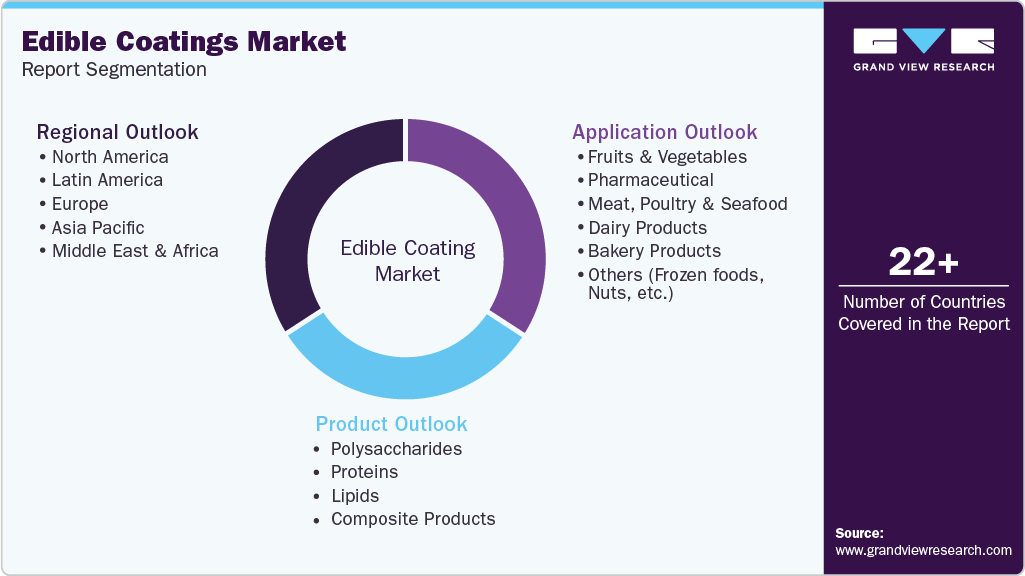
This report forecasts revenue & volume growth at global, regional, and country levels and provides an analysis of the latest industry trends in each of the sub-segments from 2018 to 2033. For this study, Grand View Research has segmented the global edible coatings market report based on product, application, and region:
-
Product Outlook (Volume, Kilotons; Revenue, USD Million, 2018 - 2033)
-
Polysaccharides
-
Proteins
-
Lipids
-
Composite Products
-
-
Application Outlook (Volume, Kilotons; Revenue, USD Million, 2018 - 2033)
-
Fruits & Vegetables
-
Pharmaceutical
-
Meat, Poultry & Seafood
-
Dairy Products
-
Bakery Products
-
Others (Frozen foods, Nuts, etc.)
-
-
Regional Outlook (Volume, Kilotons; Revenue, USD Million, 2018 - 2033)
-
North America
-
U.S.
-
Canada
-
Mexico
-
-
Latin America
-
Brazil
-
Argentina
-
-
Europe
-
Germany
-
UK
-
Italy
-
Spain
-
France
-
-
Asia Pacific
-
China
-
Japan
-
South Korea
-
India
-
-
Middle East & Africa
-
Saudi Arabia
-
South Africa
-
-
Frequently Asked Questions About This Report
b. The global edible coatings market size was estimated at USD 2,156.3 million in 2024 and is expected to reach USD 2,270.0 million in 2025.
b. The global edible coatings market is expected to grow at a compound annual growth rate of 6.7% from 2025 to 2033 to reach USD 3,811.8 million by 2033.
b. North America dominated the edible coatings market with a share of 34.4% in 2024. The market is driven by the strong presence of established food processing industries, advanced R&D capabilities, and early adoption of sustainable food preservation technologies.
b. Some key players operating in the edible coatings market include Cargill, Inc., Apeel Sciences, Ingredion, Tate & Lyle , Kerry Group plc, dsm-firmenich, Mantrose-Haeuser Co., Inc., AgroFresh, and Sufresca.
b. Key factors that are driving the market growth are rising consumer demand for fresh, chemical-free, and longer-lasting food products. Increasing regulatory focus on food safety and waste reduction is accelerating the adoption of natural, plant-based coatings that preserve freshness and extend shelf life across various perishable categories.


Share this report with your colleague or friend.
Need a Tailored Report?
Customize this report to your needs — add regions, segments, or data points, with 20% free customization.


ISO 9001:2015 & 27001:2022 Certified
We are GDPR and CCPA compliant! Your transaction & personal information is safe and secure. For more details, please read our privacy policy.
Trusted market insights - try a free sample
See how our reports are structured and why industry leaders rely on Grand View Research. Get a free sample or ask us to tailor this report to your needs.













