
- Home
- »
- Medical Devices
- »
-
Electromyography Devices Market Size Report, 2026-2033GVR Report cover
![Electromyography Devices Market (2026 - 2033)Report]()
Electromyography Devices Market (2026 - 2033)
Size, Share & Trends Analysis Report By Product (Hardware & Systems, Electrodes & Sensors, Accessories, Software), By Technology, By Clinical Application, By End Use, And Regional Segment Forecasts
Market Size, 2025
$1.5BMarket Estimate, 2026
$1.6BMarket Forecast, 2033
$2.4BCAGR, 2026–2033
6.5%Electromyography Devices Market Summary
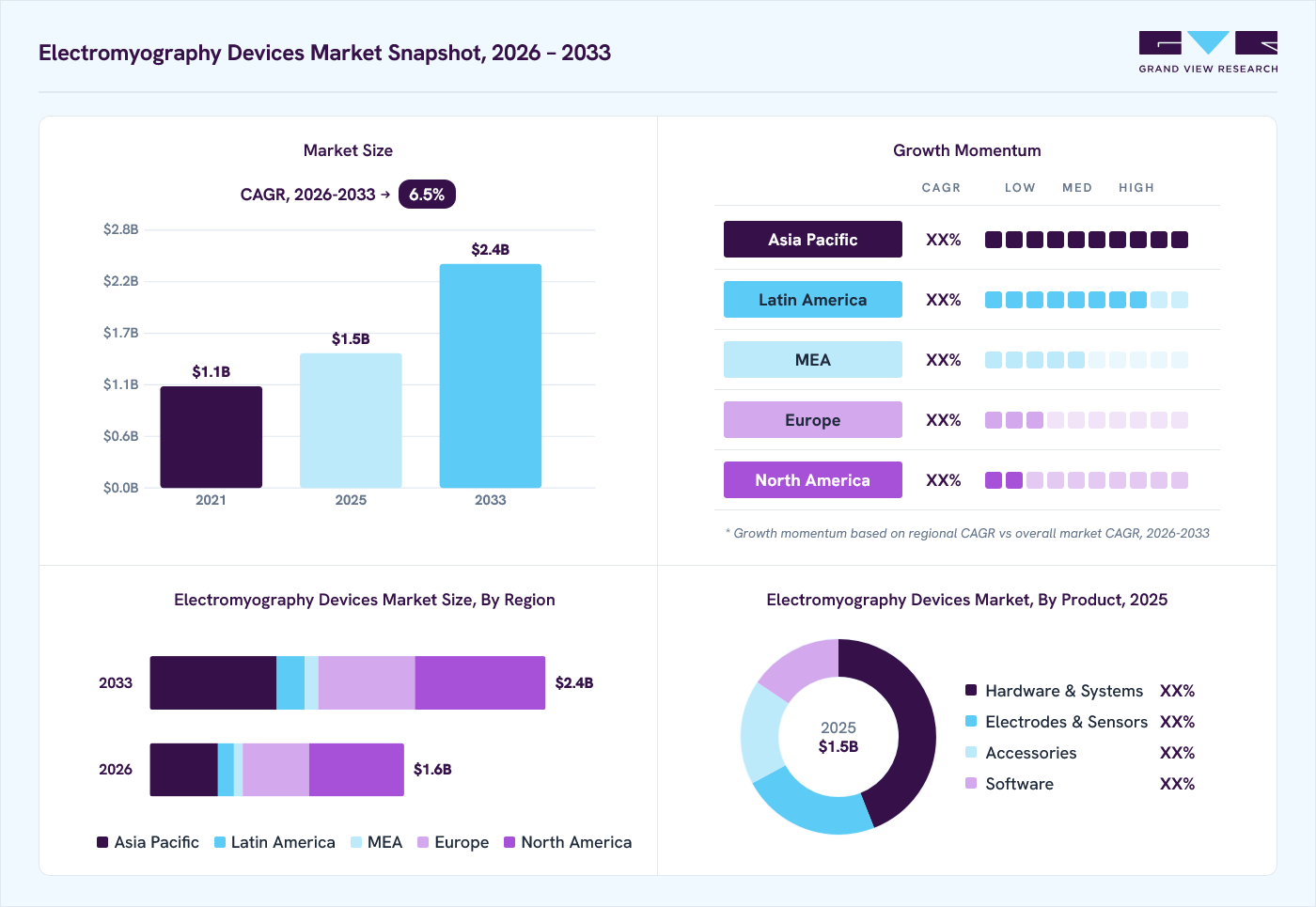
The global electromyography devices market size was valued at USD 1.5 billion in 2025 and is projected to grow from USD 1.6 billion in 2026 to USD 2.4 billion by 2033, at a CAGR of 6.5% from 2026 to 2033. North America dominated the market, accounting for a revenue share of 38.0% in 2025. The market is driven by the increasing prevalence of neuromuscular and peripheral nerve disorders, including neuropathies, carpal tunnel syndrome, radiculopathy, and motor neuron diseases.
Key Market Trends & Insights
- By product: The hardware & systems segment led the market with the largest revenue share of 44.0% in 2025.
- By technology: The surface EMG segment led the market with the largest revenue share of 43.1% in 2025.
- By clinical application: The neuromuscular disorder diagnosis segment led the market with the largest revenue share of 31.1% in 2025.
- By end use: The hospitals & surgical centers segment led the market with the largest revenue share of 34.8% in 2025.
Regional Highlights
- Largest regional market: North America (38.0% revenue share, 2025)
- Fastest-growing regional market: Asia Pacific (highest CAGR, 2026-2033)
- By country: The U.S. held the largest market share in 2025
Market Size & Forecast
- Market size in 2025: USD 1.5 Billion
- Estimated market size in 2026: USD 1.6 Billion
- Projected market size by 2033: USD 2.4 Billion
- CAGR (2026-2033): 6.5%
Growing adoption of EMG in neurological diagnosis, rehabilitation, sports medicine, and intraoperative nerve monitoring, coupled with advancements in portable, wireless, and high-density EMG systems, is further supporting market growth. The increasing prevalence of neuromuscular and peripheral nerve disorders, including diabetic neuropathy, carpal tunnel syndrome, radiculopathy, myopathies, and motor neuron diseases, is driving demand for electromyography (EMG) devices. EMG and nerve conduction studies are widely used to assess nerve and muscle function, localize nerve damage, determine disease severity, and differentiate between nerve and muscle disorders.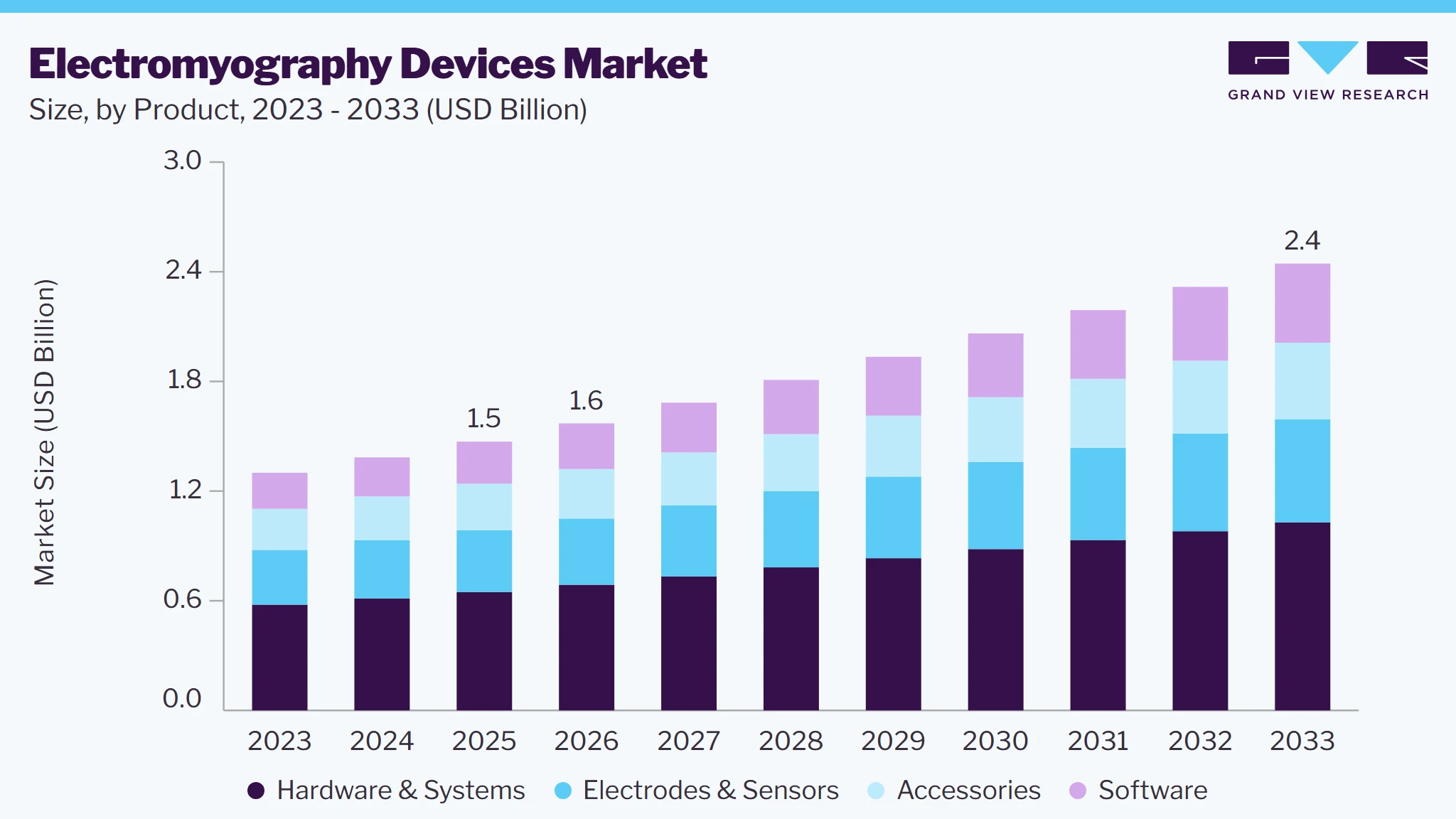
The growing burden of neurological and neuromuscular disorders is increasing the need for accurate and functional diagnostic testing, supporting demand for electromyography (EMG) devices. EMG, often performed alongside nerve conduction studies (NCS), helps clinicians evaluate nerve and muscle function, identify peripheral nerve damage, differentiate nerve from muscle disorders, and diagnose conditions such as peripheral neuropathy, carpal tunnel syndrome, radiculopathy, and motor neuron disorders.
For instance, in March 2025, the American Association of Neuromuscular & Electrodiagnostic Medicine (AANEM) identifies EMG and nerve-conduction studies as electrodiagnostic tests used to evaluate a broad range of neurological and neuromuscular conditions. Its recommended policy includes specific diagnostic indications and ICD-10-CM diagnoses for needle EMG and nerve conduction studies.
In addition, the U.S. National Institute of Neurological Disorders and Stroke (NINDS) continues to identify EMG and NCS as diagnostic procedures used in evaluating neurological symptoms and disorders. The NINDS neurological diagnostic testing resource was updated in March 2026, underscoring the continued role of electrodiagnostic testing in contemporary neurological practice.
Furthermore, technological advancements are driving the electromyography (EMG) devices market by enabling the development of wireless, portable, high-density, multi-channel, and multimodal EMG systems that deliver higher-quality signals and greater flexibility. For example, newer systems such as Noraxon’s Ultium EMG support sampling rates of up to 4,000 Hz, integrated inertial measurement units (IMUs), real-time synchronization, and wireless data transmission, enabling simultaneous assessment of muscle activity and movement.
The integration of digital software, automated signal processing, mobile connectivity, and EMG-triggered rehabilitation technologies is also expanding applications beyond conventional neurological diagnostics into rehabilitation, biomechanics, sports medicine, and prosthetics. The FDA recognizes EMG-triggered powered exercise equipment for muscle re-education and rehabilitation, while its updated recognition of IEC 60601-2-40 (2024 edition) reflects continuing standardization of modern electromyograph and evoked-response equipment.
Market Dynamics
The market is driven by the increasing need for the diagnosis of neuromuscular and peripheral nerve disorders, with EMG and nerve conduction studies widely used to assess muscle and nerve function. Technological advancements in portable, wireless, surface, and high-density EMG systems are expanding applications across clinical diagnostics, rehabilitation, sports medicine, and research. However, adoption is constrained by equipment costs, the need for specialized expertise, and the complexity of interpreting EMG results, while opportunities remain in wearable systems, advanced signal analysis, and rehabilitation applications.
The increasing use of EMG devices in rehabilitation and sports medicine is supporting market growth by enabling clinicians and sports professionals to evaluate muscle activation, fatigue, coordination, and recovery. Surface and wireless EMG systems are applied in post-stroke rehabilitation, physiotherapy, gait analysis, injury prevention, athletic performance assessment, and exercise monitoring, expanding demand beyond traditional neurological diagnostics.
The high cost of advanced EMG systems can restrain market adoption, particularly among smaller hospitals, outpatient clinics, and healthcare facilities in price-sensitive markets. Systems with high channel counts, integrated nerve-conduction testing, neuromuscular ultrasound, wireless sensors, and advanced software require higher initial investment and maintenance expenditure. This may lead some facilities to continue using conventional systems or postpone equipment upgrades.
The growing adoption of portable and wireless EMG systems presents a significant market opportunity by enabling flexible assessment of muscle activity outside conventional neurodiagnostic laboratories. Lightweight wireless devices can support ambulatory monitoring, rehabilitation, sports performance assessment, gait analysis, and point-of-care testing. Integration with smartphones, tablets, and motion sensors can further improve mobility and real-time data collection, expanding EMG applications across clinical and non-clinical settings.
Market Characteristics
The degree of innovation in the electromyography devices industry is high, driven by the development of wireless, wearable, portable, and high-density EMG systems that enable more detailed and flexible measurement of muscle activity. Recent advances include 128-channel wireless HD-EMG systems, flexible electrode arrays, AI/ML-based signal processing, and multimodal integration with IMUs, expanding EMG applications into rehabilitation, prosthetics, sports, and human-machine interfaces. The emergence of HD-sEMG is particularly significant, enabling spatial mapping of muscle activation rather than relying only on conventional single-site measurements.
The level of mergers and acquisitions (M&A) in the electromyography (EMG) devices market is moderate, with activity primarily focused on strengthening neurodiagnostic portfolios, expanding geographic reach, and acquiring complementary EMG technologies. For instance, in January 2023, Natus Medical Incorporated announced the completion of its acquisition of Micromed Holding SAS, a global provider of neurophysiology solutions. The acquisition expanded Natus’ Neuro portfolio, with Micromed’s products to be integrated and further developed alongside Natus’ existing technologies.
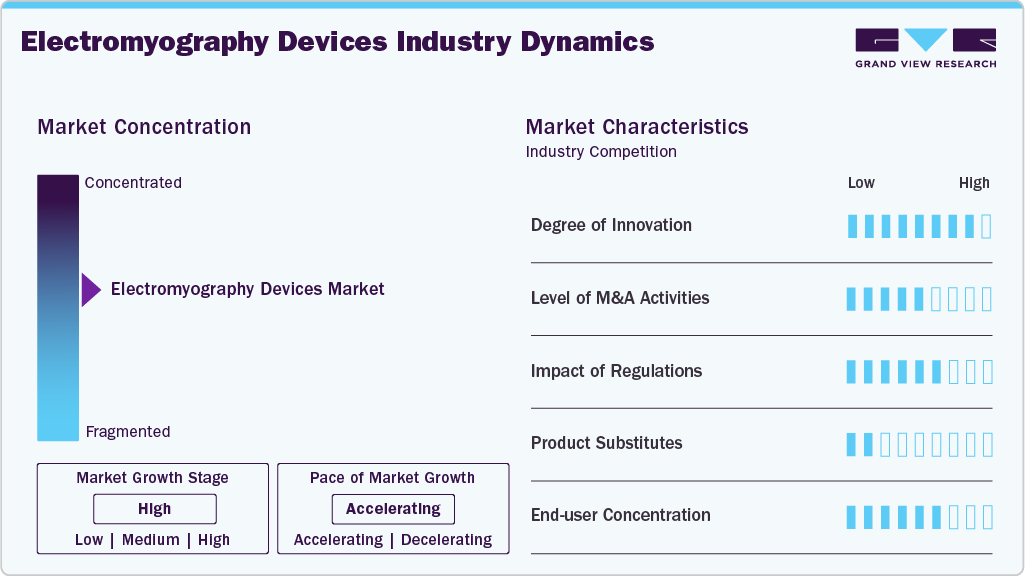
Regulations have a moderate-to-high impact on the electromyography (EMG) devices market because manufacturers must meet safety, performance, quality, and premarket requirements before commercialization. In the U.S., diagnostic electromyographs are Class II medical devices that require 510(k) premarket notification, thereby increasing development and compliance requirements.
The adoption of IEC 60601-2-40:2024, which specifies basic safety and essential-performance requirements for electromyographs and evoked-response equipment, is also encouraging manufacturers to improve device safety and performance. Regulations can increase development costs and time-to-market while simultaneously improving product quality and supporting clinician confidence in EMG systems.
The electromyography devices industry has a high concentration of high-end use in hospitals and specialized neurology/neurophysiology centers, where EMG/NCS is routinely used to diagnose peripheral neuropathies, myopathies, nerve injuries, and motor neuron disorders. Rehabilitation centers and physiotherapy clinics represent another important end-use segment, particularly for surface EMG applications in muscle assessment and post-stroke rehabilitation. Diagnostic centers and outpatient clinics are also expanding their use of EMG as electrodiagnostic testing becomes integrated into neurological and musculoskeletal evaluation.
Analyst Perspective
The market has favorable growth potential due to increasing demand for electrodiagnostic evaluation of peripheral nerve, muscle, neuromuscular junction, and motor neuron disorders. EMG is commonly used with nerve conduction studies to distinguish nerve-related from muscle-related conditions and support diagnosis and treatment planning. Market development is also supported by advances in portable, wireless, multi-channel, and high-density EMG systems, expanding applications into rehabilitation, sports medicine, biomechanics, and research. However, adoption remains influenced by the need for trained specialists, clinical interpretation, equipment costs, and regulatory requirements, making product usability, workflow integration, and clinical accuracy important competitive differentiators.
Product Insights
The hardware & systems segment dominated the market with a revenue share of 44.0% in 2025, supported by demand for complete EMG/NCS/EP systems used in hospitals, neurology clinics, and diagnostic centers. Leading manufacturers offer integrated platforms combining amplifiers, stimulators, signal-processing units, and clinical software, reinforcing hardware as the core revenue-generating component of EMG systems.
The software segment is expected to grow at the fastest rate in the market during the forecast period, driven by increasing demand for advanced EMG signal processing, visualization, analysis, and automated reporting capabilities. Integration of AI-based algorithms, cloud connectivity, digital data management, and real-time analytics is enhancing diagnostic efficiency and supporting personalized rehabilitation. Growing adoption of software-enabled EMG systems is also expanding applications across clinical diagnostics, sports medicine, research, and remote monitoring.
Technology Insights
The surface EMG segment dominated the market with the largest share of 43.1% in 2025, supported by its non-invasive nature, ease of use, and expanding applications across rehabilitation, physiotherapy, sports medicine, and biomechanics. The growing adoption of wireless and wearable sEMG systems is further expanding use beyond conventional clinical settings, enabling real-time muscle-activity monitoring during movement and exercise. In addition, advances in high-density sEMG and AI-based signal analysis are improving muscle-activity assessment and supporting personalized rehabilitation applications.
The wireless/wearable EMG segment is expected to grow at the fastest rate in the market during the forecast period, driven by rising demand for portable, non-restrictive muscle-activity monitoring. These systems enable real-time EMG data collection during rehabilitation, sports activities, gait analysis, and everyday movement, while wireless connectivity improves patient mobility and usability. Increasing integration with motion sensors, smartphones, and digital health platforms is further expanding adoption.
Clinical Application Insights
The neuromuscular disorder diagnosis segment dominated the market with a revenue share of 31.1% in 2025, driven by the established use of EMG and nerve conduction studies to evaluate muscle, peripheral nerve, motor neuron, and neuromuscular junction disorders. EMG is particularly important for diagnosing myopathies, peripheral neuropathies, radiculopathies, plexopathies, and motor neuron disorders, supporting its strong clinical utilization. Growing demand for accurate localization and characterization of neuromuscular abnormalities is expected to sustain this segment’s leading position.
The prosthetics & human movement analysis segment is expected to grow at the fastest rate during the forecast period, driven by the increasing use of EMG signals for myoelectric prosthetic control, gait assessment, biomechanics, and movement rehabilitation. Advances in wireless and high-density EMG sensors enable more precise measurement of muscle activation during natural movement, supporting improved prosthetic functionality and personalized rehabilitation.
End Use Insights
The hospitals & surgical centers segment led the market with the largest revenue share of 34.8% in 2025, driven by the routine use of EMG for neuromuscular diagnosis and the growing adoption of EMG-based intraoperative neuromonitoring. Hospitals use EMG systems across neurology, neurosurgery, orthopedics, and spinal procedures to evaluate nerve and muscle function and monitor neural integrity during surgery. The availability of specialized neurophysiology teams and integrated EMG/NCS platforms further supports the segment’s leading position.
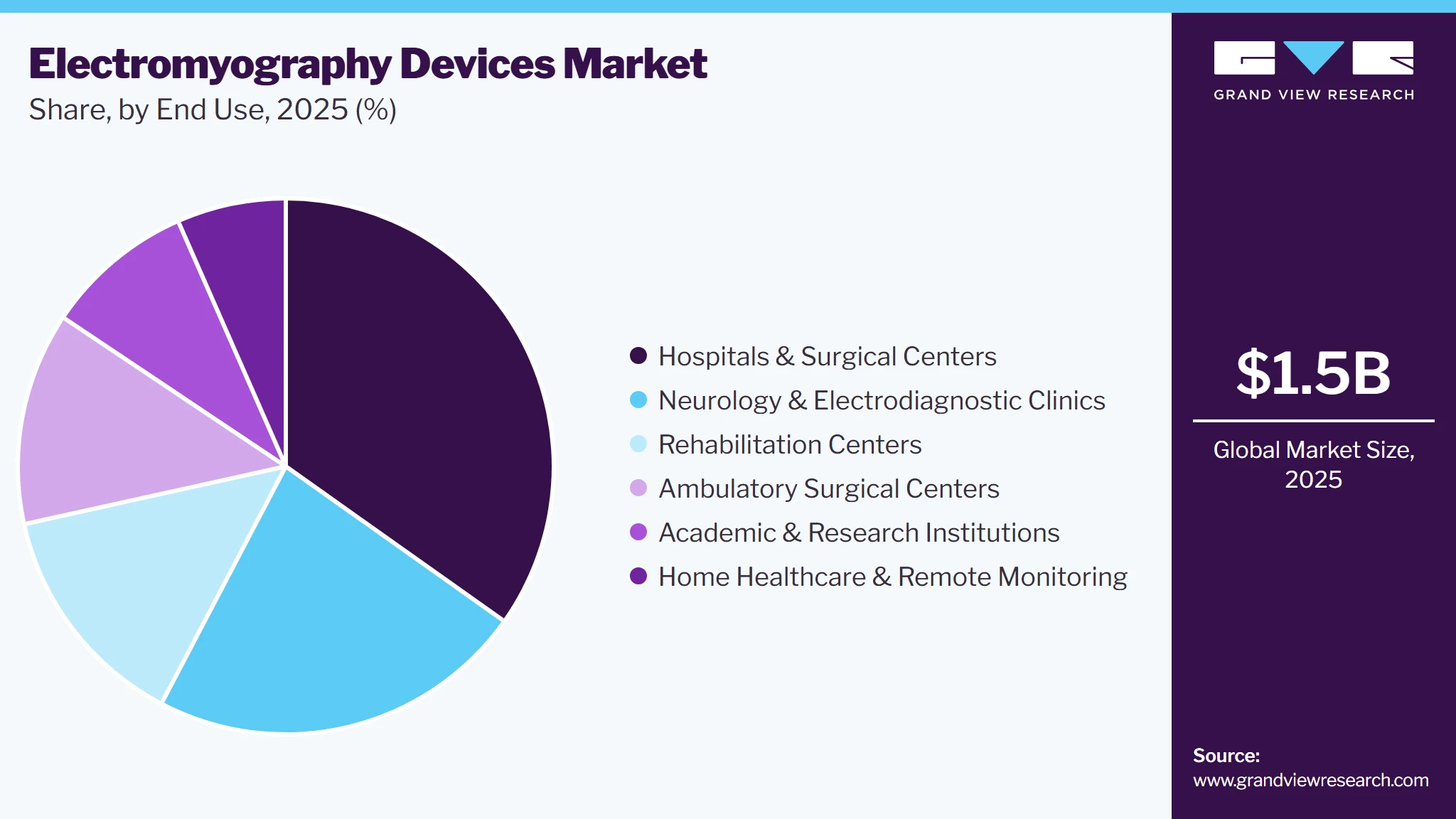
The home healthcare & remote monitoring segment is expected to grow at the fastest rate during the forecast period, supported by the increasing availability of compact, wireless, and wearable EMG systems. These technologies enable assessment of muscle activity outside conventional clinical settings and can support home-based rehabilitation, remote physiotherapy, recovery monitoring, and longitudinal assessment of muscle function. Integration with mobile devices and digital health platforms is further improving remote data collection and enabling greater continuity of patient monitoring.
Regional Insights
North America dominated the electromyography devices market with the largest revenue share of 38.0% in 2025. The market is supported by the region’s well-developed neurological diagnostic infrastructure, high adoption of electrodiagnostic testing, and growing burden of neuromuscular and peripheral nerve disorders. In the U.S., diagnostic electromyographs are regulated as Class II medical devices and require 510(k) clearance, while the FDA recognizes IEC 60601-2-40:2024 for EMG and evoked-response equipment, supporting continued product development and technological upgrades. The region also has a large base of specialized providers; for example, AANEM reports that more than 40% of neurologists and 55% of physical medicine and rehabilitation physicians use needle EMG and nerve-conduction studies for neuromuscular diagnosis. Increasing adoption of EMG in neurology, rehabilitation, intraoperative monitoring, and advanced neuromuscular diagnostics is therefore expected to sustain North America’s position as a major regional market.

U.S. Electromyography Devices Market Trends
The electromyography devices market in the U.S. is driven by rising demand for neurological and neuromuscular diagnostics, supported by the country’s advanced healthcare infrastructure and the widespread availability of specialized neurology and rehabilitation services. Rising cases of peripheral neuropathy, diabetes-related nerve disorders, carpal tunnel syndrome, radiculopathy, and other neuromuscular conditions are increasing the need for EMG and nerve conduction studies. In addition, growing adoption of portable, wireless, multi-channel, and advanced EMG systems across hospitals, diagnostic centers, rehabilitation facilities, and research institutions is supporting market expansion.
Europe Electromyography Devices Market Trends
The electromyography devices market in Europe is supported by the region’s substantial neurological disease burden, aging population, and established network of neurology, rehabilitation, and neurophysiology services. Neurological disorders represent a major and growing healthcare burden in Europe, with aging expected to further increase the prevalence of neurodegenerative and neuromuscular conditions, supporting demand for neurological and electrodiagnostic testing. In addition, the EU Medical Device Regulation (EU MDR 2017/745), applicable since May 2021, provides a strengthened framework for medical-device safety and clinical performance, while ongoing digitalization through EUDAMED is supporting greater transparency and market surveillance. The growing adoption of advanced, portable, wireless, and multi-channel EMG systems across hospitals, diagnostic centers, rehabilitation facilities, and research institutions is expected to further support market growth.
The UK electromyography devices market is supported by the established NHS neurophysiology infrastructure and growing demand for the diagnosis of peripheral nerve, muscle, and neuromuscular disorders. NHS England identifies EMG as an important diagnostic procedure for investigating muscle weakness, spinal problems, motor neuron disease, and disorders affecting the peripheral nervous system, and major NHS neurophysiology centers provide EMG and nerve conduction studies as part of specialized neurological services. The increasing use of EMG across neurology, rehabilitation, and specialized neurophysiology services, together with the continued adoption of advanced EMG systems, is supporting market development. The market is also influenced by the UK’s medical-device regulatory framework, with the MHRA overseeing devices and manufacturers, which are required to comply with applicable UK MDR requirements for the Great Britain market.
The electromyography devices market in Franceis supported by an established healthcare infrastructure and increasing demand for the diagnosis of neuromuscular, peripheral nerve, and muscle disorders. The growing use of EMG across hospitals, neurology centers, and rehabilitation facilities, along with the adoption of advanced, portable, and digital EMG systems, is supporting market growth. The market is regulated by the EU Medical Device Regulation (EU MDR), with ANSM overseeing medical device safety and surveillance.
Asia Pacific Electromyography Devices Market Trends
The electromyography devices market in the Asia Pacific is experiencing fastest growth due to the rising burden of neurological and neuromuscular disorders, expanding healthcare infrastructure, and increasing access to specialized neurological diagnostics. In Asia, neurological disorders accounted for 167.4 million DALYs in 2019, with stroke, migraine, and dementia among the leading contributors. Growing investments in hospitals and neuro-specialty centers across China, Japan, India, South Korea, and Southeast Asia, along with increasing adoption of portable, wireless, and advanced EMG systems, are supporting regional market expansion.
Japan electromyography devices market is supported by an advanced healthcare system, an aging population, and increasing demand for neurological and neuromuscular diagnostics. Japan has established expertise in neurophysiology, with companies such as Nihon Kohden offering dedicated EMG/nerve-conduction systems, including the Neuropack X1, available in 6- and 12-channel configurations. The adoption of advanced EMG systems across hospitals, neurology departments, and research institutions, together with Japan’s strong medical-device technology base, is expected to support continued market development.
Latin America Electromyography Devices Market Trends
The electromyography devices market in Latin America is supported by improving healthcare infrastructure, rising demand for neurological diagnostics, and increasing awareness of neuromuscular disorders. Brazil represents a key regional market, with a 2023 survey identifying 469 active electromyographers, although significant regional disparities in access remain. Growing investments in hospitals and rehabilitation services, particularly in Brazil and Argentina, together with the adoption of portable, cost-effective EMG systems, are expected to drive market expansion.
MEA Electromyography Devices Market Trends
The electromyography devices market in MEA is supported by the rising burden of neurological disorders and the gradual expansion of specialized neurodiagnostic and rehabilitation services. In the Middle East and North Africa, neurological conditions accounted for 17.6 million DALYs and 441,100 deaths in 2019, while the region recorded approximately 221.1 million prevalent neurological cases. In Africa, increasing availability of clinical neurophysiology services and growing training in EMG/NCS are improving access to electrodiagnostic testing; a 2025 survey found that 74% of surveyed clinicians across 17 African countries had experience performing EMG/NCS studies. Consequently, investments in hospital infrastructure, neurology services, and advanced diagnostic technologies are expected to support the adoption of EMG devices in the region.
Key Electromyography Devices Company Insights
The market includes established companies such as Natus Medical, Nihon Kohden, Cadwell, Medtronic, Neurosoft, Noraxon, and Delsys, offering clinical EMG/NCS systems, intraoperative monitoring, and wireless or research-oriented EMG technologies. Company-specific EMG market-share data are generally not publicly disclosed, so competitive positioning is assessed based on product portfolio, technological capabilities, geographic presence, and adoption across clinical and research applications.
Key Electromyography Devices Companies
The following key companies have been profiled for this study on the electromyography devices market:
-
Natus Medical Incorporated (ArchiMed)
-
NIHON KOHDEN CORPORATION
-
Cadwell Industries Inc.
-
Medtronic
-
Neurosoft LLC
-
Noraxon
-
Delsys
-
Cometa srl
-
Artinis Medical Systems
-
Biometrics Ltd
-
EB Neuro S.p.A. (Hanix Group)
-
Allengers
Competitive Benchmarking
Category
Operating Strategies
Competitive Edge
Weakness
Established Players (Natus Medical, Nihon Kohden, Cadwell, Medtronic)
- Expand integrated EMG/NCS/EP platforms and software solutions
- Strengthen hospital and neurology-clinic relationships
- Invest in product upgrades, clinical validation, and global distribution
- Established clinical reputation and installed base
- Broad product portfolios
- Strong hospital and distributor networks
- Higher system cost and complexity
- Longer sales and procurement cycles
- Less flexibility in niche applications such as wearable and research-focused EMG
Emerging Players (Noraxon, Delsys, Cometa, OT Bioelettronica)
- Focus on wireless, wearable, portable, and high-density EMG
- Target sports, rehabilitation, biomechanics, research, and specialized clinical applications
- Integrate EMG with IMUs, motion analysis, and advanced software
- Faster product innovation
- Strong wireless and wearable capabilities
- Portable and flexible systems
- Smaller clinical installed base
- Limited geographic reach
- Narrower product portfolios
Recent Developments:
-
In January 2026, Natus Medical Incorporated announced the launch of the latest version of its Natus Elite EMG software, introducing Augmented Visual Electromyograph (AVEMG) technology. The new release combines the platform’s established functionality and reliability with enhanced visualization capabilities, representing a further advancement in EMG diagnostics.
-
In April 2025, Cadwell Industries, Inc. launched its latest Sierra software release, introducing patent-pending, fully synchronized electromyography (EMG) and ultrasound capabilities. The new functionality was designed to enhance clinical insights while streamlining workflows for neurodiagnostic procedures.
-
In October 2023, Rhythmlink International LLC announced the launch of its new concentric needle product family for electromyography (EMG) and nerve conduction velocity (NCV) studies. The disposable needles were available in four sizes and were designed to pair with a reusable cable specifically developed for Rhythmlink’s EMG needles.
Electromyography Devices Market Report Scope
Report Attribute
Details
Market size in 2025
USD 1.5 billion
Estimated market size in 2026
USD 1.6 billion
Projected market size by 2033
USD 2.4 billion
Growth rate
CAGR of 6.5% from 2026 to 2033
Actual data
2021 - 2025
Forecast period
2026 - 2033
Quantitative units
Revenue in USD billion and CAGR from 2026 to 2033
Report coverage
Revenue forecast, company ranking, competitive landscape, growth factors, and trends
Segments covered
Product, technology, clinical application, end use, region
Regional scope
North America; Europe; Asia Pacific; Latin America; MEA
Country scope
U.S.; Canada; Mexico; UK; Germany; France; Italy; Spain; Denmark; Sweden; Norway; Japan; China; India; Thailand; Australia; South Korea; Brazil; Argentina; South Africa; Saudi Arabia; UAE; Kuwait
Key companies profiled
Natus Medical Incorporated (ArchiMed); NIHON KOHDEN CORPORATION; Cadwell Industries Inc.; Medtronic; Neurosoft LLC; Noraxon; Delsys; Cometa srl; Artinis Medical Systems; Biometrics Ltd; EB Neuro S.p.A. (Hanix Group); Allengers
Customization scope
Free report customization (equivalent up to 8 analyst’s working days) with purchase. Addition or alteration to country, regional & segment scope
Pricing and purchase options
Avail customized purchase options to meet your exact research needs. Explore purchase options
Global Electromyography Devices Market Report Segmentation
This report forecasts revenue growth at global, regional, and country levels and provides an analysis of the latest industry trends in each of the sub-segments from 2021 to 2033. For this study, Grand View Research has segmented the global electromyography devices market report based on product, technology, clinical application, end use, and region:
-
Product Outlook (Revenue, USD Million, 2021 - 2033)
-
Hardware & Systems
-
Stationary / Standalone EMG Systems
-
Portable / Handheld EMG Systems
-
Wearable & Wireless EMG Patches
-
Integrated Systems (EMG-EEG / EMG-EP / EMG-IONM)
-
-
Electrodes & Sensors
-
Surface Electrodes
-
Needle Electrodes
-
High-Density EMG Electrode Arrays
-
-
Accessories
-
Patient Cables & Lead Wires
-
Junction Boxes & Connectors
-
Conductive Gels & Skin Preparation Products
-
Replacement Parts
-
-
Software
-
Signal Acquisition Software
-
Analysis & Reporting Software
-
AI-assisted Diagnostic Software
-
-
-
Technology Outlook (Revenue, USD Million, 2021 - 2033)
-
Surface EMG
-
Intramuscular / Needle EMG (iEMG)
-
High-Density EMG (HD-EMG)
-
Wireless / Wearable EMG
-
-
Clinical Application Outlook (Revenue, USD Million, 2021 - 2033)
-
Neuromuscular Disorder Diagnosis
-
Intraoperative Neuromonitoring (IONM)
-
Physical Medicine & Rehabilitation
-
Orthopedics & Sports Medicine
-
Prosthetics & Human Movement Analysis
-
Research & Academia
-
-
End Use Outlook (Revenue, USD Million; 2021 - 2033)
-
Hospitals & Surgical Centers
-
Ambulatory Surgical Centers
-
Neurology & Electrodiagnostic Clinics
-
Rehabilitation Centers
-
Academic & Research Institutions
-
Home Healthcare & Remote Monitoring
-
-
Regional Outlook (Revenue, USD Million, 2021 - 2033)
-
North America
-
U.S.
-
Canada
-
Mexico
-
-
Europe
-
Germany
-
UK
-
France
-
Italy
-
Spain
-
Sweden
-
Denmark
-
Norway
-
-
Asia Pacific
-
Japan
-
China
-
India
-
Australia
-
South Korea
-
Thailand
-
-
Latin America
-
Brazil
-
Argentina
-
-
Middle East & Africa
-
South Africa
-
Saudi Arabia
-
UAE
-
Kuwait
-
-
Research Methodology
The electromyography devices market figures in this report are based on a proven research process that combines executive interviews with secondary research from proprietary databases, company filings, and recognized regulatory and institutional sources. Market size is built through value-chain sizing—reconciling supply-side and demand-side estimates—and triangulated with bottom-up and top-down approaches. Every estimate passes multiple levels of expert validation before publication, with each electromyography devices segment quantified using the revenue-capture definitions in the table below.
Segment Definition
Product
Revenue capture definition
Hardware & Systems
Revenue generated from the sale of complete EMG systems, including EMG/NCS machines, amplifiers, processors, data-acquisition units, and integrated diagnostic platforms.
Electrodes & Sensors
Revenue generated from disposable and reusable needle, surface, wireless, and high-density EMG electrodes and muscle-activity sensors used for signal acquisition.
Accessories
Revenue generated from complementary EMG equipment such as cables, leads, electrode holders, stimulation probes, adapters, carts, and other supporting components.
Software
Revenue generated from EMG-specific software for signal acquisition, processing, visualization, analysis, reporting, data management, and system upgrades or licenses.
Delivered Customizations
This report has been delivered with the following In-depth customizations
Client Request
Customization Delivered
Value Adds
Country-specific analysis
Market assessment customized by country, including demand patterns, regulatory environment, consumer preferences, distribution structure, and key local competitors
Helps identify country-level opportunities, market-entry priorities, and regulatory considerations
Product share analysis
Customized assessment of market shares across gels, creams, patches, sprays, ointments, and other formulations, along with leading product categories
Enables identification of high-performing product formats and areas for portfolio expansion
Competitive analysis
Customized benchmarking of mature and emerging players based on product portfolio, pricing, distribution reach, formulation innovation, brand positioning, and strategic initiatives
Supports competitor benchmarking, differentiation strategies, and identification of competitive gaps
Frequently Asked Questions About This Report
The global electromyography devices market size was estimated at USD 1.5 billion in 2025 and is estimated at USD 1.6 billion in 2026.
The global electromyography devices market is expected to grow at a CAGR of 6.5% from 2026 to 2033, reaching USD 2.4 billion by 2033.
North America dominated the electromyography devices market with a share of 38.0% in 2025.
Asia Pacific is the fastest-growing region over the forecast period.
Key factors that are driving the market growth include the increasing prevalence of neuromuscular and peripheral nerve disorders, including neuropathies, carpal tunnel syndrome, radiculopathy, and motor neuron diseases. Growing adoption of EMG in neurological diagnosis, rehabilitation, sports medicine, and intraoperative nerve monitoring, coupled with advancements in portable, wireless, and high-density EMG systems.
Some key players operating in the electromyography devices market include Natus Medical Incorporated (ArchiMed), NIHON KOHDEN CORPORATION, Cadwell Industries Inc., Medtronic, Neurosoft LLC, Noraxon, Delsys, Cometa srl, Artinis Medical Systems, Biometrics Ltd, EB Neuro S.p.A. (Hanix Group), Allengers
Surface EMG dominated the electromyography devices market with a share of 43.1% in 2025 while wireless/wearable EMG segment is second fastest growing market.
The neuromuscular disorder diagnosis segment dominated the market with a revenue share of 31.1% in 2025, driven by the established use of EMG and nerve conduction studies to evaluate muscle, peripheral nerve, motor neuron, and neuromuscular junction disorders.
Hospitals & surgical centers dominated the electromyography devices market with a share of 34.8% in 2025 while home healthcare & remote monitoring segment is second fastest growing market
About the Author(s)
Medical Devices Research Team
Healthcare · Medical DevicesThis report was authored by the medical devices research team at Grand View Research - comprising two research analysts, one senior research analyst, and one industry expert - with specialized expertise in the medical devices segment of the healthcare industry. All findings are based on proprietary healthcare databases, executive interviews, and regulatory analysis, subject to internal peer review prior to publication.
Last Updated:
Speak to Analyst


Customize this report to your needs — add regions, segments, or data points, with 20% free customization.
Or view our licence options:


ISO 9001:2015 & 27001:2022 Certified
We are GDPR and CCPA compliant! Your transaction & personal information is safe and secure. For more details, please read our privacy policy.


