
- Home
- »
- Next Generation Technologies
- »
-
Embedded AI Market Size And Share Report, 2026-2033GVR Report cover

Embedded AI Market (2026 - 2033)
Size, Share & Trends Analysis Report By Offering (Hardware, Software, Services), By Data Type (Sensor Data, Image & Video Data, Numeric Data, Categorial Data), By Vertical (Healthcare, BFSI, IT & ITES), By Region, And Segment Forecasts
Market Size, 2025
$11.3BMarket Estimate, 2026
$12.9BMarket Forecast, 2033
$33.2BCAGR, 2026–2033
14.5%Embedded AI Market Summary
The global embedded AI market size was valued at USD 11.3 billion in 2025 and is projected to grow from USD 12.9 billion in 2026 to USD 33.2 billion by 2033, at a CAGR of 14.5% from 2026 to 2033. The market in North America dominated with a revenue share of 31.5% in 2025. The market is driven by the increased adoption of AI-enabled microcontrollers and NPUs that deliver higher performance while maintaining low power consumption.
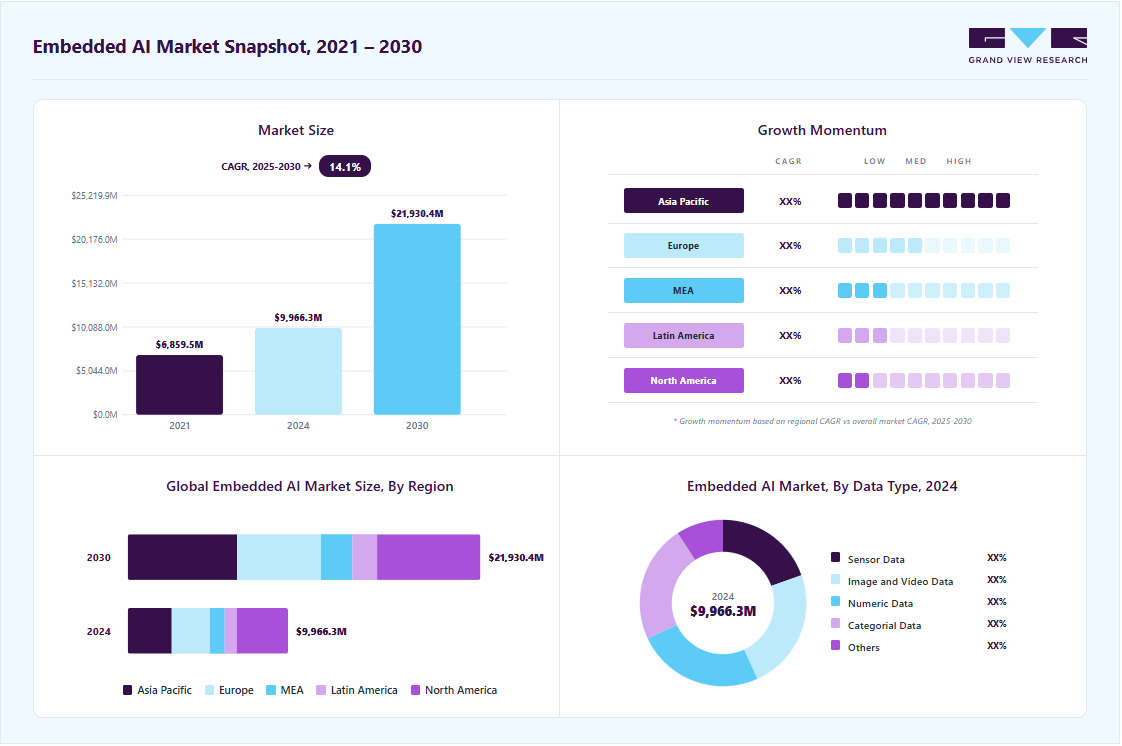 Source: Grand View Research, IR Documents, Primary Interviews, Paid DatabasesTo learn more about this report,
 Download Free Sample Report
 Key Market Trends & Insights
- By offering: Software segment held the largest market share of 41.2% in 2025.
- By data type: Image and video data segment held the largest market share of 25.6% in 2025.
- By vertical: Automotive segment held the largest market share of 18.9% in 2025.
Regional Highlights
- Largest regional market: North America (31.5% revenue share, 2025)
- Fastest-growing regional market: Asia Pacific (highest CAGR, 2026-2033)
- By country: The U.S. held the largest market share in 2025.
Market Size & Forecast
- Market size in 2025: USD 11.3 Billion
- Estimated market size in 2026: USD 12.9 Billion
- Projected market size by 2033: USD 33.2 Billion
- CAGR (2026-2033): 14.5%
Three ways to get this report
Buy it, customize it, or ask a question.Ask an Analyst
A direct answer, usually in 1 working day
- AccessReport author, directly
- Reply timeWithin 1 working day
- No sales callDirect answer only
- FormatEmail reply
- CostFree, no cost
Get the Full Report
What the study covers
- FormatsPDF · Excel · Dashboard
- Timeline2026–2033 annual, 2025 base
- Coverage20+ countries, 5 regions
- Companies10+ key players profiled
Customize the Report
20% free customization
- IncludeCountries, segments, points
- TailorTo your product definition
- ExtendDeeper competitor detail
- OrA fully bespoke study
- Turnaround5–10 working days
The increasing demand for more powerful and energy-efficient processors is driven by the need to effectively manage complex AI algorithms and integrate with Image & Video Data-based AI services, enhancing scalability and providing users with opportunities to utilize embedded AI solutions.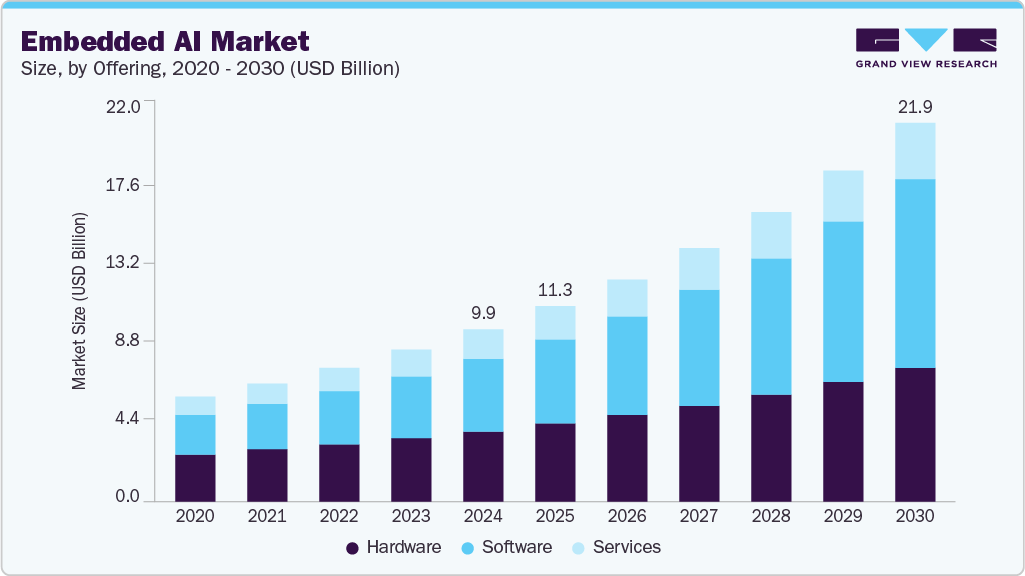 To learn more about this report, Download Free Sample Report
 The growing demand for advanced technologies that deliver personalized and adaptive experiences is driving the acceptance of embedded AI solutions in the market. The push for personalized interactions has led to the incorporation of AI capabilities into several embedded systems. By utilizing embedded AI, devices and applications can analyze user data, preferences, and behaviors to offer customized recommendations, suggestions, and responses, thereby boosting user satisfaction and engagement. In addition, embedded AI solutions can facilitate autonomous behavior in devices and systems, minimizing the need for continuous user input. This is especially valuable in areas like autonomous vehicles, smart home automation, and industrial automation, where AI algorithms can support intelligent decision-making and automated actions.
Market Dynamics
The embedded AI market is primarily driven by the growing need for real-time intelligence in connected devices, where low-latency processing and improved data privacy are essential. Industries are increasingly integrating AI directly into edge hardware to support autonomous decision-making, predictive maintenance, and intelligent automation without relying on constant cloud connectivity. Advancements in AI-optimized processors and energy-efficient chip architectures are further accelerating deployment across consumer electronics, automotive, industrial, and healthcare applications.
The increasing demand for real-time decision-making is driving the adoption of embedded AI across connected devices in industries such as automotive, manufacturing, healthcare, and consumer electronics. By processing data directly on the device instead of relying on cloud infrastructure, embedded AI enables faster response times, lower latency, and uninterrupted operation even in environments with limited network connectivity. The rapid expansion of IoT ecosystems and smart devices is further accelerating the need for intelligent edge computing capabilities. As organizations prioritize data privacy, operational efficiency, and autonomous functionality, embedded AI is becoming a core technology for delivering secure, responsive, and context-aware applications across a wide range of connected systems.
Embedded AI systems often operate on edge devices with restricted processing power, memory capacity, and energy budgets, limiting their ability to execute complex AI models efficiently. While AI algorithms continue to grow in size and sophistication, many embedded platforms cannot support these workloads without compromising speed, accuracy, or battery life. This creates a challenge for applications that require advanced real-time inference in compact and resource-constrained environments. The need to balance computational efficiency with AI performance also raises hardware design costs and slows the adoption of advanced embedded AI solutions, particularly in cost-sensitive industries.
Smartphones, wearables, smart home systems, laptops, cameras, and personal health devices are incorporating embedded AI to enable real-time voice recognition, image enhancement, predictive features, and personalized user experiences without depending on cloud processing. This shift improves response times, enhances data privacy, and reduces power consumption, making on-device AI an attractive feature for both consumers and device manufacturers.
As demand grows for always-on, context-aware, and energy-efficient smart products, manufacturers are expanding investments in embedded AI to differentiate their offerings and deliver seamless intelligent experiences. The increasing availability of AI-ready hardware and software ecosystems is expected to further accelerate adoption across the global consumer electronics industry.
Market Concentration & Characteristics
The embedded AI market exhibits a high degree of innovation, driven by continuous advancements in AI accelerators, neural processing units (NPUs), TinyML, and edge computing technologies. Companies are rapidly developing low-power AI chips and software frameworks to enable real-time intelligence across consumer electronics, automotive, industrial automation, healthcare, and IoT devices. Frequent product launches and improvements in on-device generative AI capabilities continue to accelerate technological differentiation.
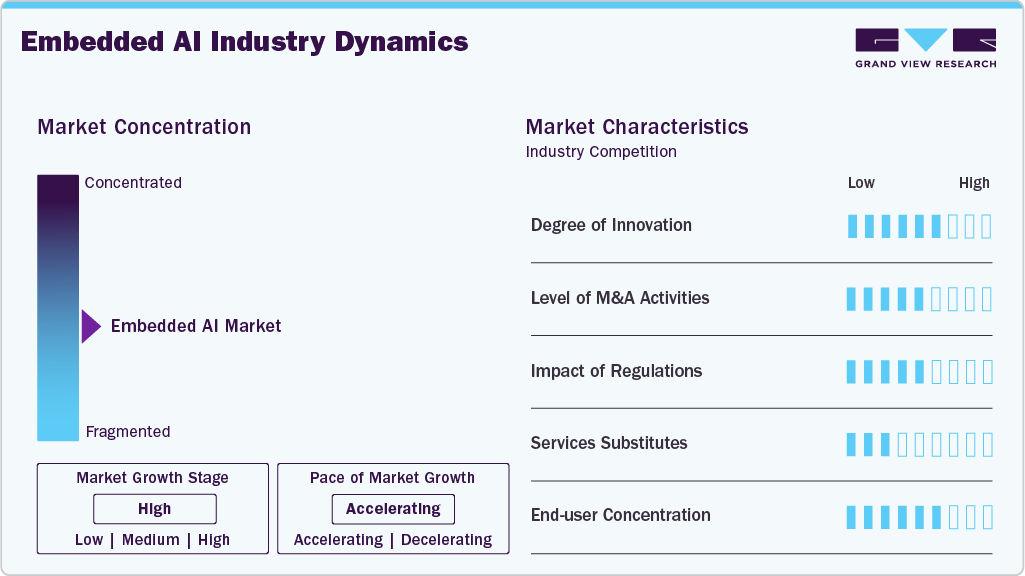 To learn more about this report, Download Free Sample Report
 Regulations have a moderate impact on the embedded AI market as governments increasingly introduce standards related to AI transparency, cybersecurity, functional safety, and data privacy. Compliance requirements are particularly important in automotive, healthcare, and industrial applications where embedded AI systems support safety-critical operations. These evolving regulatory frameworks encourage responsible AI deployment while raising compliance requirements for vendors.
Analyst Perspective
The embedded AI market is transitioning from a hardware-centric ecosystem to an integrated intelligence platform where value is increasingly created through the combination of AI processors, optimized software frameworks, and edge computing capabilities. The strongest competitive advantage belongs to vendors that deliver scalable, power-efficient, and secure AI solutions across automotive, industrial automation, healthcare, consumer electronics, and IoT applications, enabling real-time decision-making without continuous cloud dependence. As AI-enabled devices become more prevalent, the market is shifting toward unified hardware-software ecosystems that simplify deployment, improve performance, and support long-term adoption across multiple industries.
Offering Insights
Based on offering, the software segment led the market with the largest revenue share of 41.2% in 2025 and is expected to grow at the fastest CAGR over the forecast period. Embedded AI software is vital in the market, offering essential algorithms, frameworks, and libraries that empower AI capabilities within embedded systems. This software harnesses the potential of AI in embedded devices, facilitating intelligent decision-making, real-time data analysis, and improved functionality across diverse industries. By enabling local data processing and interpretation, embedded AI software enhances device autonomy, boosts performance, and enriches user experiences. Moreover, the proliferation of connected devices and the rising demand for real-time data processing are fueling the need for sophisticated embedded AI solutions. This trend is evident in sectors such as automotive, healthcare, and industrial automation, where embedded AI software is revolutionizing operations and user interactions. As technology continues to evolve, the embedded AI software industry is expected to grow rapidly, driven by innovations that enable smarter, more adaptable, and cost-effective solutions
The hardware segment is expected to grow at a significant CAGR over the forecast period. The growth is driven by the increasing demand for more powerful and energy-efficient processors capable of handling complex AI algorithms. As AI applications become more sophisticated and resource-intensive, the need for advanced hardware solutions, such as high-performance CPUs, GPUs, and specialized AI accelerators, is surging. This trend is further fueled by the growing adoption of autonomous and intelligent systems that require tailored experiences, prompting manufacturers to innovate and enhance their hardware offerings. In addition, the rise of edge computing is reshaping the landscape, as devices increasingly process data locally, reducing reliance on Image & Video Data services and enabling faster decision-making.
Data Type Insights
Based on data type, the image and video data segment led the market with the largest revenue share of 25.6% in 2025, due to the widespread adoption of computer vision across surveillance, autonomous vehicles, industrial automation, healthcare imaging, and smart retail applications. These workloads require real-time, on-device processing of high-resolution visual data, driving demand for embedded AI processors with dedicated vision acceleration capabilities. The increasing deployment of AI-enabled cameras, ADAS, robotics, and machine vision systems further strengthens segment growth, while edge-based image processing improves response time, reduces bandwidth usage, and enhances data privacy.
The sensor data segment is estimated to grow at the fastest CAGR over the forecast period. The rise of smart devices, such as fitness trackers and home automation systems, exemplifies the utility of sensor data, which collects vital information like heart rates, sleep patterns, and environmental conditions to provide tailored recommendations and enhance user experiences. In addition, the incorporation of sensor data into embedded AI systems leads to improved operational efficiency, cost savings, and enhanced safety across various industries. As the demand for intelligent and autonomous systems grows, the ability to process and analyze sensor data locally will become increasingly critical, positioning this segment for robust growth in the coming years. Overall, the integration of sensor data with embedded AI technologies is set to play a pivotal role in shaping the future of smart applications and systems.
Vertical Insights
Based on vertical, the automotive segment led the market with the largest revenue share of 18.9% in 2025 and is expected to grow at a significant CAGR over the forecast period. The automotive industry is experiencing a surge in the adoption of embedded AI technologies, driven by the rapid advancements in autonomous driving, electric vehicles, and connected car features. Autonomous driving is a key application area where embedded AI is revolutionizing the automotive industry. AI algorithms, combined with sensors like cameras, radar, and lidar, enable vehicles to perceive their surroundings, identify potential hazards, and make real-time decisions to ensure safe navigation. Advanced driver assistance systems (ADAS) powered by embedded AI are becoming increasingly sophisticated, offering features like lane-keeping, adaptive cruise control, and automatic emergency braking.
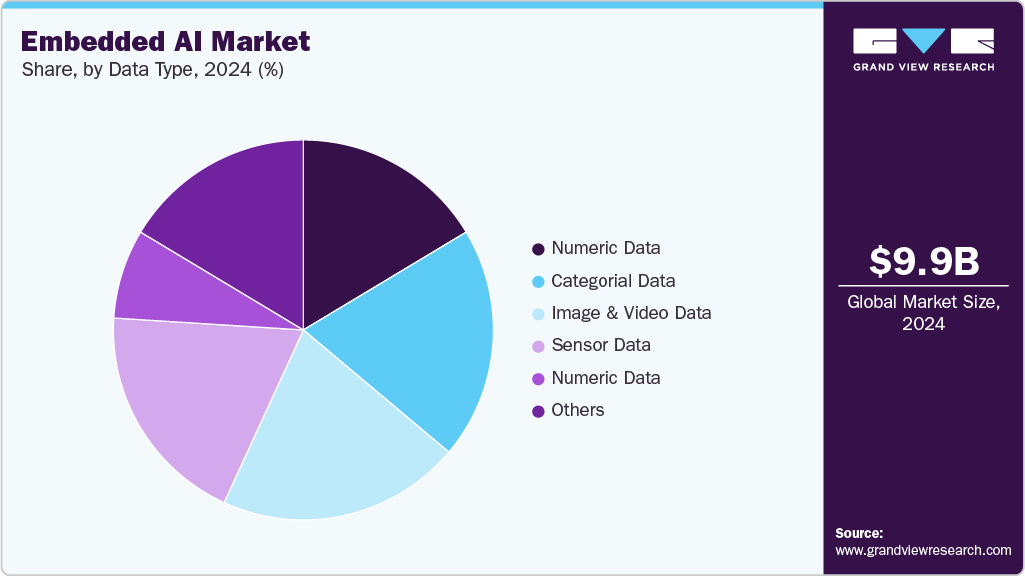 To learn more about this report, Download Free Sample Report
 The healthcare segment is estimated to grow at the fastest CAGR over the forecast period. The growth is driven by the increasing demand for advanced diagnostic tools, personalized treatment options, and enhanced patient care. This surge is fueled by significant investments from both private and government sectors aimed at integrating AI solutions into medical devices and healthcare systems. Embedded AI is being utilized to analyze vast amounts of medical data, enabling healthcare professionals to make more accurate diagnoses and develop tailored treatment plans for patients. In addition, the rise of telemedicine and remote monitoring solutions has accelerated the need for AI-driven tools that can process and analyze data in real-time, further enhancing patient outcomes. As healthcare providers increasingly recognize the potential of embedded AI to improve operational efficiency and patient satisfaction, the growth trajectory for this segment is expected to remain strong over the forecast period.
Regional Insights
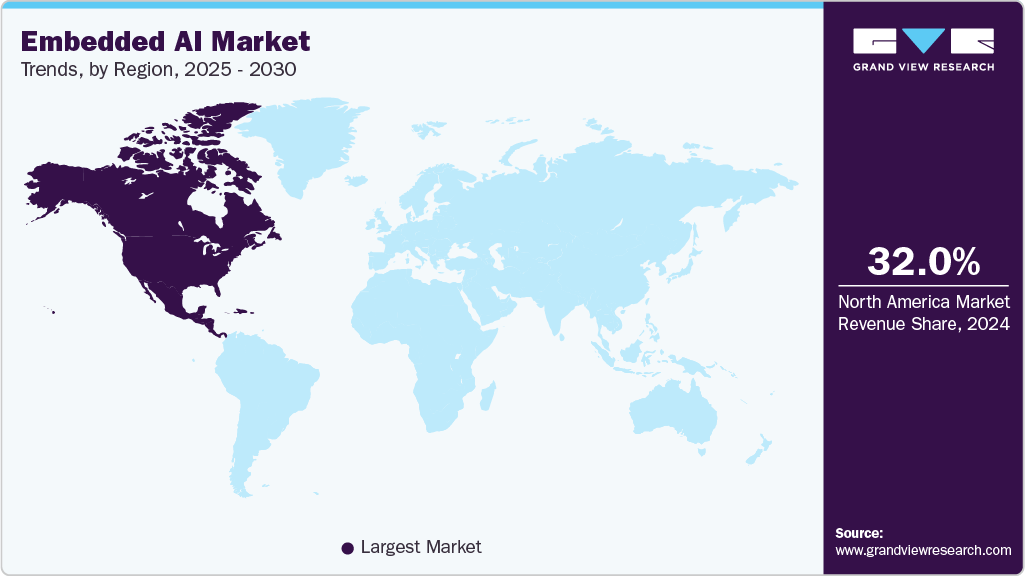
North America dominated the embedded AI market with the largest revenue share of 31.5% in 2025. The region's growth in this sector is fueled by its presence of leading AI technology firms, strong R&D capabilities, and a well-established market ecosystem. Recent years have seen a steady increase in embedded AI adoption in North America, spurred by advancements in AI technologies, rising demand for intelligent edge devices, and the widespread use of IoT applications. Overall, the adoption of embedded AI in North America is accelerating across various industries, driven by technological progress, the expansion of IoT, a supportive infrastructure, and growing awareness of the benefits it offers.
 To learn more about this report, Download Free Sample Report
 U.S. Embedded AI Market Trends
The embedded AI market in the U.S. held the largest share in the North America region in 2025. The U.S. has established itself as a leader in technological innovation, fostering a collaborative ecosystem of research institutions, universities, and technology companies that push the boundaries of AI capabilities. The emphasis on enhancing operational efficiency, improving decision-making processes, and delivering personalized customer experiences is propelling the adoption of embedded AI solutions. In addition, the rise of IoT devices and the demand for intelligent systems that can process and analyze data locally further contribute to the growth of embedded AI in the region.
Europe Embedded AI Market Trends
The embedded AI market in Europe is anticipated to grow at a significant CAGR during the forecast period. This growth is driven due to the automotive industry as a significant contributor to the growth of embedded AI in Europe, with applications such as gesture recognition, object identification, voice assistants, and predictive maintenance. Automakers and AI technology providers are forming partnerships to offer AI-driven solutions that enhance convenience, customer experience, and safety.
Asia Pacific Embedded AI Market Trends
The embedded AI market in Asia Pacific is estimated to grow at the fastest CAGR over the forecast period. This surge is primarily driven by the rapid expansion of e-commerce and digital transformation in the retail sector across the region. Embedded AI technologies play a crucial role in enabling personalized recommendations, supply chain optimization, and fraud detection in e-commerce platforms. Moreover, the emphasis on smart city initiatives and urban development projects in the Asia-Pacific region is another key driver for embedded AI growth. As countries invest in building sustainable and technologically advanced cities, embedded AI technologies are being integrated to enhance intelligent infrastructure, efficient energy management, and improved public services.
Key Embedded AI Company Insights
Prominent firms have used product launches and developments, followed by expansions, mergers and acquisitions, partnerships, collaborations, contracts, and agreements, as their primary business strategy to increase their market share. The companies have used various techniques to enhance market penetration and boost their position in the competitive industry.
-
IBM operates in over 170 countries with a mission to make the world work better through responsible technology and ethical business practices. The company specializes in modernizing businesses by offering AI-driven and hybrid cloud solutions that help organizations predict trends, automate processes, and secure operations. IBM’s expertise extends to designing, deploying, and managing end-to-end solutions tailored to address complex business challenges, with a strong emphasis on integrating AI into applications, servers, and storage for maximum productivity and efficiency. Their offerings are designed to unlock the value of proprietary data and prepare organizations for the next generation of AI, including embedded AI capabilities that enhance automation and decision-making within business processes.
-
Intel is a technology provider renowned for advancing semiconductor innovation and enabling transformative computing experiences. The company’s embedded AI offerings are centered around edge-optimized processors, FPGAs, and GPUs, such as the Intel Core Ultra and Agilex 5 FPGAs, which bring powerful AI capabilities to edge devices across industries like retail, healthcare, industrial, and automotive. These solutions enable real-time AI inference, advanced visual computing, and automation, allowing enterprises to deploy sophisticated embedded AI systems that streamline operations and enhance decision-making at the edge. Intel’s AI edge platforms are designed for flexibility, scalability, and rapid deployment, making embedded AI accessible and efficient for a wide range of business applications.
Key Embedded AI Companies
The following key companies have been profiled for this study on the embedded AI market.
-
HPE
-
Google (Alphabet Inc.)
-
IBM
-
Intel
-
LUIS Technology
-
Microsoft
-
NVIDIA Corporation
-
Oracle
-
Qualcomm
-
Salesforce
-
Siemens
Competitive Benchmarking
Category
Operating Strategies
Competitive Edge
Weakness
Established Players (HPE; Google (Alphabet Inc.); IBM; Intel; Microsoft; NVIDIA Corporation; Oracle; Qualcomm; Siemens)
- Invest in AI-optimized processors, edge computing platforms, and integrated hardware-software ecosystems.
- Expand market presence through strategic partnerships, acquisitions, and industry-specific embedded AI solutions.
- Strong semiconductor expertise, global distribution networks, and extensive R&D capabilities.
- Broad product portfolios spanning AI hardware, software frameworks, and enterprise deployment platforms.
- Large product portfolios can increase development complexity and extend commercialization timelines.
- High dependence on enterprise and OEM adoption cycles may delay revenue realization in emerging applications.
Emerging Players (LUIS Technology; Salesforce)
- Focus on niche embedded AI applications with specialized edge inference and industry-specific solutions.
- Prioritize product innovation and collaborative development with technology partners and system integrators.
- Greater flexibility in developing customized AI solutions for targeted use cases.
- Faster product iteration and responsiveness to evolving edge AI requirements.
- Limited global market reach and smaller customer ecosystems compared with established competitors.
- Lower financial resources and brand recognition can restrict large-scale commercial deployments.
Recent Developments
-
In March 2025, NVIDIA has announced partnerships with leading telecom and technology companies-including T-Mobile, MITRE, Cisco, ODC, and Booz Allen Hamilton-to develop AI-native wireless network hardware, software, and architecture for 6G. This collaboration aims to integrate artificial intelligence into next generation 6G networks, enabling enhanced connectivity, efficiency, and new services for billions of users worldwide. The initiative will leverage NVIDIA’s AI Aerial platform to drive innovation and set new standards in wireless communication.
-
In September 2024, Oracle unveiled powerful new AI capabilities across its Oracle Fusion Cloud Applications Suite, introducing over 50 new AI agents and advanced features to optimize finance, supply chain, HR, sales, marketing, and service operations. These enhancements, embedded at no extra cost, empower organizations to automate workflows, accelerate decision-making, and increase productivity. With its fully integrated technology stack, Oracle enables customers to leverage the latest AI innovations seamlessly. The updates further strengthen Oracle's position as a leader in enterprise cloud applications and AI-driven business transformation.
Embedded AI Market Report Scope
Report Attribute
Details
Market size in 2025
USD 11.3 billion
Estimated market size in 2026
USD 12.9 billion
Projected market size by 2033
USD 33.2 billion
Growth rate
CAGR of 14.5% from 2026 to 2033
Base year for estimation
2025
Historical data
2021 - 2024
Forecast period
2026 - 2033
Quantitative units
Revenue in USD million/billion and CAGR from 2026 to 2033
Report coverage
Revenue forecast, company ranking, competitive landscape, growth factors, and trends
Segments covered
Offering, data type, vertical, region
Regional scope
North America, Asia Pacific; Europe; MEA; Latin America
Country scope
U.S.; Canada; Mexico; Germany; UK; France; China; Japan; India; South Korea; Australia; Brazil; Saudi Arabia; South Africa; UAE
Key companies profiled
HPE; Google (Alphabet Inc.); IBM; Intel; LUIS; Technology; Microsoft; NVIDIA; Oracle; Qualcomm; Salesforce; Siemens
Customization scope
Free report customization (equivalent up to 8 analysts' working days) with purchase. Addition or alteration to country, regional & segment scope.
Pricing and purchase options
Avail customized purchase options to meet your exact research needs. Explore purchase options
Global Embedded AI Market Report Segmentation
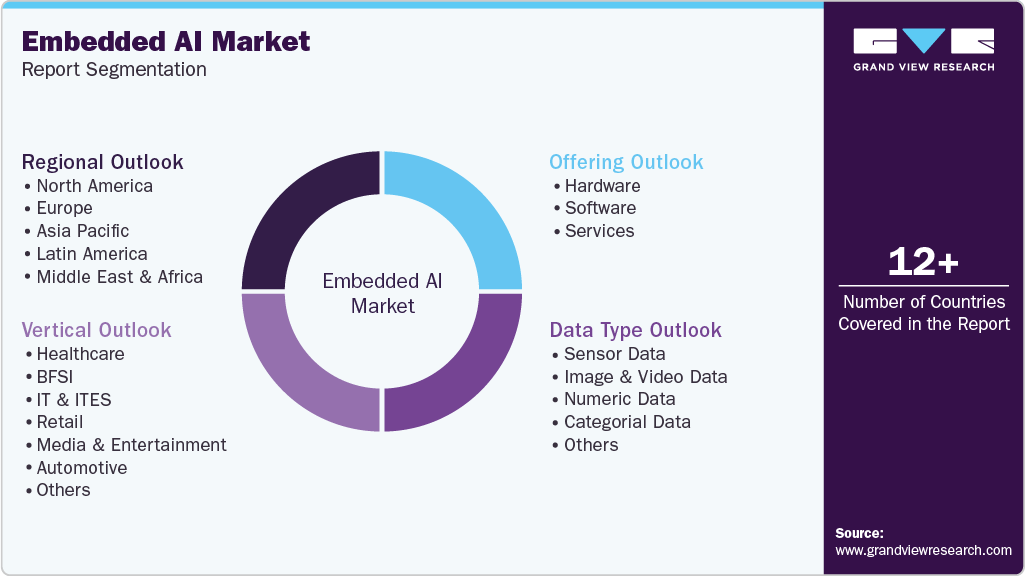
This report forecasts revenue growth at global, regional, and country levels and provides an analysis of the latest industry trends in each of the sub-segments from 2021 to 2033. For this study, Grand View Research has segmented the global embedded AI market report based on offering, data type, vertical, and region:
 To learn more about this report, Download Free Sample Report
 -
Offering Outlook (Revenue, USD Million, 2021 - 2033)
-
Hardware
-
Software
-
Services
-
-
Data Type Outlook (Revenue, USD Million, 2021 - 2033)
-
Sensor Data
-
Image & Video Data
-
Numeric Data
-
Categorial Data
-
Others
-
-
Vertical Outlook (Revenue, USD Million, 2021 - 2033)
-
Healthcare
-
BFSI
-
IT & ITES
-
Retail
-
Media & Entertainment
-
Automotive
-
Telecom
-
Manufacturing
-
Others
-
-
Regional Outlook (Revenue, USD Million, 2021 - 2033)
-
North America
-
U.S.
-
Canada
-
-
Europe
-
Germany
-
UK
-
France
-
-
Asia Pacific
-
China
-
Japan
-
India
-
South Korea
-
Australia
-
-
Latin America
-
Brazil
-
Mexico
-
-
Middle East and Africa (MEA)
-
Kingdom of Saudi Arabia
-
UAE
-
South Africa
-
-
Research Methodology
The Embedded AI market figures in this report are based on a proven research process that combines executive interviews with secondary research from proprietary databases, company filings, and recognized regulatory and institutional sources. Market size is built through value-chain sizing - reconciling supply-side and demand-side estimates - and triangulated with bottom-up and top-down approaches. Every estimate passes multiple levels of expert validation before publication, with each Embedded AI segment quantified using the revenue-capture definitions in the table below.
Segment Definition
Segment - Offering
Revenue capture definition
Hardware
The hardware segment captures revenue generated from AI-enabled processors, microcontrollers, NPUs, GPUs, ASICs, FPGAs, sensors, and embedded computing modules designed for on-device AI processing. It includes dedicated edge AI chipsets and integrated hardware platforms deployed across connected devices and intelligent systems.
Software
Revenue in the software segment is derived from embedded AI operating software, inference engines, AI development frameworks, middleware, and model optimization tools. It also includes edge AI platforms that enable model deployment, device management, and application integration across embedded environments.
Services
The services segment includes revenue from consulting, system integration, deployment, customization, maintenance, technical support, and managed services associated with embedded AI implementations. It covers professional expertise that enables efficient integration, optimization, and lifecycle management of embedded AI solutions.
Segment - Data Type
Revenue capture definition
Sensor Data
This segment captures revenue generated from embedded AI solutions that process inputs from sensors such as temperature, pressure, motion, proximity, LiDAR, radar, and inertial measurement units. It supports real-time monitoring, anomaly detection, and autonomous decision-making across industrial, automotive, and healthcare applications.
Image and Video Data
Revenue in this segment is derived from embedded AI platforms that analyze images and video streams directly on edge devices. These solutions are widely used for facial recognition, object detection, quality inspection, surveillance, and advanced driver assistance systems.
Numeric Data
This segment includes revenue from embedded AI applications that process numerical and time-series data generated by connected devices and equipment. It is commonly deployed for predictive analytics, equipment diagnostics, energy optimization, and performance monitoring.
Categorial Data
Revenue under this segment covers embedded AI solutions that interpret structured categorical information such as device states, user profiles, event classifications, and operational labels. These applications support intelligent automation, rule-based decision systems, and contextual processing across connected environments.
Others
This segment accounts for revenue from embedded AI solutions handling additional data formats, including audio signals, text, geospatial information, and multimodal data combinations. These capabilities support applications such as voice assistants, language processing, location-based services, and integrated edge intelligence.
Segment - Vertical
Revenue capture definition
Healthcare
Embedded AI generates revenue from medical devices, patient monitoring systems, diagnostic imaging, and wearable health technologies that perform real-time analysis at the point of care. Demand is supported by the adoption of intelligent clinical workflows and remote healthcare solutions.
BFSI
Revenue in the BFSI segment comes from embedded AI integrated into payment terminals, biometric authentication systems, fraud detection devices, and secure banking infrastructure. Financial institutions use on-device intelligence to improve transaction security and operational efficiency.
IT & ITES
The IT & ITES segment captures revenue through embedded AI-enabled edge servers, enterprise devices, smart workstations, and intelligent infrastructure management systems. Organizations deploy these solutions to support automation, resource optimization, and secure computing environments.
Retail
Revenue is generated from AI-enabled point-of-sale systems, smart shelves, self-checkout kiosks, inventory tracking devices, and in-store analytics platforms. Retailers use embedded intelligence to improve customer engagement and streamline store operations.
Media & Entertainment
This segment derives revenue from embedded AI in smart TVs, streaming devices, gaming consoles, cameras, and audio systems that enable content optimization and personalized experiences. AI-powered consumer devices continue to expand across digital entertainment ecosystems.
Automotive
The automotive segment captures revenue from embedded AI integrated into advanced driver assistance systems, in-vehicle infotainment, driver monitoring, and vehicle control units. Increasing electronic content in modern vehicles supports broader adoption of AI-enabled automotive platforms.
Telecom
Revenue is generated through embedded AI in network equipment, edge communication devices, base stations, and intelligent customer premises equipment. Telecom providers deploy these solutions to improve network performance, traffic management, and service reliability.
Manufacturing
The manufacturing segment includes revenue from AI-enabled industrial robots, machine controllers, predictive maintenance systems, and quality inspection equipment. Embedded intelligence enhances production efficiency by enabling localized data processing and automated decision-making.
Others
This segment covers embedded AI applications across agriculture, aerospace, defense, logistics, energy, and smart city infrastructure. Revenue is supported by industry-specific deployments requiring real-time analytics, automation, and autonomous system capabilities.
Estimation Model
Layer Name
Key Questions
Description
Device Base Layer
Where can embedded AI be deployed?
Identify the installed base and annual shipments of AI-capable devices across major industries to establish the addressable embedded AI ecosystem.
AI Adoption Layer
How many devices integrate embedded AI?
Apply embedded AI adoption rates across eligible devices to estimate the number of products incorporating on-device AI capabilities.
Technology Layer
Which embedded AI technologies are used?
Measure the distribution of deployments across AI hardware, embedded software, and edge inference technologies to estimate segment-wise market contribution.
Monetization Layer
How much revenue is generated?
Apply the average revenue generated from AI processors, software platforms, licensing, and engineering services to estimate the overall embedded AI market size.
Delivered Customizations
This report has been delivered with the following In-depth customizations
Client Request
Customization Delivered
Value Adds
Market Entry & Expansion Assessment
Regional demand sizing and forecasting
Customer segmentation and buying behavior analysis
Competitive landscape benchmarking
Regulatory and distribution channel assessment
Identified high-growth market opportunities
Supported go-to-market strategy development
Highlighted investment priorities and risks
Enabled data-driven expansion planning
Technology & Innovation Assessment
Emerging technology trend analysis
Innovation pipeline
Technology adoption readiness assessment
Ecosystem and partnership mapping
Identified future growth areas
Supported roadmap planning innovation
Evaluated commercialization potential
Strengthened strategic partnership decisions
Customer & End-User Insights Study
Consumer awareness and adoption analysis
Purchase decision journey mapping
Satisfaction and loyalty assessment
Usage pattern and pain-point evaluation
Revealed key adoption drivers and barriers
Supported customer-centric product development
Improved targeting and engagement strategy
Identified opportunities for retention and upselling
Frequently Asked Questions About This Report
The automotive segment led with a 18.9% revenue share in 2025, while healthcare is the fastest-growing segment
North America dominated the embedded AI market with a share of 31.5% in 2025. The region's growth in this sector is fueled by its presence of leading AI technology firms, strong R&D capabilities, and a well-established market ecosystem.
The global embedded AI market size was valued at USD 11.3 billion in 2025 and is estimated at USD 12.9 billion for 2026.
The global embedded AI market is expected to grow at a CAGR of 14.5% from 2026 to 2033, reaching USD 33.2 billion by 2033.
Some key players operating in the embedded AI market include HPE; Google (Alphabet Inc.); IBM; Intel; LUIS; Technology; Microsoft; NVIDIA; Oracle; Qualcomm; Salesforce; Siemens
Key factors such as the increased adoption of AI-enabled microcontrollers and NPUs that deliver higher performance while maintaining low power consumption.
Asia Pacific is the fastest-growing region over the forecast period.
The software segment led with a 41.2% revenue share in 2025.
Image and video data held the largest revenue share in 2025, while sensor data is the fastest-growing segment.
About the Author(s)
Next Generation Technologies Research Team
Technology · Next Generation TechnologiesThis report was authored by the next generation technologies research team at Grand View Research - comprising two research analysts, one senior research analyst, and one industry expert - with specialized expertise in the next generation technologies segment of the technology industry. All findings are based on proprietary technology databases, executive interviews, and regulatory analysis, subject to internal peer review prior to publication.
Last Updated:
Speak to Analyst

Customize this report to your needs - add regions, segments, or data points, with 20% free customization.
Or view our licence options:


ISO 9001:2015 & 27001:2022 Certified
We are GDPR and CCPA compliant! Your transaction & personal information is safe and secure. For more details, please read our privacy policy.


