
- Home
- »
- Advanced Interior Materials
- »
-
Energy Recovery Ventilator Market Size Report, 2026-2033GVR Report cover

Energy Recovery Ventilator Market (2026 - 2033) Size, Share & Trends Analysis Report By Product (Wall-Mount ERVs, Ceiling-Mount ERVs, Cabinet-Mount), By End Use (Residential, Commercial, Industrial), By Distribution Channel, By Installation, By Region, And Segment Forecasts
Market Size, 2025
$4.4BMarket Estimate, 2026
$4.6BMarket Forecast, 2033
$6.6BCAGR, 2026–2033
5.3%Energy Recovery Ventilator Market Summary
The global energy recovery ventilator market size was valued at USD 4.4 billion in 2025 and is projected to grow from USD 4.6 billion in 2026 to USD 6.6 billion by 2033, at a CAGR of 5.3% from 2026 to 2033. North America dominated the industry with the largest revenue share of 30.1% in 2025. Growing awareness of indoor air quality and stricter ventilation regulations are major drivers of the market.
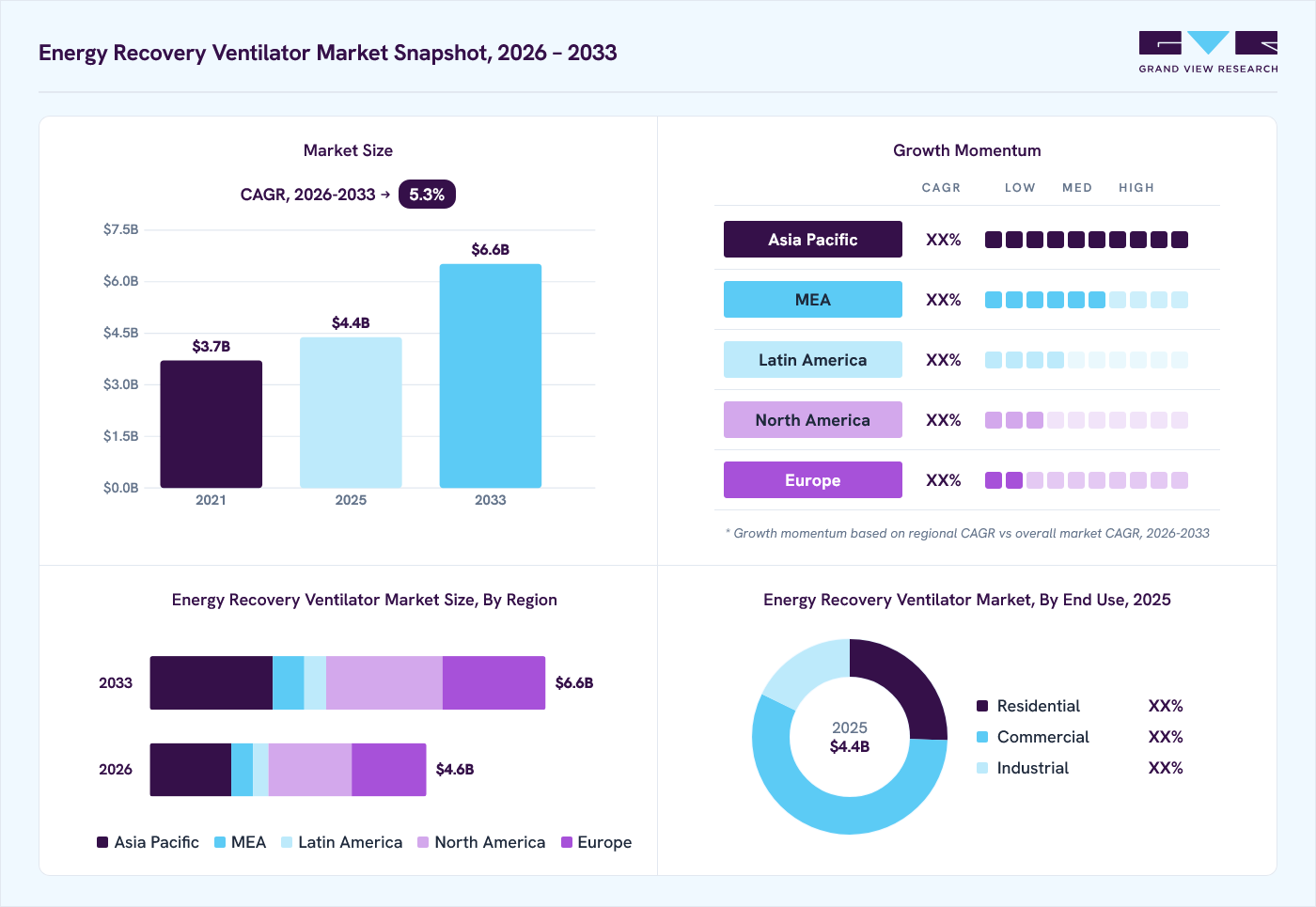 Source: Grand View Research, IR Documents, Primary Interviews, Paid DatabasesTo learn more about this report,
 Download Free Sample Report
 Key Market Trends & Insights
- By product: Wall-mount ERVs dominated the market, with a revenue share of 44.3% in 2025.
- By distribution channel: Offline segment held the largest market share of 85.8% in 2025.
- By installation: New construction projects segment led the market with the largest revenue share of 71.6% in 2025.
- By end-use: Commercial segment led the market with the largest revenue share of 56.7% in 2025.
Regional Highlights
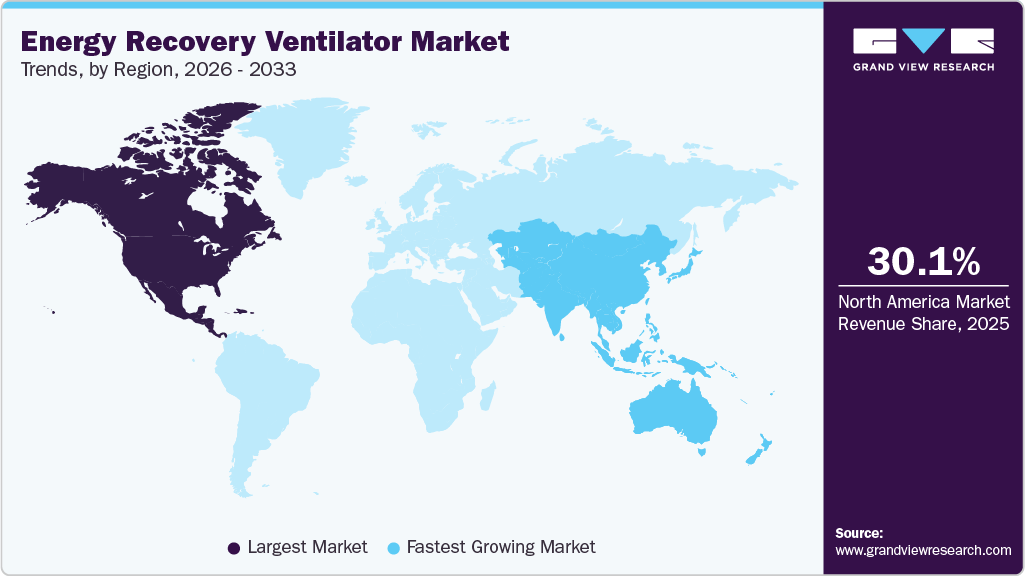
- Largest regional market: North America (30.1% revenue share, 2025)
- Fastest-growing regional market: Asia Pacific (highest CAGR, 2026-2033)
- The U.S. energy recovery ventilator industry leads the North American market.
Market Size & Forecast
- Market size in 2025: USD 4.4 Billion
- Estimated market size in 2026: USD 4.6 Billion
- Projected market size by 2033: USD 6.6 Billion
- CAGR (2026-2033): 5.3%
GVR research-powered AIAsk Prism AI about the energy recovery ventilator marketGet cited answers from GVR research on market growth, segments, regulations and forecasts.Start with✓ Source-linked answers ✓ Market-specific context ✓ Traceable figuresExplore Prism AI ↗
Increasing concerns about airborne pollutants, allergens, and health risks have encouraged residential and commercial building owners to adopt efficient ventilation solutions. Green building certifications and energy efficiency standards are also pushing developers to integrate ERV systems into modern infrastructure.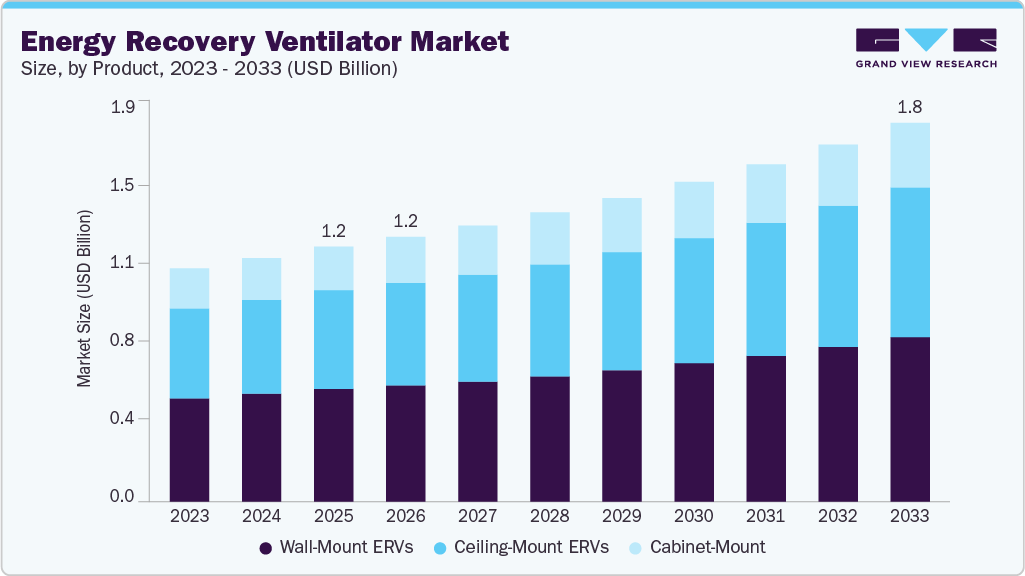 To learn more about this report, Download Free Sample Report
 Another key growth factor is the increasing focus on energy efficiency and sustainable building practices across industries. ERVs help reduce heating and cooling loads by recovering energy from exhaust air, lowering overall energy consumption and operating costs. Governments and organizations are promoting eco-friendly construction through incentives and regulations, supporting market expansion. Technological advancements, including smart controls and compact system designs, are further improving performance and encouraging adoption across residential, commercial, and industrial sectors.
Market Dynamics
The increasing focus on energy efficiency and indoor air quality is a major factor driving the energy recovery ventilator (ERV) market. Governments and regulatory bodies across various countries are implementing stricter building energy efficiency standards and green building regulations, encouraging the adoption of advanced ventilation systems that reduce energy consumption while maintaining healthy indoor environments. ERVs help recover heat and moisture from outgoing air and transfer it to incoming fresh air, significantly reducing heating and cooling loads in residential, commercial, and industrial buildings.
Despite the long-term energy-saving benefits offered by energy recovery ventilators, the market faces challenges related to high initial installation costs and retrofitting complexities. ERV systems often require significant upfront investment for equipment procurement, ductwork modifications, system integration, and professional installation, which can discourage adoption among cost-sensitive residential users and small commercial facilities.
Market Concentration & Characteristics
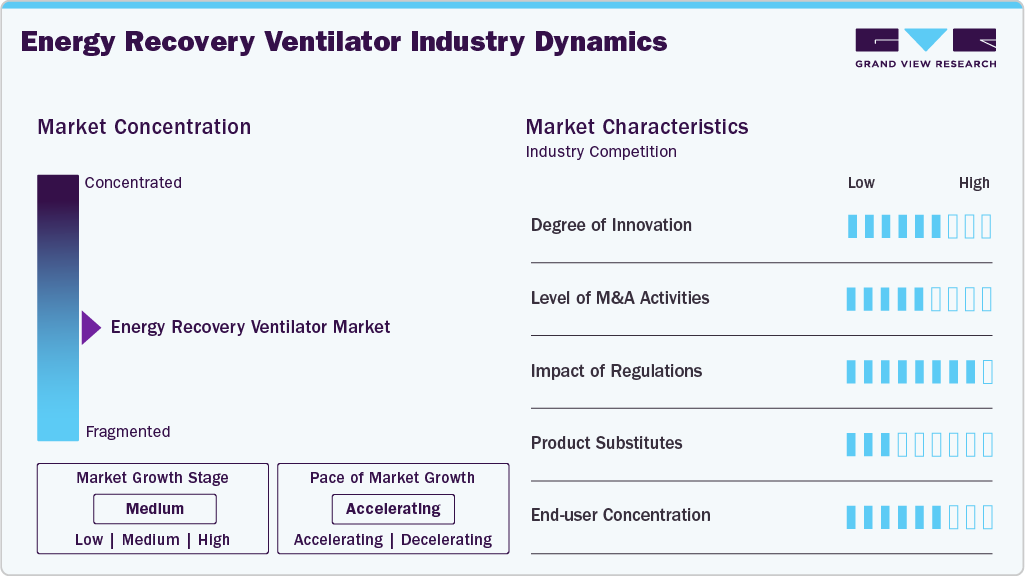
The energy recovery ventilator industry is moderately fragmented, with several international HVAC companies alongside regional manufacturers competing across various applications. Large players focus on innovation, energy efficiency, and integrated ventilation solutions, while smaller companies offer customized and cost-effective systems tailored to local building standards. The presence of multiple vendors prevents high market concentration and keeps competition dynamic. Continuous product development and growing demand for sustainable ventilation further encourage new entrants and strategic partnerships.
The market for energy recovery ventilator shows a strong level of innovation driven by the need for energy efficiency and improved indoor air quality. Manufacturers are introducing advanced heat exchange cores, smart sensors, and automation features to enhance performance and user control. Integration with building management systems and IoT-enabled monitoring is becoming more common in commercial applications.
 To learn more about this report, Download Free Sample Report
 Regulatory frameworks play a significant role in shaping market growth, especially through energy efficiency standards and ventilation requirements in building codes. Governments and industry bodies are promoting sustainable construction practices, which encourage the adoption of ERV systems. Indoor air quality guidelines and carbon reduction targets further support demand across residential and commercial sectors. Compliance with regional standards also drives manufacturers to improve product efficiency and environmental performance.
End user demand is relatively diversified, with residential, commercial, and industrial sectors contributing to market expansion. Commercial buildings such as offices, healthcare facilities, and educational institutions represent a major share due to strict ventilation needs. The residential segment is growing steadily as homeowners prioritize energy savings and healthier indoor environments. Industrial applications remain niche but are expanding where controlled ventilation is essential for operational safety and compliance.
Drivers, Opportunities & Restraints
Rising demand for energy-efficient HVAC solutions and growing awareness of indoor air quality are key drivers of the energy recovery ventilator industry. Increasing urbanization and construction activities are encouraging the adoption of advanced ventilation systems in residential and commercial buildings. Stricter energy regulations and green building standards are pushing developers to integrate ERVs into new projects.
Expanding smart building infrastructure and the growing adoption of IoT-enabled HVAC systems create strong opportunities for ERV manufacturers. Emerging economies offer significant growth potential due to rapid infrastructure development and increasing focus on sustainable construction. Retrofit projects in older buildings also present a large untapped market as property owners upgrade ventilation systems to meet modern standards. Innovations in compact and modular ERV designs further open opportunities in space-constrained urban environments.
High initial installation costs and complex system integration can limit adoption, particularly among small residential users. Lack of awareness in developing regions and dependence on skilled installation professionals may slow market penetration. Maintenance requirements and operational complexity can also discourage some end users from adopting ERV systems.
Product Insights
Wall-mount ERVs dominated the product segment in 2025 and accounted for 44.3% share, due to their compact design, ease of installation, and suitability for residential and small commercial applications. These units gained strong adoption in retrofit projects where space limitations required flexible mounting options. Cost-effectiveness and simplified maintenance further supported their widespread use across urban housing developments. Growing demand for decentralized ventilation solutions also strengthened their leading market share.
Ceiling-mount ERVs emerged as the fastest-growing segment in 2025 owing to increasing demand for concealed ventilation systems in modern buildings. Commercial offices, healthcare facilities, and premium residential projects preferred ceiling-mounted units for better aesthetics and optimized space utilization. Advancements in compact design and quieter operation improved their appeal among architects and HVAC planners. Rising adoption of integrated HVAC solutions in smart buildings continues to accelerate growth in this segment.
Distribution Channel Insights
The offline distribution channel dominated the market and accounted for 85.8% share in 2025, due to the technical nature of ERV systems and the need for professional consultation. HVAC contractors, authorized dealers, and distributors playing key role in product selection, installation support, and after-sales services. Large commercial and industrial buyers preferred offline channels for customized solutions and project-based procurement. Strong distributor networks and long-standing supplier relationships further supported the segment’s leading position.
The online channel is emerging as the fastest-growing distribution segment, driven by increasing digitalization and expanding e-commerce platforms. Residential customers and small businesses are increasingly purchasing ERVs online due to easier product comparison, competitive pricing, and wider availability. Manufacturers are also strengthening direct-to-customer sales through digital platforms and virtual consultation tools. Growing confidence in online purchasing and improved logistics infrastructure continue to accelerate this segment’s growth.
Installation Insights
New construction projects dominated the installation segment and accounted for 71.6% share in 2025, due to the increasing integration of energy-efficient ventilation systems during building design and development stages. Developers are incorporating ERVs to comply with green building standards and stricter energy regulations. Early-stage installation allows better system optimization and cost efficiency compared to post-construction upgrades. Rapid urbanization and expansion of commercial infrastructure further strengthened demand from new construction projects.
The retrofit and renovation segment is experiencing moderate growth as existing buildings upgrade ventilation systems to improve indoor air quality and energy performance. Aging infrastructure and evolving regulatory requirements are encouraging property owners to replace traditional ventilation systems with ERVs. However, installation complexity and higher modification costs limit faster adoption in older structures.
End Use Insights
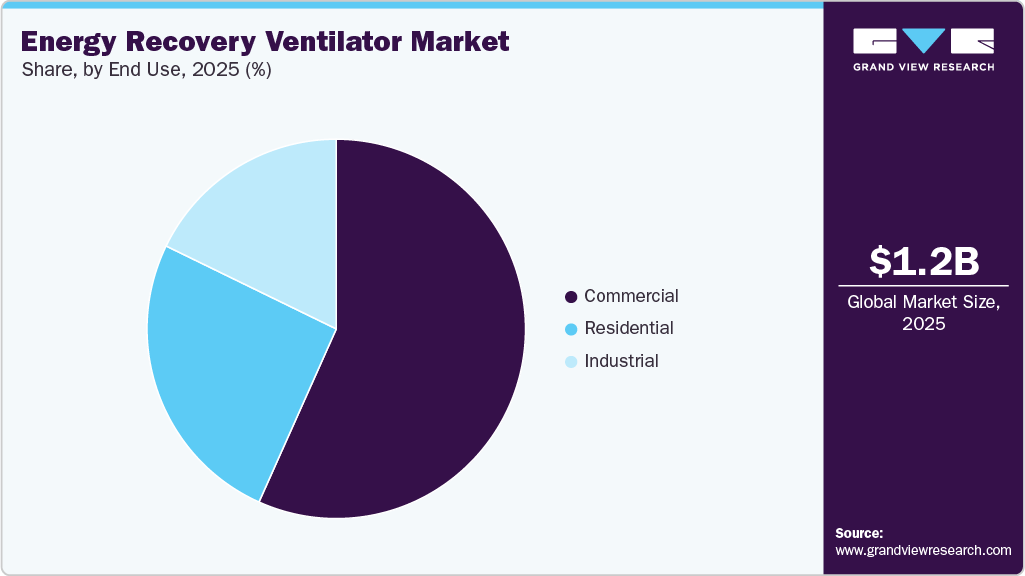
In 2025, the commercial segment dominated the market and accounted for 56.7% share, due to high ventilation requirements in offices, healthcare facilities, educational institutions, and retail spaces. Strict indoor air quality regulations and energy efficiency targets encouraged the adoption of ERV systems in large commercial buildings. The need to maintain controlled airflow while reducing operational energy costs supported strong demand. Expansion of commercial infrastructure and smart building initiatives further reinforced the segment’s leading position.
 To learn more about this report, Download Free Sample Report
 The residential segment is growing significantly as homeowners increasingly focus on healthier indoor environments and energy savings. Rising awareness about air pollution and ventilation efficiency has boosted demand for ERVs in apartments and modern housing projects. Compact designs and improved affordability are making these systems more accessible to residential users.
Regional Insights
North America energy recovery ventilator industry dominated the global market in 2025 and accounted for 30.1% share, due to strong adoption of energy-efficient HVAC technologies and strict building energy codes. High awareness of indoor air quality and sustainability goals supported widespread ERV installation across residential and commercial sectors. The presence of major HVAC manufacturers and advanced infrastructure further strengthened market growth. Increasing renovation activities and green building certifications also contributed to regional leadership.
 To learn more about this report, Download Free Sample Report
 U.S. Energy Recovery Ventilator Market Trends
The U.S. energy recovery ventilator industry leads the North American market due to strong adoption of advanced HVAC systems across commercial and residential sectors. Strict building energy standards and increasing focus on sustainable construction encourage widespread ERV integration. High demand from healthcare facilities, offices, and educational institutions supports continuous product deployment. Technological innovation and the presence of major industry players further strengthen market dominance.
Canada energy recovery ventilator industry is witnessing notable growth driven by colder climate conditions that increase the need for efficient heat recovery ventilation solutions. Government initiatives promoting energy-efficient buildings and carbon reduction targets support ERV adoption in new construction projects. Rising awareness of indoor air quality and ventilation performance also contributes to expanding residential demand. Growth in green building practices and renovation activities continues to create new opportunities.
Europe Energy Recovery Ventilator Market Trends
The energy recovery ventilator industry in Europe is witnessing steady growth due to stringent energy efficiency regulations and strong emphasis on low-carbon building solutions. Policies supporting nearly zero-energy buildings and improved indoor air quality standards are boosting ERV adoption. Renovation of aging infrastructure across Western and Northern Europe creates additional opportunities. Technological innovation and demand for sustainable ventilation solutions continue to drive market expansion.
Germany energy recovery ventilator industry leads the European market due to strong emphasis on energy-efficient building practices and strict environmental regulations. The country’s focus on passive houses and high-performance construction standards drives widespread ERV adoption. Advanced HVAC engineering capabilities and continuous innovation from local manufacturers further strengthen market presence. Growing demand from commercial buildings and residential renovation projects supports sustained leadership.
France energy recovery ventilator industry is experiencing steady growth supported by increasing investments in sustainable construction and energy renovation programs. Government initiatives promoting improved ventilation and reduced carbon emissions are encouraging ERV integration across new and existing buildings. Rising awareness of indoor air quality and modernization of residential infrastructure contribute to expanding adoption. The shift toward smart and energy-efficient building technologies continues to support market expansion.
Asia Pacific Energy Recovery Ventilator Market Trends
Asia Pacific energy recovery ventilator industry is expected to be the fastest-growing region at a CAGR of 6.1% over the forecast period, driven by rapid urbanization, expanding construction activities, and rising demand for modern ventilation systems. Growing awareness of air pollution and energy efficiency is encouraging adoption across residential and commercial buildings. Government initiatives promoting sustainable infrastructure and smart city development are supporting market expansion. Increasing investments in HVAC technologies across countries like China, India, and Southeast Asia further accelerate growth.
China energy recovery ventilator industry dominated the Asia Pacific market in 2025 due to large-scale urban development and high construction activity across residential and commercial sectors. Growing concerns over air pollution and indoor air quality are accelerating the adoption of advanced ventilation systems. Strong government support for energy-efficient buildings and smart city projects further boosts demand. The presence of a large manufacturing base also helps reduce costs and increase market penetration.
The energy recovery ventilator industry in India is emerging as a fast-growing market driven by rapid urbanization and expansion of commercial and residential infrastructure. Increasing awareness of indoor air quality, especially in urban areas, is encouraging the use of ERV systems. Government initiatives focused on energy efficiency and sustainable buildings are supporting market growth. Rising investments in offices, healthcare, and premium housing projects continue to create new opportunities.
Middle East & Africa Energy Recovery Ventilator Market Trends
The Middle East and Africa energy recovery ventilator industry is growing as demand increases for efficient cooling and ventilation solutions in harsh climatic conditions. Expanding commercial infrastructure, hospitality projects, and smart city initiatives are encouraging ERV deployment. Governments are promoting energy efficiency to reduce power consumption, creating opportunities for advanced HVAC technologies. Rising construction activities and modernization efforts continue to support market growth across the region.
Saudi Arabia energy recovery ventilator industry is experiencing steady growth, driven by large-scale infrastructure development and diversification initiatives under national transformation programs. Increasing construction of commercial complexes, healthcare facilities, and smart city projects is supporting demand for advanced ventilation systems. The need for energy-efficient cooling solutions in extreme climate conditions further encourages ERV adoption. Growing focus on sustainable building standards and improved indoor air quality continues to create expansion opportunities.
Latin America Energy Recovery Ventilator Market Trends
Latin America energy recovery ventilator industry is experiencing gradual growth supported by rising commercial construction and improving awareness of energy-efficient building systems. Increasing investments in infrastructure development and urban housing projects are encouraging ERV adoption. However, cost sensitivity and limited technical awareness in some countries may slow faster penetration. Despite challenges, demand for improved indoor comfort and ventilation efficiency supports steady market progress.
The energy recovery ventilator industry in Brazil is showing steady growth, supported by rising commercial construction and modernization of building infrastructure. Increasing awareness of energy efficiency and indoor air quality is encouraging adoption across offices, healthcare facilities, and residential projects. Expansion of urban development and green building initiatives is creating demand for advanced ventilation solutions. Improving HVAC technology adoption and investment in sustainable construction continue to support market expansion.
Key Energy Recovery Ventilator Company Insights
Some of the key players operating in the market include Daikin; Carrier; Johnson Controls.
-
Daikin offers a wide portfolio of energy recovery ventilators integrated with its broader HVAC ecosystem, focusing on high-efficiency heat recovery technology and advanced ventilation control solutions. The company combines ERV systems with VRV/VRF air conditioning, air purification, and smart building management platforms to deliver energy-optimized indoor environments. Its offerings extend across commercial, residential, and industrial applications, including chillers, heat pumps, and refrigeration systems. Daikin also emphasizes inverter technology and low-carbon solutions aligned with sustainability goals. Strong R&D investments support innovation in compact ventilation designs and enhanced energy performance.
-
Carrier provides energy recovery ventilator solutions as part of its comprehensive indoor climate management portfolio, emphasizing energy savings and improved air quality in commercial and residential buildings. The company integrates ERVs with rooftop units, air handling systems, and advanced building automation platforms to optimize ventilation efficiency. Beyond ventilation, Carrier operates across heating, cooling, refrigeration, and cold chain logistics solutions, supporting diverse verticals such as healthcare, data centers, and commercial infrastructure. Its offerings include digital monitoring tools and smart controls for predictive maintenance and performance optimization. Continuous product development focuses on sustainability, decarbonization, and intelligent HVAC system integration.
Key Energy Recovery Ventilator Companies:
The following key companies have been profiled for this study on the energy recovery ventilator market.
- Marut Air
- Panasonic Corporation
- Maico Ventilation Pvt. Ltd
- Bosch Home Comfort Group
- Carrier
- Greenheck Fan Corporation
- Johnson Controls.
- Ruskin
- Daikin
- Lennox International Inc.
- Systemair AB
- NMB Technologies Corporation
- Trane
- Reventon Group Sp. z o.o.
- Samsung
Competitive Benchmarking
Operating Strategies
Competitive Edge
Weaknesses
Mature Players: Panasonic Corporation; Bosch Home Comfort Group; Carrier; Johnson Controls; Daikin; Lennox International Inc.; Trane; Samsung; Systemair AB
- Strong focus on energy-efficient HVAC and smart ventilation technologies
- Significant investments in IoT-enabled HVAC systems and green building technologies
- Extensive global distribution, installation, and aftermarket service networks
- Strong global brand recognition and diversified HVAC product portfolios
- Advanced technological capabilities in energy recovery and smart building integration
- Strong penetration across residential, commercial, and industrial sectors
- Premium pricing compared to regional manufacturers
- High dependence on construction and commercial real estate cycles
- Complex product installation and maintenance requirements
Emerging Players: Marut Air; Maico Ventilation Pvt. Ltd; Greenheck Fan Corporation; Ruskin; NMB Technologies Corporation; Reventon Group Sp. z o.o.
- Focus on application-specific ventilation and air movement solutions
- Expansion into regional and mid-sized commercial markets
- Increasing emphasis on compact, energy-efficient, and customized ventilation systems
- Competitive pricing and strong regional market presence
- Flexibility in offering customized ventilation and airflow management solutions
- Growing adoption in industrial and commercial ventilation projects
- Faster responsiveness to localized customer requirements
- Comparatively lower global market penetration and brand visibility
- Limited product diversification compared to multinational HVAC leaders
- Lower investments in advanced smart HVAC ecosystem integration
Recent Developments
-
In February 2026, Panasonic Eco Systems North America presented its latest indoor air quality solutions at NAHB International Builders' Show (IBS) designed to enhance residential comfort and energy performance. The showcase included Intelli-Balance Elite and Elite Plus+ energy recovery ventilators, WhisperGreen Select ventilation fans, and the OASYS whole-home air quality management system, demonstrating integrated ventilation and smart air control for modern housing environments.
-
In November 2024,Oji Holdings developed a new energy recovery ventilator core using cellulose nanofiber technology to improve heat exchange performance and ventilation efficiency. The design enables effective transfer of heat and moisture while maintaining air separation. It supports energy savings and enhanced indoor air quality. The solution is intended for advanced ERV applications, particularly in North America.
Energy Recovery Ventilator Market Report Scope
Report Attribute
Details
Market size in 2025
USD 4.4 Billion
Estimated market size in 2026
USD 4.6 Billion
Revenue forecast in 2033
USD 6.6 Billion
Growth rate
CAGR of 5.3% from 2026 to 2033
Historical data
2021 - 2024
Forecast period
2026 - 2033
Quantitative units
Revenue in USD million/billion and CAGR from 2026 to 2033
Report coverage
Revenue forecast, company ranking, competitive landscape, growth factors, and trends
Segments covered
Product, distribution channel, installation, end use, region
Regional scope
North America; Europe; Asia Pacific; Latin America; Middle East & Africa
Country scope
U.S.; Canada; Mexico; UK; Germany; France; Spain; Italy; China; Japan; India; Australia; South Korea; Brazil; Argentina; Saudi Arabia; South Africa; UAE
Key companies profiled
Marut Air; Panasonic Corporation; Maico Ventilation Pvt. Ltd; Bosch Home Comfort Group; Carrier; Greenheck Fan Corporation; Johnson Controls; Ruskin; Daikin; Lennox International Inc.; Systemair AB; NMB Technologies Corporation; Trane; Reventon Group Sp. z o.o.; Samsung
Customization scope
Free report customization (equivalent up to 8 analysts working days) with purchase. Addition or alteration to country, regional & segment scope.
Pricing and purchase options
Avail customized purchase options to meet your exact research needs. Explore purchase options
Global Energy Recovery Ventilator Market Report Segmentation
This report forecasts revenue growth at global, regional, and country levels and provides an analysis of the latest industry trends in each of the sub-segments from 2021 to 2033. For this study, Grand View Research has segmented the global energy recovery ventilator market report based on product, distribution channel, installation, end use, and region.
-
Product Outlook (Revenue, USD Million, 2021 - 2033)
-
Wall-Mount ERVs
-
Ceiling-Mount ERVs
-
Cabinet-Mount
-
-
Distribution Channel Outlook (Revenue, USD Million, 2021 - 2033)
-
Online
-
Offline
-
-
Installation Outlook (Revenue, USD Million, 2021 - 2033)
-
New Construction
-
Retrofit / Renovation
-
-
End Use Outlook (Revenue, USD Million, 2021 - 2033)
-
Residential
-
Commercial
-
Industrial
-
-
Regional Outlook (Revenue, USD Million, 2021 - 2033)
-
North America
-
U.S.
-
Canada
-
Mexico
-
-
Europe
-
Germany
-
France
-
Italy
-
Spain
-
UK
-
-
Asia Pacific
-
China
-
India
-
Japan
-
South Korea
-
Australia
-
-
Latin America
-
Brazil
-
Argentina
-
-
Middle East and Africa
-
Saudi Arabia
-
UAE
-
South Africa
-
-
Delivered Customizations
This report has been delivered with the following In-depth customizations
Client Request
Customization Delivered
Value Adds
Regional Segmentation
Detailed market estimates and forecasts for the Energy Recovery Ventilator (ERV) Market across North America, Europe, Asia Pacific, Latin America, and Middle East & Africa. Country-level demand analysis covering residential, commercial, healthcare, hospitality, and industrial infrastructure sectors.
Identify high-growth regional markets and sustainable building investment hotspots. Support regional expansion strategies, distributor network optimization, and demand forecasting.
Opportunity Assessment
Identification of emerging growth opportunities driven by green building initiatives, stricter indoor air quality regulations, smart HVAC adoption, energy-efficient infrastructure development, and increasing awareness regarding healthy indoor environments.
Prioritize high-growth applications and investment opportunities. Support innovation roadmap development and long-term strategic planning.
Competitive Benchmarking
Detailed benchmarking of leading ERV manufacturers based on product portfolio, airflow efficiency, energy-saving capabilities, smart HVAC integration, regional presence, and sustainability initiatives.
Enable competitive intelligence and strategic differentiation. Support product positioning, partnership evaluation, and innovation benchmarking.
Frequently Asked Questions About This Report
The global energy recovery ventilator market, in terms of revenue, is expected to grow at a compound annual growth rate of 5.3% from 2026 to 2033 to reach USD 6.6 billion by 2033.
The global energy recovery ventilator market size was estimated at USD 4.4 billion in 2025 and is expected to be USD 4.6 billion in 2026.
North America energy recovery ventilator industry dominated the global market in 2025 and accounted for 30.1% share.
Some of the key players operating in the global energy recovery ventilator market include Marut Air; Panasonic Corporation; Maico Ventilation Pvt. Ltd; Bosch Home Comfort Group; Carrier; Greenheck Fan Corporation; Johnson Controls; Ruskin; Daikin; Lennox International Inc.; Systemair AB; NMB Technologies Corporation; Trane; Reventon Group Sp. z o.o. Samsung.
Growing demand for energy-efficient HVAC systems and increasing focus on indoor air quality are major drivers of the global energy recovery ventilator market. Stricter building energy regulations and sustainability targets are encouraging the adoption of advanced ventilation solutions. Rising construction activities and smart building development further support market growth.
Asia Pacific energy recovery ventilator industry is expected to be the fastest-growing region at a CAGR of 6.1% over the forecast period.
Wall-mount ERVs dominated the product segment in 2025 and accounted for 44.3% share, while ceiling-mount ERVs emerged as the fastest-growing segment
The offline distribution channel dominated the market and accounted for 85.8% share in 2025, due to the technical nature of ERV systems and the need for professional consultation.
New construction projects dominated the installation segment and accounted for 71.6% share in 2025 and retrofit and renovation segment is experiencing moderate growth.
The commercial segment dominated the market and accounted for 56.7% share in 2025 while the residential segment is growing significantly.
About the Author(s)
Advanced Interior Materials Research Team
Advanced Materials · Advanced Interior MaterialsThis report was authored by the advanced interior materials research team at Grand View Research - comprising two research analysts, one senior research analyst, and one industry expert - with specialized expertise in the advanced interior materials segment of the advanced materials industry. All findings are based on proprietary advanced materials databases, executive interviews, and regulatory analysis, subject to internal peer review prior to publication.
Last Updated:
Speak to Analyst

Customize this report to your needs - add regions, segments, or data points, with 20% free customization.
Or view our licence options:


ISO 9001:2015 & 27001:2022 Certified
We are GDPR and CCPA compliant! Your transaction & personal information is safe and secure. For more details, please read our privacy policy.


