
- Home
- »
- Power Generation & Storage
- »
-
Energy Transition Market Size And Trends Report, 2026-2033GVR Report cover

Energy Transition Market (2026 - 2033)
Size, Share & Trends Analysis Report By Type (Renewable Energy, Electrification, Energy Efficiency), By Sector (Power & Utility, Transportation), By Region (North America, Europe, Asia Pacific, Latin America, MEA), And Segment Forecasts
Market Size, 2025
$2.8TMarket Estimate, 2026
$3.0TMarket Forecast, 2033
$5.9TCAGR, 2026–2033
9.8%Energy Transition Market Summary
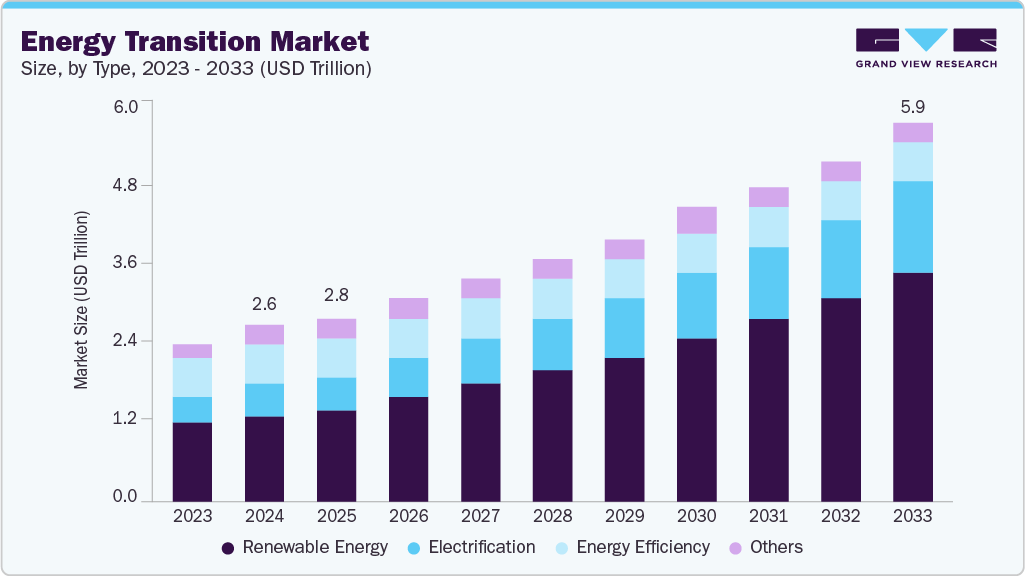
The global energy transition market size was valued at USD 2.8 trillion in 2025 and is projected to grow from USD 3.0 trillion in 2026 to USD 5.9 trillion by 2033, at a CAGR of 9.8% from 2026 to 2033. The Asia Pacific held the largest share of 44.6% of the global market in 2025. The industry is expanding rapidly due to rising global efforts to reduce emissions, combat climate change, and drive large-scale adoption of clean energy solutions.
 Source: Grand View Research, IR Documents, Primary Interviews, Paid DatabasesTo learn more about this report,
 Download Free Sample Report
 Key Market Trends & Insights
- By type: Renewable energy segment accounted for the largest market share of 50.8% in 2025.
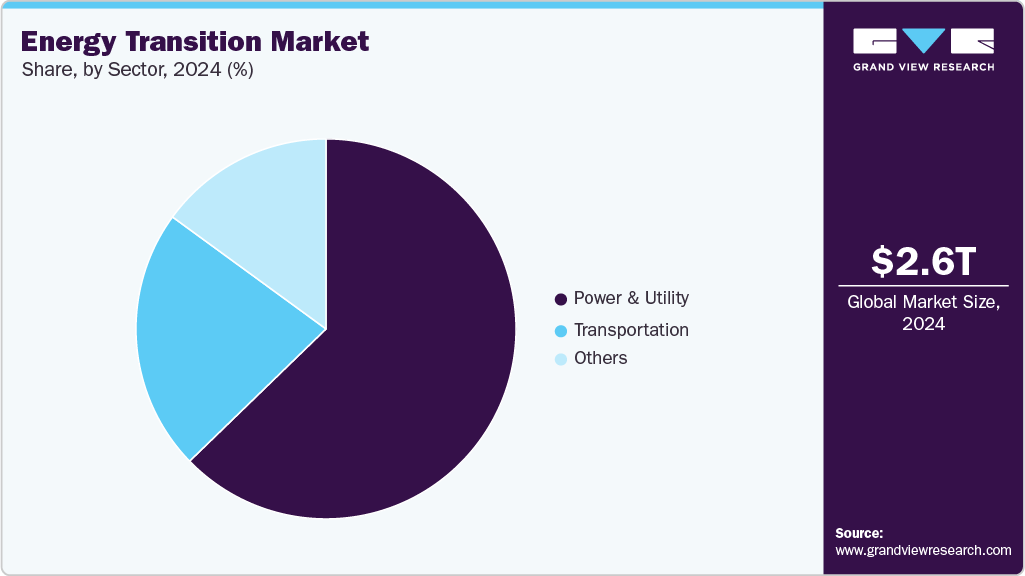
- By sector: Power & utility sub-segment held the largest revenue share of 63.2% in 2025.
Regional Highlights
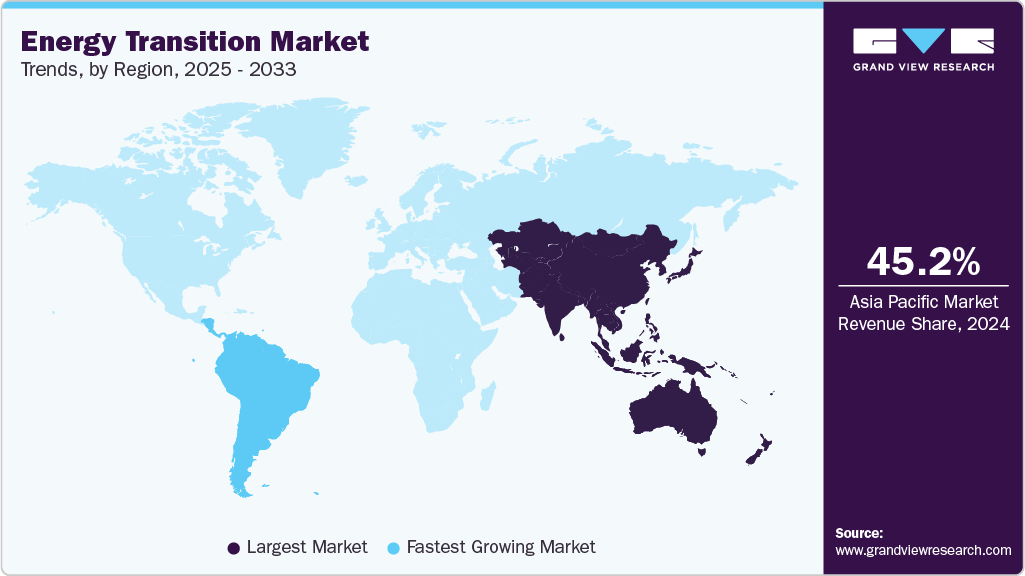
- Largest regional market: Asia Pacific (44.6% revenue share, 2025)
- Fastest-growing regional market: Latin America (12.2% CAGR, 2026-2033)
- By country: China is expected to grow significantly over the forecast period.
Market Size & Forecast
- Market size in 2025: USD 2.8 Trillion
- Estimated market size in 2026: USD 3.0 Trillion
- Projected market size by 2033: USD 5.9 Trillion
- CAGR (2026-2033): 9.8%
Three ways to get this report
Buy it, customize it, or ask a question.Ask an Analyst
Analyst response in 1 business day
- AccessReport author, directly
- Reply timeWithin 1 working day
- No sales callDirect answer only
- FormatEmail reply
- CostFree, no cost
Get the Full Report
What the study covers
- FormatsPDF · Excel · Dashboard
- Timeline2026–2033 annual, 2025 base
- Coverage20+ countries, 5 regions
- Companies10+ key players profiled
Customize the Report
20% free customization
- IncludeCountries, segments, points
- TailorTo your product definition
- ExtendDeeper competitor detail
- OrA fully bespoke study
- Turnaround5–10 working days
Increasing investments in renewable technologies such as solar energy and wind energy, along with supportive government policies, are significantly accelerating market growth. Growing electrification across transport and industry, coupled with advancements in hydrogen and energy storage, is further strengthening the expansion of the market.The industry is experiencing rapid growth, driven by the global push to reduce emissions and address climate change. This momentum is accelerating the adoption of clean energy worldwide. Government subsidies, tax benefits, and renewable energy mandates are boosting the deployment of solar energy and wind energy, while also driving investments in emerging solutions like energy storage, hydrogen, and grid modernization to support large-scale integration of clean power. Companies pursuing net-zero goals are increasing the demand for clean energy procurement.
 To learn more about this report, Download Free Sample Report
 Geopolitical shocks and volatile fossil fuel prices are pushing nations to diversify their energy mix and reduce dependence on conventional energy sources. Supply disruptions and price spikes have exposed the vulnerabilities associated with over-reliance on imported fuels, prompting governments to prioritize energy security. As a result, countries are accelerating investments in domestic and renewable energy sources such as solar energy and wind energy. This shift is also supported by long-term strategies aimed at stabilizing energy costs and enhancing resilience against global market fluctuations.
Market Dynamics
Growing investments in renewable power generation, grid modernization, and electrification projects are significantly supporting expansion of the global energy transition market. Governments and private sector companies across major economies are increasing spending on renewable energy facilities, battery energy storage systems, electric vehicle charging infrastructure, hydrogen projects, and smart grid technologies to support long-term decarbonization objectives.
According to the International Energy Agency (IEA), global energy investments are projected to surpass USD 3 trillion in 2026, with a substantial share allocated toward clean energy-related infrastructure and technologies. In addition, rising electricity consumption from industrial electrification, electric vehicles, and AI-driven data centers is accelerating the need for renewable energy integration and transmission network expansion.
The global energy transition market continues to face challenges associated with high infrastructure investment needs and limitations in existing electricity grid networks. Expanding renewable power capacity, battery energy storage systems, hydrogen infrastructure, electric vehicle charging facilities, and transmission networks requires significant capital expenditure and lengthy project execution timelines. Across several regions, outdated grid systems and inadequate transmission connectivity remain major barriers to large-scale integration of renewable energy sources such as wind and solar power. Furthermore, permitting complexities, supply chain constraints for critical minerals and equipment, and rising financing costs are increasing uncertainty for energy transition projects. These factors may slow the pace of clean energy deployment, particularly across developing and energy-import-dependent economies.
Sector Insights
Based on sector, the power & utility segment held the largest share of 63.2%. This segment is driven by the large-scale integration of renewable energy sources and the ongoing transformation of electricity systems. The rapid expansion of distributed solutions such as rooftop solar energy, battery storage, and smart meters is increasing the need for advanced grid management and optimization systems. Utilities are investing heavily in digital infrastructure and smart grid technologies to efficiently manage decentralized power generation. These developments, combined with rising electricity demand and grid modernization efforts, are reinforcing the central role of the power & utilities sector.
The transportation segment is projected to register the fastest CAGR of 11.2% over the forecast period, supported by the rapid adoption of electric mobility solutions across passenger, commercial, and heavy-duty vehicle segments. This growth is further supported by the large-scale deployment of charging infrastructure, which is essential to accommodate the rising number of EVs globally. The expansion of charging networks, along with supportive policies and technological advancements, is enabling a more reliable and accessible ecosystem for electric mobility.
Type Insights
Based on type, the renewable energy segment accounted for the largest market share of 50.8% in 2025, driven by strong regulatory and policy support promoting clean energy adoption. Stringent net-zero commitments, carbon pricing mechanisms, and government subsidies have significantly accelerated the deployment of renewable energies. Rising corporate sustainability initiatives and ESG commitments are increasing demand for renewable power through long-term Power Purchase Agreements (PPAs), ensuring stable revenue streams for developers. The scalability, declining costs, and policy-driven incentives associated with renewable energy continue to support its dominant position within the industry.
 To learn more about this report, Download Free Sample Report
 The electrification segment is the fastest-growing segment with a projected CAGR of 13.0% over the forecast period, driven by rapid cost reductions and technological advancements across the energy ecosystem. Declining costs of solar energy photovoltaics (PV), wind energy, and battery energy storage systems (BESS) are making electricity from renewable sources increasingly affordable in many regions. This cost advantage is accelerating the shift toward electrified applications across transport, industry, and buildings, replacing conventional fossil fuel-based systems. The improvements in battery performance, charging infrastructure, and grid integration are further supporting the widespread adoption of electrification solutions.
Regional Insights
Asia Pacific energy transition market accounted for the largest share of 44.6% in 2025, primarily driven by strong policy support and the region’s expanding industrial base. Governments across key economies are implementing regulatory measures such as carbon pricing mechanisms, along with incentives and grants, to encourage the adoption of clean energy solutions. These policies are accelerating investments in technologies such as solar energy and wind energy, particularly in energy-intensive industries. Growing collaboration between governments, industry bodies, and private enterprises is enhancing technology adoption and enabling the development of a structured energy transition across the region.
 To learn more about this report, Download Free Sample Report
 Addressing knowledge and skills gaps through training programs and industry collaboration is enabling companies to better understand and deploy energy transition technologies. The active involvement of government agencies and industry bodies in capacity building and awareness is further supporting the development of structured and scalable energy transition roadmaps across the region. This is accelerating the adoption of clean energy solutions and strengthening the region’s overall transition readiness.
China Energy Transition Market Trends
China’s energy transition market is supported by large-scale investments in grid infrastructure and energy storage to support the rapid expansion of renewable energy capacity. As the deployment of solar energy and wind energy continues to accelerate, managing supply variability has become a key priority. This is prompting significant investments in advanced grid systems and energy storage solutions to enhance flexibility and ensure reliable power distribution. The development of smart grid infrastructure and large-scale energy storage systems is enabling efficient integration of renewable energy into the national grid.
Europe Energy Transition Market Trends
The energy transition market in Europe is driven by strong regulatory frameworks aimed at accelerating decarbonization and reducing greenhouse gas emissions. Key initiatives such as the European Green Deal and REPowerEU are acting as primary catalysts, promoting large-scale investments in renewable energy, energy efficiency, and low-carbon technologies. Countries across the region are actively advancing the deployment of clean energy solutions such as solar energy and wind energy, supported by strong regulatory mandates and funding mechanisms. Continuous investments in grid modernization, electrification, and innovation are further strengthening the region’s transition toward a sustainable energy system.
North America Energy Transition Market Trends
The energy transition market in North America is supported by the expanding electrification of end-use sectors and strong infrastructure development. The increasing adoption of Electric vehicles, heat pumps, and industrial electrification is significantly raising electricity demand across the region. This shift is driving substantial investments in grid expansion, charging infrastructure, and energy management systems to ensure reliable and efficient power delivery. Advancements in clean energy technologies and supportive policy frameworks are accelerating the transition toward a low-carbon energy system.
Latin America Energy Transition Market Trends
The energy transition market in Latin America is the fastest-growing market, with a projected CAGR of 12.2% over the forecast period, driven by its strong position in the global supply of critical minerals. The region holds substantial reserves of lithium, copper, and silver, which are essential for technologies such as electric vehicles and battery energy storage systems. This resource advantage is attracting significant investments in mining, processing, and supply chain development to support the growing global demand for clean energy solutions. Countries across the region are increasingly leveraging these resources to strengthen their role in the global energy transition ecosystem.
Middle East & Africa Energy Transition Market Trends
The energy transition market in the Middle East & Africa (MEA) is driven by the increasing penetration of electric mobility across the region. The adoption of Electric vehicles is gaining momentum as governments introduce supportive policies, incentives, and infrastructure development initiatives. This shift is particularly significant in urban centers, where the need for cleaner and more efficient transportation solutions is rising alongside rapid urbanization. Investments in charging infrastructure and grid capacity are further supporting the growth of electric mobility and enhancing system reliability. As a result, growing EV penetration is playing a key role in advancing the broader energy transition across the MEA region.
Key Energy Transition Company Insights
Some of the key participants in the global energy transition market include NextEra Energy, Inc., Iberdrola, S.A., Ørsted A/S, ABB Ltd., GE Vernova, Siemens AG, Enel S.p.A., EDF Group, RWE AG and First Solar, Inc. These companies collectively hold the largest market share in the energy transition market and play a critical role in shaping industry trends and competitive dynamics. They are investing heavily in clean energy solutions such as solar energy, wind energy, hydrogen, and energy storage to align with evolving regulatory frameworks and sustainability commitments. Significant capital is being directed toward grid modernization, digitalization, and electrification infrastructure to improve system efficiency, reliability, and integration of distributed energy resources.
Their operations typically encompass the development and deployment of integrated energy solutions, including renewable power generation, transmission and distribution networks, energy storage systems, and advanced energy management platforms. Industry leaders are increasingly leveraging digital technologies such as automation, real-time monitoring, and predictive analytics to optimize asset performance, enhance operational efficiency, and ensure grid stability. The integration of smart systems and data-driven tools is enabling improved coordination across energy value chains and facilitating the transition toward more flexible and decentralized energy systems.
As global demand for clean energy continues to rise alongside tightening emission regulations, companies operating in the energy transition market are prioritizing capacity expansion, technological innovation, and geographic diversification. Strategic collaborations between utilities, technology providers, and industrial stakeholders are becoming increasingly common to accelerate project development and scale deployment. Evolving energy dynamics, including the shift toward electrification, decentralized energy systems, and low-carbon fuels, are reshaping the competitive landscape. Continuous advancements in renewable technologies, storage solutions, and grid infrastructure are expected to enhance market competitiveness and support the sustained growth of the global energy transition market.
Key Energy Transition Companies:
The following key companies have been profiled for this study on the energy transition market.
- NextEra Energy, Inc.
- Iberdrola, S.A.
- Ørsted A/S
- ABB Ltd.
- GE Vernova
- Siemens AG
- Enel S.p.A.
- EDF Group
- RWE AG
- First Solar, Inc.
Competitive Benchmarking
Operating Strategies
Competitive Edge
Weaknesses
Mature Players: Siemens Energy; ABB; Schneider Electric; Hitachi Energy; General Electric
- Expand integrated electrification, grid modernization, and renewable energy management solutions across utilities and industrial sectors.
- Strengthen partnerships with governments and utilities for large-scale decarbonization and infrastructure modernization projects.
- Strong global infrastructure presence with diversified capabilities across power systems, grid technologies, and industrial electrification.
- Established customer base, advanced engineering expertise, and strong financial capabilities support execution of large-scale transition projects.
- High exposure to regulatory changes, long infrastructure project cycles, and capital-intensive operations.
- Supply chain risks and dependency on critical minerals and power equipment availability.
Emerging Players: Fluence Energy; Form Energy; Energy Vault; Northvolt; Stegra
- Develop scalable clean energy solutions targeting renewable integration, grid flexibility, and industrial emission reduction applications.
- Pursue strategic investments and technology partnerships to accelerate the commercialization of next-generation energy transition technologies.
- Increasing alignment with global decarbonization goals and ESG-focused investment trends.
- Greater operational flexibility and faster innovation cycles compared to traditional energy infrastructure companies.
- Limited operating scale and shorter commercialization track record versus established infrastructure leaders.
- High dependency on policy support, financing availability, and technology scalability.
Recent Developments
-
In November 2025, Solis launched EverCore, an all-in-one solution integrating an inverter, battery, and energy management system (EMS) for commercial energy storage applications. This innovation enhances system efficiency, simplifies installation, and enables advanced energy optimization, supporting the growing demand for integrated and scalable storage solutions.
Energy Transition Market Report Scope
Report Attribute
Details
Market Definition
The Energy Transition market refers to the global revenue generated from the deployment of technologies, infrastructure, and services that enable the shift from fossil fuel-based energy systems to low-carbon and renewable energy sources across power generation, transportation, industry, and end-use sectors.
Market size in 2025
USD 2.8 trillion
Estimated market size in 2026
USD 3.0 trillion
Projected market size by 2033
USD 5.9 trillion
Growth rate
CAGR of 9.8% from 2026 to 2033
Base year for estimation
2025
Historical data
2021 - 2024
Forecast period
2026 - 2033
Quantitative units
Revenue in USD billion/trillion, and CAGR from 2026 to 2033
Report coverage
Revenue forecast, competitive landscape, growth factors, and trends
Segments covered
Type, sector, region
Regional scope
North America; Europe; Asia Pacific; Latin America; Middle East & Africa
Country scope
U.S.; Canada; Mexico; Germany; UK; France; Italy; Spain; China; India; Australia; Japan; South Korea; Brazil; Argentina; Saudi Arabia; UAE; South Africa
Key companies profiled
NextEra Energy, Inc.; Iberdrola, S.A.; Ørsted A/S; ABB Ltd.; GE Vernova; Siemens AG; Enel S.p.A.; EDF Group; RWE AG; First Solar, Inc.
Customization scope
Free report customization (equivalent up to 8 analysts working days) with purchase. Addition or alteration to country, regional & segment scope.
Pricing and purchase options
Avail customized purchase options to meet your exact research needs. Explore purchase options
Global Energy Transition Market Report Segmentation
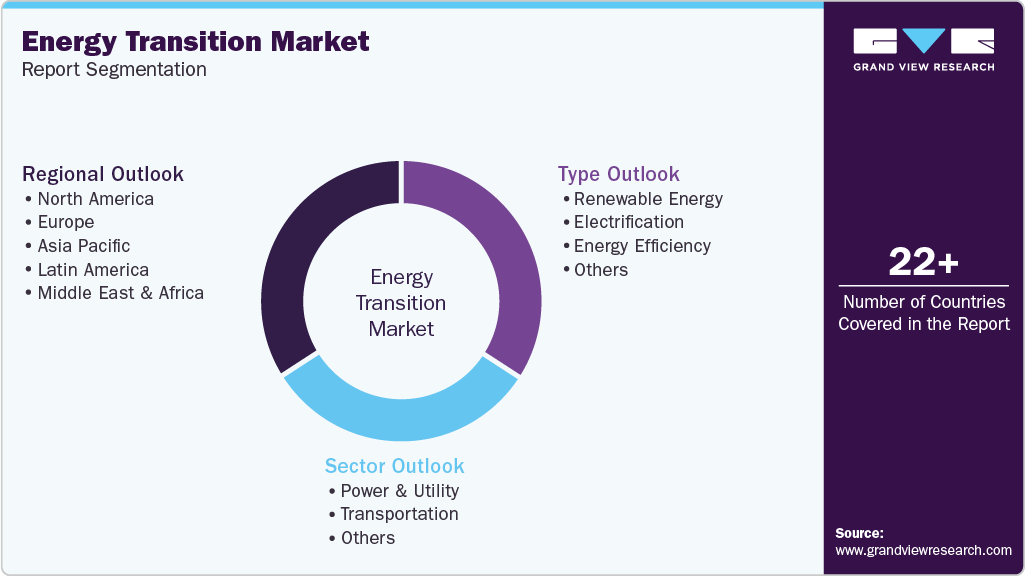
This report forecasts revenue growth at global, regional, and country levels and provides an analysis of the latest industry trends in each of the sub-segments from 2021 to 2033. For this study, Grand View Research has segmented the global energy transition market report on the basis of type, sector, and region:
 To learn more about this report, Download Free Sample Report
 -
Type Outlook (Revenue, USD Trillion, 2021 - 2033)
-
Renewable Energy
-
Electrification
-
Energy Efficiency
-
Others
-
-
Sector Outlook (Revenue, USD Trillion, 2021 - 2033)
-
Power & Utility
-
Transportation
-
Others
-
-
Regional Outlook (Revenue, USD Trillion, 2021 - 2033)
-
North America
-
U.S.
-
Canada
-
Mexico
-
-
Europe
-
Germany
-
UK
-
France
-
Italy
-
Spain
-
-
Asia Pacific
-
China
-
India
-
Australia
-
Japan
-
South Korea
-
-
Latin America
-
Brazil
-
Argentina
-
-
Middle East & Africa
-
Saudi Arabia
-
UAE
-
South Africa
-
-
Delivered Customizations
This report has been delivered with the following In-depth customizations
Client Request
Customization Delivered
Value Adds
Energy Storage & Grid Modernization Assessment
Detailed study of battery energy storage systems (BESS), smart grid investments, transmission infrastructure expansion, and renewable energy integration projects.
Provided insights into grid flexibility requirements, energy storage deployment trends, and power infrastructure modernization opportunities.
Industrial Electrification & Decarbonization Analysis
Analysis of electrification trends across industrial manufacturing, transportation, and heavy industries, including transition pathways from fossil-fuel-based operations to low-carbon energy systems.
Supported understanding of sector-wise decarbonization potential and future electricity demand growth.
Regional Renewable Energy Transition Assessment
Assessment of renewable energy deployment targets, installed capacity additions, grid integration challenges, and investment trends across major economies and emerging markets.
Enabled evaluation of regional clean energy adoption trends and infrastructure development opportunities.
Frequently Asked Questions About This Report
The global energy transition market size was valued at USD 2.8 trillion in 2025 and is estimated at USD 3.0 trillion for 2026.
The renewable energy segment led the market with a 50.8% share in 2025, while the electrification segment is the fastest-growing.
The power & utility sub-segment held the largest revenue share of 63.2% in 2025, while the transportation segment is projected to register the fastest CAGR during the forecast period.
Asia Pacific dominated the global energy transition market with a 44.6% share in 2025.
The global energy transition market is expected to grow at a CAGR of 9.8% from 2026 to 2033, reaching USD 5.9 trillion by 2033.
Latin America is the fastest-growing region over the forecast period, with a CAGR of 12.2%.
Some of the key players operating in the energy transition market include NextEra Energy, Inc., Iberdrola, S.A., Ørsted A/S, ABB Ltd., GE Vernova, Siemens AG, Enel S.p.A., EDF Group, RWE AG, and First Solar, Inc.
Key factors driving the energy transition market include rising investments in renewable energy and electrification infrastructure, increasing efforts to reduce emissions and combat climate change, supportive government policies and incentives, growing adoption of solar and wind energy, expansion of energy storage systems, hydrogen technologies, grid modernization initiatives, and increasing demand for clean energy solutions.
About the Author(s)
Power Generation & Storage Research Team
Energy & Power · Power Generation & StorageThis report was authored by the power generation & storage research team at Grand View Research - comprising two research analysts, one senior research analyst, and one industry expert - with specialized expertise in the power generation & storage segment of the energy & power industry. All findings are based on proprietary energy & power databases, executive interviews, and regulatory analysis, subject to internal peer review prior to publication.
Last Updated:
Speak to Analyst

Customize this report to your needs - add regions, segments, or data points, with 20% free customization.
Or view our licence options:


ISO 9001:2015 & 27001:2022 Certified
We are GDPR and CCPA compliant! Your transaction & personal information is safe and secure. For more details, please read our privacy policy.


