
- Home
- »
- Next Generation Technologies
- »
-
Europe Anti-Drone Market Size, Share, Industry Report, 2033GVR Report cover
![Europe Anti-Drone Market Size, Share & Trends Report]()
Europe Anti-Drone Market (2025 - 2033) Size, Share & Trends Analysis Report By Component (Hardware, Software), By Type, By Range, By Technology, By Mitigation Type, By Defense Type, By End Use, By Country, And Segment Forecasts
- Report ID: GVR-4-68040-643-3
- Number of Report Pages: 110
- Format: PDF
- Historical Range: 2021 - 2023
- Forecast Period: 2025 - 2033
- Industry: Technology
- Report Summary
- Table of Contents
- Segmentation
- Methodology
- Download FREE Sample
-
 Download Sample Report
Europe Anti-Drone Market Size & Trends
The Europe anti-drone market size was estimated at USD 432.6 million in 2024 and is projected to reach USD 4,079.3 million by 2033, growing at a CAGR of 28.1% from 2025 to 2033. Key market trends driving this growth include the rising integration of artificial intelligence and machine learning in drone detection systems, which enhances real-time threat identification and response capabilities. Additionally, there is a growing shift toward multi-layered counter-drone solutions that combine radar, RF detection, acoustic sensors, and electro-optical systems for more comprehensive coverage. The increasing deployment of mobile and portable anti-drone units, especially by defense and law enforcement agencies, is also gaining traction.
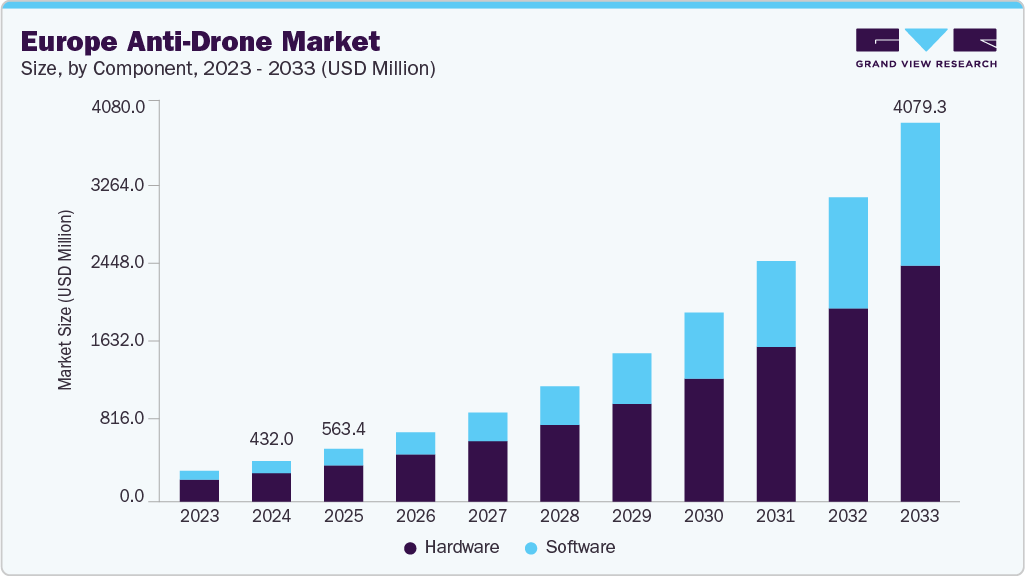
Stringent regulatory frameworks across the European Union for anti-drone action plans are key growth factors accelerating the market growth. These regulations aim to enhance airspace security and mitigate risks posed by unauthorized drones, encouraging investments in advanced detection, jamming, and neutralization technologies. Integrating AI and machine learning into drone detection systems further boosts the anti-drone industry by improving accuracy and response times.
Additionally, the growing preference is for integrated, multi-layered counter-drone systems that combine detection, tracking, and neutralization capabilities into unified platforms, moving beyond standalone hardware or jamming solutions. This shift is driven by the need to address increasingly complex and coordinated drone threats targeting critical infrastructure, public events, and sensitive airspace. As a result, European stakeholders are investing in solutions that fuse radar, RF, optical, and acoustic sensors with advanced analytics and real-time command-and-control software, enabling centralized management and rapid response across large or multiple sites. These factors are expected to drive the market growth in the coming years.
Furthermore, technological advancements in radar systems, signal jamming, laser weapons, and UAV-based counter-drone platforms enhance the capabilities of anti-drone systems in Europe. UAV-based countermeasures are growing faster, offering real-time detection and neutralization. Such innovations, combined with rising geopolitical tensions and security threats, are expected to drive the Europe anti-drone industry growth in the coming years.
Moreover, companies are investing heavily in research and development to innovate new anti-drone technologies, including directed energy weapons (DEWs) and jamming systems, and advanced detection and neutralization technologies, such as high-energy lasers and artificial intelligence systems. For instance, in June 2024, Safran Group launched the Skyjacker system at Eurosatory 2024 in Paris, specifically targeting the growing threat of unauthorized UAVs in European environments. This innovative system employs advanced technologies, including radar and electro-optical sensors, to detect and neutralize drones effectively. Such strategies by key companies are expected to drive the Europe anti-drone industry expansion in the coming years.
Component Insights
The hardware segment accounted for the largest market share, over 67% in 2024, driven by the increasing demand for sophisticated components such as radars, sensors, infrared systems, and jammers tailored to meet stringent defense and law enforcement requirements. The region’s focus on high-performance, scalable, and flexible hardware solutions is fueled by rising security concerns from drone threats in critical infrastructure, airports, and urban areas. European governments’ investments in upgrading defense capabilities and complying with strict aviation safety regulations further propel hardware adoption.
The software segment is expected to witness the fastest CAGR of over 31% from 2025 to 2033, owing to the integration of artificial intelligence (AI) and machine learning in anti-drone systems. These technologies enhance detection accuracy, threat classification, and response speed, critical in the region’s complex airspace environments. European initiatives promoting AI-driven security technologies and the need to counter increasingly sophisticated drone threats contribute to the rising demand for advanced software solutions.
Type Insights
The ground-based segment accounted for the largest market share in 2024. This growth can be attributed to its ability to respond rapidly and cover widespread areas, especially around sensitive military installations and urban centers. European defense strategies emphasizing perimeter security and multi-layered defense integration with existing surveillance infrastructure support the preference for ground-based solutions.
The UAV-based segment is expected to register the fastest CAGR from 2025 to 2033, owing to its specialized real-time drone detection, tracking, and neutralization capabilities. European security agencies value UAV-based systems for their mobility and precision in complex operational scenarios, such as border control and event security. Technological advancements in UAV payloads and real-time data processing also drive the growth.
Range Insights
The less than 5 km segment dominated the market in 2024, owing to its suitability for protecting urban environments, critical infrastructure, and public events where immediate response is essential. The dense population and complex airspace in European cities necessitate reliable short-range solutions to quickly detect and mitigate drone threats. These factors are expected to drive segmental growth in the coming years.
The more than 5 km segment is expected to register the fastest CAGR from 2025 to 2033. The segment is gaining traction in Europe to secure larger areas such as military bases, airports, and national borders. The increasing sophistication of drone threats and the need for comprehensive airspace monitoring drive demand for extended-range detection and mitigation technologies.
Technology Insights
The anti-drone radar segment dominated the market in 2024, owing to its high accuracy in differentiating drones from other aerial objects and its long-range detection capabilities. The integration of AI enhances radar effectiveness, aligning well with Europe’s stringent regulatory standards for non-intrusive, passive detection methods that ensure minimal disruption to civilian air traffic.
The thermal image segment is expected to register the fastest CAGR from 2025 to 2033, owing to its ability to detect drones under various weather and low-visibility conditions, which is crucial given the region’s diverse climate. European security agencies increasingly adopt thermal imaging to complement radar systems for all-weather surveillance.
Mitigation Type Insights
The destructive segment dominated the market in 2024, owing to the need for immediate neutralization of hostile drones in high-risk zones. Using laser systems and missile effectors reflects Europe’s focus on precision targeting and minimizing collateral damage in sensitive environments, further driving the segmental growth.
The non-destructive segment is expected to register the fastest CAGR from 2025 to 2033. Non-destructive systems, such as electronic countermeasures, are gaining traction in Europe for scenarios requiring minimal physical impact, such as urban or commercial settings. These systems disrupt drone navigation and communication, aligning with Europe’s regulatory emphasis on safe and controlled mitigation methods.
Defense Type Insights
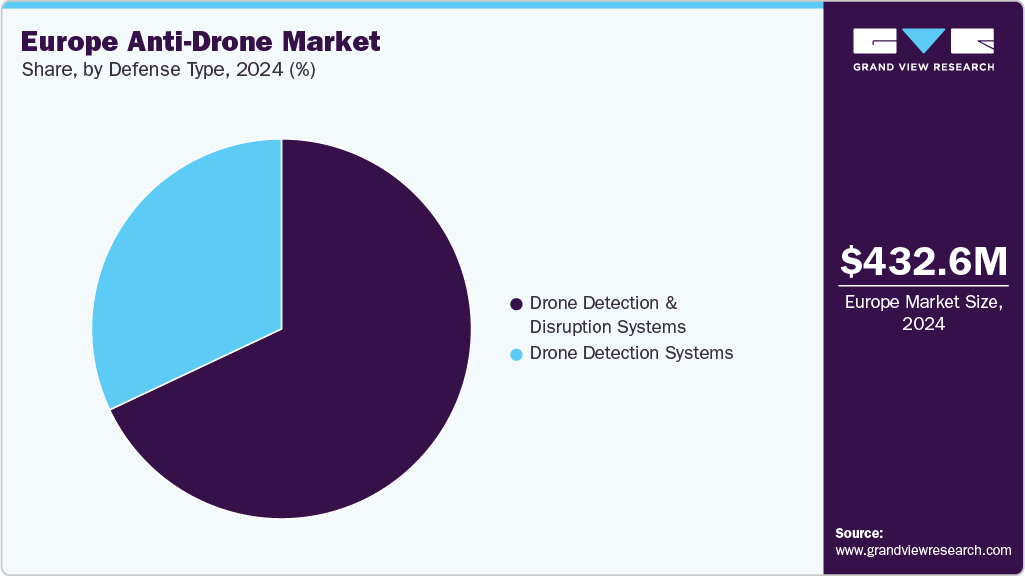
The drone detection & disruption systems segment dominated the market in 2024. Europe is increasingly deploying integrated drone detection and disruption systems that combine radar, electronic warfare, and kinetic solutions. This multi-layered approach is driven by the need to address diverse drone threats comprehensively while integrating with existing security infrastructures.
The detection segment is expected to register the fastest CAGR from 2025 to 2033, driven by escalating concerns over drone-related security threats targeting critical infrastructure such as airports, power plants, government facilities, and public venues. The increasing frequency of unauthorized drone incursions, including surveillance, smuggling, and potential terrorist activities, compels governments and private sectors to invest heavily in robust detection technologies. Advanced detection systems leverage active radars, radio frequency (RF) detectors, optical sensors (including long-range, visible, and thermal cameras), and acoustic sensors to identify and track unauthorized drones accurately.
End Use Insights
The military & defense segment dominated the market in 2024, driven by the growing need to protect sensitive defense infrastructure and national borders from unauthorized drone activities. Key trends supporting this dominance include the integration of AI and machine learning for enhanced threat detection and response, adopting multi-layered detection systems combining radar, RF, acoustic, and optical sensors, and the increasing deployment of mobile and portable counter-drone units for rapid tactical use. Additionally, advancements in directed-energy weapons such as high-power microwaves and lasers are emerging as effective neutralization tools.
The commercial segment is projected to grow at the fastest CAGR from 2025 to 2033, driven by the rising use of drones in logistics, infrastructure monitoring, event security, and urban surveillance. This growth is fueled by the increasing need to safeguard public spaces and commercial assets from unauthorized drone intrusions. Key trends supporting this expansion include the adoption of non-destructive countermeasures like RF jamming and net-based capture systems, the rise of drone-defense-as-a-service (DDaaS) models offering scalable solutions, and advancements in AI-powered detection technologies that enhance accuracy and reduce false.
Key Europe Anti-Drone Company Insights
Some key players operating in the market include Thales Group and DroneShield Limited.
-
Thales Group is a multinational company that operates in the aerospace, defense, transportation, and security markets. The company specializes in providing solutions for critical infrastructure protection, cybersecurity, air traffic management, satellite navigation systems, and communication networks. Thales has a strong focus on innovation and technological development to meet the evolving needs of its customers worldwide. The company’s diverse portfolio includes avionics systems for aircraft, radar systems for defense applications, transportation systems for railways and urban mobility, and digital security solutions.
-
DroneShield Limited is a prominent player in the European anti-drone market, specializing in counter-drone detection and mitigation systems. The company offers solutions that detect, identify, and neutralize unauthorized drones using a combination of radar, radio frequency (RF) sensors, and jamming technologies. The company’s products are widely used by government, military, and commercial customers to protect critical infrastructure and public events from rogue drone threats.
Blighter Surveillance Systems and Dedrone Holdings, Inc. are some of the emerging participants in the anti-drone market.
-
Blighter Surveillance Systems is a UK-based company specializing in developing and manufacturing advanced electronic-scanning radars and surveillance solutions. The company’s anti-drone systems are designed to detect, track, and classify drones in various environments, providing real-time situational awareness to security forces and organizations. Blighter’s technology integrates radar, cameras, and software to offer a comprehensive solution for countering unauthorized drone activities.
-
Dedrone Holdings, Inc. is a global company in airspace security, offering a range of anti-drone solutions to protect critical infrastructure, government facilities, public events, and private properties from the threats posed by drones. The company’s platform combines RF sensors, cameras, and AI-based software to detect and mitigate unauthorized drone incursions effectively. The company focuses on providing scalable and customizable anti-drone systems that can be tailored to meet the specific needs of different clients.
Key Europe Anti-Drone Companies:
- Blighter Surveillance Systems
- CERBAIR
- Dedrone Holdings, Inc.
- DroneShield Ltd
- MARSS Group
- MBDA
- QinetiQ Group plc
- Saab AB
- TEKEVER
- Thales Group
Recent Developments
-
In January 2025, CERBAIR partnered with GEOS by signing a Memorandum of Understanding to accelerate and facilitate the deployment of sovereign, accessible counter-drone systems tailored to high-risk areas and customers with growing security needs.
-
In October 2024, MARSS Group completed the installation of its NiDAR Counter Unmanned Aerial System (CUAS) on a prestigious 120+ metre superyacht, marking a significant milestone in maritime security.
-
In May 2024, Droneshield Limited announced the release of DroneSentry C2 Next-Gen v1.00. This advanced command-and-control system enhances the capabilities of anti-drone systems by providing centralized monitoring and control functionalities.
Europe Anti-Drone Market Report Scope:
Report Attribute
Details
Market size value in 2025
USD 563.4 million
Revenue forecast in 2033
USD 4,079.3 million
Growth rate
CAGR of 28.1% from 2025 to 2033
Base year for estimation
2024
Historical data
2021 - 2023
Forecast period
2025 - 2033
Quantitative units
Revenue in USD million/billion and CAGR from 2025 to 2033
Report coverage
Revenue forecast, company ranking, competitive landscape, growth factors, and trends
Segments covered
Component, type, range, technology, mitigation type, defense type, end use, and country
Country scope
UK; Germany; France; Italy; Spain
Key companies profiled
Blighter Surveillance Systems; CERBAIR; Dedrone Holdings, Inc.; DroneShield Ltd; MARSS Group; MBDA; QinetiQ Group plc; Saab AB; TEKEVER; Thales Group
Customization scope
Free report customization (equivalent to up to 8 analyst’s working days) with purchase. Addition or alteration to country, regional & segment scope.
Pricing and purchase options
Avail customized purchase options to meet your exact research needs. Explore purchase options
Europe Anti-Drone Market Report Segmentation
This report forecasts revenue growth at the regional & country levels and provides an analysis of the latest industry trends in each of the sub-segments from 2021 to 2033. For this study, Grand View Research has segmented the Europe anti-drone market report based on component, type, range, technology, mitigation type, defense type, end use, and country:
-
Component Outlook (Revenue, USD Million, 2021 - 2033)
-
Hardware
-
Radars
-
Acoustic Sensors
-
Infrared and Video Surveillance Systems
-
RF Detectors
-
Jammers
-
Others
-
-
Software
-
-
Type Outlook (Revenue, USD Million, 2021 - 2033)
-
Ground Based
-
Fixed
-
Mobile
-
-
Handheld
-
UAV Based
-
-
Range Outlook (Revenue, USD Million, 2021 - 2033)
-
Less than 5 km
-
More than 5 km
-
-
Technology Outlook (Revenue, USD Million, 2021 - 2033)
-
Europe Anti-Drone Radar
-
RF Scan
-
Thermal Image
-
Others
-
-
Mitigation Type Outlook (Revenue, USD Million, 2021 - 2033)
-
Destructive System
-
Laser System
-
Missile Effector
-
Electronic Countermeasure
-
-
Non-destructive System
-
-
Defense Type Outlook (Revenue, USD Million, 2021 - 2033)
-
Drone Detection & Disruption Systems
-
Drone Detection System
-
-
End Use Outlook (Revenue, USD Million, 2021 - 2033)
-
Military & Defense
-
Commercial
-
Government
-
Others
-
-
Country Outlook (Revenue, USD Million, 2021 - 2033)
-
UK
-
Germany
-
France
-
Italy
-
Spain
-
Frequently Asked Questions About This Report
b. The Europe anti-drone market size was estimated at USD 432.6 million in 2024 and is expected to reach USD 563.4 million in 2025.
b. The Europe anti-drone market is expected to grow at a compound annual growth rate of 28.1% from 2025 to 2030 to reach USD 4,079.3 million by 2033.
b. The hardware segment accounted for the largest market share of over 67% in 2024, driven by the increasing demand for sophisticated components such as radars, sensors, infrared systems, and jammers tailored to meet stringent defense and law enforcement requirements.
b. Some key players operating in the Europe anti-drone market include Blighter Surveillance Systems, CERBAIR, Dedrone Holdings, Inc., DroneShield Ltd, MARSS Group, MBDA, QinetiQ Group plc, Saab AB, TEKEVER, and Thales Group.
b. Key factors that are driving the Europe anti-drone market include the rising integration of artificial intelligence and machine learning in drone detection systems, the growing shift toward multi-layered counter-drone solutions, and the increasing deployment of mobile and portable anti-drone units.


Share this report with your colleague or friend.
Need a Tailored Report?
Customize this report to your needs — add regions, segments, or data points, with 20% free customization.


ISO 9001:2015 & 27001:2022 Certified
We are GDPR and CCPA compliant! Your transaction & personal information is safe and secure. For more details, please read our privacy policy.
Trusted market insights - try a free sample
See how our reports are structured and why industry leaders rely on Grand View Research. Get a free sample or ask us to tailor this report to your needs.













