
- Home
- »
- IT Services & Applications
- »
-
Europe Cybersecurity Market Size, Industry Report, 2033GVR Report cover

Europe Cybersecurity Market (2026 - 2033) Size, Share & Trends Analysis Report By Offering (Hardware, Software), By Type, By Security, By Solution, By Deployment (Cloud, On-premises), By Organization Size, By End Use, By Approach, By Region, And Segment Forecasts
Europe Cybersecurity Market Summary
The Europe cybersecurity market size was estimated at USD 71.34 billion in 2025 and is projected to reach USD 160.74 billion by 2033, growing at a CAGR of 10.8% from 2026 to 2033. The growing digital transformation initiatives across industries in Europe are significantly driving the cybersecurity market by expanding the overall digital footprint of organizations.
Key Market Trends & Insights
- Germany's cybersecurity industry held the major share of over 21.7% in 2025.
- The cybersecurity industry in Spain is expected to grow significantly over the forecast period.
- By offering, the hardware segment accounted for the largest revenue share of 50.6% in 2025.
- By security, the network security segment accounted for the largest share in 2025.
- By solution, the Identity and Access Management (IAM) segment accounted for the largest share in 2025.
Market Size & Forecast
- 2025 Market Size: USD 71.34 Billion
- 2033 Projected Market Size: USD 160.74 Billion
- CAGR (2026-2033): 10.8%
- Germany: Largest market in 2025
- Spain: Fastest growing market in 2025
Three ways to get this report
Buy it, customize it, or ask a question.Ask an Analyst
Analyst response in 1 business day
- AccessReport author, directly
- Reply timeWithin 1 working day
- No sales callDirect answer only
- FormatEmail reply
- CostFree, no cost
Get the Full Report
What the study covers
- FormatsPDF · Excel · Dashboard
- Timeline2026–2033 annual, 2025 base
- Coverage20+ countries, 5 regions
- Companies10+ key players profiled
Customize the Report
20% free customization
- IncludeCountries, segments, points
- TailorTo your product definition
- ExtendDeeper competitor detail
- OrA fully bespoke study
- Turnaround5–10 working days
Businesses across sectors such as manufacturing, healthcare, banking, retail, and government are rapidly adopting advanced technologies, including cloud computing, artificial intelligence, big data analytics, and automation. This transformation enhances operational efficiency and innovation but simultaneously increases exposure to cyber risks. As systems become more interconnected, vulnerabilities can emerge across multiple layers of digital infrastructure.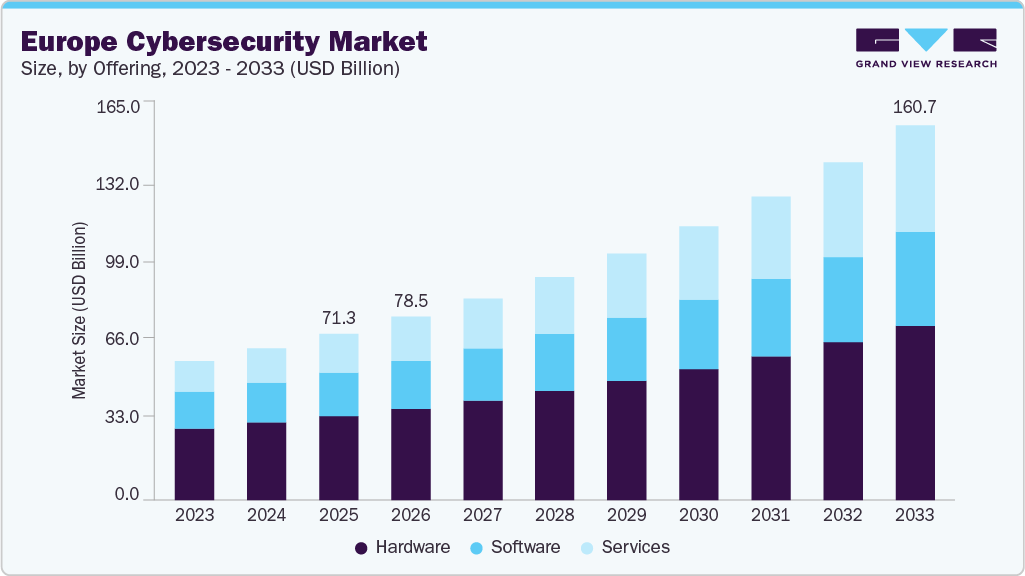 Source: Grand View Research, IR Documents, Primary Interviews, Paid DatabasesTo learn more about this report,
 Download Free Sample Report
 The integration of Industry 4.0 practices within manufacturing sectors in Europe is further accelerating demand for cybersecurity solutions, as smart factories rely on interconnected machines, sensors, and control systems that communicate in real time to optimize production processes; while this connectivity improves efficiency, it also exposes industrial environments to cyber threats that can disrupt operations, leading to production downtime, financial losses, and safety risks, prompting organizations to invest in specialized cybersecurity solutions to protect industrial control systems and ensure secure communication between devices, and this need is further amplified by the convergence of operational technology (OT) and IT systems, which increases the complexity of security requirements and necessitates continuous monitoring and real-time threat detection, a trend also evident in critical infrastructure segments such as the Europe railway cybersecurity market, where secure and resilient digital systems are essential, making this ongoing industrial transformation a major contributor to the growth of the cybersecurity market in Europe.
The rise of smart cities and digital public infrastructure projects in Europe is further fueling the cybersecurity market, as governments increasingly implement smart technologies such as intelligent transportation systems, smart grids, and digital public services to enhance urban living; these interconnected systems rely on continuous data exchange, significantly increasing exposure to cyber threats and driving the need for robust cybersecurity solutions to protect critical infrastructure and ensure uninterrupted service delivery, while rising concerns over public safety and service disruption are prompting governments to invest in secure communication networks and centralized monitoring systems, alongside strengthening collaboration with private sector players to enhance cybersecurity capabilities, and this growing demand is reflected in the expanding Europe cybersecurity services market size, as organizations seek advanced managed and professional services to safeguard complex digital ecosystems, making the expansion of smart infrastructure a key driver for the cybersecurity market in the region.
The rapid digitization of financial services and the expansion of fintech ecosystems in Europe are also driving cybersecurity demand, as banks and financial institutions increasingly offer digital services such as online banking, mobile payments, and digital wallets that handle large volumes of sensitive financial data, making them prime targets for cybercriminals; as a result, organizations are implementing robust security measures including encryption, multi-factor authentication, and advanced fraud detection systems to protect customer data and ensure transaction integrity, while stringent regulatory frameworks across the financial sector further reinforce the need for strong cybersecurity practices, and the growing emphasis on maintaining customer trust and preventing financial losses is contributing to the expansion of the Europe cybersecurity services market size, as institutions increasingly rely on managed and professional security services to strengthen their defenses, making this ongoing digital transformation a significant driver of the cybersecurity market in the region.
Offering Insights
The hardware segment dominated the European market, accounting for 50.6% revenue share in 2025, driven by the increasing adoption of dedicated security appliances and network infrastructure devices designed to protect enterprise networks. With the rising sophistication of cyber threats, organizations are investing in firewalls, unified threat management (UTM) devices, intrusion detection and prevention systems (IDPS), and secure routers to establish robust, hardware-based defense mechanisms. These devices offer high-speed processing, encryption capabilities, and real-time threat mitigation, which are often more efficient than software-only solutions, especially for large-scale networks. Moreover, the European regulatory landscape, which emphasizes stringent data protection and cybersecurity compliance standards, such as the GDPR, also contributes to the growth of the hardware. Hardware-based security solutions are often seen as essential to meet these compliance requirements, particularly in sectors like banking, healthcare, and government, where sensitive data is at stake. Enterprises are increasingly integrating hardware security modules (HSMs) and next-generation firewalls to ensure secure access control, data integrity, and encryption, supporting both regulatory adherence and operational resilience.
The services segment is expected to grow at a significant CAGR from 2026 to 2033. The rapid adoption of digital transformation initiatives, cloud computing, and hybrid IT environments has also intensified the demand for cybersecurity services. Many organizations lack the specialized skills to monitor, detect, and respond to advanced threats internally. Services such as threat intelligence, incident response, and continuous monitoring are therefore gaining traction, as they provide real-time protection against increasingly sophisticated cyberattacks. The surge in cloud computing adoption across Europe has emerged as a pivotal driver for cybersecurity services growth. As organizations migrate critical workloads and sensitive data to public, private, and hybrid cloud environments, the attack surface expands, creating new vulnerabilities that traditional on-premises security tools cannot fully address. Cloud infrastructures often involve multiple vendors, shared responsibility models, and complex configurations, making consistent security enforcement challenging.
Security Insights
The network security segment dominated the market in 2025. The expansion of critical infrastructure protection initiatives is also significantly boosting network security demand. Sectors such as energy, transportation, healthcare, and manufacturing are increasingly targeted by cyberattacks, prompting governments and regulators to enforce stricter network monitoring and resilience requirements. Agencies such as the European Union Agency for Cybersecurity (ENISA) are actively promoting risk management frameworks and incident reporting standards, which are driving organizations to upgrade their network security posture.
The artificial intelligence model/machine learning model security segment is expected to grow at the fastest CAGR from 2026 to 2033, as these systems introduce fundamentally new attack vectors that traditional cybersecurity tools are not designed to address. Unlike conventional software, AI models can be compromised through techniques such as data poisoning (manipulating training datasets to alter model behavior), adversarial attacks (crafting inputs that deceive models into incorrect outputs), model inversion (extracting sensitive training data), and model theft via API exploitation. According to findings from the World Economic Forum’s Global Cybersecurity Outlook 2026, the rapid escalation of AI-related risks is fundamentally reshaping cybersecurity priorities, with 87% of respondents identifying AI vulnerabilities as the fastest-growing cyber risk in 2025. A notable shift in threat perception is evident, as concerns around data leaks linked to generative AI have surged to 34%, overtaking adversarial capabilities (29%), which previously dominated at 47% in 2025, highlighting how widespread enterprise adoption of generative AI tools is exposing sensitive data through unintended outputs, model misuse, and weak governance controls.
Solution Insights
The Identity and Access Management (IAM) segment dominated the market in 2025. Organizations increasingly operate across multiple cloud platforms, on-premises systems, and mobile environments, creating a sprawling access landscape that is difficult to secure manually. IAM solutions help centralize identity governance, enforce role-based access controls, and implement multi-factor authentication, thereby reducing the risk of unauthorized access and data breaches. In addition, the increasing frequency and sophistication of cyberattacks, including phishing, credential stuffing, and insider threats, are prompting enterprises to strengthen identity security as a first line of defense. This combination of operational complexity and heightened threat exposure is pushing organizations across Europe to invest more heavily in IAM platforms.
The Intrusion Detection System/Intrusion Prevention System (IDS/IPS) segment is expected to grow at the fastest CAGR from 2026 to 2033. With a large proportion of network traffic now encrypted using SSL/TLS protocols, traditional inspection methods are becoming less effective. Modern IDS/IPS solutions in Europe are increasingly incorporating SSL/TLS inspection and decryption capabilities to identify hidden threats within encrypted traffic streams. This capability is critical as attackers increasingly use encryption to evade detection, pushing organizations to invest in more sophisticated inspection technologies despite the associated performance and privacy challenges.
Deployment Insights
The cloud segment held the largest revenue share in 2025, due to the rise of hybrid and multi-cloud strategies among European enterprises, which is driving the growth of the cloud deployment segment. Companies are increasingly distributing workloads across multiple cloud providers to avoid vendor lock-in, enhance redundancy, and optimize performance. This complexity, however, introduces new security challenges, such as inconsistent policy enforcement, misconfigurations, and cross-cloud vulnerabilities. Consequently, organizations are investing heavily in advanced cloud security solutions, automated threat detection, and continuous monitoring services that can span hybrid environments. The demand is particularly high in sectors with strict compliance requirements like banking, healthcare, and critical infrastructure, where cloud deployments must adhere to stringent security standards while supporting remote work and digital transformation initiatives.
The on-premises segment is expected to grow at a significant CAGR from 2026 to 2033, as many European enterprises still operate legacy IT systems that are not fully compatible with cloud-native security solutions. On-premises deployment allows cybersecurity tools to be integrated directly with existing infrastructure, including industrial control systems (ICS), SCADA networks, and legacy enterprise resource planning (ERP) platforms. This is particularly relevant for sectors like manufacturing, transportation, and energy, where replacing legacy systems is costly or operationally disruptive. The ability to secure legacy infrastructure without full migration to the cloud drives continued demand for on-premises solutions. For example, the UK’s State of Digital Government review revealed that, on average, 28% of central government technology remains classified as legacy, up from 26% in 2023. The proportion of legacy systems varies more widely among other public bodies, with NHS trusts reporting between 10% and 50%, and police forces ranging from 10% to 70% of their technology considered legacy.
Organization Size Insights
The large enterprises segment held the largest revenue share in 2025, as large enterprises are placing a strong emphasis on operational resilience due to the high financial and reputational impact of cyber incidents. Cyberattacks can disrupt supply chains, critical infrastructure, and customer services. To mitigate these risks, organizations are investing in advanced disaster recovery, incident response planning, continuous monitoring, and cyber insurance solutions. This strategic focus on resilience and risk mitigation is accelerating enterprise spending on comprehensive cybersecurity solutions.
The SMEs segment is expected to grow at a significant CAGR from 2026 to 2033. SMEs in Europe are increasingly moving workloads to cloud platforms and adopting SaaS solutions for core business functions such as CRM, HR, and accounting. While these platforms offer scalability and cost efficiency, they also present new security challenges, including misconfigured cloud storage, data leakage, and unauthorized access. This trend is driving SMEs to adopt cloud security solutions, including cloud access security brokers (CASBs), secure email gateways, and multi-factor authentication tools. Vendors offering cloud-native, cost-effective solutions are capturing a growing share of this market.
End Use Insights
The IT and telecommunications segment held the largest revenue share in 2025, due to the rapid expansion of digital infrastructure and the increasing complexity of cyber threats targeting this sector. With the proliferation of cloud computing, 5G networks, and edge computing, IT and telecom companies are handling exponentially larger volumes of sensitive data, ranging from customer personal information to critical operational data. This heightened exposure has made these organizations prime targets for sophisticated cyberattacks, including ransomware, Distributed Denial of Service (DDoS) attacks, and advanced persistent threats (APTs). Consequently, there is a growing demand for advanced cybersecurity solutions, including next-generation firewalls, intrusion detection and prevention systems, network segmentation technologies, and AI-driven threat intelligence, to safeguard their infrastructure and maintain service continuity.
The healthcare segment is expected to grow at a significant CAGR from 2026 to 2033, driven by the increasing digitization of healthcare services. Hospitals, clinics, and telemedicine platforms are rapidly adopting electronic health records (EHRs), connected medical devices, and cloud-based patient management systems to enhance efficiency and patient care. This digital transformation has expanded the attack surface for cybercriminals, making healthcare organizations prime targets for ransomware, data breaches, and phishing attacks. Therefore, there is a heightened demand for advanced cybersecurity solutions, including network security, endpoint protection, identity and access management, and threat intelligence services specifically tailored for the healthcare sector.
Approach Insights
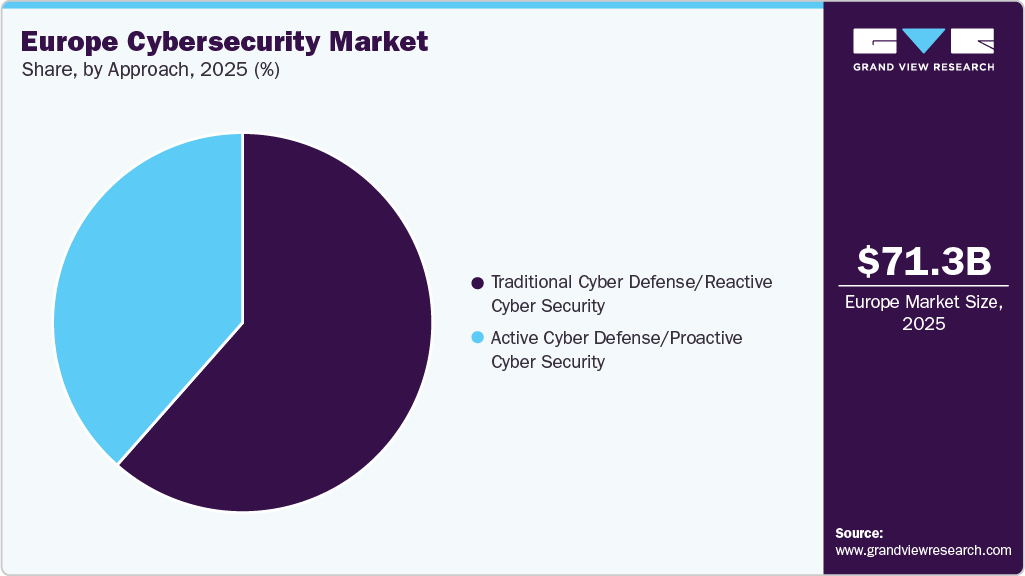
Traditional cyber defense (reactive cybersecurity) accounted for the largest market share in the market due to the widespread presence of legacy IT and operational technology systems, strong reliance on established security tools such as firewalls, antivirus, IDS, and SIEM, and a regulatory environment focused on compliance, incident reporting, and breach response rather than prevention; organizations across the region, especially SMEs, tend to prioritize cost-effective and proven solutions over complex, investment-heavy proactive strategies, while limited cybersecurity talent further slows the adoption of advanced approaches like AI-driven threat detection and zero-trust frameworks, and this trend is particularly evident in critical infrastructure segments such as the Europe railway cybersecurity market, where aging and interconnected systems necessitate continued dependence on reactive mechanisms to monitor, detect, and respond to cyber threats.
 To learn more about this report, Download Free Sample Report
 Active cyber defense (proactive cybersecurity) is projected to witness the fastest growth over the forecast period due to the rapidly evolving and sophisticated threat landscape, where organizations are increasingly shifting from reactive models to intelligence-driven strategies that can anticipate, prevent, and neutralize attacks before they occur; the rising frequency of ransomware, advanced persistent threats (APTs), and large-scale cyber incidents across Europe is pushing enterprises to adopt capabilities such as threat hunting, real-time monitoring, AI/ML-based anomaly detection, and automated response systems. At the same time, the growing complexity of IT environments driven by cloud, IoT, and remote work further necessitates continuous and predictive security frameworks. Additionally, stringent regulations such as GDPR and NIS2 are compelling organizations to strengthen their cybersecurity posture beyond compliance toward resilience and prevention. The expanding European cybersecurity services market size, projected to grow at a notable pace with increasing demand for managed detection and response (MDR), consulting, and outsourced security operations, is further accelerating the adoption of proactive approaches, as enterprises leverage external expertise to implement advanced, scalable, and continuously evolving defense mechanisms.
Country Insights
The cybersecurity industry in the UK is expected to grow rapidly in the coming years, supported by steady demand from sectors such as automotive electronics, industrial automation, and emerging renewable energy Solutions. Local firms and design teams rely on these tools to handle complex, high-reliability circuits while meeting strict standards for efficiency and sustainability. Adoption of cloud-based platforms has picked up noticeably, allowing better teamwork across distributed projects and quicker iterations on miniaturized or flexible designs, which fits well with the country's push toward innovative, compact products.
Germany cybersecurity industry held a significant market share in 2025. Strong demand stems from the country's leading position in automotive manufacturing, where electric vehicles and advanced driver-assistance systems require precise, high-reliability circuit layouts, alongside steady needs from industrial automation and renewable energy sectors. Local firms and European suppliers alike focus on tools that handle complex multilayer boards, signal integrity checks, and thermal simulations, often blending on-premises security with emerging cloud features to support collaborative engineering teams.
Key Europe Cybersecurity Company Insights
Some of the key companies operating in the market are Airbus, Atos SE, Avast (Gen Digital Inc.), BAE Systems, Bitdefender, among others. They are among the leading participants in the Europe cybersecurity industry.
-
In December 2025, Airbus SE secured a framework contract worth up to USD 58.8 million from the French Defence Procurement Agency (DGA) to integrate artificial intelligence into weapons, communication, cybersecurity, and information systems used by the French Armed Forces. This initiative, developed in collaboration with France’s Ministerial Agency for Defence AI (AMIAD), strengthens Europe’s strategic focus on sovereign AI capabilities, reducing dependence on non-European technologies while enhancing defense, intelligence, and cybersecurity operations across the region.
-
In March 2026, Atos SE unveiled its new Threat Research Center (TRC), a next-generation intelligence hub designed to strengthen proactive cyber defense capabilities. The center consolidates advanced threat intelligence, vulnerability research, and AI-powered automation to deliver faster detection and response to emerging cyber threats. This initiative reinforces Atos’ position as a major cybersecurity provider in Europe, supporting regional digital sovereignty and enhancing cyber resilience for enterprises, governments, and critical infrastructure across the continent.
-
In March 2026, Airbus SE announced a definitive agreement to acquire Ultra Cyber Ltd from the Cobham Ultra group, strengthening its sovereign cybersecurity capabilities in the UK and across Europe. This acquisition enhances Airbus’ end-to-end cyber portfolio, integrates over 200 skilled employees, and supports the creation of a scalable UK-based sovereign cyber champion within its Defence and Space division. The move aligns with Airbus’ strategy to become a leading multi-sovereign cybersecurity player in Europe, with the transaction expected to close in the second half of 2026, subject to regulatory approvals.
Key Europe Cybersecurity Companies:
- Airbus
- Atos SE
- Avast (Gen Digital Inc.)
- BAE Systems
- Bitdefender
- Darktrace Holdings Limited
- AO Kaspersky Lab
- NCC Group
- Rohde & Schwarz
- SAP SE
- Siemens AG
- Stormshield
- Thales
- LevelBlue
- WithSecure
Europe Cybersecurity Market Report Scope
Report Attribute
Details
Market size value in 2026
USD 78.46 billion
Revenue forecast in 2033
USD 160.74 billion
Growth rate
CAGR of 10.8% from 2026 to 2033
Actual data
2021 - 2025
Forecast period
2026 - 2033
Quantitative units
Revenue in USD billion and CAGR from 2026 to 2033
Report coverage
Revenue forecast, company share, competitive landscape, growth factors, and trends
Segments covered
Offering; Security; Solution; Deployment;Organization Size; End Use; Approach; Country
Country scope
Germany; France; UK; Spain; Italy
Key companies profiled
Airbus; Atos SE; Avast (Gen Digital Inc.); BAE Systems; Bitdefender; Darktrace Holdings Limited; AO Kaspersky Lab; NCC Group; Rohde & Schwarz; SAP SE; Siemens AG; Stormshield; Thales LevelBlue; WithSecure; Others
Customization scope
Free report customization (equivalent to 8 analysts working days) with purchase. Addition or alteration to country, regional & segment scope.
Pricing and purchase options
Avail customized purchase options to meet your exact research needs. Explore purchase options
Europe Cybersecurity Market Report Segmentation
This report forecasts revenue growth at country levels and provides an analysis of the latest industry trends in each of the sub-segments from 2021 to 2033. For this study, Grand View Research has segmented the Europe Cybersecurity market report based on offering, security, solution, deployment, organization size, end use, approach, and region:
-
Offering Outlook (Revenue, USD Billion, 2021 - 2033)
-
Hardware
-
Software
-
Services
-
Professional Services
-
Consulting
-
Governance, Risk, and Compliance (GRC)
-
Incident Response and Readiness
-
Implementation and Integration
-
Training & Education
-
Others
-
-
Managed Services
-
Managed Detection and Response
-
Managed Protection and Controls
-
Managed Security Functions
-
Others
-
-
-
-
Security Outlook (Revenue, USD Billion, 2021 - 2033)
-
Endpoint Security
-
Cloud Security
-
Network Security
-
Application Security
-
Infrastructure Protection
-
Data Security
-
Artificial Intelligence Model/Machine Learning Model Security
-
Hardware Security
-
Others
-
-
Solution Outlook (Revenue, USD Billion, 2021 - 2033)
-
Unified Threat Management (UTM)
-
Intrusion Detection System/Intrusion
-
Prevention System (IDS/IPS)
-
Data Loss Prevention (DLP)
-
Identity and Access Management (IAM)
-
Security Information and Event Management (SIEM) & Security Orchestration Automation & Response (SOAR)
-
DDoS
-
Risk and Compliance Management
-
Others
-
-
Deployment Outlook (Revenue, USD Billion, 2021 - 2033)
-
Cloud
-
On-premises
-
-
Organization Size Outlook (Revenue, USD Billion, 2021 - 2033)
-
Large Enterprises
-
SMEs
-
-
End Use Outlook (Revenue, USD Billion, 2021 - 2033)
-
IT and Telecommunications
-
Retail and E-Commerce
-
BFSI
-
Healthcare
-
Government and Defense
-
Manufacturing
-
Energy and Utilities
-
Automotive
-
Marine
-
Transportation and Logistics
-
Others
-
-
Approach Outlook (Revenue, USD Billion, 2021 - 2033)
-
Traditional Cyber Defense/Reactive Cybersecurity
-
Active Cyber Defense/Proactive Cybersecurity
-
-
Country Outlook (Revenue, USD Billion, 2021 - 2033)
-
Germany
-
UK
-
France
-
Italy
-
Spain
-
Frequently Asked Questions About This Report
The Europe cybersecurity market size was estimated at USD 71.34 billion in 2025 and is expected to reach USD 78.46 billion in 2026.
The Europe cybersecurity market is expected to grow at a compound annual growth rate of 10.8% from 2026 to 2033 to reach USD 160.74 million by 2033.
Factors such as the growing digital transformation initiatives across industries in Europe are significantly driving the cybersecurity market by expanding the overall digital footprint of organizations.
The hardware segment accounted for the largest market share in the Europe cybersecurity market in 2025, driven by the increasing adoption of dedicated security appliances and network infrastructure devices designed to protect enterprise networks.
Some key players operating in the market include Airbus, Atos SE, Avast (Gen Digital Inc.), BAE Systems, Bitdefender, Darktrace Holdings Limited, AO Kaspersky Lab, NCC Group, Rohde & Schwarz, SAP SE, Siemens AG, Stormshield, Thales, LevelBlue, WithSecure, and Others.
About the Author(s)
IT Services & Applications Research Team
Technology · IT Services & ApplicationsThis report was authored by the it services & applications research team at Grand View Research - comprising two research analysts, one senior research analyst, and one industry expert - with specialized expertise in the it services & applications segment of the technology industry. All findings are based on proprietary technology databases, executive interviews, and regulatory analysis, subject to internal peer review prior to publication.
Last Updated:
Speak to Analyst

Customize this report to your needs - add regions, segments, or data points, with 20% free customization.
Or view our licence options:


ISO 9001:2015 & 27001:2022 Certified
We are GDPR and CCPA compliant! Your transaction & personal information is safe and secure. For more details, please read our privacy policy.


