
- Home
- »
- Next Generation Technologies
- »
-
Europe Electrolyzer Testing Market, Industry Report, 2033GVR Report cover
![Europe Electrolyzer Testing Market Size, Share & Trends Report]()
Europe Electrolyzer Testing Market (2026 - 2033) Size, Share & Trends Analysis Report By Technology (Alkaline Electrolyzers, Proton Exchange Membrane), By Testing Service, By Power Capacity, By Business Model (Pay-Per-Test, Subscription), By End-use, By Region, And Segment Forecasts
Europe Electrolyzer Testing Market Summary
The Europe electrolyzer testing market size was estimated at USD 319.4 million in 2025 and is projected to reach USD 527.0 million by 2033, growing at a CAGR of 6.8% from 2026 to 2033. The market growth is driven by rising scrutiny from insurers, financiers, and project owners, who increasingly require independent test validation before approving deployments.
Key Market Trends & Insights
- Germany led the Europe electrolyzer testing industry, accounting for a revenue share of 30.3% in 2025.
- By technology, the proton exchange membrane (PEM) technology segment led the Europe electrolyzer testing industry, accounting for a revenue share of 41.01% in 2025.
- By testing service, the performance & efficiency testing segment held the largest revenue share of 34.10% in 2025.
- By end-use, the electrolyzer OEMs segment accounted for the largest revenue share of the Europe electrolyzer testing industry in 2025.
Market Size & Forecast
- 2025 Market Size: USD 319.4 Million
- 2033 Projected Market Size: USD 527.0 Million
- CAGR (2026-2033): 6.8%
Growing diversification of electrolyzer designs and materials is creating demand for customized test programs beyond standard protocols. Regulatory alignment and certification demand is driving more rigorous type and conformity testing, as manufacturers seek recognized approvals to access broader markets. Test houses are expanding capabilities to cover evolving safety and pressure containment protocols, alongside emissions and materials verification. Growing emphasis on standardized testing protocols is encouraging harmonization across labs and suppliers. That is prompting investment in accredited facilities and traceable measurement systems.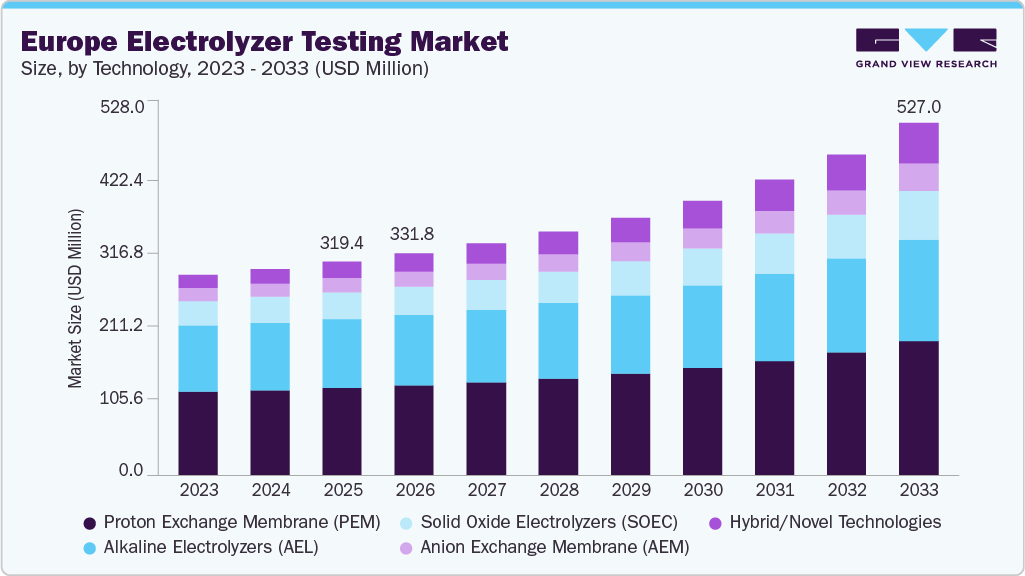
Performance validation and lifetime durability testing are becoming central as developer’s push units from prototype to continuous operation. There is rising interest in accelerated aging, degradation profiling, and stack-level endurance assessments to predict real-world reliability. Independent third-party benchmarking services are gaining traction to provide comparative performance data. These services help OEMs and buyers reduce technical uncertainty during procurement decisions.
Integration and interoperability testing is increasing in importance as electrolyzers are paired with diverse power inputs and downstream systems. Focused test programs now evaluate dynamic response, power fluctuation tolerance, and control-system interactions. Digital test methods, including simulation, digital twins, and remote monitoring, are being combined with physical tests to shorten development cycles. Parallel attention on supply-chain quality assurance and component traceability is improving reproducibility and confidence in test outcomes.
Technology Insights
The proton exchange membrane (PEM) technology segment led the Europe electrolyzer testing industry, accounting for a revenue share of 41.01% in 2025.Manufacturers are prioritizing on-site hydrogen production linked with downstream applications, such as fuel cells, to validate system reliability, efficiency, and durability under continuous operating conditions.For instance, in November 2025, Bosch commissioned its first in-house electrolyzer at its Bamberg site in Germany to produce renewable hydrogen under real operating conditions. The 2.5 MW system integrates two proton exchange membrane stacks supplied by Hybrion, enabling production of more than one metric ton of green hydrogen per day using renewable electricity.
The hybrid / novel technologies segment is predicted to foresee significant growth in the forecast period. The increasing attention as developers seek to overcome efficiency, cost, and material limitations associated with conventional electrolysis systems. Testing demand in this segment is primarily driven by early-stage innovation, where new system architectures, materials, and operating principles require rigorous validation under controlled and real-world conditions.The segment is characterized by a higher concentration of prototype testing, accelerated degradation analysis, and customized test protocols.
Testing Service Insights
The performance & efficiency testing segment accounted for the largest revenue share of 34.10% in 2025. This growth is driven by increasing emphasis on optimizing hydrogen output and minimizing energy consumption across electrolyzer technologies. As project developers and OEMs scale deployments, demand for precise validation of system efficiency under real-world operating conditions is rising. The integration of variable renewable energy sources is further increasing the need for advanced performance testing to assess operational flexibility and load-following capability.
The degradation testing segment is predicted to foresee significant growth over the forecast period. This strong growth is primarily driven by the increasing deployment of electrolyzers in long-duration and industrial-scale hydrogen production projects across Europe. As electrolyzer systems operate continuously over extended lifecycles, stakeholders are placing greater emphasis on understanding performance decay, component aging, and efficiency loss.
Power Capacity Insights
The 0.5-1 MW segment accounted for the largest market revenue share in 2025.Government incentives and regional policies are supporting domestic manufacturing, enabling companies to scale mid-range electrolyzer production efficiently. For instance, in June 2024, Advait Infratech announced plans to expand its electrolyzer production capacity in Kadi, Gujarat, from 120 MW per year to 200 MW per year by 2025, encompassing 0.3 MW, 0.5 MW, 1 MW stacks, and 2/4/8 MW modules.
The 1-2 MW segment is predicted to foresee significant growth in the forecast period. Growing policy support and expanding MW-scale project pipelines are accelerating investments in robust testing infrastructure across the continent. For instance, in April 2025, McPhy Italy advanced its capabilities by completing Phase 1 hot commissioning of a 1 MW test bench, achieving full operational functionality at nominal load. Phase 2 industrial testing is scheduled to confirm system stability, leveraging a 1.2 MW electrical supply and fully approved safety systems.
Business Model Insights
The project-based test campaigns segment accounted for the largest revenue share of the Europe electrolyzer testing market in 2025. Project-based test campaigns are driven by the increasing scale and complexity of commercial hydrogen projects in Europe. Developers and EPC firms require structured, multi-phase testing programs aligned with project timelines and commissioning milestones. This model supports comprehensive validation covering performance, safety, and system integration.
The subscription segment is projected to foresee significant growth over the forecast period. The subscription-based testing model is driven by the need for continuous performance monitoring and long-term technology optimization. Electrolyzer OEMs and research institutions increasingly adopt this model to support ongoing development programs. Subscription arrangements provide predictable costs and sustained access to advanced testing infrastructure.
End-use Insights
The electrolyzer OEMs segment accounted for the largest revenue share of the Europe electrolyzer testing industry in 2025. Increasing competition among electrolyzer manufacturers is driving higher demand for advanced testing services from OEMs. OEMs are intensifying performance, efficiency, and durability testing to differentiate products in a rapidly expanding market. Growing emphasis on certification and compliance is strengthening reliance on independent testing facilities.
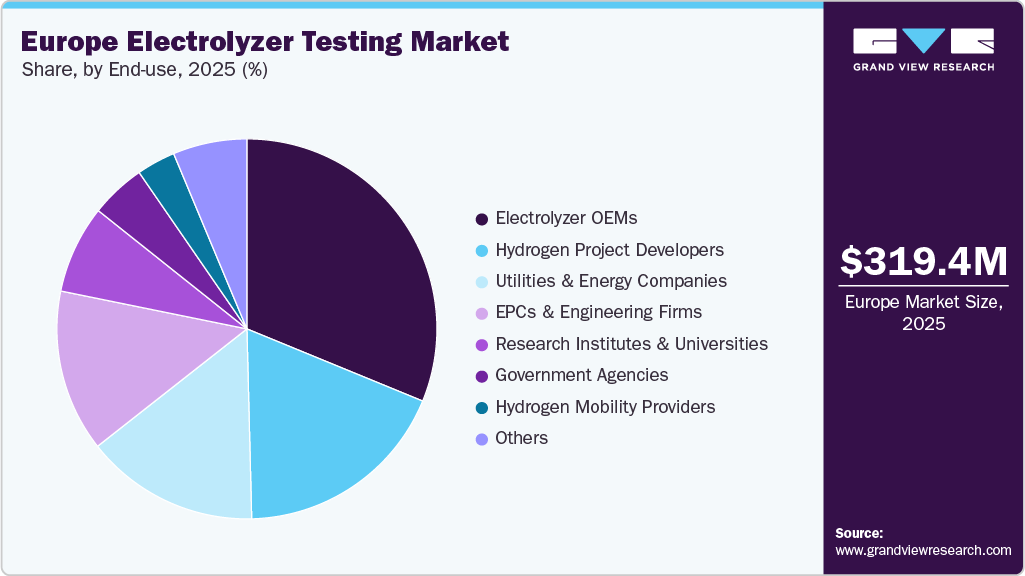
The hydrogen mobility providers segment is projected to grow significantly over the forecast period. Expansion of hydrogen-powered transportation is driving testing demand from hydrogen mobility providers. These stakeholders require rigorous validation to ensure system safety, reliability, and fuel quality. Testing supports compliance with mobility-specific operational and safety standards. Increasing deployment of hydrogen refueling stations is strengthening demand for system-level and performance testing.
Regional Insights
The Europe electrolyzer testing market held a significant share of the global market in 2025. Governments across Europe are prioritizing hydrogen as a strategic energy carrier, which is accelerating investment in testing infrastructure and certification capabilities. The market is shifting from pilot-scale validation toward commercial and industrial-scale system testing. Integration of renewable energy sources is further driving demand for performance, efficiency, and system-level testing under variable operating conditions.
Germany Electrolyzer Testing Market Trends
Germany led the Europe electrolyzer testing industry, accounting for a revenue share of 30.3% in 2025. The market growth is driven due to its leadership role in industrial decarbonization and hydrogen technology development. Strong government support and funding programs are accelerating large-scale electrolyzer deployment and associated testing demand. Germany places significant emphasis on performance optimization, degradation testing, and long-term reliability assessment.
UK Electrolyzer Testing Market Trends
The UK electrolyzer testing industry’s growth is driven by national hydrogen strategies aimed at supporting net-zero targets and energy security. Increasing focus on offshore wind integration is creating demand for testing electrolyzers under variable and intermittent power conditions. The UK market places strong emphasis on safety and certification testing to support deployment in industrial clusters and public-facing infrastructure.
Key Europe Electrolyzer Testing Company Insights
Some key companies in the Europe electrolyzer testing industry are Intertek, SGS,TUV SUD, and DNV
-
DNV offers verification and certification for hydrogen production facilities including electrolyzers under PED and CE marking. Its services provide regulatory compliance for design and equipment validation. This covers standards development and recommended practices. Key products include audits for electrolysis systems in EU markets.
-
Intertek conducts testing and certification for hydrogen refueling stations, components, and electrolyzer systems. Products feature helium and deionized water-based leak detection tools. Offerings encompass leakage checks, high-voltage insulation, and flow resistance assessments. These ensure safety for stacks and peripherals.
Key Europe Electrolyzer Testing Companies:
- Air Liquide
- DNV
- Enapter GmbH
- Fraunhofer Institute for Wind Energy Systems
- HORIBA FuelCon GmbH
- Intertek
- McPhy Energy
- SGS
- TU Graz Hydrogen Electrolysis
- TUV SUD
Recent Developments
-
In July 2025, Enapter GmbH launched the Nexus 2500, a 2.5 MW multicore electrolyzer that maintains the 40-foot container size of prior models through advanced stacks. The system delivers over one ton of green hydrogen daily at 99.999% purity and operates via AI softwarefor real-time optimization of temperature, pressure, and power from renewables..
-
In April 2025, TU Graz Hydrogen Electrolysis opened Austria's first university-based megawatt-scale H2 electrolysis test centre at Campus Inffeldgasse, spanning 250 square metres with electrolyzers of 1.6 to 2.5 MW capacity. This infrastructure integrates production, storage, and utilization for hydrogen research across scales from materials to pre-industrial applications.
Europe Electrolyzer Testing Market Report Scope
Report Attribute
Details
Market size in 2026
USD 331.8 million
Revenue forecast in 2033
USD 527.0 million
Growth rate
CAGR of 6.8% from 2026 to 2033
Base year for estimation
2025
Actual data
2021 - 2024
Forecast period
2026 - 2033
Quantitative units
Revenue in USD million and CAGR from 2026 to 2033
Report coverage
Revenue forecast, company ranking, competitive landscape, growth factors, and trends
Segments covered
Technology, testing service, power capacity, business model, end use, and region
Regional scope
Europe
Country scope
UK; Germany; France
Key companies profiled
Air Liquide; DNV; Enapter GmbH; Fraunhofer Institute for Wind Energy Systems; HORIBA FuelCon GmbH; Intertek; McPhy Energy; SGS; TU Graz Hydrogen Electrolysis; TUV SUD
Customization scope
Free report customization (equivalent up to 8 analysts working days) with purchase. Addition or alteration to country, regional & segment scope.
Pricing and purchase options
Avail customized purchase options to meet your exact research needs. Explore purchase options
Europe Electrolyzer Testing Market Report Segmentation
This report forecasts revenue growth at the regional and country levels and provides an analysis of the latest industry trends in each of the sub-segments from 2021 to 2033. For this study, Grand View Research has segmented the Europe electrolyzer testing market report based on technology, testing service, power capacity, business model, end-use, and region:
-
Technology Outlook (Revenue, USD Million, 2021 - 2033)
-
Proton Exchange Membrane (PEM)
-
Alkaline Electrolyzers (AEL)
-
Solid Oxide Electrolyzers (SOEC)
-
Anion Exchange Membrane (AEM)
-
Hybrid / Novel Technologies
-
-
Testing Service Outlook (Revenue, USD Million, 2021 - 2033)
-
Performance & Efficiency Testing
-
Degradation Testing
-
Safety & Certification Testing
-
System-Level Testing
-
Others
-
-
Power Capacity Outlook (Revenue, USD Million, 2021 - 2033)
-
0.5-1 MW
-
1-2 MW
-
2-5 MW
-
-
Business Model Outlook (Revenue, USD Million, 2021 - 2033)
-
Pay-Per-Test
-
Project-Based Test Campaigns
-
Subscription
-
Others
-
-
End-use Outlook (Revenue, USD Million, 2021 - 2033)
-
Electrolyzer OEMs
-
Hydrogen Project Developers
-
EPCs & Engineering Firms
-
Utilities & Energy Companies
-
Hydrogen Mobility Providers
-
Research Institutes & Universities
-
Government Agencies
-
Others
-
-
Regional Outlook (Revenue, USD Million, 2021 - 2033)
-
Europe
-
UK
-
Germany
-
France
-
-
Frequently Asked Questions About This Report
The Europe electrolyzer testingmarket size was estimated at USD 319.4 million in 2025 and is expected to reach USD 331.8 million in 2026.
The Europe electrolyzer testing market is expected to grow at a compound annual growth rate of 6.8% from 2026 to 2033 to reach USD 527.0 million by 2033.
Germany dominated the Europe Electrolyzer Testing market with a share of 30.3% in 2025. This is attributable due to its leadership role in industrial decarbonization and hydrogen technology development. Strong government support and funding programs are accelerating large-scale electrolyzer deployment and associated testing demand.
Some key players operating in the Europe electrolyzer testing market include Key companies profiled Air Liquide;DNV; Enapter GmbH; Fraunhofer Institute for Wind Energy Systems; HORIBA FuelCon GmbH; Intertek; McPhy Energy; SGS; TU Graz Hydrogen Electrolysis; TUV SUD
Key factors that are driving the market growth include rising scrutiny from insurers, financiers, and project owners, who increasingly require independent test validation before approving deployments.
About the Author(s)
Next Generation Technologies Research Team
Technology · Next Generation TechnologiesThis report was authored by the next generation technologies research team at Grand View Research - comprising two research analysts, one senior research analyst, and one industry expert - with specialized expertise in the next generation technologies segment of the technology industry. All findings are based on proprietary technology databases, executive interviews, and regulatory analysis, subject to internal peer review prior to publication.
Last Updated:
Speak to Analyst

Need a Tailored Report?
Customize this report to your needs — add regions, segments, or data points, with 20% free customization.
Or view our licence options:


ISO 9001:2015 & 27001:2022 Certified
We are GDPR and CCPA compliant! Your transaction & personal information is safe and secure. For more details, please read our privacy policy.












