
- Home
- »
- Next Generation Technologies
- »
-
Europe Smart TV Market Size & Share, Industry Report, 2030GVR Report cover
![Europe Smart TV Market Size, Share & Trends Report]()
Europe Smart TV Market (2025 - 2030) Size, Share & Trends Analysis Report By Operating System (Android, Tizen, WebOS, Roku), By Resolution (4K UHD TV, HDTV), By Screen Size, By Distribution Channel (Online, Offline), By Technology, By Country, And Segment Forecasts
- Report ID: GVR-4-68040-814-1
- Number of Report Pages: 120
- Format: PDF
- Historical Range: 2018 - 2023
- Forecast Period: 2025 - 2030
- Industry: Technology
- Report Summary
- Table of Contents
- Segmentation
- Methodology
- Download FREE Sample
-
 Download Sample Report
Europe Smart TV Market Summary
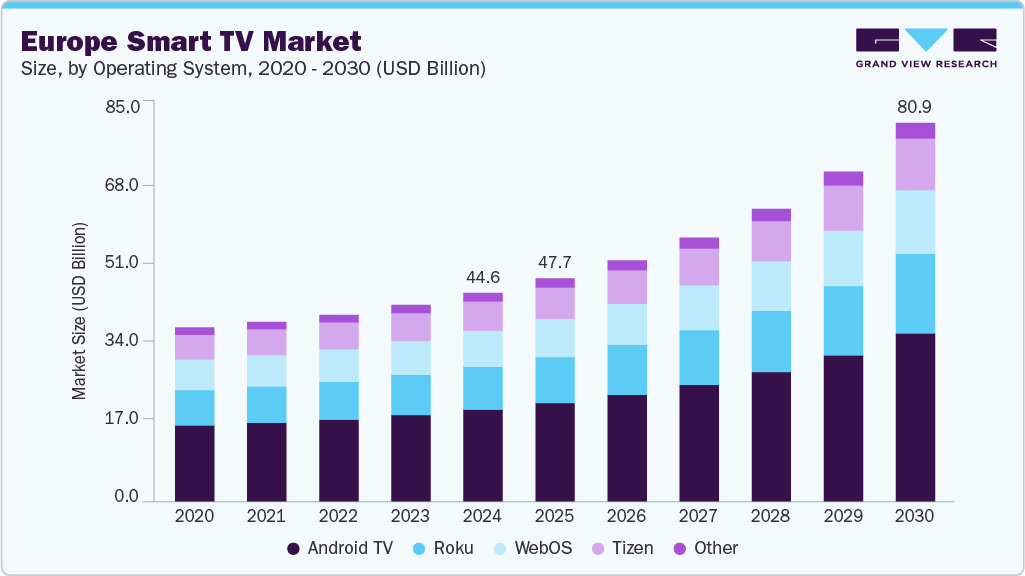
The Europe smart TV market size was estimated at USD 44,576.0 million in 2024 and is projected to reach USD 80,972.6 million by 2030, growing at a CAGR of 11.2% from 2025 to 2030. This growth includes the rising consumer preference for large-screen and ultra-high-definition (UHD) displays. Advancements in OLED, QLED, and MicroLED panel technologies enhance picture quality, energy efficiency, and form factor design, driving product adoption. Expanding high-speed broadband networks and 5G infrastructure enables seamless streaming, gaming, and interactive services.
Supportive government initiatives promoting digital entertainment, along with growing partnerships between content providers and device manufacturers, are accelerating innovation and adoption across Europe. Stringent regulatory frameworks across the European Union for data privacy, content protection, and broadcasting standards are major growth drivers for the Europe smart TV industry. Harmonized policies, such as the Digital Services Act (DSA) and the General Data Protection Regulation (GDPR), are encouraging manufacturers and service providers to adopt robust cybersecurity measures, enhance user consent mechanisms, and establish transparent data-sharing practices. These initiatives are fostering trust among consumers and enabling cross-border streaming services, fueling innovation and adoption across the continent.
In addition, the rising consumer preference for high-quality viewing experiences and connected entertainment is expanding the demand for advanced smart TV platforms and related services. The increasing penetration of 4K and 8K resolution displays enhances content consumption. The growth in subscription-based video-on-demand (SVOD) platforms, interactive gaming, and integrated voice-controlled interfaces drives investments in smart TV hardware and software. These trends significantly improve user engagement and provide new monetization avenues, accelerating European market growth.
Furthermore, the rapid adoption of IoT-enabled home entertainment systems and seamless device integration is transforming the smart TV ecosystem. Smart TVs are increasingly being paired with smart speakers, lighting systems, and home automation devices to offer unified digital experience. These advancements are particularly beneficial in multi-lingual environments and smart home setups, where enhanced interoperability and intuitive interfaces reduce friction and improve user experience.
Moreover, continuous R&D investments by leading consumer electronics brands and emerging tech startups drive innovation in display technologies, energy efficiency, and user interfaces. Collaborations are underway to improve OLED panel manufacturing, reduce power consumption, and integrate advanced content discovery algorithms. These initiatives are laying the groundwork for scalable and intelligent smart TV solutions, pushing the market toward sustained growth in the coming years.
Operating System Insights
The android TVs segment accounted for the largest market share of over 43% in 2024, driven by the surge in demand for feature-rich, user-centric smart TV platforms, streaming services, and content ecosystems. The Android-based operating systems, seamless app integration, and intuitive interfaces are propelled by increasing adoption in households, hospitality, and education sectors. Growing consumer preference for familiar interfaces aligned with Android devices, along with competitive pricing across multiple product tiers, is compelling manufacturers to invest in scalable, customizable, and user-friendly smart TV platforms, reinforcing the dominance of this segment in the Europe smart TV industry.
The Roku segment is expected to witness the fastest CAGR of over 11% from 2025 to 2030. This growth is driven by Europe’s rising demand for simplified and cost-effective streaming solutions that cater to a diverse consumer base. The platform’s compatibility with major streaming services, easy-to-use interface, and affordable pricing make it particularly appealing to households seeking hassle-free entertainment options. Increasing investments in connected living technologies and smart home integration are encouraging wider adoption of Roku-enabled smart TVs. Collaborations between streaming providers and device manufacturers further expand Roku’s reach, accelerating its growth across Europe.
Screen Size Insights
The 46- to 55-inch segment dominated the market with the largest share in 2024, owing to its optimal balance between screen size, price, and living space compatibility. The growing adoption of 4K and HDR content, along with increasing demand for smart features such as voice control, seamless connectivity, and seamless integration with streaming apps, has further strengthened its appeal. Its affordability and ease of installation make it a preferred choice for first-time and budget-conscious buyers. The expanding availability of models from leading brands and the rise in subscription-based entertainment services are expected to fuel continued growth in this segment.
The 56- to 65-inch segment is expected to register a significant CAGR from 2025 to 2030. This growth is primarily driven by Europe’s increasing demand for immersive and premium viewing experiences in both residential and commercial settings. Large-screen smart TVs are being adopted for home entertainment, gaming lounges, corporate presentations, and public display applications. Supportive infrastructure developments and favorable financing options also make larger screen sizes more accessible, fueling the segment’s rapid expansion across the European smart TV industry.
Distribution Channel Insights
The online segment dominated the market with the largest market share in 2024, primarily due to its widespread use across residential, commercial, and hospitality applications. The convenience of browsing, comparing, and purchasing smart TVs from e-commerce platforms has made it highly accessible to consumers across Europe. Easy return policies, attractive discounts, and a wide variety of models from different brands have further encouraged online purchases. The integration of fast delivery services has enhanced customer experience, reinforcing the dominance of the online distribution channel in the Europe smart TV industry.
The offline segment is expected to grow at a significant CAGR from 2025 to 2030, driven by its optimal balance between customer reach and personalized service. Smart TVs sold through offline channels offer hands-on experience, expert guidance, and easy after-sales support, making them particularly appealing to consumers who prefer in-person assistance. European markets with diverse consumer preferences and varying levels of technological adoption benefit from the accessibility and trust offered by offline outlets, reinforcing the segment’s high growth potential across regions in Europe.
Technology Insights
The LED segment dominated the market with the largest market share in 2024, owing to its energy-efficient performance, superior display quality, and cost-effectiveness. The advancements in panel manufacturing, such as improved brightness, color accuracy, and thinner form factors, have enhanced user experience while reducing production costs. LED panels' lightweight and durable design makes them ideal for residential and commercial setups. The combination of affordability, performance, and eco-friendly features significantly contributes to the segment’s sustained growth.
The OLED segment is expected to register the fastest CAGR from 2025 to 2030. Growing demand for superior picture quality, deeper contrast ratios, and energy-efficient displays across premium entertainment and professional applications is driving interest in OLED panels. OLED technology offers thinner designs, wider viewing angles, and faster response times compared to traditional LCD panels, making it ideal for high-end smart TVs. These factors are expected to significantly boost the deployment of OLED-based smart TVs across European markets in the coming years.
Resolution Insights
The 4K UHD TV segment accounted for the largest market share in 2024. This growth can be attributed to its superior picture clarity, enhanced color accuracy, and immersive viewing experience. The increasing availability of affordable 4K content, along with advancements in panel technology and energy-efficient designs, makes it a preferred choice for both residential and commercial applications. The growing trend of home entertainment upgrades and smart home integration has further reinforced the dominance of the 4K UHD segment in the Europe smart TV industry.
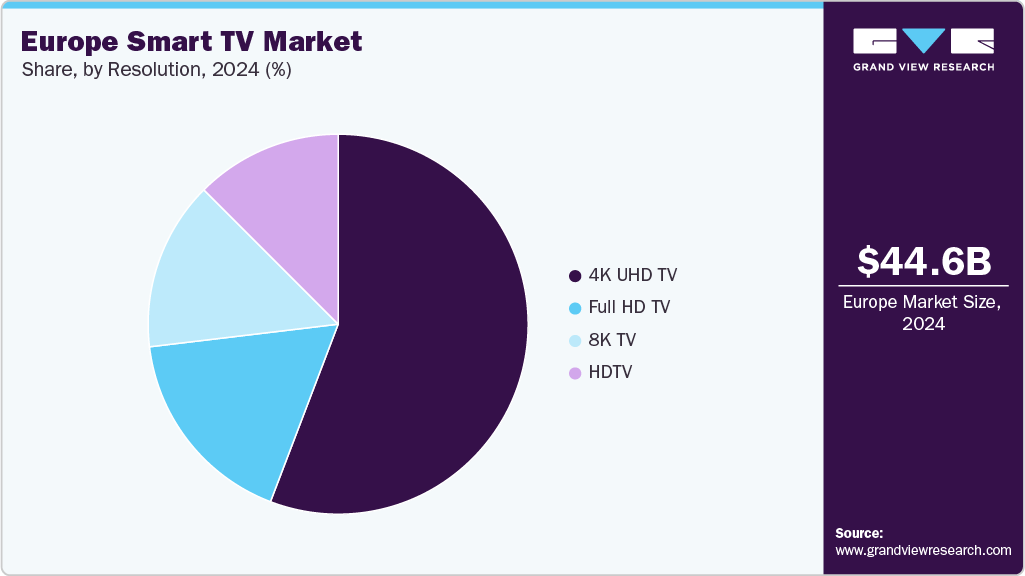
The Full HD TV segment is expected to register the fastest CAGR from 2025 to 2030, owing to its ability to deliver high-quality viewing experiences at an affordable price point. In Europe, this balance between performance and cost is increasingly valued among households seeking enhanced entertainment without upgrading to higher-end resolutions like 4K or 8K. Partnerships between broadcasters and smart TV manufacturers are expanding access to Full HD models, making it a preferred choice for many users in the Europe smart TV industry.
Country Insights
UK Smart TV Market Trends
The UK smart TV industry is expected to witness steady growth at a CAGR of over 10% from 2025 to 2030. In the UK, rapid adoption of advanced display technologies and connected entertainment solutions across households has significantly driven market growth. Major investments in broadband expansion and public Wi-Fi projects are improving accessibility, while collaborations between tech startups and academic institutions are fostering innovation in AI-driven content recommendations and personalized viewing experiences. These factors will propel the UK smart TV industry in the coming years.
Germany Smart TV Market Trends
The Germany smart TV industry accounted for the largest market share in the European market of over 18% in 2024, driven by strong government support, high consumer purchasing power, and advanced technology infrastructure. Germany’s strategic focus on promoting connected living, energy-efficient appliances, and digital entertainment solutions encourages smart TV adoption. Ongoing collaborations between tech companies and manufacturers are accelerating innovation in AI-driven interfaces, immersive viewing experiences, and sustainable display technologies, positioning Germany as a key market for smart TV advancements in Europe.
Key Europe Smart TV Company Insights
Some of the key players operating in the Europe smart TV industry include Samsung Electronics Co. Ltd. and LG Electronics Inc. among others.
-
Samsung Electronics Co. Ltd. is a leading player in the Europe smart TV industry, offering a wide range of advanced display technologies and AI-powered user. Its flagship QLED and Neo QLED series are highly popular across Europe, providing superior picture quality, energy efficiency, and smart connectivity features. The company’s commitment to long-term software updates and robust cybersecurity measures has positioned it as a trusted smart TV provider for Europe.
-
LG Electronics Inc. is a prominent player in the Europe smart TV industry, renowned for its OLED display technology and immersive viewing experiences tailored for entertainment enthusiasts and professionals. Its OLED Evo and Ultra HD TV series are widely adopted in premium segments across Europe, offering exceptional contrast ratios, color accuracy, and viewing angles. LG’s focus on AI-driven content recommendations, webOS-powered interfaces, and sustainable design aligns with Europe’s increasing demand for energy-efficient and user-friendly smart TVs.
TCL Electronics Holdings Limited and Xiaomi Corporation are some of the emerging participants in the Europe smart TV industry.
-
TCL Electronics Holdings Limited is an emerging player in the Europe smart TV industry, specializing in affordable yet feature-rich television solutions. Its flagship series, including the TCL C-series and X-series, offers advanced display technologies such as QLED panels, wide color gamut, and high refresh rates for gaming and entertainment. Strategic partnerships with content providers and continuous investments in R&D are helping TCL expand its presence and appeal across diverse markets in Europe.
-
Xiaomi Corporation is an emerging player in the Europe smart TV industry, offering competitively priced models that incorporate cutting-edge technologies typically found in high-end devices. Xiaomi’s emphasis on user experience, fast software updates, and integration with its broader ecosystem of smart devices is helping it capture market share in urban and tech-driven European markets.
Key Europe Smart TV Companies:
- Samsung Electronics Co. Ltd
- Koninklijke Philips N.V.
- LG Electronics Inc
- Sony Corporation
- TCL Electronics Holdings Limited
- Haier Inc.
- Hisense International
- Xiaomi.
- Panasonic Holdings Corporation
- Intex Technologies
Recent Developments
-
In September 2025, Haier Europe redefined the connected home experience with its Naturally Connected ecosystem, emphasizing people-centric design and sustainability. Haier introduced a new range of smart TVs featuring extensive functionalities and sizes up to 115 inches, seamlessly integrating entertainment within the broader smart home ecosystem. Haier’s commitment to innovation and customization strengthens its leadership in the Europe smart TV industry.
-
In May 2025, Hisense International unveiled its latest lineup of smart TVs, including the A85Q OLED and several mini-LED models such as the U7Q Pro and E7Q Pro. These models feature advanced AI enhancements, such as Hi-View AI Engine Pro, which offers improved picture quality. The company continues to expand its presence in the European market, focusing on delivering high-quality, affordable television options.
-
In May 2025, Xiaomi launched smart TV A Pro series in Spain, featuring 4K QLED displays with a 94% DCI-P3 color gamut and support for HDR10+ and Dolby Vision. The series includes models ranging from 43 to 75 inches and operates on Fire OS, allowing for a wide range of app installations. This move signifies Xiaomi's expansion into the European market with competitively priced, feature-rich televisions.
Europe Smart TV Market Report Scope
Report Attribute
Details
Market size value in 2025
USD 47,698.6 million
Revenue forecast in 2030
USD 80,972.6 million
Growth rate
CAGR of 11.2% from 2025 to 2030
Base year for estimation
2024
Historical data
2018 - 2023
Forecast period
2025 - 2030
Quantitative units
Revenue in USD million/billion and CAGR from 2025 to 2030
Report coverage
Revenue forecast, company ranking, competitive landscape, growth factors, and trends
Segments covered
Operating System, resolution, screen size, distribution channel, technology, country
Country scope
Austria; Belgium; Czech Republic; Denmark; Finland; France; Germany; Iceland; Ireland; Italy; Netherlands; Norway; Poland; Spain; Sweden; Switzerland; UK
Key companies profiled
Samsung Electronics Co. Ltd; Koninklijke Philips N.V.; LG Electronics Inc.; Sony Corporation; TCL Electronics Holdings Limited; Haier Inc.; Hisense International; Xiaomi; Panasonic Holdings Corporation; Intex Technologies
Customization scope
Free report customization (equivalent to up to 8 analyst’s working days) with purchase. Addition or alteration to country, regional & segment scope.
Pricing and purchase options
Avail customized purchase options to meet your exact research needs. Explore purchase options
Europe Smart TV Market Report Segmentation
This report forecasts revenue growth at the regional level and provides an analysis of the latest industry trends in each of the sub-segments from 2018 to 2030. For this study, Grand View Research has segmented the Europe smart TV market report based on operating system, resolution, screen size, distribution channel, technology, and country:
-
Operating System Outlook (Revenue, USD Million, 2018 - 2030)
-
Android TV
-
Tizen
-
WebOS
-
Roku
-
Other
-
-
Resolution Outlook (Revenue, USD Million, 2018 - 2030)
-
4K UHD TV
-
HDTV
-
Full HD TV
-
8K TV
-
-
TV Screen Size Outlook (Revenue, USD Million, 2018 - 2030)
-
Below 32 inches
-
32 to 45 inches
-
46 to 55 inches
-
56 to 65 inches
-
Above 65 inches
-
-
Distribution Channel Outlook (Revenue, USD Million, 2018 - 2030)
-
Online
-
Offline
-
-
Technology Outlook (Revenue, USD Million, 2018 - 2030)
-
OLED
-
QLED
-
LED
-
Others
-
-
Country Outlook (Revenue, USD Million, 2018 - 2030)
-
Austria
-
Belgium
-
Czech Republic
-
Denmark
-
Finland
-
France
-
Germany
-
Iceland
-
Ireland
-
Italy
-
Netherlands
-
Norway
-
Poland
-
Spain
-
Sweden
-
Switzerland
-
UK
-
Frequently Asked Questions About This Report
b. The Europe smart TV market was estimated at USD 44,576.0 million in 2024 and is expected to reach USD 47,698.6 million in 2025.
b. The Europe smart TV market is expected to grow at a compound annual growth rate of 11.2% from 2025 to 2030 and to reach USD 80,972.6 million by 2030.
b. The Germany smart TV market accounted for the largest market share of over 18% in 2024, driven by strong government support, high consumer purchasing power, and advanced technology infrastructure. Germany’s strategic focus on promoting connected living, energy-efficient appliances, and digital entertainment solutions encourages smart TV adoption. Ongoing collaborations between tech companies and manufacturers are accelerating innovation in AI-driven interfaces, immersive viewing experiences, and sustainable display technologies, positioning Germany as a key market for smart TV advancements in Europe.
b. The key players in the Europe smart TV market are Samsung Electronics Co. Ltd, Koninklijke Philips N.V., LG Electronics Inc, Sony Corporation, TCL Electronics Holdings Limited, Haier Inc., Hisense International, Xiaomi., Panasonic Holdings Corporation, Intex Technologies
b. Key drivers of the Europe smart TV market include the rising consumer preference for large-screen and ultra-high-definition (UHD) displays, advancements in OLED, QLED, and MicroLED panel technologies enhance picture quality, energy efficiency.

Share this report with your colleague or friend.
Need a Tailored Report?
Customize this report to your needs — add regions, segments, or data points, with 20% free customization.


ISO 9001:2015 & 27001:2022 Certified
We are GDPR and CCPA compliant! Your transaction & personal information is safe and secure. For more details, please read our privacy policy.
Trusted market insights - try a free sample
See how our reports are structured and why industry leaders rely on Grand View Research. Get a free sample or ask us to tailor this report to your needs.













