
- Home
- »
- Healthcare IT
- »
-
Europe Surgical Display Market Size, Industry Report, 2033GVR Report cover
![Europe Surgical Display Market Size, Volume, Share & Trends Report]()
Europe Surgical Display Market (2026 - 2033) Size, Volume, Share & Trends Analysis Report By Resolution (High Definition (HD), Full HD, 4K Ultra HD, 8K Ultra HD), By Display (LED, LCD, OLED Displays), By Application, By End Use, By Country, And Segment Forecasts
- Report ID: GVR-4-68040-884-4
- Number of Report Pages: 90
- Format: PDF
- Historical Range: 2021 - 2025
- Forecast Period: 2026 - 2033
- Industry: Healthcare
- Report Summary
- Table of Contents
- Segmentation
- Methodology
- Download FREE Sample
-
 Download Sample Report
Europe Surgical Display Market Summary
The Europe surgical display market size was estimated at USD 223.23 million in 2025 and is projected to reach USD 288.64 million by 2033, growing at a CAGR of 3.28% from 2026 to 2033. This growth is primarily driven by increasing adoption of minimally invasive surgeries, rising demand for high-resolution imaging (4K/8K displays), increasing use of robotic-assisted and image-guided surgeries, and strong healthcare infrastructure and modernization initiatives.
Key Market Trends & Insights
- The UK dominated the market with the largest revenue share of 8.4% in 2025.
- Based on resolution, the 4K Ultra HD (Ultra High Definition) segment led the market with the largest revenue share of 38.6% in 2025.
- Based on display, the LCD (liquid crystal display) segment led the market with the largest revenue share of 50.3% in 2025.
- Based on application, the endoscopy segment led the market with the largest revenue share in 2025.
- Based on end use, the hospitals segment held the largest revenue share in 2025.
Market Size & Forecast
- 2025 Market Size: USD 223.23 Million
- 2033 Projected Market Size: USD 288.64 Million
- CAGR (2026-2033): 3.28%
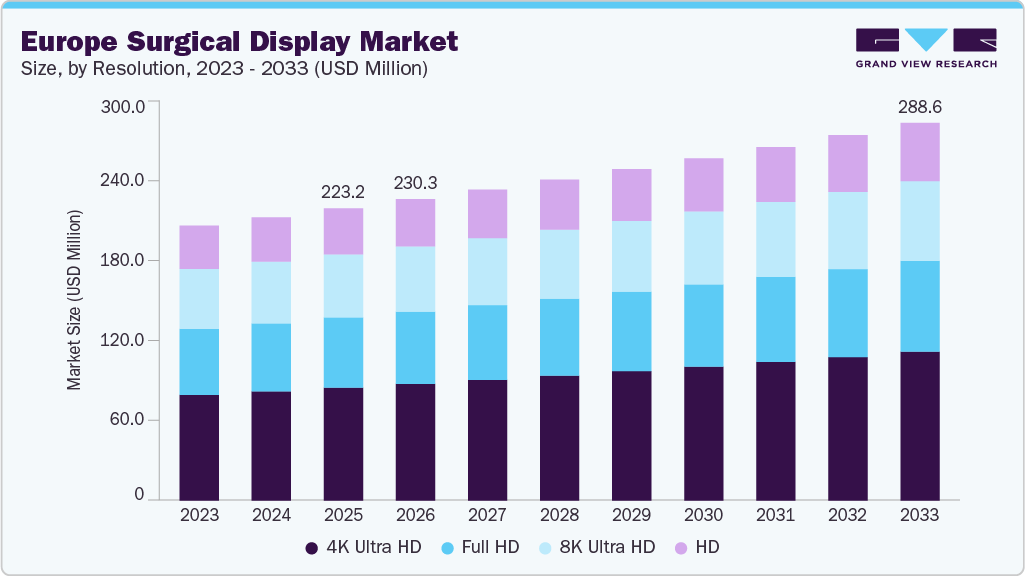
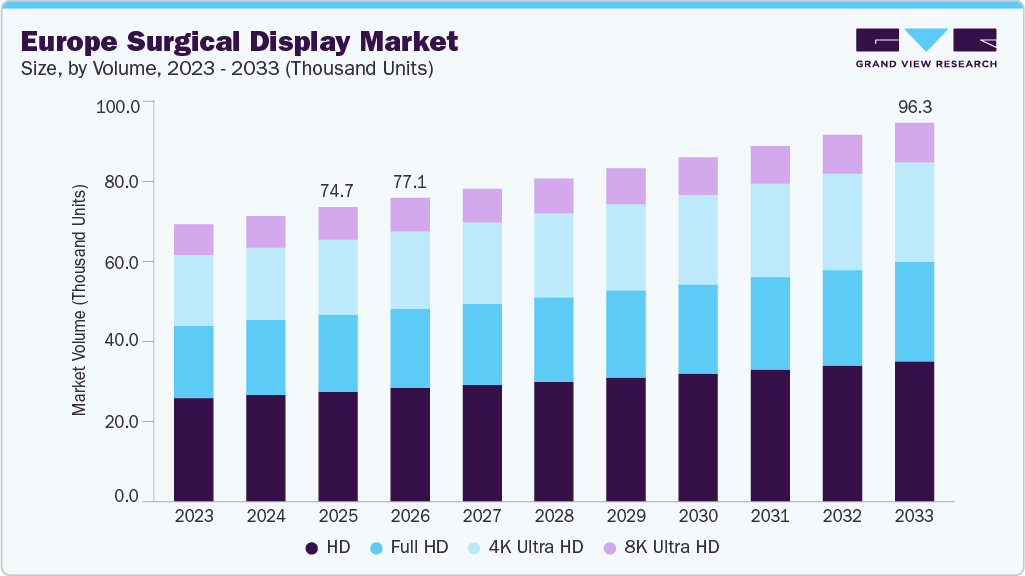
According to an article published by ScienceDirect in December 2024, the adoption of minimally invasive surgeries (MIS) in England has increased significantly, with resections for colon cancer rising from 34.9% to 72.9% and for rectal cancer from 28.8% to 72.5%. Additionally, robot-assisted surgeries have shown notable growth, increasing from 0.1% to 2.7% for colon cancer and from 0.2% to 7.9% for rectal cancer. This growing shift toward MIS and robotic-assisted procedures is driving the demand for advanced surgical displays, as these technologies rely heavily on high-resolution, real-time visualization to enhance surgical precision and outcomes.
Moreover, in April 2024, Karolinska University Hospital became the first in Europe to perform surgery using a newly approved single-port robotic system, marking a key milestone in next-generation surgical innovation. This technology enables complex procedures to be performed through a single entry point, reducing surgical trauma and improving precision, thereby accelerating the transition toward highly digital, technology-driven operating rooms where surgeons depend on real-time, high-definition visualization systems. As robotic platforms evolve, the demand for advanced surgical displays with enhanced image clarity, depth perception, and seamless integration continues to rise, thereby supporting overall market growth.
The ongoing digital transformation of healthcare systems across Europe is significantly contributing to the growth of the surgical display market. In January 2025, the EU-funded SUSA project was launched with an investment of USD 14.31 million (€12.4 million) and involved 12 European universities to enhance digital skills in healthcare through advanced training programs in AI, data analytics, and digital technologies. This initiative aims to train over 6,500 graduates and upskill healthcare professionals, supporting the transition toward a more digitally integrated healthcare ecosystem. Such initiatives are accelerating the adoption of digitally advanced operating rooms and data-driven clinical environments, where high-performance surgical displays are essential for real-time visualization and clinical decision-making. As healthcare systems continue to modernize and integrate advanced technologies, the demand for innovative and high-resolution surgical display systems is expected to rise across Europe.
Market Concentration & Characteristics
The Europe surgical display market experiences a high degree of innovation driven by technological advancements. For instance, in August 2025, Sony launched the LMD-43M1MD, a 43-inch 4K 2D Mini LED surgical monitor with HDR, VESA DisplayHDR 1000 certification, and Advanced Local Dimming, featuring a BT.2020 wide color gamut. It enhances OR visibility for precise imaging in minimally invasive procedures.
The level of partnerships and collaborations in the market is high, as companies are increasingly forming strategic alliances with AI firms, medical device manufacturers, and healthcare providers to enhance visualization capabilities and operating room efficiency. For instance, in March 2024, Barco collaborated with NVIDIA and SoftAcuity to integrate AI and real-time data analytics into digital operating rooms. Such partnerships enable the development of AI-powered, high-resolution surgical display systems and accelerate the adoption of integrated and connected OR environments across Europe, thereby supporting overall market growth.
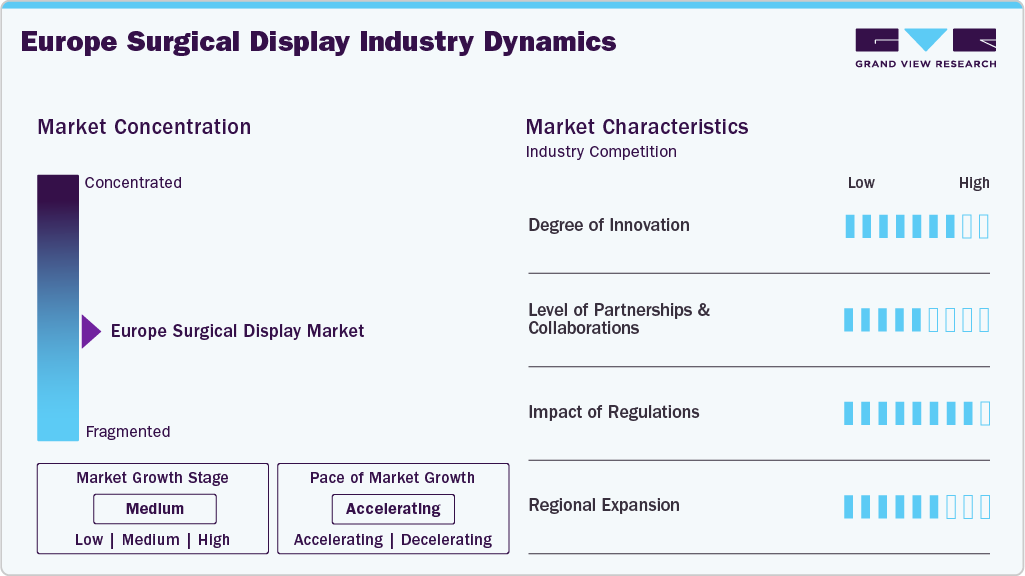
The impact of regulations on the Europe surgical display industry is high, as stringent compliance requirements under frameworks such as the EU Medical Device Regulation (MDR) 2017/745 mandate rigorous standards for safety, performance, and clinical validation. These regulations increase approval timelines and operational costs for manufacturers, but they also ensure high product quality, reliability, and patient safety. As a result, regulatory policies play a critical role in shaping market dynamics and driving the adoption of certified, high-performance surgical display systems across Europe.
The level of geographical expansion is moderate, as the region represents a mature and well-established healthcare market. Companies are focusing on strengthening their presence through product launches, digital operating room integrations, and hospital-level deployments, which are gradually expanding access to advanced surgical display systems across European countries.
Resolution Insights
Based on resolution, the 4K Ultra HD segment held the largest market share of 38.6% in 2025, driven by surgeons’ growing need for highly detailed visualization during complex procedures. The superior clarity, color accuracy, and depth offered by 4K displays enhance precision in minimally invasive surgeries. The increasing adoption of advanced imaging systems, hospital investments in modern OR infrastructure, and the rising emphasis on improving surgical outcomes further supported the segment’s strong market dominance.
The full HD segment is expected to hold a prominent share during the forecast period owing to its cost-effectiveness and widespread adoption across healthcare facilities. Full HD displays offer adequate image clarity for most surgical procedures and are more affordable than 4K and advanced display technologies. Moreover, their high compatibility with existing surgical systems and infrastructure supports continued usage, particularly in mid-sized hospitals and outpatient settings, thereby sustaining segment growth.
Display Insights
Liquid crystal display (LCD) technology dominated the surgical display market with revenue share of 50.3% in 2025, owing to its cost-effectiveness, widespread availability, and consistent image quality suitable for most surgical procedures. Its reliability, energy efficiency, and compatibility with existing operating room systems have made LCD the preferred choice across hospitals and ambulatory surgical centers.
Meanwhile, organic light-emitting diode (OLEDs) are expected to experience the fastest growth during the forecast period, driven by their superior image quality, high contrast ratios, and true black levels, which enhance the visualization of fine anatomical details. Their lightweight design, wide viewing angles, and reduced motion blur make them increasingly preferred for advanced and minimally invasive surgical procedures.
Application Insights
In terms of application, the endoscopy segment dominated the surgical display industry with a share of 28.0% in 2025, owing to the rising volume of minimally invasive procedures such as gastrointestinal, urological, and laparoscopic surgeries, which require high-resolution (4K/3D) displays for real-time visualization and precision. The expansion of cancer screening programs and early diagnosis initiatives further supports segment growth. In addition, the growing burden of chronic diseases such as colorectal cancer, gastrointestinal disorders, and urological conditions across Europe is increasing the demand for diagnostic and therapeutic endoscopy.
The orthopedic surgery segment held a prominent share in 2025, owing to the rising volume of joint replacement and trauma procedures driven by the aging population and increasing incidence of musculoskeletal disorders. These procedures require high-precision imaging and real-time visualization, increasing the demand for high-resolution surgical displays.
End Use Insights
The hospital segment dominated the market with the largest share in 2025. Hospitals are adopting advanced surgical techniques, such as minimally invasive surgery, which require high-resolution displays for precise visualization during procedures. These displays improve surgical outcomes, reduce complications, and enhance patient satisfaction. Hospitals also use surgical displays for educational purposes, training surgeons, and staying up to date on new techniques.
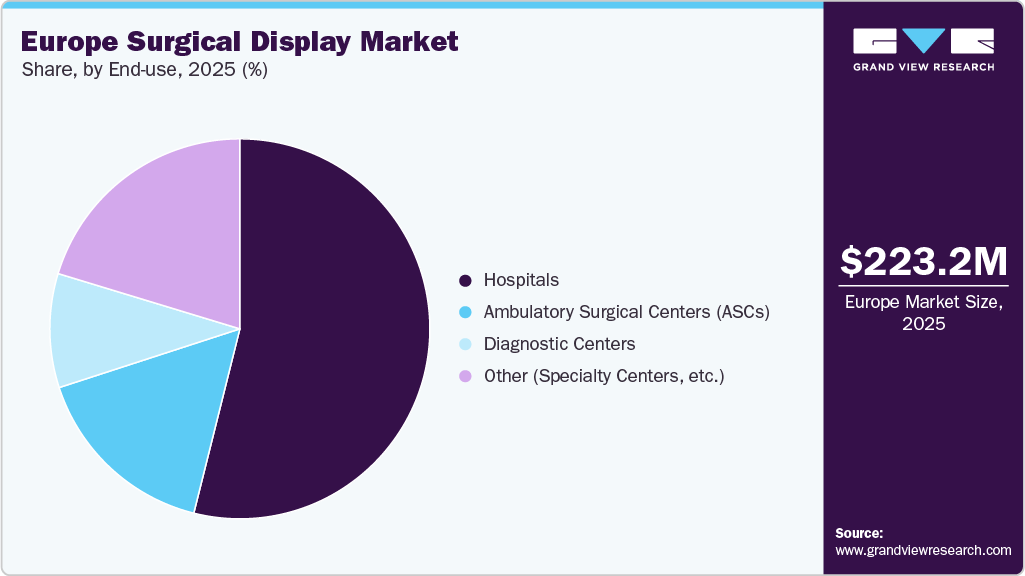
The Ambulatory Surgical Centers (ASC) segment is expected to grow at the fastest CAGR from 2026 to 2033. ASCs specialize in minimally invasive procedures, providing efficient, high-quality same-day surgical care. These centers invest heavily in advanced surgical technologies, including surgical displays, to support a range of minimally invasive procedures, including laparoscopic, endoscopic, and orthopedic procedures.
Country Insights
The Germany surgical display industry is growing strongly due to the increasing introduction of advanced robotic visualization systems for neurosurgery. These systems provide high-resolution, real-time imaging and enhanced 3D visualization, allowing surgeons to perform highly precise and minimally invasive procedures. For instance, in September 2024, Carl Zeiss Meditec AG launched the KINEVO 900 S, an advanced robotic visualization system for neurosurgery. The system enhances surgical precision with improved digital visualization, collaborative assistance features, and integrated intelligent connectivity. The continuous advancement and adoption of such innovative robotic visualization technologies are significantly driving the demand for high-performance surgical displays in Germany.
The surgical display industry in the UK is expected to witness substantial growth in the forecast period. This growth is driven by an aging population, higher prevalence of chronic diseases, and increased demand for minimally invasive surgeries. As surgical volumes increase, hospitals and surgical centers require more reliable, high-quality display systems to support efficient, accurate procedures. This continued demand for surgical infrastructure is contributing to the growth of the surgical display market.
Key Europe Surgical Display Company Insights
The Europe surgical display market remains moderately consolidated, characterized by the presence of a few established players along with several regional and niche providers. Strategic partnerships and collaborations with hospitals, medical device companies, and technology providers are being leveraged to strengthen product integration and expand market presence across the region.
Key Europe Surgical Display Companies:
- Barco
- EIZO Corporation
- Sony Group Corporation
- LG Electronics
- Siemens Healthineers
- Koninklijke Philips N.V.
- Olympus Corporation
- STERIS plc
- NDS Surgical Imaging
- Advantech Co., Ltd.
- KARL STORZ
Recent Developments
-
In March 2026, Olympus Corporation announced the launch of its next-generation VISERA ELITE III surgical imaging platform, developed with Sony, to enhance surgical visualization and workflow efficiency. The platform integrates advanced technologies, including True 4K/3D imaging, fluorescence-guided surgery, and AI-enabled features, to support minimally invasive procedures and improve clinical decision-making across multiple specialties.
-
In April 2024, EIZO Corporation announced the launch of two new CuratOR monitors designed for operating rooms and interventional radiology, including a high-brightness touch monitor for medical image display and system control. These monitors are optimized for both grayscale and color imaging, supporting accurate visualization in procedures such as cardiology and angiography while enhancing workflow efficiency in surgical environments.
-
In March 2025, Barco unveiled AI-powered surgical innovations at NVIDIA GTC 2025, including the Brilliant Assistant display and Nexxis Compute platform. These solutions integrate NVIDIA Holoscan technology to enable real-time video processing, hands-free interaction, and AI-driven visualization, enhancing surgical precision, workflow efficiency, and operating room connectivity.
Europe Surgical Display Market Report Scope
Report Attribute
Details
Market size value in 2026
USD 230.3 million
Revenue forecast in 2033
USD 288.64 million
Growth rate
CAGR of 3.28% from 2026 to 2033
Actual data
2021 - 2025
Forecast period
2026 - 2033
Quantitative units
Revenue in USD million, Volume in Thousands Unit and CAGR from 2026 to 2033
Report coverage
Revenue forecast, company ranking, competitive landscape, growth factors, and trends
Segments covered
Resolution, display, application, end use, country
Country scope
UK; Germany; France; Italy; Spain; Sweden; Denmark; Norway; Ukraine; Russia
Key companies profiled
Barco; EIZO Corporation; Sony Group Corporation; LG Electronics; Siemens Healthineers; Koninklijke Philips N.V.; Olympus Corporation; STERIS plc; NDS Surgical Imaging; Advantech Co., Ltd.; KARL STORZ
Customization scope
Free report customization (equivalent up to 8 analysts working days) with purchase. Addition or alteration to country, regional & segment scope.
Pricing and purchase options
Avail customized purchase options to meet your exact research needs. Explore purchase options
Europe Surgical Display Market Report Segmentation
This report forecasts revenue growth and provides at regional and country levels an analysis of the latest trends in each of the sub-segments from 2021 to 2033. For this report, Grand View Research has segmented the Europe surgical display market report based on resolution, display, application, end use, and country:
-
Resolution Outlook (Volume, Thousand Units; Revenue, USD Million, 2021 - 2033)
-
High Definition (HD)
-
Full HD
-
4K ULTRA HD
-
8K ULTRA HD
-
-
Display Outlook (Volume, Thousand Units; Revenue, USD Million, 2021 - 2033)
-
Light-Emitting Diode (LED) Displays
-
Liquid Crystal Display (LCD)
-
Organic Light-Emitting Diode (OLED) Displays
-
-
Application Outlook (Volume, Thousand Units; Revenue, USD Million, 2021 - 2033)
-
Endoscopy
-
Orthopedic Surgery
-
Neurosurgery
-
Cardiovascular Surgery
-
Others
-
-
End Use Outlook (Volume, Thousand Units; Revenue, USD Million, 2021 - 2033)
-
Hospitals
-
Ambulatory Surgical Centers (ASCs)
-
Diagnostic Centers
-
Others
-
-
Country Outlook (Volume, Thousand Units; Revenue, USD Million, 2021 - 2033)
-
UK
-
Germany
-
France
-
Italy
-
Spain
-
Sweden
-
Denmark
-
Norway
-
Ukraine
-
Russia
-
Frequently Asked Questions About This Report
b. The Europe surgical display market size was estimated at USD 223.2 million in 2025 and is expected to reach USD 230.3 million in 2026.
b. The Europe surgical display market is expected to grow at a compound annual growth rate of 3.28% from 2026 to 2033 to reach USD 288.6 million by 2033.
b. Based on application, the endoscopy segment dominated the surgical display market with a share of 28.0% in 2025, owing to the rising volume of minimally invasive procedures such as gastrointestinal, urological, and laparoscopic surgeries, which require high-resolution (4K/3D) displays for real-time visualization and precision.
b. Some key players operating in the Europe surgical display market include Barco, EIZO Corporation, Sony Group Corporation, LG Electronics, Siemens Healthineers, Koninklijke Philips N.V., Olympus Corporation, STERIS plc, NDS Surgical Imaging, Advantech Co., Ltd., KARL STORZ
b. Key factors that are driving the market growth include increasing adoption of minimally invasive surgeries, rising demand for high-resolution imaging (4K/8K displays), increasing use of robotic-assisted and image-guided surgeries, and strong healthcare infrastructure and modernization initiatives


Share this report with your colleague or friend.
Need a Tailored Report?
Customize this report to your needs — add regions, segments, or data points, with 20% free customization.


ISO 9001:2015 & 27001:2022 Certified
We are GDPR and CCPA compliant! Your transaction & personal information is safe and secure. For more details, please read our privacy policy.
Trusted market insights - try a free sample
See how our reports are structured and why industry leaders rely on Grand View Research. Get a free sample or ask us to tailor this report to your needs.













