
- Home
- »
- Automotive & Transportation
- »
-
EV Charging Management Software Platform Market 2033GVR Report cover

EV Charging Management Software Platform Market (2026 - 2033)
Size, Share & Trends Analysis Report By Module (Operation Management, Energy Management, EV Billing and Payment), By Deployment, By Charger Type, By Application, By Region, And Segment Forecasts
Market Size, 2025
$1.6BMarket Estimate, 2026
$1.9BMarket Forecast, 2033
$8.4BCAGR, 2026–2033
23.6%EV Charging Management Software Platform Market Summary
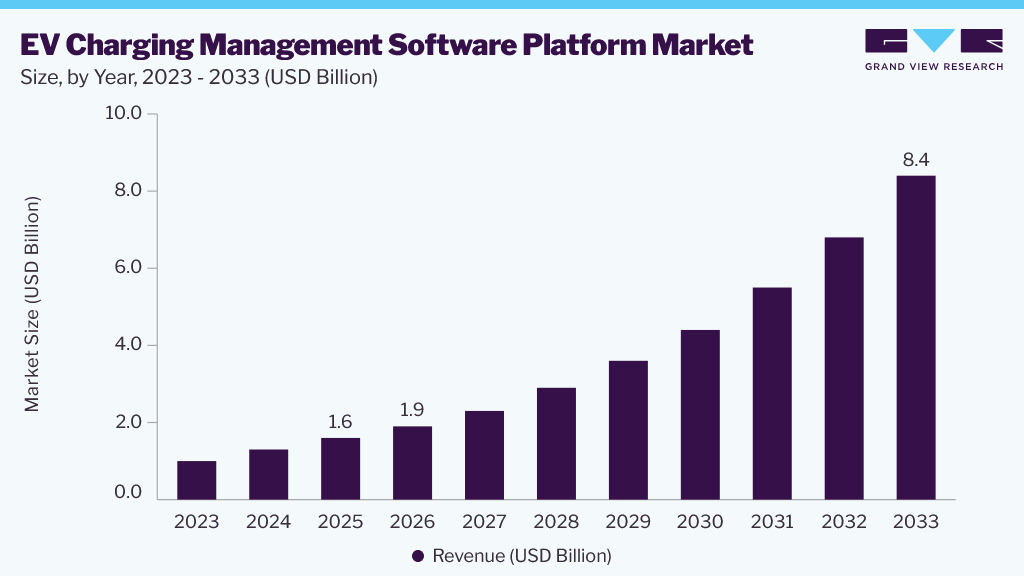
The global EV charging management software platform market size was valued at USD 1.6 billion in 2025 and is projected to grow from USD 1.9 billion in 2026 to USD 8.4 billion by 2033, at a CAGR of 23.6% from 2026 to 2033. North America dominated the market, accounting for the largest revenue share of approximately 28.0% in the global market in 2025. Factors contributing to market growth include the increasing adoption of electric vehicles, the expansion of charging infrastructure networks, and rising demand for centralized charging-station management solutions.
Key Market Trends & Insights
- By module: The operation management segment held the largest market share of around 30.0% in 2025.
- By charger type: The level 2 charger segment held the largest market share of over 50.0% in 2025.
- By deployment: The public chargers segment held the largest revenue share of over 69.5% in 2025.
- By application: The commercial segment held the largest market share of over 81.0% in 2025.
Regional Insights
- Largest regional market: North America (28.0% revenue share, 2025)
- Fastest-growing regional market: Asia Pacific (highest CAGR, 2026-2033)
Market Size & Forecast
- Market size in 2025: USD 1.6 Billion
- Estimated market size in 2026: USD 1.9 Billion
- Projected market size by 2033: USD 8.4 Billion
- CAGR (2026-2033): 23.6%
Three ways to get this report
Buy it, customize it, or ask a question.Ask an Analyst
Analyst response in 1 business day
- AccessReport author, directly
- Reply timeWithin 1 working day
- No sales callDirect answer only
- FormatEmail reply
- CostFree, no cost
Get the Full Report
What the study covers
- FormatsPDF · Excel · Dashboard
- Timeline2026–2033 annual, 2025 base
- Coverage20+ countries, 5 regions
- Companies10+ key players profiled
Customize the Report
20% free customization
- IncludeCountries, segments, points
- TailorTo your product definition
- ExtendDeeper competitor detail
- OrA fully bespoke study
- Turnaround5–10 working days
The growing deployment of smart charging technologies, the integration of payment and billing systems, and the need to optimize charger utilization and energy consumption are further driving demand for EV charging management software platforms.The increasing adoption of electric vehicles is driving the need for software platforms to monitor, control, and optimize charging infrastructure. Charging point operators and fleet managers are increasingly using charging management software to manage the availability of chargers, energy consumption, user authentication, payment processing, and remote diagnostics through centralized platforms. The expansion of public charging networks and workplace charging installations is further increasing demand for solutions that efficiently support large-scale charging operations.
 Source: Grand View Research, IR Documents, Primary Interviews, Paid DatabasesTo learn more about this report,
 Download Free Sample Report
 The growing deployment of smart charging technologies is also supporting software adoption across EV charging networks. Features such as load balancing, dynamic energy management, predictive maintenance, and real-time monitoring are becoming important for improving charger utilization and operational efficiency. For instance, in January 2025, AMPECO announced a partnership with Hubject to enable Plug & Charge functionality and strengthen interoperability across charging networks. The collaboration supports seamless charging experiences for EV users and highlights the increasing emphasis on software-driven charging infrastructure management. In addition, the integration of cloud computing, artificial intelligence, and data analytics is enabling charging operators to improve network performance and support the expansion of connected EV charging ecosystems.
Market Dynamics
The EV charging management software platform industry is experiencing steady growth, driven by the rapid expansion of electric mobility and the increasing deployment of charging infrastructure across residential, commercial, and public settings. Charging network operators are increasingly adopting digital platforms to improve operational visibility and support large-scale charger deployment. The growing shift toward connected mobility ecosystems and the rising importance of efficient charging operations are driving software adoption.
The expansion of EV charging infrastructure is increasing the need for software platforms capable of managing large and geographically dispersed charging networks. Charging point operators are adopting EV charging management software to monitor charger performance, manage user access, process payments, optimize energy consumption, and support remote diagnostics through a centralized platform. As charging networks continue to scale, operators require solutions that improve operational visibility and ensure reliable charger availability across multiple locations.
The growing focus on interoperability and network efficiency is further supporting software adoption. For instance, in July 2025, Plugzmart launched Relay, a multi-CMS connectivity platform that enables interoperability across EV charging networks without requiring full Open Charge Point Interface (OCPI) implementation. The platform facilitates communication between different charging management systems and supports seamless network integration. In addition, in December 2025, Exicom introduced a platform to streamline EV charging infrastructure operations by addressing software and operational bottlenecks faced by charge point operators. These developments highlight the growing importance of intelligent software platforms in managing the expanding EV charging ecosystem.
The deployment of EV charging management software platforms often requires substantial investment in software integration, cloud infrastructure, network connectivity, cybersecurity measures, and ongoing system maintenance. Charging point operators managing large charging networks frequently need to integrate software platforms with chargers from multiple manufacturers, payment gateways, energy management systems, and fleet management solutions. These requirements can increase implementation complexity and overall deployment costs, particularly for small and medium-sized operators with limited financial resources. In addition, software upgrades, customization requirements, and compliance with evolving industry standards further contribute to operational expenditures.
In addition, several charging network operators continued to invest in software modernization and interoperability upgrades to support the expansion of charging infrastructure and connected charging services. The need for continuous technology investments and platform enhancements can create financial challenges for operators, potentially slowing the adoption of advanced EV charging management software solutions across cost-sensitive markets.
The increasing deployment of EV charging infrastructure is driving demand for predictive maintenance solutions that can identify equipment issues before charger failures occur. AI-enabled predictive maintenance platforms analyze real-time operational data from charging stations to detect performance anomalies, forecast maintenance requirements, and reduce unplanned downtime. These capabilities help charging network operators improve charger reliability, optimize maintenance schedules, and enhance overall network performance. As charging networks expand, predictive maintenance is becoming an important tool for ensuring consistent service availability and reducing operational disruptions.
For instance, in January 2026, Autel Energy announced its CES 2026 showcase, highlighting its expanding portfolio of interoperable, grid-ready EV charging hardware. The company also showcased intelligent charging and inspection automation solutions designed to support homeowners, fleets, commercial operators, and municipalities. The increasing integration of intelligent charging technologies and automation capabilities into the charging infrastructure is creating opportunities for software providers that support connected EV charging ecosystems.
Analyst Perspective
The EV charging management software platform industry is evolving from a focus on charger monitoring to a critical digital layer within the broader EV ecosystem. As charging networks expand in scale and complexity, software capabilities such as interoperability, remote asset management, energy optimization, and automated operations are becoming key differentiators for network operators. Competitive advantage is increasingly shifting toward platforms that can integrate diverse charging hardware, support multiple payment and roaming systems, and deliver actionable operational insights. Vendors capable of enabling scalable network management while maintaining charger reliability and user experience are expected to strengthen their position as the EV charging landscape continues to mature.
Module Insights
The operation management segment led the market with the largest revenue share of around 30.0% in 2025, primarily driven by the increasing need for efficient monitoring and management of expanding EV charging networks. Operation management platforms enable charging point operators to oversee charger availability, monitor network performance, conduct remote diagnostics, manage energy consumption, and coordinate maintenance activities through centralized systems. These capabilities support charger reliability, operational efficiency, and network scalability, making operation management software a critical component of EV charging infrastructure. The growing deployment of public, commercial, and fleet charging stations continues to support demand for operation management solutions.
The EV billing and payment segment is expected to grow at a significant CAGR during the forecast period. The segment benefits from the increasing adoption of digital payment systems and the need for automated billing across diverse charging networks. EV charging operators are increasingly implementing software solutions that support dynamic pricing, subscription-based charging services, invoicing, roaming settlements, and real-time payment processing. The expansion of public charging infrastructure and the growing number of charging service providers are further accelerating the adoption of advanced billing and payment platforms.
Deployment Insights
The public chargers segment led the market with the largest revenue share of over 69.5% in 2025. Public charging networks require centralized software platforms to manage charger availability, user authentication, payment processing, network monitoring, and remote diagnostics across multiple locations. The continued deployment of charging stations across highways, urban centers, commercial facilities, and transportation hubs has increased the need for efficient network management and operational oversight. Growing investments in public charging infrastructure are further supporting the adoption of EV charging management software platforms across large-scale charging networks.
The private chargers segment is expected to grow at the fastest CAGR over the forecast period. The increasing deployment of charging stations across workplaces, fleet depots, residential communities, and commercial facilities is driving demand for software solutions that support charger monitoring, access control, charging schedules, and energy management. Organizations operating private charging infrastructure are increasingly using digital platforms to improve charger utilization and manage electricity consumption. The expansion of fleet electrification programs is further contributing to software adoption across privately operated charging networks.
Charger Type Insights
The Level 2 charger segment led the market with the largest revenue share of over 50.0% in 2025. Level 2 chargers are widely deployed across workplaces, commercial establishments, multi-unit residential buildings, and destination charging locations due to their balance of charging speed and installation costs. The widespread deployment of these chargers has increased the need for software platforms that manage user access, charger utilization, payment processing, and operational monitoring. In addition, the suitability of Level 2 chargers for daily and long-duration charging applications continues to support their adoption across diverse charging environments, contributing to sustained demand for charging management software solutions.
The Level 3 charger segment is expected to register at the fastest CAGR during the forecast period. The expansion of fast-charging infrastructure along highways, urban mobility corridors, and commercial charging hubs is increasing the deployment of Level 3 chargers. These charging systems require advanced software capabilities to support load management, real-time monitoring, remote diagnostics, and network performance optimization due to their high-power operating requirements. The growing focus on reducing charging times and supporting long-distance EV travel is accelerating investment in fast-charging infrastructure, creating additional demand for sophisticated charging management software platforms.
Application Insights
The commercial segment led the market with the largest revenue share of over 81.0% in 2025, driven by the increasing deployment of charging infrastructure across retail centers, office complexes, fleet depots, parking facilities, hotels, and transportation hubs. Charging networks operating across multiple locations require software platforms to monitor chargers, process payments, manage energy, authenticate users, and oversee operations. The increasing scale of public-facing and fleet charging operations has accelerated the adoption of centralized management platforms. For instance, in May 2025, Eaton and ChargePoint announced a collaboration to accelerate and simplify the deployment of EV charging infrastructure across the U.S., Canada, and countries in Europe by integrating EV charging and infrastructure solutions. The growing scale and complexity of charging networks continue to reinforce the adoption of software platforms for network management and operational control.
The residential segment is expected to grow at the fastest CAGR during the forecast period. Increasing electric vehicle ownership and the rising installation of home charging systems are driving growth in the residential segment. As more consumers adopt electric vehicles, demand for software-enabled charging solutions is increasing to support charging schedules, energy monitoring, and remote charger management. Residential charging platforms also help users track electricity consumption and manage charging activities via digital applications. The integration of smart home energy technologies and connected charging systems is further driving software adoption in residential charging environments.
Regional Insights
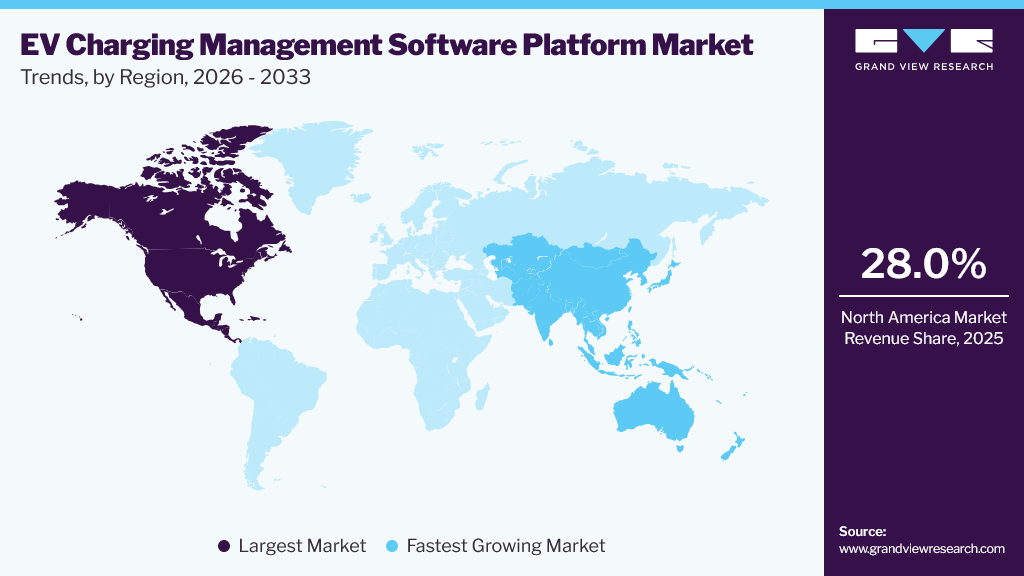
North America region dominated the global EV charging management software platform market with the largest revenue share of approximately 28.0% in 2025. The region has established a mature EV charging ecosystem supported by extensive charging infrastructure deployment, strong EV adoption, and the presence of leading charging network operators and software providers. Increasing investment in charging network expansion and the growing need to manage large-scale charging operations are driving software platform adoption across the region. In addition, supportive government programs and funding initiatives to accelerate transportation electrification continue to encourage the deployment of connected charging infrastructure. These factors contribute to North America's established position in the EV charging management software platform industry.
 To learn more about this report, Download Free Sample Report
 Asia Pacific EV Charging Management Software Platform Market
The EV charging management software platform market in the Asia Pacific is expected to grow at the fastest CAGR over the forecast period. Expanding EV adoption, rapid development of charging infrastructure, and national electrification programs across China, India, Japan, and Southeast Asian countries are increasing demand for charging management solutions. Government support for EV infrastructure deployment, rising investments in charging networks, and the growing presence of charging service providers are contributing to the adoption of software platforms across the region. The increasing scale of charging infrastructure deployment is driving demand for solutions that can manage charger operations, energy utilization, and network performance across diverse charging environments.
Key EV Charging Management Software Platform Company Insights
The EV charging management software platform industry remains moderately fragmented, with software providers charging network operators and energy technology companies offering a wide range of charging management solutions. As EV charging infrastructure continues to expand, companies are increasingly focusing on platform enhancements, interoperability capabilities, and integrated charging services to strengthen their market presence.
Key EV Charging Management Software Platform Companies
The following key companies have been profiled for this study on the global EV charging management software platform market:
-
Ampeco Ltd
-
Etrel
-
Driivz
-
EVBox
-
Shell
-
Evconnect
-
Chargelab
-
Chargepoint
-
Virta
-
Touch GmbH
Recent Developments
-
In May 2025, ChargePoint introduced a next-generation software platform designed to manage diverse EV charging operations, including fleet, workplace, and commercial charging environments. The platform provides centralized management capabilities for charger monitoring, user administration, energy management, and operational analytics. The launch reflects increasing demand for software solutions to manage large, complex charging networks.
-
In October 2025, WEG acquired a majority stake in Tupi Mob, a company specializing in EV charging management software. Tupi Mob operates a digital platform that connects users with charging networks and manages charging sessions across multiple locations. The acquisition reflects increasing investment in software platforms supporting EV charging infrastructure and digital mobility services.
EV Charging Management Software Platform Market Report Scope
Report Attribute
Details
Market size in 2025
USD 1.6 billion
Estimated market size in 2026
USD 1.9 billion
Projected market size by 2033
USD 8.4 billion
Growth rate
CAGR of 23.6% from 2026 to 2033
Base year for estimation
2025
Historical data
2021 - 2024
Forecast period
2026 - 2033
Quantitative units
Revenue in USD million/billion, and CAGR from 2026 to 2033
Report coverage
Revenue forecast, company ranking, competitive landscape, growth factors, and trends
Segments covered
Module, deployment, charger type, application, region
Regional Scope
North America; Europe; Asia Pacific; Central & South America; Middle East & Africa
Country scope
U.S.; Canada; Mexico; UK; Germany; France; Italy; Spain; China; India; Japan; Australia & New Zealand, South Korea; Brazil; Argentina, South Africa, UAE
Key companies profiled
Ampeco Ltd; Etrel; Driivz; EVBox; Shell; Evconnect; Chargelab; Chargepoint; Virta; Touch GmbH.
Customization scope
Free report customization (equivalent up to 8 analysts working days) with purchase. Addition or alteration to country, regional & segment scope.
Pricing and purchase options
Avail of customized purchase options to meet your exact research needs. Explore purchase options
Global EV Charging Management Software Platform Market Report Segmentation
This report forecasts revenue growth at global, regional, and country levels and provides an analysis of the latest trends in each of the sub-segments from 2021 to 2033. For this study, Grand View Research has segmented the global EV charging management software platform market report based on module, deployment, charger type, application, and region:
-
Module Outlook (Revenue, USD Billion, 2021 - 2033)
-
Operation Management
-
Energy Management
-
EV Billing and Payment
-
Others
-
-
Deployment Outlook (Revenue, USD Billion, 2021 - 2033)
-
Private Chargers
-
Public Chargers
-
-
Charger Type Outlook (Revenue, USD Billion, 2021 - 2033)
-
Level 1
-
Level 2
-
Level 3
-
-
Application Outlook (Revenue, USD Billion, 2021 - 2033)
-
Commercial
-
Residential
-
-
Regional Outlook (Revenue, USD Billion, 2021 - 2033)
-
North America
-
U.S.
-
Canada
-
-
Europe
-
Germany
-
UK
-
France
-
Netherlands
-
Norway
-
-
Asia Pacific
-
China
-
India
-
Japan
-
South Korea
-
-
Latin America
-
Brazil
-
Mexico
-
-
Middle East & Africa
-
The Kingdom of Saudi Arabia (KSA)
-
UAE
-
South Africa
-
-
Frequently Asked Questions About This Report
The global EV charging management software platform market size was valued at USD 1.6 billion in 2025 and is estimated at USD 1.9 billion for 2026.
The global EV charging management software platform market is expected to grow at a CAGR of 23.6% from 2026 to 2033, reaching USD 8.4 billion.
North America dominated with a share of approximately 28.0% in 2025
The operations management segment accounted for the largest revenue share of around 30.0% in 2025.
Key players in the market include Ampeco Ltd, Etrel, Driivz, EVBox, Shell, Evconnect, Chargelab, Chargepoint, Virta, Touch GmbH and others.
About the Author(s)
Automotive & Transportation Research Team
Technology · Automotive & TransportationThis report was authored by the automotive & transportation research team at Grand View Research - comprising two research analysts, one senior research analyst, and one industry expert - with specialized expertise in the automotive & transportation segment of the technology industry. All findings are based on proprietary technology databases, executive interviews, and regulatory analysis, subject to internal peer review prior to publication.
Last Updated:
Speak to Analyst

Customize this report to your needs - add regions, segments, or data points, with 20% free customization.
Or view our licence options:


ISO 9001:2015 & 27001:2022 Certified
We are GDPR and CCPA compliant! Your transaction & personal information is safe and secure. For more details, please read our privacy policy.


