
- Home
- »
- Plastics, Polymers & Resins
- »
-
Expanded Polypropylene Foam Market Report, 2026-2033GVR Report cover

Expanded Polypropylene Foam Market (2026 - 2033)
Size, Share & Trends Analysis Report By Product (High Density, Low Density, Medium Density), By Application (Bumpers, Roof Pillars, Seat Bracing), By Region (North America, Europe, Asia Pacific, Latin America, MEA), And Segment Forecasts
Market Size, 2025
$1.3BMarket Estimate, 2026
$1.4BMarket Forecast, 2033
$2.6BCAGR, 2026–2033
9.0%Expanded Polypropylene Foam Market Summary
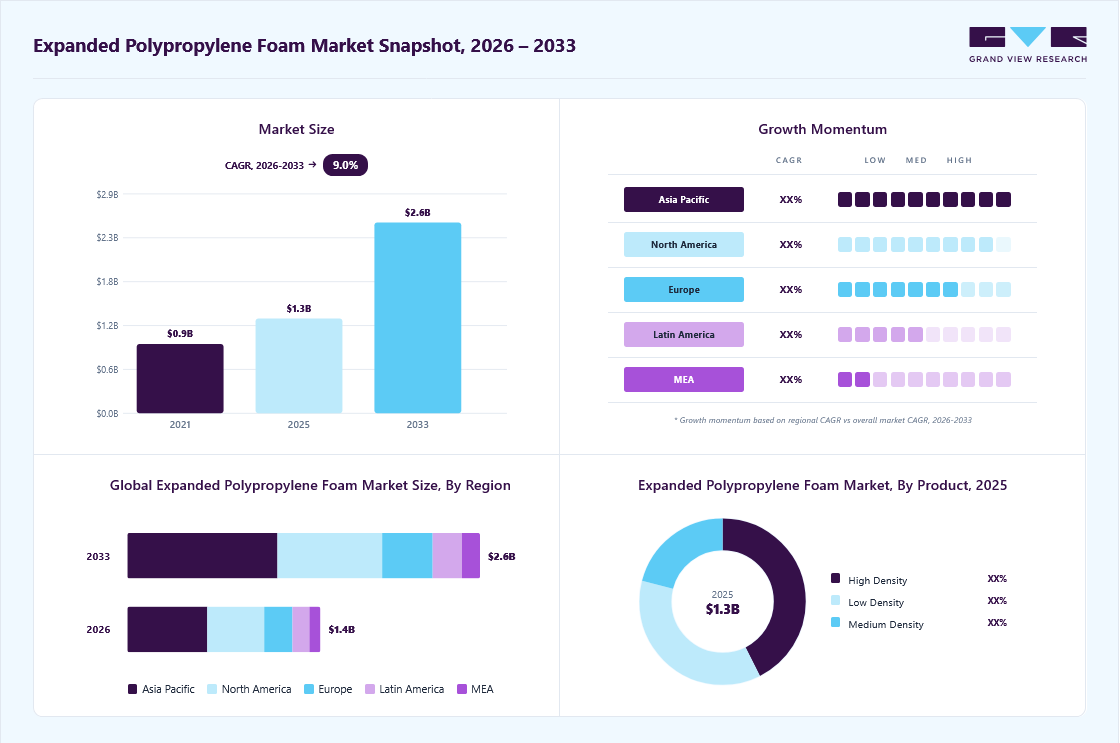
The global expanded polypropylene foam market size was valued at USD 1.3 billion in 2025 and is projected to grow from USD 1.4 billion in 2026 to USD 2.6 billion by 2033, at a CAGR of 9.0% from 2026 to 2033. Asia Pacific dominated the global market with the largest revenue share of 41.2% in 2025. This growth is attributed to the product's use across a wide range of applications, including packaging, consumer goods, building and construction, and others.
 Source: Grand View Research, IR Documents, Primary Interviews, Paid DatabasesTo learn more about this report,
 Download Free Sample Report
 Key Market Trends & Insights
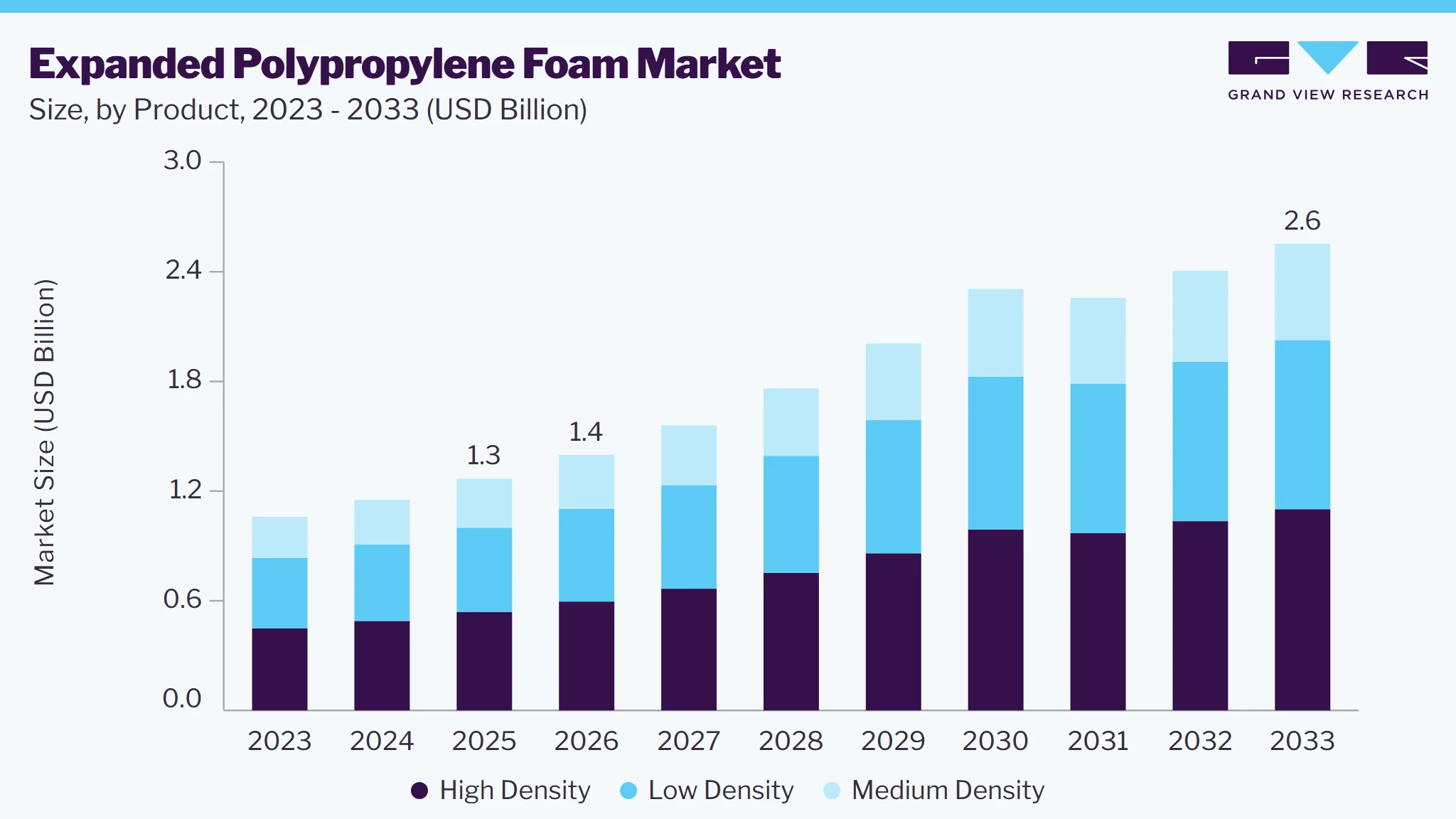
- By product: High density segment led the market with the largest revenue share of 42.5% in 2025.
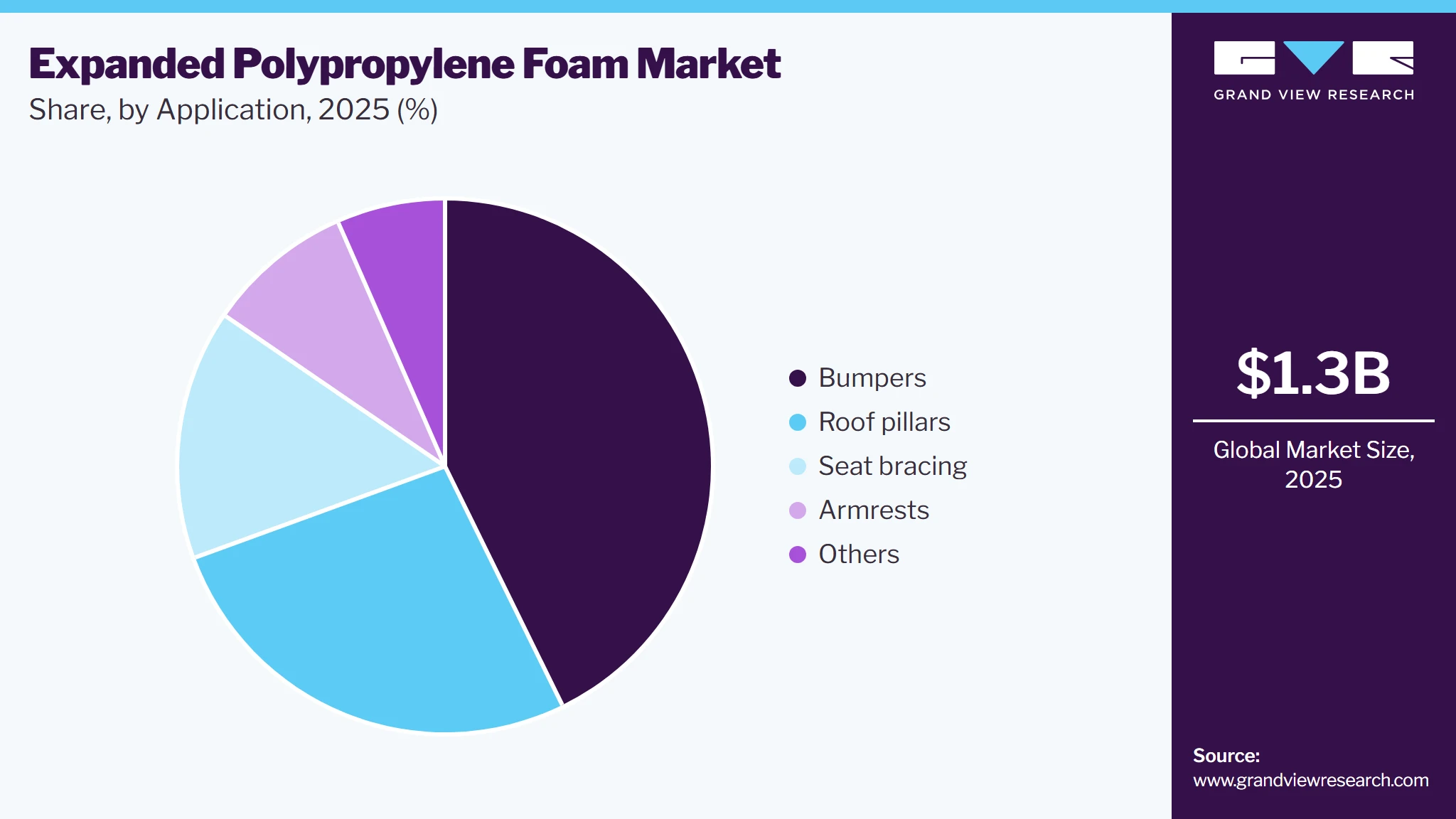
- By application: Bumpers segment led the market with the largest revenue share of 42.7% in 2025.
Regional Highlights
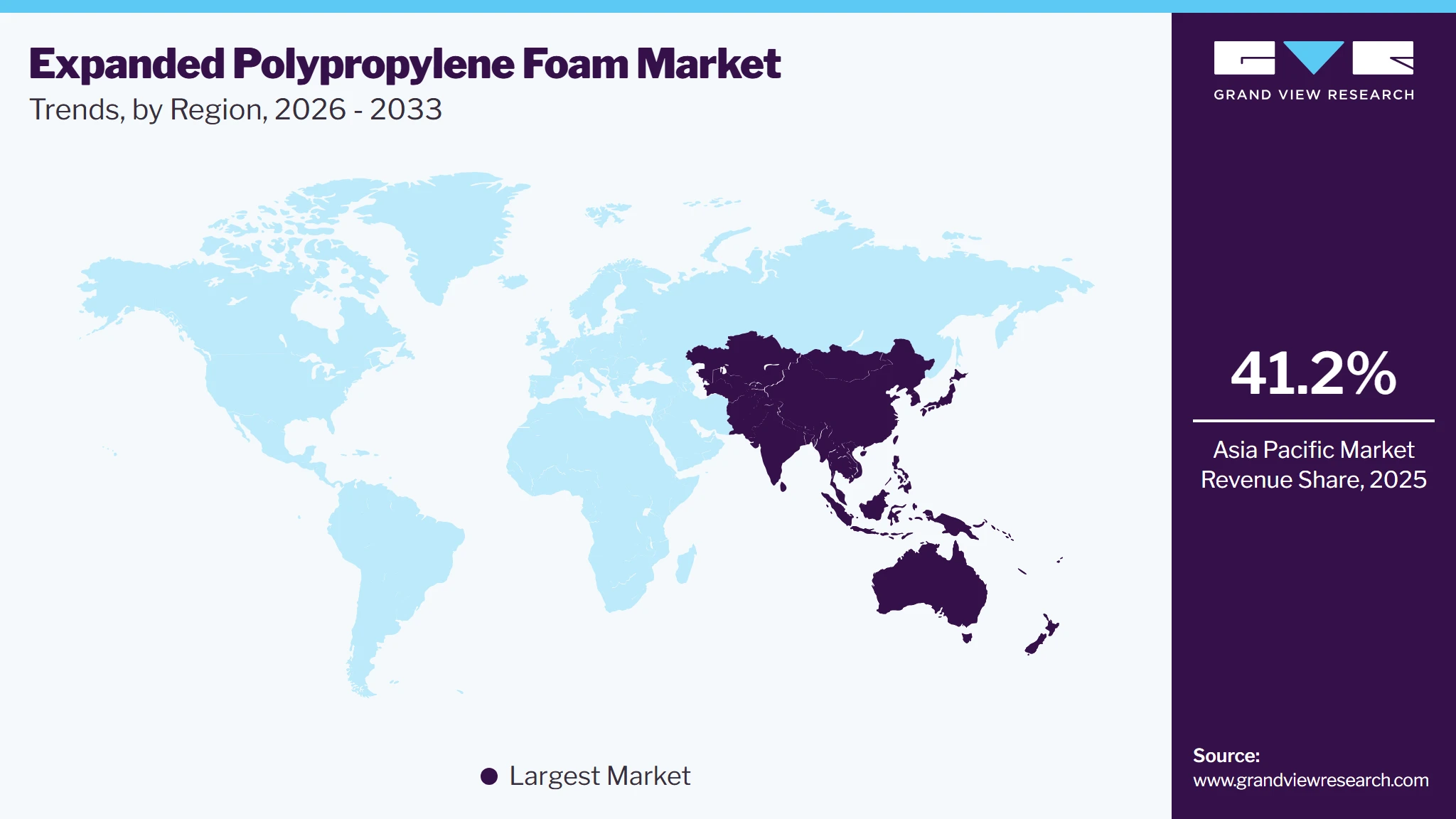
- Largest regional market: Asia Pacific (41.2% revenue share, 2025)
- By country: China held the largest share in the expanded polypropylene foam market in the Asia Pacific region in 2025.
Market Size & Forecast
- Market size in 2025: USD 1.3 Billion
- Estimated market size in 2026: USD 1.4 Billion
- Projected market size by 2033: USD 2.6 Billion
- CAGR (2026-2033): 9.0%
Three ways to get this report
Buy it, customize it, or ask a question.Ask an Analyst
Analyst response in 1 business day
- AccessReport author, directly
- Reply timeWithin 1 working day
- No sales callDirect answer only
- FormatEmail reply
- CostFree, no cost
Get the Full Report
What the study covers
- FormatsPDF · Excel · Dashboard
- Timeline2026–2033 annual, 2025 base
- Coverage20+ countries, 5 regions
- Companies10+ key players profiled
Customize the Report
20% free customization
- IncludeCountries, segments, points
- TailorTo your product definition
- ExtendDeeper competitor detail
- OrA fully bespoke study
- Turnaround5–10 working days
Expanded Polypropylene Foam offers strong impact resistance for delicate goods like computer equipment and circuit boards in non-food packaging applications. Owing to consumers' growing attention to their physical health, the use of expanded polypropylene foam in toys and sporting goods is anticipated to increase.Numerous breakthroughs and technological advancements have been made as a result of the U.S. automobile industry's shift in focus toward electricity-powered and fuel-efficient vehicles, which has led to an increase in consumer demand for high-end electric vehicles. The widespread use of high-performance materials for auto parts as a result of the rising demand for fuel-efficient vehicles has encouraged the use of chemically stable EPP foam rather than the alternatives that are now available.
 To learn more about this report, Download Free Sample Report
 High-density EPP foam products find numerous applications in car interiors, including NVH reduction, acoustic insulation, passenger safety, energy absorption, and comfort, owing to the improved chemical and especially mechanical properties of the material. The growing U.S. automotive industry is expected to drive the demand for EPP foam over the forecast period.
The demand for expanded polypropylene foam in consumer goods is expected to witness significant growth over the forecast period, attributed to the growing demand for consumer electronics and household appliances in the country. In addition, the presence of key electronics manufacturers such as Apple Inc., Samsung, and IBM, among others, strengthens the demand for consumer electronics, which, in turn, is expected to drive the growth of the consumer goods industry.
Market Dynamics
The expanded polypropylene foam market is shaped by lightweighting demand, impact absorption requirements, and the need for recyclable polyolefin solutions across automotive and packaging uses. Revenue is concentrated in Asia Pacific, while North America remains commercially important due to vehicle lightweighting and the adoption of high-performance materials. High-density grades capture the strongest value pool in bumper and structural applications, supported by premium vehicle content and safety requirements. The market is moderately fragmented, with large suppliers shaping pricing, process capability, and customer access, while substitutes such as EPS, EPE, and polyurethane continue to pressure value realization.
The most distinct growth driver in the expanded polypropylene foam market is the rising use of the material in automotive lightweighting and energy management systems. Vehicle makers are prioritizing materials that combine low weight, high crash performance, and dimensional stability, especially for bumpers, roof pillars, seat bracing, and armrest structures. EPP foam meets this demand by efficiently absorbing impact while supporting design flexibility in interiors and safety-related components. The shift toward electric and fuel-efficient vehicles further strengthens demand, as OEMs seek lighter parts that do not compromise structural performance.
This driver is reinforced by the commercial logic of platform redesign. Automotive suppliers are increasingly specifying engineered foam parts that can reduce part count, support modular assembly, and improve passenger protection without adding material complexity. High-density EPP is particularly advantaged in these uses because it captures higher revenue per unit through more demanding technical specifications. As automakers increase content per vehicle for safety, NVH reduction, and battery protection applications, the addressable revenue pool for EPP foam expands beyond standard cushioning to include engineered structural systems.
A major restraint in the market is persistent substitution pressure from EPS, EPE, and polyurethane foams. These materials often provide acceptable cushioning or insulation at a lower cost, making them attractive in price-sensitive packaging and construction channels. EPP foam, therefore, competes in a value-justified segment rather than a pure commodity segment, which limits faster penetration where performance specifications are not strict. The market also faces a broader challenge in the recycling narrative because alternative foams already benefit from more established collection and recovery systems across several end-use markets.
The clearest opportunity lies in EV battery protection, thermal insulation, and recyclable packaging systems. As OEMs and industrial users look for materials that combine shock resistance with sustainability credentials, EPP foam can move into higher-value molded components and protective packaging formats. This creates room for suppliers that can offer application engineering, closed-loop recycling support, and tighter integration with automotive and logistics customers.
Market Concentration & Characteristics
The growth stage of the EPP foam market is medium, and the pace is accelerating. The market exhibits fragmentation, with key players dominating the industry landscape. Major companies JSP, BASF SE, KANEKA CORPORATION, DS Smith, FURUKAWA ELECTRIC CO., LTD., Hanwha Group, Sonoco Products Company, Knauf Industries, Izoblok, DONGSHIN INDUSTRY INCORPORATED, Clark Foam Products Corporation, Paracoat Products Ltd., Molan-Pino South Africa, Signode Industrial Group LLC, Armacel, and others play a significant role in shaping the market dynamics. These leading players often drive innovation within the market, introducing new products, technologies, and materials to meet evolving industry demands.
The EPP foam market faces increasing competition from alternative materials such as expanded polyethylene (EPE), expanded polystyrene (EPS), and polyurethane foams. These substitutes often offer comparable cushioning and insulation properties at lower costs, making them attractive for price-sensitive applications in the packaging and construction sectors. Additionally, materials like EPS are more widely available and have established recycling infrastructures, further challenging EPP's market share. The versatility and cost-effectiveness of these alternatives necessitate continuous innovation and enhancement of the value proposition within the EPP foam industry to maintain its competitive edge.
 To learn more about this report, Download Free Sample Report
 Regulatory frameworks are influencing the EPP foam market, particularly concerning environmental and safety standards. Governments worldwide are implementing stricter regulations on plastic usage and waste management, compelling manufacturers to adopt more sustainable practices. For instance, the European Union's directives on packaging and waste have prompted a shift towards recyclable, eco-friendly materials, affecting the production and use of EPP foams. Compliance with such regulations requires significant investment in research and development to innovate and align products with evolving legal requirements, thereby affecting market dynamics.
Analyst Perspective
The expanded polypropylene foam market is moving from a volume-led cushioning category toward a more value-led engineered materials business. Automotive lightweighting, EV battery protection, and molded interior systems will remain the main demand centers, while recyclable packaging will continue to support diversified uptake. Over the next 5 to 10 years, the competitive edge will shift toward suppliers that can combine process integration, application engineering, and regional manufacturing proximity with credible sustainability positioning. Regulatory pressure on plastics and waste management will lift the importance of recyclable design and closed-loop systems, while substitution from lower-cost foams will keep pricing discipline tight. The most successful players will be those who convert technical performance into long-term OEM and industrial contracts, backed by capacity control, intellectual property, and selective consolidation. Recent portfolio moves, including facility and business transfers, indicate that the market is already rewarding specialization and scale discipline.
Application Insights
By application, the bumpers segment led the market with the largest revenue share of 42.7% in 2025, driven by increasing utilization of EPP foam in the automotive end-use. The growing demand for high-impact-resistant packaging solutions for automobile interior and exterior equipment is likely to have a positive impact on the market growth.
 To learn more about this report, Download Free Sample Report
 EPP foams are used to provide a smooth and long-lasting finish, along with high resistance to chemical and UV exposure. The high resistance of EPP foam has led to the increased usage of EPP foam products in the construction industry for the production of various parts such as roof pillars, ceilings, and others.
Population growth and demographics conducive to manufacturing are anticipated to drive the global market for EPP foam in the building sector. Products made from ABS are corrosion-resistant and more durable than those made from expanded polystyrene (EPS), and are therefore used to manufacture food containers and other materials. These advantageous properties are expected to increase demand for EPP foam across various applications, including bumpers, seat bracing, roof pillars, armrests, and others.
Product Insights
Based on the product, the high density segment led the market with the largest revenue share of 42.5% in 2025. High-density expanded polypropylene foams are used in energy management systems, such as bumpers, side tails, and safety parts of vehicles. They are also used in industrial packaging applications due to their strength against impacts. With the increasing consumption of lightweight and premium products, the demand for high-density Expanded Polypropylene Foam is expected to rise over the forecast period.
Additionally, rising global demand for electric and hybrid cars is likely to drive the use of lightweight, chemically stable materials in auto components. Rising disposable income and changing lifestyles in countries such as India, China, and Indonesia are factors contributing to the increased production of automobiles, which is likely to have a positive impact on the growth of the automotive industry. The aforementioned factors are expected to drive the high-density EPP foam segment in the region over the forecast period.
Region Insights
The North America expanded polypropylene foam market accounted for a revenue share of 29.44% in 2025, owing to the growth of end-user industries in the U.S. and Canada. Numerous breakthroughs and technological advancements have been made as a result of the U.S. automobile industry's shift in focus toward fuel-efficient vehicles and electricity-powered vehicles, which has led to an increase in consumer demand for high-end electric vehicles. The widespread usage of high-performance materials for auto parts as a result of the rising demand for fuel-efficient vehicles has encouraged the use of chemically stable EPP foam rather than the alternatives that are now available.
U.S. Expanded Polypropylene Foam Market Trends
The expanded polypropylene foam market in the U.S. is driven by the automotive sector's transition toward lightweighting initiatives to meet Corporate Average Fuel Economy (CAFE) standards and lower vehicle emissions. EPP foam is increasingly favored by domestic OEMs for its high energy absorption and structural strength in bumpers, headrests, and door panels. Additionally, the resurgence of electric vehicle (EV) production, supported by incentives from the Inflation Reduction Act, is accelerating the adoption of EPP foams in battery protection and thermal insulation applications. With rising e-commerce packaging needs and consumer demand for sustainable, recyclable materials, EPP foam is gaining strategic importance across industries.
Asia Pacific Expanded Polypropylene Foam Market Trends
Asia Pacific dominated the expanded polypropylene foam market with the largest revenue share of 41.2% in 2025. The consumer goods and electronics manufacturing industries in China, India, and Japan are experiencing rapid growth owing to rapid industrialization, abundant raw materials, and readily available labor. These factors are expected to propel the demand for EPP foam over the forecast period.
 To learn more about this report, Download Free Sample Report
 China expanded polypropylene foam market is driven by the consumer goods segment. China has witnessed tremendous growth in the sales of TV sets owing to rising viewership. In addition, the Chinese government has been pushing for digitalization, which will assist in the development of the TV industry as a whole. The growing demand for household electronics such as refrigerators, televisions, and microwave ovens is likely to augment the market growth of EPP foam in this region.
China Expanded Polypropylene Foam Market Trends
The Expanded Polypropylene Foam market in China accounted for the largest share of the Asia Pacific region in 2025.
Europe Expanded Polypropylene Foam Market Trends
The expanded polypropylene foam market in Europe is expected to grow significantly over the forecast period, owing to the presence of automotive giants such as MAN Trucks, Daimler AG, Volkswagen AG, and BMW AG. In addition, the rapidly emerging consumer goods industry in major economies such as Germany, France, and Spain is expected to propel the demand for expanded polypropylene foam over the analysis period.
Key Expanded Polypropylene Foam Companies Insights
Key players in the expanded polypropylene foam market are undertaking initiatives to strengthen their presence and expand the reach of their products and services. Strategies such as expansion activities and partnerships are key in propelling the market growth.
Key Expanded Polypropylene Foam Companies:
The following are the leading companies in the expanded polypropylene foam market.
-
JSP
-
KANEKA CORPORATION
-
DS Smith
-
FURUKAWA ELECTRIC CO., LTD.
-
Hanwha Group
-
Sonoco Products Company
-
Knauf Industries
-
Izoblok
-
DONGSHIN INDUSTRY INCORPORATED
-
Clark Foam Products Corporation
-
Paracoat Products Ltd.
-
Molan-Pino South Africa
-
Signode Industrial Group LLC
-
Armacel
Competitive Benchmarking
Category
Operating Strategies
Competitive Edge
Weakness
Established Players (JSP, KANEKA CORPORATION, DS Smith, FURUKAWA ELECTRIC CO., LTD., Hanwha Group, Sonoco Products Company, Knauf Industries, Signode Industrial Group LLC)
- Focus on integrated molded EPP platforms and multi-site supply coverage.
- Pursue OEM-linked programs in automotive, packaging, and industrial protection.
- Use acquisition-led consolidation and product rationalization to strengthen footprint.
- Strong scale and established customer access.
- Better technical depth in molded parts and process control.
- Stronger ability to absorb regulatory and capex burden.
- Higher exposure to legacy cost structures.
- Slower response in niche or highly customized segments.
- Greater dependence on mature end-use accounts.
Emerging Players (Izoblok, DONGSHIN INDUSTRY INCORPORATED, Clark Foam Products Corporation, Paracoat Products Ltd., Molan-Pino South Africa, Armacel)
- Target localized automotive and packaging accounts.
- Compete through customization, shorter lead times, and regional servicing.
- Build demand through selective partnerships and application-specific manufacturing.
- Higher agility in tailored molded formats.
- Lower overhead and faster decision cycles.
- Better positioning in regional or underserved demand pockets.
- Smaller scale and narrower geographic reach.
- Limited bargaining power on raw materials and logistics.
- Lower visibility in global OEM qualification cycles.
Recent Developments
-
In October 2024, Engineered Foam Products Ltd, a leading UK manufacturer of expanded foam, acquired Springvale EPS Ltd, the UK's largest expanded polystyrene (EPS) block molder. This acquisition made Engineered Foam Products the largest manufacturer of EPS and expanded polypropylene (EPP) in the UK, strengthening its position in the construction and insulation markets.
-
In November 2024, BASF divested its Neopolen Expanded Polypropylene Foam business to Knauf Industries GmbH, a European specialist in molded EPP components. The deal included BASF’s production facility in Schwarzheide, Germany, along with products, intellectual property, customer and supplier contracts, and trademark rights.
Expanded Polypropylene Foam Market Report Scope
Report Attribute
Details
Market size in 2025
USD 1.3 billion
Estimated market size in 2026
USD 1.4 billion
Projected market size by 2033
USD 2.6 billion
Growth rate
CAGR of 9.0% from 2026 to 2033
Base year for estimation
2025
Historical data
2021 - 2024
Forecast period
2026 - 2033
Quantitative units
Revenue in USD million/billion, volume in kilotons, and CAGR from 2026 to 2033
Report coverage
Revenue forecast, company ranking, competitive landscape, growth factors, and trends
Segments covered
Product, application, region
Regional scope
North America; Europe; Asia Pacific; Latin America; Middle East & Africa
Country scope
U.S.; Canada; Mexico; Germany; UK; France; Italy; China; India; Japan; Brazil, Argentina, GCC Countries, South Africa
Key companies profiled
JSP; KANEKA CORPORATION; DS Smith; FURUKAWA ELECTRIC CO., LTD.; Hanwha Group; Sonoco Products Company; Knauf Industries; Izoblok; DONGSHIN INDUSTRY INCORPORATED; Clark Foam Products Corporation; Paracoat Products Ltd.; Molan-Pino South Africa; Signode Industrial Group LLC; Armacel
Customization scope
Free report customization (equivalent to up to 8 analysts' working days) with purchase. Addition or alteration to country, regional & segment scope.
Pricing and purchase options
Avail customized purchase options to meet your exact research needs. Explore purchase options
Global Expanded Polypropylene Foam Market Report Segmentation
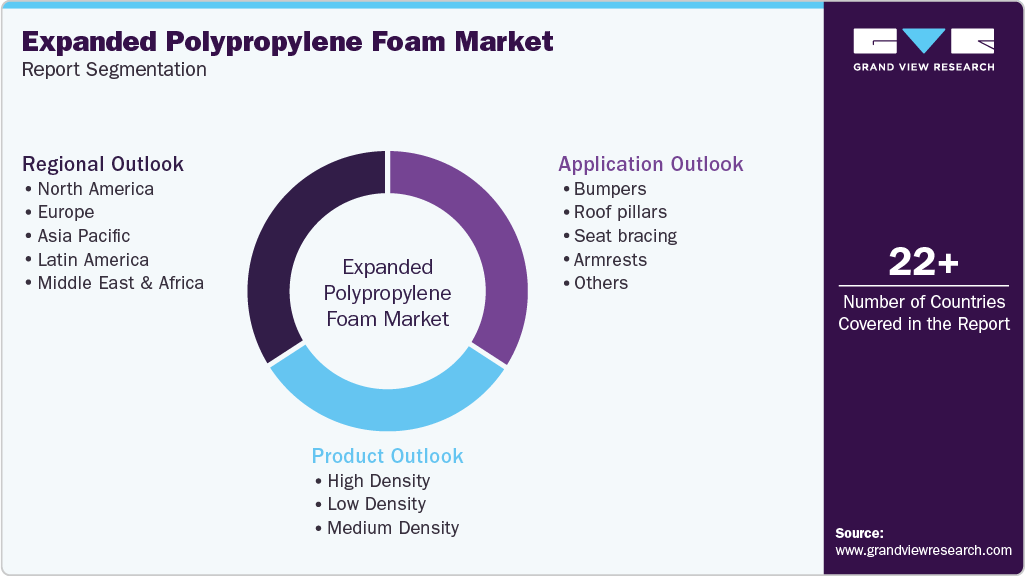
This report forecasts revenue and volume growth at the global, regional, and country levels and provides an analysis of the latest industry trends in each of the sub-segments from 2021 to 2033. For this study, Grand View Research has segmented the global expanded polypropylene foam market report based on product, application, and region:
 To learn more about this report, Download Free Sample Report
 -
Product Outlook (Volume, Kilotons; Revenue, USD Million, 2021 - 2033)
-
High Density
-
Low Density
-
Medium Density
-
-
Application Outlook (Volume, Kilotons; Revenue, USD Million, 2021 - 2033)
-
Bumpers
-
Roof pillars
-
Seat bracing
-
Armrests
-
Others
-
-
Regional Outlook (Volume, Kilotons; Revenue, USD Million, 2021 - 2033)
-
North America
-
U.S.
-
Canada
-
Mexico
-
-
Europe
-
Germany
-
UK
-
France
-
Italy
-
-
Asia Pacific
-
China
-
India
-
Japan
-
-
Latin America
-
Brazil
-
Argentina
-
-
Middle East & Africa
-
GCC Countries
-
South Africa
-
-
Research Methodology
The expanded polypropylene foam market figures in this report are based on a proven research process that combines executive interviews with secondary research from proprietary databases, company filings, and recognized regulatory and institutional sources. Market size is built through value-chain sizing - reconciling supply-side and demand-side estimates - and triangulated with bottom-up and top-down approaches. Every estimate passes multiple levels of expert validation before publication, with each expanded polypropylene foam segment quantified using the revenue-capture definitions in the table below.
Segment Definition
Segment - Product
Revenue capture definition
High Density
Revenue is captured through premium molded parts and engineered components that require higher impact resistance, structural retention, and tighter performance tolerances, especially in automotive safety modules and industrial protection systems.
Low Density
Revenue is generated through lighter-weight cushioning and cost-sensitive applications, where lower material intensity and greater moldability support broad adoption across packaging and consumer products.
Medium Density
Revenue is earned from balanced-performance applications that require a compromise between cushioning, rigidity, and cost, typically in multi-use protective and interior applications.
Segment - Application
Revenue capture definition
Bumpers
Revenue is generated from OEM and Tier 1 demand for crash-energy absorption parts, in which EPP foam is specified for impact management, lightweighting, and repeat-production programs.
Roof pillars
Revenue is generated through structural interior modules that require stiffness, weight reduction, and acoustic support, with value tied to automotive trim integration.
Seat bracing
Revenue is generated from seat structures and support applications, where the material provides shape stability, occupant comfort, and assembly efficiency.
Armrests
Revenue is earned from interior comfort components that rely on molded surface quality, low weight, and repeatable dimensional accuracy.
Others
Revenue includes residual demand from secondary molded components, packaging inserts, and niche industrial uses where EPP foam is specified for protective or functional performance.
Estimation Model
Layer Name
Key Question
Description
Demand Baseline Layer
Where does demand originate?
This layer anchors the market to regional consumption and end-use intensity, ensuring the forecast reflects actual automotive and packaging pull.
Application Mix Layer
Which applications drive revenue?
This layer isolates revenue by bumper, pillar, seat, and armrest use, because application-specific molding content drives distinct monetization patterns.
Product Mix Layer
Which grades create value?
This layer separates high-, low-, and medium-density grades to reflect performance requirements, price realization, and differing margin structures.
Supplier Validation Layer
Can supply support demand?
This layer checks announced capacity, consolidation moves, and company positioning to prevent overstatement and align revenue with competitive reach.
Delivered Customizations
This report has been delivered with the following In-depth customizations
CLIENT REQUEST
CUSTOMIZATION DELIVERED
VALUE ADDS
Add regional segmentation emphasis
Expanded the regional discussion to highlight Asia Pacific leadership, North American automotive demand, and Europe’s industrial and vehicle-focused consumption pattern.
Improves geographic prioritization for client decision-making and regional launch planning.
Include company positioning detail
Added a structured company categorization framework that separates larger, integrated players from smaller regional participants based on scale, integration, and market reach.
Clarifies the competitive hierarchy and the relevance of supplier selection.
Expand application-level revenue logic
Refined revenue capture definitions for bumpers, roof pillars, seat bracing, armrests, and residual uses based on actual commercial specification logic.
Strengthens segment interpretation for pricing, demand, and product planning.
Frequently Asked Questions About This Report
The global expanded polypropylene foam market is expected to grow at a compound annual growth rate of 9.0% from 2026 to 2033, reaching USD 2.6 billion by 2033.
Based on the product, the high density segment led the market with the largest revenue share of 42.5% in 2025.
Some key players operating in the expanded polypropylene foam market include Expanded Polypropylene Foam market include JSP, KANEKA CORPORATION, DS Smith, FURUKAWA ELECTRIC CO., LTD., Hanwha Group, Sonoco Products Company, Knauf Industries, Izoblok, and DONGSHIN INDUSTRY INCORPORATED.
The expanded polypropylene foam market is shaped by lightweighting demand, impact absorption requirements, and the need for recyclable polyolefin solutions across automotive and packaging uses.
Asia Pacific dominated the Expanded Polypropylene Foam market with the largest revenue share of 41.2% in 2025.
The clearest opportunity lies in EV battery protection, thermal insulation, and recyclable packaging systems. As OEMs and industrial users look for materials that combine shock resistance with sustainability credentials, EPP foam can move into higher-value molded components and protective packaging formats. This creates room for suppliers that can offer application engineering, closed-loop recycling support, and tighter integration with automotive and logistics customers.
Based on application, the bumpers segment led the market with the largest revenue share of 42.7% in 2025.
The global expanded polypropylene foam market size was estimated at USD 1.3 billion in 2025 and is projected to grow to USD 1.4 billion in 2026
About the Author(s)
Plastics, Polymers & Resins Research Team
Bulk Chemicals · Plastics, Polymers & ResinsThis report was authored by the plastics, polymers & resins research team at Grand View Research - comprising two research analysts, one senior research analyst, and one industry expert - with specialized expertise in the plastics, polymers & resins segment of the bulk chemicals industry. All findings are based on proprietary bulk chemicals databases, executive interviews, and regulatory analysis, subject to internal peer review prior to publication.
Last Updated:
Speak to Analyst

Customize this report to your needs - add regions, segments, or data points, with 20% free customization.
Or view our licence options:


ISO 9001:2015 & 27001:2022 Certified
We are GDPR and CCPA compliant! Your transaction & personal information is safe and secure. For more details, please read our privacy policy.


