
- Home
- »
- Next Generation Technologies
- »
-
Eyewear Market Size, Share & Growth Report, 2026-2033GVR Report cover

Eyewear Market (2026 - 2033)
Size, Share & Trends Analysis Report By Product (Prescription (RX) Glasses, Sunglasses), By Distribution Channel (E-Commerce, Brick & Mortar), By End Use (Female, Kids), By Price Range ($0-$150, $300-$500), By Region, And Segment Forecasts
Market Size, 2025
$221.9BMarket Estimate, 2026
$245.1BMarket Forecast, 2033
$463.5BCAGR, 2026–2033
9.5%Eyewear Market Summary
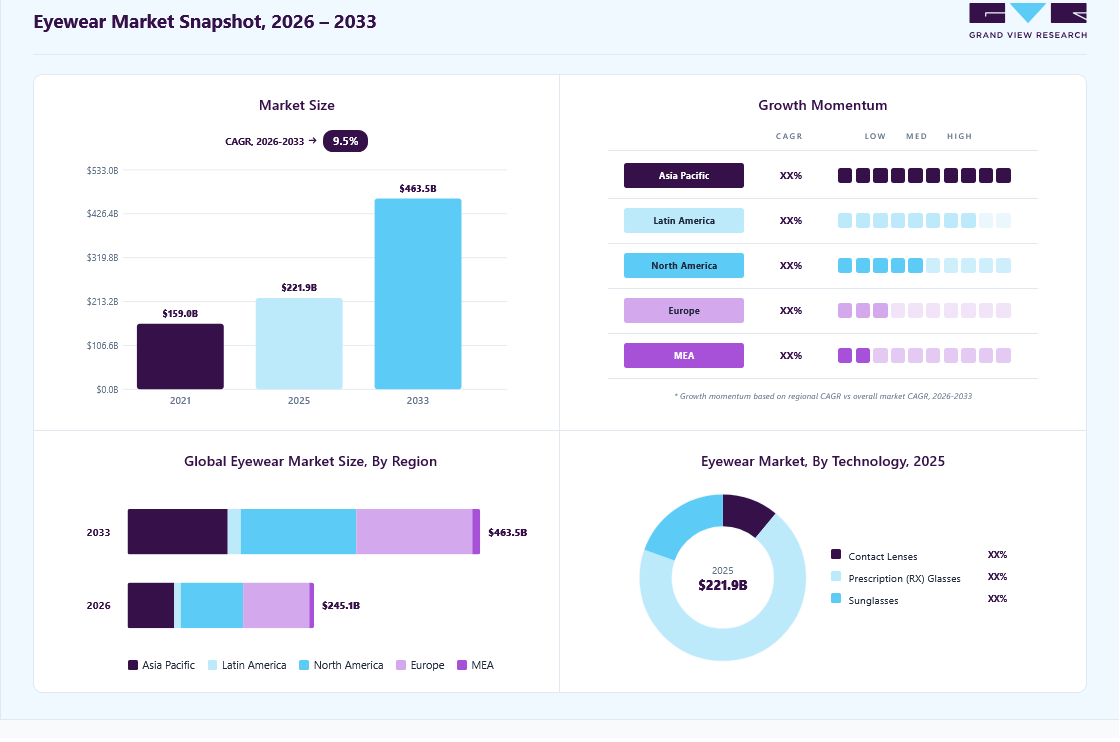
The global eyewear market size was valued at USD 221.9 billion in 2025 and is projected to grow from USD 245.1 billion in 2026 to USD 463.5 billion by 2033, at a CAGR of 9.5% from 2026 to 2033. Europe dominated the market, accounting for a revenue share of 35.9% in 2025. The market growth is driven by the rising incidence of visual impairments and heightened awareness of proactive eye health, thereby increasing utilization of prescription eyewear and vision correction solutions.
 Source: Grand View Research, IR Documents, Primary Interviews, Paid DatabasesTo learn more about this report,
 Download Free Sample Report
 Key Market Trends & Insights
- By product: Prescription glasses segment held the largest market share of 69.4% in 2025.
- By distribution channel: Brick & mortar segment accounted for the largest market share of 72.4% in 2025.
- By end use: Female segment led the market with the largest revenue share of 36.7% in 2025.
- By price range: $0-$150 segment dominated the market with the largest revenue share of 50.0% in 2025.
Regional Highlights
- Largest regional market: Europe (35.9% revenue share in 2025)
- Fastest growing regional market: Asia Pacific (highest CAGR 11.5%, 2026-2033)
- By Country: The U.S. held the largest market share in 2025
Market Size & Forecast
- Market size in 2025: USD 221.9 Billion
- Estimated market size in 2026: USD 245.1 Billion
- Projected market size by 2033: USD 463.5 Billion
- CAGR (2026-2033): 9.5%
Three ways to get this report
Buy it, customize it, or ask a question.Ask an Analyst
A direct answer, usually in 1 working day
- AccessReport author, directly
- Reply timeWithin 1 working day
- No sales callDirect answer only
- FormatEmail reply
- CostFree, no cost
Get the Full Report
What the study covers
- FormatsPDF · Excel · Dashboard
- Timeline2026–2033 annual, 2025 base
- Coverage20+ countries, 5 regions
- Companies10+ key players profiled
Customize the Report
20% free customization
- IncludeCountries, segments, points
- TailorTo your product definition
- ExtendDeeper competitor detail
- OrA fully bespoke study
- Turnaround5–10 working days
The eyewear industry is evolving from a vision-correction category into a technology-enabled, fashion-driven consumer industry, supported by rising vision-care needs, product innovation, and expanding access through digital channels. The increasing prevalence of myopia, presbyopia, and other refractive errors, combined with aging populations and prolonged near-vision activities, is driving demand for prescription spectacles, contact lenses, and advanced vision-correction solutions. The World Health Organization estimates that at least 2.2 billion people worldwide have near- or distance-vision impairment, underscoring the substantial unmet need for corrective eyewear.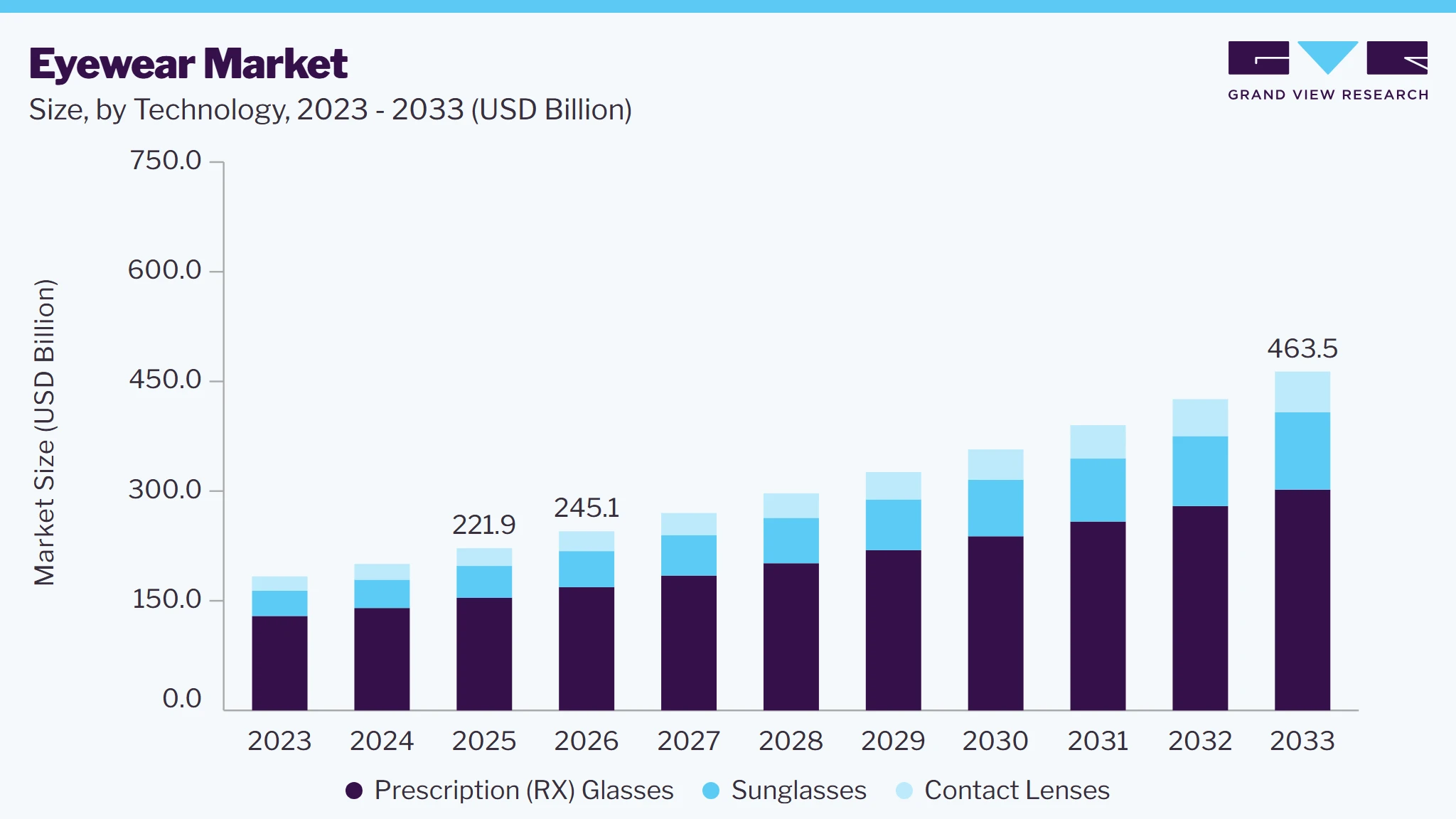 To learn more about this report, Download Free Sample Report
 Product innovation is becoming a major differentiator, particularly in myopia-management lenses, progressive lenses, lightweight materials, anti-reflective coatings, and digitally optimized vision solutions. Myopia-control spectacles and contact lenses are among the fastest-growing areas of eyewear, supported by increasing awareness and investment in clinical research. At the same time, prolonged digital-device use is sustaining consumer interest in blue-light-filtering, anti-fatigue, and other lens features positioned around digital comfort.
Meanwhile, eyewear is increasingly viewed as an extension of personal identity, accelerating demand for premium, designer, customized, and limited-edition frames and sunglasses. Luxury and fashion brands are leveraging brand heritage, celebrity collaborations, social media, and distinctive designs to command premium prices, while consumers increasingly balance aesthetics with durability, comfort, and perceived product quality.
Smart eyewear represents another emerging category, with manufacturers integrating cameras, open-ear audio, artificial intelligence, voice assistants, and augmented-reality capabilities into increasingly conventional-looking frames. Partnerships between eyewear companies and technology providers are accelerating commercialization, broadening the addressable market beyond traditional vision correction and fashion applications. As smart glasses become more functional and socially acceptable, connected eyewear is emerging as an important innovation pathway for established optical and consumer-technology players.
E-commerce, direct-to-consumer models, social commerce, virtual try-on, AI-powered recommendations, and digitally enabled eye-care services are improving convenience and expanding access to eyewear. However, physical optical stores remain important because consumers continue to value professional advice, fitting, eye examinations, and personalized services. Consequently, omnichannel models that integrate digital discovery and purchasing with physical consultations and fulfillment are becoming a key competitive strategy.
Market Dynamics
The optical retail sector and online sales platforms are facilitating increased accessibility, affordability, and convenience in eyewear procurement, thereby propelling substantial growth within the eyewear market. Increasing awareness of the importance of maintaining eye health and preventive vision care, along with the availability of advanced lens technologies such as blue-light protection, anti-glare coatings, and lightweight materials, is further accelerating market adoption in both developed and emerging economies. Digital innovations, such as virtual fitting solutions, online ophthalmic examinations, and D2C business models, are contributing to an enhanced customer experience and elevated conversion rates.
The growing burden of refractive errors and age-related vision changes is creating a sustained need for corrective eyewear across global consumer segments. Increasing prevalence of myopia, hyperopia, astigmatism, and presbyopia, coupled with population aging and changing lifestyle patterns, is expanding the addressable consumer base for prescription glasses and contact lenses. Reduced outdoor activity, prolonged near work, and greater dependence on vision-intensive tasks are further contributing to the demand for vision correction. As routine eye examinations and awareness of early vision care increase, eyewear is increasingly viewed as an essential component of everyday health and functionality rather than an occasional purchase.
At the same time, the growing integration of smartphones, computers, tablets, and other digital devices into work, education, and entertainment is reshaping consumer eyewear preferences. Extended screen exposure has heightened concerns about visual fatigue, dry eyes, glare, and prolonged near focus, prompting consumers to seek lenses designed for greater visual comfort. This trend is supporting demand for anti-reflective coatings, photochromic lenses, specialized digital-use lenses, and other performance-oriented solutions. The convergence of rising vision correction requirements with increasingly screen-centric lifestyles is therefore supporting both replacement demand and premiumization across the global eyewear market.
The relatively high cost of premium eyewear remains a key barrier to broader market adoption, particularly for consumers in price-sensitive markets. Designer frames, high-index lenses, advanced coatings, photochromic technologies, and other value-added features can significantly increase the final purchase price compared with basic eyewear. This affordability gap may limit the uptake of premium products and encourage consumers to prioritize lower-cost alternatives, particularly in emerging economies.
Limited insurance coverage and relatively low reimbursement for routine vision care and eyewear in several markets further compound the affordability challenge. As a result, consumers may postpone eye examinations, lens replacements, or frame upgrades, extending replacement cycles and restricting discretionary spending on premium products. The resulting price sensitivity can constrain market penetration and moderate the pace of premiumization, despite growing demand for technologically advanced and fashion-oriented eyewear.
The evolving role of eyewear from a functional vision-correction product to a fashion and lifestyle accessory is creating substantial opportunities for market participants. Consumers are increasingly purchasing multiple frames for different occasions, outfits, and preferences, supporting demand for designer, premium, seasonal, and customizable eyewear. The growing influence of social media, celebrity endorsements, and fashion trends is further encouraging product differentiation and shortening replacement cycles, while sustainable materials and personalized designs are emerging as additional avenues for premium positioning.
The continued shift toward online purchasing is further broadening the addressable eyewear consumer base. E-commerce platforms provide greater product variety, competitive pricing, virtual try-on capabilities, home-trial programs, and convenient delivery, reducing barriers associated with traditional eyewear shopping. Advances in digital dispensing, remote vision assessment, AI-powered frame recommendations, and omnichannel retail models are enhancing the online customer experience. As digital infrastructure and consumer confidence in online optical purchases improve, these channels are expected to generate incremental sales while enabling brands to reach underserved and geographically dispersed markets.
Market Concentration & Characteristics
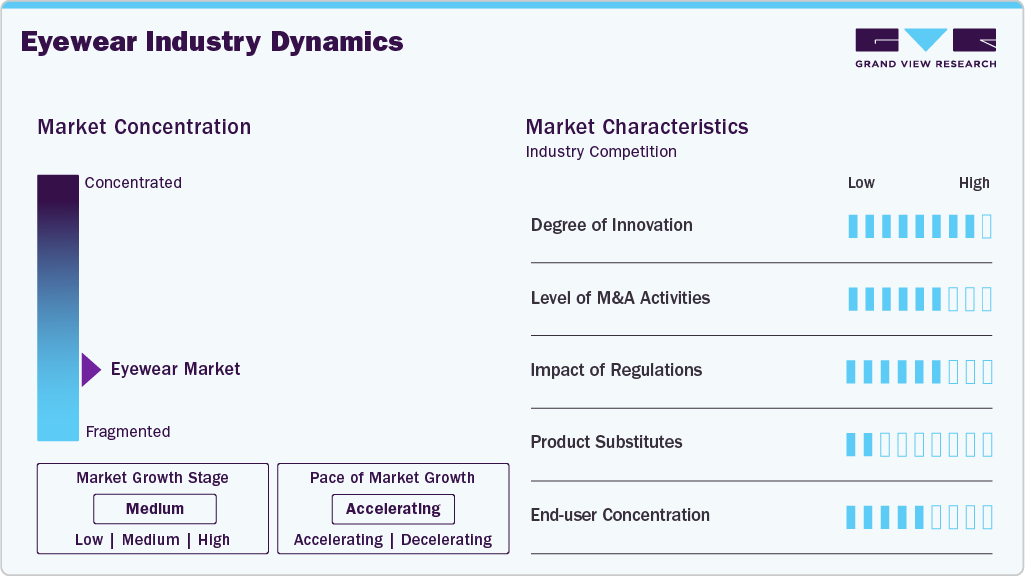
The eyewear market is moderately fragmented, with a mix of global multinational corporations, regional optical chains, independent opticians, and emerging online direct-to-consumer brands operating across different segments such as prescription eyewear, contact lenses, and fashion eyewear. The market is characterized by strong innovation intensity, driven by advancements in lens technologies, lightweight frame materials, and digital retail technologies such as virtual try-on and AI-based eye testing. The level of M&A activity in the market is medium to high, with leading players pursuing acquisitions to strengthen retail networks, expand product portfolios, and vertically integrate across manufacturing, branding, and distribution channels.
 To learn more about this report, Download Free Sample Report
 Furthermore, the impact of regulations is high, as the industry is influenced by healthcare standards, optical prescription norms, product safety regulations, and medical device approvals in several regions. The threat of substitutes is low to medium, as alternatives such as corrective surgery exist but are not widely adopted due to cost and eligibility constraints. End-user concentration is moderate, with demand primarily driven by individual consumers across age groups, though institutional buyers such as hospitals, optical clinics, and retail chains also play a significant role in distribution and sales.
Analyst Perspective
The global eyewear market is evolving through the convergence of vision care, fashion, digital commerce, and wearable technology, driving product diversification, premiumization, and technology-led differentiation. Consumers increasingly seek products combining optical performance, aesthetics, personalization, convenience, and multifunctionality, while fashion, social media, and lifestyle trends support demand for designer and premium eyewear. Advances in personalized lenses, lightweight and sustainable materials, AI-enabled optical services, virtual try-on, and connected eyewear are creating new growth opportunities. The integration of online and offline retail is reshaping purchasing journeys by combining digital convenience with professional optical services. Companies that integrate product innovation, strong branding, personalization, and omnichannel capabilities will be best positioned to gain a competitive advantage.
Product Insights
The prescription glasses segment led the eyewear industry with the largest revenue share of 69.4% in 2025 and is expected to grow at a considerable CAGR over the forecast period. Growth is being supported by increasing product personalization, premium lens technologies, and the integration of digital tools across the purchasing journey. Recent product innovation has focused on improving visual performance and customization; for instance, ZEISS introduced ZEISS ClearMind prescription lenses in January 2026, incorporating its NeurOptix technology across single-vision, progressive, and digital lens designs. Similarly, HOYA launched VisuPro All Day and VisuPro Flex in 2025 for emerging presbyopes, expanding the addressable prescription-lens market among younger consumers. Online and omnichannel platforms are further supporting accessibility through virtual try-on, digital prescription services, home trials, and personalized lens recommendations, strengthening competition beyond traditional optical retail.
The sunglasses segment is expected to record the fastest CAGR of 10.0% from 2026 to 2033, driven by the increasing convergence of fashion, performance, and technology. Product development is moving beyond conventional UV protection toward polarized, photochromic, performance-enhancing, and smart eyewear solutions. HOYA expanded its light-adaptive lens portfolio with Sensity Colours in 2025, introducing multiple color options that combine photochromic functionality with fashion-oriented personalization. Meanwhile, EssilorLuxottica and Meta expanded the smart eyewear category with Oakley Meta, integrating performance-oriented Oakley eyewear with Meta AI, cameras, open-ear audio, and hands-free functionality. These developments illustrate the increasing convergence of visual protection, fashion, performance, and connected technologies within the global sunglasses market. Collaborations with luxury brands, designers, sports companies, and technology providers are also increasing product differentiation and creating premium, lifestyle-oriented sunglasses categories.
Distribution Channel Insights
The brick & mortar segment led the eyewear market with the largest revenue share of 72.4% in 2025, supported by the continued preference of consumers for professional consultations, physical product assessment, and personalized fitting when purchasing eyewear. Optical stores increasingly combine traditional services with digital technologies to improve convenience and operational efficiency, including AI-assisted frame recommendations, digital appointment scheduling, automated refraction, and integrated eye-care services. Fielmann Group AG, for example, is expanding AI-enabled refraction technology across its European stores, with plans to deploy the technology at 300 locations by the end of 2026. The integration of optometry and vision-care services with retail is further strengthening the role of physical stores as comprehensive eyewear and eye-health destinations.
E-commerce is expected to grow at the fastest CAGR from 2026 to 2033, driven by increasing consumer acceptance of online eyewear purchasing and the expansion of direct-to-consumer and omnichannel models. Online platforms are enhancing the digital shopping experience through virtual frame visualization, personalized product recommendations, digital prescription management, home trials, and streamlined fulfillment. At the same time, leading digital-native brands are increasingly complementing online channels with physical stores, creating hybrid purchasing journeys rather than operating exclusively through e-commerce.
Warby Parker, for instance, opened 47 net new stores during 2025 and reached 323 locations, while continuing to operate as a digitally enabled direct-to-consumer brand. This convergence of digital convenience and physical retail is expected to support continued expansion of online eyewear sales while strengthening omnichannel engagement. DTC brands are also using social media and influencer marketing to engage younger, tech-savvy audiences while leveraging customer data to refine offerings and boost satisfaction. This shift toward tech-enabled, data-driven online retail is transforming e-commerce into one of the fastest-growing segments in the eyewear industry.
Price Range Insights
The $0-$150 segment dominated the eyewear industry, accounting for the largest revenue share of 50.0% in 2025, driven by strong consumer demand for affordable eyewear that combines contemporary styling with essential functionality. Value-oriented products are benefiting from the growing availability of private-label, DTC, and digitally marketed brands, which enable competitive pricing while offering features such as UV protection, lightweight frames, and diverse designs. The segment growth is also supported by shorter fashion cycles and frequent promotional campaigns, particularly across online channels. Moreover, positioning of eyewear as a higher-value combination of vision performance, technology, and lifestyle functionality is encouraging consumers to purchase multiple pairs for different occasions.
The $300-$500 segment is expected to record the fastest CAGR from 2026 to 2033, reflecting increasing consumer willingness to pay for differentiated optical performance, premium materials, personalization, and advanced lens technologies. Premium eyewear manufacturers are introducing products that combine sophisticated lens designs with lightweight construction, enhanced coatings, and customized visual solutions. Premium lens innovation is also supporting growth in the $300-$500 price range, as consumers increasingly seek differentiated optical performance and personalized vision solutions. Ongoing innovations are supporting premiumization by positioning eyewear as a higher-value combination of vision performance, technology, and lifestyle functionality.
End Use Insights
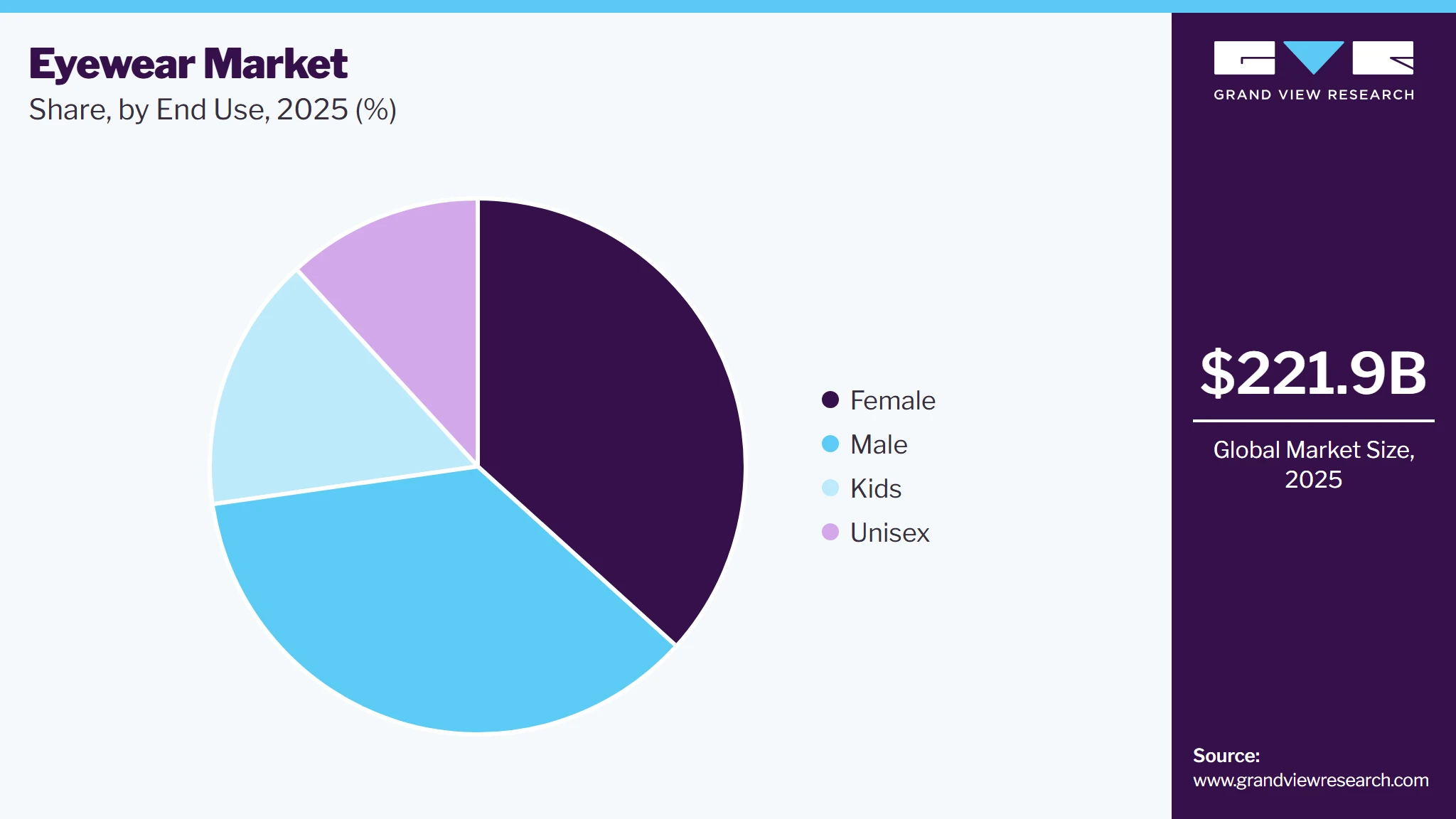
The female segment led the eyewear market with the largest revenue share of 36.7% in 2025, reflecting a strong trend toward eyewear that combines vision correction, comfort, and fashion. Women are increasingly purchasing eyewear as an accessory that complements different occasions, outfits, and lifestyles, encouraging demand for varied frame shapes, colors, materials, and premium designs. Social media, fashion influencers, and celebrity collaborations continue to accelerate style-driven purchasing, while brands are expanding women-focused collections across prescription glasses and sunglasses. The growing emphasis on personalization and seasonal fashion trends is also encouraging higher product variety and purchase frequency within the segment.
 To learn more about this report, Download Free Sample Report
 The kids segment is expected to grow at the fastest CAGR from 2026 to 2033, supported by greater awareness of pediatric eye health and increasing demand for comfortable, durable, and visually appealing eyewear. Rising adoption of early vision screening is helping identify refractive errors at younger ages, while parents are increasingly prioritizing lightweight, impact-resistant frames that can withstand active lifestyles. Product innovation is also expanding the segment, with manufacturers offering flexible constructions, colorful designs, and character-inspired styles to improve acceptance among children. Manufacturers are increasingly emphasizing lightweight construction, flexible materials, impact resistance, and ergonomic fit in children's eyewear, as these features address the durability and comfort requirements associated with active young users.
Regional Insights
Europe dominated the eyewear market with the largest revenue share of 35.9% in 2025, supported by a mature optical industry, strong presence of established eyewear and lens manufacturers, and high consumer spending on premium and fashion-oriented products. The region is witnessing continued demand for technologically advanced lenses, lightweight frames, customized vision solutions, and sustainable materials as consumers increasingly prioritize both functionality and aesthetics. Europe also remains a key hub for eyewear innovation, with manufacturers investing in advanced lens designs, personalized optical solutions, and smart eyewear. The growing influence of luxury and designer fashion further supports premiumization, while omnichannel retail is enabling brands and optical chains to combine professional eye-care services with digital purchasing convenience.
 To learn more about this report, Download Free Sample Report
 The UK eyewear market captured a considerable revenue share in 2025, supported by an aging population, rising demand for vision correction, and increasing awareness of regular eye examinations and preventive eye care. The market is also benefiting from innovations in lens coatings, photochromic technologies, lightweight materials, and personalized prescription solutions that enhance comfort and visual performance. In addition, the continued expansion of online optical platforms and hybrid retail models is improving accessibility and convenience, particularly among younger consumers. The convergence of health, fashion, technology, and digital retail is expected to remain a defining trend in the UK market, supporting demand for products that offer both visual performance and contemporary styling.
Asia Pacific Eyewear Market Trends
The Asia Pacific eyewear industry is expected to grow at the fastest CAGR of 11.5% from 2026 to 2033, driven by a large and increasingly urbanized population, rising disposable incomes, and expanding awareness of vision care. Growing demand for eyewear as both a corrective and fashion-oriented product is broadening the consumer base, particularly among younger populations. The region is also benefiting from the presence of major optical manufacturers and rapidly developing domestic brands, which are increasing product availability across price points. Meanwhile, organized optical retail, e-commerce, and omnichannel models are improving access to prescription glasses, contact lenses, and sunglasses across both developed and emerging markets. China and India are emerging as particularly important growth markets, supported by large consumer populations, expanding digital retail ecosystems, and increasing investment in optical infrastructure.
India's eyewear market is positioned for strong growth as increasing awareness of vision correction, rising incomes, urbanization, and expanding organized retail improve access to optical products. Digital-first eyewear companies and e-commerce platforms are broadening consumer reach through virtual try-on, home delivery, and competitive pricing, while younger consumers are driving demand for fashionable and customizable frames. The growing use of smartphones and computers is also contributing to greater attention toward vision health and prescription eyewear. Meanwhile, Japan's market is supported by its aging population, established optical retail infrastructure, and strong consumer preference for high-quality, lightweight, and technologically advanced products. Increasing adoption of online shopping and continued innovation in lens materials, coatings, and frame construction are further reshaping the Japanese market.
North America Eyewear Market Trends
The North America eyewear industry accounted for a significant revenue share of over 33.0% in 2025, driven by strong consumer spending on prescription eyewear, sunglasses, and premium optical products. The region benefits from a well-established optical retail infrastructure, high adoption of advanced lens technologies, and the growing influence of fashion and lifestyle trends on eyewear purchasing. Increasing demand for personalized frames, premium lenses, and technologically enhanced products is encouraging manufacturers and retailers to broaden their offerings across consumer segments.
The market is also being reshaped by the rapid expansion of e-commerce and omnichannel retail, which is improving product accessibility and purchasing convenience. Online platforms are increasingly incorporating virtual try-on, digital prescription management, home-trial programs, and personalized recommendations, while established optical retailers are integrating digital capabilities into physical stores. In addition, the growing adoption of smart eyewear and continued investment in AI-enabled optical services are creating new avenues for product differentiation and market expansion across the region.
The eyewear market in the U.S. held the largest share in the North America region in 2025, supported by an increase in the popularity of contact lenses and the growing prominence of online retailers. Moreover, the availability of advanced, lightweight, and durable eyewear solutions in the market is pushing demand across different consumer segments. The continuous expansion of e-commerce platforms and technological innovations further enhances the market dynamics, giving consumers easy access to a wide range of high-quality products.
Key Eyewear Company Insights
Some of the key players operating in the eyewear market include Bausch + Lomb Corporation and Johnson & Johnson Vision Care Inc.
-
Bausch + Lomb Corporation maintains a strong position in global eye care through its broad portfolio of contact lenses, lens-care products, and ophthalmic solutions. The company continues to expand its specialty contact lens offerings for complex vision correction needs, including astigmatism, presbyopia, and irregular corneas. Recent launches, such as the Zenlens CHROMA HOA scleral lenses and the Arise Orthokeratology Lens System in 2025, reinforce its focus on personalized and technology-enabled vision correction.
-
Johnson & Johnson Vision Care remains a major player in the contact lens market through its ACUVUE portfolio and continued investment in specialty and daily disposable lenses. The company is expanding solutions for condition-specific vision correction, including its ACUVUE OASYS MAX 1-Day MULTIFOCAL for ASTIGMATISM, launched in 2025, which addresses the combined needs of astigmatic and presbyopic patients. In 2026, the company also expanded prescription parameters for ACUVUE VITA for Astigmatism, strengthening its ability to serve a broader range of patients requiring toric correction.
Key Eyewear Companies
The following key companies have been profiled for this study on the eyewear market.
-
Bausch + Lomb Corporation
-
Zeiss Group
-
CHARMANT INC.
-
CHEMIGLAS CORPORATION
-
CooperVision Limited
-
De Rigo Vision S.p.A.
-
ESSILORLUXOTTICA
-
Fielmann Group AG
-
HOYA Corporation
-
JINS Inc.
-
Johnson & Johnson Vision Care Inc.
-
Marchon Eyewear Inc.
-
Marcolin S.p.A.
-
Prada S.p.A
-
Rodenstock GmbH
-
Safilo Group S.p.A
-
Seiko Optical Products Co. Ltd.
-
Silhouette International Schmied AG
-
Warby Parker
-
Zenni Optical Inc.
Competitive Benchmarking
Category
Operating Strategies
Competitive Edge
Weakness
Established Players (Bausch + Lomb Corporation, EssilorLuxottica, and Johnson & Johnson Vision Care Inc.)
- Focus on expanding premium eyewear portfolios through global retail and e-commerce channels.
- Invest heavily in lens innovation, brand acquisitions, and global omnichannel distribution infrastructure.
- Strong global brand presence with diversified product portfolios across prescription and fashion eyewear.
- Established optical retail networks and advanced lens manufacturing capabilities ensure market leadership.
- Heavy reliance on traditional retail channels limits the expansion of digital-native consumer engagement.
- Large legacy operations are less agile than emerging direct-to-consumer eyewear brands.
Emerging Players (Warby Parker)
- Focus on direct-to-consumer online models and digitally native eyewear platforms.
- Invest in virtual try-on technologies, social media marketing, and agile product launches.
- A strong digital-first approach enables faster customer acquisition and more personalized shopping experiences.
- Low-cost operations and flexible supply chains support competitive pricing strategies globally.
- Smaller scale relative to established global eyewear incumbents.
- Heavy reliance on digital channels increases vulnerability to competition and to fluctuations in marketing costs.
Recent Developments
-
In April 2026, ZEISS introduced its DuraVision Plus lens-coating platform, featuring CleanGuard technology designed to improve lens cleanliness and ease of cleaning. The company also advanced its vision-care technology portfolio through developments in myopia management and digital eye-care solutions. These innovations strengthen ZEISS’s positioning in premium spectacle lenses, coatings, personalized vision correction, and technology-enabled optical care.
-
In December 2025, Warby Parker announced a collaboration with Google to develop lightweight, AI-powered smart glasses, with the first product expected to launch in 2026. The glasses will leverage Google’s Android XR platform and Gemini AI, with planned screen-free and display-enabled variants offering features such as voice assistance, navigation, and translation, expanding Warby Parker’s portfolio into intelligent eyewear.
-
In February 2025, EssilorLuxottica announced plans to increase smart-glasses production capacity to 10 million units annually by the end of 2026, supported by manufacturing expansion in China and Southeast Asia. The company also plans to broaden its collaboration with Meta, introduce additional features, and support third-party brands. More than 2 million Ray-Ban Meta glasses have been sold since their September 2023 launch.
-
In February 2025, Innovative Eyewear launched its Reebok Smart Eyewear line at MIDO 2025 in Milan, introducing sport-focused frames with open-ear audio, voice assistant integration, and customizable lenses. The collection features upgraded hi-fi speakers and amplifiers for enhanced sound quality, catering to active lifestyles. Attendees experienced real-time demonstrations and previews of upcoming products from Lucyd, Nautica, and Eddie Bauer.
Eyewear Market Report Scope
Report Attribute
Details
Market size in 2025
USD 221.9 billion
Estimated market size in 2026
USD 245.1 billion
Projected market size by 2033
USD 463.5 billion
Growth rate
CAGR of 9.5% from 2026 to 2033
Base year for estimation
2025
Historical data
2021 - 2024
Forecast period
2026 - 2033
Quantitative units
Revenue in USD million/billion, volume, million units, and CAGR from 2026 to 2033
Report coverage
Revenue forecast, volume forecast, company ranking, competitive landscape, growth factors, and trends
Segments covered
Product, distribution channel, end use, price range, region
Regional scope
North America; Europe; Asia Pacific; Latin America; MEA
Country scope
U.S.; Canada; Mexico; Austria; Belgium; Czech Republic; Denmark; Finland; Germany; France; Iceland; Ireland; Italy; Netherlands; Norway; Poland; Spain; Sweden; Switzerland; UK; Australia; China; Hong Kong; India; Indonesia; Japan; Malaysia; New Zealand; Philippines; Singapore; South Korea; Taiwan; Thailand; Vietnam; Brazil; Argentina; Chile; Israel; Nigeria; UAE; Saudi Arabia; Turkey; South Africa
Key companies profiled
Bausch + Lomb Corporation; Zeiss Group; CHARMANT INC.; CHEMIGLAS CORPORATION; CooperVision Limited; De Rigo Vision S.p.A.; ESSILORLUXOTTICA; Fielmann Group AG; HOYA Corporation; JINS Inc.; Johnson & Johnson Vision Care Inc.; Marchon Eyewear Inc.; Marcolin S.p.A.; Prada S.p.A; Rodenstock GmbH; Safilo Group S.p.A; Seiko Optical Products Co. Ltd.; Silhouette International Schmied AG; Warby Parker; Zenni Optical Inc.
Customization scope
Free report customization (equivalent up to 8 analysts' working days) with purchase. Addition or alteration to country, regional & segment scope.
Pricing and purchase options
Avail customized purchase options to meet your exact research needs. Explore purchase options
Global Eyewear Market Report Segmentation
This report forecasts revenue & volume growth at the global, regional & country levels and provides an analysis of the latest industry trends and opportunities in each of the sub-segments from 2021 to 2033. For this study, Grand View Research has segmented the global eyewear market report based on product, distribution channel, price range, end use, and region:
-
Product Outlook (Volume, Million Units; Revenue, USD Million/Billion, 2021 - 2033)
-
Contact Lenses
-
Premium Contact Lenses
-
Mass Contact Lenses
-
-
Prescription (RX) Glasses
-
Prescription Glasses, by Frame
-
Frame Type
-
Full Frame
-
Half Frame
-
Rimless
-
-
Frame Style
-
Round
-
Square
-
Rectangle
-
Oval
-
Others
-
-
Frame Material
-
Metal
-
Nylon
-
Others
-
-
-
Prescription Glasses, by Lens
-
Single Vision Lenses
-
Multi-vision Lenses
-
Progressive Lenses
-
Others
-
-
-
Sunglasses
-
Sunglasses, by Frame
-
Frame Type
-
Full Frame
-
Half Frame
-
Rimless
-
-
Frame Style
-
Round
-
Square
-
Rectangle
-
Oval
-
Others
-
-
Frame Material
-
Metal
-
Nylon
-
Others
-
-
-
Sunglasses, by Lens
-
Lens Type
-
Polarized Sunglasses
-
Non-Polarized Sunglasses
-
-
Lens Material
-
CR-39
-
Polycarbonate
-
Polyurethane
-
Others
-
-
-
-
-
Distribution Channel Outlook (Volume, Million Units; Revenue, USD Million/Billion, 2021 - 2033)
-
E-Commerce
-
Brick & Mortar
-
-
End Use Outlook (Volume, Million Units; Revenue, USD Million/Billion, 2021 - 2033)
-
Male
-
Female
-
Unisex
-
Kids
-
-
Price Range Outlook (Volume, Million Units; Revenue, USD Million/Billion, 2021 - 2033)
-
$0-$150
-
$150-$250
-
$250-$300
-
$300-$500
-
$500+
-
-
Regional Outlook (Volume, Million Units; Revenue, USD Million/Billion, 2021 - 2033)
-
North America
-
U.S.
-
Canada
-
Mexico
-
-
Europe
-
Germany
-
UK
-
France
-
Italy
-
Spain
-
Austria
-
Belgium
-
Czech Republic
-
Denmark
-
Finland
-
Iceland
-
Ireland
-
Netherlands
-
Norway
-
Poland
-
Sweden
-
Switzerland
-
-
Asia Pacific
-
China
-
India
-
Australia
-
Hong Kong
-
Indonesia
-
Japan
-
Malaysia
-
New Zealand
-
Philippines
-
Singapore
-
South Korea
-
Taiwan
-
Thailand
-
Vietnam
-
-
Latin America
-
Brazil
-
Argentina
-
Chile
-
-
Middle East and Africa (MEA)
-
Israel
-
Nigeria
-
Saudi Arabia
-
South Africa
-
Turkey
-
UAE
-
-
Research Methodology
The eyewear market figures in this report are based on a proven research process that combines executive interviews with secondary research from proprietary databases, company filings, and recognized regulatory and institutional sources. Market size is built through value-chain sizing - reconciling supply-side and demand-side estimates - and triangulated with bottom-up and top-down approaches. Every estimate passes multiple levels of expert validation before publication, with each eyewear segment quantified using the revenue-capture definitions in the table below.
Market Definitions
Product
-
Contact Lenses
-
Revenue capture definition: Revenue is generated through the sale of daily, monthly, and specialty contact lenses used for vision correction and lifestyle enhancement.
-
Key growth factors: Rising prevalence of myopia, increasing demand for convenience, and growing preference for discreet vision correction solutions.
-
-
Prescription (RX) Glasses
-
Revenue capture definition: Revenue is generated through the sale of corrective eyeglasses designed to address refractive errors, including myopia, hyperopia, and astigmatism.
-
Key growth factors: Increasing incidence of vision disorders, greater frequency of eye examinations, and rising awareness of preventive eye care.
-
-
Sunglasses
-
Revenue capture definition: Revenue is generated through the sale of protective and fashion-oriented eyewear designed to minimize UV exposure and improve visual comfort.
-
Key growth factors: Rising participation in outdoor activities, increasing fashion consciousness, and growing awareness of UV-related eye protection.
-
Distribution Channel
-
E-Commerce
-
Revenue capture definition: Revenue is generated through online eyewear platforms offering digital product catalogs, virtual try-on capabilities, and home delivery.
-
Key growth factors: Increasing internet penetration, convenience-oriented purchasing behavior, and advancements in AR-enabled fitting technologies.
-
-
Brick & Mortar
-
Revenue capture definition: Revenue is generated through physical retail channels, including optical stores, specialty eyewear outlets, and optical chains.
-
Key growth factors: Availability of in-person eye examinations, personalized fitting services, product consultations, and established consumer trust.
-
End Use
-
Male
-
Revenue capture definition: Revenue is generated through eyewear products designed for male consumers, including prescription glasses, sunglasses, and sports eyewear.
-
Key growth factors: Increasing vision correction requirements and growing adoption of functional, premium, and performance-oriented eyewear.
-
-
Female
-
Revenue capture definition: Revenue is generated through functional and fashion-oriented eyewear designed for female consumers, combining vision correction with aesthetic appeal.
-
Key growth factors: Strong demand for designer frames, greater style diversity, and increasing awareness of eye health.
-
-
Unisex
-
Revenue capture definition: Revenue is generated through eyewear designed for consumers across genders, emphasizing versatile styling, universal fit, and broad market appeal.
-
Key growth factors: Growing preference for minimalist designs, gender-neutral fashion, and inclusive product offerings.
-
-
Kids
-
Revenue capture definition: Revenue is generated through specialized eyewear for children, including durable frames and corrective lenses.
-
Key growth factors: Rising prevalence of pediatric vision disorders and increasing parental awareness of early vision screening and eye care.
-
Price Range
-
$0-$150
-
Revenue capture definition: Revenue is generated through affordable, mass-market eyewear offering essential functionality at accessible price points.
-
Key growth factors: Price-sensitive consumer demand and high-volume purchases, particularly across emerging markets.
-
-
$150-$250
-
Revenue capture definition: Revenue is generated through mid-range eyewear offering a combination of quality materials, design, functionality, and brand value.
-
Key growth factors: Consumer preference for a balance between affordability, durability, and product quality.
-
-
$250-$300
-
Revenue capture definition: Revenue is generated through premium eyewear featuring enhanced aesthetics, improved lens technologies, and stronger brand positioning.
-
Key growth factors: Rising demand for stylish, higher-quality eyewear that combines design and functionality.
-
-
$300-$500
-
Revenue capture definition: Revenue is generated through high-end eyewear incorporating premium frames, advanced lens features, designer positioning, and superior construction.
-
Key growth factors: Brand influence, premiumization trends, and increasing consumer willingness to invest in higher-quality eyewear.
-
-
$500+
-
Revenue capture definition: Revenue is generated through luxury eyewear characterized by exclusive designs, premium materials, craftsmanship, and strong brand prestige.
-
Key growth factors: Growing affluent consumer base, status-oriented fashion consumption, exclusivity, and demand for premium optical performance.
-
Estimation Model
Layer Name
Key Question
Description
Consumer Base Layer
Who are the potential adopters?
Identifies the total addressable consumer base, including individuals with vision impairment, aging population groups, digitally active users experiencing eye strain, fashion-conscious consumers, children requiring vision correction, and lifestyle users adopting eyewear for aesthetics and protection.
Product & Technology Readiness Layer
Who can adopt eyewear solutions?
Adoption is driven by accessibility to vision care services, affordability of eyewear products, availability of prescription testing infrastructure, awareness of eye health, retail penetration, and readiness to adopt advanced lens technologies such as blue-light filtering, photochromic, and smart eyewear solutions.
Distribution & Adoption Layer
Who actively purchases eyewear solutions?
Applies adoption levels across consumer segments purchasing through optical retail stores, online e-commerce platforms, specialty eyewear chains, and hospital/clinic-based optical services, including both prescription and non-prescription eyewear users.
Revenue Generation Layer
How is revenue generated?
Revenue is generated from the sale of contact lenses, prescription glasses, sunglasses, premium designer frames, lens customization services, and value-added offerings such as coatings, warranties, subscription-based contact lens supply, and emerging smart eyewear devices.
Delivered Customizations
This report has been delivered with the following In-depth customizations
Client Request
Customization Delivered
Value Adds
Vision Correction Assessment, Lens Optimization & Prescription Analysis
Conducted detailed evaluation of vision correction needs across consumers, integrating eye testing data, prescription lens technologies, blue-light filtering solutions, and advanced optical coatings for enhanced visual clarity and comfort.
Enables precise vision correction, improves eye health outcomes, enhances user comfort, and reduces digital eye strain effectively.
Smart Eyewear & Digital Retail Experience Integration Strategy
Assessed deployment of smart eyewear technologies, including AR-enabled glasses, photochromic lenses, virtual try-on systems, and omnichannel retail platforms integrated with AI-driven personalization and e-commerce ecosystems.
Enhances customer purchasing experience, improves product accessibility, supports personalized recommendations, and increases retail conversion rates.
Fashion Eyewear, Brand Positioning & Consumer Engagement Development
Evaluated integration of premium eyewear branding strategies, influencer-driven marketing, fashion-oriented frame designs, and digital marketing campaigns across social media and lifestyle platforms.
Strengthens brand visibility, increases consumer engagement, drives premium product adoption, and supports lifestyle-oriented eyewear positioning.
Frequently Asked Questions About This Report
The global eyewear market size was valued at USD 221.9 billion in 2025 and is expected to reach USD 245.1 billion in 2026.
The global eyewear market is expected to grow at a compound annual growth rate of 9.5% from 2026 to 2033 to reach USD 463.5 billion by 2033.
Some of the key players in the global eyewear market include Bausch + Lomb Corporation, Zeiss Group, CHARMANT Inc., CooperVision, Warby Parker, and EssilorLuxottica.
Key factors that are driving the eyewear market growth include the growing number of ophthalmic disorders, awareness regarding eye examinations, and perception of eyewear as a fashion accessory.
The prescription (RX) glasses dominated the eyewear market with a revenue share of 69.4% in 2025. The increasing prevalence of eye conditions such as myopia, hyperopia, astigmatism, and presbyopia is driving the demand for corrective eyewear.
The female segment dominated the market with the largest revenue share of 36.7% in 2025.
The brick & mortar segment led the market with the largest revenue share of 72.4% in 2025.
Europe dominated with a 35.9% revenue share in 2025.
The $0-$150 segment dominated the market with the largest revenue share of 50.0% in 2025.
About the Author(s)
Next Generation Technologies Research Team
Technology · Next Generation TechnologiesThis report was authored by the next generation technologies research team at Grand View Research - comprising two research analysts, one senior research analyst, and one industry expert - with specialized expertise in the next generation technologies segment of the technology industry. All findings are based on proprietary technology databases, executive interviews, and regulatory analysis, subject to internal peer review prior to publication.
Last Updated:
Speak to Analyst

Customize this report to your needs - add regions, segments, or data points, with 20% free customization.
Or view our licence options:


ISO 9001:2015 & 27001:2022 Certified
We are GDPR and CCPA compliant! Your transaction & personal information is safe and secure. For more details, please read our privacy policy.


